Call or Text 727-513-9780
  • Shopping Cart Shopping Cart
    0Shopping Cart
Pure Tested Peptides | America's most trusted Peptides for sale online
  • Peptides for sale
    • Oral Peptides for sale
      • Peptide Capsules for sale
      • BPC 157 Capsules 1000mcg
      • SLU-PP-332 Capsules | 1000 mcg
      • 5-Amino-1MQ 50mg Capsules
      • Tesofensine 500mcg
    • All Peptides for sale
    • Peptide Sprays
      • BPC 157 Nasal Spray Kit
      • BPC-157 TB500 Nasal Spray Kit
      • Semax Nasal Spray 10mg
      • Selank – Nasal Spray Kit – 10mg
      • Epithalon 50MG Nasal Spray Kit
      • Ipamorelin 10mg Nasal Spray
      • Klow Nasal Spray (BPC-157 + TB-500 + GHK-Cu + KPV) | 80mg
      • Hulk Nasal Spray Tesa / Ipa Blend 6/3 MG
      • Klow Nasal Spray
      • NAD + 500 mg Nasal Spray
      • PT-141 Nasal Spray Kit
    • GHRH Peptides
      • Ipa Peptides
      • CJC-1295 Peptides
        • CJC-1295 with DAC 5 mg
        • CJC-1295 without DAC 5 mg
        • CJC-1295 Ipa 10mg
      • Tesa Peptides
        • Tesa Peptide
        • Tesa 20 mg
    • GHK-Cu Peptides
      • All GHK-Cu Peptides
      • GHK-Cu 100mg
      • KLOW Peptide Blend – Buy KLOW blend online
    • BPC Peptides
      • All BPC Peptides
      • BPC-157
      • BPC-157 TB-500
      • BPC 157 capsules 1000mcg
    • SLU-PP-332 Peptides
      • All SLU-PP-332 Peptides
      • SLU-PP-332 5mg
    • GLP3 Peptides
    • PT-141 Peptides
      • PT-141 Peptides for sale
      • PT-141 10mg
      • PT-141 Nasal Spray
    • CAG Peptides
      • Lipo-C Peptide Blend
      • CAG 5mg
      • CAG 10mg
    • MOTS-C Peptides
      • MOTS-C Peptides for sale
      • MOTS-c peptide
      • MOTS-c 10mg *6 pack*
    • 5 Amino 1MQ Peptides
      • 5 Amino 1MQ Peptides for sale
      • 5-Amino-1MQ 50mg Capsules
      • 5-Amino-1MQ 5mg
    • Epithalon Peptides
      • Epithalon Peptides for sale
      • Epithalon 10mg
      • Epithalon 50mg
  • Shop
    • GLPs
      • 5-Amino-1MQ 50mg Capsules
      • 5-Amino-1MQ 5mg
      • L-Carnitine 500mg/ml
      • Tesofensine 500mcg
      • SLU-PP-332 5mg
      • MOTS-c 10mg *6 pack*
    • Epithalon & BPC Peptides
      • Epithalon 10mg
      • Epithalon 50mg
      • BPC-157
      • BPC 157 capsules 1000mcg
      • BPC-157 TB-500
      • BPC-157 TB500 Nasal Spray Kit
      • BPC 157 Nasal Spray Kit
    • BPC TB-500 & NAD+ Peptides
      • NAD+ 500 mg
      • KLOW Peptide Blend – Buy KLOW blend online
      • GLOW Peptide Blend
      • TB 500 5mg
      • BPC 157 capsules 1000mcg – Supplement
      • BPC 157 Nasal Spray Kit
      • BPC-157
      • BPC-157 TB500 Nasal Spray Kit
      • BPC-157 TB-500
      • BPC 157 capsules 1000mcg
    • LL-37 Peptide
      • LL-37 10 mg
    • MOTS-C & Selank
      • MOTS-c peptide
      • Selank 10mg
    • GHK Peptides
      • GHK-Cu 100mg
      • GLOW Peptide Blend
      • KLOW Peptide Blend – Buy KLOW blend online
  • COAs
  • Wholesale
    • Wholesale Peptides for sale
  • PTP FAQ
  • Affiliates
    • Selank Peptide: Advanced Pharmacological Mechanisms Underlying Its Anxiolytic and Nootropic Effects in Research
      • 5-Amino-1MQ Peptide: Detailed Mechanisms of NNMT Inhibition and Its Impact on Cellular Metabolism Research
        • MOTS-C Peptide: Unraveling Its Role in Mitochondrial Dynamics and Energy Metabolism Research
          • Epithalon Peptide and Telomerase Regulation: Investigating Its Impact on Cellular Senescence and Lifespan Research Models
            • GLP2-T vs GLP2 Tirz Peptide: Understanding the Naming, Mechanistic Nuances, and Research Implications for Gut Health
      • Peptides and Polypeptides in Modern Pharmacology: What Research on Metoprolol, Prednisone, and Amlodipine Reveals
        • Polypeptide Peptides vs NSAIDs: What Naproxen and Diclofenac Teach Tissue-Repair Researchers About BPC‑157 and TB‑500
          • Peptides and Polypeptides in Endocrine Pharmacology: How GLP-1, GLP-2, and GLP-3 Retatrutide Differ From Classic Drugs Like Prednisone and Amlodipine
          • 5‑Amino‑1MQ Peptide and NNMT Inhibition: How It Compares With Statins Like Atorvastatin in Adipose and Lipid Metabolism Research
      • Enclomiphene, Estrogen Receptor Signaling, and Luteinizing Phase Biology: What Hormone Researchers Should Measure
        • Mesenchymal Stem Cells, BPC‑157, and GHK‑Cu: How Tissue Repair Peptides Compare With Classic NSAIDs Like Naproxen in Injury Models
          • Peptide Calculator Use Cases Beyond Growth Hormone: Working Through GLP‑3 Retatrutide, MOTS‑c, and BPC‑157 Research Dosing
        • Polypeptide Peptides in Endocrine and Metabolic Pharmacology: Lessons From Amlodipine, Prednisone, and Metoprolol
        • Peptides Calculator for Advanced Blends: Worked Examples for Tesamorelin, CJC‑1295, and Ipamorelin Stacks
          • Peptides and Polypeptides in Human Physiology: How Molecular Size Shapes Research Applications
            • Selank Peptide: Advanced Pharmacological Mechanisms Underlying Its Anxiolytic and Nootropic Effects in Research
          • 5-Amino-1MQ Peptide: Detailed Mechanisms of NNMT Inhibition and Its Impact on Cellular Metabolism Research
            • MOTS-C Peptide: Unraveling Its Role in Mitochondrial Dynamics and Energy Metabolism Research
              • Epithalon Peptide and Telomerase Regulation: Investigating Its Impact on Cellular Senescence and Lifespan Research Models
                • GLP2-T vs GLP2 Tirz Peptide: Understanding the Naming, Mechanistic Nuances, and Research Implications for Gut Health
                  • Peptides and Polypeptides in Endocrine Pharmacology: How GLP-1, GLP-2, and GLP-3 Retatrutide Differ From Classic Drugs Like Prednisone and Amlodipine
                    • Polypeptide Peptides vs NSAIDs: What Naproxen and Diclofenac Teach Tissue-Repair Researchers About BPC‑157 and TB‑500
                      • Peptides and Polypeptides in Modern Pharmacology: What Research on Metoprolol, Prednisone, and Amlodipine Reveals
                        • 5‑Amino‑1MQ Peptide and NNMT Inhibition: How It Compares With Statins Like Atorvastatin in Adipose and Lipid Metabolism Research
                        • Enclomiphene, Estrogen Receptor Signaling, and Luteinizing Phase Biology: What Hormone Researchers Should Measure
                        • Mesenchymal Stem Cells, BPC‑157, and GHK‑Cu: How Tissue Repair Peptides Compare With Classic NSAIDs Like Naproxen in Injury Models
                        • Peptide Calculator Use Cases Beyond Growth Hormone: Working Through GLP‑3 Retatrutide, MOTS‑c, and BPC‑157 Research Dosing
                        • Polypeptide Peptides in Endocrine and Metabolic Pharmacology: Lessons From Amlodipine, Prednisone, and Metoprolol
                        • Peptides Calculator for Advanced Blends: Worked Examples for Tesamorelin, CJC‑1295, and Ipamorelin Stacks
                        • Peptides and Polypeptides in Human Physiology: How Molecular Size Shapes Research Applications
                        • Selank Peptide: Advanced Pharmacological Mechanisms Underlying Its Anxiolytic and Nootropic Effects in Research
                        • MOTS-C Peptide: Unraveling Its Role in Mitochondrial Dynamics and Energy Metabolism Research
                        • Peptides and Polypeptides in Modern Pharmacology: What Research on Metoprolol, Prednisone, and Amlodipine Reveals
                        • Peptides and Polypeptides in Endocrine Pharmacology: How GLP-1, GLP-2, and GLP-3 Retatrutide Differ From Classic Drugs Like Prednisone and Amlodipine
                        • 5-Amino-1MQ Peptide: Detailed Mechanisms of NNMT Inhibition and Its Impact on Cellular Metabolism Research
                        • Mesenchymal Stem Cells, BPC‑157, and GHK‑Cu: How Tissue Repair Peptides Compare With Classic NSAIDs Like Naproxen in Injury Models
                        • Peptide Calculator Use Cases Beyond Growth Hormone: Working Through GLP‑3 Retatrutide, MOTS‑c, and BPC‑157 Research Dosing
                        • GLP2-T vs GLP2 Tirz Peptide: Understanding the Naming, Mechanistic Nuances, and Research Implications for Gut Health
                        • Polypeptide Peptides in Endocrine and Metabolic Pharmacology: Lessons From Amlodipine, Prednisone, and Metoprolol
                        • Polypeptide Peptides vs NSAIDs: What Naproxen and Diclofenac Teach Tissue-Repair Researchers About BPC‑157 and TB‑500
                        • Peptides and Polypeptides in Human Physiology: How Molecular Size Shapes Research Applications
                        • Peptides Calculator for Advanced Blends: Worked Examples for Tesamorelin, CJC‑1295, and Ipamorelin Stacks
                        • 5‑Amino‑1MQ Peptide and NNMT Inhibition: How It Compares With Statins Like Atorvastatin in Adipose and Lipid Metabolism Research
                        • Enclomiphene, Estrogen Receptor Signaling, and Luteinizing Phase Biology: What Hormone Researchers Should Measure
                        • Epithalon Peptide and Telomerase Regulation: Investigating Its Impact on Cellular Senescence and Lifespan Research Models
                        • Best research protocol Klow blend
                        • best time to take BPC-157
                        • best time to take DSIP (Delta Sleep Inducing Peptide)
                        • best time to take CJC-1295
                        • best time to take AOD-9604
                        • best time to take Follistatin 344
                        • best time to take Ipamorelin
                        • best time to take MK-677 (Ibutamoren)
                        • best time to take Ligandrol (LGD-4033) — research compound
                        • best time to take Ostarine (MK-2866) — research compound
                        • best time to take GHK-CU
                        • best time to take TB-500
                        • best time to take MOTS-c
                        • best time to take Semax
                        • best time to take RAD-140 (Testolone) — research compound
                        • best time to take Thymosin Alpha-1
                        • best time to take PEG-MGF
                        • Biolife Plasma, Octapharma Plasma, and Research Peptides: How Plasma Donation Labs Differ From Peptide Suppliers
                        • best time to take YK-11 — research compound
                        • best time to take PT-141 (Bremelanotide)
                        • Best research protocol Klow blend
                        • 5-Amino-1MQ and MOTS-C Synergy: Metabolic Signaling, Mitochondria, and Research Design
                        • BPC-157 and TB-500: Investigating Their Combined Effects on Angiogenesis and Cellular Migration in Tissue Repair Models
                        • BPC-157 Peptide: Gut Barrier Function, Inflammation, and Tissue-Recovery Research
                        • 5‑Amino‑1MQ and MOTS‑c Synergy in Metabolic Research: Designing NNMT and Mitochondrial Biogenesis Stacks
                        • CJC-1295 with DAC vs. Without DAC: Half-Life, Release Kinetics, and Research Implications
                        • CJC‑1295 with DAC vs. Without DAC: Expanding on Half‑Life Differences Using Tesamorelin and Ipamorelin Blend Case Studies
                        • Collagen Biology and Copper‑Binding Peptides: How GHK‑Cu, Glow Blend, and Klow Blend Interact with Skin and Connective Tissue
                        • Collagen Biology and Regenerative Peptides: How GHK‑Cu, Glow Blend, and Klow Blend Affect Extracellular Matrix Research
                    • DNA, Telomeres, and Longevity Peptides: Positioning Epithalon and MOTS‑c in Genetic Aging Research
                      • Enclomiphene Citrate: serm Mechanism, Testosterone Research, and Stack Compatibility
                        • Enclomiphene vs Enclomiphene Citrate: Formulation, Bioavailability, and Research Distinctions
                        • Epithalon Peptide Research: Telomerase Activation, Aging, and Pineal Gland Function
                        • Estrogen Receptor Signaling and Enclomiphene: How Selective Modulators Compare with Classic Polypeptide Hormones
                        • GHK-Cu Peptide: Advanced Mechanisms in Extracellular Matrix Remodeling and Wound Healing Research
                        • GHK-Cu Peptide: Collagen Synthesis, Wound Repair, and Skin-Barrier Research Models
                        • GLP-1 vs GLP-3 vs GLP-2: Peptide Classification and Research Applications
                        • GLP-2 Peptide Research Guide: Gut Barrier Function, Nutrient Absorption, and Intestinal Recovery Models
                        • GLP-3 Retatrutide vs. GLP-1 Drugs: What Triple-Agonist Biology Changes in Research Models
                        • Ipamorelin and Tesamorelin Combination: Synergistic GH Secretagogue Research and Dosing Protocols
                        • GLP2 Tirz Peptide: What It Is, Why the Name Exists, and How Researchers Should Interpret It
                        • Klow Blend Peptide Nasal Spray: What the Formulation Is Trying to Do in Cognitive Research
                        • Mitochondria, NNMT Inhibition, and Peptide Modulators: Where MOTS‑c and 5‑Amino‑1MQ Fit in Cellular Energy Research
                        • MOTS-c Peptide: Mitochondrial Function, Energy Metabolism, and What Researchers Measure
                        • MOTS-c vs. 5-Amino-1MQ: Which Metabolic Research Questions Each Compound Actually Answers
                        • Nasal Spray Peptides: Bioavailability, Administration, and Semax/Selank Research Applications
                        • PT-141 Peptide Research: Mechanism of Action and Melanocortin Receptor Signaling
                        • Retatrutide for Research: Mechanism, Structure, and GLP-1/GLP-3 Dual Action
                        • Retatrutide for Obesity and Type 2 Diabetes: What the Latest Trial Data Suggest
                        • Tesofensine Peptide Research: Mechanism, Appetite Suppression, and Neuropeptide Y Pathways
  • Contact
    • Contact Customer Service
    • Text Customer Support
  • About US
  • Shop all peptides
  • Affiliate Program
    • Affiliate Signup
  • Login / Register Login / Register Page Link Login / Register Page Link
  • Click to open the search input field Click to open the search input field Search
  • Menu Menu

Tag Archive for: epithalon storage

Optimizing Epithalon Lyophilization and Storage: Temperature-Dependent Degradation Rates in Telomere Research

Optimizing Epithalon Lyophilization and Storage: Temperature-Dependent Degradation Rates in Telomere Research

September 22, 2026/0 Comments/in Uncategorized/by

A single degree of temperature deviation during peptide storage can cost researchers months of experimental validity. For laboratories working with Epithalon in telomere and telomerase studies, this is not a theoretical concern. Quantitative stability data from 2026 laboratory documentation now make it possible to map exactly how purity erodes across four distinct temperature conditions, and the differences are striking. Optimizing Epithalon lyophilization and storage, with a clear understanding of temperature-dependent degradation rates in telomere research, is no longer optional for labs that require reproducible results across longitudinal studies.

Key Takeaways

  • Lyophilized Epithalon stored at -20 °C maintains purity above 97% for two or more years; at 40 °C, purity falls to 90% within just seven days.
  • Frost-free freezers accelerate peptide degradation through repeated thaw-refreeze cycles and should be avoided for long-term Epithalon stocks.
  • Moisture, light, and atmospheric oxygen are the three primary non-thermal degradation drivers, each contributing to isomerisation and oxidation of the peptide backbone.
  • Reconstituted Epithalon solutions must be kept at 2-8 °C and used within 24-48 hours for optimal biological activity, or within 28-30 days under strict cold-chain conditions.
  • Uncontrolled storage conditions introduce variability into telomerase activation and telomere-length assays by altering effective dose and peptide profile over time.

How Temperature Drives Peptide Bond Degradation in Epithalon
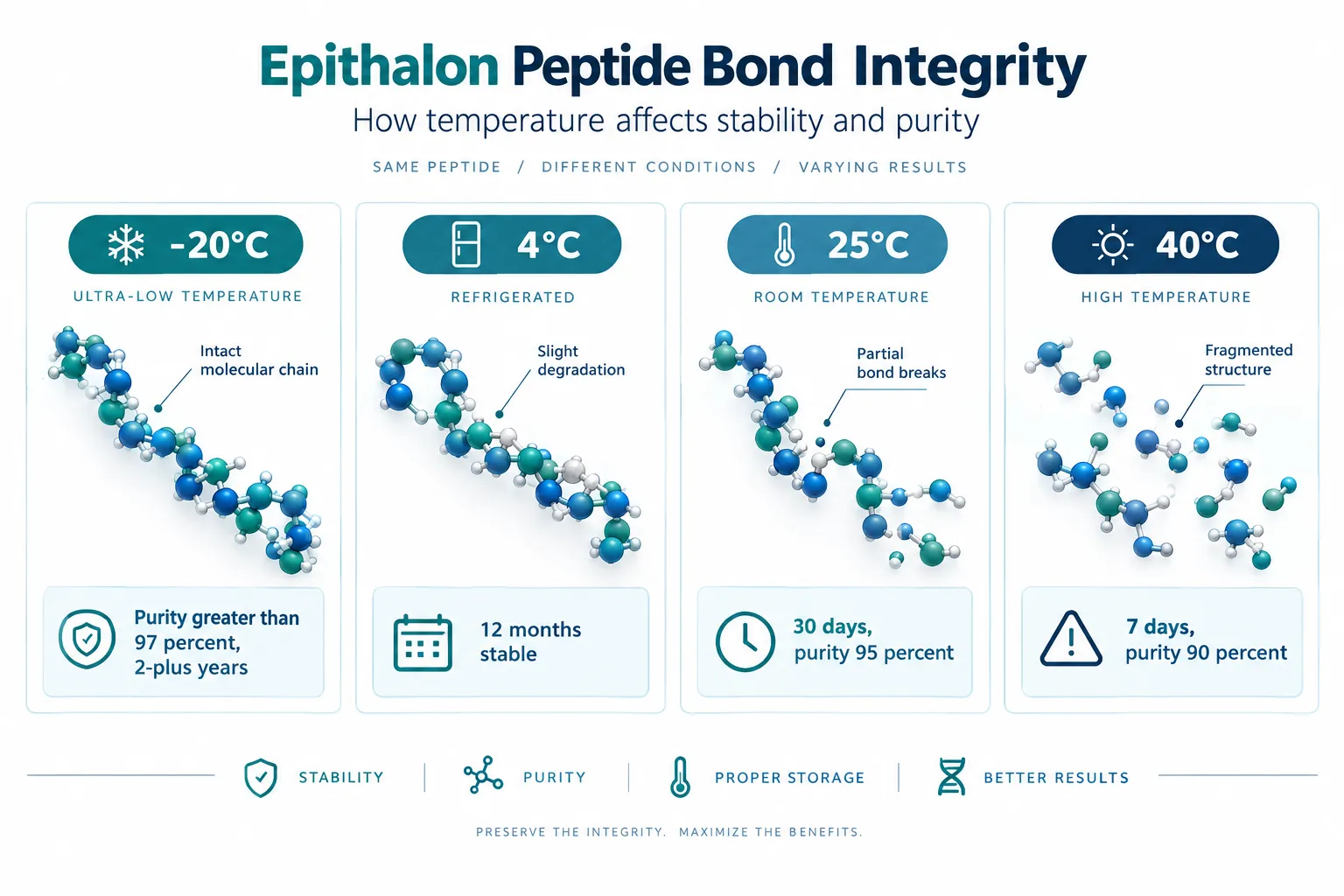
How Temperature Drives Peptide Bond Degradation in Epithalon

Epithalon is a synthetic tetrapeptide (Ala-Glu-Asp-Gly) studied extensively for its role in telomerase activation and telomere maintenance. Its short chain makes it relatively stable compared to larger peptides, but it is not immune to temperature-driven degradation pathways.

Current stability data across four temperature points tell a clear story:

Storage Temperature Purity Threshold Duration
-20 °C ≥97% 2+ years
4 °C ≥97% ~12 months
25 °C ≥95% ~30 days
40 °C ≥90% ~7 days

At -20 °C, the peptide bond network remains intact because molecular mobility is severely restricted. As temperature rises, thermal energy accelerates hydrolysis, deamidation, and oxidation. At 40 °C, the combination of heat and ambient moisture creates conditions where degradation compounds rapidly, a 90% purity floor reached in a single week represents a significant loss of research-grade material.

Key degradation pathways to understand:

  • Hydrolysis, water molecules attack peptide bonds, cleaving the chain
  • Oxidation, atmospheric oxygen attacks methionine and cysteine residues (less relevant for Epithalon's sequence, but still a concern at elevated temperatures)
  • Isomerisation, aspartate residues, present in Epithalon's sequence, are particularly susceptible to converting between L- and D-forms, altering biological activity without a visible change in purity percentage

For telomere research specifically, isomerisation is a critical concern. A peptide that appears 95% pure by HPLC may contain a significant proportion of isomerised species with altered receptor binding profiles, introducing silent variability into telomerase assays.


Optimizing Epithalon Lyophilization and Storage: Protocols That Protect Peptide Integrity
Optimizing Epithalon Lyophilization and Storage: Protocols That Protect Peptide Integrity

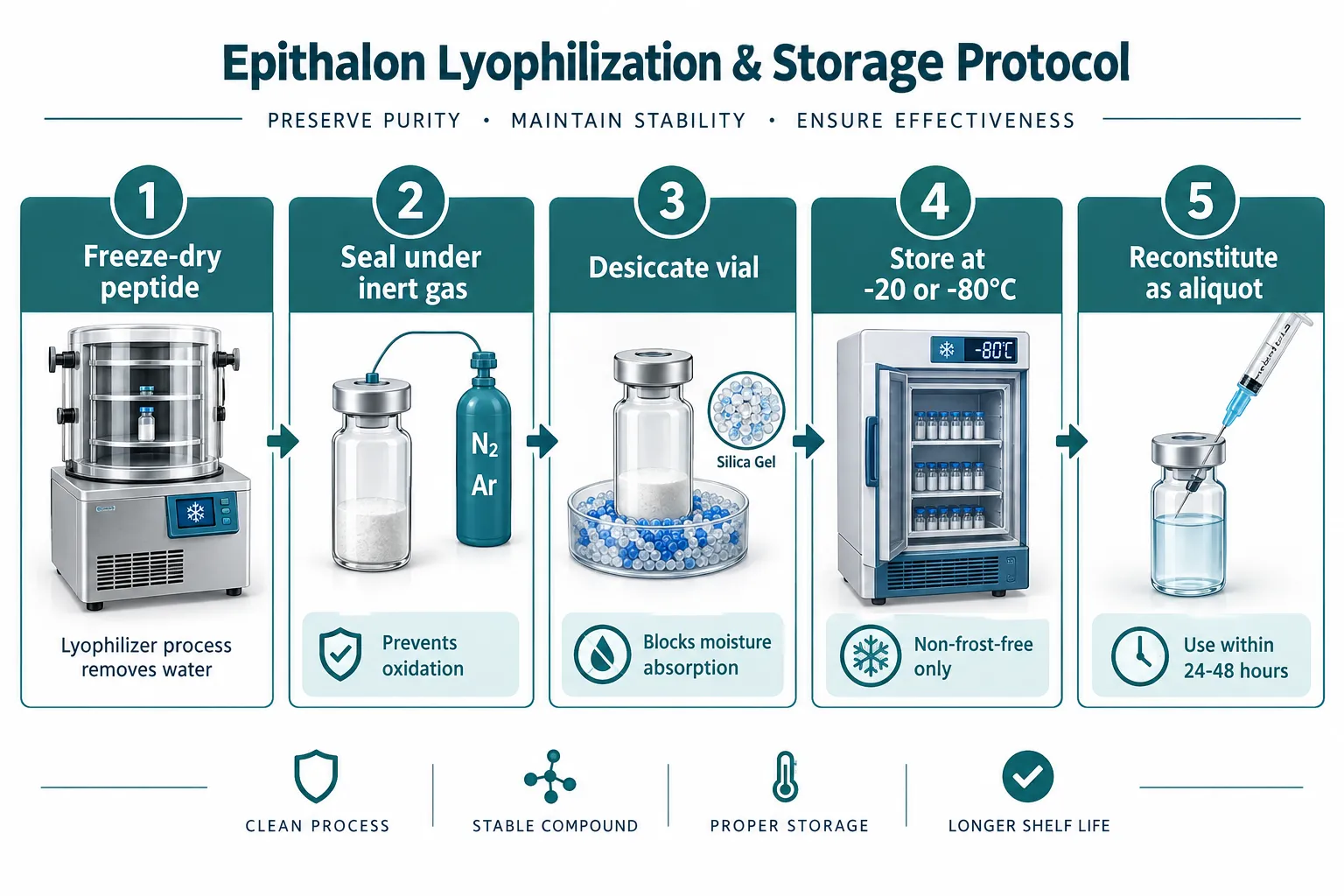
Lyophilization, freeze-drying, is the gold standard for long-term Epithalon preservation because it removes water without heat damage. However, the process only protects the peptide if post-lyophilization handling is equally rigorous.

The three pillars of effective Epithalon storage:

  1. Temperature control, Sealed lyophilized vials belong at -20 °C as the standard research condition. For archival batches intended for studies extending beyond 24 months, -80 °C is increasingly recommended. At -80 °C, minimal degradation has been documented for four or more years, making it the preferred condition for high-value telomere research stocks.

  2. Moisture exclusion, Epithalon is hygroscopic. Left unsealed or stored in a humid environment, the lyophilized powder will absorb atmospheric water, initiating the same hydrolytic degradation that elevated temperatures accelerate. Desiccant packs inside storage containers and sealed vials with crimped caps are non-negotiable.

  3. Atmosphere and light, Storage under an inert gas atmosphere (nitrogen or argon) minimizes oxidative degradation. Darkness prevents photodegradation of the peptide backbone.

"Sealed, dry, dark, -20 °C storage yields the longest stability window for lyophilized Epithalon, and 2-8 °C is reserved only for vials actively in use."

One often-overlooked hazard is the frost-free freezer. These units maintain temperature through repeated heating and cooling cycles that prevent ice buildup. For food, this is convenient. For lyophilized peptides, each micro-thaw cycle introduces mechanical stress and brief moisture exposure that cumulatively accelerates degradation. Long-term Epithalon stocks must be kept in a manual-defrost (non-frost-free) freezer.

Researchers sourcing material for extended studies can explore 50mg Epithalon formats that allow for proper aliquoting before archival storage, reducing the number of freeze-thaw cycles applied to the main stock.

For context on how complementary research peptides are handled under similar storage constraints, the SS-31 10mg research peptide considerations page provides parallel guidance on mitochondria-targeted peptide stability.


Reconstituted Epithalon and the Cold Chain in Telomere Experiments
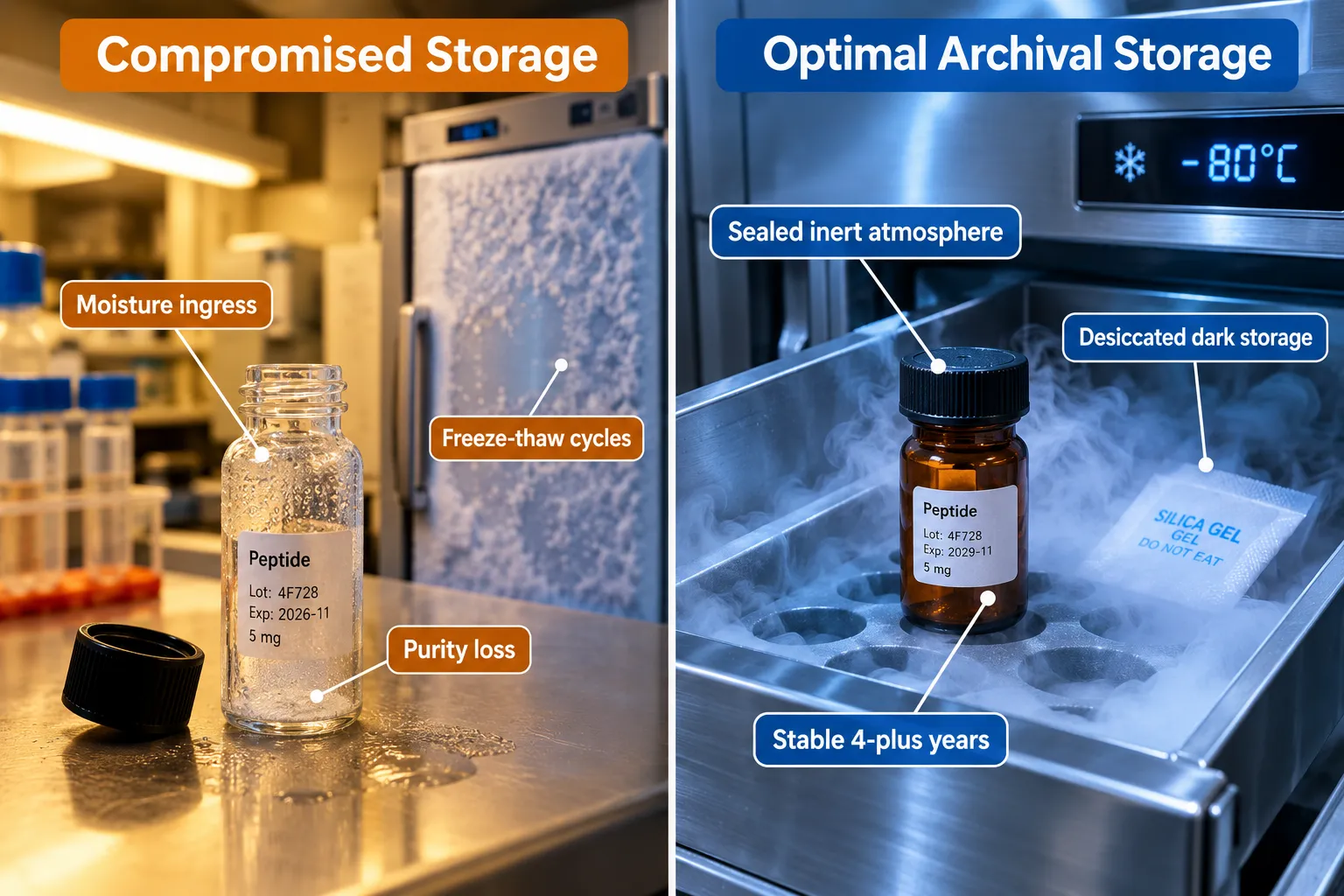
Reconstituted Epithalon and the Cold Chain in Telomere Experiments

Optimizing Epithalon lyophilization and storage in the context of temperature-dependent degradation rates in telomere research requires a clear distinction between two states: the dry lyophilized powder and the reconstituted solution.

Lyophilized (dry) powder:

  • Primary storage: -20 °C or -80 °C in sealed, desiccated, dark conditions
  • Acceptable short-term working storage: 2-8 °C for up to six months, provided the vial will be fully consumed within that window
  • Room temperature (25 °C): acceptable only as a worst-case allowance for shipping delays, not as an intentional storage strategy; cumulative room-temperature exposure should not exceed 72 hours

Reconstituted solution:

  • Store strictly at 2-8 °C immediately after reconstitution
  • For optimal biological activity in telomerase assays: use within 24-48 hours
  • Under strict sterility and cold-chain maintenance: some laboratory protocols allow use within 28-30 days
  • Never refreeze a reconstituted solution

The practical implication for telomere research programs is significant. Longitudinal experiments, which may span weeks or months, require consistent dosing with a peptide of stable purity and configuration. If reconstituted Epithalon degrades between dosing intervals, the effective concentration and isomeric profile shift, introducing variables that cannot be controlled for in data analysis.

Recommended aliquoting strategy for telomere studies:

  • Divide the bulk lyophilized stock into single-use aliquots before first use
  • Store aliquots at -20 °C (or -80 °C for multi-year programs)
  • Thaw only one aliquot per experimental session
  • Reconstitute immediately before use and discard any unused reconstituted volume after 48 hours

Researchers comparing peptide sourcing options for telomere programs can find useful procurement context at where to buy SS31 and Epithalon online, which addresses quality verification alongside sourcing. For mitochondrial co-administration studies that often accompany telomere research, SS-31 kidney health research and SS-31 ideal dosage and timing provide relevant handling parallels.

The connection between storage integrity and biological readouts is direct. Purity declines at 25 °C and 40 °C documented in 2026 stability tables correspond to progressive losses of functional integrity, meaning uncontrolled storage conditions can alter telomerase activation outcomes not by changing the experimental design, but simply by degrading the compound before it reaches the assay. Researchers interested in broader peptide stability comparisons may also find the MOTS-C and Elamipretide handling overview instructive for multi-peptide telomere research protocols.


Conclusion

The data available in 2026 leave little ambiguity: temperature is the most controllable variable in Epithalon stability management, and the difference between -20 °C and room temperature is the difference between years of research-grade material and weeks. For telomere and telomerase research programs that depend on consistent peptide dosing across longitudinal experiments, the following steps are actionable immediately:

  1. Audit current freezer type, replace frost-free units with manual-defrost models for peptide storage
  2. Aliquot before first use, divide bulk stocks into single-session volumes to eliminate repeated freeze-thaw cycles
  3. Seal under inert gas with desiccant, nitrogen or argon atmospheres with desiccant packs halt the two primary non-thermal degradation pathways
  4. Upgrade archival stocks to -80 °C, for programs extending beyond 24 months, ultra-low temperature storage is the only condition with documented stability beyond four years
  5. Establish a 48-hour reconstitution rule, prepare fresh solutions per session and discard unused reconstituted material rather than risking isomeric drift in stored solutions

Reproducible telomere research depends on compound integrity at every stage. Treating Epithalon storage as a precision variable, not an afterthought, is the foundation on which reliable biological data is built.

https://www.puretestedpeptides.com/wp-content/uploads/2026/09/optimizing-epithalon-lyophilization-and-storage-temperature-dependent-degradatio.webp 1024 1536 https://www.puretestedpeptides.com/wp-content/uploads/2026/01/buy-peptides-online.jpg 2026-09-22 13:04:272026-09-22 13:04:27Optimizing Epithalon Lyophilization and Storage: Temperature-Dependent Degradation Rates in Telomere Research
×

Helpful Links

  • My account
  • Cart
  • Checkout
  • Refund and Returns Policy
  • Privacy Policy
  • SMS Privacy Policy
  • Login
  • My Account
  • Logout

USA Made Lab Tested Peptides

All products are sold for research, laboratory, or analytical purposes only, and are not for human consumption


Pure Tested Peptides is a chemical supplier. Pure Tested Peptides is not a compounding / chemical compounding facility as defined under 503A of the Federal Food, Drug, and Cosmetic act. Pure Tested Peptides is not an outsourcing facility as defined under 503B of the Federal Food, Drug, and Cosmetic act.

The statements made within this website have not been evaluated by the US Food and Drug Administration. The products we offer are not intended to diagnose, treat, cure or prevent any disease.

Human/Animal Consumption Prohibited. Laboratory/In-Vitro Experimental Use Only

Scroll to top Scroll to top Scroll to top