Call or Text 727-513-9780
  • Shopping Cart Shopping Cart
    0Shopping Cart
Pure Tested Peptides | America's most trusted Peptides for sale online
  • Peptides for sale
    • Oral Peptides for sale
      • Peptide Capsules for sale
      • BPC 157 Capsules 1000mcg
      • SLU-PP-332 Capsules | 1000 mcg
      • 5-Amino-1MQ 50mg Capsules
      • Tesofensine 500mcg
    • All Peptides for sale
    • Peptide Sprays
      • BPC 157 Nasal Spray Kit
      • BPC-157 TB500 Nasal Spray Kit
      • Semax Nasal Spray 10mg
      • Selank – Nasal Spray Kit – 10mg
      • Epithalon 50MG Nasal Spray Kit
      • Ipamorelin 10mg Nasal Spray
      • Klow Nasal Spray (BPC-157 + TB-500 + GHK-Cu + KPV) | 80mg
      • Hulk Nasal Spray Tesa / Ipa Blend 6/3 MG
      • Klow Nasal Spray
      • NAD + 500 mg Nasal Spray
      • PT-141 Nasal Spray Kit
    • GHRH Peptides
      • Ipa Peptides
      • CJC-1295 Peptides
        • CJC-1295 with DAC 5 mg
        • CJC-1295 without DAC 5 mg
        • CJC-1295 Ipa 10mg
      • Tesa Peptides
        • Tesa Peptide
        • Tesa 20 mg
    • GHK-Cu Peptides
      • All GHK-Cu Peptides
      • GHK-Cu 100mg
      • KLOW Peptide Blend – Buy KLOW blend online
    • BPC Peptides
      • All BPC Peptides
      • BPC-157
      • BPC-157 TB-500
      • BPC 157 capsules 1000mcg
    • SLU-PP-332 Peptides
      • All SLU-PP-332 Peptides
      • SLU-PP-332 5mg
    • GLP3 Peptides
    • PT-141 Peptides
      • PT-141 Peptides for sale
      • PT-141 10mg
      • PT-141 Nasal Spray
    • CAG Peptides
      • Lipo-C Peptide Blend
      • CAG 5mg
      • CAG 10mg
    • MOTS-C Peptides
      • MOTS-C Peptides for sale
      • MOTS-c peptide
      • MOTS-c 10mg *6 pack*
    • 5 Amino 1MQ Peptides
      • 5 Amino 1MQ Peptides for sale
      • 5-Amino-1MQ 50mg Capsules
      • 5-Amino-1MQ 5mg
    • Epithalon Peptides
      • Epithalon Peptides for sale
      • Epithalon 10mg
      • Epithalon 50mg
  • Shop
    • GLPs
      • 5-Amino-1MQ 50mg Capsules
      • 5-Amino-1MQ 5mg
      • L-Carnitine 500mg/ml
      • Tesofensine 500mcg
      • SLU-PP-332 5mg
      • MOTS-c 10mg *6 pack*
    • Epithalon & BPC Peptides
      • Epithalon 10mg
      • Epithalon 50mg
      • BPC-157
      • BPC 157 capsules 1000mcg
      • BPC-157 TB-500
      • BPC-157 TB500 Nasal Spray Kit
      • BPC 157 Nasal Spray Kit
    • BPC TB-500 & NAD+ Peptides
      • NAD+ 500 mg
      • KLOW Peptide Blend – Buy KLOW blend online
      • GLOW Peptide Blend
      • TB 500 5mg
      • BPC 157 capsules 1000mcg – Supplement
      • BPC 157 Nasal Spray Kit
      • BPC-157
      • BPC-157 TB500 Nasal Spray Kit
      • BPC-157 TB-500
      • BPC 157 capsules 1000mcg
    • LL-37 Peptide
      • LL-37 10 mg
    • MOTS-C & Selank
      • MOTS-c peptide
      • Selank 10mg
    • GHK Peptides
      • GHK-Cu 100mg
      • GLOW Peptide Blend
      • KLOW Peptide Blend – Buy KLOW blend online
  • COAs
  • Wholesale
    • Wholesale Peptides for sale
  • PTP FAQ
  • Affiliates
    • Selank Peptide: Advanced Pharmacological Mechanisms Underlying Its Anxiolytic and Nootropic Effects in Research
      • 5-Amino-1MQ Peptide: Detailed Mechanisms of NNMT Inhibition and Its Impact on Cellular Metabolism Research
        • MOTS-C Peptide: Unraveling Its Role in Mitochondrial Dynamics and Energy Metabolism Research
          • Epithalon Peptide and Telomerase Regulation: Investigating Its Impact on Cellular Senescence and Lifespan Research Models
            • GLP2-T vs GLP2 Tirz Peptide: Understanding the Naming, Mechanistic Nuances, and Research Implications for Gut Health
      • Peptides and Polypeptides in Modern Pharmacology: What Research on Metoprolol, Prednisone, and Amlodipine Reveals
        • Polypeptide Peptides vs NSAIDs: What Naproxen and Diclofenac Teach Tissue-Repair Researchers About BPC‑157 and TB‑500
          • Peptides and Polypeptides in Endocrine Pharmacology: How GLP-1, GLP-2, and GLP-3 Retatrutide Differ From Classic Drugs Like Prednisone and Amlodipine
          • 5‑Amino‑1MQ Peptide and NNMT Inhibition: How It Compares With Statins Like Atorvastatin in Adipose and Lipid Metabolism Research
      • Enclomiphene, Estrogen Receptor Signaling, and Luteinizing Phase Biology: What Hormone Researchers Should Measure
        • Mesenchymal Stem Cells, BPC‑157, and GHK‑Cu: How Tissue Repair Peptides Compare With Classic NSAIDs Like Naproxen in Injury Models
          • Peptide Calculator Use Cases Beyond Growth Hormone: Working Through GLP‑3 Retatrutide, MOTS‑c, and BPC‑157 Research Dosing
        • Polypeptide Peptides in Endocrine and Metabolic Pharmacology: Lessons From Amlodipine, Prednisone, and Metoprolol
        • Peptides Calculator for Advanced Blends: Worked Examples for Tesamorelin, CJC‑1295, and Ipamorelin Stacks
          • Peptides and Polypeptides in Human Physiology: How Molecular Size Shapes Research Applications
            • Selank Peptide: Advanced Pharmacological Mechanisms Underlying Its Anxiolytic and Nootropic Effects in Research
          • 5-Amino-1MQ Peptide: Detailed Mechanisms of NNMT Inhibition and Its Impact on Cellular Metabolism Research
            • MOTS-C Peptide: Unraveling Its Role in Mitochondrial Dynamics and Energy Metabolism Research
              • Epithalon Peptide and Telomerase Regulation: Investigating Its Impact on Cellular Senescence and Lifespan Research Models
                • GLP2-T vs GLP2 Tirz Peptide: Understanding the Naming, Mechanistic Nuances, and Research Implications for Gut Health
                  • Peptides and Polypeptides in Endocrine Pharmacology: How GLP-1, GLP-2, and GLP-3 Retatrutide Differ From Classic Drugs Like Prednisone and Amlodipine
                    • Polypeptide Peptides vs NSAIDs: What Naproxen and Diclofenac Teach Tissue-Repair Researchers About BPC‑157 and TB‑500
                      • Peptides and Polypeptides in Modern Pharmacology: What Research on Metoprolol, Prednisone, and Amlodipine Reveals
                        • 5‑Amino‑1MQ Peptide and NNMT Inhibition: How It Compares With Statins Like Atorvastatin in Adipose and Lipid Metabolism Research
                        • Enclomiphene, Estrogen Receptor Signaling, and Luteinizing Phase Biology: What Hormone Researchers Should Measure
                        • Mesenchymal Stem Cells, BPC‑157, and GHK‑Cu: How Tissue Repair Peptides Compare With Classic NSAIDs Like Naproxen in Injury Models
                        • Peptide Calculator Use Cases Beyond Growth Hormone: Working Through GLP‑3 Retatrutide, MOTS‑c, and BPC‑157 Research Dosing
                        • Polypeptide Peptides in Endocrine and Metabolic Pharmacology: Lessons From Amlodipine, Prednisone, and Metoprolol
                        • Peptides Calculator for Advanced Blends: Worked Examples for Tesamorelin, CJC‑1295, and Ipamorelin Stacks
                        • Peptides and Polypeptides in Human Physiology: How Molecular Size Shapes Research Applications
                        • Selank Peptide: Advanced Pharmacological Mechanisms Underlying Its Anxiolytic and Nootropic Effects in Research
                        • MOTS-C Peptide: Unraveling Its Role in Mitochondrial Dynamics and Energy Metabolism Research
                        • Peptides and Polypeptides in Modern Pharmacology: What Research on Metoprolol, Prednisone, and Amlodipine Reveals
                        • Peptides and Polypeptides in Endocrine Pharmacology: How GLP-1, GLP-2, and GLP-3 Retatrutide Differ From Classic Drugs Like Prednisone and Amlodipine
                        • 5-Amino-1MQ Peptide: Detailed Mechanisms of NNMT Inhibition and Its Impact on Cellular Metabolism Research
                        • Mesenchymal Stem Cells, BPC‑157, and GHK‑Cu: How Tissue Repair Peptides Compare With Classic NSAIDs Like Naproxen in Injury Models
                        • Peptide Calculator Use Cases Beyond Growth Hormone: Working Through GLP‑3 Retatrutide, MOTS‑c, and BPC‑157 Research Dosing
                        • GLP2-T vs GLP2 Tirz Peptide: Understanding the Naming, Mechanistic Nuances, and Research Implications for Gut Health
                        • Polypeptide Peptides in Endocrine and Metabolic Pharmacology: Lessons From Amlodipine, Prednisone, and Metoprolol
                        • Polypeptide Peptides vs NSAIDs: What Naproxen and Diclofenac Teach Tissue-Repair Researchers About BPC‑157 and TB‑500
                        • Peptides and Polypeptides in Human Physiology: How Molecular Size Shapes Research Applications
                        • Peptides Calculator for Advanced Blends: Worked Examples for Tesamorelin, CJC‑1295, and Ipamorelin Stacks
                        • 5‑Amino‑1MQ Peptide and NNMT Inhibition: How It Compares With Statins Like Atorvastatin in Adipose and Lipid Metabolism Research
                        • Enclomiphene, Estrogen Receptor Signaling, and Luteinizing Phase Biology: What Hormone Researchers Should Measure
                        • Epithalon Peptide and Telomerase Regulation: Investigating Its Impact on Cellular Senescence and Lifespan Research Models
                        • Best research protocol Klow blend
                        • best time to take BPC-157
                        • best time to take DSIP (Delta Sleep Inducing Peptide)
                        • best time to take CJC-1295
                        • best time to take AOD-9604
                        • best time to take Follistatin 344
                        • best time to take Ipamorelin
                        • best time to take MK-677 (Ibutamoren)
                        • best time to take Ligandrol (LGD-4033) — research compound
                        • best time to take Ostarine (MK-2866) — research compound
                        • best time to take GHK-CU
                        • best time to take TB-500
                        • best time to take MOTS-c
                        • best time to take Semax
                        • best time to take RAD-140 (Testolone) — research compound
                        • best time to take Thymosin Alpha-1
                        • best time to take PEG-MGF
                        • Biolife Plasma, Octapharma Plasma, and Research Peptides: How Plasma Donation Labs Differ From Peptide Suppliers
                        • best time to take YK-11 — research compound
                        • best time to take PT-141 (Bremelanotide)
                        • Best research protocol Klow blend
                        • 5-Amino-1MQ and MOTS-C Synergy: Metabolic Signaling, Mitochondria, and Research Design
                        • BPC-157 and TB-500: Investigating Their Combined Effects on Angiogenesis and Cellular Migration in Tissue Repair Models
                        • BPC-157 Peptide: Gut Barrier Function, Inflammation, and Tissue-Recovery Research
                        • 5‑Amino‑1MQ and MOTS‑c Synergy in Metabolic Research: Designing NNMT and Mitochondrial Biogenesis Stacks
                        • CJC-1295 with DAC vs. Without DAC: Half-Life, Release Kinetics, and Research Implications
                        • CJC‑1295 with DAC vs. Without DAC: Expanding on Half‑Life Differences Using Tesamorelin and Ipamorelin Blend Case Studies
                        • Collagen Biology and Copper‑Binding Peptides: How GHK‑Cu, Glow Blend, and Klow Blend Interact with Skin and Connective Tissue
                        • Collagen Biology and Regenerative Peptides: How GHK‑Cu, Glow Blend, and Klow Blend Affect Extracellular Matrix Research
                    • DNA, Telomeres, and Longevity Peptides: Positioning Epithalon and MOTS‑c in Genetic Aging Research
                      • Enclomiphene Citrate: serm Mechanism, Testosterone Research, and Stack Compatibility
                        • Enclomiphene vs Enclomiphene Citrate: Formulation, Bioavailability, and Research Distinctions
                        • Epithalon Peptide Research: Telomerase Activation, Aging, and Pineal Gland Function
                        • Estrogen Receptor Signaling and Enclomiphene: How Selective Modulators Compare with Classic Polypeptide Hormones
                        • GHK-Cu Peptide: Advanced Mechanisms in Extracellular Matrix Remodeling and Wound Healing Research
                        • GHK-Cu Peptide: Collagen Synthesis, Wound Repair, and Skin-Barrier Research Models
                        • GLP-1 vs GLP-3 vs GLP-2: Peptide Classification and Research Applications
                        • GLP-2 Peptide Research Guide: Gut Barrier Function, Nutrient Absorption, and Intestinal Recovery Models
                        • GLP-3 Retatrutide vs. GLP-1 Drugs: What Triple-Agonist Biology Changes in Research Models
                        • Ipamorelin and Tesamorelin Combination: Synergistic GH Secretagogue Research and Dosing Protocols
                        • GLP2 Tirz Peptide: What It Is, Why the Name Exists, and How Researchers Should Interpret It
                        • Klow Blend Peptide Nasal Spray: What the Formulation Is Trying to Do in Cognitive Research
                        • Mitochondria, NNMT Inhibition, and Peptide Modulators: Where MOTS‑c and 5‑Amino‑1MQ Fit in Cellular Energy Research
                        • MOTS-c Peptide: Mitochondrial Function, Energy Metabolism, and What Researchers Measure
                        • MOTS-c vs. 5-Amino-1MQ: Which Metabolic Research Questions Each Compound Actually Answers
                        • Nasal Spray Peptides: Bioavailability, Administration, and Semax/Selank Research Applications
                        • PT-141 Peptide Research: Mechanism of Action and Melanocortin Receptor Signaling
                        • Retatrutide for Research: Mechanism, Structure, and GLP-1/GLP-3 Dual Action
                        • Retatrutide for Obesity and Type 2 Diabetes: What the Latest Trial Data Suggest
                        • Tesofensine Peptide Research: Mechanism, Appetite Suppression, and Neuropeptide Y Pathways
  • Contact
    • Contact Customer Service
    • Text Customer Support
  • About US
  • Shop all peptides
  • Affiliate Program
    • Affiliate Signup
  • Login / Register Login / Register Page Link Login / Register Page Link
  • Click to open the search input field Click to open the search input field Search
  • Menu Menu

Tag Archive for: excipient selection

Selecting Research Supplies for Peptides: Evaluating Phosphate-Buffered Saline pH, Excipients, and Reconstitution Vehicles

Selecting Research Supplies for Peptides: Evaluating Phosphate-Buffered Saline pH, Excipients, and Reconstitution Vehicles

October 27, 2026/0 Comments/in Uncategorized/by

Roughly 70% of peptide reconstitution failures in research settings trace back to a single avoidable error: choosing a buffer based on habit rather than sequence chemistry. For lab researchers who depend on clean, reproducible assay data, that mistake erodes months of work. Selecting research supplies for peptides: evaluating phosphate-buffered saline pH, excipients, and reconstitution vehicles is not a routine procurement task, it is an analytical decision that directly shapes experimental validity.

Key Takeaways

  • PBS at pH 7.0-7.4 is a reliable default diluent for many peptides at concentrations of 1 mg/mL or below, but it is not universally appropriate.
  • Peptides with free cysteine residues require degassed acidic buffers because thiol groups oxidize rapidly above pH 7.
  • Organic co-solvents such as DMSO, ACN, or DMF may be needed first for hydrophobic peptides, followed by slow dilution into PBS.
  • Excipient choice, including bulking agents, sugars, polyols, and surfactants, affects aggregation and long-term stability.
  • The product data sheet or peer-reviewed literature for a specific peptide always overrides generic PBS guidance.

Why PBS pH Is the Starting Point, Not the Final Answer
Why PBS pH Is the Starting Point, Not the Final Answer

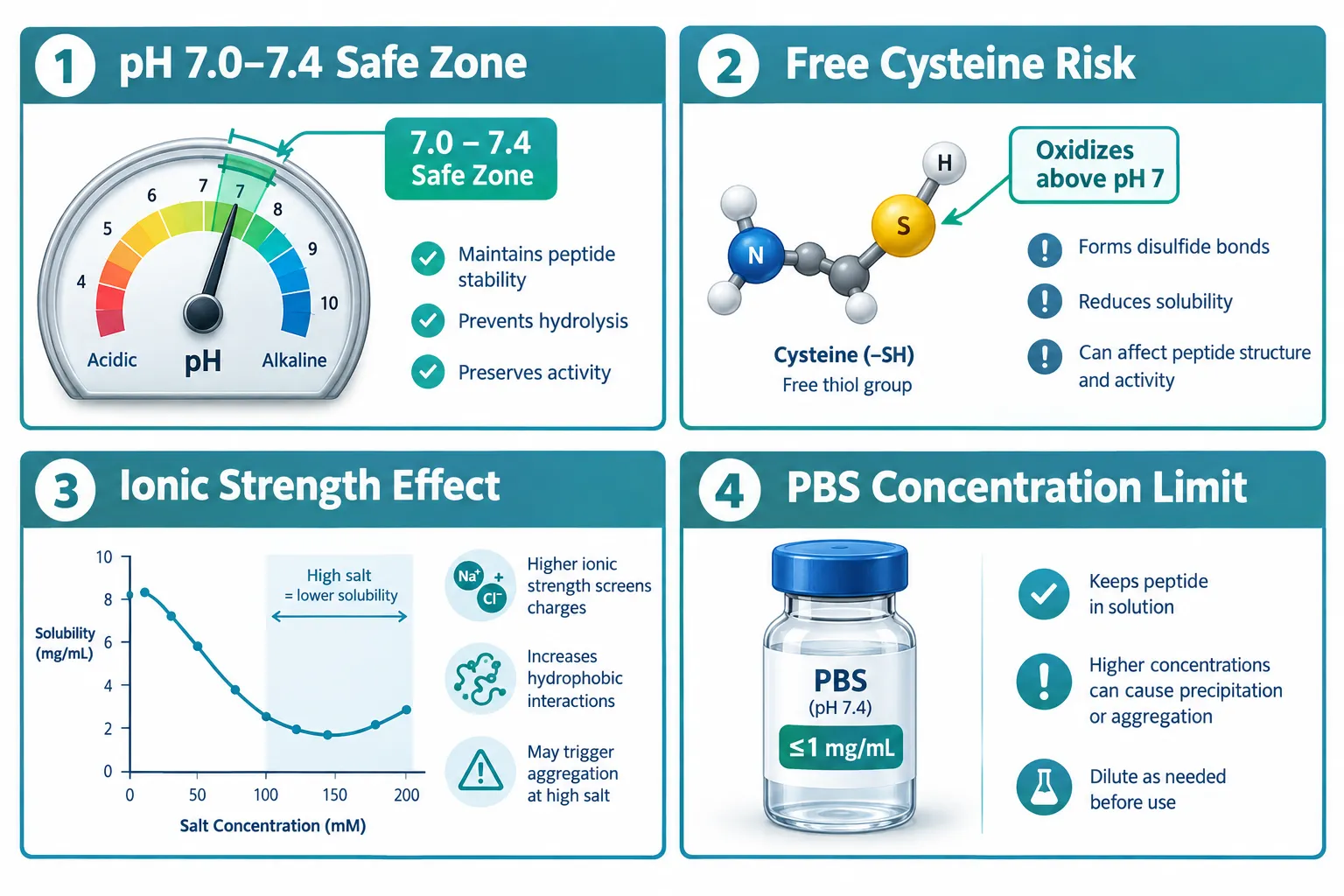
Phosphate-buffered saline at pH 7.0-7.4 with approximately 150 mM ionic strength remains the most widely cited starting vehicle for peptide reconstitution. Its physiological relevance makes it attractive for cell-based assays, and major suppliers consistently endorse it as a safe choice when a working concentration at or below 1 mg/mL is sufficient for the experiment.

However, "safe" does not mean "universal." PBS introduces two variables that can destabilize certain peptide classes: pH and ionic strength.

pH sensitivity is the more critical concern. Peptides containing free cysteine residues are particularly vulnerable. Above pH 7, thiol groups oxidize rapidly, forming intermolecular disulfide bonds that change the peptide's structure and biological activity. For these sequences, supplier guidance recommends dissolution in carefully degassed acidic buffers before any further dilution.

Ionic strength poses a separate problem. For some peptides, particularly those with stretches of charged residues, higher salt concentrations reduce net solubility by screening electrostatic repulsion between chains. If a peptide clumps or crashes out in PBS at standard ionic strength, the buffer itself may be the culprit, not the peptide lot.

"The solvent should be chosen based on the sequence and assay requirements, not based on laboratory convention."

A 2026 technical guide from Alan Scientific reinforces this directly: PBS is not always the first solvent, and ionic strength can reduce solubility for some sequences. Researchers sourcing peptides such as those covered in the BPC-157 core peptides documentation first research guide will recognize that even well-characterized peptides require buffer-specific evaluation.


Evaluating Excipients Beyond the Buffer
Evaluating Excipients Beyond the Buffer

When selecting research supplies for peptides and evaluating phosphate-buffered saline pH alongside excipients and reconstitution vehicles, researchers often focus exclusively on the diluent while overlooking formulation components that affect stability before and after reconstitution.

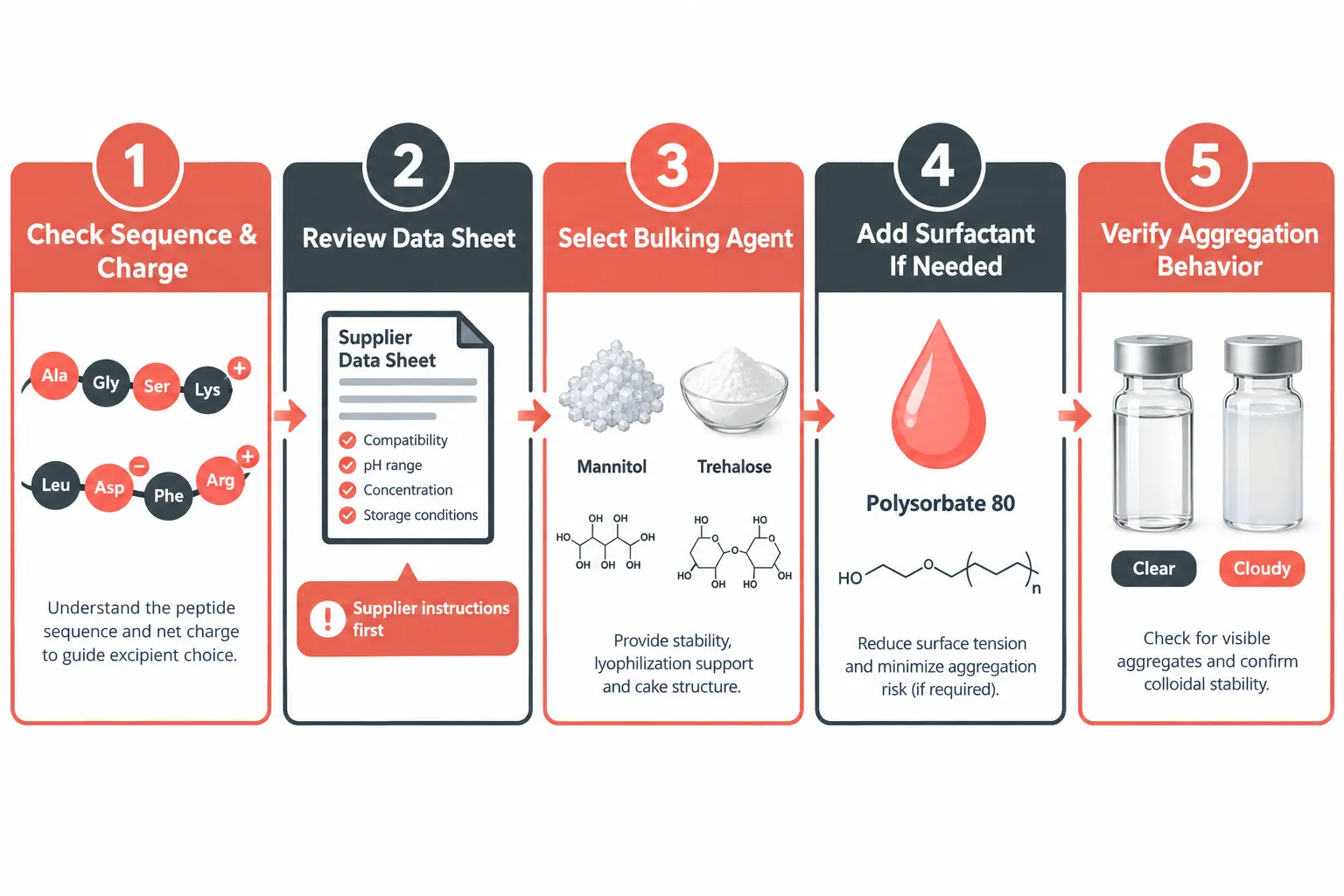
Lyophilized peptides are rarely pure active compound. Commercial research-grade peptides frequently include bulking agents, sugars or polyols, and surfactants added during the freeze-drying process to protect the peptide from aggregation and structural collapse. Understanding what is in the vial is essential before selecting a compatible reconstitution vehicle.

Common excipient categories and their functions:

Excipient Class Common Examples Primary Role
Bulking agents Mannitol, glycine Provides cake structure during lyophilization
Cryoprotectants Trehalose, sucrose Prevents aggregation during freezing
Surfactants Polysorbate 80 Reduces surface-mediated denaturation
pH adjusters Acetic acid, NaOH Maintains target pH during formulation

For researchers working with metabolic or structural peptides, such as those described in the GLP-1 peptide buy: generational research concepts and sourcing notes, excipient compatibility with downstream assay reagents is especially important. A surfactant that protects the peptide during storage may interfere with receptor-binding assays if not accounted for.

For acidic peptides that resist dissolution in PBS alone, a practical first step is dissolving the peptide in a small volume of a basic solvent such as 0.1% aqueous ammonia, then diluting to the target concentration in PBS. This sequential approach prevents precipitation and avoids forcing the peptide into a pH environment that promotes degradation.

The data sheet provided by the supplier remains the authoritative source for solvent compatibility. Generic PBS rules should yield to peptide-specific instructions whenever they exist.


Selecting the Right Reconstitution Vehicle for Hydrophobic and Hydrophilic Peptides
Selecting the Right Reconstitution Vehicle for Hydrophobic and Hydrophilic Peptides

The practical framework for selecting research supplies for peptides, evaluating phosphate-buffered saline pH, excipients, and reconstitution vehicles together, becomes clearest when researchers categorize their target peptide by hydrophilicity before opening a vial.

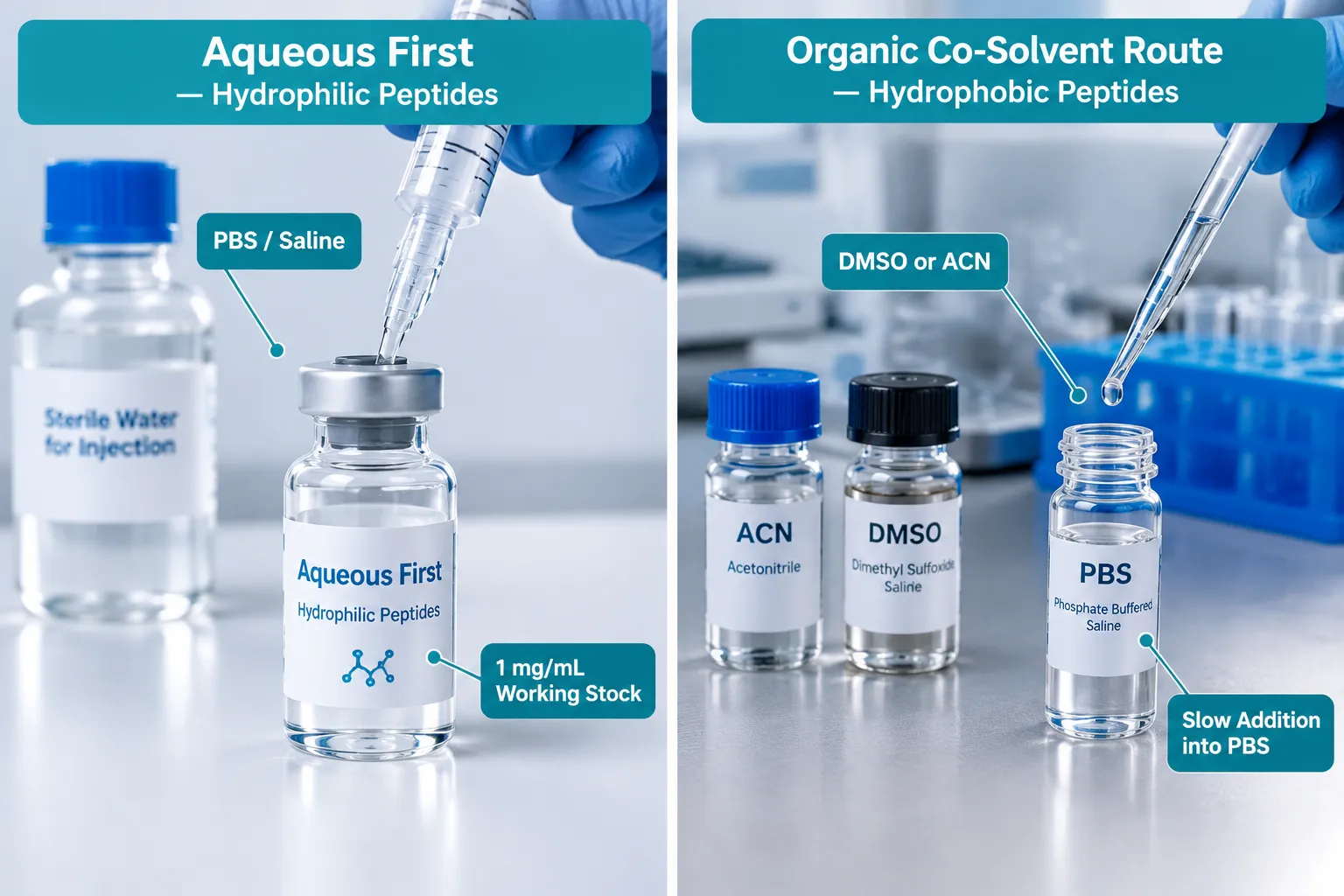
For hydrophilic peptides, the recommended workflow is straightforward:

  1. Attempt dissolution in sterile water, PBS, or physiological saline at 1 mg/mL.
  2. If soluble, use PBS pH 7.0-7.4 as the working stock vehicle.
  3. Store aliquots appropriately to avoid freeze-thaw degradation.

For hydrophobic peptides, PBS alone will often fail. The recommended approach:

  1. Dissolve the peptide in a small volume of an organic co-solvent, ACN, DMSO, or DMF are most commonly cited.
  2. Add PBS or aqueous buffer slowly into the organic solution rather than the reverse.
  3. Verify clarity and confirm concentration before use.

DMSO in particular warrants careful handling: residual DMSO above approximately 0.1% can affect cell viability in biological assays, so the final dilution factor matters.

Bacteriostatic vehicles, those containing preservatives such as benzyl alcohol, are sometimes discussed in injectable product literature, but the appropriate vehicle for any specific peptide remains product-determined rather than category-determined. Researchers evaluating compounds like those discussed in the PT-141 peptide for sale: research context, QA, and controls resource benefit from this discipline: confirm vehicle compatibility against the specific lot documentation.

For work with antioxidant peptides where mitochondrial or structural integrity is a study variable, see the SS-31 mechanism and research: where to buy SS-31 and Epithalon overview, reconstitution vehicle choice can directly influence whether oxidative endpoints reflect real biological signal or buffer artifact.

Researchers building a broader sourcing strategy should also consult a vetted where to buy peptides resource to ensure that purity documentation accompanies every lot before reconstitution decisions are made.


Conclusion

Selecting research supplies for peptides requires more than ordering a standard PBS solution and reconstituting to a convenient volume. The evaluation framework should follow a consistent sequence: assess the peptide sequence for pH-sensitive residues, confirm ionic-strength tolerances, review the supplier data sheet for approved vehicles, select excipient-compatible buffers, and match reconstitution strategy to hydrophilicity class.

Actionable next steps for 2026 lab procurement:

  • Request a certificate of analysis and full data sheet for every peptide lot before selecting a reconstitution vehicle.
  • Default to PBS pH 7.0-7.4 only when concentration requirements are at or below 1 mg/mL and the sequence contains no free cysteines.
  • Keep degassed acidic buffer, DMSO, and ACN on hand as secondary vehicles for difficult sequences.
  • Document excipient composition from the supplier and verify compatibility with all downstream assay reagents.
  • Revisit reconstitution protocols when switching peptide suppliers, even for nominally identical compounds.

Treating buffer and vehicle selection as a scientific decision, not a supply-closet default, is the single highest-leverage action available to researchers who want clean, reproducible peptide data.

https://www.puretestedpeptides.com/wp-content/uploads/2026/10/selecting-research-supplies-for-peptides-evaluating-phosphate-buffered-saline-ph.webp 1024 1536 https://www.puretestedpeptides.com/wp-content/uploads/2026/01/buy-peptides-online.jpg 2026-10-27 13:06:122026-10-27 13:06:12Selecting Research Supplies for Peptides: Evaluating Phosphate-Buffered Saline pH, Excipients, and Reconstitution Vehicles
×

Helpful Links

  • My account
  • Cart
  • Checkout
  • Refund and Returns Policy
  • Privacy Policy
  • SMS Privacy Policy
  • Login
  • My Account
  • Logout

USA Made Lab Tested Peptides

All products are sold for research, laboratory, or analytical purposes only, and are not for human consumption


Pure Tested Peptides is a chemical supplier. Pure Tested Peptides is not a compounding / chemical compounding facility as defined under 503A of the Federal Food, Drug, and Cosmetic act. Pure Tested Peptides is not an outsourcing facility as defined under 503B of the Federal Food, Drug, and Cosmetic act.

The statements made within this website have not been evaluated by the US Food and Drug Administration. The products we offer are not intended to diagnose, treat, cure or prevent any disease.

Human/Animal Consumption Prohibited. Laboratory/In-Vitro Experimental Use Only

Scroll to top Scroll to top Scroll to top