Call or Text 727-513-9780
  • Shopping Cart Shopping Cart
    0Shopping Cart
Pure Tested Peptides | America's most trusted Peptides for sale online
  • Peptides for sale
    • Oral Peptides for sale
      • Peptide Capsules for sale
      • BPC 157 Capsules 1000mcg
      • SLU-PP-332 Capsules | 1000 mcg
      • 5-Amino-1MQ 50mg Capsules
      • Tesofensine 500mcg
    • All Peptides for sale
    • Peptide Sprays
      • BPC 157 Nasal Spray Kit
      • BPC-157 TB500 Nasal Spray Kit
      • Semax Nasal Spray 10mg
      • Selank – Nasal Spray Kit – 10mg
      • Epithalon 50MG Nasal Spray Kit
      • Ipamorelin 10mg Nasal Spray
      • Klow Nasal Spray (BPC-157 + TB-500 + GHK-Cu + KPV) | 80mg
      • Hulk Nasal Spray Tesa / Ipa Blend 6/3 MG
      • Klow Nasal Spray
      • NAD + 500 mg Nasal Spray
      • PT-141 Nasal Spray Kit
    • GHRH Peptides
      • Ipa Peptides
      • CJC-1295 Peptides
        • CJC-1295 with DAC 5 mg
        • CJC-1295 without DAC 5 mg
        • CJC-1295 Ipa 10mg
      • Tesa Peptides
        • Tesa Peptide
        • Tesa 20 mg
    • GHK-Cu Peptides
      • All GHK-Cu Peptides
      • GHK-Cu 100mg
      • KLOW Peptide Blend – Buy KLOW blend online
    • BPC Peptides
      • All BPC Peptides
      • BPC-157
      • BPC-157 TB-500
      • BPC 157 capsules 1000mcg
    • SLU-PP-332 Peptides
      • All SLU-PP-332 Peptides
      • SLU-PP-332 5mg
    • GLP3 Peptides
    • PT-141 Peptides
      • PT-141 Peptides for sale
      • PT-141 10mg
      • PT-141 Nasal Spray
    • CAG Peptides
      • Lipo-C Peptide Blend
      • CAG 5mg
      • CAG 10mg
    • MOTS-C Peptides
      • MOTS-C Peptides for sale
      • MOTS-c peptide
      • MOTS-c 10mg *6 pack*
    • 5 Amino 1MQ Peptides
      • 5 Amino 1MQ Peptides for sale
      • 5-Amino-1MQ 50mg Capsules
      • 5-Amino-1MQ 5mg
    • Epithalon Peptides
      • Epithalon Peptides for sale
      • Epithalon 10mg
      • Epithalon 50mg
  • Shop
    • GLPs
      • 5-Amino-1MQ 50mg Capsules
      • 5-Amino-1MQ 5mg
      • L-Carnitine 500mg/ml
      • Tesofensine 500mcg
      • SLU-PP-332 5mg
      • MOTS-c 10mg *6 pack*
    • Epithalon & BPC Peptides
      • Epithalon 10mg
      • Epithalon 50mg
      • BPC-157
      • BPC 157 capsules 1000mcg
      • BPC-157 TB-500
      • BPC-157 TB500 Nasal Spray Kit
      • BPC 157 Nasal Spray Kit
    • BPC TB-500 & NAD+ Peptides
      • NAD+ 500 mg
      • KLOW Peptide Blend – Buy KLOW blend online
      • GLOW Peptide Blend
      • TB 500 5mg
      • BPC 157 capsules 1000mcg – Supplement
      • BPC 157 Nasal Spray Kit
      • BPC-157
      • BPC-157 TB500 Nasal Spray Kit
      • BPC-157 TB-500
      • BPC 157 capsules 1000mcg
    • LL-37 Peptide
      • LL-37 10 mg
    • MOTS-C & Selank
      • MOTS-c peptide
      • Selank 10mg
    • GHK Peptides
      • GHK-Cu 100mg
      • GLOW Peptide Blend
      • KLOW Peptide Blend – Buy KLOW blend online
  • COAs
  • Wholesale
    • Wholesale Peptides for sale
  • PTP FAQ
  • Affiliates
    • Selank Peptide: Advanced Pharmacological Mechanisms Underlying Its Anxiolytic and Nootropic Effects in Research
      • 5-Amino-1MQ Peptide: Detailed Mechanisms of NNMT Inhibition and Its Impact on Cellular Metabolism Research
        • MOTS-C Peptide: Unraveling Its Role in Mitochondrial Dynamics and Energy Metabolism Research
          • Epithalon Peptide and Telomerase Regulation: Investigating Its Impact on Cellular Senescence and Lifespan Research Models
            • GLP2-T vs GLP2 Tirz Peptide: Understanding the Naming, Mechanistic Nuances, and Research Implications for Gut Health
      • Peptides and Polypeptides in Modern Pharmacology: What Research on Metoprolol, Prednisone, and Amlodipine Reveals
        • Polypeptide Peptides vs NSAIDs: What Naproxen and Diclofenac Teach Tissue-Repair Researchers About BPC‑157 and TB‑500
          • Peptides and Polypeptides in Endocrine Pharmacology: How GLP-1, GLP-2, and GLP-3 Retatrutide Differ From Classic Drugs Like Prednisone and Amlodipine
          • 5‑Amino‑1MQ Peptide and NNMT Inhibition: How It Compares With Statins Like Atorvastatin in Adipose and Lipid Metabolism Research
      • Enclomiphene, Estrogen Receptor Signaling, and Luteinizing Phase Biology: What Hormone Researchers Should Measure
        • Mesenchymal Stem Cells, BPC‑157, and GHK‑Cu: How Tissue Repair Peptides Compare With Classic NSAIDs Like Naproxen in Injury Models
          • Peptide Calculator Use Cases Beyond Growth Hormone: Working Through GLP‑3 Retatrutide, MOTS‑c, and BPC‑157 Research Dosing
        • Polypeptide Peptides in Endocrine and Metabolic Pharmacology: Lessons From Amlodipine, Prednisone, and Metoprolol
        • Peptides Calculator for Advanced Blends: Worked Examples for Tesamorelin, CJC‑1295, and Ipamorelin Stacks
          • Peptides and Polypeptides in Human Physiology: How Molecular Size Shapes Research Applications
            • Selank Peptide: Advanced Pharmacological Mechanisms Underlying Its Anxiolytic and Nootropic Effects in Research
          • 5-Amino-1MQ Peptide: Detailed Mechanisms of NNMT Inhibition and Its Impact on Cellular Metabolism Research
            • MOTS-C Peptide: Unraveling Its Role in Mitochondrial Dynamics and Energy Metabolism Research
              • Epithalon Peptide and Telomerase Regulation: Investigating Its Impact on Cellular Senescence and Lifespan Research Models
                • GLP2-T vs GLP2 Tirz Peptide: Understanding the Naming, Mechanistic Nuances, and Research Implications for Gut Health
                  • Peptides and Polypeptides in Endocrine Pharmacology: How GLP-1, GLP-2, and GLP-3 Retatrutide Differ From Classic Drugs Like Prednisone and Amlodipine
                    • Polypeptide Peptides vs NSAIDs: What Naproxen and Diclofenac Teach Tissue-Repair Researchers About BPC‑157 and TB‑500
                      • Peptides and Polypeptides in Modern Pharmacology: What Research on Metoprolol, Prednisone, and Amlodipine Reveals
                        • 5‑Amino‑1MQ Peptide and NNMT Inhibition: How It Compares With Statins Like Atorvastatin in Adipose and Lipid Metabolism Research
                        • Enclomiphene, Estrogen Receptor Signaling, and Luteinizing Phase Biology: What Hormone Researchers Should Measure
                        • Mesenchymal Stem Cells, BPC‑157, and GHK‑Cu: How Tissue Repair Peptides Compare With Classic NSAIDs Like Naproxen in Injury Models
                        • Peptide Calculator Use Cases Beyond Growth Hormone: Working Through GLP‑3 Retatrutide, MOTS‑c, and BPC‑157 Research Dosing
                        • Polypeptide Peptides in Endocrine and Metabolic Pharmacology: Lessons From Amlodipine, Prednisone, and Metoprolol
                        • Peptides Calculator for Advanced Blends: Worked Examples for Tesamorelin, CJC‑1295, and Ipamorelin Stacks
                        • Peptides and Polypeptides in Human Physiology: How Molecular Size Shapes Research Applications
                        • Selank Peptide: Advanced Pharmacological Mechanisms Underlying Its Anxiolytic and Nootropic Effects in Research
                        • MOTS-C Peptide: Unraveling Its Role in Mitochondrial Dynamics and Energy Metabolism Research
                        • Peptides and Polypeptides in Modern Pharmacology: What Research on Metoprolol, Prednisone, and Amlodipine Reveals
                        • Peptides and Polypeptides in Endocrine Pharmacology: How GLP-1, GLP-2, and GLP-3 Retatrutide Differ From Classic Drugs Like Prednisone and Amlodipine
                        • 5-Amino-1MQ Peptide: Detailed Mechanisms of NNMT Inhibition and Its Impact on Cellular Metabolism Research
                        • Mesenchymal Stem Cells, BPC‑157, and GHK‑Cu: How Tissue Repair Peptides Compare With Classic NSAIDs Like Naproxen in Injury Models
                        • Peptide Calculator Use Cases Beyond Growth Hormone: Working Through GLP‑3 Retatrutide, MOTS‑c, and BPC‑157 Research Dosing
                        • GLP2-T vs GLP2 Tirz Peptide: Understanding the Naming, Mechanistic Nuances, and Research Implications for Gut Health
                        • Polypeptide Peptides in Endocrine and Metabolic Pharmacology: Lessons From Amlodipine, Prednisone, and Metoprolol
                        • Polypeptide Peptides vs NSAIDs: What Naproxen and Diclofenac Teach Tissue-Repair Researchers About BPC‑157 and TB‑500
                        • Peptides and Polypeptides in Human Physiology: How Molecular Size Shapes Research Applications
                        • Peptides Calculator for Advanced Blends: Worked Examples for Tesamorelin, CJC‑1295, and Ipamorelin Stacks
                        • 5‑Amino‑1MQ Peptide and NNMT Inhibition: How It Compares With Statins Like Atorvastatin in Adipose and Lipid Metabolism Research
                        • Enclomiphene, Estrogen Receptor Signaling, and Luteinizing Phase Biology: What Hormone Researchers Should Measure
                        • Epithalon Peptide and Telomerase Regulation: Investigating Its Impact on Cellular Senescence and Lifespan Research Models
                        • Best research protocol Klow blend
                        • best time to take BPC-157
                        • best time to take DSIP (Delta Sleep Inducing Peptide)
                        • best time to take CJC-1295
                        • best time to take AOD-9604
                        • best time to take Follistatin 344
                        • best time to take Ipamorelin
                        • best time to take MK-677 (Ibutamoren)
                        • best time to take Ligandrol (LGD-4033) — research compound
                        • best time to take Ostarine (MK-2866) — research compound
                        • best time to take GHK-CU
                        • best time to take TB-500
                        • best time to take MOTS-c
                        • best time to take Semax
                        • best time to take RAD-140 (Testolone) — research compound
                        • best time to take Thymosin Alpha-1
                        • best time to take PEG-MGF
                        • Biolife Plasma, Octapharma Plasma, and Research Peptides: How Plasma Donation Labs Differ From Peptide Suppliers
                        • best time to take YK-11 — research compound
                        • best time to take PT-141 (Bremelanotide)
                        • Best research protocol Klow blend
                        • 5-Amino-1MQ and MOTS-C Synergy: Metabolic Signaling, Mitochondria, and Research Design
                        • BPC-157 and TB-500: Investigating Their Combined Effects on Angiogenesis and Cellular Migration in Tissue Repair Models
                        • BPC-157 Peptide: Gut Barrier Function, Inflammation, and Tissue-Recovery Research
                        • 5‑Amino‑1MQ and MOTS‑c Synergy in Metabolic Research: Designing NNMT and Mitochondrial Biogenesis Stacks
                        • CJC-1295 with DAC vs. Without DAC: Half-Life, Release Kinetics, and Research Implications
                        • CJC‑1295 with DAC vs. Without DAC: Expanding on Half‑Life Differences Using Tesamorelin and Ipamorelin Blend Case Studies
                        • Collagen Biology and Copper‑Binding Peptides: How GHK‑Cu, Glow Blend, and Klow Blend Interact with Skin and Connective Tissue
                        • Collagen Biology and Regenerative Peptides: How GHK‑Cu, Glow Blend, and Klow Blend Affect Extracellular Matrix Research
                    • DNA, Telomeres, and Longevity Peptides: Positioning Epithalon and MOTS‑c in Genetic Aging Research
                      • Enclomiphene Citrate: serm Mechanism, Testosterone Research, and Stack Compatibility
                        • Enclomiphene vs Enclomiphene Citrate: Formulation, Bioavailability, and Research Distinctions
                        • Epithalon Peptide Research: Telomerase Activation, Aging, and Pineal Gland Function
                        • Estrogen Receptor Signaling and Enclomiphene: How Selective Modulators Compare with Classic Polypeptide Hormones
                        • GHK-Cu Peptide: Advanced Mechanisms in Extracellular Matrix Remodeling and Wound Healing Research
                        • GHK-Cu Peptide: Collagen Synthesis, Wound Repair, and Skin-Barrier Research Models
                        • GLP-1 vs GLP-3 vs GLP-2: Peptide Classification and Research Applications
                        • GLP-2 Peptide Research Guide: Gut Barrier Function, Nutrient Absorption, and Intestinal Recovery Models
                        • GLP-3 Retatrutide vs. GLP-1 Drugs: What Triple-Agonist Biology Changes in Research Models
                        • Ipamorelin and Tesamorelin Combination: Synergistic GH Secretagogue Research and Dosing Protocols
                        • GLP2 Tirz Peptide: What It Is, Why the Name Exists, and How Researchers Should Interpret It
                        • Klow Blend Peptide Nasal Spray: What the Formulation Is Trying to Do in Cognitive Research
                        • Mitochondria, NNMT Inhibition, and Peptide Modulators: Where MOTS‑c and 5‑Amino‑1MQ Fit in Cellular Energy Research
                        • MOTS-c Peptide: Mitochondrial Function, Energy Metabolism, and What Researchers Measure
                        • MOTS-c vs. 5-Amino-1MQ: Which Metabolic Research Questions Each Compound Actually Answers
                        • Nasal Spray Peptides: Bioavailability, Administration, and Semax/Selank Research Applications
                        • PT-141 Peptide Research: Mechanism of Action and Melanocortin Receptor Signaling
                        • Retatrutide for Research: Mechanism, Structure, and GLP-1/GLP-3 Dual Action
                        • Retatrutide for Obesity and Type 2 Diabetes: What the Latest Trial Data Suggest
                        • Tesofensine Peptide Research: Mechanism, Appetite Suppression, and Neuropeptide Y Pathways
  • Contact
    • Contact Customer Service
    • Text Customer Support
  • About US
  • Shop all peptides
  • Affiliate Program
    • Affiliate Signup
  • Login / Register Login / Register Page Link Login / Register Page Link
  • Click to open the search input field Click to open the search input field Search
  • Menu Menu

Tag Archive for: fibroblast keratinocyte crosstalk

What Is GHK-Cu? Copper-Dependent Matrix Remodeling and Fibroblast, Keratinocyte Crosstalk in Research Models

What Is GHK-Cu? Copper-Dependent Matrix Remodeling and Fibroblast, Keratinocyte Crosstalk in Research Models

November 2, 2026/0 Comments/in Uncategorized/by

A peptide that occurs naturally in human plasma, urine, and saliva, and drops sharply with age, has attracted sustained attention in tissue-repair research for over three decades. GHK-Cu, the copper-bound form of glycyl-L-histidyl-L-lysine, does far more than stimulate collagen. Understanding what is GHK-Cu and how copper-dependent matrix remodeling and fibroblast, keratinocyte crosstalk operate in research models requires moving past surface-level ingredient claims and into the mechanistic details: copper delivery, extracellular matrix (ECM) signaling, cell-type-specific responses, and toxicity controls.

Key Takeaways

  • GHK-Cu is a metallopeptide that chelates Cu²⁺ and delivers bioavailable copper to tissues, driving downstream changes in ECM assembly and cell signaling.
  • At picomolar-to-nanomolar concentrations, GHK-Cu shifts the MMP/TIMP balance and selectively raises dermatan sulfate and heparan sulfate without increasing hyaluronic acid.
  • Fibroblasts respond with elevated bFGF, VEGF, collagen, and elastin output; keratinocytes show increased PCNA, p63, and integrins α6/β1, a stemness-associated pattern.
  • Combined fibroblast, keratinocyte (skin-equivalent) models suggest coordinated crosstalk where copper-driven ECM changes reinforce basal-cell proliferative signaling.
  • Most current data come from in vitro and animal work; standardized human trials with defined endpoints remain scarce as of 2026.

The Copper Core: How GHK-Cu Functions as a Metallopeptide
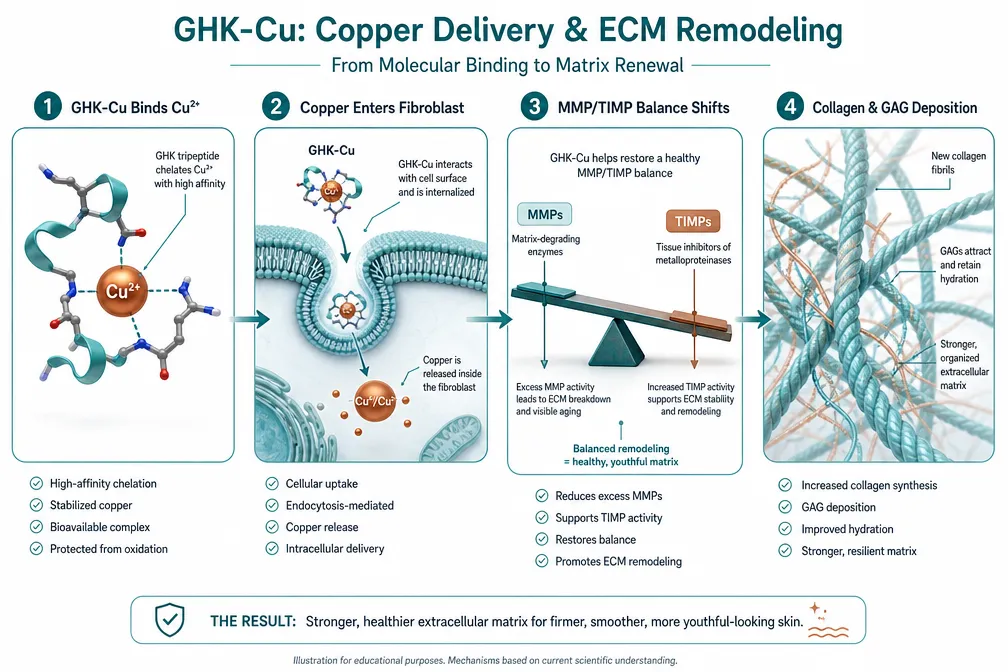
The Copper Core: How GHK-Cu Functions as a Metallopeptide

GHK-Cu is not simply a tripeptide with cosmetic benefits. Its biological activity depends on the stable Cu²⁺ complex formed by glycine, L-histidine, and L-lysine. That copper binding is the foundation of its function: the peptide acts as a carrier, shuttling copper into fibroblasts and epithelial cells where it fuels copper-dependent enzymes, particularly lysyl oxidase, which crosslinks collagen and elastin fibers in the ECM.

Without the copper ion, the free tripeptide GHK shows substantially reduced activity in ECM synthesis assays. This distinction matters for research design. Formulations that lose copper through oxidation or incompatible excipients produce inconsistent results, which partly explains the variability seen across older cell-culture studies.

Key copper-dependent processes activated by GHK-Cu:

  • Lysyl oxidase activation for collagen and elastin crosslinking
  • Superoxide dismutase (Cu/Zn-SOD) upregulation, reducing oxidative stress
  • Modulation of matrix metalloproteinases (MMPs) and their inhibitors (TIMPs)
  • Promotion of angiogenic signaling via VEGF

Process-engineering research published through 2026 highlights improved synthetic routes and delivery platforms, including topical vehicles designed to stabilize the peptide, copper complex and control copper release rate, which directly affect in vitro reproducibility. Researchers sourcing material should consult resources on research-grade copper complex purity and skin model compatibility before designing experiments.


Copper-Dependent Matrix Remodeling: ECM Markers and Dose, Response Data

What is GHK-Cu doing to the extracellular matrix at the molecular level? The answer involves a carefully balanced shift in matrix composition rather than a simple upregulation of a single protein.
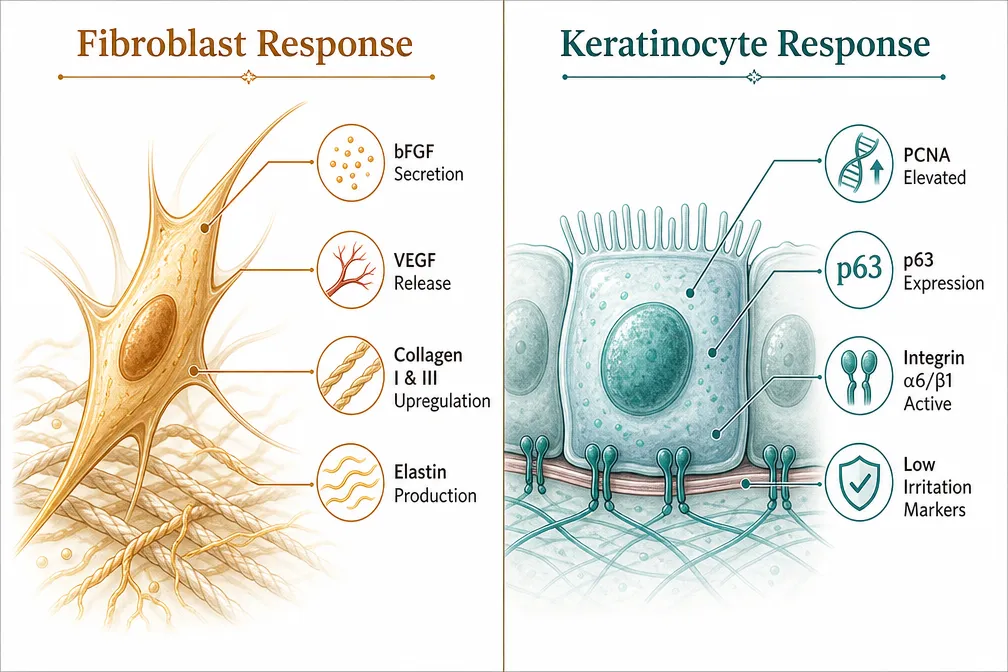
Copper-Dependent Matrix Remodeling: ECM Markers and Dose, Response Data

ECM components modulated by GHK-Cu in fibroblast models:

ECM Component Direction of Change Concentration Range
Type I collagen Increased ~10⁻⁹ M peak
Type III collagen Increased Low nanomolar
Dermatan sulfate Increased 1-10 nM optimal
Heparan sulfate Increased 1-10 nM optimal
Hyaluronic acid No significant change Across tested range
Decorin (small proteoglycan) Increased Low nanomolar

The selectivity is notable. GHK-Cu raises dermatan sulfate and heparan sulfate, both critical for growth factor binding and basement membrane organization, while leaving hyaluronic acid largely unaffected. This suggests a targeted remodeling effect rather than a broad ECM upregulation.

MMP and TIMP balance is equally important. GHK-Cu modulates the ratio between matrix-degrading MMPs and their inhibitors, resulting in net ECM accumulation rather than excess degradation. In irradiated fibroblast cultures, the peptide also accelerates proliferation and elevates early secretion of bFGF and VEGF, supporting post-radiation matrix rebuilding. This positions GHK-Cu as a matrix remodeler rather than simply a matrix builder.

"The distinction between ECM accumulation and ECM quality matters for translational research: more collagen is not always better collagen."

Researchers interested in broader peptide benchmarking frameworks can find useful methodology context in Bachem and reference standards for peptide benchmarks.


Fibroblast, Keratinocyte Crosstalk in Research Models

Understanding what is GHK-Cu in the context of copper-dependent matrix remodeling and fibroblast, keratinocyte crosstalk in research models requires examining both cell types together, not in isolation.
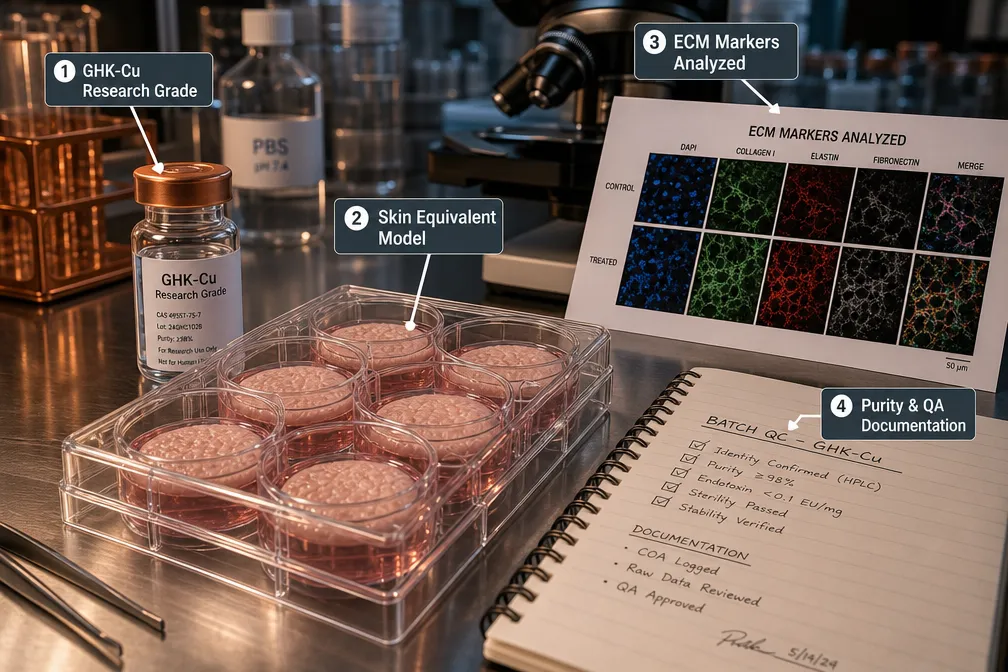
Fibroblast, Keratinocyte Crosstalk in Research Models

Fibroblast responses (summarized):

  • Accelerated proliferation in normal and irradiated dermal fibroblasts
  • Elevated bFGF and VEGF secretion in early culture phases
  • Increased type I and III collagen and elastin production
  • Shifted MMP/TIMP balance favoring matrix accumulation

Keratinocyte responses (summarized):

  • Increased proliferating cell nuclear antigen (PCNA) at 0.1-10 μM
  • Elevated p63 expression, a transcription factor linked to basal-cell stemness
  • Upregulation of integrins α6 and β1 in basal keratinocytes
  • Low pro-inflammatory cytokine burden compared with inorganic copper salts

In combined skin-equivalent models, these two response profiles appear to reinforce each other. GHK-Cu-driven fibroblast activity deposits a richer ECM scaffold, and that improved basement membrane organization, with higher heparan sulfate and decorin, supports the integrin signaling that keratinocytes use to maintain stemness and proliferative capacity. This is the fibroblast, keratinocyte crosstalk loop: matrix composition shapes keratinocyte behavior, and keratinocyte-derived signals feed back to fibroblast activity.

Critically, this crosstalk effect does not appear with inorganic copper salts at comparable concentrations. Copper chloride and copper acetate raise IL-1α and IL-8, disrupting the signaling environment rather than enhancing it. The peptide-bound delivery form is essential.

Outside the skin, a 2025 experimental colitis model found that GHK-Cu reduced inflammatory damage and supported mucosal repair, suggesting these copper-mediated repair mechanisms extend to other epithelial-stromal interfaces beyond dermal tissue.

For context on how other repair-focused peptides are evaluated in research settings, the BPC-157 core peptides documentation and first research guide offers a useful methodological parallel. Researchers also exploring oxidative stress pathways alongside GHK-Cu may find value in reviewing wound healing tag resources for experimental design frameworks.


Evidence Quality, Safety Controls, and Research Limitations

As of 2026, the preponderance of GHK-Cu data comes from in vitro fibroblast and keratinocyte cultures, skin-equivalent models, and animal studies. Small human or quasi-clinical studies report improvements in wrinkle depth and skin texture, but these typically use surrogate endpoints, modest sample sizes, and short follow-up periods.

Current evidence gaps identified in 2026 systematic reviews:

  • Limited reporting of culture replication counts and randomization
  • Absence of long-term in vivo ECM histology metrics
  • Lack of standardized human trials with defined copper exposure levels
  • Few studies directly measuring lysyl oxidase activity as a mechanistic endpoint

On safety, GHK-Cu is generally non-cytotoxic in keratinocyte cultures at tested concentrations and does not markedly raise pro-inflammatory cytokines. However, long-term systemic safety in humans remains insufficiently characterized. Regulatory authorities as of 2026 treat it primarily as a cosmetic ingredient (labeled copper tripeptide-1) or research compound, not a systemically approved drug.

Researchers sourcing GHK-Cu for in vitro work can find catalogued material at GHK-Cu for sale research product listings.


Conclusion

GHK-Cu is a mechanistically rich metallopeptide whose activity depends on intact copper complexation, appropriate concentration ranges, and intact fibroblast, keratinocyte crosstalk conditions. The research to date establishes a coherent model: copper delivery activates lysyl oxidase and shifts MMP/TIMP balance, selectively raising dermatan sulfate and heparan sulfate, which in turn supports the integrin and p63 signaling that maintains keratinocyte stemness. That cascade is the mechanistic story beneath the collagen headline.

Actionable next steps for researchers:

  1. Verify peptide, copper complex integrity and purity before designing cell-culture experiments.
  2. Use concentration ranges consistent with published dose, response data (picomolar to low micromolar) and include inorganic copper controls.
  3. Measure both fibroblast ECM markers (collagen types, GAG fractions, MMP/TIMP ratios) and keratinocyte stemness markers (PCNA, p63, integrins α6/β1) in the same skin-equivalent model.
  4. Report full culture counts, randomization methods, and cytokine safety panels alongside efficacy endpoints.
  5. Interpret translational claims cautiously until standardized human trials with histologic outcomes are published.
https://www.puretestedpeptides.com/wp-content/uploads/2026/11/what-is-ghk-cu-copper-dependent-matrix-remodeling-and-fibroblast-keratinocyte-cr.webp 672 1008 https://www.puretestedpeptides.com/wp-content/uploads/2026/01/buy-peptides-online.jpg 2026-11-02 14:10:282026-11-02 14:10:28What Is GHK-Cu? Copper-Dependent Matrix Remodeling and Fibroblast, Keratinocyte Crosstalk in Research Models
×

Helpful Links

  • My account
  • Cart
  • Checkout
  • Refund and Returns Policy
  • Privacy Policy
  • SMS Privacy Policy
  • Login
  • My Account
  • Logout

USA Made Lab Tested Peptides

All products are sold for research, laboratory, or analytical purposes only, and are not for human consumption


Pure Tested Peptides is a chemical supplier. Pure Tested Peptides is not a compounding / chemical compounding facility as defined under 503A of the Federal Food, Drug, and Cosmetic act. Pure Tested Peptides is not an outsourcing facility as defined under 503B of the Federal Food, Drug, and Cosmetic act.

The statements made within this website have not been evaluated by the US Food and Drug Administration. The products we offer are not intended to diagnose, treat, cure or prevent any disease.

Human/Animal Consumption Prohibited. Laboratory/In-Vitro Experimental Use Only

Scroll to top Scroll to top Scroll to top