Call or Text 727-513-9780
  • Shopping Cart Shopping Cart
    0Shopping Cart
Pure Tested Peptides | America's most trusted Peptides for sale online
  • Peptides for sale
    • Oral Peptides for sale
      • Peptide Capsules for sale
      • BPC 157 Capsules 1000mcg
      • SLU-PP-332 Capsules | 1000 mcg
      • 5-Amino-1MQ 50mg Capsules
      • Tesofensine 500mcg
    • All Peptides for sale
    • Peptide Sprays
      • BPC 157 Nasal Spray Kit
      • BPC-157 TB500 Nasal Spray Kit
      • Semax Nasal Spray 10mg
      • Selank – Nasal Spray Kit – 10mg
      • Epithalon 50MG Nasal Spray Kit
      • Ipamorelin 10mg Nasal Spray
      • Klow Nasal Spray (BPC-157 + TB-500 + GHK-Cu + KPV) | 80mg
      • Hulk Nasal Spray Tesa / Ipa Blend 6/3 MG
      • Klow Nasal Spray
      • NAD + 500 mg Nasal Spray
      • PT-141 Nasal Spray Kit
    • GHRH Peptides
      • Ipa Peptides
      • CJC-1295 Peptides
        • CJC-1295 with DAC 5 mg
        • CJC-1295 without DAC 5 mg
        • CJC-1295 Ipa 10mg
      • Tesa Peptides
        • Tesa Peptide
        • Tesa 20 mg
    • GHK-Cu Peptides
      • All GHK-Cu Peptides
      • GHK-Cu 100mg
      • KLOW Peptide Blend – Buy KLOW blend online
    • BPC Peptides
      • All BPC Peptides
      • BPC-157
      • BPC-157 TB-500
      • BPC 157 capsules 1000mcg
    • SLU-PP-332 Peptides
      • All SLU-PP-332 Peptides
      • SLU-PP-332 5mg
    • GLP3 Peptides
    • PT-141 Peptides
      • PT-141 Peptides for sale
      • PT-141 10mg
      • PT-141 Nasal Spray
    • CAG Peptides
      • Lipo-C Peptide Blend
      • CAG 5mg
      • CAG 10mg
    • MOTS-C Peptides
      • MOTS-C Peptides for sale
      • MOTS-c peptide
      • MOTS-c 10mg *6 pack*
    • 5 Amino 1MQ Peptides
      • 5 Amino 1MQ Peptides for sale
      • 5-Amino-1MQ 50mg Capsules
      • 5-Amino-1MQ 5mg
    • Epithalon Peptides
      • Epithalon Peptides for sale
      • Epithalon 10mg
      • Epithalon 50mg
  • Shop
    • GLPs
      • 5-Amino-1MQ 50mg Capsules
      • 5-Amino-1MQ 5mg
      • L-Carnitine 500mg/ml
      • Tesofensine 500mcg
      • SLU-PP-332 5mg
      • MOTS-c 10mg *6 pack*
    • Epithalon & BPC Peptides
      • Epithalon 10mg
      • Epithalon 50mg
      • BPC-157
      • BPC 157 capsules 1000mcg
      • BPC-157 TB-500
      • BPC-157 TB500 Nasal Spray Kit
      • BPC 157 Nasal Spray Kit
    • BPC TB-500 & NAD+ Peptides
      • NAD+ 500 mg
      • KLOW Peptide Blend – Buy KLOW blend online
      • GLOW Peptide Blend
      • TB 500 5mg
      • BPC 157 capsules 1000mcg – Supplement
      • BPC 157 Nasal Spray Kit
      • BPC-157
      • BPC-157 TB500 Nasal Spray Kit
      • BPC-157 TB-500
      • BPC 157 capsules 1000mcg
    • LL-37 Peptide
      • LL-37 10 mg
    • MOTS-C & Selank
      • MOTS-c peptide
      • Selank 10mg
    • GHK Peptides
      • GHK-Cu 100mg
      • GLOW Peptide Blend
      • KLOW Peptide Blend – Buy KLOW blend online
  • COAs
  • Wholesale
    • Wholesale Peptides for sale
  • PTP FAQ
  • Affiliates
    • Selank Peptide: Advanced Pharmacological Mechanisms Underlying Its Anxiolytic and Nootropic Effects in Research
      • 5-Amino-1MQ Peptide: Detailed Mechanisms of NNMT Inhibition and Its Impact on Cellular Metabolism Research
        • MOTS-C Peptide: Unraveling Its Role in Mitochondrial Dynamics and Energy Metabolism Research
          • Epithalon Peptide and Telomerase Regulation: Investigating Its Impact on Cellular Senescence and Lifespan Research Models
            • GLP2-T vs GLP2 Tirz Peptide: Understanding the Naming, Mechanistic Nuances, and Research Implications for Gut Health
      • Peptides and Polypeptides in Modern Pharmacology: What Research on Metoprolol, Prednisone, and Amlodipine Reveals
        • Polypeptide Peptides vs NSAIDs: What Naproxen and Diclofenac Teach Tissue-Repair Researchers About BPC‑157 and TB‑500
          • Peptides and Polypeptides in Endocrine Pharmacology: How GLP-1, GLP-2, and GLP-3 Retatrutide Differ From Classic Drugs Like Prednisone and Amlodipine
          • 5‑Amino‑1MQ Peptide and NNMT Inhibition: How It Compares With Statins Like Atorvastatin in Adipose and Lipid Metabolism Research
      • Enclomiphene, Estrogen Receptor Signaling, and Luteinizing Phase Biology: What Hormone Researchers Should Measure
        • Mesenchymal Stem Cells, BPC‑157, and GHK‑Cu: How Tissue Repair Peptides Compare With Classic NSAIDs Like Naproxen in Injury Models
          • Peptide Calculator Use Cases Beyond Growth Hormone: Working Through GLP‑3 Retatrutide, MOTS‑c, and BPC‑157 Research Dosing
        • Polypeptide Peptides in Endocrine and Metabolic Pharmacology: Lessons From Amlodipine, Prednisone, and Metoprolol
        • Peptides Calculator for Advanced Blends: Worked Examples for Tesamorelin, CJC‑1295, and Ipamorelin Stacks
          • Peptides and Polypeptides in Human Physiology: How Molecular Size Shapes Research Applications
            • Selank Peptide: Advanced Pharmacological Mechanisms Underlying Its Anxiolytic and Nootropic Effects in Research
          • 5-Amino-1MQ Peptide: Detailed Mechanisms of NNMT Inhibition and Its Impact on Cellular Metabolism Research
            • MOTS-C Peptide: Unraveling Its Role in Mitochondrial Dynamics and Energy Metabolism Research
              • Epithalon Peptide and Telomerase Regulation: Investigating Its Impact on Cellular Senescence and Lifespan Research Models
                • GLP2-T vs GLP2 Tirz Peptide: Understanding the Naming, Mechanistic Nuances, and Research Implications for Gut Health
                  • Peptides and Polypeptides in Endocrine Pharmacology: How GLP-1, GLP-2, and GLP-3 Retatrutide Differ From Classic Drugs Like Prednisone and Amlodipine
                    • Polypeptide Peptides vs NSAIDs: What Naproxen and Diclofenac Teach Tissue-Repair Researchers About BPC‑157 and TB‑500
                      • Peptides and Polypeptides in Modern Pharmacology: What Research on Metoprolol, Prednisone, and Amlodipine Reveals
                        • 5‑Amino‑1MQ Peptide and NNMT Inhibition: How It Compares With Statins Like Atorvastatin in Adipose and Lipid Metabolism Research
                        • Enclomiphene, Estrogen Receptor Signaling, and Luteinizing Phase Biology: What Hormone Researchers Should Measure
                        • Mesenchymal Stem Cells, BPC‑157, and GHK‑Cu: How Tissue Repair Peptides Compare With Classic NSAIDs Like Naproxen in Injury Models
                        • Peptide Calculator Use Cases Beyond Growth Hormone: Working Through GLP‑3 Retatrutide, MOTS‑c, and BPC‑157 Research Dosing
                        • Polypeptide Peptides in Endocrine and Metabolic Pharmacology: Lessons From Amlodipine, Prednisone, and Metoprolol
                        • Peptides Calculator for Advanced Blends: Worked Examples for Tesamorelin, CJC‑1295, and Ipamorelin Stacks
                        • Peptides and Polypeptides in Human Physiology: How Molecular Size Shapes Research Applications
                        • Selank Peptide: Advanced Pharmacological Mechanisms Underlying Its Anxiolytic and Nootropic Effects in Research
                        • MOTS-C Peptide: Unraveling Its Role in Mitochondrial Dynamics and Energy Metabolism Research
                        • Peptides and Polypeptides in Modern Pharmacology: What Research on Metoprolol, Prednisone, and Amlodipine Reveals
                        • Peptides and Polypeptides in Endocrine Pharmacology: How GLP-1, GLP-2, and GLP-3 Retatrutide Differ From Classic Drugs Like Prednisone and Amlodipine
                        • 5-Amino-1MQ Peptide: Detailed Mechanisms of NNMT Inhibition and Its Impact on Cellular Metabolism Research
                        • Mesenchymal Stem Cells, BPC‑157, and GHK‑Cu: How Tissue Repair Peptides Compare With Classic NSAIDs Like Naproxen in Injury Models
                        • Peptide Calculator Use Cases Beyond Growth Hormone: Working Through GLP‑3 Retatrutide, MOTS‑c, and BPC‑157 Research Dosing
                        • GLP2-T vs GLP2 Tirz Peptide: Understanding the Naming, Mechanistic Nuances, and Research Implications for Gut Health
                        • Polypeptide Peptides in Endocrine and Metabolic Pharmacology: Lessons From Amlodipine, Prednisone, and Metoprolol
                        • Polypeptide Peptides vs NSAIDs: What Naproxen and Diclofenac Teach Tissue-Repair Researchers About BPC‑157 and TB‑500
                        • Peptides and Polypeptides in Human Physiology: How Molecular Size Shapes Research Applications
                        • Peptides Calculator for Advanced Blends: Worked Examples for Tesamorelin, CJC‑1295, and Ipamorelin Stacks
                        • 5‑Amino‑1MQ Peptide and NNMT Inhibition: How It Compares With Statins Like Atorvastatin in Adipose and Lipid Metabolism Research
                        • Enclomiphene, Estrogen Receptor Signaling, and Luteinizing Phase Biology: What Hormone Researchers Should Measure
                        • Epithalon Peptide and Telomerase Regulation: Investigating Its Impact on Cellular Senescence and Lifespan Research Models
                        • Best research protocol Klow blend
                        • best time to take BPC-157
                        • best time to take DSIP (Delta Sleep Inducing Peptide)
                        • best time to take CJC-1295
                        • best time to take AOD-9604
                        • best time to take Follistatin 344
                        • best time to take Ipamorelin
                        • best time to take MK-677 (Ibutamoren)
                        • best time to take Ligandrol (LGD-4033) — research compound
                        • best time to take Ostarine (MK-2866) — research compound
                        • best time to take GHK-CU
                        • best time to take TB-500
                        • best time to take MOTS-c
                        • best time to take Semax
                        • best time to take RAD-140 (Testolone) — research compound
                        • best time to take Thymosin Alpha-1
                        • best time to take PEG-MGF
                        • Biolife Plasma, Octapharma Plasma, and Research Peptides: How Plasma Donation Labs Differ From Peptide Suppliers
                        • best time to take YK-11 — research compound
                        • best time to take PT-141 (Bremelanotide)
                        • Best research protocol Klow blend
                        • 5-Amino-1MQ and MOTS-C Synergy: Metabolic Signaling, Mitochondria, and Research Design
                        • BPC-157 and TB-500: Investigating Their Combined Effects on Angiogenesis and Cellular Migration in Tissue Repair Models
                        • BPC-157 Peptide: Gut Barrier Function, Inflammation, and Tissue-Recovery Research
                        • 5‑Amino‑1MQ and MOTS‑c Synergy in Metabolic Research: Designing NNMT and Mitochondrial Biogenesis Stacks
                        • CJC-1295 with DAC vs. Without DAC: Half-Life, Release Kinetics, and Research Implications
                        • CJC‑1295 with DAC vs. Without DAC: Expanding on Half‑Life Differences Using Tesamorelin and Ipamorelin Blend Case Studies
                        • Collagen Biology and Copper‑Binding Peptides: How GHK‑Cu, Glow Blend, and Klow Blend Interact with Skin and Connective Tissue
                        • Collagen Biology and Regenerative Peptides: How GHK‑Cu, Glow Blend, and Klow Blend Affect Extracellular Matrix Research
                    • DNA, Telomeres, and Longevity Peptides: Positioning Epithalon and MOTS‑c in Genetic Aging Research
                      • Enclomiphene Citrate: serm Mechanism, Testosterone Research, and Stack Compatibility
                        • Enclomiphene vs Enclomiphene Citrate: Formulation, Bioavailability, and Research Distinctions
                        • Epithalon Peptide Research: Telomerase Activation, Aging, and Pineal Gland Function
                        • Estrogen Receptor Signaling and Enclomiphene: How Selective Modulators Compare with Classic Polypeptide Hormones
                        • GHK-Cu Peptide: Advanced Mechanisms in Extracellular Matrix Remodeling and Wound Healing Research
                        • GHK-Cu Peptide: Collagen Synthesis, Wound Repair, and Skin-Barrier Research Models
                        • GLP-1 vs GLP-3 vs GLP-2: Peptide Classification and Research Applications
                        • GLP-2 Peptide Research Guide: Gut Barrier Function, Nutrient Absorption, and Intestinal Recovery Models
                        • GLP-3 Retatrutide vs. GLP-1 Drugs: What Triple-Agonist Biology Changes in Research Models
                        • Ipamorelin and Tesamorelin Combination: Synergistic GH Secretagogue Research and Dosing Protocols
                        • GLP2 Tirz Peptide: What It Is, Why the Name Exists, and How Researchers Should Interpret It
                        • Klow Blend Peptide Nasal Spray: What the Formulation Is Trying to Do in Cognitive Research
                        • Mitochondria, NNMT Inhibition, and Peptide Modulators: Where MOTS‑c and 5‑Amino‑1MQ Fit in Cellular Energy Research
                        • MOTS-c Peptide: Mitochondrial Function, Energy Metabolism, and What Researchers Measure
                        • MOTS-c vs. 5-Amino-1MQ: Which Metabolic Research Questions Each Compound Actually Answers
                        • Nasal Spray Peptides: Bioavailability, Administration, and Semax/Selank Research Applications
                        • PT-141 Peptide Research: Mechanism of Action and Melanocortin Receptor Signaling
                        • Retatrutide for Research: Mechanism, Structure, and GLP-1/GLP-3 Dual Action
                        • Retatrutide for Obesity and Type 2 Diabetes: What the Latest Trial Data Suggest
                        • Tesofensine Peptide Research: Mechanism, Appetite Suppression, and Neuropeptide Y Pathways
  • Contact
    • Contact Customer Service
    • Text Customer Support
  • About US
  • Shop all peptides
  • Affiliate Program
    • Affiliate Signup
  • Login / Register Login / Register Page Link Login / Register Page Link
  • Click to open the search input field Click to open the search input field Search
  • Menu Menu

Tag Archive for: food intake experiments

GLP-Class Peptides and Omeprazole: How Acid Suppression Can Alter Exposure, Intake, and Gastric-Emptying Experiments

GLP-Class Peptides and Omeprazole: How Acid Suppression Can Alter Exposure, Intake, and Gastric-Emptying Experiments

October 16, 2026/0 Comments/in Uncategorized/by

Proton pump inhibitors are among the most prescribed drugs worldwide, yet their interaction with GLP-class peptide research is rarely discussed in experimental design guides. When researchers combine GLP-class peptides and omeprazole, whether intentionally or as a background medication in a subject, acid suppression can quietly reshape gastric pH, slow motility, and distort the very endpoints the experiment was designed to measure. Understanding these interactions is not optional; it is a prerequisite for valid data.

Key Takeaways

  • Omeprazole raises intragastric pH, which can alter the stability, absorption, and bioavailability of orally administered GLP-class peptides.
  • GLP-1 and related peptides independently slow gastric emptying, and combining them with a PPI can compound motility delays in ways that confound pharmacokinetic readouts.
  • Food intake and nutrient-sensing endpoints are sensitive to gastric acid status, meaning PPI co-administration introduces a second variable that must be controlled.
  • Experiments measuring gastric emptying half-life must account for both the peptide effect and the omeprazole effect separately.
  • Robust study designs require dedicated vehicle-plus-PPI control groups to isolate true peptide activity from acid-suppression artifacts.

The Gastric Physiology Behind GLP-Class Peptides and Omeprazole
The Gastric Physiology Behind GLP-Class Peptides and Omeprazole

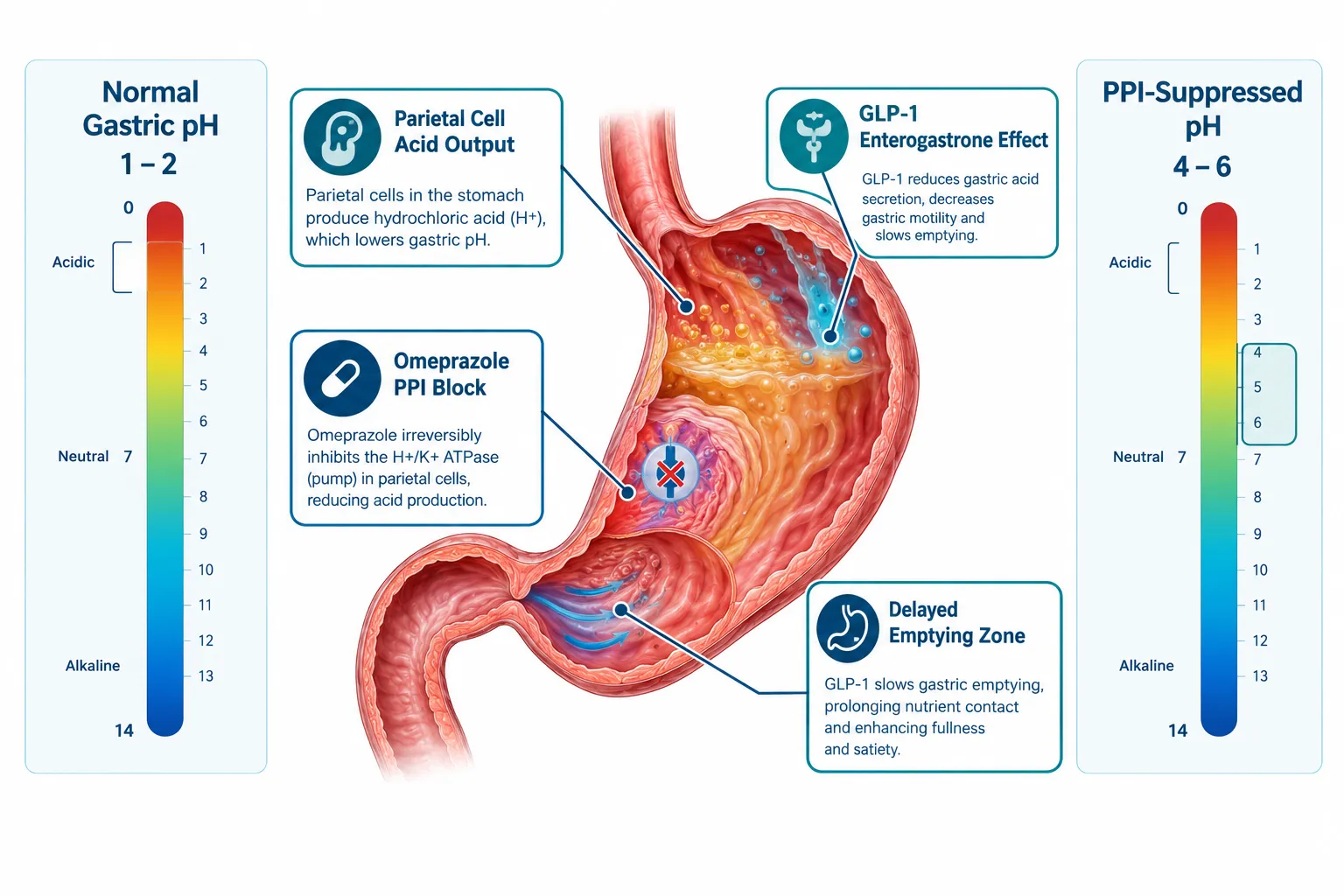
GLP-1 (glucagon-like peptide-1) and its structural relatives act as natural enterogastrones, hormones released from intestinal L-cells that suppress gastric acid secretion and slow gastric motility. This dual action is mediated through both vagal neural pathways and direct receptor signaling on parietal cells and smooth muscle. The result is a coordinated brake on gastric output that evolved to pace nutrient delivery into the small intestine.

Omeprazole works through an entirely different mechanism. As a proton pump inhibitor, it irreversibly blocks the H+/K+-ATPase enzyme on parietal cells, raising intragastric pH from the normal range of 1-2 up to 4-6 or higher. This pH shift has consequences far beyond acid reduction:

  • Peptide stability: Many peptides are acid-labile or protease-sensitive at specific pH ranges. Raising gastric pH changes the degradation environment for any orally administered compound.
  • Nutrient sensing: Gastric acid is a key trigger for cholecystokinin and secretin release. Suppress acid, and the entire upper GI hormonal cascade shifts, including signals that interact with GLP-receptor pathways.
  • Motility: Acid itself participates in feedback loops that govern antral contractions. PPI-induced acid suppression can independently slow gastric emptying, separate from any peptide effect.

When studying GLP-3 peptides or related analogs, this background physiology matters enormously. The peptide is not operating in a neutral gastric environment; it is operating in one already modified by the PPI.


How Omeprazole Confounds GLP-Class Peptide Exposure and Intake Experiments

The phrase "GLP-class peptides and omeprazole: how acid suppression can alter exposure, intake, and gastric-emptying experiments" captures a real and underappreciated methodological problem. Consider a standard food intake study where a GLP-1 receptor agonist is expected to reduce caloric consumption. If subjects or animals are also receiving omeprazole, the following confounders enter the data:

1. Altered peptide bioavailability
Oral peptide formulations depend on predictable gastric conditions for controlled release. A pH shift from omeprazole changes dissolution kinetics, potentially increasing or decreasing systemic exposure independent of the peptide's own pharmacology.

2. Independent appetite suppression via acid-suppression pathways
Reduced gastric acid alters ghrelin secretion patterns. Ghrelin, the primary hunger-stimulating hormone, is produced in the gastric fundus and its release is modulated by intragastric pH. Omeprazole-driven pH elevation can suppress ghrelin independently, creating a false signal of enhanced GLP-mediated appetite reduction.

3. Compounded gastric emptying delay
A 2026 systematic review confirmed that GLP-1 agonists prolong gastric emptying half-life by approximately 74 minutes on average. Omeprazole adds its own motility-slowing effect on top of this. In a combined scenario, gastric emptying delay becomes the sum of two independent mechanisms, making it impossible to attribute the observed delay to the peptide alone without proper controls.

Researchers exploring GLP peptides for research applications must account for these layered effects when designing protocols.

"The failure to separate vehicle effects, acid-suppression effects, and peptide effects in a single experimental arm is one of the most common sources of irreproducible GLP-related data."


Designing Controls That Separate Acid Suppression From Peptide Activity
Designing Controls That Separate Acid Suppression From Peptide Activity

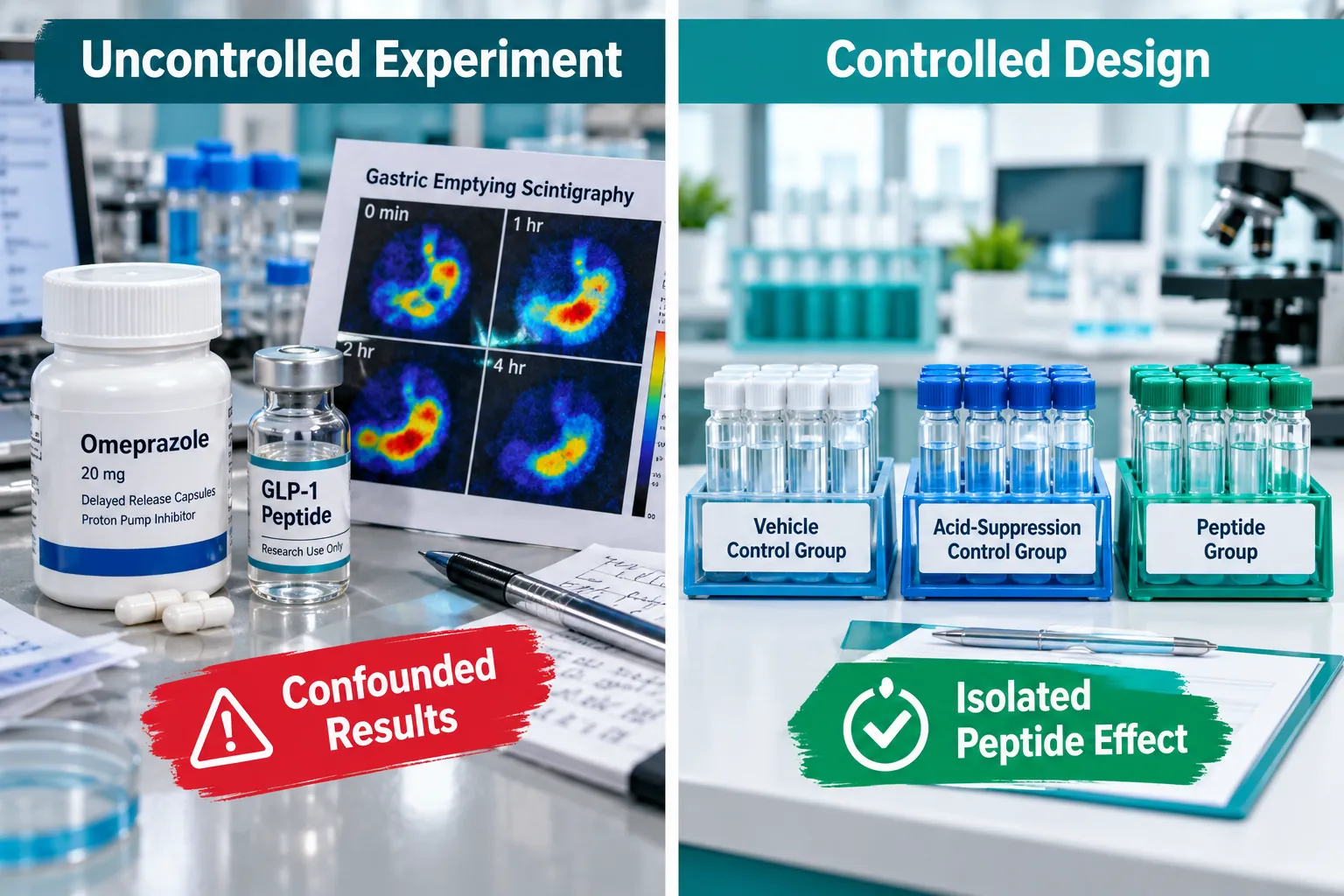
The solution to omeprazole-driven confounding is not to avoid PPIs, in many clinical or translational settings, co-administration is unavoidable. The solution is rigorous control group architecture.

Minimum required control groups for a GLP-peptide gastric emptying study with PPI background:

Group Treatment Purpose
Vehicle only Saline or carrier, no PPI True baseline
PPI only Omeprazole at study dose Isolates acid-suppression effect
Peptide + vehicle GLP analog, no PPI Isolates peptide effect
Peptide + PPI Full combination Measures interaction

This four-arm design allows researchers to calculate the additive versus synergistic contribution of each agent to the observed endpoints. Without the PPI-only arm, any motility or intake change in the combination group cannot be cleanly attributed.

For experiments involving GLP-3 RT peptide formulations or nasal delivery routes, the acid-suppression concern shifts but does not disappear. Systemically absorbed peptides still encounter a GI tract altered by omeprazole, affecting downstream nutrient sensing and motility feedback even when the peptide bypasses gastric degradation entirely.

Additional design considerations:

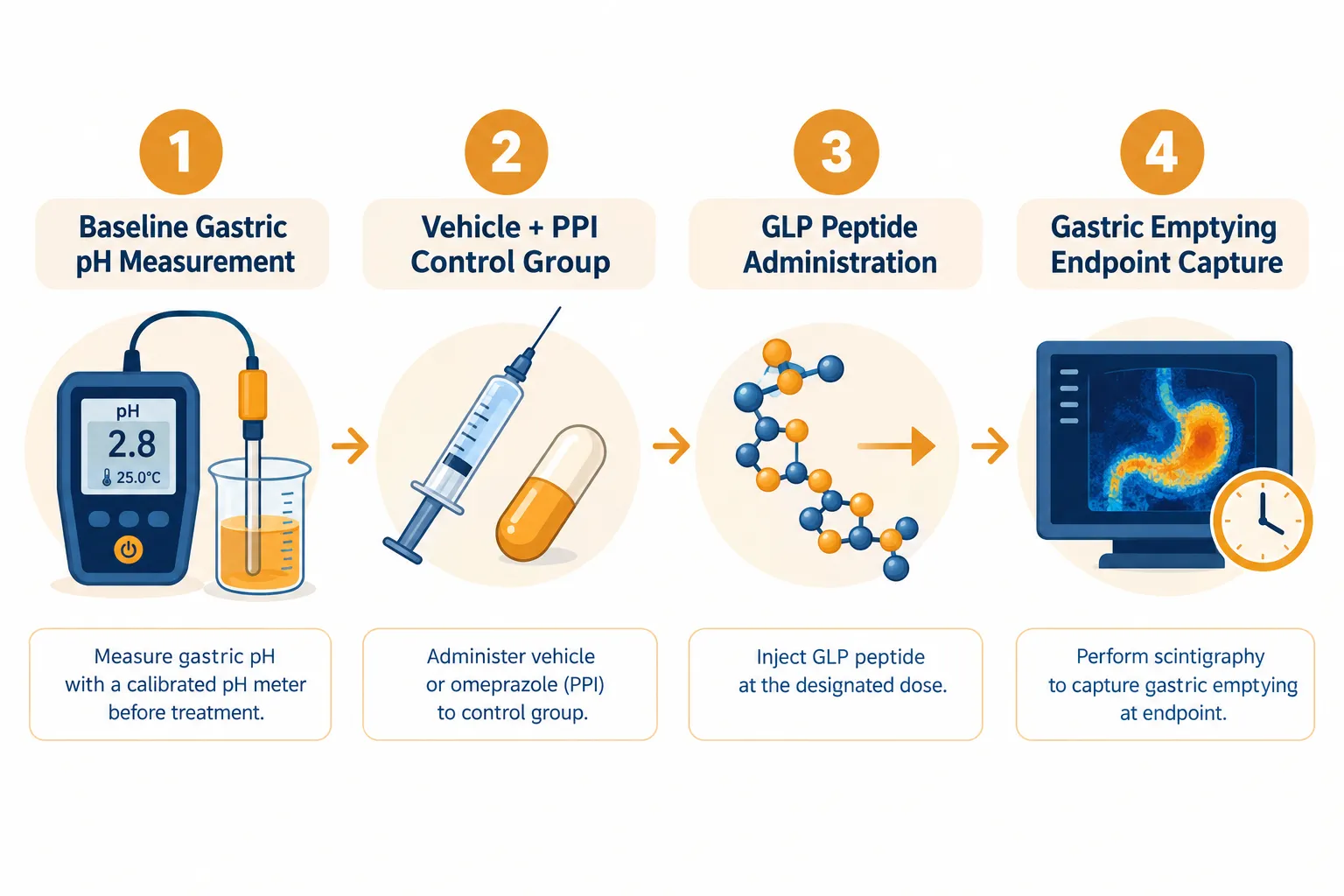
  • Measure intragastric pH directly at baseline and post-PPI to confirm the degree of acid suppression achieved.
  • Use scintigraphy or the acetaminophen absorption method to quantify gastric emptying half-life independently for each arm.
  • Time blood draws for peptide pharmacokinetics relative to gastric emptying status, not just clock time post-dose.
  • In rodent models, note that omeprazole dosing required to achieve human-equivalent acid suppression is substantially higher per kilogram, an underdosed PPI arm produces incomplete suppression and noisy data.

Researchers sourcing compounds for these studies can explore GLP-3 peptide for sale options alongside appropriate vehicle and control materials. Those running multi-compound protocols may also find wholesale peptides for sale resources useful for consistent lot-to-lot supply.


Practical Implications for Translational and Clinical Research
Practical Implications for Translational and Clinical Research

The translational stakes of this issue are significant. Tirzepatide and other dual GLP-1/GIP receptor agonists show dose- and time-dependent effects on gastric emptying that evolve over weeks of repeated dosing. If a clinical pharmacokinetic study enrolls participants who are chronic PPI users, a common scenario given PPI prevalence, the gastric emptying baseline is already shifted before the peptide is introduced.

Peri-procedural gastroenterology guidance issued in 2026 highlights retained gastric contents as a safety concern with GLP-1 receptor agonists, particularly before endoscopy. Omeprazole co-administration does not resolve this risk and may extend it. Any protocol that monitors gastric residual volume as a safety endpoint must treat PPI use as a stratification variable, not a nuisance covariate.

For those investigating appetite-related endpoints alongside gastric physiology, understanding what the strongest peptide for weight loss research involves requires this same level of mechanistic clarity. Acid suppression is a background variable that can masquerade as peptide efficacy or attenuate it, depending on the direction of its effect on the specific endpoint measured.

It is worth noting that direct pharmacokinetic interaction trials specifically pairing GLP-class peptides with omeprazole remain limited in the published literature as of 2026. The mechanistic case for interaction is strong, but researchers should treat specific magnitude estimates as provisional until dedicated trials report. This gap itself represents a meaningful research opportunity.


Conclusion

GLP-class peptides and omeprazole represent a physiologically active combination that demands explicit attention in experimental design. Acid suppression alters gastric pH, modifies peptide stability, shifts hunger-hormone baselines, and adds an independent layer of motility delay on top of the peptide's own gastric-emptying effects. The result, in an uncontrolled study, is data that cannot cleanly attribute observed changes to the peptide under investigation.

Actionable next steps for researchers:

  1. Audit existing protocols for PPI co-administration, whether intentional or as a background medication in enrolled subjects.
  2. Add a dedicated PPI-only control arm to any gastric emptying, food intake, or oral bioavailability study involving GLP-class peptides.
  3. Measure intragastric pH directly rather than assuming omeprazole achieves a standard suppression level across all subjects.
  4. Pre-stratify clinical study participants by PPI use status before randomization.
  5. Treat the GLP-peptide-plus-omeprazole interaction as an open research question and design studies that generate, rather than obscure, mechanistic data on this pairing.

Clean data in this field requires acknowledging that the stomach is not a passive container. It is an active participant in every GLP-related endpoint being measured.

https://www.puretestedpeptides.com/wp-content/uploads/2026/10/glp-class-peptides-and-omeprazole-how-acid-suppression-can-alter-exposure-intake.webp 1024 1536 https://www.puretestedpeptides.com/wp-content/uploads/2026/01/buy-peptides-online.jpg 2026-10-16 13:04:352026-10-16 13:04:35GLP-Class Peptides and Omeprazole: How Acid Suppression Can Alter Exposure, Intake, and Gastric-Emptying Experiments
×

Helpful Links

  • My account
  • Cart
  • Checkout
  • Refund and Returns Policy
  • Privacy Policy
  • SMS Privacy Policy
  • Login
  • My Account
  • Logout

USA Made Lab Tested Peptides

All products are sold for research, laboratory, or analytical purposes only, and are not for human consumption


Pure Tested Peptides is a chemical supplier. Pure Tested Peptides is not a compounding / chemical compounding facility as defined under 503A of the Federal Food, Drug, and Cosmetic act. Pure Tested Peptides is not an outsourcing facility as defined under 503B of the Federal Food, Drug, and Cosmetic act.

The statements made within this website have not been evaluated by the US Food and Drug Administration. The products we offer are not intended to diagnose, treat, cure or prevent any disease.

Human/Animal Consumption Prohibited. Laboratory/In-Vitro Experimental Use Only

Scroll to top Scroll to top Scroll to top