Call or Text 727-513-9780
  • Shopping Cart Shopping Cart
    0Shopping Cart
Pure Tested Peptides | America's most trusted Peptides for sale online
  • Peptides for sale
    • Oral Peptides for sale
      • Peptide Capsules for sale
      • BPC 157 Capsules 1000mcg
      • SLU-PP-332 Capsules | 1000 mcg
      • 5-Amino-1MQ 50mg Capsules
      • Tesofensine 500mcg
    • All Peptides for sale
    • Peptide Sprays
      • BPC 157 Nasal Spray Kit
      • BPC-157 TB500 Nasal Spray Kit
      • Semax Nasal Spray 10mg
      • Selank – Nasal Spray Kit – 10mg
      • Epithalon 50MG Nasal Spray Kit
      • Ipamorelin 10mg Nasal Spray
      • Klow Nasal Spray (BPC-157 + TB-500 + GHK-Cu + KPV) | 80mg
      • Hulk Nasal Spray Tesa / Ipa Blend 6/3 MG
      • Klow Nasal Spray
      • NAD + 500 mg Nasal Spray
      • PT-141 Nasal Spray Kit
    • GHRH Peptides
      • Ipa Peptides
      • CJC-1295 Peptides
        • CJC-1295 with DAC 5 mg
        • CJC-1295 without DAC 5 mg
        • CJC-1295 Ipa 10mg
      • Tesa Peptides
        • Tesa Peptide
        • Tesa 20 mg
    • GHK-Cu Peptides
      • All GHK-Cu Peptides
      • GHK-Cu 100mg
      • KLOW Peptide Blend – Buy KLOW blend online
    • BPC Peptides
      • All BPC Peptides
      • BPC-157
      • BPC-157 TB-500
      • BPC 157 capsules 1000mcg
    • SLU-PP-332 Peptides
      • All SLU-PP-332 Peptides
      • SLU-PP-332 5mg
    • GLP3 Peptides
    • PT-141 Peptides
      • PT-141 Peptides for sale
      • PT-141 10mg
      • PT-141 Nasal Spray
    • CAG Peptides
      • Lipo-C Peptide Blend
      • CAG 5mg
      • CAG 10mg
    • MOTS-C Peptides
      • MOTS-C Peptides for sale
      • MOTS-c peptide
      • MOTS-c 10mg *6 pack*
    • 5 Amino 1MQ Peptides
      • 5 Amino 1MQ Peptides for sale
      • 5-Amino-1MQ 50mg Capsules
      • 5-Amino-1MQ 5mg
    • Epithalon Peptides
      • Epithalon Peptides for sale
      • Epithalon 10mg
      • Epithalon 50mg
  • Shop
    • GLPs
      • 5-Amino-1MQ 50mg Capsules
      • 5-Amino-1MQ 5mg
      • L-Carnitine 500mg/ml
      • Tesofensine 500mcg
      • SLU-PP-332 5mg
      • MOTS-c 10mg *6 pack*
    • Epithalon & BPC Peptides
      • Epithalon 10mg
      • Epithalon 50mg
      • BPC-157
      • BPC 157 capsules 1000mcg
      • BPC-157 TB-500
      • BPC-157 TB500 Nasal Spray Kit
      • BPC 157 Nasal Spray Kit
    • BPC TB-500 & NAD+ Peptides
      • NAD+ 500 mg
      • KLOW Peptide Blend – Buy KLOW blend online
      • GLOW Peptide Blend
      • TB 500 5mg
      • BPC 157 capsules 1000mcg – Supplement
      • BPC 157 Nasal Spray Kit
      • BPC-157
      • BPC-157 TB500 Nasal Spray Kit
      • BPC-157 TB-500
      • BPC 157 capsules 1000mcg
    • LL-37 Peptide
      • LL-37 10 mg
    • MOTS-C & Selank
      • MOTS-c peptide
      • Selank 10mg
    • GHK Peptides
      • GHK-Cu 100mg
      • GLOW Peptide Blend
      • KLOW Peptide Blend – Buy KLOW blend online
  • COAs
  • Wholesale
    • Wholesale Peptides for sale
  • PTP FAQ
  • Affiliates
    • Selank Peptide: Advanced Pharmacological Mechanisms Underlying Its Anxiolytic and Nootropic Effects in Research
      • 5-Amino-1MQ Peptide: Detailed Mechanisms of NNMT Inhibition and Its Impact on Cellular Metabolism Research
        • MOTS-C Peptide: Unraveling Its Role in Mitochondrial Dynamics and Energy Metabolism Research
          • Epithalon Peptide and Telomerase Regulation: Investigating Its Impact on Cellular Senescence and Lifespan Research Models
            • GLP2-T vs GLP2 Tirz Peptide: Understanding the Naming, Mechanistic Nuances, and Research Implications for Gut Health
      • Peptides and Polypeptides in Modern Pharmacology: What Research on Metoprolol, Prednisone, and Amlodipine Reveals
        • Polypeptide Peptides vs NSAIDs: What Naproxen and Diclofenac Teach Tissue-Repair Researchers About BPC‑157 and TB‑500
          • Peptides and Polypeptides in Endocrine Pharmacology: How GLP-1, GLP-2, and GLP-3 Retatrutide Differ From Classic Drugs Like Prednisone and Amlodipine
          • 5‑Amino‑1MQ Peptide and NNMT Inhibition: How It Compares With Statins Like Atorvastatin in Adipose and Lipid Metabolism Research
      • Enclomiphene, Estrogen Receptor Signaling, and Luteinizing Phase Biology: What Hormone Researchers Should Measure
        • Mesenchymal Stem Cells, BPC‑157, and GHK‑Cu: How Tissue Repair Peptides Compare With Classic NSAIDs Like Naproxen in Injury Models
          • Peptide Calculator Use Cases Beyond Growth Hormone: Working Through GLP‑3 Retatrutide, MOTS‑c, and BPC‑157 Research Dosing
        • Polypeptide Peptides in Endocrine and Metabolic Pharmacology: Lessons From Amlodipine, Prednisone, and Metoprolol
        • Peptides Calculator for Advanced Blends: Worked Examples for Tesamorelin, CJC‑1295, and Ipamorelin Stacks
          • Peptides and Polypeptides in Human Physiology: How Molecular Size Shapes Research Applications
            • Selank Peptide: Advanced Pharmacological Mechanisms Underlying Its Anxiolytic and Nootropic Effects in Research
          • 5-Amino-1MQ Peptide: Detailed Mechanisms of NNMT Inhibition and Its Impact on Cellular Metabolism Research
            • MOTS-C Peptide: Unraveling Its Role in Mitochondrial Dynamics and Energy Metabolism Research
              • Epithalon Peptide and Telomerase Regulation: Investigating Its Impact on Cellular Senescence and Lifespan Research Models
                • GLP2-T vs GLP2 Tirz Peptide: Understanding the Naming, Mechanistic Nuances, and Research Implications for Gut Health
                  • Peptides and Polypeptides in Endocrine Pharmacology: How GLP-1, GLP-2, and GLP-3 Retatrutide Differ From Classic Drugs Like Prednisone and Amlodipine
                    • Polypeptide Peptides vs NSAIDs: What Naproxen and Diclofenac Teach Tissue-Repair Researchers About BPC‑157 and TB‑500
                      • Peptides and Polypeptides in Modern Pharmacology: What Research on Metoprolol, Prednisone, and Amlodipine Reveals
                        • 5‑Amino‑1MQ Peptide and NNMT Inhibition: How It Compares With Statins Like Atorvastatin in Adipose and Lipid Metabolism Research
                        • Enclomiphene, Estrogen Receptor Signaling, and Luteinizing Phase Biology: What Hormone Researchers Should Measure
                        • Mesenchymal Stem Cells, BPC‑157, and GHK‑Cu: How Tissue Repair Peptides Compare With Classic NSAIDs Like Naproxen in Injury Models
                        • Peptide Calculator Use Cases Beyond Growth Hormone: Working Through GLP‑3 Retatrutide, MOTS‑c, and BPC‑157 Research Dosing
                        • Polypeptide Peptides in Endocrine and Metabolic Pharmacology: Lessons From Amlodipine, Prednisone, and Metoprolol
                        • Peptides Calculator for Advanced Blends: Worked Examples for Tesamorelin, CJC‑1295, and Ipamorelin Stacks
                        • Peptides and Polypeptides in Human Physiology: How Molecular Size Shapes Research Applications
                        • Selank Peptide: Advanced Pharmacological Mechanisms Underlying Its Anxiolytic and Nootropic Effects in Research
                        • MOTS-C Peptide: Unraveling Its Role in Mitochondrial Dynamics and Energy Metabolism Research
                        • Peptides and Polypeptides in Modern Pharmacology: What Research on Metoprolol, Prednisone, and Amlodipine Reveals
                        • Peptides and Polypeptides in Endocrine Pharmacology: How GLP-1, GLP-2, and GLP-3 Retatrutide Differ From Classic Drugs Like Prednisone and Amlodipine
                        • 5-Amino-1MQ Peptide: Detailed Mechanisms of NNMT Inhibition and Its Impact on Cellular Metabolism Research
                        • Mesenchymal Stem Cells, BPC‑157, and GHK‑Cu: How Tissue Repair Peptides Compare With Classic NSAIDs Like Naproxen in Injury Models
                        • Peptide Calculator Use Cases Beyond Growth Hormone: Working Through GLP‑3 Retatrutide, MOTS‑c, and BPC‑157 Research Dosing
                        • GLP2-T vs GLP2 Tirz Peptide: Understanding the Naming, Mechanistic Nuances, and Research Implications for Gut Health
                        • Polypeptide Peptides in Endocrine and Metabolic Pharmacology: Lessons From Amlodipine, Prednisone, and Metoprolol
                        • Polypeptide Peptides vs NSAIDs: What Naproxen and Diclofenac Teach Tissue-Repair Researchers About BPC‑157 and TB‑500
                        • Peptides and Polypeptides in Human Physiology: How Molecular Size Shapes Research Applications
                        • Peptides Calculator for Advanced Blends: Worked Examples for Tesamorelin, CJC‑1295, and Ipamorelin Stacks
                        • 5‑Amino‑1MQ Peptide and NNMT Inhibition: How It Compares With Statins Like Atorvastatin in Adipose and Lipid Metabolism Research
                        • Enclomiphene, Estrogen Receptor Signaling, and Luteinizing Phase Biology: What Hormone Researchers Should Measure
                        • Epithalon Peptide and Telomerase Regulation: Investigating Its Impact on Cellular Senescence and Lifespan Research Models
                        • Best research protocol Klow blend
                        • best time to take BPC-157
                        • best time to take DSIP (Delta Sleep Inducing Peptide)
                        • best time to take CJC-1295
                        • best time to take AOD-9604
                        • best time to take Follistatin 344
                        • best time to take Ipamorelin
                        • best time to take MK-677 (Ibutamoren)
                        • best time to take Ligandrol (LGD-4033) — research compound
                        • best time to take Ostarine (MK-2866) — research compound
                        • best time to take GHK-CU
                        • best time to take TB-500
                        • best time to take MOTS-c
                        • best time to take Semax
                        • best time to take RAD-140 (Testolone) — research compound
                        • best time to take Thymosin Alpha-1
                        • best time to take PEG-MGF
                        • Biolife Plasma, Octapharma Plasma, and Research Peptides: How Plasma Donation Labs Differ From Peptide Suppliers
                        • best time to take YK-11 — research compound
                        • best time to take PT-141 (Bremelanotide)
                        • Best research protocol Klow blend
                        • 5-Amino-1MQ and MOTS-C Synergy: Metabolic Signaling, Mitochondria, and Research Design
                        • BPC-157 and TB-500: Investigating Their Combined Effects on Angiogenesis and Cellular Migration in Tissue Repair Models
                        • BPC-157 Peptide: Gut Barrier Function, Inflammation, and Tissue-Recovery Research
                        • 5‑Amino‑1MQ and MOTS‑c Synergy in Metabolic Research: Designing NNMT and Mitochondrial Biogenesis Stacks
                        • CJC-1295 with DAC vs. Without DAC: Half-Life, Release Kinetics, and Research Implications
                        • CJC‑1295 with DAC vs. Without DAC: Expanding on Half‑Life Differences Using Tesamorelin and Ipamorelin Blend Case Studies
                        • Collagen Biology and Copper‑Binding Peptides: How GHK‑Cu, Glow Blend, and Klow Blend Interact with Skin and Connective Tissue
                        • Collagen Biology and Regenerative Peptides: How GHK‑Cu, Glow Blend, and Klow Blend Affect Extracellular Matrix Research
                    • DNA, Telomeres, and Longevity Peptides: Positioning Epithalon and MOTS‑c in Genetic Aging Research
                      • Enclomiphene Citrate: serm Mechanism, Testosterone Research, and Stack Compatibility
                        • Enclomiphene vs Enclomiphene Citrate: Formulation, Bioavailability, and Research Distinctions
                        • Epithalon Peptide Research: Telomerase Activation, Aging, and Pineal Gland Function
                        • Estrogen Receptor Signaling and Enclomiphene: How Selective Modulators Compare with Classic Polypeptide Hormones
                        • GHK-Cu Peptide: Advanced Mechanisms in Extracellular Matrix Remodeling and Wound Healing Research
                        • GHK-Cu Peptide: Collagen Synthesis, Wound Repair, and Skin-Barrier Research Models
                        • GLP-1 vs GLP-3 vs GLP-2: Peptide Classification and Research Applications
                        • GLP-2 Peptide Research Guide: Gut Barrier Function, Nutrient Absorption, and Intestinal Recovery Models
                        • GLP-3 Retatrutide vs. GLP-1 Drugs: What Triple-Agonist Biology Changes in Research Models
                        • Ipamorelin and Tesamorelin Combination: Synergistic GH Secretagogue Research and Dosing Protocols
                        • GLP2 Tirz Peptide: What It Is, Why the Name Exists, and How Researchers Should Interpret It
                        • Klow Blend Peptide Nasal Spray: What the Formulation Is Trying to Do in Cognitive Research
                        • Mitochondria, NNMT Inhibition, and Peptide Modulators: Where MOTS‑c and 5‑Amino‑1MQ Fit in Cellular Energy Research
                        • MOTS-c Peptide: Mitochondrial Function, Energy Metabolism, and What Researchers Measure
                        • MOTS-c vs. 5-Amino-1MQ: Which Metabolic Research Questions Each Compound Actually Answers
                        • Nasal Spray Peptides: Bioavailability, Administration, and Semax/Selank Research Applications
                        • PT-141 Peptide Research: Mechanism of Action and Melanocortin Receptor Signaling
                        • Retatrutide for Research: Mechanism, Structure, and GLP-1/GLP-3 Dual Action
                        • Retatrutide for Obesity and Type 2 Diabetes: What the Latest Trial Data Suggest
                        • Tesofensine Peptide Research: Mechanism, Appetite Suppression, and Neuropeptide Y Pathways
  • Contact
    • Contact Customer Service
    • Text Customer Support
  • About US
  • Shop all peptides
  • Affiliate Program
    • Affiliate Signup
  • Login / Register Login / Register Page Link Login / Register Page Link
  • Click to open the search input field Click to open the search input field Search
  • Menu Menu

Tag Archive for: freeze-thaw testing

Klow Blend Nasal Spray Stability Study: A Research Framework for Container Closure, Temperature, and Freeze–Thaw Testing

Klow Blend Nasal Spray Stability Study: A Research Framework for Container Closure, Temperature, and Freeze–Thaw Testing

September 29, 2026/0 Comments/in Uncategorized/by

Fewer than one in ten peptide blend formulations reach nasal spray format with a documented stability protocol behind them, and the Klow Blend is no exception. As of 2026, no formally published stability study specific to Klow Blend nasal spray exists, yet researcher demand for a rigorous, reproducible framework has never been higher. Filling that gap requires drawing on established pharmaceutical principles, current vendor guidance, and regulatory touchstones like ICH Q1A and USP to build a study design that is both practical and defensible. This article outlines exactly that framework, covering the Klow Blend Nasal Spray Stability Study: A Research Framework for Container Closure, Temperature, and Freeze, Thaw Testing from study design through analytical endpoints.

Key Takeaways

  • No formal published stability study for Klow Blend nasal spray exists as of 2026; a structured research framework is the critical next step.
  • Lyophilized Klow Blend stored at minus 20°C or below can remain stable for up to 1-2 years; reconstituted solutions degrade far faster, typically within 7-30 days at 2-8°C.
  • Freeze, thaw cycling is one of the most significant degradation risks and must be a central variable in any stability-indicating study design.
  • Container closure integrity, tested against USP standards, is a foundational pillar of the framework, covering both glass vials and nasal spray pump bottles.
  • pH, appearance, and identity or purity reassessment at defined time points are the core analytical endpoints that make a stability study truly stability-indicating.

Designing a Stability-Indicating Study for Klow Blend Nasal Spray
Designing a Stability-Indicating Study for Klow Blend Nasal Spray

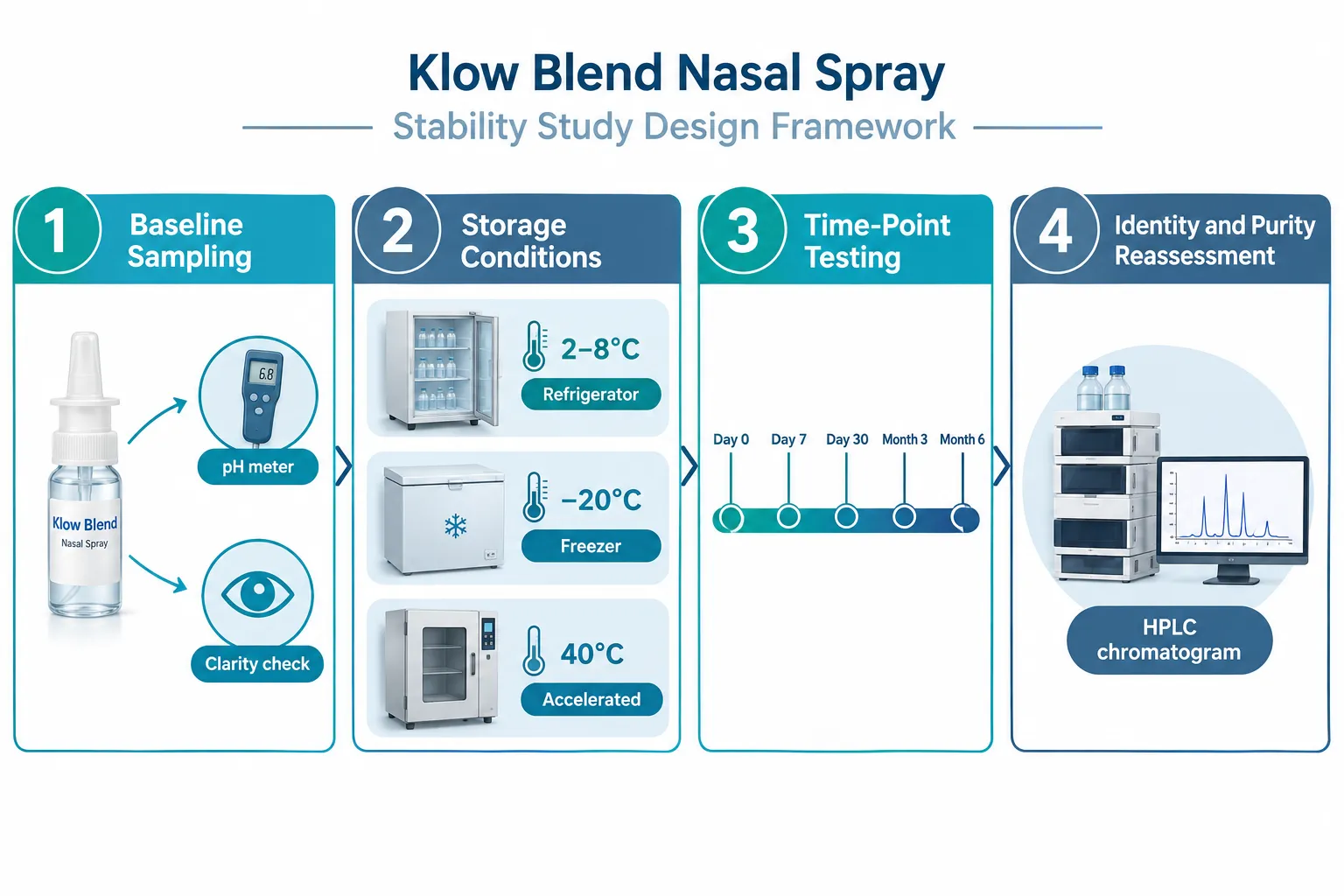
A stability-indicating study is only as strong as its sampling schedule and its choice of analytical methods. For the Klow Blend Nasal Spray Stability Study: A Research Framework for Container Closure, Temperature, and Freeze, Thaw Testing, the study design should mirror ICH Q1A(R2) long-term and accelerated conditions while accounting for the unique degradation pathways of peptide blends in aqueous nasal spray format.

Sampling Schedule and Storage Conditions

A practical sampling matrix should include the following time points and conditions:

Condition Temperature Humidity Time Points
Long-term 2-8°C (refrigerated) Ambient Day 0, 7, 30, 90, 180 days
Accelerated 25°C / 60% RH Controlled Day 0, 14, 30, 90 days
Stress (freeze) minus 20°C N/A Day 0, 30, 90, 180 days
Freeze, thaw Cycled (minus 20°C to 25°C) N/A 1, 3, 5 cycles

Day 0 baseline sampling is non-negotiable. Without a confirmed baseline for appearance, pH, and purity, no downstream comparison is meaningful.

Stability-Indicating Analytical Endpoints

The following endpoints must be assessed at every time point:

  • Appearance: Visual clarity, color change, and particulate matter
  • pH: Measured with a calibrated electrode; peptide stability is highly pH-dependent
  • Identity: Confirmed via HPLC retention time or mass spectrometry
  • Purity and related substances: Quantified by reverse-phase HPLC with UV detection
  • Osmolality: Relevant to nasal tolerability and formulation integrity
  • Microbial limits: Especially critical for multi-dose nasal spray formats

"A stability study that measures only appearance is not a stability study, it is a visual inspection log."

This principle is especially relevant for complex peptide blends, where degradation can proceed at the molecular level long before any visible change occurs. Products like Semax nasal spray and GLP nasal spray formulations face the same challenge, making robust analytical testing essential across the category.


Container Closure Integrity: The Foundation of the Klow Blend Nasal Spray Research Framework
Container Closure Integrity: The Foundation of the Klow Blend Nasal Spray Research Framework

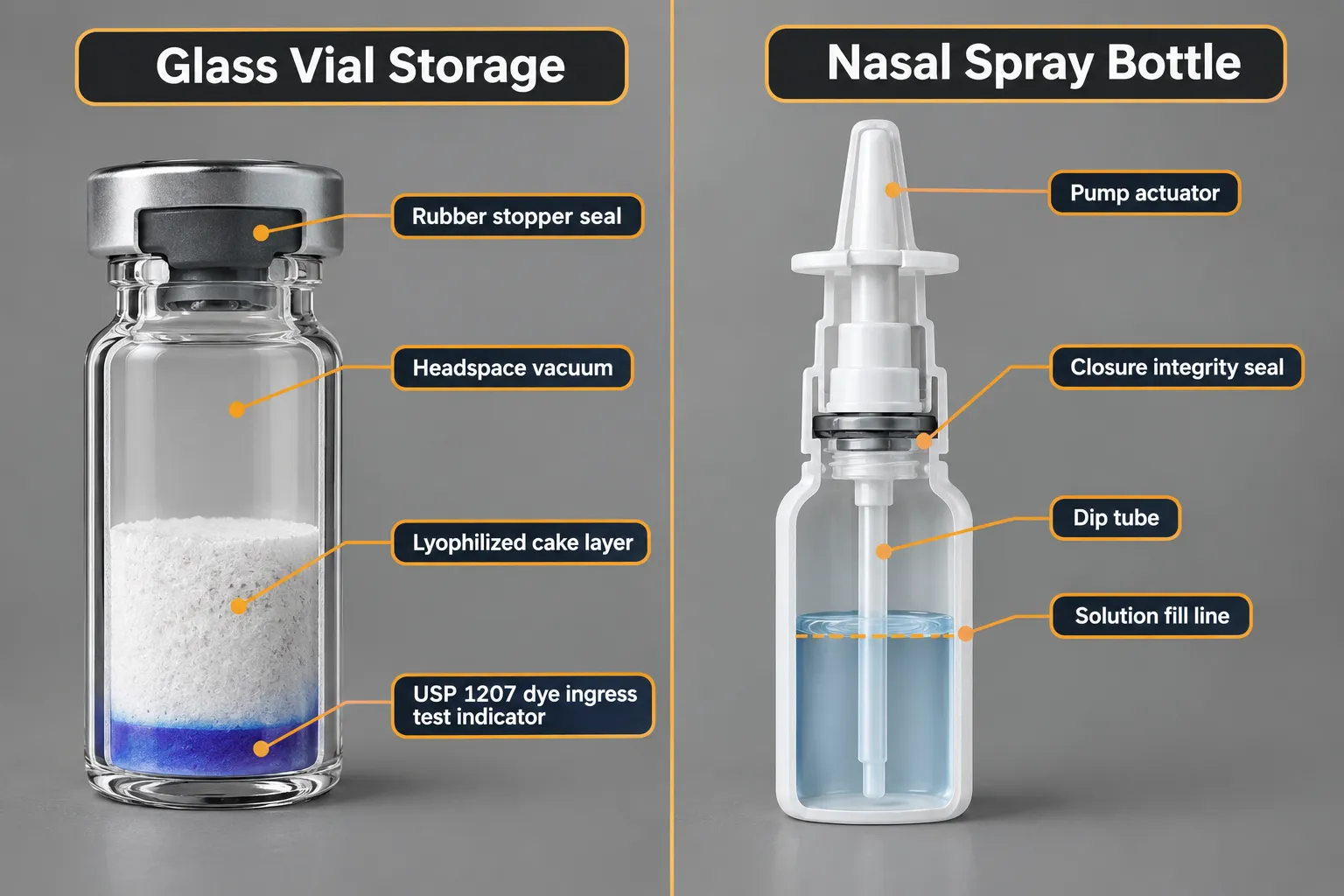
Container closure integrity (CCI) is not a secondary concern, it is a primary stability variable. For the Klow Blend Nasal Spray Stability Study: A Research Framework for Container Closure, Temperature, and Freeze, Thaw Testing, two distinct container types must be evaluated separately and comparatively.

Glass Vials vs. Nasal Spray Pump Bottles

Glass vials (typically borosilicate Type I) are the standard for lyophilized Klow Blend storage. Testing under USP should include dye ingress methodology, with vacuum level explicitly de-emphasized as a quality marker, vacuum is an incidental property of the lyophilization process, not a reliable CCI indicator on its own.

Nasal spray pump bottles (commonly HDPE or polypropylene) introduce additional variables:

  • Pump actuator seal integrity over repeated use cycles
  • Dip tube length and material compatibility with the peptide solution
  • Headspace oxygen exposure with each actuation
  • Closure torque and re-seal performance

A container-closure test matrix should evaluate both upright and inverted storage orientations, since nasal spray bottles are often stored and used in positions that differ from standard vials. Researchers working with multi-peptide blends, such as those exploring BPC-157 and TB-500 blend formats, will recognize these variables as consistent across complex peptide spray systems.

Material Compatibility Considerations

Peptides can adsorb to plastic surfaces, particularly at low concentrations. Any CCI framework for Klow Blend nasal spray should include:

  • Extractables and leachables screening from pump components
  • Adsorption studies comparing glass vs. polymer contact surfaces
  • Light transmission testing for amber vs. clear containers

Temperature Control and Freeze, Thaw Testing: Core Pillars of the Framework
Temperature Control and Freeze, Thaw Testing: Core Pillars of the Framework

Temperature management sits at the heart of every practical recommendation for Klow Blend storage, and it must be formalized within any stability study design.

Cold-Chain Requirements

Current guidance is consistent: lyophilized Klow Blend stored at minus 20°C or below retains stability for up to 1-2 years when protected from light and moisture. Once reconstituted, stability drops sharply. Refrigerated storage at 2-8°C is the standard, with a use window of approximately 7-30 days depending on formulation specifics and excipient composition.

This sharp stability cliff between dry and reconstituted states has direct implications for nasal spray products, which are by definition reconstituted solutions. Researchers formulating or evaluating products like GLP-3 RT 20mg peptide nasal spray or ipamorelin spray formats face this same reconstituted-stability constraint.

Freeze, Thaw Cycle Testing Protocol

Freeze, thaw cycling is consistently identified as a major degradation pathway for peptide solutions. A formal freeze, thaw sub-study within the broader Klow Blend framework should include:

  1. Baseline sample preparation at Day 0 with full analytical characterization
  2. Cycle definition: Freeze at minus 20°C for a minimum of 12 hours, then thaw at room temperature (approximately 20-25°C) for 2 hours
  3. Cycle increments: Test at 1, 3, and 5 complete cycles
  4. Post-cycle analysis: Full analytical panel including appearance, pH, purity by HPLC, and particulate count
  5. Aliquot controls: Parallel samples stored continuously at 2-8°C without cycling serve as the non-cycled reference

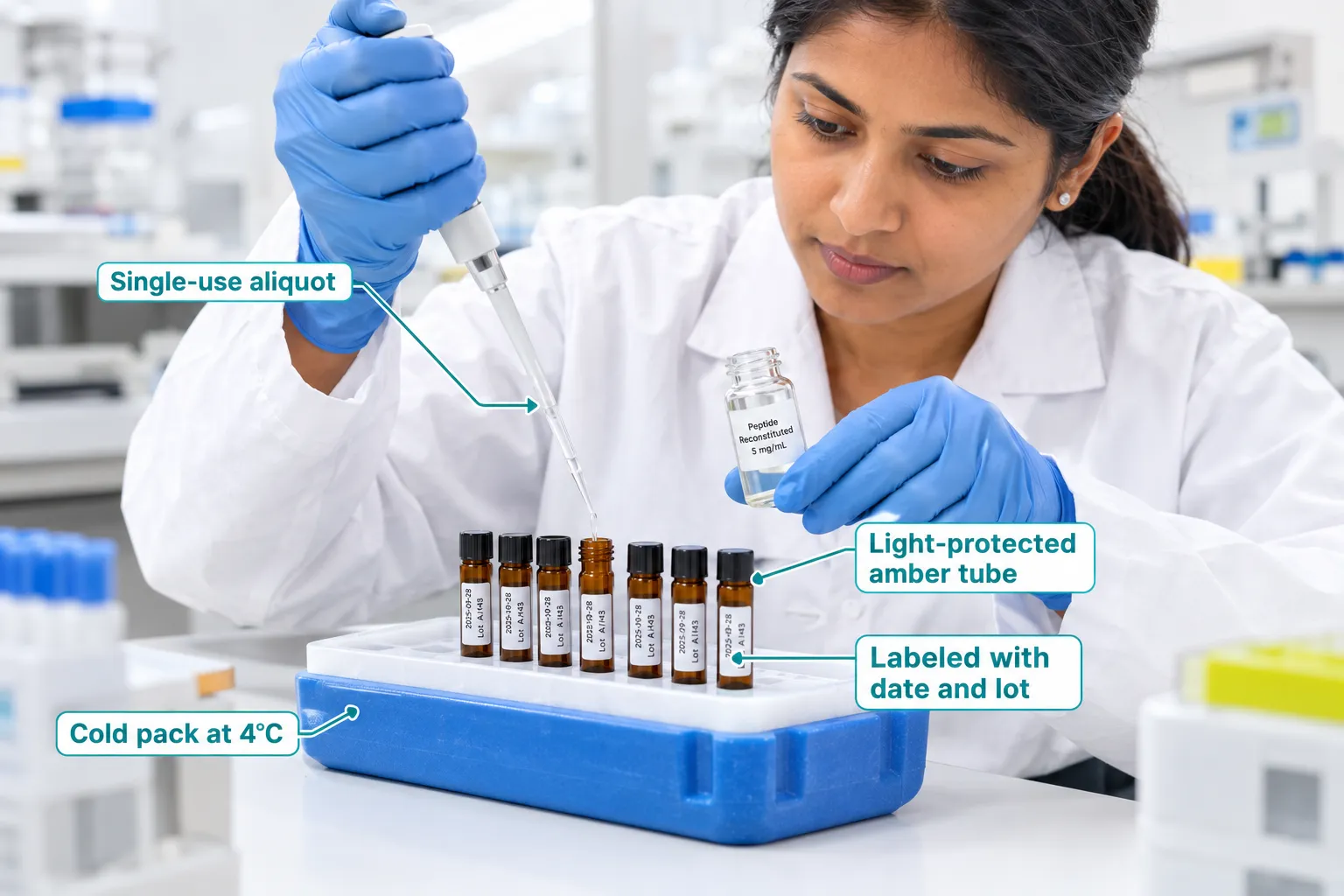
The practical implication of this data is already reflected in vendor guidance: immediate aliquoting after reconstitution is strongly recommended to avoid repeated freeze, thaw exposure. Single-use aliquots stored in light-protected amber tubes at 2-8°C represent the current best practice.

Short Temperature Excursions During Shipping

Shipping data suggest that Klow Blend formulations show modest resilience to brief temperature excursions, for example, exposure to ambient temperatures during transit for less than 24-48 hours. This informs the design of a shipping simulation stress test, which should be included as an optional but recommended component of any comprehensive stability framework. Similar considerations apply to complex growth hormone-axis blends such as the Tesamorelin CJC1295 Ipamorelin 12mg blend, where cold-chain integrity during shipping is equally critical.


Conclusion

The absence of a formally published Klow Blend nasal spray stability study in 2026 does not mean researchers must work without a framework. The Klow Blend Nasal Spray Stability Study: A Research Framework for Container Closure, Temperature, and Freeze, Thaw Testing outlined here provides a structured, actionable path forward built on established pharmaceutical science.

Actionable next steps for researchers and formulators:

  • Establish a Day 0 baseline with full analytical characterization before any stability study begins
  • Select container types deliberately and test both glass vials and nasal spray pump bottles under USP CCI protocols
  • Build freeze, thaw cycling into the study design as a primary variable, not an afterthought
  • Maintain cold-chain discipline, reconstituted Klow Blend solutions should be aliquoted immediately and used within the 7-30 day window
  • Prioritize pH and HPLC purity as the core stability-indicating endpoints, not appearance alone
  • Design sampling schedules that align with ICH Q1A(R2) time points to enable future regulatory comparison

As formal stability data emerge, this framework will serve as the scaffold onto which peer-reviewed evidence can be built. Until then, rigorous application of these principles represents the highest standard of research practice available.

https://www.puretestedpeptides.com/wp-content/uploads/2026/09/klow-blend-nasal-spray-stability-study-a-research-framework-for-container-closur.webp 1024 1536 https://www.puretestedpeptides.com/wp-content/uploads/2026/01/buy-peptides-online.jpg 2026-09-29 13:03:562026-09-29 13:03:56Klow Blend Nasal Spray Stability Study: A Research Framework for Container Closure, Temperature, and Freeze–Thaw Testing
×

Helpful Links

  • My account
  • Cart
  • Checkout
  • Refund and Returns Policy
  • Privacy Policy
  • SMS Privacy Policy
  • Login
  • My Account
  • Logout

USA Made Lab Tested Peptides

All products are sold for research, laboratory, or analytical purposes only, and are not for human consumption


Pure Tested Peptides is a chemical supplier. Pure Tested Peptides is not a compounding / chemical compounding facility as defined under 503A of the Federal Food, Drug, and Cosmetic act. Pure Tested Peptides is not an outsourcing facility as defined under 503B of the Federal Food, Drug, and Cosmetic act.

The statements made within this website have not been evaluated by the US Food and Drug Administration. The products we offer are not intended to diagnose, treat, cure or prevent any disease.

Human/Animal Consumption Prohibited. Laboratory/In-Vitro Experimental Use Only

Scroll to top Scroll to top Scroll to top