Call or Text 727-513-9780
  • Shopping Cart Shopping Cart
    0Shopping Cart
Pure Tested Peptides | America's most trusted Peptides for sale online
  • Peptides for sale
    • Oral Peptides for sale
      • Peptide Capsules for sale
      • BPC 157 Capsules 1000mcg
      • SLU-PP-332 Capsules | 1000 mcg
      • 5-Amino-1MQ 50mg Capsules
      • Tesofensine 500mcg
    • All Peptides for sale
    • Peptide Sprays
      • BPC 157 Nasal Spray Kit
      • BPC-157 TB500 Nasal Spray Kit
      • Semax Nasal Spray 10mg
      • Selank – Nasal Spray Kit – 10mg
      • Epithalon 50MG Nasal Spray Kit
      • Ipamorelin 10mg Nasal Spray
      • Klow Nasal Spray (BPC-157 + TB-500 + GHK-Cu + KPV) | 80mg
      • Hulk Nasal Spray Tesa / Ipa Blend 6/3 MG
      • Klow Nasal Spray
      • NAD + 500 mg Nasal Spray
      • PT-141 Nasal Spray Kit
    • GHRH Peptides
      • Ipa Peptides
      • CJC-1295 Peptides
        • CJC-1295 with DAC 5 mg
        • CJC-1295 without DAC 5 mg
        • CJC-1295 Ipa 10mg
      • Tesa Peptides
        • Tesa Peptide
        • Tesa 20 mg
    • GHK-Cu Peptides
      • All GHK-Cu Peptides
      • GHK-Cu 100mg
      • KLOW Peptide Blend – Buy KLOW blend online
    • BPC Peptides
      • All BPC Peptides
      • BPC-157
      • BPC-157 TB-500
      • BPC 157 capsules 1000mcg
    • SLU-PP-332 Peptides
      • All SLU-PP-332 Peptides
      • SLU-PP-332 5mg
    • GLP3 Peptides
    • PT-141 Peptides
      • PT-141 Peptides for sale
      • PT-141 10mg
      • PT-141 Nasal Spray
    • CAG Peptides
      • Lipo-C Peptide Blend
      • CAG 5mg
      • CAG 10mg
    • MOTS-C Peptides
      • MOTS-C Peptides for sale
      • MOTS-c peptide
      • MOTS-c 10mg *6 pack*
    • 5 Amino 1MQ Peptides
      • 5 Amino 1MQ Peptides for sale
      • 5-Amino-1MQ 50mg Capsules
      • 5-Amino-1MQ 5mg
    • Epithalon Peptides
      • Epithalon Peptides for sale
      • Epithalon 10mg
      • Epithalon 50mg
  • Shop
    • GLPs
      • 5-Amino-1MQ 50mg Capsules
      • 5-Amino-1MQ 5mg
      • L-Carnitine 500mg/ml
      • Tesofensine 500mcg
      • SLU-PP-332 5mg
      • MOTS-c 10mg *6 pack*
    • Epithalon & BPC Peptides
      • Epithalon 10mg
      • Epithalon 50mg
      • BPC-157
      • BPC 157 capsules 1000mcg
      • BPC-157 TB-500
      • BPC-157 TB500 Nasal Spray Kit
      • BPC 157 Nasal Spray Kit
    • BPC TB-500 & NAD+ Peptides
      • NAD+ 500 mg
      • KLOW Peptide Blend – Buy KLOW blend online
      • GLOW Peptide Blend
      • TB 500 5mg
      • BPC 157 capsules 1000mcg – Supplement
      • BPC 157 Nasal Spray Kit
      • BPC-157
      • BPC-157 TB500 Nasal Spray Kit
      • BPC-157 TB-500
      • BPC 157 capsules 1000mcg
    • LL-37 Peptide
      • LL-37 10 mg
    • MOTS-C & Selank
      • MOTS-c peptide
      • Selank 10mg
    • GHK Peptides
      • GHK-Cu 100mg
      • GLOW Peptide Blend
      • KLOW Peptide Blend – Buy KLOW blend online
  • COAs
  • Wholesale
    • Wholesale Peptides for sale
  • PTP FAQ
  • Affiliates
    • Selank Peptide: Advanced Pharmacological Mechanisms Underlying Its Anxiolytic and Nootropic Effects in Research
      • 5-Amino-1MQ Peptide: Detailed Mechanisms of NNMT Inhibition and Its Impact on Cellular Metabolism Research
        • MOTS-C Peptide: Unraveling Its Role in Mitochondrial Dynamics and Energy Metabolism Research
          • Epithalon Peptide and Telomerase Regulation: Investigating Its Impact on Cellular Senescence and Lifespan Research Models
            • GLP2-T vs GLP2 Tirz Peptide: Understanding the Naming, Mechanistic Nuances, and Research Implications for Gut Health
      • Peptides and Polypeptides in Modern Pharmacology: What Research on Metoprolol, Prednisone, and Amlodipine Reveals
        • Polypeptide Peptides vs NSAIDs: What Naproxen and Diclofenac Teach Tissue-Repair Researchers About BPC‑157 and TB‑500
          • Peptides and Polypeptides in Endocrine Pharmacology: How GLP-1, GLP-2, and GLP-3 Retatrutide Differ From Classic Drugs Like Prednisone and Amlodipine
          • 5‑Amino‑1MQ Peptide and NNMT Inhibition: How It Compares With Statins Like Atorvastatin in Adipose and Lipid Metabolism Research
      • Enclomiphene, Estrogen Receptor Signaling, and Luteinizing Phase Biology: What Hormone Researchers Should Measure
        • Mesenchymal Stem Cells, BPC‑157, and GHK‑Cu: How Tissue Repair Peptides Compare With Classic NSAIDs Like Naproxen in Injury Models
          • Peptide Calculator Use Cases Beyond Growth Hormone: Working Through GLP‑3 Retatrutide, MOTS‑c, and BPC‑157 Research Dosing
        • Polypeptide Peptides in Endocrine and Metabolic Pharmacology: Lessons From Amlodipine, Prednisone, and Metoprolol
        • Peptides Calculator for Advanced Blends: Worked Examples for Tesamorelin, CJC‑1295, and Ipamorelin Stacks
          • Peptides and Polypeptides in Human Physiology: How Molecular Size Shapes Research Applications
            • Selank Peptide: Advanced Pharmacological Mechanisms Underlying Its Anxiolytic and Nootropic Effects in Research
          • 5-Amino-1MQ Peptide: Detailed Mechanisms of NNMT Inhibition and Its Impact on Cellular Metabolism Research
            • MOTS-C Peptide: Unraveling Its Role in Mitochondrial Dynamics and Energy Metabolism Research
              • Epithalon Peptide and Telomerase Regulation: Investigating Its Impact on Cellular Senescence and Lifespan Research Models
                • GLP2-T vs GLP2 Tirz Peptide: Understanding the Naming, Mechanistic Nuances, and Research Implications for Gut Health
                  • Peptides and Polypeptides in Endocrine Pharmacology: How GLP-1, GLP-2, and GLP-3 Retatrutide Differ From Classic Drugs Like Prednisone and Amlodipine
                    • Polypeptide Peptides vs NSAIDs: What Naproxen and Diclofenac Teach Tissue-Repair Researchers About BPC‑157 and TB‑500
                      • Peptides and Polypeptides in Modern Pharmacology: What Research on Metoprolol, Prednisone, and Amlodipine Reveals
                        • 5‑Amino‑1MQ Peptide and NNMT Inhibition: How It Compares With Statins Like Atorvastatin in Adipose and Lipid Metabolism Research
                        • Enclomiphene, Estrogen Receptor Signaling, and Luteinizing Phase Biology: What Hormone Researchers Should Measure
                        • Mesenchymal Stem Cells, BPC‑157, and GHK‑Cu: How Tissue Repair Peptides Compare With Classic NSAIDs Like Naproxen in Injury Models
                        • Peptide Calculator Use Cases Beyond Growth Hormone: Working Through GLP‑3 Retatrutide, MOTS‑c, and BPC‑157 Research Dosing
                        • Polypeptide Peptides in Endocrine and Metabolic Pharmacology: Lessons From Amlodipine, Prednisone, and Metoprolol
                        • Peptides Calculator for Advanced Blends: Worked Examples for Tesamorelin, CJC‑1295, and Ipamorelin Stacks
                        • Peptides and Polypeptides in Human Physiology: How Molecular Size Shapes Research Applications
                        • Selank Peptide: Advanced Pharmacological Mechanisms Underlying Its Anxiolytic and Nootropic Effects in Research
                        • MOTS-C Peptide: Unraveling Its Role in Mitochondrial Dynamics and Energy Metabolism Research
                        • Peptides and Polypeptides in Modern Pharmacology: What Research on Metoprolol, Prednisone, and Amlodipine Reveals
                        • Peptides and Polypeptides in Endocrine Pharmacology: How GLP-1, GLP-2, and GLP-3 Retatrutide Differ From Classic Drugs Like Prednisone and Amlodipine
                        • 5-Amino-1MQ Peptide: Detailed Mechanisms of NNMT Inhibition and Its Impact on Cellular Metabolism Research
                        • Mesenchymal Stem Cells, BPC‑157, and GHK‑Cu: How Tissue Repair Peptides Compare With Classic NSAIDs Like Naproxen in Injury Models
                        • Peptide Calculator Use Cases Beyond Growth Hormone: Working Through GLP‑3 Retatrutide, MOTS‑c, and BPC‑157 Research Dosing
                        • GLP2-T vs GLP2 Tirz Peptide: Understanding the Naming, Mechanistic Nuances, and Research Implications for Gut Health
                        • Polypeptide Peptides in Endocrine and Metabolic Pharmacology: Lessons From Amlodipine, Prednisone, and Metoprolol
                        • Polypeptide Peptides vs NSAIDs: What Naproxen and Diclofenac Teach Tissue-Repair Researchers About BPC‑157 and TB‑500
                        • Peptides and Polypeptides in Human Physiology: How Molecular Size Shapes Research Applications
                        • Peptides Calculator for Advanced Blends: Worked Examples for Tesamorelin, CJC‑1295, and Ipamorelin Stacks
                        • 5‑Amino‑1MQ Peptide and NNMT Inhibition: How It Compares With Statins Like Atorvastatin in Adipose and Lipid Metabolism Research
                        • Enclomiphene, Estrogen Receptor Signaling, and Luteinizing Phase Biology: What Hormone Researchers Should Measure
                        • Epithalon Peptide and Telomerase Regulation: Investigating Its Impact on Cellular Senescence and Lifespan Research Models
                        • Best research protocol Klow blend
                        • best time to take BPC-157
                        • best time to take DSIP (Delta Sleep Inducing Peptide)
                        • best time to take CJC-1295
                        • best time to take AOD-9604
                        • best time to take Follistatin 344
                        • best time to take Ipamorelin
                        • best time to take MK-677 (Ibutamoren)
                        • best time to take Ligandrol (LGD-4033) — research compound
                        • best time to take Ostarine (MK-2866) — research compound
                        • best time to take GHK-CU
                        • best time to take TB-500
                        • best time to take MOTS-c
                        • best time to take Semax
                        • best time to take RAD-140 (Testolone) — research compound
                        • best time to take Thymosin Alpha-1
                        • best time to take PEG-MGF
                        • Biolife Plasma, Octapharma Plasma, and Research Peptides: How Plasma Donation Labs Differ From Peptide Suppliers
                        • best time to take YK-11 — research compound
                        • best time to take PT-141 (Bremelanotide)
                        • Best research protocol Klow blend
                        • 5-Amino-1MQ and MOTS-C Synergy: Metabolic Signaling, Mitochondria, and Research Design
                        • BPC-157 and TB-500: Investigating Their Combined Effects on Angiogenesis and Cellular Migration in Tissue Repair Models
                        • BPC-157 Peptide: Gut Barrier Function, Inflammation, and Tissue-Recovery Research
                        • 5‑Amino‑1MQ and MOTS‑c Synergy in Metabolic Research: Designing NNMT and Mitochondrial Biogenesis Stacks
                        • CJC-1295 with DAC vs. Without DAC: Half-Life, Release Kinetics, and Research Implications
                        • CJC‑1295 with DAC vs. Without DAC: Expanding on Half‑Life Differences Using Tesamorelin and Ipamorelin Blend Case Studies
                        • Collagen Biology and Copper‑Binding Peptides: How GHK‑Cu, Glow Blend, and Klow Blend Interact with Skin and Connective Tissue
                        • Collagen Biology and Regenerative Peptides: How GHK‑Cu, Glow Blend, and Klow Blend Affect Extracellular Matrix Research
                    • DNA, Telomeres, and Longevity Peptides: Positioning Epithalon and MOTS‑c in Genetic Aging Research
                      • Enclomiphene Citrate: serm Mechanism, Testosterone Research, and Stack Compatibility
                        • Enclomiphene vs Enclomiphene Citrate: Formulation, Bioavailability, and Research Distinctions
                        • Epithalon Peptide Research: Telomerase Activation, Aging, and Pineal Gland Function
                        • Estrogen Receptor Signaling and Enclomiphene: How Selective Modulators Compare with Classic Polypeptide Hormones
                        • GHK-Cu Peptide: Advanced Mechanisms in Extracellular Matrix Remodeling and Wound Healing Research
                        • GHK-Cu Peptide: Collagen Synthesis, Wound Repair, and Skin-Barrier Research Models
                        • GLP-1 vs GLP-3 vs GLP-2: Peptide Classification and Research Applications
                        • GLP-2 Peptide Research Guide: Gut Barrier Function, Nutrient Absorption, and Intestinal Recovery Models
                        • GLP-3 Retatrutide vs. GLP-1 Drugs: What Triple-Agonist Biology Changes in Research Models
                        • Ipamorelin and Tesamorelin Combination: Synergistic GH Secretagogue Research and Dosing Protocols
                        • GLP2 Tirz Peptide: What It Is, Why the Name Exists, and How Researchers Should Interpret It
                        • Klow Blend Peptide Nasal Spray: What the Formulation Is Trying to Do in Cognitive Research
                        • Mitochondria, NNMT Inhibition, and Peptide Modulators: Where MOTS‑c and 5‑Amino‑1MQ Fit in Cellular Energy Research
                        • MOTS-c Peptide: Mitochondrial Function, Energy Metabolism, and What Researchers Measure
                        • MOTS-c vs. 5-Amino-1MQ: Which Metabolic Research Questions Each Compound Actually Answers
                        • Nasal Spray Peptides: Bioavailability, Administration, and Semax/Selank Research Applications
                        • PT-141 Peptide Research: Mechanism of Action and Melanocortin Receptor Signaling
                        • Retatrutide for Research: Mechanism, Structure, and GLP-1/GLP-3 Dual Action
                        • Retatrutide for Obesity and Type 2 Diabetes: What the Latest Trial Data Suggest
                        • Tesofensine Peptide Research: Mechanism, Appetite Suppression, and Neuropeptide Y Pathways
  • Contact
    • Contact Customer Service
    • Text Customer Support
  • About US
  • Shop all peptides
  • Affiliate Program
    • Affiliate Signup
  • Login / Register Login / Register Page Link Login / Register Page Link
  • Click to open the search input field Click to open the search input field Search
  • Menu Menu

Tag Archive for: gh pulse

Tesamorelin and Ipamorelin Peptides: Separating GH-Pulse, Visceral-Fat, and Body-Composition Readouts

Tesamorelin and Ipamorelin Peptides: Separating GH-Pulse, Visceral-Fat, and Body-Composition Readouts

October 17, 2026/0 Comments/in Uncategorized/by

Visceral fat responds to growth hormone secretagogues in measurably different ways depending on which peptide drives the GH signal, yet most community protocols treat tesa and ipamorelin as interchangeable tools. Tesamorelin and Ipamorelin Peptides: Separating GH-Pulse, Visceral-Fat, and Body-Composition Readouts is not just a labeling exercise; it is a prerequisite for designing experiments or interpreting outcomes with any confidence. Without isolating each variable, researchers risk attributing fat-loss effects to a peptide that has no proven capacity to produce them.

Key Takeaways

  • Tesamorelin is an FDA-approved GHRH analog with robust Phase III evidence for visceral and hepatic fat reduction; ipamorelin is a ghrelin mimetic with no equivalent body-composition data.
  • Ipamorelin produces sharp, selective GH pulses with minimal cortisol or prolactin spillover, making it useful for studying pulsatility, not fat mobilization.
  • Confounding variables, sleep quality, caloric intake, lean mass changes, must be measured independently to isolate each peptide's true contribution.
  • Combination stacks of tesa and ipamorelin are growing in the research market, but controlled evidence for additive or synergistic effects remains absent as of 2026.
  • Experimental design, not anecdote, is the only reliable path to separating GH-pulse readouts from visceral-fat and body-composition outcomes.

Mechanism Differences That Define the Experimental Problem
Mechanism Differences That Define the Experimental Problem

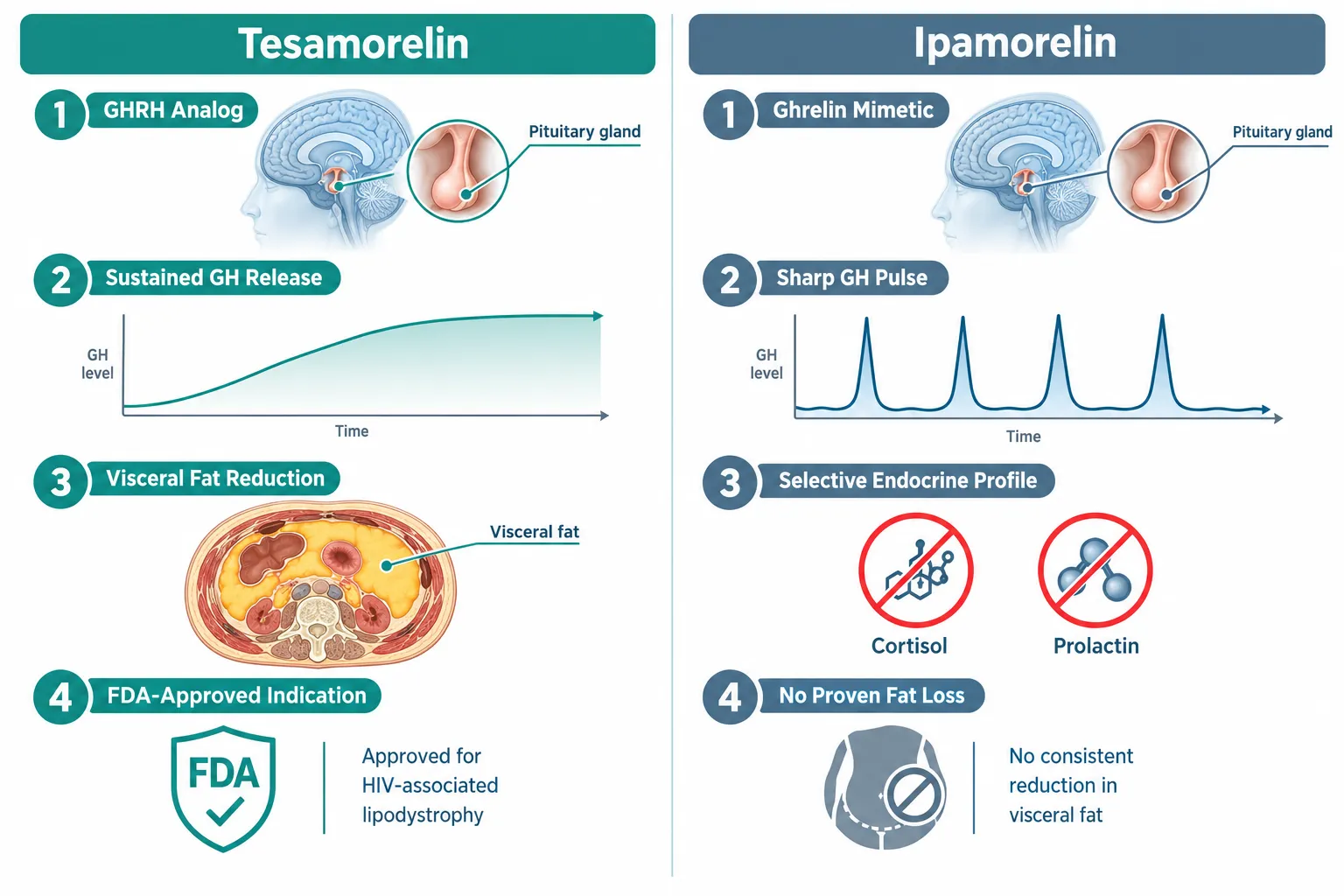
Tesamorelin is a synthetic analog of growth hormone-releasing hormone (GHRH). It binds pituitary GHRH receptors and stimulates a sustained, physiologically shaped GH release. Its approved indication covers HIV-associated lipodystrophy, where Phase III trials documented significant reductions in visceral adipose tissue (VAT) and hepatic fat. Importantly, a post-hoc Phase III analysis confirmed that efficacy held regardless of whether subjects presented with dorsal fat accumulation, meaning the fat-loss signal was not an artifact of a specific phenotype.

Ipamorelin operates through a different receptor class entirely. As a ghrelin mimetic and growth hormone secretagogue receptor (GHSR) agonist, it triggers a sharp, high-amplitude GH pulse. What distinguishes it from older secretagogues such as GHRP-6 is its endocrine selectivity: cortisol and prolactin remain largely unaffected at standard doses. Animal studies and surgical-patient data confirm that ipamorelin's pulsatile output is real and reproducible, but no controlled human trial has linked those pulses to meaningful reductions in VAT, subcutaneous fat, or improvements in lean mass.

This mechanistic divergence is the central experimental problem. When both peptides are administered together, any observed body-composition change cannot be cleanly attributed to either agent without a study design that isolates the variables.

For researchers exploring Tesamorelin as a standalone compound, understanding this distinction is foundational before adding any secondary secretagogue.


Designing Studies That Separate GH-Pulse, Visceral-Fat, and Body-Composition Readouts
Designing Studies That Separate GH-Pulse, Visceral-Fat, and Body-Composition Readouts

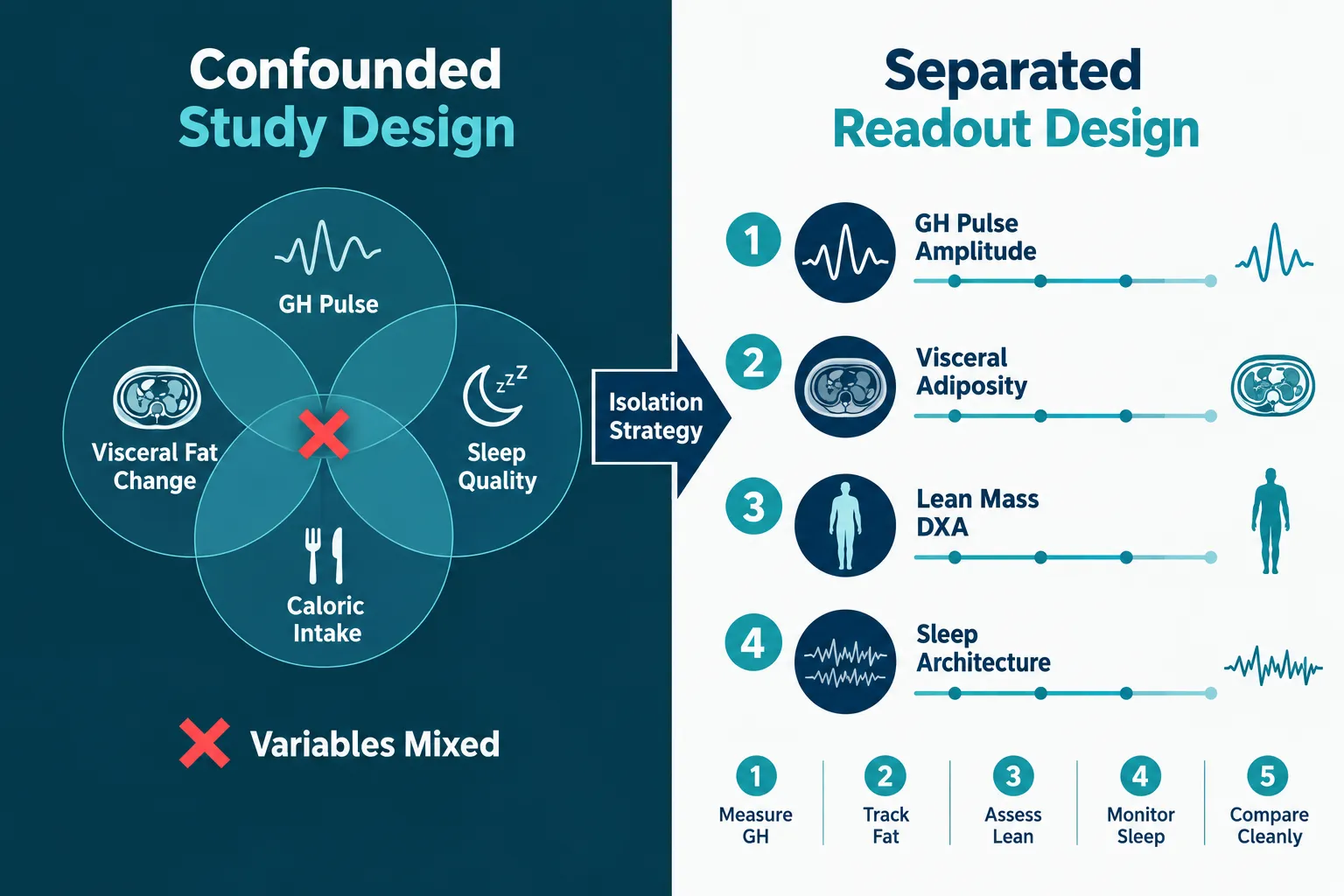
The phrase "Tesamorelin and Ipamorelin Peptides: Separating GH-Pulse, Visceral-Fat, and Body-Composition Readouts" describes an active methodological challenge. Four variables routinely confound each other in poorly designed protocols:

1. GH pulse amplitude and timing
Ipamorelin's GH spike peaks within 15-30 minutes of administration and clears rapidly. Tesamorelin produces a broader, more sustained curve. Measuring both with serial serum GH sampling requires time-stamped blood draws that align with each peptide's pharmacokinetic window, not a single morning trough.

2. Visceral and hepatic adiposity
Tesamorelin's documented effect is specifically on VAT and liver fat, not subcutaneous fat. MRI or CT cross-sectional imaging at L4-L5 is the accepted readout. DXA alone will miss the visceral compartment. Studies that report only total body fat percentage cannot confirm a tesamorelin-specific effect.

3. Lean mass changes
GH promotes protein synthesis. Any gain in lean mass will alter the body-composition ratio independent of fat loss. DXA with regional analysis separates appendicular lean mass from trunk fat, providing a cleaner readout.

4. Sleep quality and caloric intake
GH secretion is tightly coupled to slow-wave sleep. Ipamorelin is frequently dosed at bedtime precisely to align with natural nocturnal GH release. If sleep quality improves, or if subjects reduce caloric intake during a study period, both variables independently affect body composition. Neither is controlled for in most community-reported protocols.

A properly designed experiment would include:

  • Baseline and endpoint MRI for VAT
  • Serial GH sampling matched to each peptide's peak window
  • DXA with regional lean-mass analysis
  • Validated sleep-quality instruments (e.g., polysomnography or actigraphy)
  • Standardized dietary intake logging

Researchers reviewing CJC-1295 Ipamorelin cycle protocols will recognize that most community designs omit at least three of these five elements.


The Combination Stack: Evidence Gap and Practical Considerations
The Combination Stack: Evidence Gap and Practical Considerations

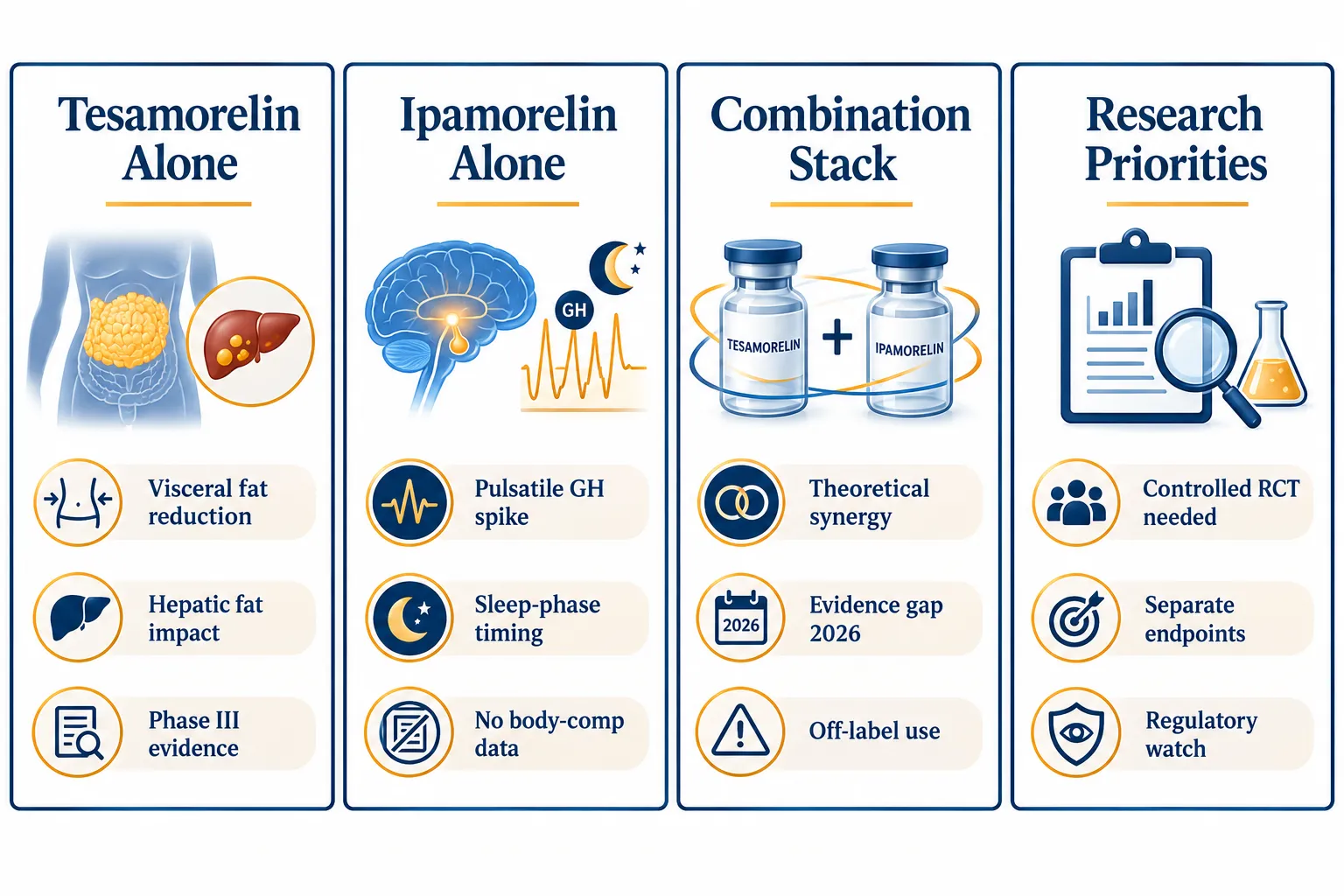
By October 2026, blended formulations pairing tesa with ipamorelin, sometimes alongside CJC-1295 or AOD-9604, have become a notable segment of the research-peptide market. The theoretical rationale is straightforward: tesa provides the GHRH signal, ipamorelin provides a complementary GHSR pulse, and together they may produce a more complete GH secretory pattern than either alone.

The evidence gap, however, is substantial. No published randomized controlled trial has tested this combination in humans for visceral fat, lean mass, or metabolic endpoints. The synergy argument is mechanistically plausible but remains unverified.

Endpoint Tesamorelin Evidence Ipamorelin Evidence Combination Evidence
Visceral fat reduction Phase III RCT confirmed None None
Hepatic fat reduction RCT data available None None
GH pulse amplitude Moderate, sustained High, sharp Theoretical additive
Lean mass change Modest, documented Animal data only None
Safety in combination Unknown Unknown Unknown

For researchers comparing secretagogue options, the Tesamorelin vs Sermorelin comparison offers useful context on how GHRH analogs differ in potency and indication before layering in a second agent.

Those working with multi-peptide blends can review formulation details such as the Tesamorelin AOD9604 CJC1295 Ipamorelin 12mg blend to understand what components are present, while recognizing that the body-composition evidence base applies only to tesa as a single agent.

Regulatory commentary in 2026 continues to flag GH-axis manipulation through off-label stacks as an area requiring closer scrutiny, particularly regarding long-term IGF-1 elevation and insulin sensitivity.

For those assessing the broader peptide landscape, resources on what is the strongest peptide for weight loss provide comparative context across multiple compound classes.


Conclusion

Separating GH-pulse readouts from visceral-fat and body-composition outcomes is not a semantic distinction, it determines whether experimental data is actionable or misleading. Tesamorelin carries the only robust human evidence for targeted VAT reduction among GH secretagogues. Ipamorelin contributes a selective, reproducible GH pulse with a clean endocrine profile, but that pulse has not been linked to meaningful fat loss in controlled settings.

Actionable next steps for researchers:

  • Design protocols with endpoint-specific measurement tools: MRI for VAT, DXA for lean mass, serial GH sampling for pulse characterization.
  • Control for sleep quality and caloric intake as independent variables before attributing body-composition changes to any peptide.
  • Treat combination stacks as hypothesis-generating, not evidence-based, until RCT data exists.
  • Consult CJC-1295 Ipamorelin assay planning resources when structuring multi-peptide assays to ensure sourcing and measurement integrity.
  • Review Tesamorelin vs Sermorelin comparisons to benchmark tesa's evidence profile against other GHRH analogs before selecting a research compound.

The field will advance only when experimental design matches the complexity of the biology, and that starts with measuring the right outcome for the right peptide.

https://www.puretestedpeptides.com/wp-content/uploads/2026/10/tesamorelin-and-ipamorelin-peptides-separating-gh-pulse-visceral-fat-and-body-co.webp 1024 1536 https://www.puretestedpeptides.com/wp-content/uploads/2026/01/buy-peptides-online.jpg 2026-10-17 13:04:592026-10-17 13:04:59Tesamorelin and Ipamorelin Peptides: Separating GH-Pulse, Visceral-Fat, and Body-Composition Readouts
×

Helpful Links

  • My account
  • Cart
  • Checkout
  • Refund and Returns Policy
  • Privacy Policy
  • SMS Privacy Policy
  • Login
  • My Account
  • Logout
  • About
  • Contact
  • COA / Lab Testing
  • Shipping Policy
  • Terms and Conditions
  • Research Use Disclaimer

USA Made Lab Tested Peptides

All products are sold for research, laboratory, or analytical purposes only, and are not for human consumption


Pure Tested Peptides is a chemical supplier. Pure Tested Peptides is not a compounding / chemical compounding facility as defined under 503A of the Federal Food, Drug, and Cosmetic act. Pure Tested Peptides is not an outsourcing facility as defined under 503B of the Federal Food, Drug, and Cosmetic act.

The statements made within this website have not been evaluated by the US Food and Drug Administration. The products we offer are not intended to diagnose, treat, cure or prevent any disease.

Human/Animal Consumption Prohibited. Laboratory/In-Vitro Experimental Use Only

Scroll to top Scroll to top Scroll to top