Klow Peptide Nasal Spray Stability: How to Investigate pH, Osmolality, Pump Dose Uniformity, and Storage Drift
A multi-peptide nasal spray that combines four distinct active compounds in a single 10 mL vial introduces formulation complexity that most single-API products never face. Klow Peptide Nasal Spray Stability: How to Investigate pH, Osmolality, Pump Dose Uniformity, and Storage Drift is not a question with a published answer yet, no peer-reviewed stability dataset exists for this blend as of 2026. What does exist is a rigorous framework borrowed from EMA and FDA nasal-product guidance that any qualified investigator can apply to this research-grade formulation.
Key Takeaways
- Klow contains GHK-Cu, BPC-157, TB-500, and KPV in sterile saline; no validated stability specifications or shelf-life data have been published for this blend.
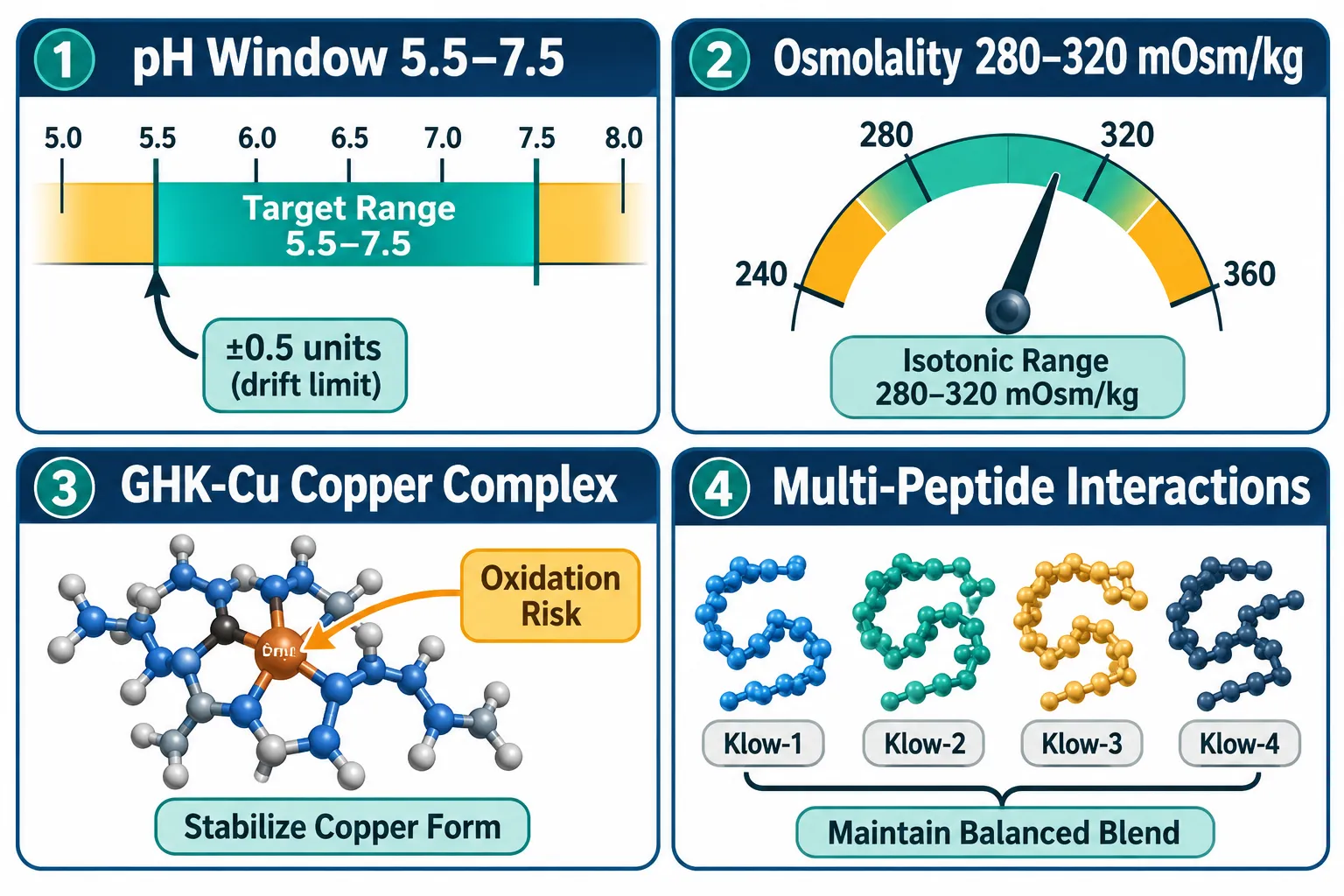
- Target pH 5.5-7.5, osmolality 280-320 mOsm/kg, and dose accuracy within ±10 % (US) or ±15 % (EU) are reasonable starting benchmarks drawn from general nasal-spray standards.
- The copper-binding peptide GHK-Cu raises plausible oxidation and pH-drift risks that require proactive monitoring and stress testing.
- Pump dose uniformity must be sampled at the beginning, middle, and end of each container, across multiple containers and batches.
- Because Klow is sold for research use only and carries no regulatory approval, all stability targets are investigator-defined and must be justified experimentally.
Understanding Klow's Formulation and Why Stability Is Complicated
Klow is formulated as a ready-mixed sterile saline solution delivering approximately 80 mg of peptides per 10 mL container: GHK-Cu at 50 mg, BPC-157 at 10 mg, TB-500 at 10 mg, and KPV at 10 mg. Each metered actuation delivers roughly 1.4 mg of combined peptide mass across approximately 57 sprays. Third-party certificates of analysis report peptide purity near 99.5 %, but purity at manufacture and stability over the product's usable life are entirely different concerns.
The core challenge is that each peptide has its own pH stability profile. Peptide and protein drugs frequently require mildly acidic conditions, sometimes pH 4.0-5.5, for maximum stability, while other actives may prefer slightly basic environments. Blending four such compounds into one vial means no single pH can be fully optimal for all four simultaneously. GHK-Cu is a copper-chelating peptide, which adds an oxidation risk not present in a standard peptide solution. Copper ions can catalyze oxidative degradation of neighboring peptides like BPC-157 and TB-500, creating inter-peptide interactions that are, frankly, poorly characterized in literature as of 2026.
For researchers comparing nasal spray formulations, resources like the GLP-3 RT 20mg Peptide Nasal Spray and Semax Nasal Spray provide useful reference points for how single or simpler multi-peptide nasal formulations are described in a research context.
"For a copper-chelating peptide blended with three other labile peptides, in-vial oxidation and pH drift are not theoretical concerns, they are expected failure modes that stability protocols must actively monitor."
Investigating pH and Osmolality in Klow Peptide Nasal Spray Stability
pH and osmolality are the two most accessible formulation variables and, in the absence of published Klow-specific specifications, must be treated as investigator-defined critical quality attributes.
pH targets and monitoring:
| Parameter | General Nasal Spray Target | Recommended Drift Limit |
|---|---|---|
| pH | 5.5-7.5 | No more than ±0.5 units from release value |
| Osmolality | 280-320 mOsm/kg | Flag any shift outside isotonic range |
| Peptide concentration | Within ±5 % of label | Monitor at each stability timepoint |
pH should be measured at release and at each stability timepoint. A drift exceeding approximately 0.5 pH units from the initial value is a signal worth investigating. For GHK-Cu, acidification over storage would be consistent with copper-mediated oxidative processes. For KPV, an alkaline drift could indicate hydrolysis byproducts accumulating in solution.
Osmolality serves a dual purpose: it reflects mucosal tolerability (near-isotonic solutions reduce nasal irritation and support predictable absorption) and it functions as a formulation-integrity signal. Drift outside the 280-320 mOsm/kg window during storage can indicate water loss through imperfect container seals, salt precipitation, or degradation of excipients, all of which could alter peptide aggregation behavior and ultimately affect spray performance.
Stress testing, elevated temperature (typically 40 °C/75 % relative humidity for accelerated studies) and light exposure, should be built into any investigator-driven Klow stability program. Antioxidant or chelating excipients may help control copper-mediated degradation, but their inclusion requires its own compatibility assessment.
Pump Dose Uniformity: Protocols and Acceptance Benchmarks
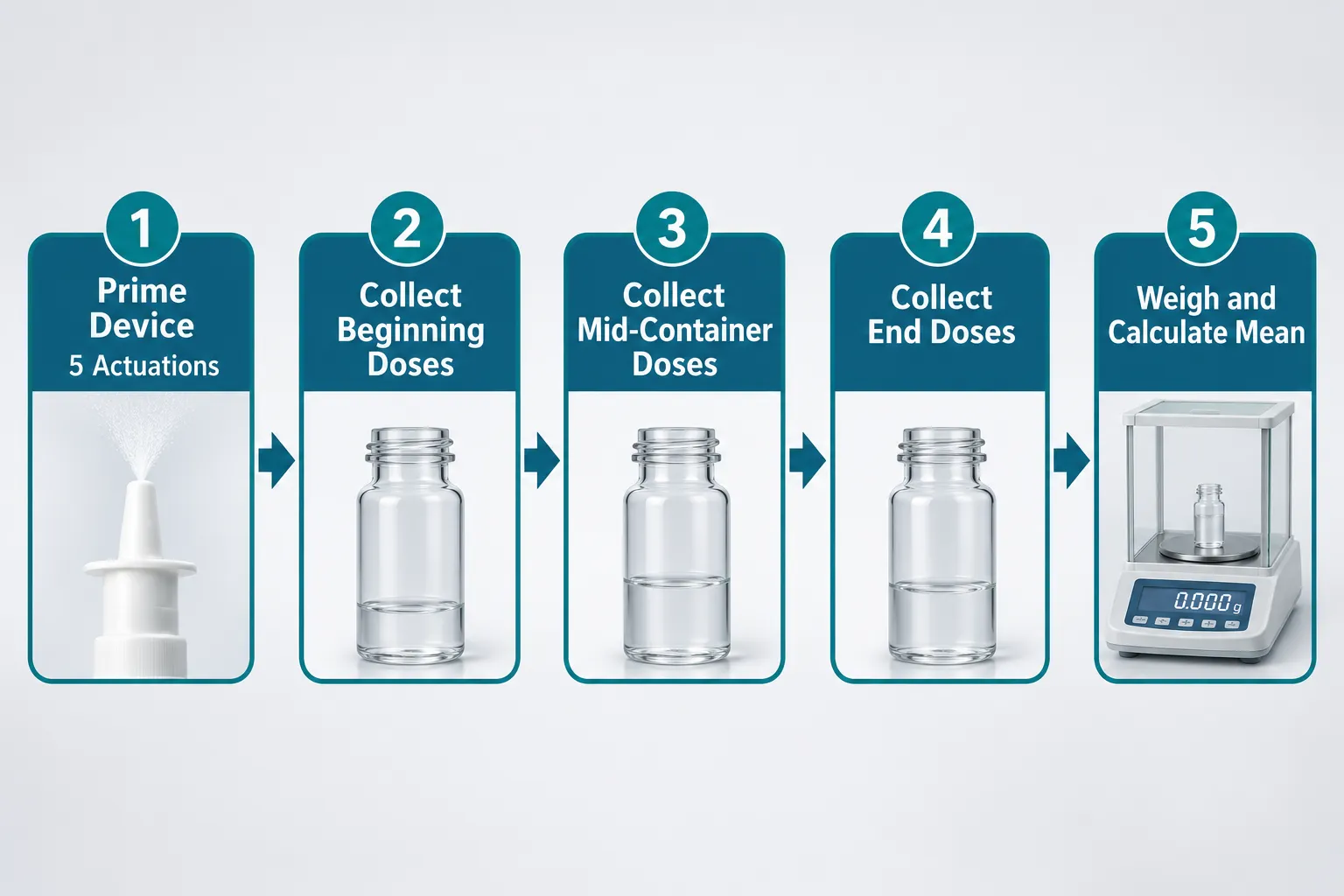
Dose uniformity for a metered nasal spray is not a single measurement, it is a pattern of measurements taken across the full life of the device. Both FDA nasal-spray guidance and EMA inhalation/nasal-product guidelines require sampling from the beginning, middle, and end of each container.
A practical sampling protocol for Klow:
- Prime each device with five actuations before collecting data doses.
- Collect three actuations representing the "beginning" of the container.
- Collect three actuations from the middle portion (approximately spray 25-30 of 57).
- Collect three actuations representing the "end" (final five sprays).
- Weigh or assay each collected dose; calculate mean and coefficient of variation.
Regulatory benchmarks for delivered dose uniformity in multi-dose nasal containers are approximately ±10 % of target in the US context and ±15 % in the EU context. Applied to Klow's approximately 1.4 mg per actuation, this translates to a practical US range of roughly 1.26-1.54 mg and an EU range of 1.19-1.61 mg per spray, not official Klow limits, but reasonable investigator benchmarks.
Testing must also capture inter-device variability. At minimum, ten containers per batch should be tested to satisfy EMA expectations for delivered dose consistency. For more on how research peptide supply and quality documentation are assessed across vendors, see this overview of peptide supplier comparisons interpreting PeptideTech and PeptideSc.
Monitoring Storage Drift Across the Klow Nasal Spray Shelf Life
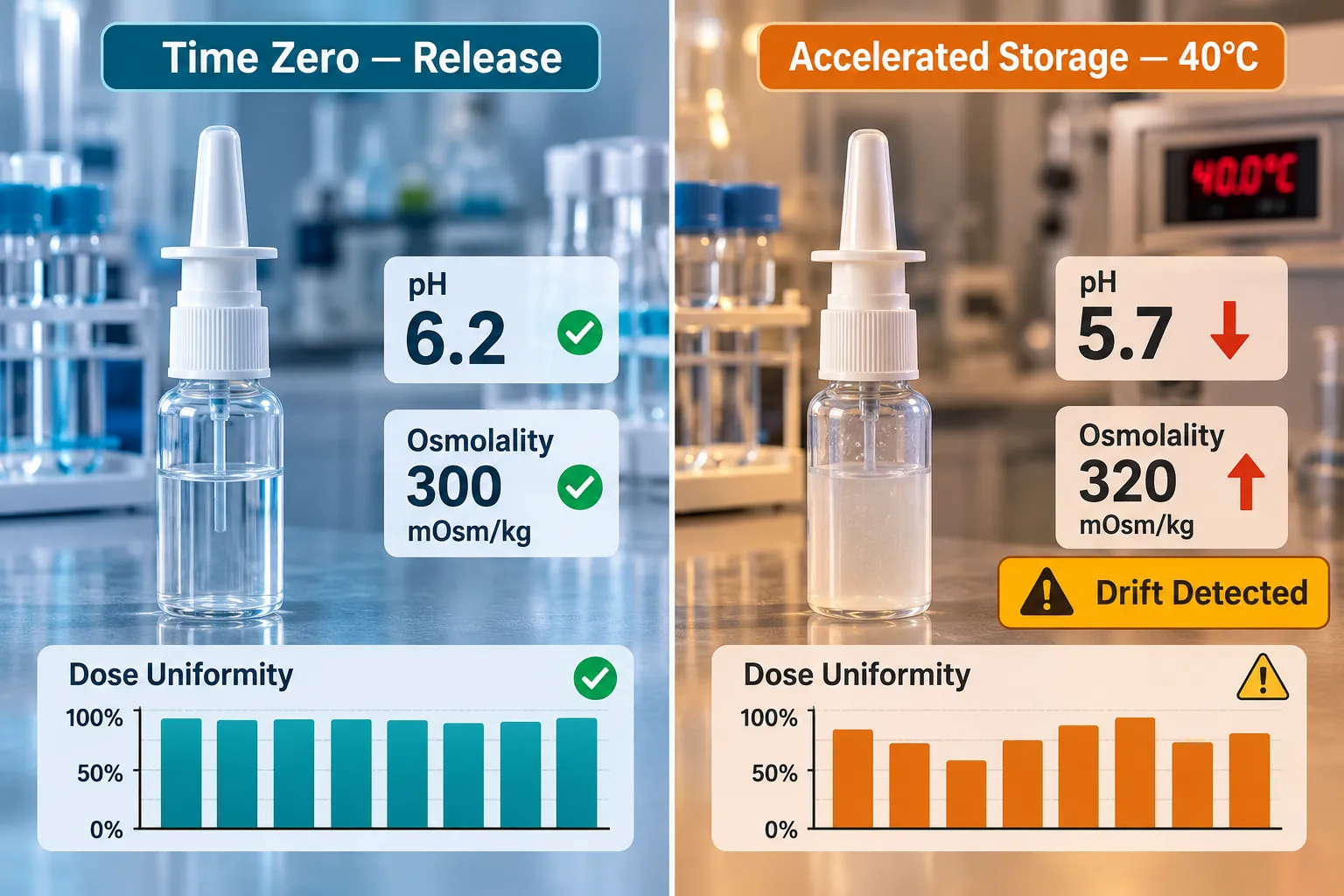
Storage drift encompasses every measurable formulation change that accumulates between the day of manufacture and the last intended use. For a research nasal spray like Klow, the absence of a published expiry-based stability study means investigators must define their own timepoints and acceptance criteria.
Recommended stability timepoints for an exploratory Klow study:
- T=0 (release): pH, osmolality, peptide assay by HPLC, dose uniformity, visual appearance
- T=1 month (refrigerated and room temperature): Repeat all T=0 tests; check for particulates
- T=3 months: Full panel plus any degradation impurity profiling
- T=6 months: Full panel; compare pump shot-weight CV to T=0 baseline
- Accelerated (40 °C/75 % RH, 1 and 3 months): Stress markers for oxidation, aggregation
The GHK-Cu component is the highest-risk variable for drift. Its copper complex can catalyze oxidation of methionine-containing or cysteine-containing neighbors, and the resulting degradants may shift both pH and osmolality readings if present in sufficient quantity.
For context on other research peptides where multi-variable stability considerations arise, see the SS31 Peptide category, SS31 is a mitochondria-targeted antioxidant peptide where oxidation monitoring is similarly central to formulation integrity.
Health Canada listed Klow among seized gym products in December 2025, reinforcing that it remains a non-approved substance. This status does not eliminate the value of rigorous investigator-led stability work; it simply means no regulatory body has reviewed or accepted any such data yet.
For anyone researching the broader peptide landscape, the GLP-1 Peptides category and resources on what is the strongest peptide for weight loss offer perspective on how regulatory and formulation standards differ across compound classes.
Conclusion
Klow Peptide Nasal Spray Stability: How to Investigate pH, Osmolality, Pump Dose Uniformity, and Storage Drift is currently an open research question with no published dataset to anchor expectations. The most defensible approach in 2026 is to treat Klow as a non-approved multi-API nasal liquid and apply established EMA and FDA nasal-product frameworks to design every element of the stability program.
Actionable next steps for investigators:
- Establish release specifications for pH (5.5-7.5), osmolality (280-320 mOsm/kg), and peptide concentration (±5 % of label) before beginning any storage study.
- Run dose uniformity across a minimum of ten containers, sampling beginning, middle, and end of each device.
- Include a 40 °C accelerated arm in every stability study to detect copper-mediated oxidation and pH drift early.
- Document every lot-to-lot deviation in shot weight and pH; treat a drift of more than 0.5 pH units or osmolality outside the isotonic window as a formulation failure signal.
- Do not make efficacy or safety claims based on stability data alone; Klow's research-only status means all findings remain investigational.
Rigorous formulation monitoring is the difference between reproducible research data and results that cannot be trusted across lots.