Call or Text 727-513-9780
  • Shopping Cart Shopping Cart
    0Shopping Cart
Pure Tested Peptides | America's most trusted Peptides for sale online
  • Peptides for sale
    • Oral Peptides for sale
      • Peptide Capsules for sale
      • BPC 157 Capsules 1000mcg
      • SLU-PP-332 Capsules | 1000 mcg
      • 5-Amino-1MQ 50mg Capsules
      • Tesofensine 500mcg
    • All Peptides for sale
    • Peptide Sprays
      • BPC 157 Nasal Spray Kit
      • BPC-157 TB500 Nasal Spray Kit
      • Semax Nasal Spray 10mg
      • Selank – Nasal Spray Kit – 10mg
      • Epithalon 50MG Nasal Spray Kit
      • Ipamorelin 10mg Nasal Spray
      • Klow Nasal Spray (BPC-157 + TB-500 + GHK-Cu + KPV) | 80mg
      • Hulk Nasal Spray Tesa / Ipa Blend 6/3 MG
      • Klow Nasal Spray
      • NAD + 500 mg Nasal Spray
      • PT-141 Nasal Spray Kit
    • GHRH Peptides
      • Ipa Peptides
      • CJC-1295 Peptides
        • CJC-1295 with DAC 5 mg
        • CJC-1295 without DAC 5 mg
        • CJC-1295 Ipa 10mg
      • Tesa Peptides
        • Tesa Peptide
        • Tesa 20 mg
    • GHK-Cu Peptides
      • All GHK-Cu Peptides
      • GHK-Cu 100mg
      • KLOW Peptide Blend – Buy KLOW blend online
    • BPC Peptides
      • All BPC Peptides
      • BPC-157
      • BPC-157 TB-500
      • BPC 157 capsules 1000mcg
    • SLU-PP-332 Peptides
      • All SLU-PP-332 Peptides
      • SLU-PP-332 5mg
    • GLP3 Peptides
    • PT-141 Peptides
      • PT-141 Peptides for sale
      • PT-141 10mg
      • PT-141 Nasal Spray
    • CAG Peptides
      • Lipo-C Peptide Blend
      • CAG 5mg
      • CAG 10mg
    • MOTS-C Peptides
      • MOTS-C Peptides for sale
      • MOTS-c peptide
      • MOTS-c 10mg *6 pack*
    • 5 Amino 1MQ Peptides
      • 5 Amino 1MQ Peptides for sale
      • 5-Amino-1MQ 50mg Capsules
      • 5-Amino-1MQ 5mg
    • Epithalon Peptides
      • Epithalon Peptides for sale
      • Epithalon 10mg
      • Epithalon 50mg
  • Shop
    • GLPs
      • 5-Amino-1MQ 50mg Capsules
      • 5-Amino-1MQ 5mg
      • L-Carnitine 500mg/ml
      • Tesofensine 500mcg
      • SLU-PP-332 5mg
      • MOTS-c 10mg *6 pack*
    • Epithalon & BPC Peptides
      • Epithalon 10mg
      • Epithalon 50mg
      • BPC-157
      • BPC 157 capsules 1000mcg
      • BPC-157 TB-500
      • BPC-157 TB500 Nasal Spray Kit
      • BPC 157 Nasal Spray Kit
    • BPC TB-500 & NAD+ Peptides
      • NAD+ 500 mg
      • KLOW Peptide Blend – Buy KLOW blend online
      • GLOW Peptide Blend
      • TB 500 5mg
      • BPC 157 capsules 1000mcg – Supplement
      • BPC 157 Nasal Spray Kit
      • BPC-157
      • BPC-157 TB500 Nasal Spray Kit
      • BPC-157 TB-500
      • BPC 157 capsules 1000mcg
    • LL-37 Peptide
      • LL-37 10 mg
    • MOTS-C & Selank
      • MOTS-c peptide
      • Selank 10mg
    • GHK Peptides
      • GHK-Cu 100mg
      • GLOW Peptide Blend
      • KLOW Peptide Blend – Buy KLOW blend online
  • COAs
  • Wholesale
    • Wholesale Peptides for sale
  • PTP FAQ
  • Affiliates
    • Selank Peptide: Advanced Pharmacological Mechanisms Underlying Its Anxiolytic and Nootropic Effects in Research
      • 5-Amino-1MQ Peptide: Detailed Mechanisms of NNMT Inhibition and Its Impact on Cellular Metabolism Research
        • MOTS-C Peptide: Unraveling Its Role in Mitochondrial Dynamics and Energy Metabolism Research
          • Epithalon Peptide and Telomerase Regulation: Investigating Its Impact on Cellular Senescence and Lifespan Research Models
            • GLP2-T vs GLP2 Tirz Peptide: Understanding the Naming, Mechanistic Nuances, and Research Implications for Gut Health
      • Peptides and Polypeptides in Modern Pharmacology: What Research on Metoprolol, Prednisone, and Amlodipine Reveals
        • Polypeptide Peptides vs NSAIDs: What Naproxen and Diclofenac Teach Tissue-Repair Researchers About BPC‑157 and TB‑500
          • Peptides and Polypeptides in Endocrine Pharmacology: How GLP-1, GLP-2, and GLP-3 Retatrutide Differ From Classic Drugs Like Prednisone and Amlodipine
          • 5‑Amino‑1MQ Peptide and NNMT Inhibition: How It Compares With Statins Like Atorvastatin in Adipose and Lipid Metabolism Research
      • Enclomiphene, Estrogen Receptor Signaling, and Luteinizing Phase Biology: What Hormone Researchers Should Measure
        • Mesenchymal Stem Cells, BPC‑157, and GHK‑Cu: How Tissue Repair Peptides Compare With Classic NSAIDs Like Naproxen in Injury Models
          • Peptide Calculator Use Cases Beyond Growth Hormone: Working Through GLP‑3 Retatrutide, MOTS‑c, and BPC‑157 Research Dosing
        • Polypeptide Peptides in Endocrine and Metabolic Pharmacology: Lessons From Amlodipine, Prednisone, and Metoprolol
        • Peptides Calculator for Advanced Blends: Worked Examples for Tesamorelin, CJC‑1295, and Ipamorelin Stacks
          • Peptides and Polypeptides in Human Physiology: How Molecular Size Shapes Research Applications
            • Selank Peptide: Advanced Pharmacological Mechanisms Underlying Its Anxiolytic and Nootropic Effects in Research
          • 5-Amino-1MQ Peptide: Detailed Mechanisms of NNMT Inhibition and Its Impact on Cellular Metabolism Research
            • MOTS-C Peptide: Unraveling Its Role in Mitochondrial Dynamics and Energy Metabolism Research
              • Epithalon Peptide and Telomerase Regulation: Investigating Its Impact on Cellular Senescence and Lifespan Research Models
                • GLP2-T vs GLP2 Tirz Peptide: Understanding the Naming, Mechanistic Nuances, and Research Implications for Gut Health
                  • Peptides and Polypeptides in Endocrine Pharmacology: How GLP-1, GLP-2, and GLP-3 Retatrutide Differ From Classic Drugs Like Prednisone and Amlodipine
                    • Polypeptide Peptides vs NSAIDs: What Naproxen and Diclofenac Teach Tissue-Repair Researchers About BPC‑157 and TB‑500
                      • Peptides and Polypeptides in Modern Pharmacology: What Research on Metoprolol, Prednisone, and Amlodipine Reveals
                        • 5‑Amino‑1MQ Peptide and NNMT Inhibition: How It Compares With Statins Like Atorvastatin in Adipose and Lipid Metabolism Research
                        • Enclomiphene, Estrogen Receptor Signaling, and Luteinizing Phase Biology: What Hormone Researchers Should Measure
                        • Mesenchymal Stem Cells, BPC‑157, and GHK‑Cu: How Tissue Repair Peptides Compare With Classic NSAIDs Like Naproxen in Injury Models
                        • Peptide Calculator Use Cases Beyond Growth Hormone: Working Through GLP‑3 Retatrutide, MOTS‑c, and BPC‑157 Research Dosing
                        • Polypeptide Peptides in Endocrine and Metabolic Pharmacology: Lessons From Amlodipine, Prednisone, and Metoprolol
                        • Peptides Calculator for Advanced Blends: Worked Examples for Tesamorelin, CJC‑1295, and Ipamorelin Stacks
                        • Peptides and Polypeptides in Human Physiology: How Molecular Size Shapes Research Applications
                        • Selank Peptide: Advanced Pharmacological Mechanisms Underlying Its Anxiolytic and Nootropic Effects in Research
                        • MOTS-C Peptide: Unraveling Its Role in Mitochondrial Dynamics and Energy Metabolism Research
                        • Peptides and Polypeptides in Modern Pharmacology: What Research on Metoprolol, Prednisone, and Amlodipine Reveals
                        • Peptides and Polypeptides in Endocrine Pharmacology: How GLP-1, GLP-2, and GLP-3 Retatrutide Differ From Classic Drugs Like Prednisone and Amlodipine
                        • 5-Amino-1MQ Peptide: Detailed Mechanisms of NNMT Inhibition and Its Impact on Cellular Metabolism Research
                        • Mesenchymal Stem Cells, BPC‑157, and GHK‑Cu: How Tissue Repair Peptides Compare With Classic NSAIDs Like Naproxen in Injury Models
                        • Peptide Calculator Use Cases Beyond Growth Hormone: Working Through GLP‑3 Retatrutide, MOTS‑c, and BPC‑157 Research Dosing
                        • GLP2-T vs GLP2 Tirz Peptide: Understanding the Naming, Mechanistic Nuances, and Research Implications for Gut Health
                        • Polypeptide Peptides in Endocrine and Metabolic Pharmacology: Lessons From Amlodipine, Prednisone, and Metoprolol
                        • Polypeptide Peptides vs NSAIDs: What Naproxen and Diclofenac Teach Tissue-Repair Researchers About BPC‑157 and TB‑500
                        • Peptides and Polypeptides in Human Physiology: How Molecular Size Shapes Research Applications
                        • Peptides Calculator for Advanced Blends: Worked Examples for Tesamorelin, CJC‑1295, and Ipamorelin Stacks
                        • 5‑Amino‑1MQ Peptide and NNMT Inhibition: How It Compares With Statins Like Atorvastatin in Adipose and Lipid Metabolism Research
                        • Enclomiphene, Estrogen Receptor Signaling, and Luteinizing Phase Biology: What Hormone Researchers Should Measure
                        • Epithalon Peptide and Telomerase Regulation: Investigating Its Impact on Cellular Senescence and Lifespan Research Models
                        • Best research protocol Klow blend
                        • best time to take BPC-157
                        • best time to take DSIP (Delta Sleep Inducing Peptide)
                        • best time to take CJC-1295
                        • best time to take AOD-9604
                        • best time to take Follistatin 344
                        • best time to take Ipamorelin
                        • best time to take MK-677 (Ibutamoren)
                        • best time to take Ligandrol (LGD-4033) — research compound
                        • best time to take Ostarine (MK-2866) — research compound
                        • best time to take GHK-CU
                        • best time to take TB-500
                        • best time to take MOTS-c
                        • best time to take Semax
                        • best time to take RAD-140 (Testolone) — research compound
                        • best time to take Thymosin Alpha-1
                        • best time to take PEG-MGF
                        • Biolife Plasma, Octapharma Plasma, and Research Peptides: How Plasma Donation Labs Differ From Peptide Suppliers
                        • best time to take YK-11 — research compound
                        • best time to take PT-141 (Bremelanotide)
                        • Best research protocol Klow blend
                        • 5-Amino-1MQ and MOTS-C Synergy: Metabolic Signaling, Mitochondria, and Research Design
                        • BPC-157 and TB-500: Investigating Their Combined Effects on Angiogenesis and Cellular Migration in Tissue Repair Models
                        • BPC-157 Peptide: Gut Barrier Function, Inflammation, and Tissue-Recovery Research
                        • 5‑Amino‑1MQ and MOTS‑c Synergy in Metabolic Research: Designing NNMT and Mitochondrial Biogenesis Stacks
                        • CJC-1295 with DAC vs. Without DAC: Half-Life, Release Kinetics, and Research Implications
                        • CJC‑1295 with DAC vs. Without DAC: Expanding on Half‑Life Differences Using Tesamorelin and Ipamorelin Blend Case Studies
                        • Collagen Biology and Copper‑Binding Peptides: How GHK‑Cu, Glow Blend, and Klow Blend Interact with Skin and Connective Tissue
                        • Collagen Biology and Regenerative Peptides: How GHK‑Cu, Glow Blend, and Klow Blend Affect Extracellular Matrix Research
                    • DNA, Telomeres, and Longevity Peptides: Positioning Epithalon and MOTS‑c in Genetic Aging Research
                      • Enclomiphene Citrate: serm Mechanism, Testosterone Research, and Stack Compatibility
                        • Enclomiphene vs Enclomiphene Citrate: Formulation, Bioavailability, and Research Distinctions
                        • Epithalon Peptide Research: Telomerase Activation, Aging, and Pineal Gland Function
                        • Estrogen Receptor Signaling and Enclomiphene: How Selective Modulators Compare with Classic Polypeptide Hormones
                        • GHK-Cu Peptide: Advanced Mechanisms in Extracellular Matrix Remodeling and Wound Healing Research
                        • GHK-Cu Peptide: Collagen Synthesis, Wound Repair, and Skin-Barrier Research Models
                        • GLP-1 vs GLP-3 vs GLP-2: Peptide Classification and Research Applications
                        • GLP-2 Peptide Research Guide: Gut Barrier Function, Nutrient Absorption, and Intestinal Recovery Models
                        • GLP-3 Retatrutide vs. GLP-1 Drugs: What Triple-Agonist Biology Changes in Research Models
                        • Ipamorelin and Tesamorelin Combination: Synergistic GH Secretagogue Research and Dosing Protocols
                        • GLP2 Tirz Peptide: What It Is, Why the Name Exists, and How Researchers Should Interpret It
                        • Klow Blend Peptide Nasal Spray: What the Formulation Is Trying to Do in Cognitive Research
                        • Mitochondria, NNMT Inhibition, and Peptide Modulators: Where MOTS‑c and 5‑Amino‑1MQ Fit in Cellular Energy Research
                        • MOTS-c Peptide: Mitochondrial Function, Energy Metabolism, and What Researchers Measure
                        • MOTS-c vs. 5-Amino-1MQ: Which Metabolic Research Questions Each Compound Actually Answers
                        • Nasal Spray Peptides: Bioavailability, Administration, and Semax/Selank Research Applications
                        • PT-141 Peptide Research: Mechanism of Action and Melanocortin Receptor Signaling
                        • Retatrutide for Research: Mechanism, Structure, and GLP-1/GLP-3 Dual Action
                        • Retatrutide for Obesity and Type 2 Diabetes: What the Latest Trial Data Suggest
                        • Tesofensine Peptide Research: Mechanism, Appetite Suppression, and Neuropeptide Y Pathways
  • Contact
    • Contact Customer Service
    • Text Customer Support
  • About US
  • Shop all peptides
  • Affiliate Program
    • Affiliate Signup
  • Login / Register Login / Register Page Link Login / Register Page Link
  • Click to open the search input field Click to open the search input field Search
  • Menu Menu

Tag Archive for: glp-1r agonism

GLP2-T and GLP2 Tirz Peptide Differentiation: Receptor Binding Affinity and Intestinal Epithelial Growth Pathways

GLP2-T and GLP2 Tirz Peptide Differentiation: Receptor Binding Affinity and Intestinal Epithelial Growth Pathways

September 19, 2026/0 Comments/in Uncategorized/by

Two peptides share overlapping catalog names yet operate through entirely different receptor systems, a distinction that matters enormously in gastrointestinal research. Understanding GLP2-T and GLP2 Tirz Peptide Differentiation: Receptor Binding Affinity and Intestinal Epithelial Growth Pathways is not a matter of minor pharmacological nuance; it is the difference between a dedicated intestinotrophic hormone and a synthetic dual-receptor chimeric agonist with metabolic applications.

Key Takeaways

  • Native GLP-2 is a 33-amino-acid endogenous hormone that binds exclusively to the GLP-2 receptor and drives intestinal mucosal growth.
  • GLP2-T (also catalogued as GLP-2 Tirz) is a research alias for tirzepatide, a 39-amino-acid synthetic peptide that targets both GIP and GLP-1 receptors, not the GLP-2 receptor.
  • The naming overlap is a catalog convention, not a chemical relationship; these two peptides are structurally and mechanistically distinct.
  • GLP2-T carries Aib substitutions and a C20 lipid chain that extend its half-life through albumin binding, unlike native GLP-2.
  • Researchers must verify molecular identity before selecting either compound for intestinal epithelial or metabolic pathway studies.

Structural Identity: Native GLP-2 vs. GLP2-T
Structural Identity: Native GLP-2 vs. GLP2-T

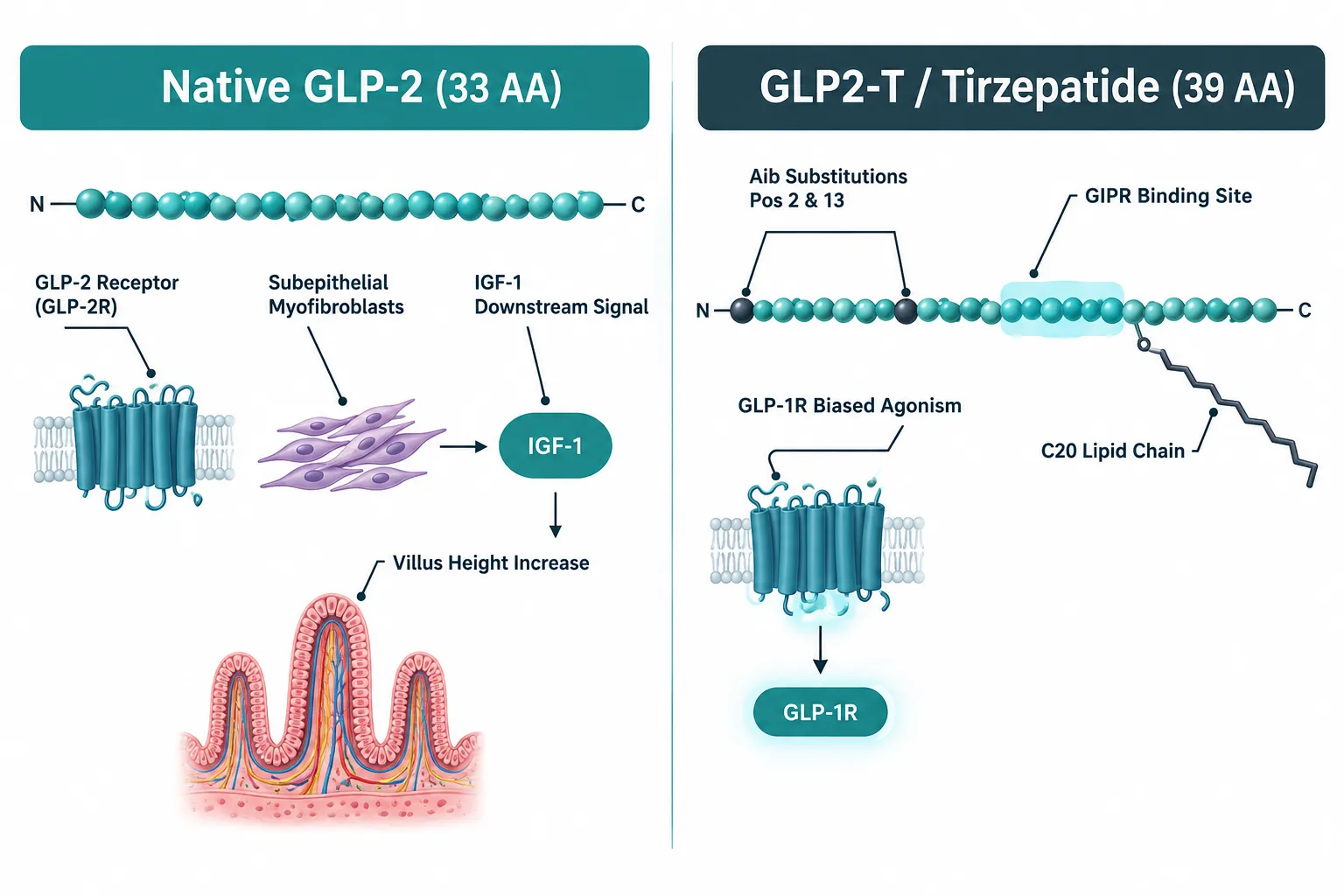
At the molecular level, the distinction begins with chain length and origin. Native GLP-2 is a 33-amino-acid peptide hormone derived from the proglucagon gene. It is secreted primarily by intestinal L-cells in response to nutrient intake and binds with high specificity to the GLP-2 receptor (GLP-2R), a G-protein-coupled receptor expressed predominantly on subepithelial myofibroblasts and enteric neurons.

GLP2-T, by contrast, is a 39-amino-acid synthetic peptide. Its catalog synonyms include "GLP-2 T," "GLP-2 (T)," "P1206," and "LY3298176", the last being the research identifier for tirzepatide. The molecular formula is C225H348N48O68, with CAS number 2023788-19-2. This peptide is engineered as a dual GIP/GLP-1 receptor agonist, meaning it does not engage the GLP-2 receptor at all.

A September 2026 catalog update clarified this confusion directly, stating that "GLP-2 (T)" is a catalog alias and "not a chemical identity." The two compounds are separate entities that happen to share a naming convention used by some research suppliers.

Structural features of GLP2-T / Tirzepatide:

  • 39-amino-acid GIP-based linear backbone
  • C-terminal amidation
  • Aminoisobutyric acid (Aib) substitutions at positions 2 and 13
  • Attached C20 fatty acid lipid chain for albumin binding
  • Extended plasma half-life compared to native GLP-2

For researchers exploring related incretin-class compounds, the Tesofensine Mechanism Explained: Noradrenergic Appetite Modulation vs Incretin-Based GLP-3 and GLP-1 Pathways resource provides useful context on how GLP-1 pathway agents compare across different compound classes.

GLP2-T and GLP2 Tirz Peptide Differentiation: Receptor Binding Affinity Compared
GLP2-T and GLP2 Tirz Peptide Differentiation: Receptor Binding Affinity Compared

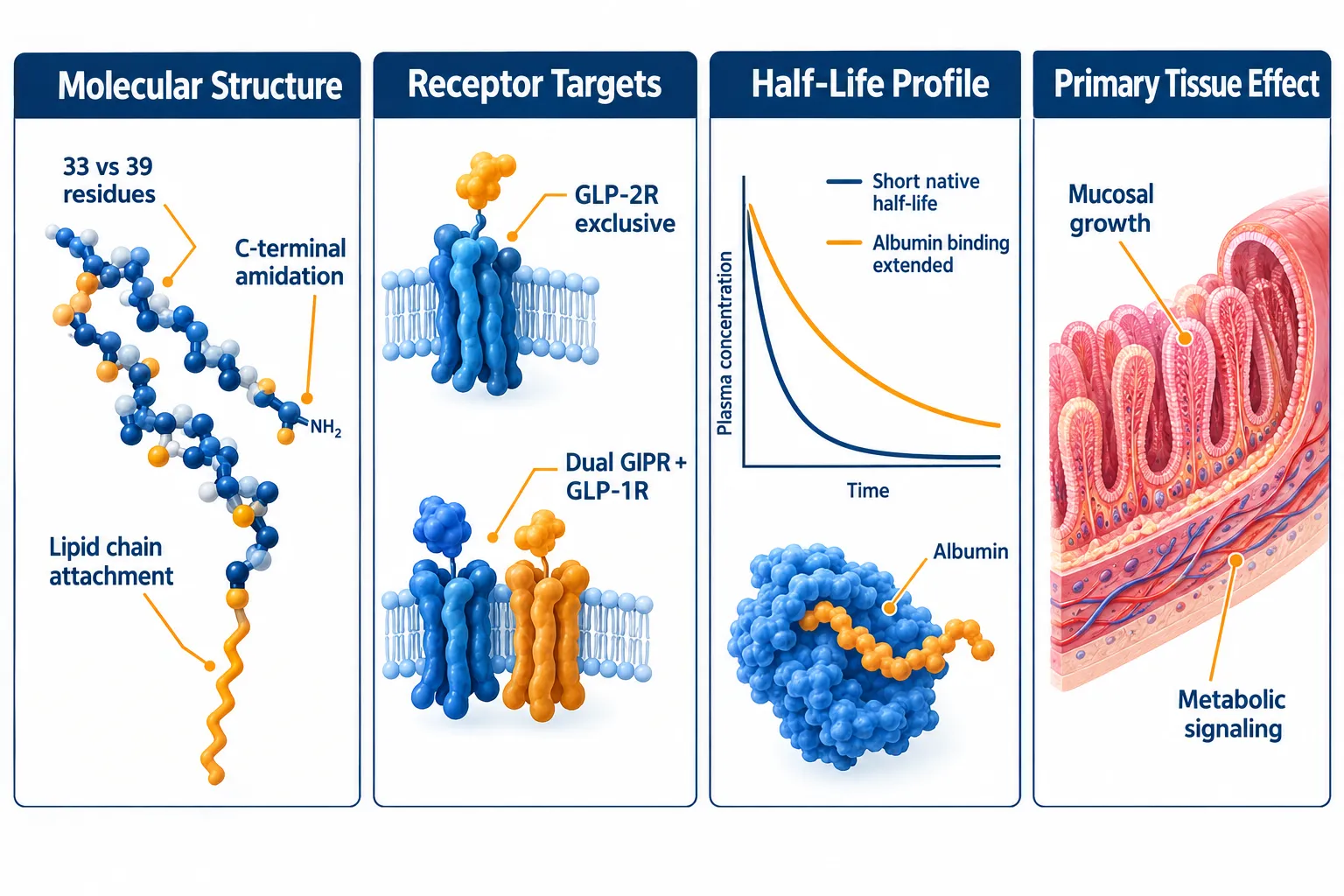
The receptor binding profiles of these two peptides represent the core of GLP2-T and GLP2 Tirz Peptide Differentiation: Receptor Binding Affinity and Intestinal Epithelial Growth Pathways research.

Native GLP-2 Receptor Binding

Native GLP-2 demonstrates exclusive, high-affinity binding to GLP-2R. Because GLP-2R is not expressed directly on enterocytes, its intestinotrophic effects are mediated indirectly through paracrine signaling. Downstream mediators include:

  • Insulin-like growth factor 1 (IGF-1), primary growth mediator
  • Keratinocyte growth factor (KGF)
  • Epidermal growth factor receptor (EGFR) ligands

This indirect mechanism is why GLP-2 increases villus height and mucosal thickness without directly stimulating epithelial cells at the receptor level.

GLP2-T / Tirzepatide Receptor Binding

GLP2-T delivers balanced GIP receptor (GIPR) agonism combined with biased GLP-1 receptor (GLP-1R) activation. The term "biased" here is important: GLP2-T activates GLP-1R through a qualitatively different signaling profile compared to native GLP-1 analogs such as semaglutide. This biased agonism is thought to contribute to its distinct metabolic effects in preclinical models.

Key Distinction: GLP2-T binds GIPR and GLP-1R with high affinity. Native GLP-2 binds GLP-2R exclusively. Neither compound substitutes for the other in receptor-specific research protocols.
Feature Native GLP-2 GLP2-T (Tirzepatide)
Chain length 33 amino acids 39 amino acids
Primary receptor GLP-2R GIPR + GLP-1R
Lipid chain None C20 fatty acid
Half-life extension Short (native) Extended (albumin binding)
Intestinal growth effect Direct intestinotrophic Indirect / metabolic
Research classification Endogenous hormone analog Synthetic dual agonist

Researchers working with GLP-class peptides may also find the Peptides 101 for Research-Use Only Buyers: Structure, Mechanisms, and Where GLP-3, MOTS-C, and 5-Amino-1MQ Fit In article a useful structural primer.

Intestinal Epithelial Growth Pathways: How GLP-2 Drives Mucosal Expansion
Intestinal Epithelial Growth Pathways: How GLP-2 Drives Mucosal Expansion

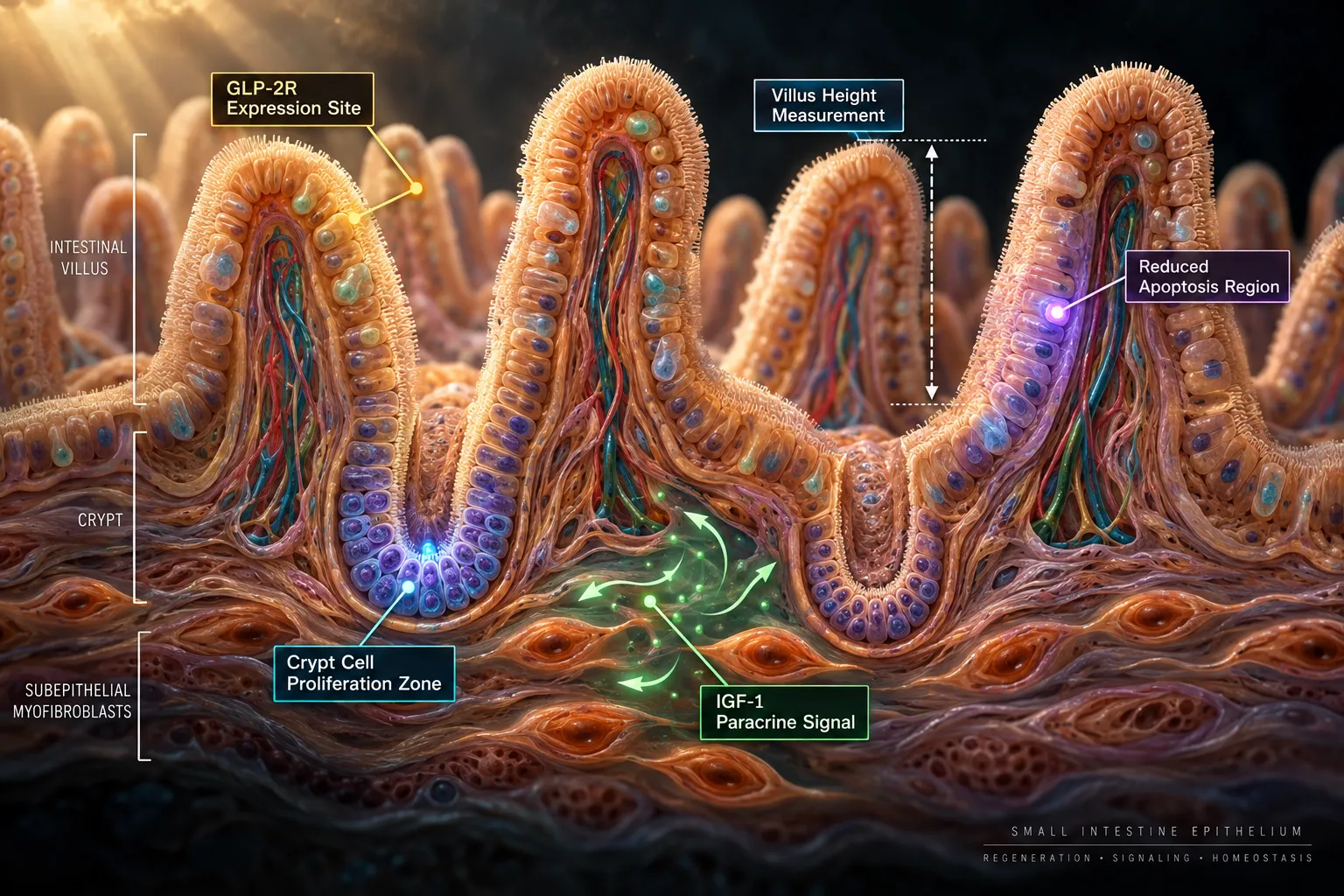
The intestinotrophic pathway activated by native GLP-2 is well-characterized in the peer-reviewed literature and forms the mechanistic basis for GLP-2 analog therapies used in malabsorptive conditions such as short bowel syndrome.

The GLP-2R Signaling Cascade

When GLP-2 binds GLP-2R on subepithelial myofibroblasts and enteric neurons, it initiates a signaling cascade that produces measurable structural changes in the intestinal mucosa:

  1. GLP-2R activation on subepithelial myofibroblasts
  2. IGF-1 secretion into the lamina propria
  3. Crypt cell proliferation increases
  4. Apoptosis suppression in villus epithelial cells
  5. Net increase in villus height and mucosal surface area
  6. Enhanced nutrient absorption capacity

These effects are specific to the GLP-2/GLP-2R axis. GLP2-T/tirzepatide does not replicate this pathway because it does not bind GLP-2R.

Why GLP2-T Does Not Substitute in Intestinal Epithelial Research

Researchers investigating intestinal epithelial growth pathways must use native GLP-2 or a GLP-2 analog when the experimental goal involves mucosal mass, villus morphology, or crypt proliferation. Using GLP2-T in place of GLP-2 would produce results reflecting GIPR and GLP-1R activity, a fundamentally different biological context.

For researchers exploring related GLP-class compounds, the GLP-3 Peptide for Sale and GLP-3R 10mg Peptide GA10 pages offer additional context on adjacent incretin-family research tools. Similarly, the Peptides and Polypeptides in Endocrine Pharmacology: How Enclomiphene Interfaces with Estrogen Receptor Biology article illustrates how receptor specificity shapes research outcomes across peptide classes.

Practical Implications for GLP2-T and GLP2 Tirz Peptide Differentiation in Research Design

The naming ambiguity between GLP-2 and GLP2-T is not trivial. Selecting the wrong compound based on a catalog alias can invalidate experimental results. Researchers should apply the following verification steps before procurement:

  • Confirm CAS number: Native GLP-2 analogs carry different CAS identifiers than tirzepatide (CAS 2023788-19-2).
  • Check molecular formula: C225H348N48O68 confirms tirzepatide identity.
  • Review receptor target: GLP-2R studies require GLP-2; GIPR/GLP-1R studies require GLP2-T.
  • Verify chain length: 33 residues (GLP-2) vs. 39 residues (GLP2-T/tirzepatide).
  • Confirm lipid modification: The C20 lipid chain is exclusive to GLP2-T.

Those sourcing GLP-class research compounds may also find the GLP-3 Peptide RETA 10mg 99% Pure Third Party Tested listing useful for understanding purity and testing standards relevant to this compound family.

Conclusion

The confusion between native GLP-2 and GLP2-T (tirzepatide) stems from a catalog naming convention, not from any shared biochemistry. Native GLP-2 is a 33-residue endogenous hormone that exclusively activates GLP-2R to drive intestinal mucosal growth through IGF-1-mediated paracrine signaling. GLP2-T is a 39-residue synthetic dual agonist targeting GIPR and GLP-1R, with no GLP-2R activity.

Actionable next steps for researchers:

  • Always cross-reference CAS numbers and molecular formulas before ordering either compound.
  • Design experimental protocols around receptor target, not catalog name.
  • When studying intestinal epithelial growth pathways, confirm that the compound selected activates GLP-2R specifically.
  • Consult third-party tested product documentation to verify structural identity and purity before use.
  • Review incretin-class receptor biology literature to understand how biased GLP-1R agonism in GLP2-T differs from canonical GLP-1R activation.

Precision in peptide selection is the foundation of reproducible gastrointestinal research. Understanding GLP2-T and GLP2 Tirz Peptide Differentiation: Receptor Binding Affinity and Intestinal Epithelial Growth Pathways at the structural level ensures that experimental outcomes reflect the intended biology, not a naming artifact.

https://www.puretestedpeptides.com/wp-content/uploads/2026/09/glp2-t-and-glp2-tirz-peptide-differentiation-receptor-binding-affinity-and-intes.webp 1024 1536 https://www.puretestedpeptides.com/wp-content/uploads/2026/01/buy-peptides-online.jpg 2026-09-19 13:04:032026-09-19 13:04:03GLP2-T and GLP2 Tirz Peptide Differentiation: Receptor Binding Affinity and Intestinal Epithelial Growth Pathways
×

Helpful Links

  • My account
  • Cart
  • Checkout
  • Refund and Returns Policy
  • Privacy Policy
  • SMS Privacy Policy
  • Login
  • My Account
  • Logout

USA Made Lab Tested Peptides

All products are sold for research, laboratory, or analytical purposes only, and are not for human consumption


Pure Tested Peptides is a chemical supplier. Pure Tested Peptides is not a compounding / chemical compounding facility as defined under 503A of the Federal Food, Drug, and Cosmetic act. Pure Tested Peptides is not an outsourcing facility as defined under 503B of the Federal Food, Drug, and Cosmetic act.

The statements made within this website have not been evaluated by the US Food and Drug Administration. The products we offer are not intended to diagnose, treat, cure or prevent any disease.

Human/Animal Consumption Prohibited. Laboratory/In-Vitro Experimental Use Only

Scroll to top Scroll to top Scroll to top