Call or Text 727-513-9780
  • Shopping Cart Shopping Cart
    0Shopping Cart
Pure Tested Peptides | America's most trusted Peptides for sale online
  • Peptides for sale
    • Oral Peptides for sale
      • Peptide Capsules for sale
      • BPC 157 Capsules 1000mcg
      • SLU-PP-332 Capsules | 1000 mcg
      • 5-Amino-1MQ 50mg Capsules
      • Tesofensine 500mcg
    • All Peptides for sale
    • Peptide Sprays
      • BPC 157 Nasal Spray Kit
      • BPC-157 TB500 Nasal Spray Kit
      • Semax Nasal Spray 10mg
      • Selank – Nasal Spray Kit – 10mg
      • Epithalon 50MG Nasal Spray Kit
      • Ipamorelin 10mg Nasal Spray
      • Klow Nasal Spray (BPC-157 + TB-500 + GHK-Cu + KPV) | 80mg
      • Hulk Nasal Spray Tesa / Ipa Blend 6/3 MG
      • Klow Nasal Spray
      • NAD + 500 mg Nasal Spray
      • PT-141 Nasal Spray Kit
    • GHRH Peptides
      • Ipa Peptides
      • CJC-1295 Peptides
        • CJC-1295 with DAC 5 mg
        • CJC-1295 without DAC 5 mg
        • CJC-1295 Ipa 10mg
      • Tesa Peptides
        • Tesa Peptide
        • Tesa 20 mg
    • GHK-Cu Peptides
      • All GHK-Cu Peptides
      • GHK-Cu 100mg
      • KLOW Peptide Blend – Buy KLOW blend online
    • BPC Peptides
      • All BPC Peptides
      • BPC-157
      • BPC-157 TB-500
      • BPC 157 capsules 1000mcg
    • SLU-PP-332 Peptides
      • All SLU-PP-332 Peptides
      • SLU-PP-332 5mg
    • GLP3 Peptides
    • PT-141 Peptides
      • PT-141 Peptides for sale
      • PT-141 10mg
      • PT-141 Nasal Spray
    • CAG Peptides
      • Lipo-C Peptide Blend
      • CAG 5mg
      • CAG 10mg
    • MOTS-C Peptides
      • MOTS-C Peptides for sale
      • MOTS-c peptide
      • MOTS-c 10mg *6 pack*
    • 5 Amino 1MQ Peptides
      • 5 Amino 1MQ Peptides for sale
      • 5-Amino-1MQ 50mg Capsules
      • 5-Amino-1MQ 5mg
    • Epithalon Peptides
      • Epithalon Peptides for sale
      • Epithalon 10mg
      • Epithalon 50mg
  • Shop
    • GLPs
      • 5-Amino-1MQ 50mg Capsules
      • 5-Amino-1MQ 5mg
      • L-Carnitine 500mg/ml
      • Tesofensine 500mcg
      • SLU-PP-332 5mg
      • MOTS-c 10mg *6 pack*
    • Epithalon & BPC Peptides
      • Epithalon 10mg
      • Epithalon 50mg
      • BPC-157
      • BPC 157 capsules 1000mcg
      • BPC-157 TB-500
      • BPC-157 TB500 Nasal Spray Kit
      • BPC 157 Nasal Spray Kit
    • BPC TB-500 & NAD+ Peptides
      • NAD+ 500 mg
      • KLOW Peptide Blend – Buy KLOW blend online
      • GLOW Peptide Blend
      • TB 500 5mg
      • BPC 157 capsules 1000mcg – Supplement
      • BPC 157 Nasal Spray Kit
      • BPC-157
      • BPC-157 TB500 Nasal Spray Kit
      • BPC-157 TB-500
      • BPC 157 capsules 1000mcg
    • LL-37 Peptide
      • LL-37 10 mg
    • MOTS-C & Selank
      • MOTS-c peptide
      • Selank 10mg
    • GHK Peptides
      • GHK-Cu 100mg
      • GLOW Peptide Blend
      • KLOW Peptide Blend – Buy KLOW blend online
  • COAs
  • Wholesale
    • Wholesale Peptides for sale
  • PTP FAQ
  • Affiliates
    • Selank Peptide: Advanced Pharmacological Mechanisms Underlying Its Anxiolytic and Nootropic Effects in Research
      • 5-Amino-1MQ Peptide: Detailed Mechanisms of NNMT Inhibition and Its Impact on Cellular Metabolism Research
        • MOTS-C Peptide: Unraveling Its Role in Mitochondrial Dynamics and Energy Metabolism Research
          • Epithalon Peptide and Telomerase Regulation: Investigating Its Impact on Cellular Senescence and Lifespan Research Models
            • GLP2-T vs GLP2 Tirz Peptide: Understanding the Naming, Mechanistic Nuances, and Research Implications for Gut Health
      • Peptides and Polypeptides in Modern Pharmacology: What Research on Metoprolol, Prednisone, and Amlodipine Reveals
        • Polypeptide Peptides vs NSAIDs: What Naproxen and Diclofenac Teach Tissue-Repair Researchers About BPC‑157 and TB‑500
          • Peptides and Polypeptides in Endocrine Pharmacology: How GLP-1, GLP-2, and GLP-3 Retatrutide Differ From Classic Drugs Like Prednisone and Amlodipine
          • 5‑Amino‑1MQ Peptide and NNMT Inhibition: How It Compares With Statins Like Atorvastatin in Adipose and Lipid Metabolism Research
      • Enclomiphene, Estrogen Receptor Signaling, and Luteinizing Phase Biology: What Hormone Researchers Should Measure
        • Mesenchymal Stem Cells, BPC‑157, and GHK‑Cu: How Tissue Repair Peptides Compare With Classic NSAIDs Like Naproxen in Injury Models
          • Peptide Calculator Use Cases Beyond Growth Hormone: Working Through GLP‑3 Retatrutide, MOTS‑c, and BPC‑157 Research Dosing
        • Polypeptide Peptides in Endocrine and Metabolic Pharmacology: Lessons From Amlodipine, Prednisone, and Metoprolol
        • Peptides Calculator for Advanced Blends: Worked Examples for Tesamorelin, CJC‑1295, and Ipamorelin Stacks
          • Peptides and Polypeptides in Human Physiology: How Molecular Size Shapes Research Applications
            • Selank Peptide: Advanced Pharmacological Mechanisms Underlying Its Anxiolytic and Nootropic Effects in Research
          • 5-Amino-1MQ Peptide: Detailed Mechanisms of NNMT Inhibition and Its Impact on Cellular Metabolism Research
            • MOTS-C Peptide: Unraveling Its Role in Mitochondrial Dynamics and Energy Metabolism Research
              • Epithalon Peptide and Telomerase Regulation: Investigating Its Impact on Cellular Senescence and Lifespan Research Models
                • GLP2-T vs GLP2 Tirz Peptide: Understanding the Naming, Mechanistic Nuances, and Research Implications for Gut Health
                  • Peptides and Polypeptides in Endocrine Pharmacology: How GLP-1, GLP-2, and GLP-3 Retatrutide Differ From Classic Drugs Like Prednisone and Amlodipine
                    • Polypeptide Peptides vs NSAIDs: What Naproxen and Diclofenac Teach Tissue-Repair Researchers About BPC‑157 and TB‑500
                      • Peptides and Polypeptides in Modern Pharmacology: What Research on Metoprolol, Prednisone, and Amlodipine Reveals
                        • 5‑Amino‑1MQ Peptide and NNMT Inhibition: How It Compares With Statins Like Atorvastatin in Adipose and Lipid Metabolism Research
                        • Enclomiphene, Estrogen Receptor Signaling, and Luteinizing Phase Biology: What Hormone Researchers Should Measure
                        • Mesenchymal Stem Cells, BPC‑157, and GHK‑Cu: How Tissue Repair Peptides Compare With Classic NSAIDs Like Naproxen in Injury Models
                        • Peptide Calculator Use Cases Beyond Growth Hormone: Working Through GLP‑3 Retatrutide, MOTS‑c, and BPC‑157 Research Dosing
                        • Polypeptide Peptides in Endocrine and Metabolic Pharmacology: Lessons From Amlodipine, Prednisone, and Metoprolol
                        • Peptides Calculator for Advanced Blends: Worked Examples for Tesamorelin, CJC‑1295, and Ipamorelin Stacks
                        • Peptides and Polypeptides in Human Physiology: How Molecular Size Shapes Research Applications
                        • Selank Peptide: Advanced Pharmacological Mechanisms Underlying Its Anxiolytic and Nootropic Effects in Research
                        • MOTS-C Peptide: Unraveling Its Role in Mitochondrial Dynamics and Energy Metabolism Research
                        • Peptides and Polypeptides in Modern Pharmacology: What Research on Metoprolol, Prednisone, and Amlodipine Reveals
                        • Peptides and Polypeptides in Endocrine Pharmacology: How GLP-1, GLP-2, and GLP-3 Retatrutide Differ From Classic Drugs Like Prednisone and Amlodipine
                        • 5-Amino-1MQ Peptide: Detailed Mechanisms of NNMT Inhibition and Its Impact on Cellular Metabolism Research
                        • Mesenchymal Stem Cells, BPC‑157, and GHK‑Cu: How Tissue Repair Peptides Compare With Classic NSAIDs Like Naproxen in Injury Models
                        • Peptide Calculator Use Cases Beyond Growth Hormone: Working Through GLP‑3 Retatrutide, MOTS‑c, and BPC‑157 Research Dosing
                        • GLP2-T vs GLP2 Tirz Peptide: Understanding the Naming, Mechanistic Nuances, and Research Implications for Gut Health
                        • Polypeptide Peptides in Endocrine and Metabolic Pharmacology: Lessons From Amlodipine, Prednisone, and Metoprolol
                        • Polypeptide Peptides vs NSAIDs: What Naproxen and Diclofenac Teach Tissue-Repair Researchers About BPC‑157 and TB‑500
                        • Peptides and Polypeptides in Human Physiology: How Molecular Size Shapes Research Applications
                        • Peptides Calculator for Advanced Blends: Worked Examples for Tesamorelin, CJC‑1295, and Ipamorelin Stacks
                        • 5‑Amino‑1MQ Peptide and NNMT Inhibition: How It Compares With Statins Like Atorvastatin in Adipose and Lipid Metabolism Research
                        • Enclomiphene, Estrogen Receptor Signaling, and Luteinizing Phase Biology: What Hormone Researchers Should Measure
                        • Epithalon Peptide and Telomerase Regulation: Investigating Its Impact on Cellular Senescence and Lifespan Research Models
                        • Best research protocol Klow blend
                        • best time to take BPC-157
                        • best time to take DSIP (Delta Sleep Inducing Peptide)
                        • best time to take CJC-1295
                        • best time to take AOD-9604
                        • best time to take Follistatin 344
                        • best time to take Ipamorelin
                        • best time to take MK-677 (Ibutamoren)
                        • best time to take Ligandrol (LGD-4033) — research compound
                        • best time to take Ostarine (MK-2866) — research compound
                        • best time to take GHK-CU
                        • best time to take TB-500
                        • best time to take MOTS-c
                        • best time to take Semax
                        • best time to take RAD-140 (Testolone) — research compound
                        • best time to take Thymosin Alpha-1
                        • best time to take PEG-MGF
                        • Biolife Plasma, Octapharma Plasma, and Research Peptides: How Plasma Donation Labs Differ From Peptide Suppliers
                        • best time to take YK-11 — research compound
                        • best time to take PT-141 (Bremelanotide)
                        • Best research protocol Klow blend
                        • 5-Amino-1MQ and MOTS-C Synergy: Metabolic Signaling, Mitochondria, and Research Design
                        • BPC-157 and TB-500: Investigating Their Combined Effects on Angiogenesis and Cellular Migration in Tissue Repair Models
                        • BPC-157 Peptide: Gut Barrier Function, Inflammation, and Tissue-Recovery Research
                        • 5‑Amino‑1MQ and MOTS‑c Synergy in Metabolic Research: Designing NNMT and Mitochondrial Biogenesis Stacks
                        • CJC-1295 with DAC vs. Without DAC: Half-Life, Release Kinetics, and Research Implications
                        • CJC‑1295 with DAC vs. Without DAC: Expanding on Half‑Life Differences Using Tesamorelin and Ipamorelin Blend Case Studies
                        • Collagen Biology and Copper‑Binding Peptides: How GHK‑Cu, Glow Blend, and Klow Blend Interact with Skin and Connective Tissue
                        • Collagen Biology and Regenerative Peptides: How GHK‑Cu, Glow Blend, and Klow Blend Affect Extracellular Matrix Research
                    • DNA, Telomeres, and Longevity Peptides: Positioning Epithalon and MOTS‑c in Genetic Aging Research
                      • Enclomiphene Citrate: serm Mechanism, Testosterone Research, and Stack Compatibility
                        • Enclomiphene vs Enclomiphene Citrate: Formulation, Bioavailability, and Research Distinctions
                        • Epithalon Peptide Research: Telomerase Activation, Aging, and Pineal Gland Function
                        • Estrogen Receptor Signaling and Enclomiphene: How Selective Modulators Compare with Classic Polypeptide Hormones
                        • GHK-Cu Peptide: Advanced Mechanisms in Extracellular Matrix Remodeling and Wound Healing Research
                        • GHK-Cu Peptide: Collagen Synthesis, Wound Repair, and Skin-Barrier Research Models
                        • GLP-1 vs GLP-3 vs GLP-2: Peptide Classification and Research Applications
                        • GLP-2 Peptide Research Guide: Gut Barrier Function, Nutrient Absorption, and Intestinal Recovery Models
                        • GLP-3 Retatrutide vs. GLP-1 Drugs: What Triple-Agonist Biology Changes in Research Models
                        • Ipamorelin and Tesamorelin Combination: Synergistic GH Secretagogue Research and Dosing Protocols
                        • GLP2 Tirz Peptide: What It Is, Why the Name Exists, and How Researchers Should Interpret It
                        • Klow Blend Peptide Nasal Spray: What the Formulation Is Trying to Do in Cognitive Research
                        • Mitochondria, NNMT Inhibition, and Peptide Modulators: Where MOTS‑c and 5‑Amino‑1MQ Fit in Cellular Energy Research
                        • MOTS-c Peptide: Mitochondrial Function, Energy Metabolism, and What Researchers Measure
                        • MOTS-c vs. 5-Amino-1MQ: Which Metabolic Research Questions Each Compound Actually Answers
                        • Nasal Spray Peptides: Bioavailability, Administration, and Semax/Selank Research Applications
                        • PT-141 Peptide Research: Mechanism of Action and Melanocortin Receptor Signaling
                        • Retatrutide for Research: Mechanism, Structure, and GLP-1/GLP-3 Dual Action
                        • Retatrutide for Obesity and Type 2 Diabetes: What the Latest Trial Data Suggest
                        • Tesofensine Peptide Research: Mechanism, Appetite Suppression, and Neuropeptide Y Pathways
  • Contact
    • Contact Customer Service
    • Text Customer Support
  • About US
  • Shop all peptides
  • Affiliate Program
    • Affiliate Signup
  • Login / Register Login / Register Page Link Login / Register Page Link
  • Click to open the search input field Click to open the search input field Search
  • Menu Menu

Tag Archive for: glp-2 teduglutide

Where to Buy Research-Grade GLP2-T and GLP2 Tirz Peptides: Navigating Naming Confusion, Certificates of Analysis, and Storage

Where to Buy Research-Grade GLP2-T and GLP2 Tirz Peptides: Navigating Naming Confusion, Certificates of Analysis, and Storage

September 21, 2026/0 Comments/in Uncategorized/by

More than a dozen vendor aliases now circulate for what is essentially the same class of incretin-analog research compound, and that naming chaos is costing laboratories time, money, and experimental validity. For any researcher trying to understand where to buy research-grade GLP2-T and GLP2 Tirz peptides: navigating naming confusion, certificates of analysis, and storage is not a minor administrative task; it is a prerequisite for reproducible science.

Key Takeaways

  • GLP2-T and GLP2 Tirz are distinct compounds: the first is a teduglutide-type GLP-2 analog; the second is a tirzepatide analog (LY3298176 scaffold), confusing them leads to flawed experimental design.
  • Vendor naming inconsistency is widespread in 2026; always map the alias back to the confirmed amino acid sequence before ordering.
  • A legitimate Certificate of Analysis (COA) must include HPLC purity, mass spectrometry confirmation, lot number, and test date.
  • Lyophilized GLP2-T and GLP2 Tirz peptides should be stored at -20°C; reconstituted solutions degrade rapidly above 4°C.
  • These compounds are sold strictly for laboratory research purposes and are not approved for human use.

Understanding the Naming Confusion Around GLP2-T and GLP2 Tirz
Understanding the Naming Confusion Around GLP2-T and GLP2 Tirz

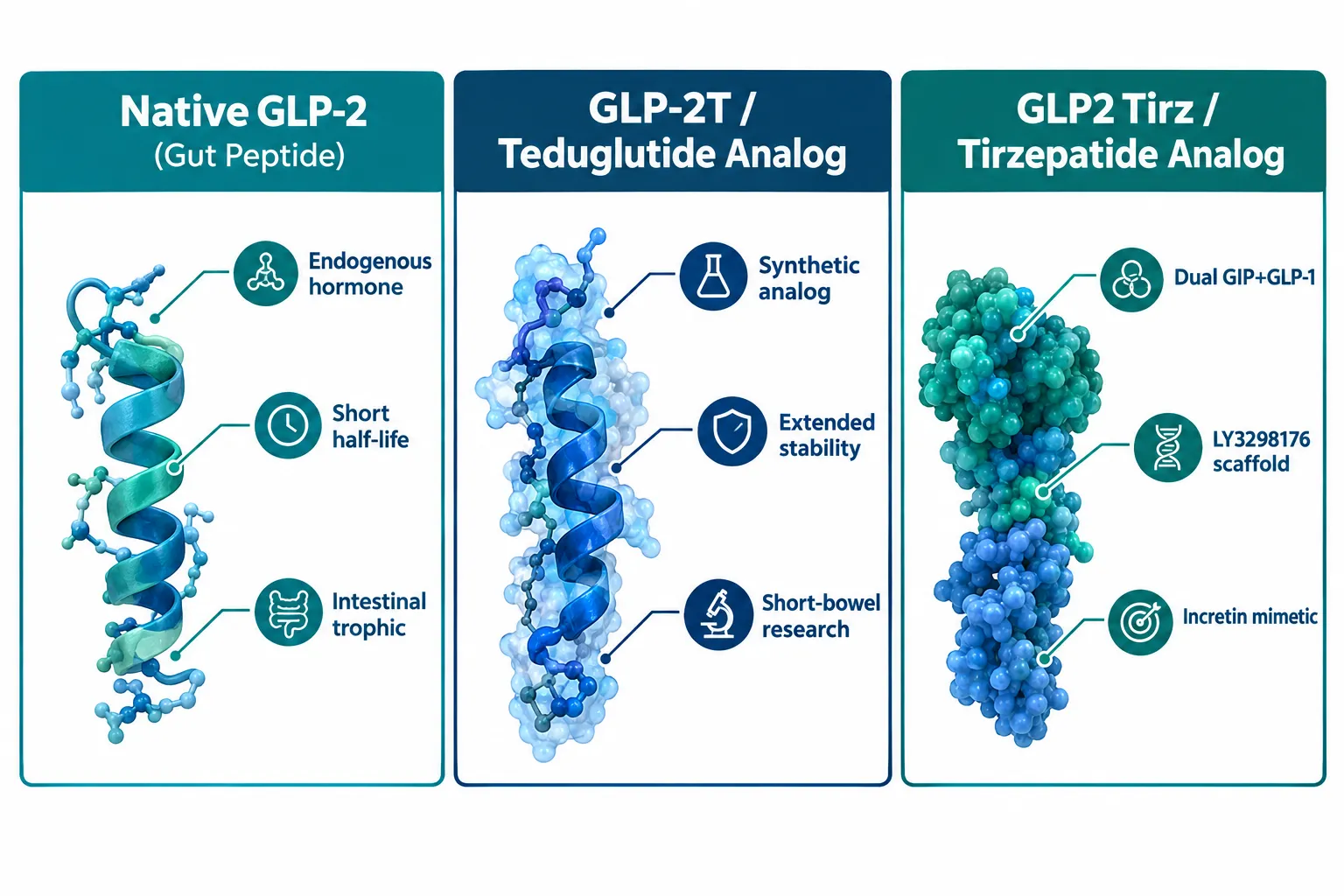
Three distinct molecules share overlapping abbreviations in current vendor catalogs, and conflating them is a serious research error.

Native GLP-2 is an endogenous gut peptide secreted by intestinal L-cells. It promotes intestinal growth and barrier function but has a very short half-life in circulation. It is not the same as either research compound discussed here.

GLP-2T (sometimes written GLP2-T or GLP-2 Tirz in some catalogs) most accurately refers to a synthetic teduglutide-type analog, a longer-acting GLP-2 derivative designed to resist dipeptidyl peptidase-4 degradation. It is studied for intestinal adaptation models and short-bowel syndrome research.

GLP2 Tirz, by contrast, is a tirzepatide analog built on the LY3298176 scaffold. Tirzepatide is a dual GIP and GLP-1 receptor agonist. When vendors use the label "GLP2 Tirz," they are almost always referring to this incretin mimetic, not to a GLP-2 gut peptide at all. The "GLP2" prefix in this context is a vendor shorthand, not a pharmacological classification.

"The single most common sourcing mistake in 2026 is ordering a GLP-2 gut peptide when the research protocol calls for a tirzepatide analog, or vice versa."

Researchers exploring the broader incretin peptide landscape may also find it useful to review GLP-1 peptides to understand how receptor-targeting profiles differ across this compound class. For those specifically investigating GLP-3-type analogs, browsing GLP-3 peptides for sale provides additional context on related naming conventions.

Quick alias mapping table:

Vendor Label Likely Identity Primary Receptor Target
GLP2-T Teduglutide analog GLP-2 receptor
GLP2 Tirz Tirzepatide analog (LY3298176) GIP + GLP-1 receptors
GLP-2 Native gut peptide GLP-2 receptor
GLP-3R GLP-3 receptor-targeted analog GLP-3 receptor

Always request the full amino acid sequence from the vendor before ordering. A sequence confirmation eliminates alias ambiguity entirely.

Where to Buy Research-Grade GLP2-T and GLP2 Tirz Peptides: Vendor Selection and COA Standards
Where to Buy Research-Grade GLP2-T and GLP2 Tirz Peptides: Vendor Selection and COA Standards

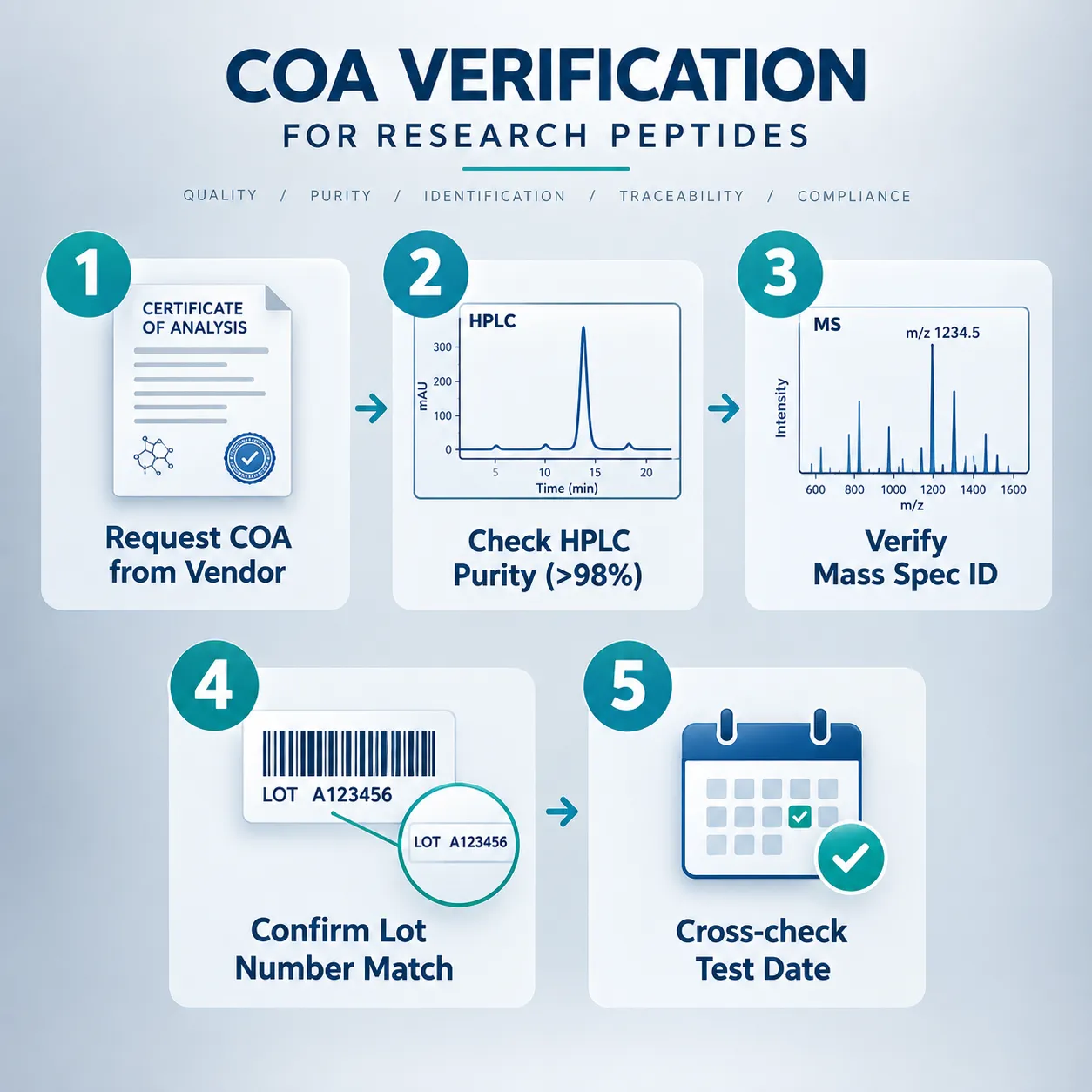
When navigating where to buy research-grade GLP2-T and GLP2 Tirz peptides, the Certificate of Analysis is the single most important document a vendor can provide. In 2026, reputable suppliers now offer multi-point COAs as a baseline expectation, not a premium feature.

A compliant COA for GLP2-T or GLP2 Tirz should include:

  • HPLC purity result: Minimum 98% purity is the accepted research-grade threshold. Results below 95% indicate insufficient purification.
  • Mass spectrometry (MS) confirmation: Confirms the molecular weight matches the stated sequence. This is non-negotiable for peptides above 3,000 Da.
  • Lot number: Enables batch-level traceability. If a vendor cannot supply lot-specific COAs, treat that as a disqualifying red flag.
  • Test date: COA data older than 18 months should be treated with caution, particularly for reconstituted or improperly stored stock.
  • Endotoxin testing: Increasingly standard for injectable-grade research peptides.

Vendors offering GLP-3 peptide products alongside GLP2-T analogs often apply the same COA standards across their incretin catalog, which simplifies cross-compound procurement for multi-peptide research programs.

Vendor red flags to avoid:

  • No third-party testing; only in-house COA claims
  • Purity stated as a range (e.g., "95-99%") rather than a specific lot result
  • No mass spec data provided
  • Inability to confirm the amino acid sequence on request

Legal status in 2026 remains firm: GLP2-T and GLP2 Tirz peptides are research chemicals sold exclusively for in vitro and preclinical laboratory use. FDA enforcement activity has increased around vendors marketing these compounds with clinical language or dosing guidance. Researchers should purchase only from suppliers who clearly label products as "for research use only" and do not provide human-use instructions.

For researchers working across multiple peptide classes, understanding how endocrine pharmacology intersects with receptor biology is valuable context, the article on peptides and polypeptides in endocrine pharmacology covers relevant mechanistic background.

Storage Best Practices for Lyophilized and Reconstituted GLP2-T and GLP2 Tirz
Storage Best Practices for Lyophilized and Reconstituted GLP2-T and GLP2 Tirz

Improper storage is the leading cause of peptide degradation in research settings, and GLP2-T and GLP2 Tirz analogs are particularly sensitive given their longer amino acid chains and susceptibility to oxidation.

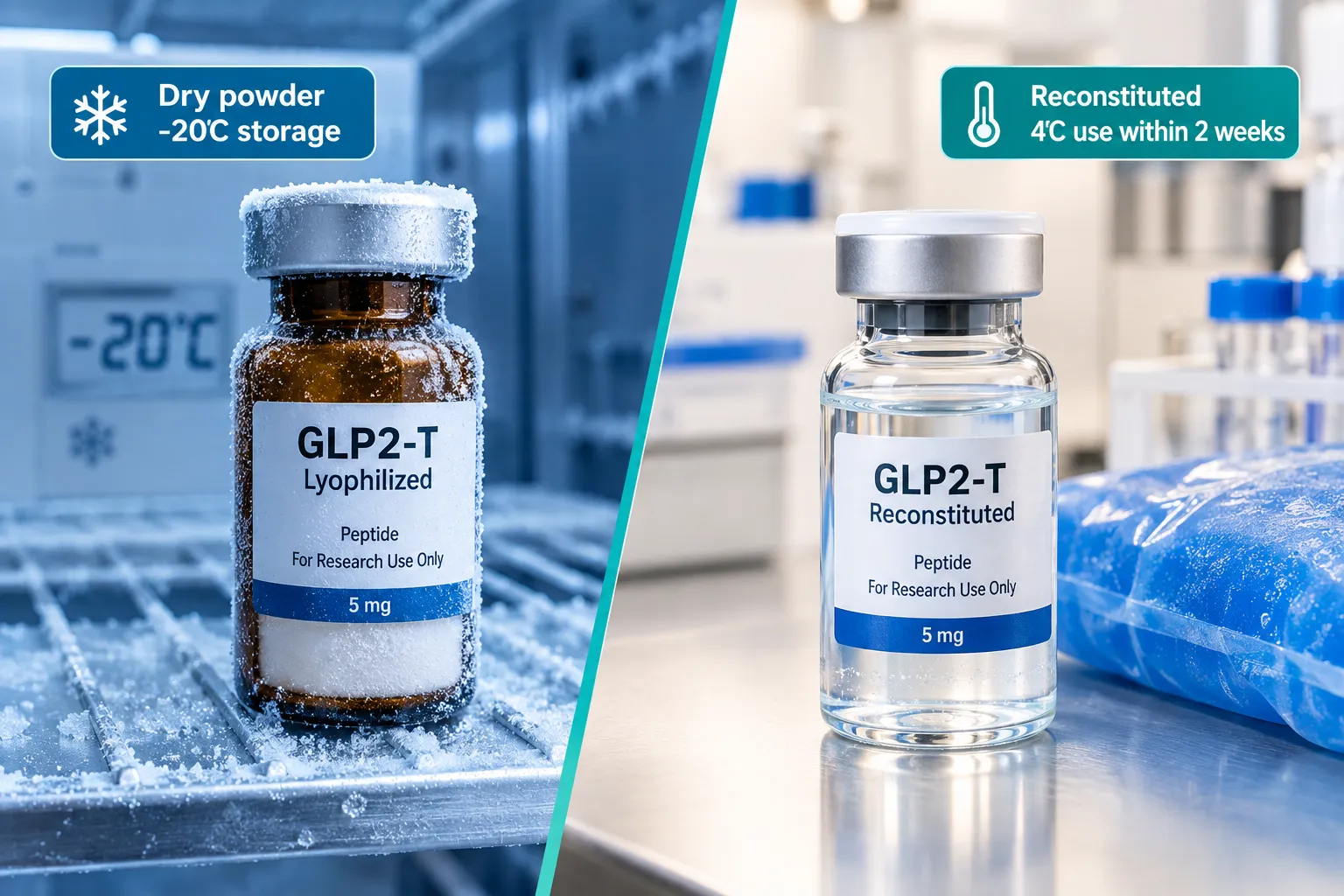
Lyophilized (dry powder) storage:

  • Store at -20°C in a frost-free freezer, away from repeated freeze-thaw cycling
  • Keep vials sealed and desiccated until use
  • Avoid storing near the freezer door where temperature fluctuates
  • Shelf stability at -20°C: typically 24 months from manufacture date when properly sealed

After reconstitution:

  • Use sterile bacteriostatic water or the diluent specified in the COA
  • Store reconstituted solution at 4°C (standard laboratory refrigerator)
  • Use within 14 days of reconstitution; many researchers treat 7 days as the conservative limit for high-sensitivity assays
  • Avoid repeated freeze-thaw of reconstituted solution, aliquot before freezing if longer storage is needed
  • Protect from light; amber vials or foil wrapping are recommended

Common storage mistakes:

  1. Reconstituting with plain sterile water instead of bacteriostatic water (accelerates microbial contamination)
  2. Storing lyophilized peptide at 4°C instead of -20°C (reduces shelf life significantly)
  3. Failing to aliquot before freezing reconstituted stock (freeze-thaw degradation compounds with each cycle)

Researchers sourcing related mitochondria-targeted peptides alongside GLP2-T may find parallel storage guidance applicable, the SS-31 kidney health research resource addresses cold-chain handling for similarly sensitive compounds.

For those building multi-peptide research stacks, the IPA Sermorelin stack research article provides useful context on how storage compatibility across peptide classes affects experimental design.

Conclusion

The path to reliable GLP2-T and GLP2 Tirz research starts before the order is placed. Confirm the compound identity by sequence, not by vendor label. Demand a lot-specific COA with HPLC purity above 98%, mass spec confirmation, and a recent test date. Store lyophilized peptide at -20°C and work quickly once reconstituted. Avoid any vendor that uses clinical language, omits third-party testing, or cannot clarify which molecule they are actually selling.

Actionable next steps:

  1. Map the vendor's alias to the confirmed amino acid sequence before purchasing.
  2. Request a current, lot-specific COA and verify all five key data points before use.
  3. Establish a cold-chain protocol before the shipment arrives, not after.
  4. Monitor FDA guidance updates, as enforcement around incretin-analog marketing language is expected to tighten through late 2026.
https://www.puretestedpeptides.com/wp-content/uploads/2026/09/where-to-buy-research-grade-glp2-t-and-glp2-tirz-peptides-navigating-naming-conf.webp 1024 1536 https://www.puretestedpeptides.com/wp-content/uploads/2026/01/buy-peptides-online.jpg 2026-09-21 13:10:302026-09-21 13:10:30Where to Buy Research-Grade GLP2-T and GLP2 Tirz Peptides: Navigating Naming Confusion, Certificates of Analysis, and Storage
×

Helpful Links

  • My account
  • Cart
  • Checkout
  • Refund and Returns Policy
  • Privacy Policy
  • SMS Privacy Policy
  • Login
  • My Account
  • Logout

USA Made Lab Tested Peptides

All products are sold for research, laboratory, or analytical purposes only, and are not for human consumption


Pure Tested Peptides is a chemical supplier. Pure Tested Peptides is not a compounding / chemical compounding facility as defined under 503A of the Federal Food, Drug, and Cosmetic act. Pure Tested Peptides is not an outsourcing facility as defined under 503B of the Federal Food, Drug, and Cosmetic act.

The statements made within this website have not been evaluated by the US Food and Drug Administration. The products we offer are not intended to diagnose, treat, cure or prevent any disease.

Human/Animal Consumption Prohibited. Laboratory/In-Vitro Experimental Use Only

Scroll to top Scroll to top Scroll to top