Call or Text 727-513-9780
  • Shopping Cart Shopping Cart
    0Shopping Cart
Pure Tested Peptides | America's most trusted Peptides for sale online
  • Peptides for sale
    • Oral Peptides for sale
      • Peptide Capsules for sale
      • BPC 157 Capsules 1000mcg
      • SLU-PP-332 Capsules | 1000 mcg
      • 5-Amino-1MQ 50mg Capsules
      • Tesofensine 500mcg
    • All Peptides for sale
    • Peptide Sprays
      • BPC 157 Nasal Spray Kit
      • BPC-157 TB500 Nasal Spray Kit
      • Semax Nasal Spray 10mg
      • Selank – Nasal Spray Kit – 10mg
      • Epithalon 50MG Nasal Spray Kit
      • Ipamorelin 10mg Nasal Spray
      • Klow Nasal Spray (BPC-157 + TB-500 + GHK-Cu + KPV) | 80mg
      • Hulk Nasal Spray Tesa / Ipa Blend 6/3 MG
      • Klow Nasal Spray
      • NAD + 500 mg Nasal Spray
      • PT-141 Nasal Spray Kit
    • GHRH Peptides
      • Ipa Peptides
      • CJC-1295 Peptides
        • CJC-1295 with DAC 5 mg
        • CJC-1295 without DAC 5 mg
        • CJC-1295 Ipa 10mg
      • Tesa Peptides
        • Tesa Peptide
        • Tesa 20 mg
    • GHK-Cu Peptides
      • All GHK-Cu Peptides
      • GHK-Cu 100mg
      • KLOW Peptide Blend – Buy KLOW blend online
    • BPC Peptides
      • All BPC Peptides
      • BPC-157
      • BPC-157 TB-500
      • BPC 157 capsules 1000mcg
    • SLU-PP-332 Peptides
      • All SLU-PP-332 Peptides
      • SLU-PP-332 5mg
    • GLP3 Peptides
    • PT-141 Peptides
      • PT-141 Peptides for sale
      • PT-141 10mg
      • PT-141 Nasal Spray
    • CAG Peptides
      • Lipo-C Peptide Blend
      • CAG 5mg
      • CAG 10mg
    • MOTS-C Peptides
      • MOTS-C Peptides for sale
      • MOTS-c peptide
      • MOTS-c 10mg *6 pack*
    • 5 Amino 1MQ Peptides
      • 5 Amino 1MQ Peptides for sale
      • 5-Amino-1MQ 50mg Capsules
      • 5-Amino-1MQ 5mg
    • Epithalon Peptides
      • Epithalon Peptides for sale
      • Epithalon 10mg
      • Epithalon 50mg
  • Shop
    • GLPs
      • 5-Amino-1MQ 50mg Capsules
      • 5-Amino-1MQ 5mg
      • L-Carnitine 500mg/ml
      • Tesofensine 500mcg
      • SLU-PP-332 5mg
      • MOTS-c 10mg *6 pack*
    • Epithalon & BPC Peptides
      • Epithalon 10mg
      • Epithalon 50mg
      • BPC-157
      • BPC 157 capsules 1000mcg
      • BPC-157 TB-500
      • BPC-157 TB500 Nasal Spray Kit
      • BPC 157 Nasal Spray Kit
    • BPC TB-500 & NAD+ Peptides
      • NAD+ 500 mg
      • KLOW Peptide Blend – Buy KLOW blend online
      • GLOW Peptide Blend
      • TB 500 5mg
      • BPC 157 capsules 1000mcg – Supplement
      • BPC 157 Nasal Spray Kit
      • BPC-157
      • BPC-157 TB500 Nasal Spray Kit
      • BPC-157 TB-500
      • BPC 157 capsules 1000mcg
    • LL-37 Peptide
      • LL-37 10 mg
    • MOTS-C & Selank
      • MOTS-c peptide
      • Selank 10mg
    • GHK Peptides
      • GHK-Cu 100mg
      • GLOW Peptide Blend
      • KLOW Peptide Blend – Buy KLOW blend online
  • COAs
  • Wholesale
    • Wholesale Peptides for sale
  • PTP FAQ
  • Affiliates
    • Selank Peptide: Advanced Pharmacological Mechanisms Underlying Its Anxiolytic and Nootropic Effects in Research
      • 5-Amino-1MQ Peptide: Detailed Mechanisms of NNMT Inhibition and Its Impact on Cellular Metabolism Research
        • MOTS-C Peptide: Unraveling Its Role in Mitochondrial Dynamics and Energy Metabolism Research
          • Epithalon Peptide and Telomerase Regulation: Investigating Its Impact on Cellular Senescence and Lifespan Research Models
            • GLP2-T vs GLP2 Tirz Peptide: Understanding the Naming, Mechanistic Nuances, and Research Implications for Gut Health
      • Peptides and Polypeptides in Modern Pharmacology: What Research on Metoprolol, Prednisone, and Amlodipine Reveals
        • Polypeptide Peptides vs NSAIDs: What Naproxen and Diclofenac Teach Tissue-Repair Researchers About BPC‑157 and TB‑500
          • Peptides and Polypeptides in Endocrine Pharmacology: How GLP-1, GLP-2, and GLP-3 Retatrutide Differ From Classic Drugs Like Prednisone and Amlodipine
          • 5‑Amino‑1MQ Peptide and NNMT Inhibition: How It Compares With Statins Like Atorvastatin in Adipose and Lipid Metabolism Research
      • Enclomiphene, Estrogen Receptor Signaling, and Luteinizing Phase Biology: What Hormone Researchers Should Measure
        • Mesenchymal Stem Cells, BPC‑157, and GHK‑Cu: How Tissue Repair Peptides Compare With Classic NSAIDs Like Naproxen in Injury Models
          • Peptide Calculator Use Cases Beyond Growth Hormone: Working Through GLP‑3 Retatrutide, MOTS‑c, and BPC‑157 Research Dosing
        • Polypeptide Peptides in Endocrine and Metabolic Pharmacology: Lessons From Amlodipine, Prednisone, and Metoprolol
        • Peptides Calculator for Advanced Blends: Worked Examples for Tesamorelin, CJC‑1295, and Ipamorelin Stacks
          • Peptides and Polypeptides in Human Physiology: How Molecular Size Shapes Research Applications
            • Selank Peptide: Advanced Pharmacological Mechanisms Underlying Its Anxiolytic and Nootropic Effects in Research
          • 5-Amino-1MQ Peptide: Detailed Mechanisms of NNMT Inhibition and Its Impact on Cellular Metabolism Research
            • MOTS-C Peptide: Unraveling Its Role in Mitochondrial Dynamics and Energy Metabolism Research
              • Epithalon Peptide and Telomerase Regulation: Investigating Its Impact on Cellular Senescence and Lifespan Research Models
                • GLP2-T vs GLP2 Tirz Peptide: Understanding the Naming, Mechanistic Nuances, and Research Implications for Gut Health
                  • Peptides and Polypeptides in Endocrine Pharmacology: How GLP-1, GLP-2, and GLP-3 Retatrutide Differ From Classic Drugs Like Prednisone and Amlodipine
                    • Polypeptide Peptides vs NSAIDs: What Naproxen and Diclofenac Teach Tissue-Repair Researchers About BPC‑157 and TB‑500
                      • Peptides and Polypeptides in Modern Pharmacology: What Research on Metoprolol, Prednisone, and Amlodipine Reveals
                        • 5‑Amino‑1MQ Peptide and NNMT Inhibition: How It Compares With Statins Like Atorvastatin in Adipose and Lipid Metabolism Research
                        • Enclomiphene, Estrogen Receptor Signaling, and Luteinizing Phase Biology: What Hormone Researchers Should Measure
                        • Mesenchymal Stem Cells, BPC‑157, and GHK‑Cu: How Tissue Repair Peptides Compare With Classic NSAIDs Like Naproxen in Injury Models
                        • Peptide Calculator Use Cases Beyond Growth Hormone: Working Through GLP‑3 Retatrutide, MOTS‑c, and BPC‑157 Research Dosing
                        • Polypeptide Peptides in Endocrine and Metabolic Pharmacology: Lessons From Amlodipine, Prednisone, and Metoprolol
                        • Peptides Calculator for Advanced Blends: Worked Examples for Tesamorelin, CJC‑1295, and Ipamorelin Stacks
                        • Peptides and Polypeptides in Human Physiology: How Molecular Size Shapes Research Applications
                        • Selank Peptide: Advanced Pharmacological Mechanisms Underlying Its Anxiolytic and Nootropic Effects in Research
                        • MOTS-C Peptide: Unraveling Its Role in Mitochondrial Dynamics and Energy Metabolism Research
                        • Peptides and Polypeptides in Modern Pharmacology: What Research on Metoprolol, Prednisone, and Amlodipine Reveals
                        • Peptides and Polypeptides in Endocrine Pharmacology: How GLP-1, GLP-2, and GLP-3 Retatrutide Differ From Classic Drugs Like Prednisone and Amlodipine
                        • 5-Amino-1MQ Peptide: Detailed Mechanisms of NNMT Inhibition and Its Impact on Cellular Metabolism Research
                        • Mesenchymal Stem Cells, BPC‑157, and GHK‑Cu: How Tissue Repair Peptides Compare With Classic NSAIDs Like Naproxen in Injury Models
                        • Peptide Calculator Use Cases Beyond Growth Hormone: Working Through GLP‑3 Retatrutide, MOTS‑c, and BPC‑157 Research Dosing
                        • GLP2-T vs GLP2 Tirz Peptide: Understanding the Naming, Mechanistic Nuances, and Research Implications for Gut Health
                        • Polypeptide Peptides in Endocrine and Metabolic Pharmacology: Lessons From Amlodipine, Prednisone, and Metoprolol
                        • Polypeptide Peptides vs NSAIDs: What Naproxen and Diclofenac Teach Tissue-Repair Researchers About BPC‑157 and TB‑500
                        • Peptides and Polypeptides in Human Physiology: How Molecular Size Shapes Research Applications
                        • Peptides Calculator for Advanced Blends: Worked Examples for Tesamorelin, CJC‑1295, and Ipamorelin Stacks
                        • 5‑Amino‑1MQ Peptide and NNMT Inhibition: How It Compares With Statins Like Atorvastatin in Adipose and Lipid Metabolism Research
                        • Enclomiphene, Estrogen Receptor Signaling, and Luteinizing Phase Biology: What Hormone Researchers Should Measure
                        • Epithalon Peptide and Telomerase Regulation: Investigating Its Impact on Cellular Senescence and Lifespan Research Models
                        • Best research protocol Klow blend
                        • best time to take BPC-157
                        • best time to take DSIP (Delta Sleep Inducing Peptide)
                        • best time to take CJC-1295
                        • best time to take AOD-9604
                        • best time to take Follistatin 344
                        • best time to take Ipamorelin
                        • best time to take MK-677 (Ibutamoren)
                        • best time to take Ligandrol (LGD-4033) — research compound
                        • best time to take Ostarine (MK-2866) — research compound
                        • best time to take GHK-CU
                        • best time to take TB-500
                        • best time to take MOTS-c
                        • best time to take Semax
                        • best time to take RAD-140 (Testolone) — research compound
                        • best time to take Thymosin Alpha-1
                        • best time to take PEG-MGF
                        • Biolife Plasma, Octapharma Plasma, and Research Peptides: How Plasma Donation Labs Differ From Peptide Suppliers
                        • best time to take YK-11 — research compound
                        • best time to take PT-141 (Bremelanotide)
                        • Best research protocol Klow blend
                        • 5-Amino-1MQ and MOTS-C Synergy: Metabolic Signaling, Mitochondria, and Research Design
                        • BPC-157 and TB-500: Investigating Their Combined Effects on Angiogenesis and Cellular Migration in Tissue Repair Models
                        • BPC-157 Peptide: Gut Barrier Function, Inflammation, and Tissue-Recovery Research
                        • 5‑Amino‑1MQ and MOTS‑c Synergy in Metabolic Research: Designing NNMT and Mitochondrial Biogenesis Stacks
                        • CJC-1295 with DAC vs. Without DAC: Half-Life, Release Kinetics, and Research Implications
                        • CJC‑1295 with DAC vs. Without DAC: Expanding on Half‑Life Differences Using Tesamorelin and Ipamorelin Blend Case Studies
                        • Collagen Biology and Copper‑Binding Peptides: How GHK‑Cu, Glow Blend, and Klow Blend Interact with Skin and Connective Tissue
                        • Collagen Biology and Regenerative Peptides: How GHK‑Cu, Glow Blend, and Klow Blend Affect Extracellular Matrix Research
                    • DNA, Telomeres, and Longevity Peptides: Positioning Epithalon and MOTS‑c in Genetic Aging Research
                      • Enclomiphene Citrate: serm Mechanism, Testosterone Research, and Stack Compatibility
                        • Enclomiphene vs Enclomiphene Citrate: Formulation, Bioavailability, and Research Distinctions
                        • Epithalon Peptide Research: Telomerase Activation, Aging, and Pineal Gland Function
                        • Estrogen Receptor Signaling and Enclomiphene: How Selective Modulators Compare with Classic Polypeptide Hormones
                        • GHK-Cu Peptide: Advanced Mechanisms in Extracellular Matrix Remodeling and Wound Healing Research
                        • GHK-Cu Peptide: Collagen Synthesis, Wound Repair, and Skin-Barrier Research Models
                        • GLP-1 vs GLP-3 vs GLP-2: Peptide Classification and Research Applications
                        • GLP-2 Peptide Research Guide: Gut Barrier Function, Nutrient Absorption, and Intestinal Recovery Models
                        • GLP-3 Retatrutide vs. GLP-1 Drugs: What Triple-Agonist Biology Changes in Research Models
                        • Ipamorelin and Tesamorelin Combination: Synergistic GH Secretagogue Research and Dosing Protocols
                        • GLP2 Tirz Peptide: What It Is, Why the Name Exists, and How Researchers Should Interpret It
                        • Klow Blend Peptide Nasal Spray: What the Formulation Is Trying to Do in Cognitive Research
                        • Mitochondria, NNMT Inhibition, and Peptide Modulators: Where MOTS‑c and 5‑Amino‑1MQ Fit in Cellular Energy Research
                        • MOTS-c Peptide: Mitochondrial Function, Energy Metabolism, and What Researchers Measure
                        • MOTS-c vs. 5-Amino-1MQ: Which Metabolic Research Questions Each Compound Actually Answers
                        • Nasal Spray Peptides: Bioavailability, Administration, and Semax/Selank Research Applications
                        • PT-141 Peptide Research: Mechanism of Action and Melanocortin Receptor Signaling
                        • Retatrutide for Research: Mechanism, Structure, and GLP-1/GLP-3 Dual Action
                        • Retatrutide for Obesity and Type 2 Diabetes: What the Latest Trial Data Suggest
                        • Tesofensine Peptide Research: Mechanism, Appetite Suppression, and Neuropeptide Y Pathways
  • Contact
    • Contact Customer Service
    • Text Customer Support
  • About US
  • Shop all peptides
  • Affiliate Program
    • Affiliate Signup
  • Login / Register Login / Register Page Link Login / Register Page Link
  • Click to open the search input field Click to open the search input field Search
  • Menu Menu

Tag Archive for: glucagon receptor contributions

GLP-3 Retatrutide Research Models: How to Separate GLP-1, GIP, and Glucagon Receptor Contributions

GLP-3 Retatrutide Research Models: How to Separate GLP-1, GIP, and Glucagon Receptor Contributions

October 8, 2026/0 Comments/in Uncategorized/by

Retatrutide activates three distinct hormone receptors simultaneously, yet most published analyses treat its effects as a single pharmacological event. That framing obscures the mechanistic picture and limits the design of better molecules. The real scientific challenge is attribution: which receptor drives appetite suppression, which governs energy expenditure, and which fine-tunes insulin secretion? Applying rigorous GLP-3 Retatrutide Research Models to separate GLP-1, GIP, and glucagon receptor contributions is now a central priority in metabolic pharmacology.

Key Takeaways

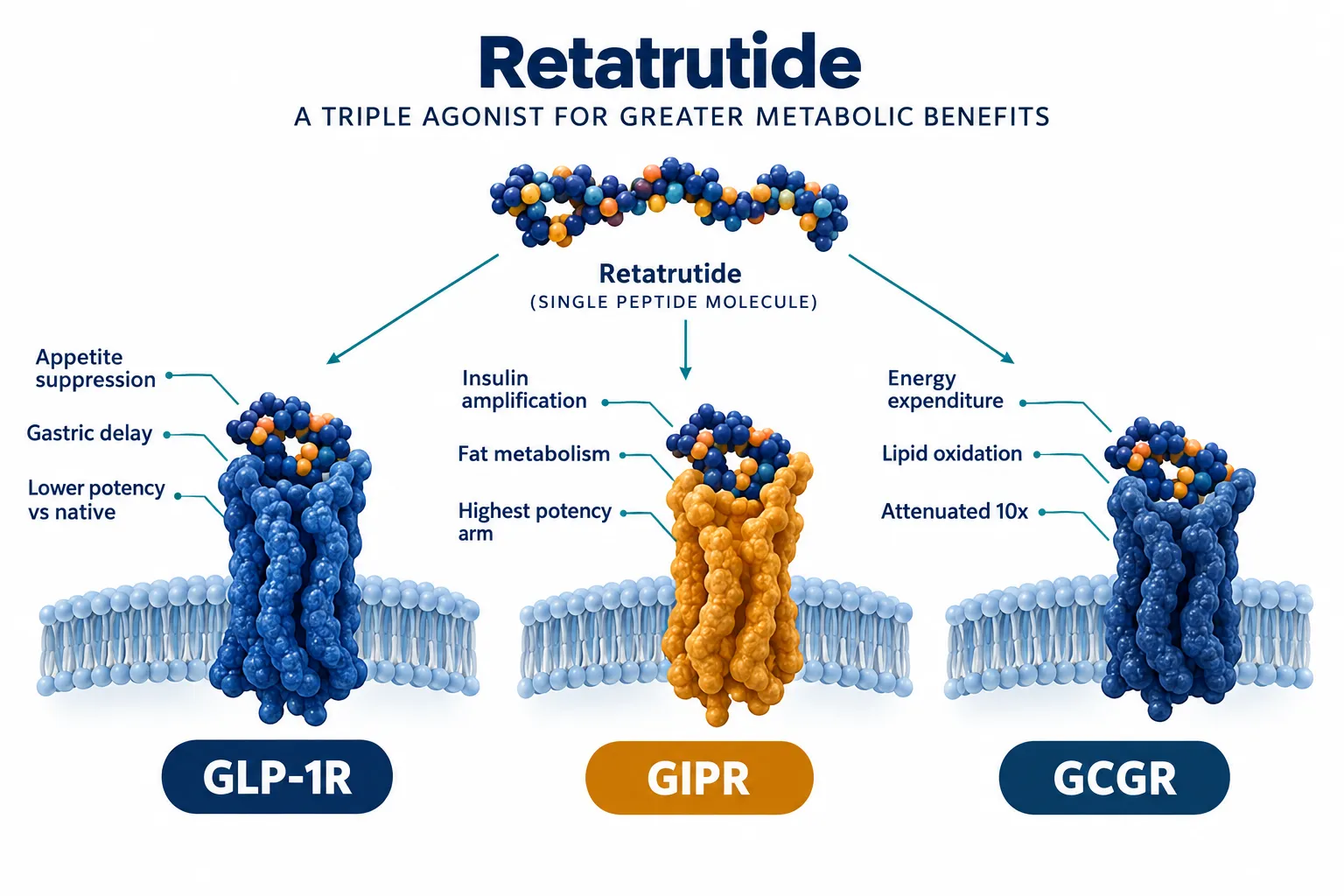
  • Retatrutide is intentionally engineered with higher potency at GIPR and reduced potency at GLP-1R and GCGR relative to native ligands, encoding a separable receptor "weighting" that can be exploited in mechanistic studies.
  • GLP-1R blockade or knockout primarily blunts appetite suppression and gastric emptying delay; GCGR disruption mainly reduces energy expenditure, lipid oxidation, and natriuresis.
  • Single-receptor cell lines measuring cAMP and beta-arrestin recruitment provide the cleanest in vitro separation of each receptor's signaling contribution.
  • Cryo-EM structures reveal receptor-specific conformations at ECL1 and TM1, enabling rational design of chimeric and mutant receptors for mechanistic dissection.
  • Orthogonal biomarker panels, indirect calorimetry, hepatic MRI-PDFF, gastric emptying scintigraphy, and glucagon/ketone profiles, allow investigators to attribute clinical endpoints to specific receptor arms.

Understanding Retatrutide's Engineered Receptor Weighting
Understanding Retatrutide's Engineered Receptor Weighting

Retatrutide (LY3437943) is a synthetic fatty diacid-conjugated peptide that co-activates GLP-1R, GIPR, and GCGR. Its design is deliberately asymmetric. In human receptor assays, it shows several-fold greater potency at GIPR than endogenous GIP itself, while displaying lower potency than native GLP-1 at GLP-1R and lower potency than native glucagon at GCGR. Glucagon receptor activity is intentionally attenuated to roughly one-tenth of GLP-1R activity.

This asymmetry is not incidental, it is the foundation for receptor-deconvolution research. Because each arm operates at a different intrinsic potency, dose-response experiments can be designed to selectively saturate one receptor while leaving others sub-maximally engaged. Researchers exploring GLP-1 Retatrutide activity profiles will recognize this tiered potency as a built-in experimental lever.

Why this matters for modeling: A molecule with equal potency at all three receptors would make attribution nearly impossible. Retatrutide's intentional imbalance means that incremental dose increases will disproportionately engage the highest-affinity receptor first, allowing investigators to map which effects emerge at low, medium, and high occupancy.


Core Experimental Strategies in GLP-3 Retatrutide Research Models: How to Separate GLP-1, GIP, and Glucagon Receptor Contributions
Core Experimental Strategies in GLP-3 Retatrutide Research Models: How to Separate GLP-1, GIP, and Glucagon Receptor Contribu

Single-Receptor Cell Lines and In Vitro Signaling Assays

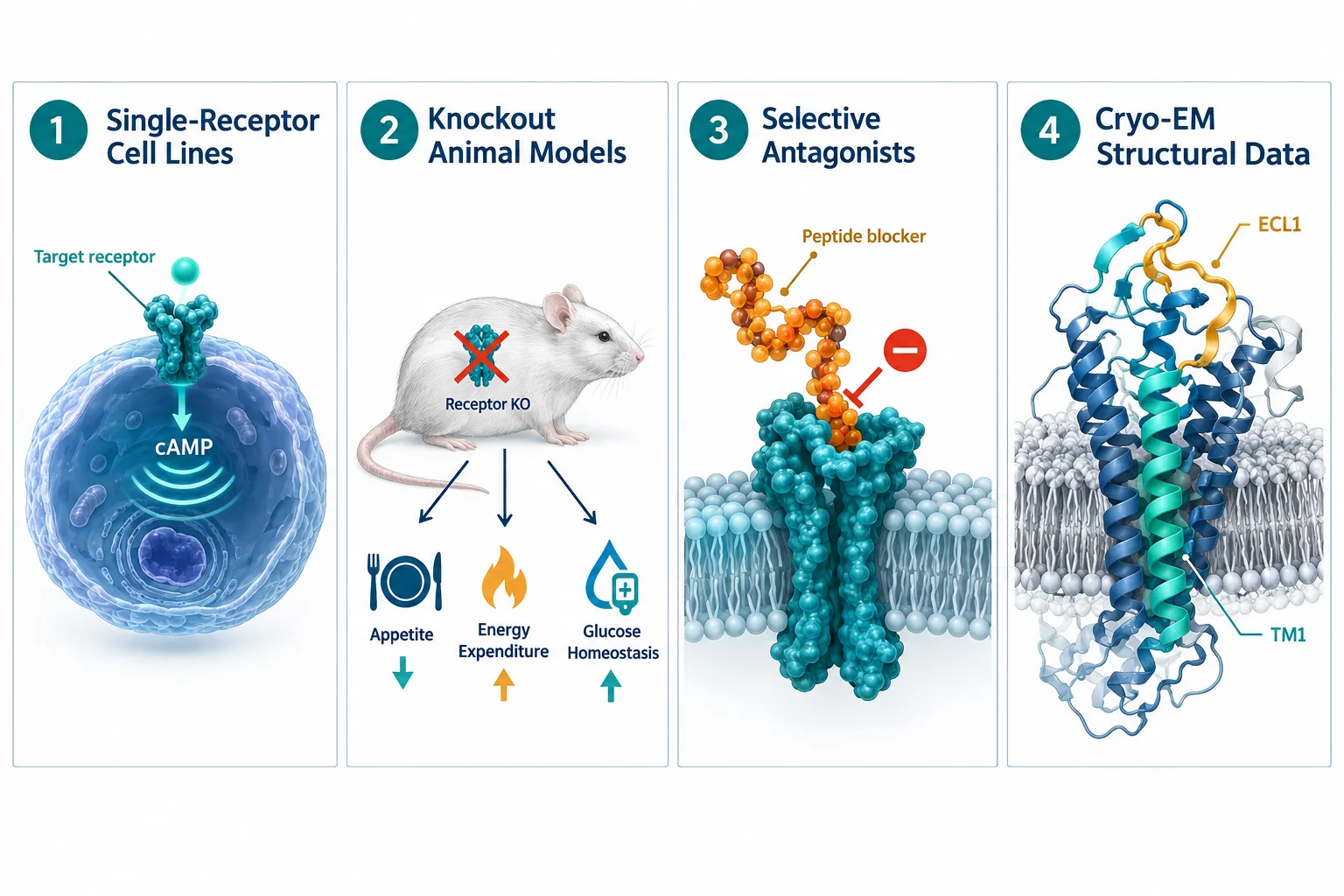
The cleanest starting point for receptor attribution is a cell system expressing only one receptor. By exposing GLP-1R-only, GIPR-only, or GCGR-only cell lines to retatrutide and measuring:

  • cAMP accumulation (primary Gs-coupled readout)
  • Beta-arrestin recruitment (biased signaling indicator)
  • Receptor internalization kinetics

…investigators generate EC50 and Emax values for each receptor in isolation. Comparing these values against native ligand benchmarks quantifies how much of the molecule's activity "belongs" to each receptor arm. This approach directly supports the broader goal of GLP-3 Retatrutide Research Models to separate GLP-1, GIP, and glucagon receptor contributions at the molecular level.

Cryo-EM Structural Models as a Design Blueprint

High-resolution cryo-EM structures of retatrutide bound separately to GLP-1R, GIPR, and GCGR reveal a single continuous alpha-helix penetrating the transmembrane core. The N-terminal segment (residues 1-13) drives receptor activation, while the C-terminal helix engages the extracellular domain and ECL1.

Critically, receptor-specific conformational differences appear at ECL1 and the extracellular tip of TM1. These structural distinctions provide a rational basis for:

  1. Introducing point mutations at receptor-peptide contact sites
  2. Building chimeric receptors that swap ECL1 regions between GLP-1R and GCGR
  3. Designing analogs with altered N-terminal sequences to bias activation toward one receptor

These tools allow researchers to test how specific peptide-receptor contacts govern signaling, turning structural data into functional attribution experiments.

Preclinical Knockout and Antagonist Models

Animal models remain the gold standard for whole-organism receptor attribution:

Intervention Primary Effect Reduced Preserved Effects
GLP-1R knockout or blockade Appetite suppression, gastric emptying delay Glucose lowering, energy expenditure
GCGR knockout or antagonism Energy expenditure, lipid oxidation, natriuresis Appetite suppression, insulin secretion
GIPR deficiency Insulin secretory response, adipose metabolism Appetite effects largely intact

This table reflects a consistent pattern across multiple preclinical studies: each receptor arm has a dominant physiological role that becomes visible only when the other arms are silenced. For researchers sourcing materials for such studies, options like buy Retatrutide peptide and GLP-3 Retatrutide buy online USA provide access to research-grade material.


Orthogonal Biomarker Panels and Clinical Attribution Frameworks
Orthogonal Biomarker Panels and Clinical Attribution Frameworks

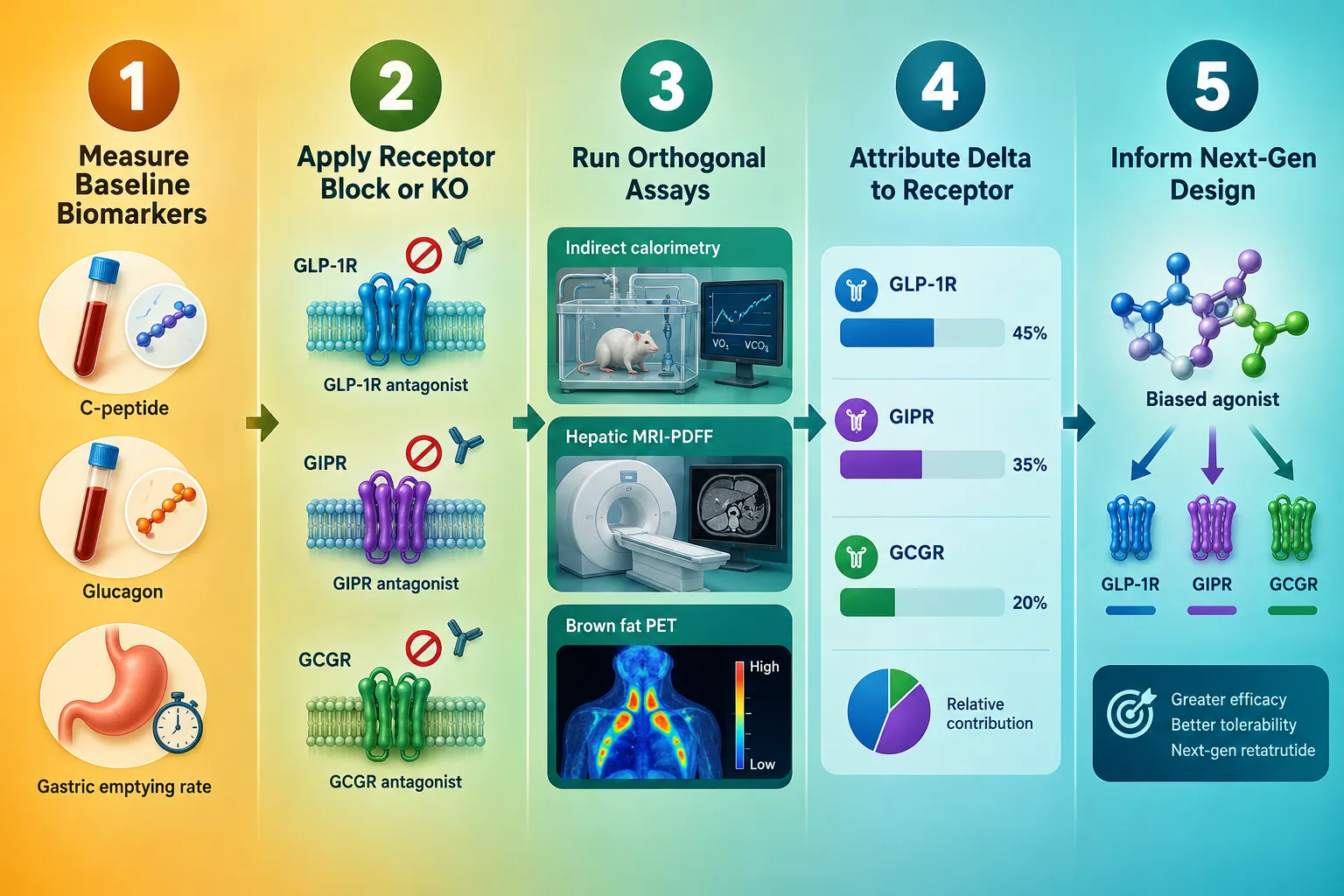
Preclinical knockout data only goes so far. In clinical and translational settings, receptor-specific attribution relies on orthogonal biomarker panels, multiple independent readouts that each correlate preferentially with one receptor arm.

GLP-1R-dominant biomarkers:

  • Gastric emptying scintigraphy (delayed emptying tracks GLP-1R engagement)
  • Nausea and vomiting incidence (GI adverse events mirror GLP-1 agonist patterns)
  • Appetite visual analog scores

GIPR-dominant biomarkers:

  • Insulin/C-peptide ratios during mixed-meal tolerance tests
  • Adipose tissue lipolysis markers
  • Musculoskeletal symptom patterns in adverse-event monitoring

GCGR-dominant biomarkers:

  • Indirect calorimetry (resting energy expenditure and respiratory quotient)
  • Hepatic MRI-PDFF for liver fat quantification
  • Brown adipose tissue activity via PET imaging
  • Glucagon and ketone body profiles
  • Natriuresis and renal hemodynamic measures

"By comparing retatrutide's weight and HbA1c outcomes to those of GLP-1 mono-agonists and GLP-1/GIP dual agonists in meta-analyses, modeling studies apportion the incremental 3-5% additional weight loss and greater hepatic fat reduction largely to the glucagon receptor component."

This comparative framework, triagonist versus dual agonist versus mono-agonist, functions as a clinical receptor-subtraction model. The "extra" efficacy beyond what tirzepatide or semaglutide achieves is attributed to the GCGR arm by difference. Researchers interested in the broader cardiometabolic context can explore polypeptide peptides in cardiometabolic models for additional comparative context.

Pharmacokinetic Modeling as a Temporal Lever

Retatrutide's fatty diacid conjugation produces a half-life of approximately six days, enabling once-weekly dosing. Because GLP-1R, GIPR, and GCGR differ in internalization and desensitization kinetics, PK/PD time-course modeling reveals how receptor contributions shift across the dosing interval. GLP-1R and GIPR effects tend to dominate early satiety and postprandial glucose control, while sustained GCGR engagement drives ongoing energy expenditure and lipid oxidation later in the cycle. This temporal separation adds another dimension to the attribution toolkit.

For researchers sourcing high-purity material for PK/PD studies, GLP-3 Reta 20mg and Reta 20mg for sale options are available with third-party purity verification.


Future Directions: Biased Agonism and Next-Generation Attribution Tools

The 2026 research landscape points toward increasingly precise receptor-deconvolution strategies. Several developments are expected to advance the field:

  • Biased agonist analogs, GCGR-biased molecules for NASH research; GLP-1/GIP-biased analogs for pure glycemic control, will allow prospective attribution rather than retrospective subtraction
  • Tissue-targeted delivery, hepatic-targeted GCGR agonism to isolate liver-specific effects from systemic thermogenesis
  • Receptor-selective biomarker panels in phase 3 trials, systematic collection of indirect calorimetry, hepatic imaging, and renal endpoints to formally decompose triagonist effects
  • Chimeric receptor mutagenesis panels, expanded use of ECL1-swapped and TM1-mutant constructs informed by cryo-EM data

These approaches collectively move the field from descriptive pharmacology toward quantitative receptor attribution, the ultimate goal of rigorous GLP-3 Retatrutide Research Models that separate GLP-1, GIP, and glucagon receptor contributions with experimental precision. Researchers building these models can also reference IPA Sermorelin stack research for comparative multi-peptide experimental design strategies.


Conclusion

Separating the individual receptor contributions of retatrutide is not merely an academic exercise, it directly informs the design of safer, more targeted metabolic therapies. The practical framework involves four complementary layers: engineered potency asymmetry as a built-in experimental lever, single-receptor cell assays and cryo-EM structural data for molecular-level attribution, knockout and antagonist animal models for whole-organism validation, and orthogonal biomarker panels for clinical translation.

Actionable next steps for researchers in 2026:

  1. Establish single-receptor cell lines expressing GLP-1R, GIPR, or GCGR individually before running multi-receptor assays
  2. Pair every in vivo retatrutide experiment with at least one receptor-selective antagonist arm to generate subtraction data
  3. Include indirect calorimetry and hepatic imaging endpoints alongside glycemic measures to capture GCGR-specific signals
  4. Use PK/PD time-course sampling at 24h, 72h, and 144h post-dose to capture temporal shifts in receptor dominance
  5. Cross-reference findings against published triagonist versus dual-agonist comparator data to validate receptor attribution estimates

For research teams sourcing verified material, buy GLP-3 peptide 10mg 99% pure third-party tested options ensure experimental reproducibility from the starting point.

https://www.puretestedpeptides.com/wp-content/uploads/2026/10/glp-3-retatrutide-research-models-how-to-separate-glp-1-gip-and-glucagon-recepto.webp 1024 1536 https://www.puretestedpeptides.com/wp-content/uploads/2026/01/buy-peptides-online.jpg 2026-10-08 13:13:042026-10-08 13:13:04GLP-3 Retatrutide Research Models: How to Separate GLP-1, GIP, and Glucagon Receptor Contributions
×

Helpful Links

  • My account
  • Cart
  • Checkout
  • Refund and Returns Policy
  • Privacy Policy
  • SMS Privacy Policy
  • Login
  • My Account
  • Logout

USA Made Lab Tested Peptides

All products are sold for research, laboratory, or analytical purposes only, and are not for human consumption


Pure Tested Peptides is a chemical supplier. Pure Tested Peptides is not a compounding / chemical compounding facility as defined under 503A of the Federal Food, Drug, and Cosmetic act. Pure Tested Peptides is not an outsourcing facility as defined under 503B of the Federal Food, Drug, and Cosmetic act.

The statements made within this website have not been evaluated by the US Food and Drug Administration. The products we offer are not intended to diagnose, treat, cure or prevent any disease.

Human/Animal Consumption Prohibited. Laboratory/In-Vitro Experimental Use Only

Scroll to top Scroll to top Scroll to top