

MOTS-c Peptide Research: Mitochondrial Signaling, Metabolic Flexibility, and Exercise-Aging Models
Mitochondrial-derived peptides were largely overlooked until researchers discovered that the mitochondrial genome encodes small bioactive molecules capable of traveling to the cell nucleus and rewriting gene expression. MOTS-c is one such molecule, and the body of work surrounding MOTS-c Peptide Research: Mitochondrial Signaling, Metabolic Flexibility, and Exercise-Aging Models has grown rapidly into one of the most compelling areas of metabolic biology.
Key Takeaways
- MOTS-c is encoded in mitochondrial DNA and acts as a retrograde signal between mitochondria and the nucleus.
- Its primary mechanism involves the Folate-AICAR-AMPK pathway, a central regulator of cellular energy balance.
- Exercise increases circulating MOTS-c levels in skeletal muscle and blood, suggesting it may partly explain exercise's metabolic benefits.
- MOTS-c expression declines with age, correlating with reduced metabolic flexibility and increased disease risk.
- Research models link MOTS-c to insulin sensitivity, muscle performance, and multiple age-related conditions.
What Is MOTS-c and How Does Mitochondrial Signaling Work
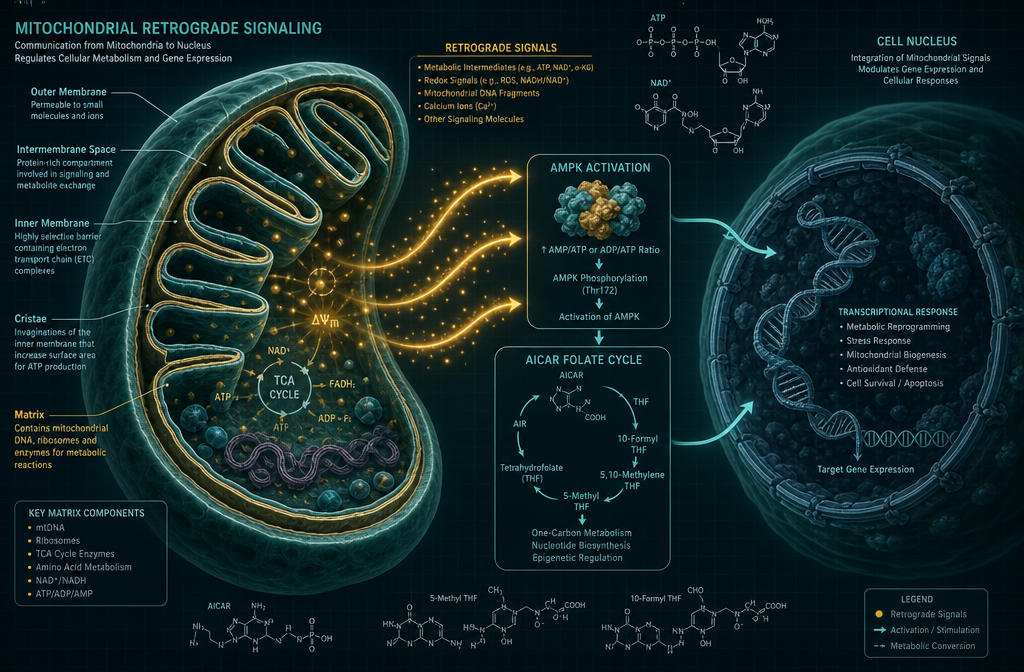
MOTS-c (Mitochondrial Open Reading Frame of the 12S rRNA type-c) is a 16-amino-acid peptide encoded within the 12S ribosomal RNA region of mitochondrial DNA. Unlike most peptides, it originates outside the nuclear genome, which makes its biology particularly unusual.
Under metabolic stress or physical exertion, MOTS-c translocates from the mitochondria to the cell nucleus. Once there, it binds to antioxidant response elements (ARE) and modulates gene expression tied to energy metabolism, inflammation, and oxidative stress. This mitochondria-to-nucleus communication is called retrograde signaling, and MOTS-c is now considered one of its key molecular messengers.
Researchers exploring MOTS-c mitochondrial research themes note that this retrograde pathway allows the cell to rapidly adjust its metabolic output in response to environmental demands. The primary route runs through the Folate-AICAR-AMPK axis, a well-established energy-sensing cascade. When this pathway activates, cells shift fuel usage, improve insulin sensitivity, and reduce inflammatory signaling.
"MOTS-c acts as a cellular stress sensor that bridges mitochondrial output with nuclear gene regulation — a feedback loop critical for metabolic homeostasis."
For researchers also studying adjacent mitochondrial compounds, SS-31 (Elamipretide) represents another peptide model focused on mitochondrial membrane integrity and cardiolipin stabilization, offering a complementary angle to MOTS-c's signaling role.
MOTS-c Peptide Research: Mitochondrial Signaling, Metabolic Flexibility, and Exercise-Aging Models in Skeletal Muscle
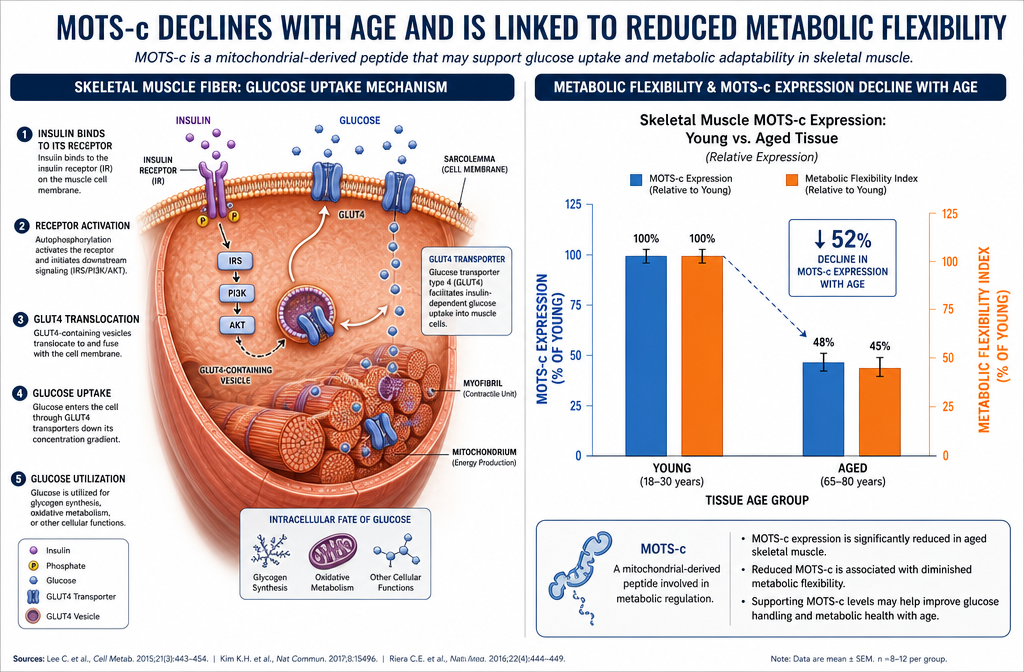
Skeletal muscle is both a primary site of MOTS-c production and a major target of its action. Exercise studies in humans have documented measurable increases in MOTS-c concentrations within muscle tissue and systemic circulation following physical activity. This positions MOTS-c as a potential exercise-mimetic signal — a molecule that may carry some of the metabolic benefits of movement.
Key research findings in muscle and metabolism:
| Research Area | Observed Effect |
|---|---|
| Insulin sensitivity | Improved glucose uptake via AMPK activation |
| Skeletal muscle performance | Enhanced endurance and strength output in aged mice |
| Inflammation | Reduced pro-inflammatory cytokine signaling |
| Oxidative stress | Upregulation of antioxidant gene expression |
These findings align with broader work on MOTS-c metabolic flexibility research themes, which examines how the peptide helps cells switch between fuel sources — a capacity that declines significantly with age and in metabolic disease states.
Researchers studying metabolic compounds like AOD-9604 and NAD+ energetics and longevity often position MOTS-c alongside these agents when building multi-pathway models of metabolic restoration.
MOTS-c Peptide Research: Mitochondrial Signaling, Metabolic Flexibility, and Exercise-Aging Models Across the Lifespan

One of the most significant findings in this field is that MOTS-c levels decline measurably with age. This decline tracks closely with the loss of metabolic flexibility, increased insulin resistance, and rising susceptibility to conditions including type 2 diabetes, cardiovascular disease, osteoporosis, postmenopausal obesity, and neurodegenerative conditions such as Alzheimer's disease.
Systemic administration of MOTS-c in aged mouse models has restored physical performance metrics across multiple age groups, suggesting the peptide may act as a healthspan-promoting signal rather than simply a stress response molecule.
Age-related conditions linked to declining MOTS-c:
- Type 2 diabetes and insulin resistance
- Cardiovascular metabolic dysfunction
- Bone density loss and osteoporosis
- Postmenopausal weight gain
- Cognitive decline and neuroinflammation
This broad disease relevance has made MOTS-c a subject of interest in mitochondrial longevity research, where the goal is to identify molecular targets that slow the functional decline associated with biological aging.
Researchers building comprehensive aging models may also consider Epithalon longevity signals and 5-Amino-1MQ as part of multi-target frameworks, given their distinct but complementary mechanisms in cellular aging pathways.
Conclusion
MOTS-c research has moved from a curiosity about non-nuclear peptide encoding to a serious scientific inquiry into how mitochondria regulate whole-body metabolism and aging. The evidence points to a peptide that rises with exercise, declines with age, and influences insulin sensitivity, muscle function, and inflammatory balance through a well-defined signaling pathway.
Actionable next steps for researchers:
- Review current preclinical exercise-aging models to understand dosing and administration protocols used in MOTS-c studies.
- Explore the Folate-AICAR-AMPK pathway in depth to contextualize MOTS-c findings within broader metabolic biology.
- Consider how MOTS-c fits alongside complementary mitochondrial and metabolic peptide research for multi-pathway study designs.
- Monitor emerging human trial data, as most published evidence remains preclinical.
As research in 2026 continues to expand, MOTS-c stands as a strong model for understanding how mitochondrial signals shape metabolic health across the lifespan.