

Enclomiphene Research Materials: Base, Citrate, and Analytical Identity Checks for Hormone-Model Experiments
Fewer than one in five commercial enclomiphene lots tested by independent analytical laboratories in recent years have carried full counterion confirmation alongside standard purity data, a gap that creates real problems when researchers try to compare results across batches or institutions. For anyone sourcing Enclomiphene Research Materials: Base, Citrate, and Analytical Identity Checks for Hormone-Model Experiments, that single oversight can invalidate dosing calculations, skew receptor-binding data, and make batch-to-batch reproducibility impossible.
This guide moves beyond the basic base-versus-citrate comparison to give researchers a structured purchasing and verification checklist covering salt identity, assay method, residual solvents, counterion confirmation, and batch consistency.
Key Takeaways
- Enclomiphene is supplied as either the free base or the citrate salt; the two forms carry different molecular weights, and failing to apply the correct salt factor corrupts dosing math in hormone-model experiments.
- A complete Certificate of Analysis (COA) for research-grade material should include HPLC purity, NMR salt identity, ESI-MS confirmation, residual solvent data (GC headspace), and water content.
- Counterion confirmation via NMR or ion chromatography is the most commonly missing data point in commercial COAs as of 2026.
- Batch consistency checks, comparing COA values across at least two consecutive lots, are essential before committing to a long experimental series.
- Enclomiphene is classified as a research-use-only compound in most jurisdictions; it is not approved for human use outside specific regulatory pathways.
Understanding the Two Chemical Forms: Base and Citrate
Enclomiphene is the trans-isomer of clomiphene, a selective estrogen receptor modulator (serm) that acts at hypothalamic estrogen receptors to reduce negative feedback on gonadotropin-releasing hormone. It reaches the market in two primary salt forms, and the distinction matters far more than many procurement workflows acknowledge.
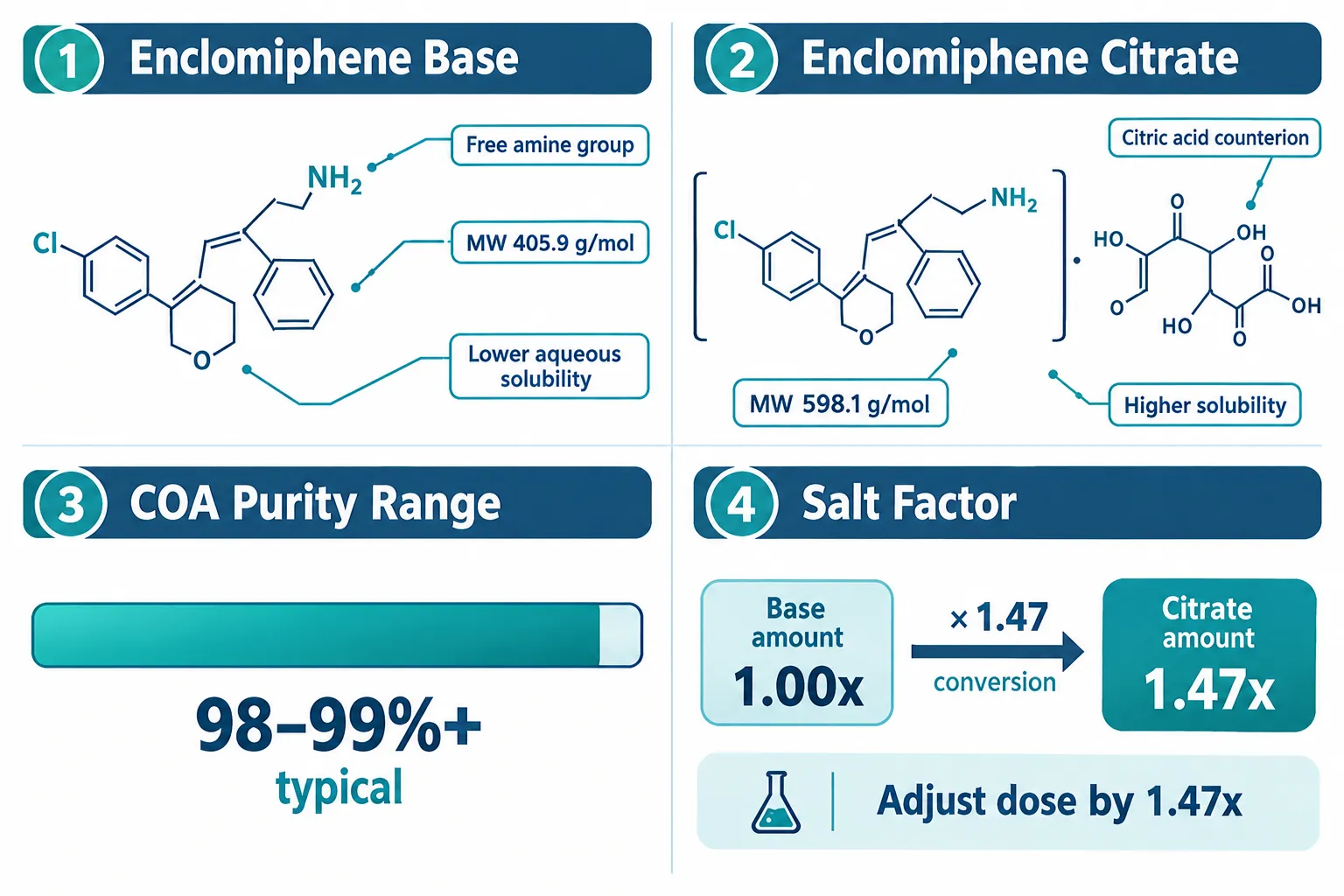
Enclomiphene free base carries a molecular weight of approximately 405.9 g/mol. It is less soluble in aqueous buffers, which makes it better suited to organic-solvent stock preparations (DMSO, ethanol) commonly used in cell-based assays. Enclomiphene citrate pairs the active molecule with citric acid as a counterion, raising the molecular weight to roughly 598.1 g/mol. The citrate form dissolves more readily in water, which is advantageous for in vitro hormone-model systems that require aqueous dosing vehicles.
The practical consequence: a researcher who assumes citrate when the material is actually the free base will underdose by approximately 32% relative to the active moiety. The conversion factor, roughly 1.47, must be applied whenever switching between forms or when a supplier's labeling is ambiguous.
Quick reference: key differences
| Property | Free Base | Citrate Salt |
|---|---|---|
| Molecular weight | ~405.9 g/mol | ~598.1 g/mol |
| Aqueous solubility | Low | Moderate, high |
| Preferred vehicle | DMSO / ethanol | Aqueous buffer |
| Salt factor vs base | 1.00 | ~1.47 |
| Counterion | None | Citric acid |
Researchers building hormone-model systems, particularly hypothalamic-pituitary-gonadal (HPG) axis simulations, should document the chosen form in every experimental protocol. This is the same level of rigor applied when sourcing other structurally complex research agents; see the discussion of structural identity documentation in this overview of peptides 101 for research-use only buyers.
The Analytical Identity Checklist for Enclomiphene Research Materials
The core of responsible sourcing for Enclomiphene Research Materials: Base, Citrate, and Analytical Identity Checks for Hormone-Model Experiments is a structured verification checklist applied to every lot before it enters an experiment. The following five-point framework covers the most critical analytical dimensions.
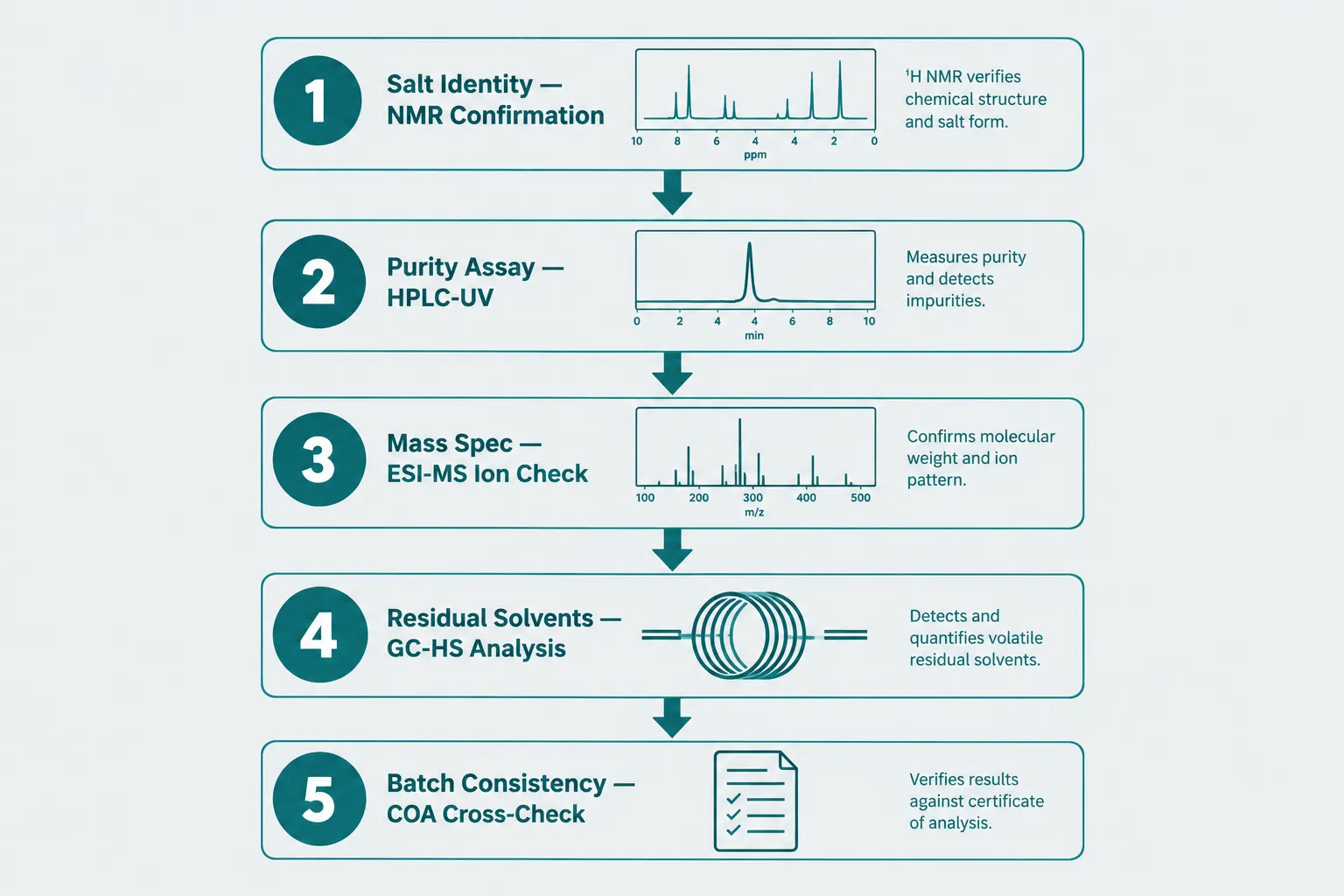
1. Salt Identity via NMR
Proton NMR (1H-NMR) is the gold-standard method for confirming whether a lot is the free base or a specific salt form. For the citrate, characteristic citric acid proton signals appear in the 2.5-2.8 ppm region. A COA that reports only HPLC purity without NMR data cannot confirm salt identity. Suppliers who provide NMR spectra as part of their documentation package should be prioritized.
2. Purity Assay via HPLC-UV
High-performance liquid chromatography with UV detection (typically at 254 nm) remains the standard purity assay. Research-grade material in 2026 is expected to meet 98% or higher purity by HPLC. The COA should specify the column type, mobile phase, and integration method. A single broad purity figure without chromatographic conditions is insufficient for experimental validation.
3. Mass Spectrometry Confirmation (ESI-MS)
Electrospray ionization mass spectrometry (ESI-MS) provides molecular ion confirmation independent of chromatographic separation. For enclomiphene free base, the expected [M+H]+ ion appears at m/z 406.2; for the citrate, the spectrum should show both the enclomiphene cation and the citrate anion. ESI-MS data on a COA rules out structural analogs and degradation products that can co-elute on HPLC.
4. Residual Solvents via GC Headspace
Synthesis and recrystallization of enclomiphene typically involves chlorinated solvents or alcohols. ICH Q3C residual solvent limits apply to pharmaceutical-grade material, and research-grade suppliers increasingly adopt these thresholds as a quality benchmark. Gas chromatography headspace (GC-HS) analysis should be requested for any lot used in cell-viability or receptor-binding assays where solvent contamination could confound results.
5. Counterion Confirmation via Ion Chromatography
This is the most commonly absent data point. Ion chromatography (IC) or capillary electrophoresis can quantify the citrate counterion directly, confirming the correct stoichiometry of the salt. Without it, a lot labeled "citrate" may be a partial salt or a mixed form. Batch-to-batch counterion ratio variation is a known source of irreproducibility in serm research.
Checklist summary:
- NMR spectrum confirming salt form
- HPLC-UV purity (98%+ with stated conditions)
- ESI-MS molecular ion confirmation
- GC-HS residual solvent panel
- IC or CE counterion quantification
- Karl Fischer water content (relevant for hygroscopic citrate lots)
Applying Verified Materials in Hormone-Model Experiments
Once analytical identity is confirmed, the experimental design for HPG-axis hormone models can proceed with confidence. Enclomiphene's mechanism centers on competitive antagonism at hypothalamic estrogen receptors, which reduces estrogenic negative feedback and elevates luteinizing hormone (LH) and follicle-stimulating hormone (FSH) output. This makes it a useful tool in cell-based and ex vivo models studying gonadotropin regulation, male hypogonadism mechanisms, and fertility signaling.
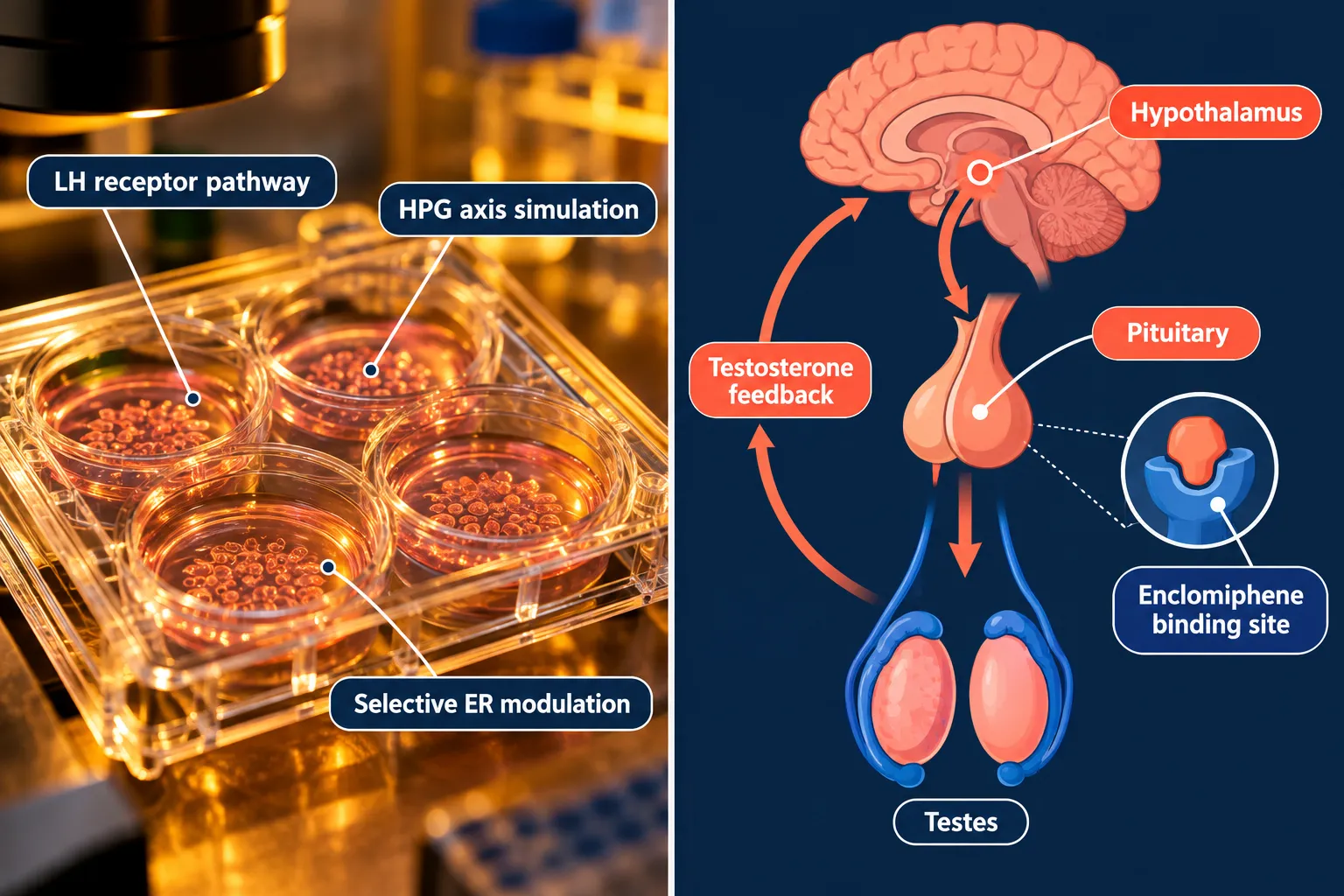
For researchers working with aqueous dosing systems, the citrate form is generally preferred due to its superior solubility. For lipid-based or organic-vehicle assay systems, the free base dissolves more cleanly. In either case, stock solutions should be prepared fresh or stored under inert gas at -20°C to prevent oxidative degradation of the stilbene backbone.
Batch consistency across a multi-experiment series requires comparing COA values, purity, water content, and counterion ratio, across at least two consecutive lots before committing. A purity drop of even 1-2% between lots can translate to meaningful receptor-occupancy differences at low nanomolar concentrations typical of serm experiments.
The approach mirrors best practices seen in other research-grade compound categories. For example, the purity evaluation standards applied when sourcing research-grade Glow Blend Peptide materials follow the same logic: identity first, purity second, batch consistency third.
Researchers interested in broader hormone-axis modeling may also find value in reviewing growth hormone secretagogue mechanisms, such as the detailed pharmacokinetic profile covered in this CJC-1295 with and without DAC mechanism comparison, as multi-axis hormone models increasingly combine serm and GH-pathway tools.
For procurement teams evaluating supplier quality programs, the standards applied to wholesale peptides for sale at reputable suppliers, including third-party COA availability and batch traceability, provide a useful quality benchmark applicable to small-molecule research materials like enclomiphene as well.
"The counterion is not a footnote, it is half the molecule. Treating salt identity as an afterthought is one of the most preventable sources of irreproducibility in serm research."
As of mid-2026, regulatory positioning for enclomiphene remains research-use only in most jurisdictions outside specific approved clinical pathways. Researchers should confirm local regulatory status before procurement and ensure all use is confined to in vitro or appropriately approved in vivo model systems.
Conclusion
Sourcing Enclomiphene Research Materials: Base, Citrate, and Analytical Identity Checks for Hormone-Model Experiments responsibly requires more than checking a purity percentage. The five-point analytical checklist, NMR salt identity, HPLC-UV purity, ESI-MS molecular confirmation, GC-HS residual solvents, and IC counterion quantification, gives research teams the data needed to dose accurately, compare results across batches, and publish reproducible findings.
Actionable next steps for research teams in 2026:
- Request full COA documentation including NMR and ESI-MS before approving any new lot.
- Apply the 1.47 salt factor correction whenever switching between base and citrate forms.
- Implement a batch-consistency log comparing at least two consecutive lot COAs before starting a new experimental series.
- Specify the dosing vehicle (aqueous vs. organic) in the protocol and select the appropriate salt form accordingly.
- Confirm the regulatory classification of enclomiphene in your jurisdiction before procurement.
Analytical rigor at the purchasing stage is the cheapest insurance a research program can buy.