Call or Text 727-513-9780
  • Shopping Cart Shopping Cart
    0Shopping Cart
Pure Tested Peptides | America's most trusted Peptides for sale online
  • Peptides for sale
    • Oral Peptides for sale
      • Peptide Capsules for sale
      • BPC 157 Capsules 1000mcg
      • SLU-PP-332 Capsules | 1000 mcg
      • 5-Amino-1MQ 50mg Capsules
      • Tesofensine 500mcg
    • All Peptides for sale
    • Peptide Sprays
      • BPC 157 Nasal Spray Kit
      • BPC-157 TB500 Nasal Spray Kit
      • Semax Nasal Spray 10mg
      • Selank – Nasal Spray Kit – 10mg
      • Epithalon 50MG Nasal Spray Kit
      • Ipamorelin 10mg Nasal Spray
      • Klow Nasal Spray (BPC-157 + TB-500 + GHK-Cu + KPV) | 80mg
      • Hulk Nasal Spray Tesa / Ipa Blend 6/3 MG
      • Klow Nasal Spray
      • NAD + 500 mg Nasal Spray
      • PT-141 Nasal Spray Kit
    • GHRH Peptides
      • Ipa Peptides
      • CJC-1295 Peptides
        • CJC-1295 with DAC 5 mg
        • CJC-1295 without DAC 5 mg
        • CJC-1295 Ipa 10mg
      • Tesa Peptides
        • Tesa Peptide
        • Tesa 20 mg
    • GHK-Cu Peptides
      • All GHK-Cu Peptides
      • GHK-Cu 100mg
      • KLOW Peptide Blend – Buy KLOW blend online
    • BPC Peptides
      • All BPC Peptides
      • BPC-157
      • BPC-157 TB-500
      • BPC 157 capsules 1000mcg
    • SLU-PP-332 Peptides
      • All SLU-PP-332 Peptides
      • SLU-PP-332 5mg
    • GLP3 Peptides
    • PT-141 Peptides
      • PT-141 Peptides for sale
      • PT-141 10mg
      • PT-141 Nasal Spray
    • CAG Peptides
      • Lipo-C Peptide Blend
      • CAG 5mg
      • CAG 10mg
    • MOTS-C Peptides
      • MOTS-C Peptides for sale
      • MOTS-c peptide
      • MOTS-c 10mg *6 pack*
    • 5 Amino 1MQ Peptides
      • 5 Amino 1MQ Peptides for sale
      • 5-Amino-1MQ 50mg Capsules
      • 5-Amino-1MQ 5mg
    • Epithalon Peptides
      • Epithalon Peptides for sale
      • Epithalon 10mg
      • Epithalon 50mg
  • Shop
    • GLPs
      • 5-Amino-1MQ 50mg Capsules
      • 5-Amino-1MQ 5mg
      • L-Carnitine 500mg/ml
      • Tesofensine 500mcg
      • SLU-PP-332 5mg
      • MOTS-c 10mg *6 pack*
    • Epithalon & BPC Peptides
      • Epithalon 10mg
      • Epithalon 50mg
      • BPC-157
      • BPC 157 capsules 1000mcg
      • BPC-157 TB-500
      • BPC-157 TB500 Nasal Spray Kit
      • BPC 157 Nasal Spray Kit
    • BPC TB-500 & NAD+ Peptides
      • NAD+ 500 mg
      • KLOW Peptide Blend – Buy KLOW blend online
      • GLOW Peptide Blend
      • TB 500 5mg
      • BPC 157 capsules 1000mcg – Supplement
      • BPC 157 Nasal Spray Kit
      • BPC-157
      • BPC-157 TB500 Nasal Spray Kit
      • BPC-157 TB-500
      • BPC 157 capsules 1000mcg
    • LL-37 Peptide
      • LL-37 10 mg
    • MOTS-C & Selank
      • MOTS-c peptide
      • Selank 10mg
    • GHK Peptides
      • GHK-Cu 100mg
      • GLOW Peptide Blend
      • KLOW Peptide Blend – Buy KLOW blend online
  • COAs
  • Wholesale
    • Wholesale Peptides for sale
  • PTP FAQ
  • Affiliates
    • Selank Peptide: Advanced Pharmacological Mechanisms Underlying Its Anxiolytic and Nootropic Effects in Research
      • 5-Amino-1MQ Peptide: Detailed Mechanisms of NNMT Inhibition and Its Impact on Cellular Metabolism Research
        • MOTS-C Peptide: Unraveling Its Role in Mitochondrial Dynamics and Energy Metabolism Research
          • Epithalon Peptide and Telomerase Regulation: Investigating Its Impact on Cellular Senescence and Lifespan Research Models
            • GLP2-T vs GLP2 Tirz Peptide: Understanding the Naming, Mechanistic Nuances, and Research Implications for Gut Health
      • Peptides and Polypeptides in Modern Pharmacology: What Research on Metoprolol, Prednisone, and Amlodipine Reveals
        • Polypeptide Peptides vs NSAIDs: What Naproxen and Diclofenac Teach Tissue-Repair Researchers About BPC‑157 and TB‑500
          • Peptides and Polypeptides in Endocrine Pharmacology: How GLP-1, GLP-2, and GLP-3 Retatrutide Differ From Classic Drugs Like Prednisone and Amlodipine
          • 5‑Amino‑1MQ Peptide and NNMT Inhibition: How It Compares With Statins Like Atorvastatin in Adipose and Lipid Metabolism Research
      • Enclomiphene, Estrogen Receptor Signaling, and Luteinizing Phase Biology: What Hormone Researchers Should Measure
        • Mesenchymal Stem Cells, BPC‑157, and GHK‑Cu: How Tissue Repair Peptides Compare With Classic NSAIDs Like Naproxen in Injury Models
          • Peptide Calculator Use Cases Beyond Growth Hormone: Working Through GLP‑3 Retatrutide, MOTS‑c, and BPC‑157 Research Dosing
        • Polypeptide Peptides in Endocrine and Metabolic Pharmacology: Lessons From Amlodipine, Prednisone, and Metoprolol
        • Peptides Calculator for Advanced Blends: Worked Examples for Tesamorelin, CJC‑1295, and Ipamorelin Stacks
          • Peptides and Polypeptides in Human Physiology: How Molecular Size Shapes Research Applications
            • Selank Peptide: Advanced Pharmacological Mechanisms Underlying Its Anxiolytic and Nootropic Effects in Research
          • 5-Amino-1MQ Peptide: Detailed Mechanisms of NNMT Inhibition and Its Impact on Cellular Metabolism Research
            • MOTS-C Peptide: Unraveling Its Role in Mitochondrial Dynamics and Energy Metabolism Research
              • Epithalon Peptide and Telomerase Regulation: Investigating Its Impact on Cellular Senescence and Lifespan Research Models
                • GLP2-T vs GLP2 Tirz Peptide: Understanding the Naming, Mechanistic Nuances, and Research Implications for Gut Health
                  • Peptides and Polypeptides in Endocrine Pharmacology: How GLP-1, GLP-2, and GLP-3 Retatrutide Differ From Classic Drugs Like Prednisone and Amlodipine
                    • Polypeptide Peptides vs NSAIDs: What Naproxen and Diclofenac Teach Tissue-Repair Researchers About BPC‑157 and TB‑500
                      • Peptides and Polypeptides in Modern Pharmacology: What Research on Metoprolol, Prednisone, and Amlodipine Reveals
                        • 5‑Amino‑1MQ Peptide and NNMT Inhibition: How It Compares With Statins Like Atorvastatin in Adipose and Lipid Metabolism Research
                        • Enclomiphene, Estrogen Receptor Signaling, and Luteinizing Phase Biology: What Hormone Researchers Should Measure
                        • Mesenchymal Stem Cells, BPC‑157, and GHK‑Cu: How Tissue Repair Peptides Compare With Classic NSAIDs Like Naproxen in Injury Models
                        • Peptide Calculator Use Cases Beyond Growth Hormone: Working Through GLP‑3 Retatrutide, MOTS‑c, and BPC‑157 Research Dosing
                        • Polypeptide Peptides in Endocrine and Metabolic Pharmacology: Lessons From Amlodipine, Prednisone, and Metoprolol
                        • Peptides Calculator for Advanced Blends: Worked Examples for Tesamorelin, CJC‑1295, and Ipamorelin Stacks
                        • Peptides and Polypeptides in Human Physiology: How Molecular Size Shapes Research Applications
                        • Selank Peptide: Advanced Pharmacological Mechanisms Underlying Its Anxiolytic and Nootropic Effects in Research
                        • MOTS-C Peptide: Unraveling Its Role in Mitochondrial Dynamics and Energy Metabolism Research
                        • Peptides and Polypeptides in Modern Pharmacology: What Research on Metoprolol, Prednisone, and Amlodipine Reveals
                        • Peptides and Polypeptides in Endocrine Pharmacology: How GLP-1, GLP-2, and GLP-3 Retatrutide Differ From Classic Drugs Like Prednisone and Amlodipine
                        • 5-Amino-1MQ Peptide: Detailed Mechanisms of NNMT Inhibition and Its Impact on Cellular Metabolism Research
                        • Mesenchymal Stem Cells, BPC‑157, and GHK‑Cu: How Tissue Repair Peptides Compare With Classic NSAIDs Like Naproxen in Injury Models
                        • Peptide Calculator Use Cases Beyond Growth Hormone: Working Through GLP‑3 Retatrutide, MOTS‑c, and BPC‑157 Research Dosing
                        • GLP2-T vs GLP2 Tirz Peptide: Understanding the Naming, Mechanistic Nuances, and Research Implications for Gut Health
                        • Polypeptide Peptides in Endocrine and Metabolic Pharmacology: Lessons From Amlodipine, Prednisone, and Metoprolol
                        • Polypeptide Peptides vs NSAIDs: What Naproxen and Diclofenac Teach Tissue-Repair Researchers About BPC‑157 and TB‑500
                        • Peptides and Polypeptides in Human Physiology: How Molecular Size Shapes Research Applications
                        • Peptides Calculator for Advanced Blends: Worked Examples for Tesamorelin, CJC‑1295, and Ipamorelin Stacks
                        • 5‑Amino‑1MQ Peptide and NNMT Inhibition: How It Compares With Statins Like Atorvastatin in Adipose and Lipid Metabolism Research
                        • Enclomiphene, Estrogen Receptor Signaling, and Luteinizing Phase Biology: What Hormone Researchers Should Measure
                        • Epithalon Peptide and Telomerase Regulation: Investigating Its Impact on Cellular Senescence and Lifespan Research Models
                        • Best research protocol Klow blend
                        • best time to take BPC-157
                        • best time to take DSIP (Delta Sleep Inducing Peptide)
                        • best time to take CJC-1295
                        • best time to take AOD-9604
                        • best time to take Follistatin 344
                        • best time to take Ipamorelin
                        • best time to take MK-677 (Ibutamoren)
                        • best time to take Ligandrol (LGD-4033) — research compound
                        • best time to take Ostarine (MK-2866) — research compound
                        • best time to take GHK-CU
                        • best time to take TB-500
                        • best time to take MOTS-c
                        • best time to take Semax
                        • best time to take RAD-140 (Testolone) — research compound
                        • best time to take Thymosin Alpha-1
                        • best time to take PEG-MGF
                        • Biolife Plasma, Octapharma Plasma, and Research Peptides: How Plasma Donation Labs Differ From Peptide Suppliers
                        • best time to take YK-11 — research compound
                        • best time to take PT-141 (Bremelanotide)
                        • Best research protocol Klow blend
                        • 5-Amino-1MQ and MOTS-C Synergy: Metabolic Signaling, Mitochondria, and Research Design
                        • BPC-157 and TB-500: Investigating Their Combined Effects on Angiogenesis and Cellular Migration in Tissue Repair Models
                        • BPC-157 Peptide: Gut Barrier Function, Inflammation, and Tissue-Recovery Research
                        • 5‑Amino‑1MQ and MOTS‑c Synergy in Metabolic Research: Designing NNMT and Mitochondrial Biogenesis Stacks
                        • CJC-1295 with DAC vs. Without DAC: Half-Life, Release Kinetics, and Research Implications
                        • CJC‑1295 with DAC vs. Without DAC: Expanding on Half‑Life Differences Using Tesamorelin and Ipamorelin Blend Case Studies
                        • Collagen Biology and Copper‑Binding Peptides: How GHK‑Cu, Glow Blend, and Klow Blend Interact with Skin and Connective Tissue
                        • Collagen Biology and Regenerative Peptides: How GHK‑Cu, Glow Blend, and Klow Blend Affect Extracellular Matrix Research
                    • DNA, Telomeres, and Longevity Peptides: Positioning Epithalon and MOTS‑c in Genetic Aging Research
                      • Enclomiphene Citrate: serm Mechanism, Testosterone Research, and Stack Compatibility
                        • Enclomiphene vs Enclomiphene Citrate: Formulation, Bioavailability, and Research Distinctions
                        • Epithalon Peptide Research: Telomerase Activation, Aging, and Pineal Gland Function
                        • Estrogen Receptor Signaling and Enclomiphene: How Selective Modulators Compare with Classic Polypeptide Hormones
                        • GHK-Cu Peptide: Advanced Mechanisms in Extracellular Matrix Remodeling and Wound Healing Research
                        • GHK-Cu Peptide: Collagen Synthesis, Wound Repair, and Skin-Barrier Research Models
                        • GLP-1 vs GLP-3 vs GLP-2: Peptide Classification and Research Applications
                        • GLP-2 Peptide Research Guide: Gut Barrier Function, Nutrient Absorption, and Intestinal Recovery Models
                        • GLP-3 Retatrutide vs. GLP-1 Drugs: What Triple-Agonist Biology Changes in Research Models
                        • Ipamorelin and Tesamorelin Combination: Synergistic GH Secretagogue Research and Dosing Protocols
                        • GLP2 Tirz Peptide: What It Is, Why the Name Exists, and How Researchers Should Interpret It
                        • Klow Blend Peptide Nasal Spray: What the Formulation Is Trying to Do in Cognitive Research
                        • Mitochondria, NNMT Inhibition, and Peptide Modulators: Where MOTS‑c and 5‑Amino‑1MQ Fit in Cellular Energy Research
                        • MOTS-c Peptide: Mitochondrial Function, Energy Metabolism, and What Researchers Measure
                        • MOTS-c vs. 5-Amino-1MQ: Which Metabolic Research Questions Each Compound Actually Answers
                        • Nasal Spray Peptides: Bioavailability, Administration, and Semax/Selank Research Applications
                        • PT-141 Peptide Research: Mechanism of Action and Melanocortin Receptor Signaling
                        • Retatrutide for Research: Mechanism, Structure, and GLP-1/GLP-3 Dual Action
                        • Retatrutide for Obesity and Type 2 Diabetes: What the Latest Trial Data Suggest
                        • Tesofensine Peptide Research: Mechanism, Appetite Suppression, and Neuropeptide Y Pathways
  • Contact
    • Contact Customer Service
    • Text Customer Support
  • About US
  • Shop all peptides
  • Affiliate Program
    • Affiliate Signup
  • Login / Register Login / Register Page Link Login / Register Page Link
  • Click to open the search input field Click to open the search input field Search
  • Menu Menu

Tag Archive for: hplc peptide analysis

Regulatory Horizons for Research-Use Peptides: COA Compliance and Batch Identity Standards

Regulatory Horizons for Research-Use Peptides: COA Compliance and Batch Identity Standards

October 30, 2026/0 Comments/in Uncategorized/by

Fewer than one in three research-grade peptide suppliers currently provide COAs that meet the orthogonal identity verification standards now expected by institutional procurement committees. That gap is closing fast. As regulatory frameworks converge around drug-substance benchmarks, laboratories sourcing synthetic peptides for in vitro and preclinical work face a new compliance reality in 2026 — one where a single HPLC purity percentage is no longer enough to satisfy internal audits or demonstrate rigorous research intent.

This article maps the updated landscape of regulatory horizons for research-use peptides: COA compliance and batch identity standards, explaining what analytical methods are now expected, how impurity thresholds are being applied to research reagents, and what a defensible COA looks like today.

Key Takeaways

  • At least two orthogonal analytical methods — typically RP-HPLC and LC-MS — are now the baseline expectation for peptide identity confirmation on a COA.
  • Impurity thresholds drawn from ICH Q3A/Q3B guidance are being mirrored in research-use peptide COAs, with unspecified impurities generally held below 0.5%.
  • "Research Use Only" labeling does not shield suppliers from regulatory scrutiny if marketing language implies therapeutic use.
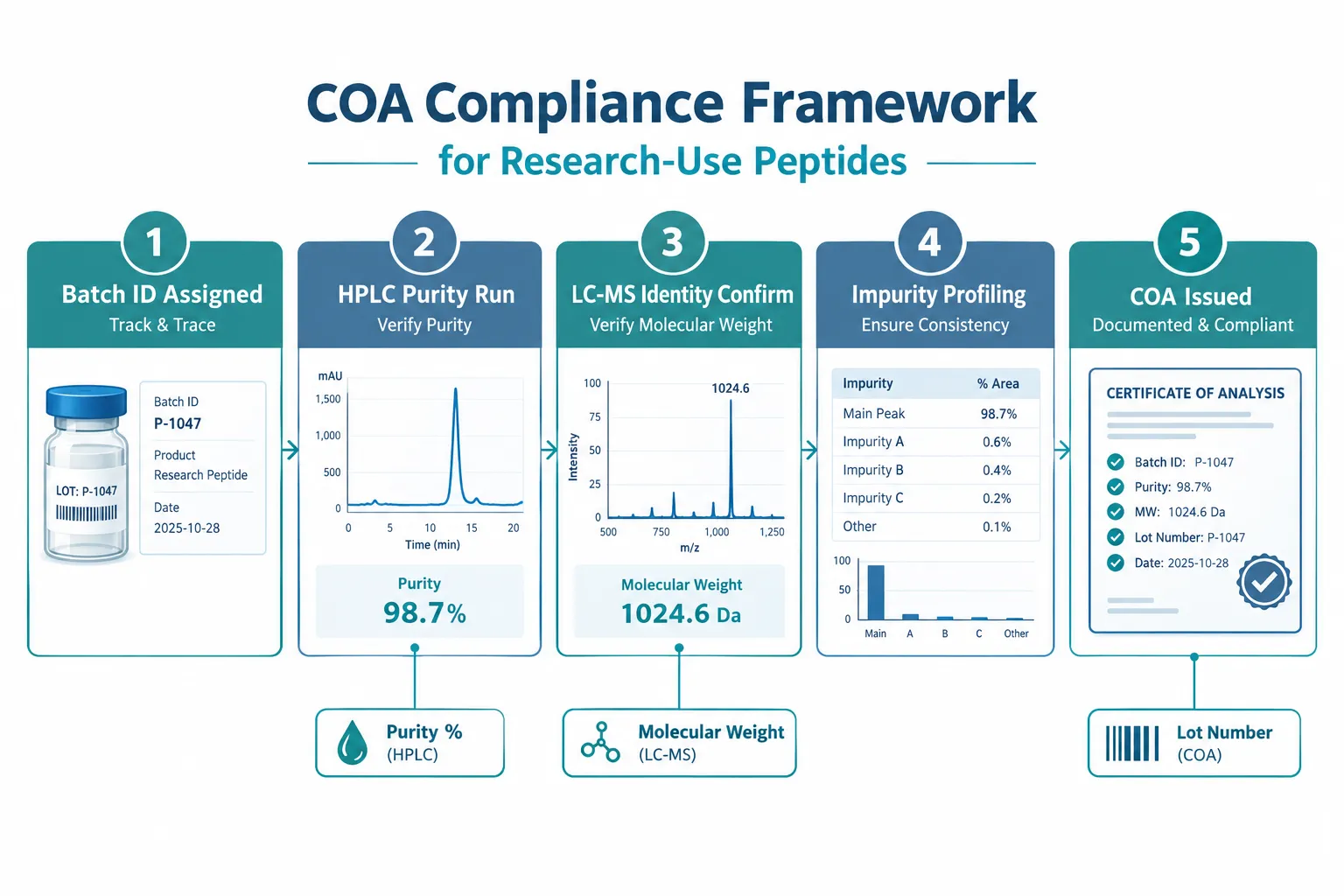
  • Batch-specific COAs must include lot number, testing date, explicit methods, numerical purity, measured molecular weight, and laboratory identity.
  • Stability data and re-test dating, guided by ICH Q1E principles, are increasingly expected on high-quality COA documents.

What COA Compliance Means for Research-Use Peptides in 2026

The regulatory horizons for research-use peptides: COA compliance and batch identity standards have shifted considerably over the past two years. Drug-substance guidelines from the EMA and USP now function as de facto benchmarks even for research reagents, because no dedicated RUO-specific COA standard exists in U.S. regulation.
What COA Compliance Means for Research-Use Peptides in 2026

The EMA's 2026 guideline on synthetic peptide manufacture requires at least two orthogonal methods to unambiguously confirm sequence identity and sets this as a batch release specification. USP's chapter on quality attributes of synthetic peptide drug substances mirrors this, naming RP-HPLC and mass spectrometry as the primary tools while citing ICH Q6A's requirement that identity tests distinguish closely related structural analogues likely to appear as synthesis impurities.

A 2026 peer-reviewed regulatory review concluded that this cross-framework expectation — spanning ICH Q6A, USP-NF, EDQM, and EMA — is now being adopted by suppliers marketing any peptide as high-quality, including research reagents. For laboratories sourcing compounds such as lab-tested peptides, this translates directly into COA evaluation criteria.

The "Two Orthogonal Methods" Standard in Practice

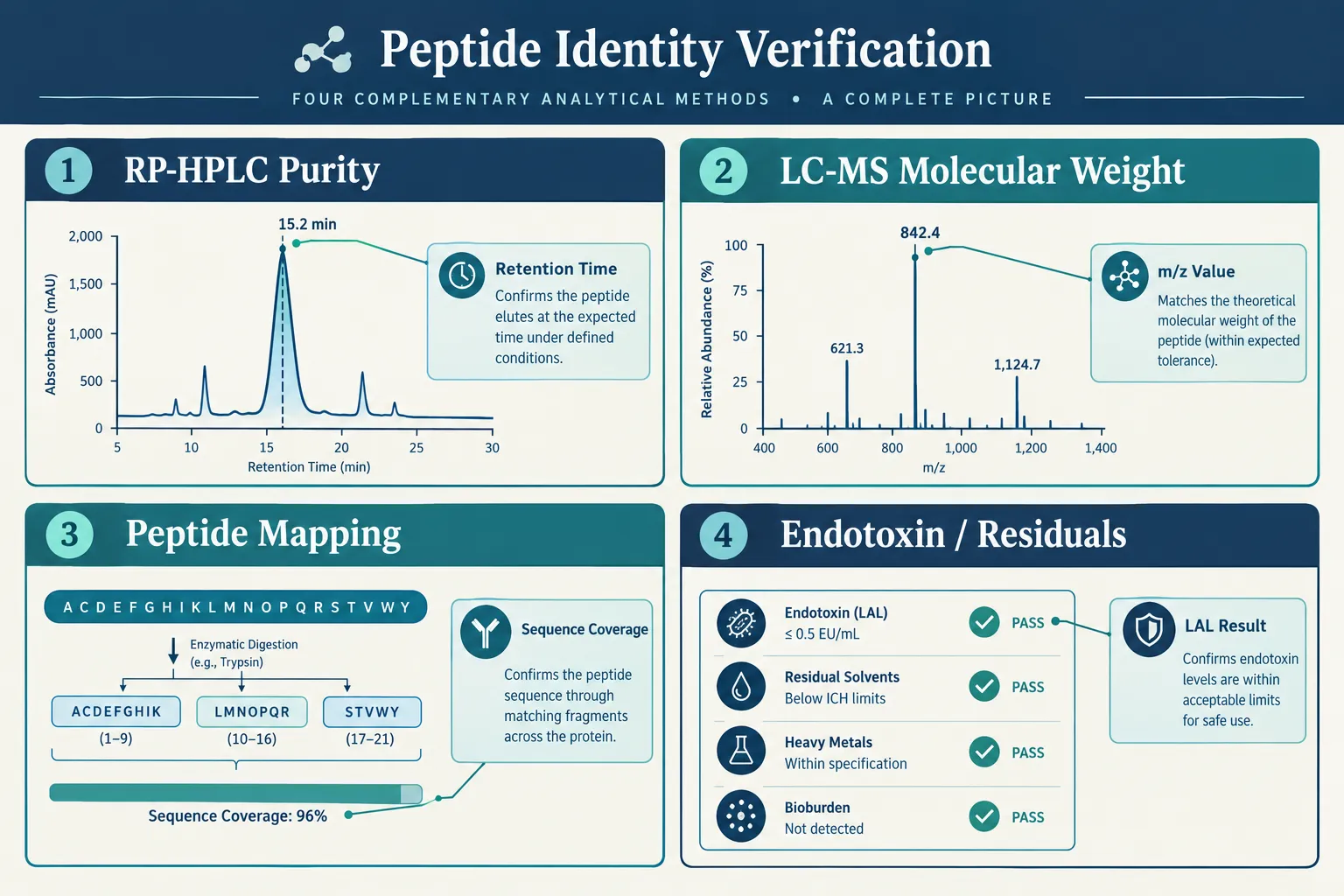
Relying solely on HPLC purity is no longer defensible. Experts interpret current guidance as requiring at least one highly specific method — high-resolution mass spectrometry or sequence-confirming peptide mapping — complemented by chromatographic purity profiling. The combination must be capable of discriminating the target peptide from structural analogues.

Minimum COA identity section should include:

Test Acceptable Method Purpose
Molecular weight confirmation LC-MS or HR-MS Confirms sequence-level identity
Purity profile RP-HPLC (UV) Quantifies related substances
Sequence confirmation Peptide mapping or MS/MS Discriminates analogues and truncations
Counter-ion / residuals Ion chromatography or NMR Verifies synthesis route integrity

Impurity Thresholds and Batch Identity Requirements

The second pillar of evolving regulatory horizons for research-use peptides: COA compliance and batch identity standards concerns how impurities are controlled and reported.
Impurity Thresholds and Batch Identity Requirements

A 2025 analysis collating ICH Q3A/Q3B and the FDA's 2021 peptide ANDA guidance found that unspecified impurities in chemically synthesised molecules are generally limited to 0.5%, with specific peptide impurities controlled between 0.10% and 0.5% depending on risk classification. These thresholds are now appearing in research-use peptide COAs, which increasingly list individual impurity peaks by relative retention time alongside total related substances.

For peptides used in cell-based or immunological assays — such as those explored in GLP-1 peptide research and sourcing or GHK-Cu copper peptide sourcing — COAs are increasingly expected to include:

  • Endotoxin levels (LAL or rFC method)
  • Residual solvents (ICH Q3C class limits)
  • Heavy metals (ICP-MS)
  • Counter-ion content tied to TFA or acetate used in synthesis

A batch-specific COA — not a generic product-level document — is the minimum standard. It must carry: product name, batch/lot number, testing date, named analytical methods, numerical purity percentages, measured molecular weight (within +/-1 Da of theoretical), and the testing laboratory's identity. Chromatograms and mass spectra should accompany the document where possible.

Stability is also entering the conversation. The ICH Q1E draft guideline endorsed in April 2025 extends harmonised stability expectations to complex synthetic molecules. Industry commentaries note that COAs for research-use peptides are starting to carry re-test dates aligned with ICH-style protocols rather than vague shelf-life claims. This is particularly relevant for compounds covered in resources like SS-31 mechanism and research sourcing and SS-31 kidney health research.


RUO Labeling, Supplier Standards, and Institutional Procurement

The "Research Use Only" designation creates a regulatory gray zone that makes COA rigor even more critical. RUO is formally defined under 21 CFR 809.10(c)(2)(i) for in vitro diagnostic products — not for peptide reagents. This means the designation offers no automatic protection from FDA enforcement if supplier communications suggest human therapeutic use.

RUO Labeling, Supplier Standards, and Institutional Procurement

A 2026 sourcing advisory for institutional labs outlined four non-negotiable supplier criteria:

  1. US-based fulfillment with traceable logistics
  2. Batch-specific third-party COAs combining HPLC and LC-MS
  3. Nitrogen-purged vial packaging to prevent oxidative degradation
  4. Strict RUO positioning with zero therapeutic marketing claims

An October 2026 guide for state and institutional labs reinforced that reputable suppliers support peptides with documentation demonstrating control over purity and identity, framing RUO compounds explicitly as laboratory-grade materials not evaluated for safety or efficacy outside controlled research.

For researchers working with compounds such as those found in GHRP-2 vs. sermorelin comparisons or exploring GLP-3 triple agonist research planning, these criteria represent the floor, not the ceiling, of supplier evaluation.

"Robust COA documentation and clear batch identity are compliance prerequisites — not optional quality perks."

A 2025 immunogenicity review further noted that peptides used in immunological or cell-based research should carry COAs with extensive structural characterization, particularly where sequence features may affect biological responses. This has raised expectations for detailed MS fragmentation data on peptides with known receptor activity.


Conclusion

The regulatory horizons for research-use peptides: COA compliance and batch identity standards are no longer a future concern — they are a present-tense procurement requirement. Laboratories that treat COA review as a checkbox exercise risk using uncharacterized material that undermines data integrity and exposes institutions to compliance liability.

Actionable next steps for research teams:

  • Audit every current peptide supplier against the two-orthogonal-methods standard for identity confirmation.
  • Reject any COA that lacks a batch/lot number, named analytical methods, and numerical impurity data.
  • Request endotoxin and residual solvent data for any peptide contacting biological systems.
  • Verify that supplier marketing contains no therapeutic use language before issuing a purchase order.
  • Align internal storage and re-test protocols with ICH Q1E-style stability expectations.

As drug-substance guidelines from EMA, USP, and ICH continue to set the de facto bar for research reagents, the laboratories that thrive will be those that treat identity documentation not as paperwork overhead but as foundational scientific infrastructure.

https://www.puretestedpeptides.com/wp-content/uploads/2026/10/regulatory-horizons-for-research-use-peptides-coa-compliance-and-batch-identity.webp 1024 1536 https://www.puretestedpeptides.com/wp-content/uploads/2026/01/buy-peptides-online.jpg 2026-10-30 13:06:112026-10-30 13:06:11Regulatory Horizons for Research-Use Peptides: COA Compliance and Batch Identity Standards
×

Helpful Links

  • My account
  • Cart
  • Checkout
  • Refund and Returns Policy
  • Privacy Policy
  • SMS Privacy Policy
  • Login
  • My Account
  • Logout

USA Made Lab Tested Peptides

All products are sold for research, laboratory, or analytical purposes only, and are not for human consumption


Pure Tested Peptides is a chemical supplier. Pure Tested Peptides is not a compounding / chemical compounding facility as defined under 503A of the Federal Food, Drug, and Cosmetic act. Pure Tested Peptides is not an outsourcing facility as defined under 503B of the Federal Food, Drug, and Cosmetic act.

The statements made within this website have not been evaluated by the US Food and Drug Administration. The products we offer are not intended to diagnose, treat, cure or prevent any disease.

Human/Animal Consumption Prohibited. Laboratory/In-Vitro Experimental Use Only

Scroll to top Scroll to top Scroll to top