Call or Text 727-513-9780
  • Shopping Cart Shopping Cart
    0Shopping Cart
Pure Tested Peptides | America's most trusted Peptides for sale online
  • Peptides for sale
    • Oral Peptides for sale
      • Peptide Capsules for sale
      • BPC 157 Capsules 1000mcg
      • SLU-PP-332 Capsules | 1000 mcg
      • 5-Amino-1MQ 50mg Capsules
      • Tesofensine 500mcg
    • All Peptides for sale
    • Peptide Sprays
      • BPC 157 Nasal Spray Kit
      • BPC-157 TB500 Nasal Spray Kit
      • Semax Nasal Spray 10mg
      • Selank – Nasal Spray Kit – 10mg
      • Epithalon 50MG Nasal Spray Kit
      • Ipamorelin 10mg Nasal Spray
      • Klow Nasal Spray (BPC-157 + TB-500 + GHK-Cu + KPV) | 80mg
      • Hulk Nasal Spray Tesa / Ipa Blend 6/3 MG
      • Klow Nasal Spray
      • NAD + 500 mg Nasal Spray
      • PT-141 Nasal Spray Kit
    • GHRH Peptides
      • Ipa Peptides
      • CJC-1295 Peptides
        • CJC-1295 with DAC 5 mg
        • CJC-1295 without DAC 5 mg
        • CJC-1295 Ipa 10mg
      • Tesa Peptides
        • Tesa Peptide
        • Tesa 20 mg
    • GHK-Cu Peptides
      • All GHK-Cu Peptides
      • GHK-Cu 100mg
      • KLOW Peptide Blend – Buy KLOW blend online
    • BPC Peptides
      • All BPC Peptides
      • BPC-157
      • BPC-157 TB-500
      • BPC 157 capsules 1000mcg
    • SLU-PP-332 Peptides
      • All SLU-PP-332 Peptides
      • SLU-PP-332 5mg
    • GLP3 Peptides
    • PT-141 Peptides
      • PT-141 Peptides for sale
      • PT-141 10mg
      • PT-141 Nasal Spray
    • CAG Peptides
      • Lipo-C Peptide Blend
      • CAG 5mg
      • CAG 10mg
    • MOTS-C Peptides
      • MOTS-C Peptides for sale
      • MOTS-c peptide
      • MOTS-c 10mg *6 pack*
    • 5 Amino 1MQ Peptides
      • 5 Amino 1MQ Peptides for sale
      • 5-Amino-1MQ 50mg Capsules
      • 5-Amino-1MQ 5mg
    • Epithalon Peptides
      • Epithalon Peptides for sale
      • Epithalon 10mg
      • Epithalon 50mg
  • Shop
    • GLPs
      • 5-Amino-1MQ 50mg Capsules
      • 5-Amino-1MQ 5mg
      • L-Carnitine 500mg/ml
      • Tesofensine 500mcg
      • SLU-PP-332 5mg
      • MOTS-c 10mg *6 pack*
    • Epithalon & BPC Peptides
      • Epithalon 10mg
      • Epithalon 50mg
      • BPC-157
      • BPC 157 capsules 1000mcg
      • BPC-157 TB-500
      • BPC-157 TB500 Nasal Spray Kit
      • BPC 157 Nasal Spray Kit
    • BPC TB-500 & NAD+ Peptides
      • NAD+ 500 mg
      • KLOW Peptide Blend – Buy KLOW blend online
      • GLOW Peptide Blend
      • TB 500 5mg
      • BPC 157 capsules 1000mcg – Supplement
      • BPC 157 Nasal Spray Kit
      • BPC-157
      • BPC-157 TB500 Nasal Spray Kit
      • BPC-157 TB-500
      • BPC 157 capsules 1000mcg
    • LL-37 Peptide
      • LL-37 10 mg
    • MOTS-C & Selank
      • MOTS-c peptide
      • Selank 10mg
    • GHK Peptides
      • GHK-Cu 100mg
      • GLOW Peptide Blend
      • KLOW Peptide Blend – Buy KLOW blend online
  • COAs
  • Wholesale
    • Wholesale Peptides for sale
  • PTP FAQ
  • Affiliates
    • Selank Peptide: Advanced Pharmacological Mechanisms Underlying Its Anxiolytic and Nootropic Effects in Research
      • 5-Amino-1MQ Peptide: Detailed Mechanisms of NNMT Inhibition and Its Impact on Cellular Metabolism Research
        • MOTS-C Peptide: Unraveling Its Role in Mitochondrial Dynamics and Energy Metabolism Research
          • Epithalon Peptide and Telomerase Regulation: Investigating Its Impact on Cellular Senescence and Lifespan Research Models
            • GLP2-T vs GLP2 Tirz Peptide: Understanding the Naming, Mechanistic Nuances, and Research Implications for Gut Health
      • Peptides and Polypeptides in Modern Pharmacology: What Research on Metoprolol, Prednisone, and Amlodipine Reveals
        • Polypeptide Peptides vs NSAIDs: What Naproxen and Diclofenac Teach Tissue-Repair Researchers About BPC‑157 and TB‑500
          • Peptides and Polypeptides in Endocrine Pharmacology: How GLP-1, GLP-2, and GLP-3 Retatrutide Differ From Classic Drugs Like Prednisone and Amlodipine
          • 5‑Amino‑1MQ Peptide and NNMT Inhibition: How It Compares With Statins Like Atorvastatin in Adipose and Lipid Metabolism Research
      • Enclomiphene, Estrogen Receptor Signaling, and Luteinizing Phase Biology: What Hormone Researchers Should Measure
        • Mesenchymal Stem Cells, BPC‑157, and GHK‑Cu: How Tissue Repair Peptides Compare With Classic NSAIDs Like Naproxen in Injury Models
          • Peptide Calculator Use Cases Beyond Growth Hormone: Working Through GLP‑3 Retatrutide, MOTS‑c, and BPC‑157 Research Dosing
        • Polypeptide Peptides in Endocrine and Metabolic Pharmacology: Lessons From Amlodipine, Prednisone, and Metoprolol
        • Peptides Calculator for Advanced Blends: Worked Examples for Tesamorelin, CJC‑1295, and Ipamorelin Stacks
          • Peptides and Polypeptides in Human Physiology: How Molecular Size Shapes Research Applications
            • Selank Peptide: Advanced Pharmacological Mechanisms Underlying Its Anxiolytic and Nootropic Effects in Research
          • 5-Amino-1MQ Peptide: Detailed Mechanisms of NNMT Inhibition and Its Impact on Cellular Metabolism Research
            • MOTS-C Peptide: Unraveling Its Role in Mitochondrial Dynamics and Energy Metabolism Research
              • Epithalon Peptide and Telomerase Regulation: Investigating Its Impact on Cellular Senescence and Lifespan Research Models
                • GLP2-T vs GLP2 Tirz Peptide: Understanding the Naming, Mechanistic Nuances, and Research Implications for Gut Health
                  • Peptides and Polypeptides in Endocrine Pharmacology: How GLP-1, GLP-2, and GLP-3 Retatrutide Differ From Classic Drugs Like Prednisone and Amlodipine
                    • Polypeptide Peptides vs NSAIDs: What Naproxen and Diclofenac Teach Tissue-Repair Researchers About BPC‑157 and TB‑500
                      • Peptides and Polypeptides in Modern Pharmacology: What Research on Metoprolol, Prednisone, and Amlodipine Reveals
                        • 5‑Amino‑1MQ Peptide and NNMT Inhibition: How It Compares With Statins Like Atorvastatin in Adipose and Lipid Metabolism Research
                        • Enclomiphene, Estrogen Receptor Signaling, and Luteinizing Phase Biology: What Hormone Researchers Should Measure
                        • Mesenchymal Stem Cells, BPC‑157, and GHK‑Cu: How Tissue Repair Peptides Compare With Classic NSAIDs Like Naproxen in Injury Models
                        • Peptide Calculator Use Cases Beyond Growth Hormone: Working Through GLP‑3 Retatrutide, MOTS‑c, and BPC‑157 Research Dosing
                        • Polypeptide Peptides in Endocrine and Metabolic Pharmacology: Lessons From Amlodipine, Prednisone, and Metoprolol
                        • Peptides Calculator for Advanced Blends: Worked Examples for Tesamorelin, CJC‑1295, and Ipamorelin Stacks
                        • Peptides and Polypeptides in Human Physiology: How Molecular Size Shapes Research Applications
                        • Selank Peptide: Advanced Pharmacological Mechanisms Underlying Its Anxiolytic and Nootropic Effects in Research
                        • MOTS-C Peptide: Unraveling Its Role in Mitochondrial Dynamics and Energy Metabolism Research
                        • Peptides and Polypeptides in Modern Pharmacology: What Research on Metoprolol, Prednisone, and Amlodipine Reveals
                        • Peptides and Polypeptides in Endocrine Pharmacology: How GLP-1, GLP-2, and GLP-3 Retatrutide Differ From Classic Drugs Like Prednisone and Amlodipine
                        • 5-Amino-1MQ Peptide: Detailed Mechanisms of NNMT Inhibition and Its Impact on Cellular Metabolism Research
                        • Mesenchymal Stem Cells, BPC‑157, and GHK‑Cu: How Tissue Repair Peptides Compare With Classic NSAIDs Like Naproxen in Injury Models
                        • Peptide Calculator Use Cases Beyond Growth Hormone: Working Through GLP‑3 Retatrutide, MOTS‑c, and BPC‑157 Research Dosing
                        • GLP2-T vs GLP2 Tirz Peptide: Understanding the Naming, Mechanistic Nuances, and Research Implications for Gut Health
                        • Polypeptide Peptides in Endocrine and Metabolic Pharmacology: Lessons From Amlodipine, Prednisone, and Metoprolol
                        • Polypeptide Peptides vs NSAIDs: What Naproxen and Diclofenac Teach Tissue-Repair Researchers About BPC‑157 and TB‑500
                        • Peptides and Polypeptides in Human Physiology: How Molecular Size Shapes Research Applications
                        • Peptides Calculator for Advanced Blends: Worked Examples for Tesamorelin, CJC‑1295, and Ipamorelin Stacks
                        • 5‑Amino‑1MQ Peptide and NNMT Inhibition: How It Compares With Statins Like Atorvastatin in Adipose and Lipid Metabolism Research
                        • Enclomiphene, Estrogen Receptor Signaling, and Luteinizing Phase Biology: What Hormone Researchers Should Measure
                        • Epithalon Peptide and Telomerase Regulation: Investigating Its Impact on Cellular Senescence and Lifespan Research Models
                        • Best research protocol Klow blend
                        • best time to take BPC-157
                        • best time to take DSIP (Delta Sleep Inducing Peptide)
                        • best time to take CJC-1295
                        • best time to take AOD-9604
                        • best time to take Follistatin 344
                        • best time to take Ipamorelin
                        • best time to take MK-677 (Ibutamoren)
                        • best time to take Ligandrol (LGD-4033) — research compound
                        • best time to take Ostarine (MK-2866) — research compound
                        • best time to take GHK-CU
                        • best time to take TB-500
                        • best time to take MOTS-c
                        • best time to take Semax
                        • best time to take RAD-140 (Testolone) — research compound
                        • best time to take Thymosin Alpha-1
                        • best time to take PEG-MGF
                        • Biolife Plasma, Octapharma Plasma, and Research Peptides: How Plasma Donation Labs Differ From Peptide Suppliers
                        • best time to take YK-11 — research compound
                        • best time to take PT-141 (Bremelanotide)
                        • Best research protocol Klow blend
                        • 5-Amino-1MQ and MOTS-C Synergy: Metabolic Signaling, Mitochondria, and Research Design
                        • BPC-157 and TB-500: Investigating Their Combined Effects on Angiogenesis and Cellular Migration in Tissue Repair Models
                        • BPC-157 Peptide: Gut Barrier Function, Inflammation, and Tissue-Recovery Research
                        • 5‑Amino‑1MQ and MOTS‑c Synergy in Metabolic Research: Designing NNMT and Mitochondrial Biogenesis Stacks
                        • CJC-1295 with DAC vs. Without DAC: Half-Life, Release Kinetics, and Research Implications
                        • CJC‑1295 with DAC vs. Without DAC: Expanding on Half‑Life Differences Using Tesamorelin and Ipamorelin Blend Case Studies
                        • Collagen Biology and Copper‑Binding Peptides: How GHK‑Cu, Glow Blend, and Klow Blend Interact with Skin and Connective Tissue
                        • Collagen Biology and Regenerative Peptides: How GHK‑Cu, Glow Blend, and Klow Blend Affect Extracellular Matrix Research
                    • DNA, Telomeres, and Longevity Peptides: Positioning Epithalon and MOTS‑c in Genetic Aging Research
                      • Enclomiphene Citrate: serm Mechanism, Testosterone Research, and Stack Compatibility
                        • Enclomiphene vs Enclomiphene Citrate: Formulation, Bioavailability, and Research Distinctions
                        • Epithalon Peptide Research: Telomerase Activation, Aging, and Pineal Gland Function
                        • Estrogen Receptor Signaling and Enclomiphene: How Selective Modulators Compare with Classic Polypeptide Hormones
                        • GHK-Cu Peptide: Advanced Mechanisms in Extracellular Matrix Remodeling and Wound Healing Research
                        • GHK-Cu Peptide: Collagen Synthesis, Wound Repair, and Skin-Barrier Research Models
                        • GLP-1 vs GLP-3 vs GLP-2: Peptide Classification and Research Applications
                        • GLP-2 Peptide Research Guide: Gut Barrier Function, Nutrient Absorption, and Intestinal Recovery Models
                        • GLP-3 Retatrutide vs. GLP-1 Drugs: What Triple-Agonist Biology Changes in Research Models
                        • Ipamorelin and Tesamorelin Combination: Synergistic GH Secretagogue Research and Dosing Protocols
                        • GLP2 Tirz Peptide: What It Is, Why the Name Exists, and How Researchers Should Interpret It
                        • Klow Blend Peptide Nasal Spray: What the Formulation Is Trying to Do in Cognitive Research
                        • Mitochondria, NNMT Inhibition, and Peptide Modulators: Where MOTS‑c and 5‑Amino‑1MQ Fit in Cellular Energy Research
                        • MOTS-c Peptide: Mitochondrial Function, Energy Metabolism, and What Researchers Measure
                        • MOTS-c vs. 5-Amino-1MQ: Which Metabolic Research Questions Each Compound Actually Answers
                        • Nasal Spray Peptides: Bioavailability, Administration, and Semax/Selank Research Applications
                        • PT-141 Peptide Research: Mechanism of Action and Melanocortin Receptor Signaling
                        • Retatrutide for Research: Mechanism, Structure, and GLP-1/GLP-3 Dual Action
                        • Retatrutide for Obesity and Type 2 Diabetes: What the Latest Trial Data Suggest
                        • Tesofensine Peptide Research: Mechanism, Appetite Suppression, and Neuropeptide Y Pathways
  • Contact
    • Contact Customer Service
    • Text Customer Support
  • About US
  • Shop all peptides
  • Affiliate Program
    • Affiliate Signup
  • Login / Register Login / Register Page Link Login / Register Page Link
  • Click to open the search input field Click to open the search input field Search
  • Menu Menu

Tag Archive for: hydrochlorothiazide

Spironolactone, Furosemide, and Hydrochlorothiazide: Fluid-Balance Controls in Peptide Studies

Spironolactone, Furosemide, and Hydrochlorothiazide: Fluid-Balance Controls in Peptide Studies

October 22, 2026/0 Comments/in Uncategorized/by

Fluid balance is not a passive backdrop in peptide research, it actively shapes the data. When plasma volume shifts by even 5 to 10 percent, circulating concentrations of growth hormone peptides, natriuretic peptides, and metabolic signaling molecules can move in ways that have nothing to do with the compound being studied. Understanding how spironolactone, furosemide, and hydrochlorothiazide: fluid-balance controls in peptide studies operate mechanistically is therefore essential for anyone interpreting or designing experiments that involve cardiovascular, renal, or growth-hormone endpoints.

Key Takeaways

  • Spironolactone, furosemide, and hydrochlorothiazide each act on a different nephron segment, producing distinct fluid and electrolyte shifts that can distort peptide study outcomes.
  • Plasma volume contraction, potassium dysregulation, and sodium changes all confound growth-hormone, natriuretic peptide, and metabolic peptide endpoints.
  • Atrial natriuretic peptide (ANP) and antidiuretic hormone (ADH) are directly modulated by diuretic therapy, making them unreliable as isolated endpoints unless diuretic effects are controlled.
  • Combination diuretic strategies, especially furosemide plus hydrochlorothiazide, are gaining renewed interest based on recent cardiorenal trial data.
  • Rigorous pre-study electrolyte and renal function baselines are the single most important protocol step before introducing any peptide compound alongside diuretic agents.

How Each Diuretic Targets a Different Nephron Segment

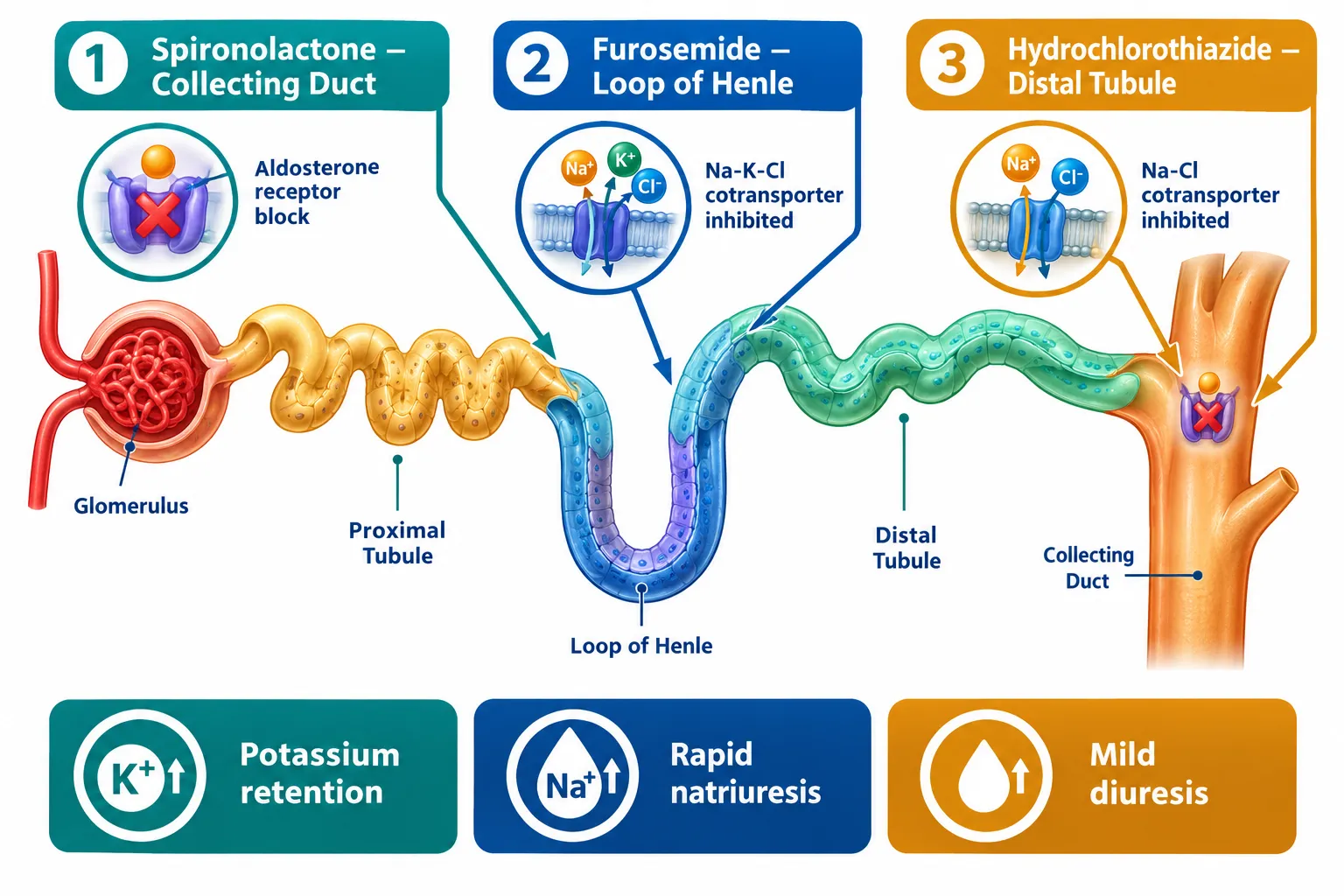
The kidney filters roughly 180 liters of fluid daily, and diuretics interrupt that process at precise points. Knowing those points is the foundation of understanding spironolactone, furosemide, and hydrochlorothiazide: fluid-balance controls in peptide studies.
How Each Diuretic Targets a Different Nephron Segment

Furosemide is a loop diuretic. It blocks the sodium-potassium-chloride (Na-K-Cl) cotransporter in the thick ascending limb of the loop of Henle. This segment normally reabsorbs about 25 percent of filtered sodium, so furosemide produces rapid, high-volume natriuresis. The result is swift plasma volume contraction, a variable that directly affects the apparent concentration of any circulating peptide.

Hydrochlorothiazide (HCTZ) acts further downstream, at the sodium-chloride cotransporter in the distal convoluted tubule. Its diuretic effect is milder and slower than furosemide, making it useful for sustained, lower-magnitude volume reduction. However, it persistently lowers serum potassium and can raise blood glucose, both of which interfere with insulin-related and growth-hormone peptide assays.

Spironolactone is an aldosterone receptor antagonist that works in the collecting duct. By blocking aldosterone binding, it prevents the transcription of sodium channels, reducing sodium reabsorption and retaining potassium. This potassium-sparing property is critical in peptide research contexts where hypokalemia would itself alter cellular signaling.

Diuretic Site of Action Key Ion Effect Onset
Furosemide Loop of Henle Loses K+, Na+, Cl- 30-60 min
Hydrochlorothiazide Distal tubule Loses K+, Na+ 2-4 hours
Spironolactone Collecting duct Retains K+, loses Na+ 24-48 hours

Fluid Shifts, Electrolytes, and Peptide Endpoint Distortion

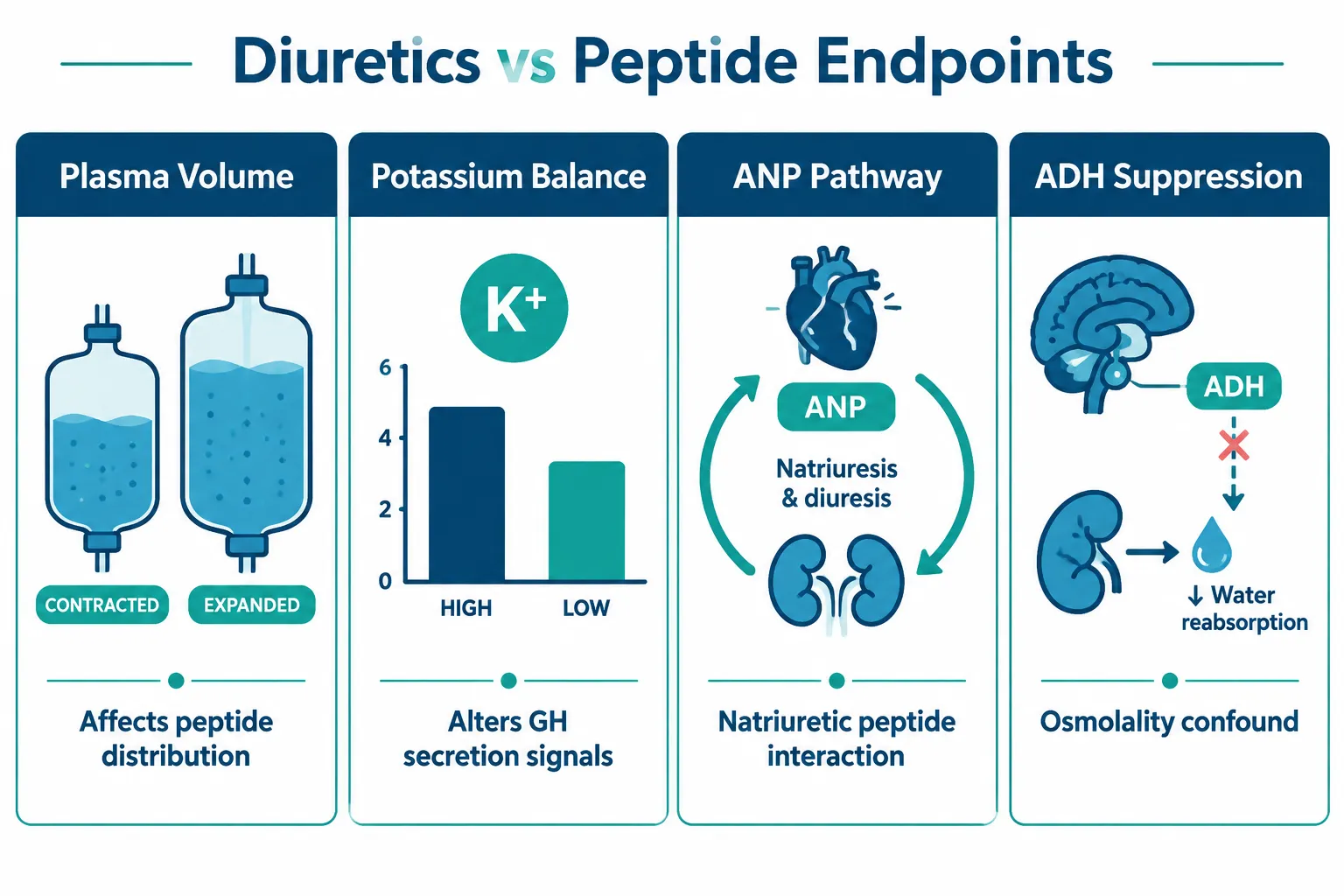
The core problem in peptide research is straightforward: volume, osmolality, and electrolyte status alter peptide secretion, distribution, and receptor sensitivity independent of any test compound.

This is especially relevant when studying cardioprotective agents. Research involving SS-31 peptide benefits in mitochondrial or cardiorenal models, for example, must account for baseline volume status because plasma volume contraction alone can trigger compensatory neurohumoral responses that mimic or mask peptide activity.
Fluid Shifts, Electrolytes, and Peptide Endpoint Distortion

Potassium and growth hormone secretion are closely linked. Hypokalemia, a predictable consequence of both furosemide and HCTZ, suppresses insulin secretion and impairs the somatotropic axis. Studies involving growth-hormone-releasing peptides that do not account for thiazide-induced potassium losses risk attributing blunted GH responses to the peptide when the real cause is electrolyte imbalance.

Sodium and plasma osmolality govern ADH (antidiuretic hormone) release. Diuretic-induced hypernatremia or hyponatremia directly shifts ADH levels, which in turn modulates aquaporin-mediated water reabsorption throughout the nephron. In any study using natriuretic peptides or vasopressin-adjacent compounds, this represents a critical confound. The same principle applies when evaluating metabolic peptides such as GLP-3 research compounds, where fluid dynamics affect nutrient absorption and gut hormone signals.

ANP (atrial natriuretic peptide) is both a research target and a physiological variable. Diuresis reduces atrial wall tension, which suppresses ANP release. Any study measuring ANP as a primary endpoint, or using it as a proxy for cardiac stress, must document and control baseline diuretic exposure.

Key insight: Volume contraction caused by even modest furosemide doses can reduce measured ANP by 15 to 30 percent, a shift large enough to obscure a peptide's true cardioprotective signal.


Combination Strategies, Diuretic Resistance, and Implications for Research Protocols

Recent cardiorenal evidence has revived interest in combining diuretics rather than escalating single-agent doses. The CLOROTIC trial and follow-up 2026 synthesis data confirm that furosemide combined with hydrochlorothiazide achieves superior decongestion in acute heart failure compared with furosemide alone, with a manageable electrolyte burden when monitored carefully.

Spironolactone adds a complementary layer. Its aldosterone-blocking mechanism not only retains potassium but reduces cardiac fibrosis pathways, making it directly relevant to studies using cardioprotective peptides. Those exploring SS-31 10mg research peptide considerations in cardiomyopathy models should note that concurrent spironolactone use will alter aldosterone-related gene expression in the heart, a biological variable that must be controlled or documented.
Combination Strategies, Diuretic Resistance, and Implications for Research Protocols

Diuretic resistance, defined as inadequate response despite adequate dosing, is itself a significant confounder. It often reflects compensatory nephron hypertrophy, elevated aldosterone, or worsening renal function. In a peptide study context, diuretic resistance introduces non-linearity: the relationship between administered diuretic dose and actual volume effect becomes unpredictable, making peptide-endpoint interpretations unreliable.

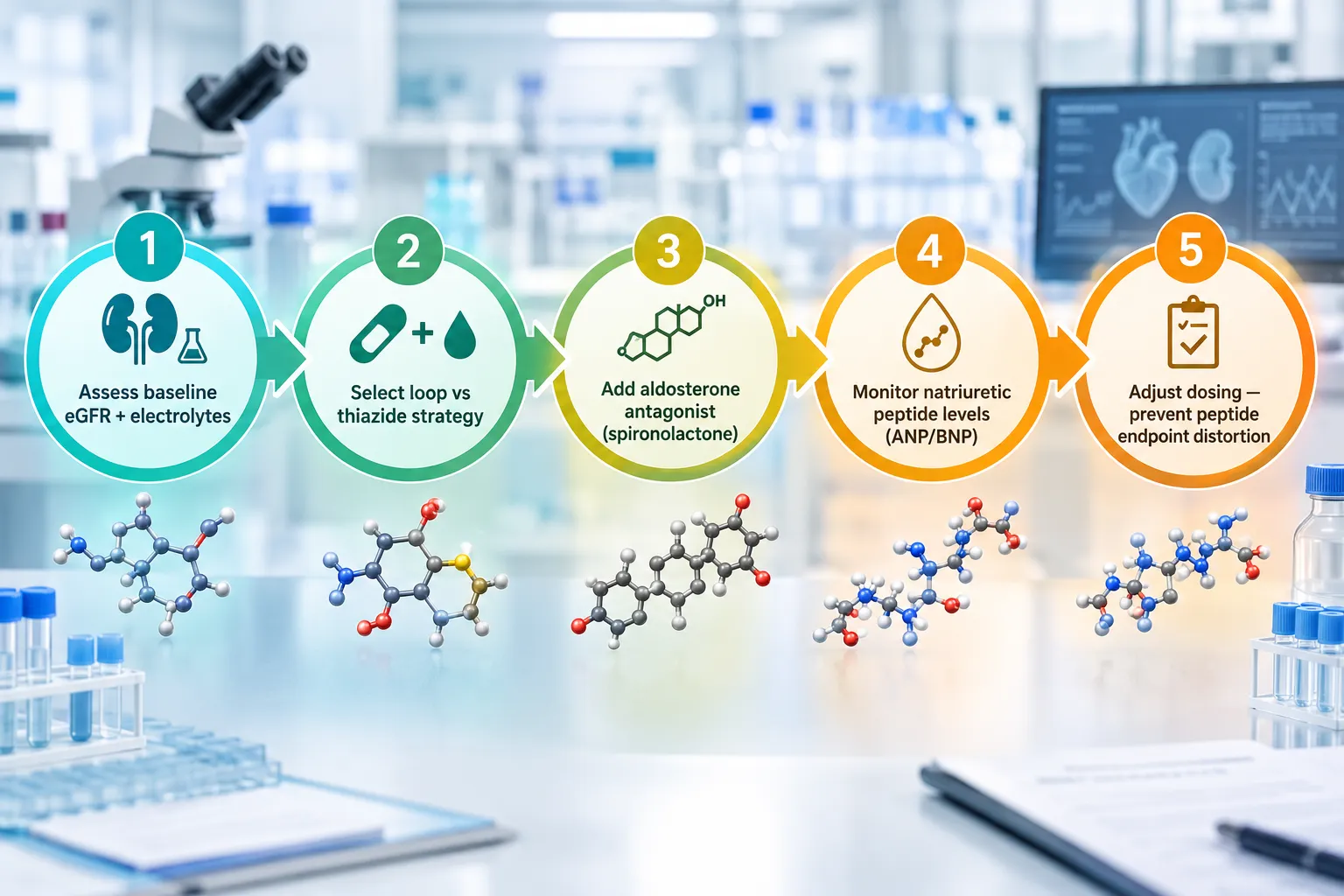
A practical protocol checklist for researchers includes:

  • Measure serum potassium, sodium, creatinine, and eGFR at baseline and at each study interval
  • Document exact diuretic dose, timing, and route before peptide administration
  • Allow a sufficient washout period if switching diuretic classes between study arms
  • Use ANP and BNP as co-variables, not primary endpoints, unless the study is specifically designed around natriuretic peptide dynamics
  • For metabolic peptide studies, including compounds profiled in resources like Peptides 101 for research-use only buyers, document body weight, urine output, and hydration status at every checkpoint

For researchers working with PT-141 or other receptor-targeted peptides, hormonal cross-talk with aldosterone and ADH pathways can alter receptor expression profiles. Reviewing PT-141 research context, QA, and controls highlights how tightly controlled physiological variables must be before attributing receptor-level changes to the peptide alone.

Similarly, mitochondria-targeted peptides discussed under Peptide SS-31 research resources operate in a cellular environment that diuretic-driven electrolyte shifts can profoundly alter, particularly regarding mitochondrial membrane potential and potassium channel activity.


Conclusion

The interplay between spironolactone, furosemide, and hydrochlorothiazide, as fluid-balance controls in peptide studies, determines whether experimental data reflects actual peptide activity or uncontrolled physiological noise. Researchers and study designers should treat diuretic co-administration not as a peripheral clinical detail but as a primary methodological variable.

Actionable next steps:

  1. Establish a full electrolyte and renal function panel before any peptide study involving diuretics.
  2. Document diuretic class, dose, and timing in every study arm and report them as co-variables in analysis.
  3. Treat ANP, ADH, and aldosterone levels as confounders to be measured, not as spontaneous outcomes.
  4. When combining furosemide and hydrochlorothiazide based on current evidence, plan for potassium supplementation or spironolactone co-administration to maintain electrolyte stability.
  5. Apply the same rigor to metabolic, cardiovascular, and growth-hormone peptide studies alike, fluid balance does not discriminate by peptide class.

Controlling these variables is not overcaution. It is the minimum standard for producing interpretable, reproducible peptide research in 2026.

https://www.puretestedpeptides.com/wp-content/uploads/2026/10/spironolactone-furosemide-and-hydrochlorothiazide-fluid-balance-controls-in-pept.webp 1024 1536 https://www.puretestedpeptides.com/wp-content/uploads/2026/01/buy-peptides-online.jpg 2026-10-22 13:04:072026-10-22 13:04:07Spironolactone, Furosemide, and Hydrochlorothiazide: Fluid-Balance Controls in Peptide Studies
×

Helpful Links

  • My account
  • Cart
  • Checkout
  • Refund and Returns Policy
  • Privacy Policy
  • SMS Privacy Policy
  • Login
  • My Account
  • Logout

USA Made Lab Tested Peptides

All products are sold for research, laboratory, or analytical purposes only, and are not for human consumption


Pure Tested Peptides is a chemical supplier. Pure Tested Peptides is not a compounding / chemical compounding facility as defined under 503A of the Federal Food, Drug, and Cosmetic act. Pure Tested Peptides is not an outsourcing facility as defined under 503B of the Federal Food, Drug, and Cosmetic act.

The statements made within this website have not been evaluated by the US Food and Drug Administration. The products we offer are not intended to diagnose, treat, cure or prevent any disease.

Human/Animal Consumption Prohibited. Laboratory/In-Vitro Experimental Use Only

Scroll to top Scroll to top Scroll to top