Call or Text 727-513-9780
  • Shopping Cart Shopping Cart
    0Shopping Cart
Pure Tested Peptides | America's most trusted Peptides for sale online
  • Peptides for sale
    • Oral Peptides for sale
      • Peptide Capsules for sale
      • BPC 157 Capsules 1000mcg
      • SLU-PP-332 Capsules | 1000 mcg
      • 5-Amino-1MQ 50mg Capsules
      • Tesofensine 500mcg
    • All Peptides for sale
    • Peptide Sprays
      • BPC 157 Nasal Spray Kit
      • BPC-157 TB500 Nasal Spray Kit
      • Semax Nasal Spray 10mg
      • Selank – Nasal Spray Kit – 10mg
      • Epithalon 50MG Nasal Spray Kit
      • Ipamorelin 10mg Nasal Spray
      • Klow Nasal Spray (BPC-157 + TB-500 + GHK-Cu + KPV) | 80mg
      • Hulk Nasal Spray Tesa / Ipa Blend 6/3 MG
      • Klow Nasal Spray
      • NAD + 500 mg Nasal Spray
      • PT-141 Nasal Spray Kit
    • GHRH Peptides
      • Ipa Peptides
      • CJC-1295 Peptides
        • CJC-1295 with DAC 5 mg
        • CJC-1295 without DAC 5 mg
        • CJC-1295 Ipa 10mg
      • Tesa Peptides
        • Tesa Peptide
        • Tesa 20 mg
    • GHK-Cu Peptides
      • All GHK-Cu Peptides
      • GHK-Cu 100mg
      • KLOW Peptide Blend – Buy KLOW blend online
    • BPC Peptides
      • All BPC Peptides
      • BPC-157
      • BPC-157 TB-500
      • BPC 157 capsules 1000mcg
    • SLU-PP-332 Peptides
      • All SLU-PP-332 Peptides
      • SLU-PP-332 5mg
    • GLP3 Peptides
    • PT-141 Peptides
      • PT-141 Peptides for sale
      • PT-141 10mg
      • PT-141 Nasal Spray
    • CAG Peptides
      • Lipo-C Peptide Blend
      • CAG 5mg
      • CAG 10mg
    • MOTS-C Peptides
      • MOTS-C Peptides for sale
      • MOTS-c peptide
      • MOTS-c 10mg *6 pack*
    • 5 Amino 1MQ Peptides
      • 5 Amino 1MQ Peptides for sale
      • 5-Amino-1MQ 50mg Capsules
      • 5-Amino-1MQ 5mg
    • Epithalon Peptides
      • Epithalon Peptides for sale
      • Epithalon 10mg
      • Epithalon 50mg
  • Shop
    • GLPs
      • 5-Amino-1MQ 50mg Capsules
      • 5-Amino-1MQ 5mg
      • L-Carnitine 500mg/ml
      • Tesofensine 500mcg
      • SLU-PP-332 5mg
      • MOTS-c 10mg *6 pack*
    • Epithalon & BPC Peptides
      • Epithalon 10mg
      • Epithalon 50mg
      • BPC-157
      • BPC 157 capsules 1000mcg
      • BPC-157 TB-500
      • BPC-157 TB500 Nasal Spray Kit
      • BPC 157 Nasal Spray Kit
    • BPC TB-500 & NAD+ Peptides
      • NAD+ 500 mg
      • KLOW Peptide Blend – Buy KLOW blend online
      • GLOW Peptide Blend
      • TB 500 5mg
      • BPC 157 capsules 1000mcg – Supplement
      • BPC 157 Nasal Spray Kit
      • BPC-157
      • BPC-157 TB500 Nasal Spray Kit
      • BPC-157 TB-500
      • BPC 157 capsules 1000mcg
    • LL-37 Peptide
      • LL-37 10 mg
    • MOTS-C & Selank
      • MOTS-c peptide
      • Selank 10mg
    • GHK Peptides
      • GHK-Cu 100mg
      • GLOW Peptide Blend
      • KLOW Peptide Blend – Buy KLOW blend online
  • COAs
  • Wholesale
    • Wholesale Peptides for sale
  • PTP FAQ
  • Affiliates
    • Selank Peptide: Advanced Pharmacological Mechanisms Underlying Its Anxiolytic and Nootropic Effects in Research
      • 5-Amino-1MQ Peptide: Detailed Mechanisms of NNMT Inhibition and Its Impact on Cellular Metabolism Research
        • MOTS-C Peptide: Unraveling Its Role in Mitochondrial Dynamics and Energy Metabolism Research
          • Epithalon Peptide and Telomerase Regulation: Investigating Its Impact on Cellular Senescence and Lifespan Research Models
            • GLP2-T vs GLP2 Tirz Peptide: Understanding the Naming, Mechanistic Nuances, and Research Implications for Gut Health
      • Peptides and Polypeptides in Modern Pharmacology: What Research on Metoprolol, Prednisone, and Amlodipine Reveals
        • Polypeptide Peptides vs NSAIDs: What Naproxen and Diclofenac Teach Tissue-Repair Researchers About BPC‑157 and TB‑500
          • Peptides and Polypeptides in Endocrine Pharmacology: How GLP-1, GLP-2, and GLP-3 Retatrutide Differ From Classic Drugs Like Prednisone and Amlodipine
          • 5‑Amino‑1MQ Peptide and NNMT Inhibition: How It Compares With Statins Like Atorvastatin in Adipose and Lipid Metabolism Research
      • Enclomiphene, Estrogen Receptor Signaling, and Luteinizing Phase Biology: What Hormone Researchers Should Measure
        • Mesenchymal Stem Cells, BPC‑157, and GHK‑Cu: How Tissue Repair Peptides Compare With Classic NSAIDs Like Naproxen in Injury Models
          • Peptide Calculator Use Cases Beyond Growth Hormone: Working Through GLP‑3 Retatrutide, MOTS‑c, and BPC‑157 Research Dosing
        • Polypeptide Peptides in Endocrine and Metabolic Pharmacology: Lessons From Amlodipine, Prednisone, and Metoprolol
        • Peptides Calculator for Advanced Blends: Worked Examples for Tesamorelin, CJC‑1295, and Ipamorelin Stacks
          • Peptides and Polypeptides in Human Physiology: How Molecular Size Shapes Research Applications
            • Selank Peptide: Advanced Pharmacological Mechanisms Underlying Its Anxiolytic and Nootropic Effects in Research
          • 5-Amino-1MQ Peptide: Detailed Mechanisms of NNMT Inhibition and Its Impact on Cellular Metabolism Research
            • MOTS-C Peptide: Unraveling Its Role in Mitochondrial Dynamics and Energy Metabolism Research
              • Epithalon Peptide and Telomerase Regulation: Investigating Its Impact on Cellular Senescence and Lifespan Research Models
                • GLP2-T vs GLP2 Tirz Peptide: Understanding the Naming, Mechanistic Nuances, and Research Implications for Gut Health
                  • Peptides and Polypeptides in Endocrine Pharmacology: How GLP-1, GLP-2, and GLP-3 Retatrutide Differ From Classic Drugs Like Prednisone and Amlodipine
                    • Polypeptide Peptides vs NSAIDs: What Naproxen and Diclofenac Teach Tissue-Repair Researchers About BPC‑157 and TB‑500
                      • Peptides and Polypeptides in Modern Pharmacology: What Research on Metoprolol, Prednisone, and Amlodipine Reveals
                        • 5‑Amino‑1MQ Peptide and NNMT Inhibition: How It Compares With Statins Like Atorvastatin in Adipose and Lipid Metabolism Research
                        • Enclomiphene, Estrogen Receptor Signaling, and Luteinizing Phase Biology: What Hormone Researchers Should Measure
                        • Mesenchymal Stem Cells, BPC‑157, and GHK‑Cu: How Tissue Repair Peptides Compare With Classic NSAIDs Like Naproxen in Injury Models
                        • Peptide Calculator Use Cases Beyond Growth Hormone: Working Through GLP‑3 Retatrutide, MOTS‑c, and BPC‑157 Research Dosing
                        • Polypeptide Peptides in Endocrine and Metabolic Pharmacology: Lessons From Amlodipine, Prednisone, and Metoprolol
                        • Peptides Calculator for Advanced Blends: Worked Examples for Tesamorelin, CJC‑1295, and Ipamorelin Stacks
                        • Peptides and Polypeptides in Human Physiology: How Molecular Size Shapes Research Applications
                        • Selank Peptide: Advanced Pharmacological Mechanisms Underlying Its Anxiolytic and Nootropic Effects in Research
                        • MOTS-C Peptide: Unraveling Its Role in Mitochondrial Dynamics and Energy Metabolism Research
                        • Peptides and Polypeptides in Modern Pharmacology: What Research on Metoprolol, Prednisone, and Amlodipine Reveals
                        • Peptides and Polypeptides in Endocrine Pharmacology: How GLP-1, GLP-2, and GLP-3 Retatrutide Differ From Classic Drugs Like Prednisone and Amlodipine
                        • 5-Amino-1MQ Peptide: Detailed Mechanisms of NNMT Inhibition and Its Impact on Cellular Metabolism Research
                        • Mesenchymal Stem Cells, BPC‑157, and GHK‑Cu: How Tissue Repair Peptides Compare With Classic NSAIDs Like Naproxen in Injury Models
                        • Peptide Calculator Use Cases Beyond Growth Hormone: Working Through GLP‑3 Retatrutide, MOTS‑c, and BPC‑157 Research Dosing
                        • GLP2-T vs GLP2 Tirz Peptide: Understanding the Naming, Mechanistic Nuances, and Research Implications for Gut Health
                        • Polypeptide Peptides in Endocrine and Metabolic Pharmacology: Lessons From Amlodipine, Prednisone, and Metoprolol
                        • Polypeptide Peptides vs NSAIDs: What Naproxen and Diclofenac Teach Tissue-Repair Researchers About BPC‑157 and TB‑500
                        • Peptides and Polypeptides in Human Physiology: How Molecular Size Shapes Research Applications
                        • Peptides Calculator for Advanced Blends: Worked Examples for Tesamorelin, CJC‑1295, and Ipamorelin Stacks
                        • 5‑Amino‑1MQ Peptide and NNMT Inhibition: How It Compares With Statins Like Atorvastatin in Adipose and Lipid Metabolism Research
                        • Enclomiphene, Estrogen Receptor Signaling, and Luteinizing Phase Biology: What Hormone Researchers Should Measure
                        • Epithalon Peptide and Telomerase Regulation: Investigating Its Impact on Cellular Senescence and Lifespan Research Models
                        • Best research protocol Klow blend
                        • best time to take BPC-157
                        • best time to take DSIP (Delta Sleep Inducing Peptide)
                        • best time to take CJC-1295
                        • best time to take AOD-9604
                        • best time to take Follistatin 344
                        • best time to take Ipamorelin
                        • best time to take MK-677 (Ibutamoren)
                        • best time to take Ligandrol (LGD-4033) — research compound
                        • best time to take Ostarine (MK-2866) — research compound
                        • best time to take GHK-CU
                        • best time to take TB-500
                        • best time to take MOTS-c
                        • best time to take Semax
                        • best time to take RAD-140 (Testolone) — research compound
                        • best time to take Thymosin Alpha-1
                        • best time to take PEG-MGF
                        • Biolife Plasma, Octapharma Plasma, and Research Peptides: How Plasma Donation Labs Differ From Peptide Suppliers
                        • best time to take YK-11 — research compound
                        • best time to take PT-141 (Bremelanotide)
                        • Best research protocol Klow blend
                        • 5-Amino-1MQ and MOTS-C Synergy: Metabolic Signaling, Mitochondria, and Research Design
                        • BPC-157 and TB-500: Investigating Their Combined Effects on Angiogenesis and Cellular Migration in Tissue Repair Models
                        • BPC-157 Peptide: Gut Barrier Function, Inflammation, and Tissue-Recovery Research
                        • 5‑Amino‑1MQ and MOTS‑c Synergy in Metabolic Research: Designing NNMT and Mitochondrial Biogenesis Stacks
                        • CJC-1295 with DAC vs. Without DAC: Half-Life, Release Kinetics, and Research Implications
                        • CJC‑1295 with DAC vs. Without DAC: Expanding on Half‑Life Differences Using Tesamorelin and Ipamorelin Blend Case Studies
                        • Collagen Biology and Copper‑Binding Peptides: How GHK‑Cu, Glow Blend, and Klow Blend Interact with Skin and Connective Tissue
                        • Collagen Biology and Regenerative Peptides: How GHK‑Cu, Glow Blend, and Klow Blend Affect Extracellular Matrix Research
                    • DNA, Telomeres, and Longevity Peptides: Positioning Epithalon and MOTS‑c in Genetic Aging Research
                      • Enclomiphene Citrate: serm Mechanism, Testosterone Research, and Stack Compatibility
                        • Enclomiphene vs Enclomiphene Citrate: Formulation, Bioavailability, and Research Distinctions
                        • Epithalon Peptide Research: Telomerase Activation, Aging, and Pineal Gland Function
                        • Estrogen Receptor Signaling and Enclomiphene: How Selective Modulators Compare with Classic Polypeptide Hormones
                        • GHK-Cu Peptide: Advanced Mechanisms in Extracellular Matrix Remodeling and Wound Healing Research
                        • GHK-Cu Peptide: Collagen Synthesis, Wound Repair, and Skin-Barrier Research Models
                        • GLP-1 vs GLP-3 vs GLP-2: Peptide Classification and Research Applications
                        • GLP-2 Peptide Research Guide: Gut Barrier Function, Nutrient Absorption, and Intestinal Recovery Models
                        • GLP-3 Retatrutide vs. GLP-1 Drugs: What Triple-Agonist Biology Changes in Research Models
                        • Ipamorelin and Tesamorelin Combination: Synergistic GH Secretagogue Research and Dosing Protocols
                        • GLP2 Tirz Peptide: What It Is, Why the Name Exists, and How Researchers Should Interpret It
                        • Klow Blend Peptide Nasal Spray: What the Formulation Is Trying to Do in Cognitive Research
                        • Mitochondria, NNMT Inhibition, and Peptide Modulators: Where MOTS‑c and 5‑Amino‑1MQ Fit in Cellular Energy Research
                        • MOTS-c Peptide: Mitochondrial Function, Energy Metabolism, and What Researchers Measure
                        • MOTS-c vs. 5-Amino-1MQ: Which Metabolic Research Questions Each Compound Actually Answers
                        • Nasal Spray Peptides: Bioavailability, Administration, and Semax/Selank Research Applications
                        • PT-141 Peptide Research: Mechanism of Action and Melanocortin Receptor Signaling
                        • Retatrutide for Research: Mechanism, Structure, and GLP-1/GLP-3 Dual Action
                        • Retatrutide for Obesity and Type 2 Diabetes: What the Latest Trial Data Suggest
                        • Tesofensine Peptide Research: Mechanism, Appetite Suppression, and Neuropeptide Y Pathways
  • Contact
    • Contact Customer Service
    • Text Customer Support
  • About US
  • Shop all peptides
  • Affiliate Program
    • Affiliate Signup
  • Login / Register Login / Register Page Link Login / Register Page Link
  • Click to open the search input field Click to open the search input field Search
  • Menu Menu

Tag Archive for: liver organoids

5-Amino-1MQ and MOTS-c in Liver Organoids: Separating NNMT, Mitochondrial, and Lipid-Handling Effects

5-Amino-1MQ and MOTS-c in Liver Organoids: Separating NNMT, Mitochondrial, and Lipid-Handling Effects

October 26, 2026/0 Comments/in Uncategorized/by

Most metabolic peptide research defaults to adipose tissue or skeletal muscle as its experimental arena. Yet the liver processes more lipid flux, methylation chemistry, and mitochondrial signaling per gram of tissue than almost any other organ, making it the most logical but least explored frontier for compounds like 5-Amino-1MQ and MOTS-c. Understanding the distinct pathways these agents engage is now central to designing next-generation liver organoid experiments.

Separating NNMT, mitochondrial, and lipid-handling effects in liver organoids requires precise knowledge of how 5-Amino-1MQ and MOTS-c work at the molecular level before any combined model is ever attempted.

Key Takeaways

  • 5-Amino-1MQ inhibits NNMT, an enzyme that depletes NAD+ and methyl donors, while MOTS-c is a mitochondria-derived peptide that activates AMPK, these are fundamentally separate mechanisms.
  • Preclinical data show 5-Amino-1MQ reduces fat mass, lowers cholesterol, and attenuates hepatic steatosis without reducing food intake.
  • MOTS-c targets mitochondrial stress response and nuclear gene regulation in liver disease models, particularly in MASLD and fibrosis.
  • No published studies have tested 5-Amino-1MQ and MOTS-c together in liver organoids as of 2026, liver-specific organoid applications remain a forward-looking research goal.
  • Liver organoids offer readouts, lipid accumulation, mitochondrial respiration, NNMT expression, viability, and stress markers, that adipose models simply cannot replicate.

How 5-Amino-1MQ Targets NNMT and Lipid Handling
How 5-Amino-1MQ Targets NNMT and Lipid Handling

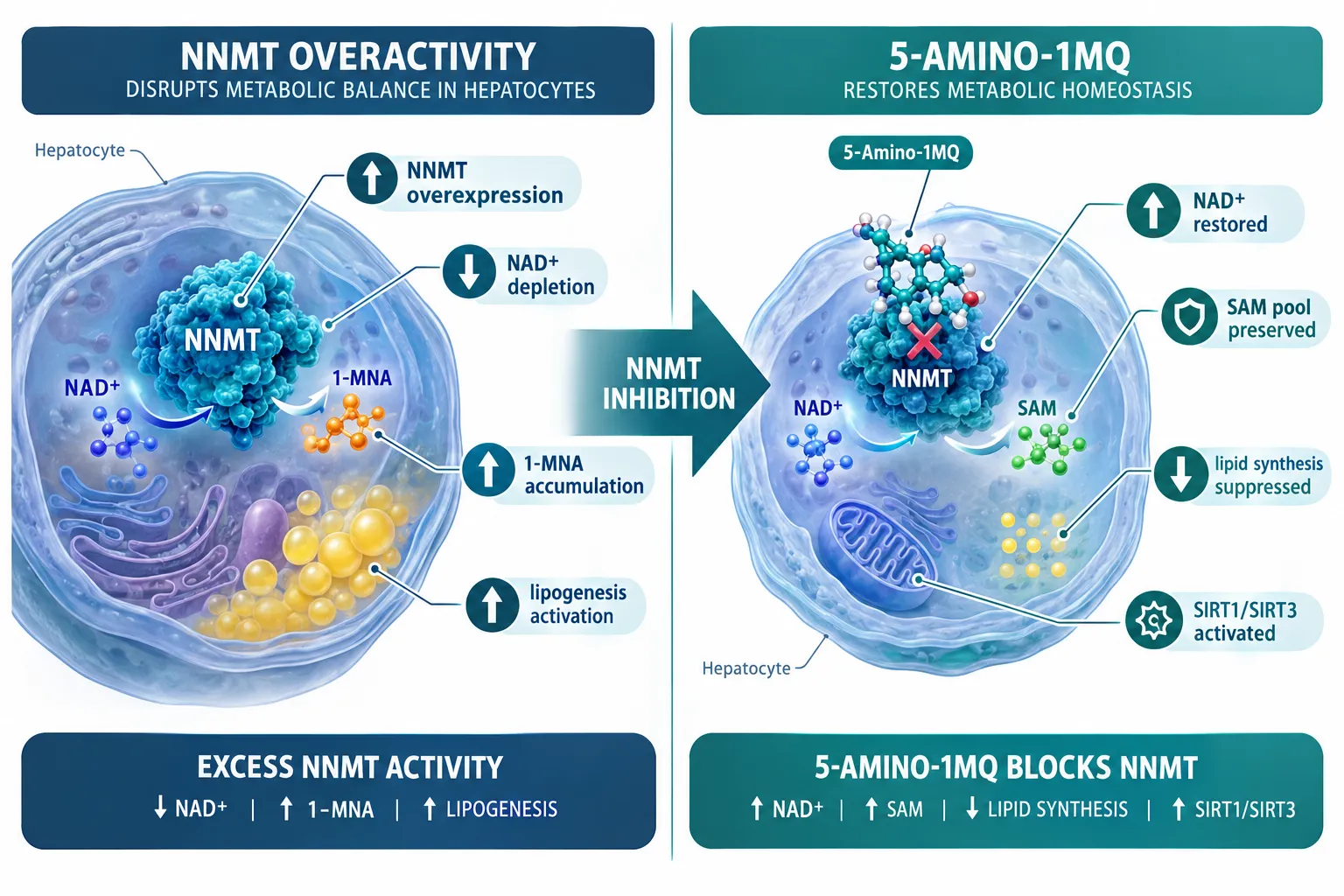
Nicotinamide N-methyltransferase (NNMT) is an enzyme overexpressed in adipose tissue and liver during obesity and insulin resistance. It consumes S-adenosylmethionine (SAM) and converts nicotinamide into 1-methylnicotinamide (1-MNA), effectively depleting two of the cell's most critical metabolic cofactors: NAD+ precursors and methyl donors.

5-Amino-1MQ is a water-soluble, membrane-permeable small molecule that competitively inhibits NNMT. By blocking this enzyme, it preserves NAD+ availability and SAM pools, which in turn activates sirtuins (SIRT1, SIRT3) and indirectly engages AMPK, though through a methylation and redox route rather than a direct energy-sensing route.

The preclinical data are striking. In diet-induced obese mice:

  • Subcutaneous 5-Amino-1MQ over 11 days reduced epididymal fat mass by roughly 35%
  • Adipocyte size shrank by more than 30%
  • Total cholesterol dropped approximately 30%
  • A 28-day study showed dose-dependent limits on weight gain, improved glucose tolerance, and less hepatic steatosis, all without reduced food intake

This hepatic steatosis reduction is the most relevant signal for liver organoid research. The liver accumulates lipid droplets when NNMT drives down NAD+ and SAM, impairing beta-oxidation and methylation-dependent gene silencing. Restoring those pools via NNMT inhibition directly shifts the hepatocyte toward lipid clearance. Researchers exploring SS31 mitochondrial dynamics alongside NNMT inhibitors will recognize a shared theme: preserving organelle function upstream of metabolic dysfunction.

"The NNMT-inhibition axis is best understood as a methylation and NAD+ salvage lever, mechanistically upstream of, and distinct from, the mitochondrial signaling lever that MOTS-c operates."


How MOTS-c Drives Mitochondrial and MASLD Signaling
How MOTS-c Drives Mitochondrial and MASLD Signaling

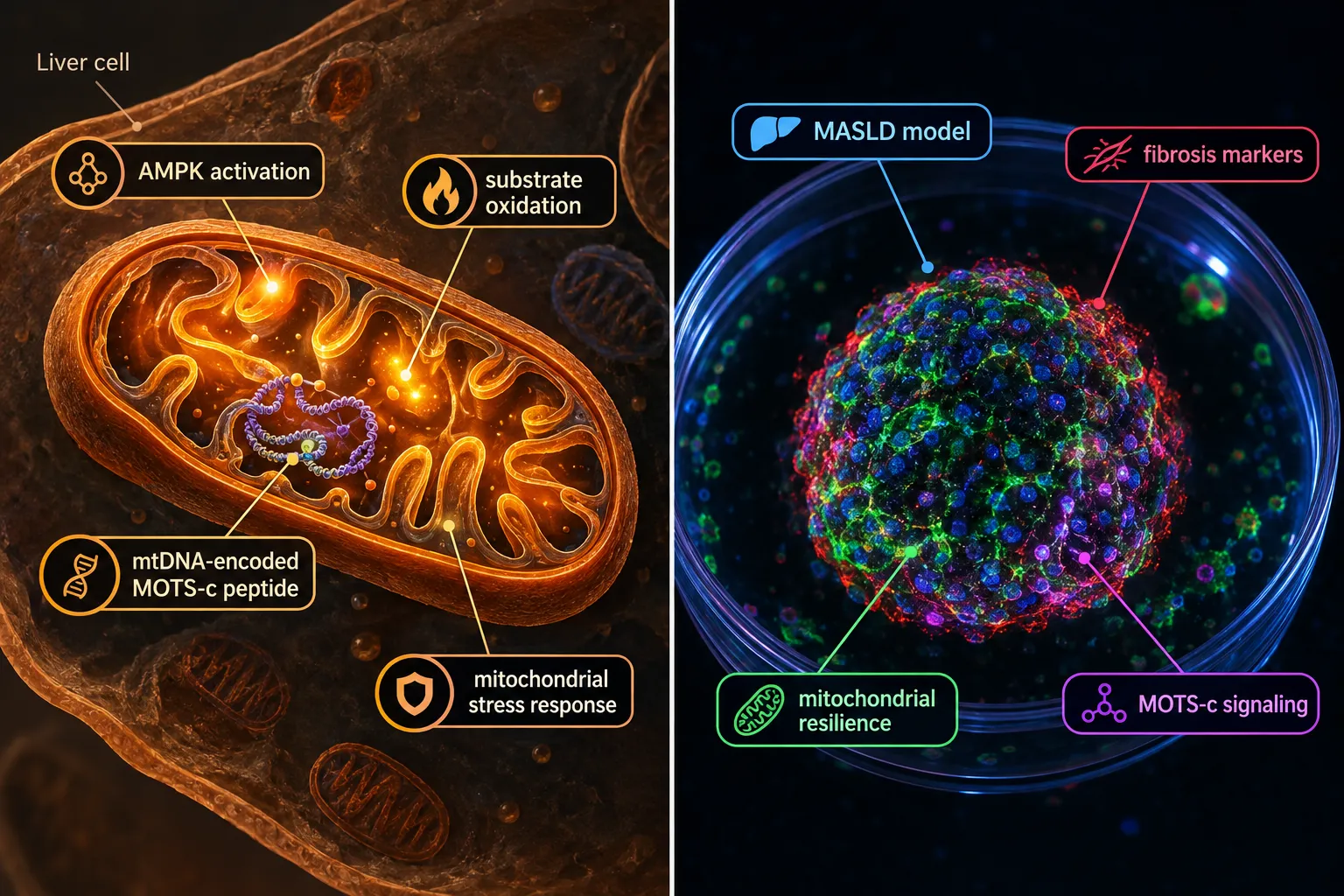
MOTS-c is a 16-amino-acid peptide encoded within the mitochondrial 12S rRNA gene, one of the very few bioactive peptides derived directly from mitochondrial DNA. Its primary mechanism is AMPK activation, which shifts substrate handling toward oxidation, suppresses lipogenesis, and regulates nuclear gene expression in metabolically stressed cells.

In liver disease models, MOTS-c has demonstrated:

Effect Pathway Involved
Reduced hepatic steatosis AMPK-driven fatty acid oxidation
Suppressed fibrotic signaling Nuclear gene regulation
Attenuated inflammation Mitochondrial stress-response signaling
Restored mitochondrial function Mitochondrial quality control

This profile maps precisely onto metabolic dysfunction-associated steatotic liver disease (MASLD) and fibrosis, making MOTS-c a strong candidate for liver organoid studies. Critically, its mechanism is not direct enzyme inhibition of a biosynthetic pathway. MOTS-c responds to mitochondrial stress and orchestrates a broader gene-expression change, which is why its effects in liver tissue cannot be predicted from 5-Amino-1MQ data alone.

For researchers interested in related mitochondrial support compounds, SS31 peptide benefits and SS31 peptides for sale represent another mitochondria-targeted research avenue that complements MOTS-c studies. Broader metabolic peptide research frameworks are also discussed in resources covering GLP-1 peptide generational research concepts.


Designing Liver Organoid Experiments to Separate These Effects
Designing Liver Organoid Experiments to Separate These Effects

The absence of published 5-Amino-1MQ and MOTS-c liver organoid studies in 2026 is not a gap, it is an open design opportunity. Kidney organoid work using 5-Amino-1MQ in human induced-pluripotent-stem-cell-derived models has already validated NNMT inhibition as a tractable organoid intervention, even if those findings cannot be extrapolated directly to hepatic tissue.

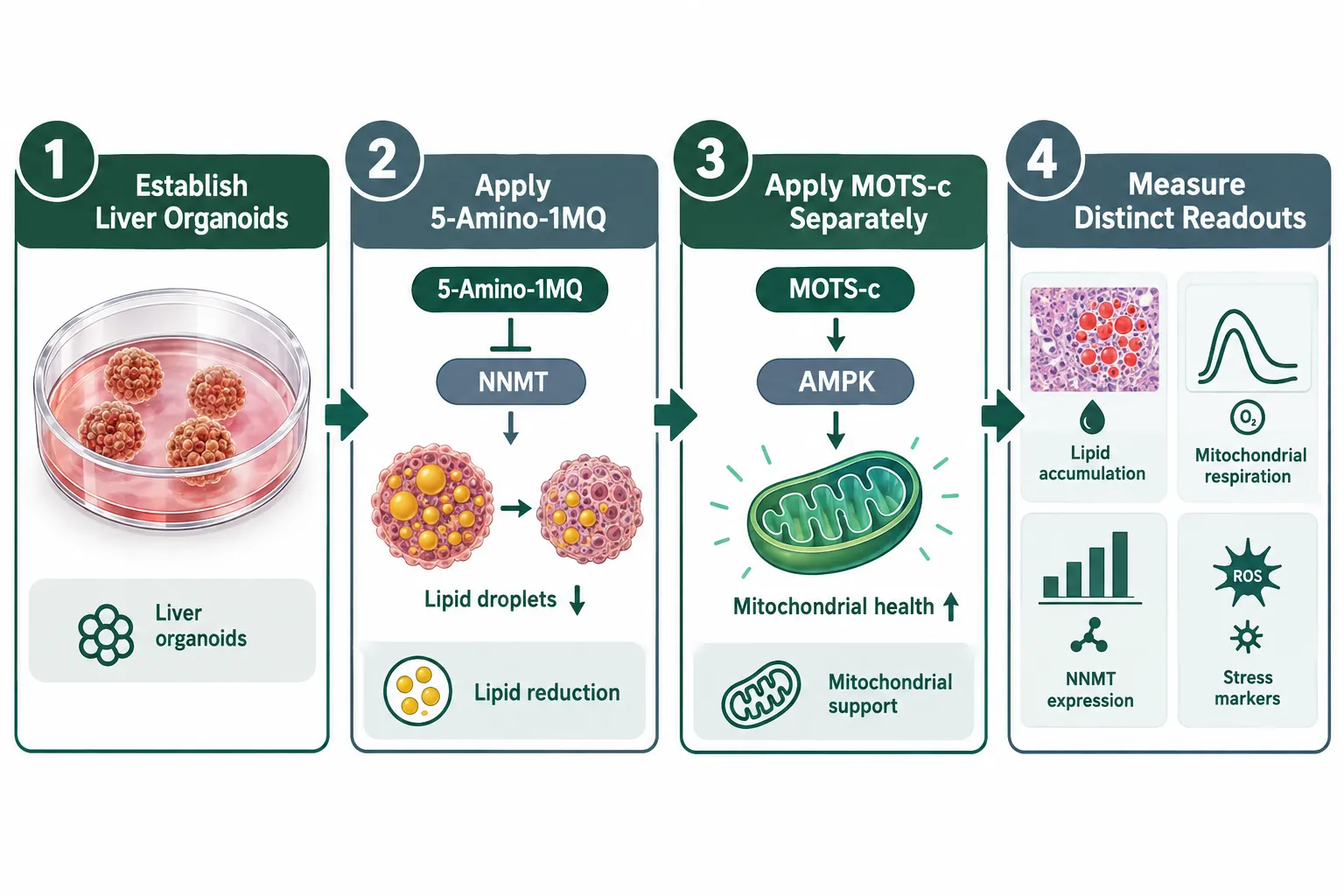
A rigorous liver organoid protocol separating NNMT, mitochondrial, and lipid-handling effects would require distinct readouts for each agent:

For 5-Amino-1MQ (NNMT/lipid axis):

  • Intracellular NAD+ and SAM quantification
  • 1-MNA efflux as a proxy for NNMT activity
  • Lipid droplet accumulation via fluorescent staining
  • Lipogenesis gene expression (FASN, ACC1)

For MOTS-c (mitochondrial/AMPK axis):

  • Mitochondrial respiration rate (oxygen consumption rate assay)
  • AMPK phosphorylation status
  • Fibrotic marker expression (TGF-beta, collagen I)
  • Mitochondrial membrane potential

Shared viability and stress panel:

  • Cell viability and organoid morphology
  • Oxidative stress markers (ROS, 8-OHdG)
  • Inflammatory cytokines (IL-6, TNF-alpha)

This separation matters because combining both agents without individual baselines would make it impossible to attribute any observed effect to the correct pathway. The "NAD+ / MOTS-c / 5-Amino-1MQ" framework now discussed in metabolic peptide research describes these as complementary but non-overlapping bottlenecks: NNMT inhibition preserves substrate availability, while MOTS-c activates the downstream signaling machinery that uses those substrates.

Researchers comparing hormone-modifying peptide frameworks, such as those reviewing tesa versus sermorelin for visceral fat reduction, will find a similar principle: mechanistic specificity at the experimental design stage prevents confounded readouts. The where to buy SS31 and Epithalon online resource also underscores the growing interest in pairing mitochondrial peptides with complementary metabolic agents in research settings.

Important regulatory note: As of 2026, no FDA-approved MOTS-c product exists, no MOTS-c trial is registered with US sites, and 5-Amino-1MQ is available only as a research compound. All organoid applications discussed here are experimental and preclinical.


Conclusion

The scientific case for studying 5-Amino-1MQ and MOTS-c in liver organoids is built on distinct mechanistic logic: one agent targets NNMT-driven depletion of NAD+ and methyl donors to correct lipid handling, while the other activates mitochondrial stress-response pathways via AMPK. Conflating these mechanisms, or testing them only in combination without individual baselines, would undermine the core value of the organoid platform.

Actionable next steps for researchers:

  1. Establish a steatotic liver organoid model (fatty acid loading or genetic MASLD model) before introducing either compound.
  2. Test 5-Amino-1MQ and MOTS-c in separate treatment arms first, using the distinct readout panels described above.
  3. Quantify NNMT expression and 1-MNA efflux as compound-specific efficacy markers for 5-Amino-1MQ.
  4. Use mitochondrial respiration assays and AMPK phosphorylation as primary readouts for MOTS-c.
  5. Only after establishing individual effect profiles should combined-treatment arms be designed, with combination-specific readouts planned in advance.

The liver organoid is not merely a convenient model, it is the only platform that captures the hepatocyte-specific interplay of methylation chemistry, lipid flux, and mitochondrial quality control that makes these two compounds genuinely interesting together. The research is early, the tools are ready, and the mechanistic separation is clear.

https://www.puretestedpeptides.com/wp-content/uploads/2026/10/5-amino-1mq-and-mots-c-in-liver-organoids-separating-nnmt-mitochondrial-and-lipi.webp 1024 1536 https://www.puretestedpeptides.com/wp-content/uploads/2026/01/buy-peptides-online.jpg 2026-10-26 13:04:582026-10-26 13:04:585-Amino-1MQ and MOTS-c in Liver Organoids: Separating NNMT, Mitochondrial, and Lipid-Handling Effects
×

Helpful Links

  • My account
  • Cart
  • Checkout
  • Refund and Returns Policy
  • Privacy Policy
  • SMS Privacy Policy
  • Login
  • My Account
  • Logout

USA Made Lab Tested Peptides

All products are sold for research, laboratory, or analytical purposes only, and are not for human consumption


Pure Tested Peptides is a chemical supplier. Pure Tested Peptides is not a compounding / chemical compounding facility as defined under 503A of the Federal Food, Drug, and Cosmetic act. Pure Tested Peptides is not an outsourcing facility as defined under 503B of the Federal Food, Drug, and Cosmetic act.

The statements made within this website have not been evaluated by the US Food and Drug Administration. The products we offer are not intended to diagnose, treat, cure or prevent any disease.

Human/Animal Consumption Prohibited. Laboratory/In-Vitro Experimental Use Only

Scroll to top Scroll to top Scroll to top