Call or Text 727-513-9780
  • Shopping Cart Shopping Cart
    0Shopping Cart
Pure Tested Peptides | America's most trusted Peptides for sale online
  • Peptides for sale
    • Oral Peptides for sale
      • Peptide Capsules for sale
      • BPC 157 Capsules 1000mcg
      • SLU-PP-332 Capsules | 1000 mcg
      • 5-Amino-1MQ 50mg Capsules
      • Tesofensine 500mcg
    • All Peptides for sale
    • Peptide Sprays
      • BPC 157 Nasal Spray Kit
      • BPC-157 TB500 Nasal Spray Kit
      • Semax Nasal Spray 10mg
      • Selank – Nasal Spray Kit – 10mg
      • Epithalon 50MG Nasal Spray Kit
      • Ipamorelin 10mg Nasal Spray
      • Klow Nasal Spray (BPC-157 + TB-500 + GHK-Cu + KPV) | 80mg
      • Hulk Nasal Spray Tesa / Ipa Blend 6/3 MG
      • Klow Nasal Spray
      • NAD + 500 mg Nasal Spray
      • PT-141 Nasal Spray Kit
    • GHRH Peptides
      • Ipa Peptides
      • CJC-1295 Peptides
        • CJC-1295 with DAC 5 mg
        • CJC-1295 without DAC 5 mg
        • CJC-1295 Ipa 10mg
      • Tesa Peptides
        • Tesa Peptide
        • Tesa 20 mg
    • GHK-Cu Peptides
      • All GHK-Cu Peptides
      • GHK-Cu 100mg
      • KLOW Peptide Blend – Buy KLOW blend online
    • BPC Peptides
      • All BPC Peptides
      • BPC-157
      • BPC-157 TB-500
      • BPC 157 capsules 1000mcg
    • SLU-PP-332 Peptides
      • All SLU-PP-332 Peptides
      • SLU-PP-332 5mg
    • GLP3 Peptides
    • PT-141 Peptides
      • PT-141 Peptides for sale
      • PT-141 10mg
      • PT-141 Nasal Spray
    • CAG Peptides
      • Lipo-C Peptide Blend
      • CAG 5mg
      • CAG 10mg
    • MOTS-C Peptides
      • MOTS-C Peptides for sale
      • MOTS-c peptide
      • MOTS-c 10mg *6 pack*
    • 5 Amino 1MQ Peptides
      • 5 Amino 1MQ Peptides for sale
      • 5-Amino-1MQ 50mg Capsules
      • 5-Amino-1MQ 5mg
    • Epithalon Peptides
      • Epithalon Peptides for sale
      • Epithalon 10mg
      • Epithalon 50mg
  • Shop
    • GLPs
      • 5-Amino-1MQ 50mg Capsules
      • 5-Amino-1MQ 5mg
      • L-Carnitine 500mg/ml
      • Tesofensine 500mcg
      • SLU-PP-332 5mg
      • MOTS-c 10mg *6 pack*
    • Epithalon & BPC Peptides
      • Epithalon 10mg
      • Epithalon 50mg
      • BPC-157
      • BPC 157 capsules 1000mcg
      • BPC-157 TB-500
      • BPC-157 TB500 Nasal Spray Kit
      • BPC 157 Nasal Spray Kit
    • BPC TB-500 & NAD+ Peptides
      • NAD+ 500 mg
      • KLOW Peptide Blend – Buy KLOW blend online
      • GLOW Peptide Blend
      • TB 500 5mg
      • BPC 157 capsules 1000mcg – Supplement
      • BPC 157 Nasal Spray Kit
      • BPC-157
      • BPC-157 TB500 Nasal Spray Kit
      • BPC-157 TB-500
      • BPC 157 capsules 1000mcg
    • LL-37 Peptide
      • LL-37 10 mg
    • MOTS-C & Selank
      • MOTS-c peptide
      • Selank 10mg
    • GHK Peptides
      • GHK-Cu 100mg
      • GLOW Peptide Blend
      • KLOW Peptide Blend – Buy KLOW blend online
  • COAs
  • Wholesale
    • Wholesale Peptides for sale
  • PTP FAQ
  • Affiliates
    • Selank Peptide: Advanced Pharmacological Mechanisms Underlying Its Anxiolytic and Nootropic Effects in Research
      • 5-Amino-1MQ Peptide: Detailed Mechanisms of NNMT Inhibition and Its Impact on Cellular Metabolism Research
        • MOTS-C Peptide: Unraveling Its Role in Mitochondrial Dynamics and Energy Metabolism Research
          • Epithalon Peptide and Telomerase Regulation: Investigating Its Impact on Cellular Senescence and Lifespan Research Models
            • GLP2-T vs GLP2 Tirz Peptide: Understanding the Naming, Mechanistic Nuances, and Research Implications for Gut Health
      • Peptides and Polypeptides in Modern Pharmacology: What Research on Metoprolol, Prednisone, and Amlodipine Reveals
        • Polypeptide Peptides vs NSAIDs: What Naproxen and Diclofenac Teach Tissue-Repair Researchers About BPC‑157 and TB‑500
          • Peptides and Polypeptides in Endocrine Pharmacology: How GLP-1, GLP-2, and GLP-3 Retatrutide Differ From Classic Drugs Like Prednisone and Amlodipine
          • 5‑Amino‑1MQ Peptide and NNMT Inhibition: How It Compares With Statins Like Atorvastatin in Adipose and Lipid Metabolism Research
      • Enclomiphene, Estrogen Receptor Signaling, and Luteinizing Phase Biology: What Hormone Researchers Should Measure
        • Mesenchymal Stem Cells, BPC‑157, and GHK‑Cu: How Tissue Repair Peptides Compare With Classic NSAIDs Like Naproxen in Injury Models
          • Peptide Calculator Use Cases Beyond Growth Hormone: Working Through GLP‑3 Retatrutide, MOTS‑c, and BPC‑157 Research Dosing
        • Polypeptide Peptides in Endocrine and Metabolic Pharmacology: Lessons From Amlodipine, Prednisone, and Metoprolol
        • Peptides Calculator for Advanced Blends: Worked Examples for Tesamorelin, CJC‑1295, and Ipamorelin Stacks
          • Peptides and Polypeptides in Human Physiology: How Molecular Size Shapes Research Applications
            • Selank Peptide: Advanced Pharmacological Mechanisms Underlying Its Anxiolytic and Nootropic Effects in Research
          • 5-Amino-1MQ Peptide: Detailed Mechanisms of NNMT Inhibition and Its Impact on Cellular Metabolism Research
            • MOTS-C Peptide: Unraveling Its Role in Mitochondrial Dynamics and Energy Metabolism Research
              • Epithalon Peptide and Telomerase Regulation: Investigating Its Impact on Cellular Senescence and Lifespan Research Models
                • GLP2-T vs GLP2 Tirz Peptide: Understanding the Naming, Mechanistic Nuances, and Research Implications for Gut Health
                  • Peptides and Polypeptides in Endocrine Pharmacology: How GLP-1, GLP-2, and GLP-3 Retatrutide Differ From Classic Drugs Like Prednisone and Amlodipine
                    • Polypeptide Peptides vs NSAIDs: What Naproxen and Diclofenac Teach Tissue-Repair Researchers About BPC‑157 and TB‑500
                      • Peptides and Polypeptides in Modern Pharmacology: What Research on Metoprolol, Prednisone, and Amlodipine Reveals
                        • 5‑Amino‑1MQ Peptide and NNMT Inhibition: How It Compares With Statins Like Atorvastatin in Adipose and Lipid Metabolism Research
                        • Enclomiphene, Estrogen Receptor Signaling, and Luteinizing Phase Biology: What Hormone Researchers Should Measure
                        • Mesenchymal Stem Cells, BPC‑157, and GHK‑Cu: How Tissue Repair Peptides Compare With Classic NSAIDs Like Naproxen in Injury Models
                        • Peptide Calculator Use Cases Beyond Growth Hormone: Working Through GLP‑3 Retatrutide, MOTS‑c, and BPC‑157 Research Dosing
                        • Polypeptide Peptides in Endocrine and Metabolic Pharmacology: Lessons From Amlodipine, Prednisone, and Metoprolol
                        • Peptides Calculator for Advanced Blends: Worked Examples for Tesamorelin, CJC‑1295, and Ipamorelin Stacks
                        • Peptides and Polypeptides in Human Physiology: How Molecular Size Shapes Research Applications
                        • Selank Peptide: Advanced Pharmacological Mechanisms Underlying Its Anxiolytic and Nootropic Effects in Research
                        • MOTS-C Peptide: Unraveling Its Role in Mitochondrial Dynamics and Energy Metabolism Research
                        • Peptides and Polypeptides in Modern Pharmacology: What Research on Metoprolol, Prednisone, and Amlodipine Reveals
                        • Peptides and Polypeptides in Endocrine Pharmacology: How GLP-1, GLP-2, and GLP-3 Retatrutide Differ From Classic Drugs Like Prednisone and Amlodipine
                        • 5-Amino-1MQ Peptide: Detailed Mechanisms of NNMT Inhibition and Its Impact on Cellular Metabolism Research
                        • Mesenchymal Stem Cells, BPC‑157, and GHK‑Cu: How Tissue Repair Peptides Compare With Classic NSAIDs Like Naproxen in Injury Models
                        • Peptide Calculator Use Cases Beyond Growth Hormone: Working Through GLP‑3 Retatrutide, MOTS‑c, and BPC‑157 Research Dosing
                        • GLP2-T vs GLP2 Tirz Peptide: Understanding the Naming, Mechanistic Nuances, and Research Implications for Gut Health
                        • Polypeptide Peptides in Endocrine and Metabolic Pharmacology: Lessons From Amlodipine, Prednisone, and Metoprolol
                        • Polypeptide Peptides vs NSAIDs: What Naproxen and Diclofenac Teach Tissue-Repair Researchers About BPC‑157 and TB‑500
                        • Peptides and Polypeptides in Human Physiology: How Molecular Size Shapes Research Applications
                        • Peptides Calculator for Advanced Blends: Worked Examples for Tesamorelin, CJC‑1295, and Ipamorelin Stacks
                        • 5‑Amino‑1MQ Peptide and NNMT Inhibition: How It Compares With Statins Like Atorvastatin in Adipose and Lipid Metabolism Research
                        • Enclomiphene, Estrogen Receptor Signaling, and Luteinizing Phase Biology: What Hormone Researchers Should Measure
                        • Epithalon Peptide and Telomerase Regulation: Investigating Its Impact on Cellular Senescence and Lifespan Research Models
                        • Best research protocol Klow blend
                        • best time to take BPC-157
                        • best time to take DSIP (Delta Sleep Inducing Peptide)
                        • best time to take CJC-1295
                        • best time to take AOD-9604
                        • best time to take Follistatin 344
                        • best time to take Ipamorelin
                        • best time to take MK-677 (Ibutamoren)
                        • best time to take Ligandrol (LGD-4033) — research compound
                        • best time to take Ostarine (MK-2866) — research compound
                        • best time to take GHK-CU
                        • best time to take TB-500
                        • best time to take MOTS-c
                        • best time to take Semax
                        • best time to take RAD-140 (Testolone) — research compound
                        • best time to take Thymosin Alpha-1
                        • best time to take PEG-MGF
                        • Biolife Plasma, Octapharma Plasma, and Research Peptides: How Plasma Donation Labs Differ From Peptide Suppliers
                        • best time to take YK-11 — research compound
                        • best time to take PT-141 (Bremelanotide)
                        • Best research protocol Klow blend
                        • 5-Amino-1MQ and MOTS-C Synergy: Metabolic Signaling, Mitochondria, and Research Design
                        • BPC-157 and TB-500: Investigating Their Combined Effects on Angiogenesis and Cellular Migration in Tissue Repair Models
                        • BPC-157 Peptide: Gut Barrier Function, Inflammation, and Tissue-Recovery Research
                        • 5‑Amino‑1MQ and MOTS‑c Synergy in Metabolic Research: Designing NNMT and Mitochondrial Biogenesis Stacks
                        • CJC-1295 with DAC vs. Without DAC: Half-Life, Release Kinetics, and Research Implications
                        • CJC‑1295 with DAC vs. Without DAC: Expanding on Half‑Life Differences Using Tesamorelin and Ipamorelin Blend Case Studies
                        • Collagen Biology and Copper‑Binding Peptides: How GHK‑Cu, Glow Blend, and Klow Blend Interact with Skin and Connective Tissue
                        • Collagen Biology and Regenerative Peptides: How GHK‑Cu, Glow Blend, and Klow Blend Affect Extracellular Matrix Research
                    • DNA, Telomeres, and Longevity Peptides: Positioning Epithalon and MOTS‑c in Genetic Aging Research
                      • Enclomiphene Citrate: serm Mechanism, Testosterone Research, and Stack Compatibility
                        • Enclomiphene vs Enclomiphene Citrate: Formulation, Bioavailability, and Research Distinctions
                        • Epithalon Peptide Research: Telomerase Activation, Aging, and Pineal Gland Function
                        • Estrogen Receptor Signaling and Enclomiphene: How Selective Modulators Compare with Classic Polypeptide Hormones
                        • GHK-Cu Peptide: Advanced Mechanisms in Extracellular Matrix Remodeling and Wound Healing Research
                        • GHK-Cu Peptide: Collagen Synthesis, Wound Repair, and Skin-Barrier Research Models
                        • GLP-1 vs GLP-3 vs GLP-2: Peptide Classification and Research Applications
                        • GLP-2 Peptide Research Guide: Gut Barrier Function, Nutrient Absorption, and Intestinal Recovery Models
                        • GLP-3 Retatrutide vs. GLP-1 Drugs: What Triple-Agonist Biology Changes in Research Models
                        • Ipamorelin and Tesamorelin Combination: Synergistic GH Secretagogue Research and Dosing Protocols
                        • GLP2 Tirz Peptide: What It Is, Why the Name Exists, and How Researchers Should Interpret It
                        • Klow Blend Peptide Nasal Spray: What the Formulation Is Trying to Do in Cognitive Research
                        • Mitochondria, NNMT Inhibition, and Peptide Modulators: Where MOTS‑c and 5‑Amino‑1MQ Fit in Cellular Energy Research
                        • MOTS-c Peptide: Mitochondrial Function, Energy Metabolism, and What Researchers Measure
                        • MOTS-c vs. 5-Amino-1MQ: Which Metabolic Research Questions Each Compound Actually Answers
                        • Nasal Spray Peptides: Bioavailability, Administration, and Semax/Selank Research Applications
                        • PT-141 Peptide Research: Mechanism of Action and Melanocortin Receptor Signaling
                        • Retatrutide for Research: Mechanism, Structure, and GLP-1/GLP-3 Dual Action
                        • Retatrutide for Obesity and Type 2 Diabetes: What the Latest Trial Data Suggest
                        • Tesofensine Peptide Research: Mechanism, Appetite Suppression, and Neuropeptide Y Pathways
  • Contact
    • Contact Customer Service
    • Text Customer Support
  • About US
  • Shop all peptides
  • Affiliate Program
    • Affiliate Signup
  • Login / Register Login / Register Page Link Login / Register Page Link
  • Click to open the search input field Click to open the search input field Search
  • Menu Menu

Tag Archive for: melanocortin receptor assays

PT-141 Melanocortin Assays: Comparing Receptor Selectivity, Calcium Signaling, and Functional Readouts

PT-141 Melanocortin Assays: Comparing Receptor Selectivity, Calcium Signaling, and Functional Readouts

September 29, 2026/0 Comments/in Uncategorized/by

Binding affinity and functional potency are not the same thing, and nowhere is that distinction more consequential than in PT-141 melanocortin assays. PT-141 (bremelanotide) binds all five melanocortin receptor subtypes (MC1R through MC5R), yet its functional activity concentrates sharply at MC3R and MC4R. Understanding why that gap exists, and how to measure it reliably, is the central challenge of melanocortin receptor pharmacology in 2026.

Key Takeaways

  • PT-141 binds all five melanocortin receptors but shows functional selectivity for MC3R and MC4R in cAMP-based assays.
  • Ki values of approximately 2.3 nM at MC4R and 14.7 nM at MC3R confirm nanomolar potency at central melanocortin targets.
  • PT-141 behaves as a partial agonist at MC4R, reaching roughly 85% of the maximal response produced by the full agonist alpha-MSH.
  • Calcium-containing buffers are essential for physiologically relevant agonist functional readouts; omitting calcium distorts efficacy measurements.
  • Meaningful selectivity comparisons require running PT-141 and comparator ligands in the same cell system, buffer, and assay format.

Understanding Receptor Selectivity in PT-141 Melanocortin Assays
Understanding Receptor Selectivity in PT-141 Melanocortin Assays

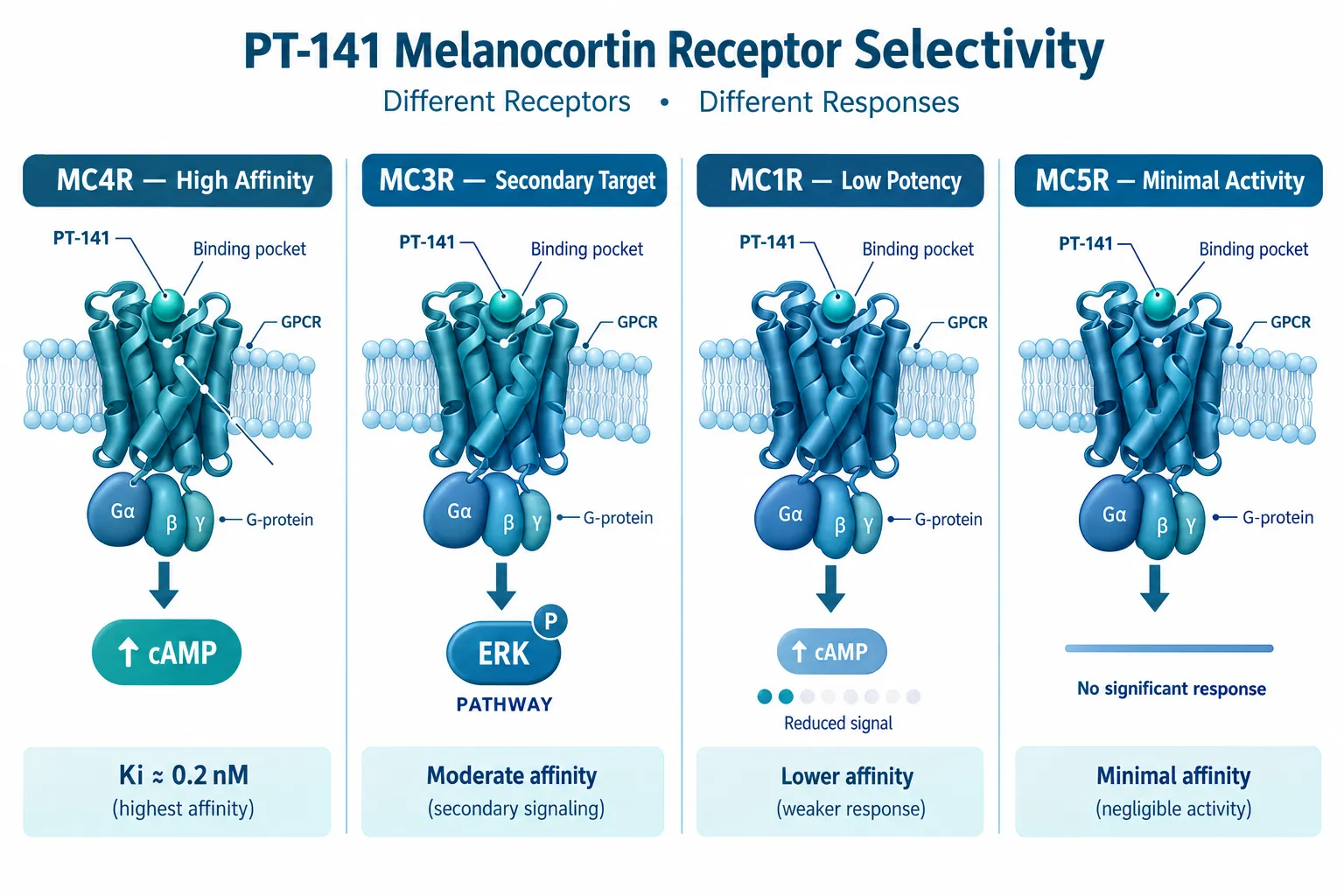
Receptor selectivity in melanocortin pharmacology is best understood as a two-layer concept: binding selectivity and functional selectivity. PT-141 does not display strong binding selectivity, competitive radioligand displacement assays using [¹²⁵I]-NDP-alpha-MSH show measurable affinity at all five receptor subtypes. The functional picture, however, is strikingly different.

In HEK293 and CHO cells transfected with human MC4R, PT-141 produces dose-dependent cAMP accumulation with EC50 values in the range of 1.8 to 18 nM, depending on assay conditions and receptor expression level. At MC1R and MC5R, functional responses under equivalent conditions are substantially weaker. This divergence between binding affinity and functional output defines PT-141 as a functionally MC3R/MC4R-selective compound.

Binding Affinity Values Across Receptor Subtypes

Receptor Approximate Ki Functional Status
MC4R ~2.3 nM High functional activity
MC3R ~14.7 nM Moderate functional activity
MC1R Higher (reduced) Low functional potency
MC5R Higher (reduced) Minimal functional activity
MC2R Not applicable ACTH-specific; PT-141 inactive

This selectivity profile makes PT-141 the preferred reference compound for assays targeting central melanocortin pathways, including those linked to energy homeostasis, sexual function, and reward circuitry. Researchers exploring broader peptide pharmacology, including lab tested peptides used as reference standards, will recognize this binding-versus-function distinction as a recurring theme across peptide classes.


Comparing Binding Assays and Functional Readouts
Comparing Binding Assays and Functional Readouts

The choice between a binding assay and a functional assay is not merely technical, it determines what biological question gets answered.

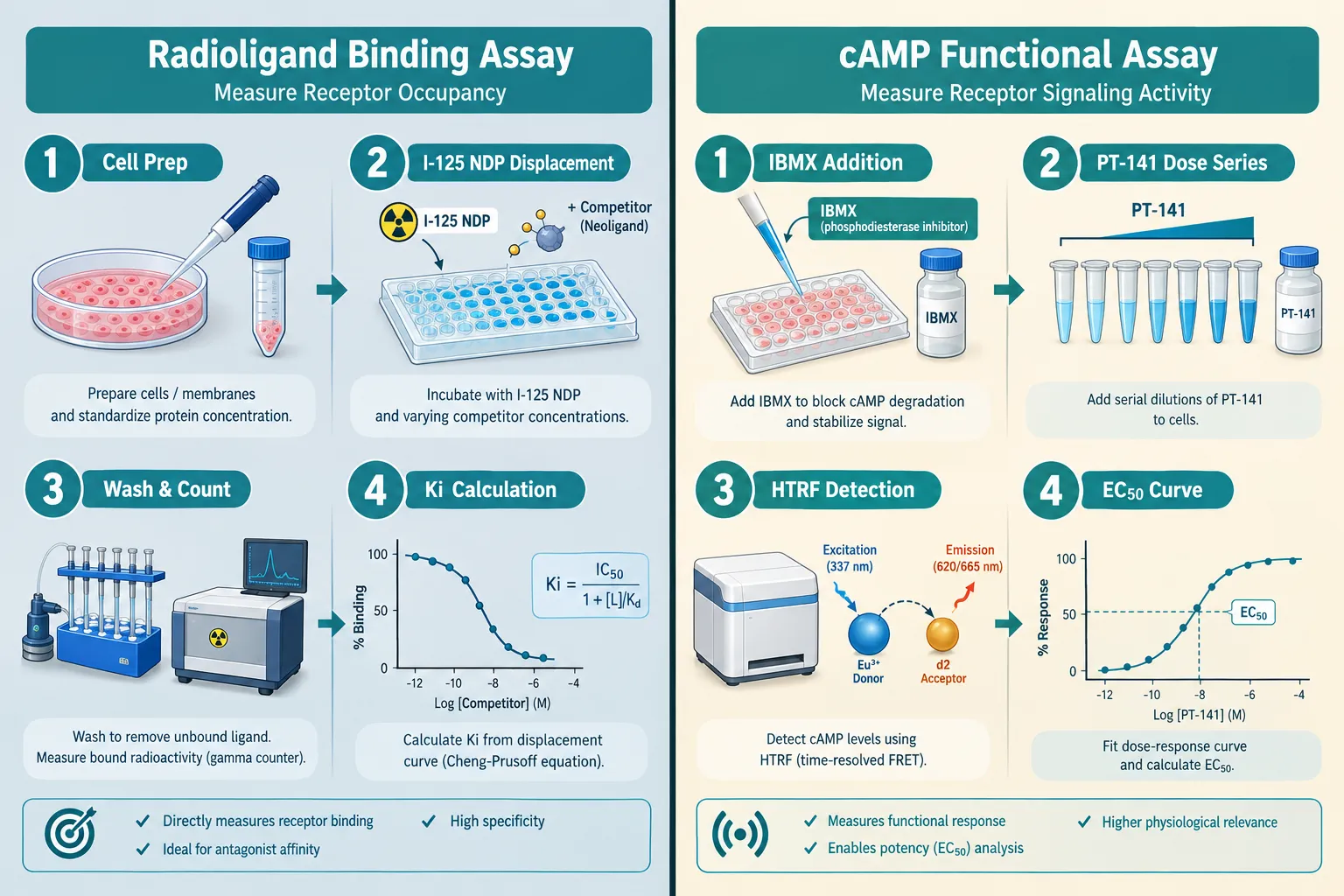
Radioligand binding assays measure how well PT-141 displaces a labeled tracer (typically [¹²⁵I]-NDP-alpha-MSH) from the receptor. The output is a Ki value: a measure of affinity, not activity. A compound can have excellent binding affinity and still be an antagonist or a very weak partial agonist.

Functional assays measure what happens after the receptor is occupied. For melanocortin receptors, the primary functional readout is cAMP accumulation via Gs-protein coupling. Recommended formats include:

  • HTRF (homogeneous time-resolved fluorescence) cAMP assays
  • AlphaScreen cAMP detection
  • Biosensor-based real-time cAMP monitoring
  • Calcium flux assays using fluorescent dyes

"A selectivity experiment should report both binding (Ki) and functional (EC50/Emax) metrics, especially for compounds like PT-141 that exhibit partial agonism and pathway divergence."

PT-141 as a Partial Agonist at MC4R

PT-141 does not produce a maximal response equivalent to the endogenous full agonist alpha-MSH. In well-controlled CHO cell systems, PT-141 reaches approximately 85% of alpha-MSH efficacy, corresponding to intrinsic activity values of 0.7 to 0.9. This partial agonism has direct implications for assay design: Emax must always be reported alongside EC50, because two compounds with identical EC50 values can produce very different maximal responses.

Comparing PT-141 with Melanotan II (MT-II) illustrates this point further. MT-II shows 3 to 5 times greater potency at MC1R in functional assays, while PT-141 maintains comparable MC4R affinity. This shift toward MC3R/MC4R and away from MC1R activity is why PT-141 is considered more appropriate for central melanocortin signaling studies and less suitable for assays focused on cutaneous pigmentation pathways.


Calcium Signaling and Multichannel Functional Readouts in PT-141 Melanocortin Assays
Calcium Signaling and Multichannel Functional Readouts in PT-141 Melanocortin Assays

cAMP is the dominant second messenger in melanocortin receptor pharmacology, but it is not the only relevant signal. PT-141's activation of MC4R also engages:

  • ERK1/2 MAPK pathways in neuronal populations
  • Intracellular calcium mobilization in specific central circuits
  • Downstream dopamine and oxytocin release, linking receptor-level signaling to neuroendocrine outputs

This multi-pathway engagement means that a cAMP-only assay may underestimate the full functional profile of PT-141 at MC4R. Multiplexed platforms that simultaneously measure cAMP, calcium flux, and MAPK activation are increasingly recommended for comprehensive characterization.

The Critical Role of Calcium in Assay Buffers

One of the most practically important findings in recent melanocortin assay methodology is the calcium dependence of agonist efficacy. PT-141's functional activity at MC4R depends on the presence of extracellular calcium, while antagonist binding does not. This asymmetry means:

  • Agonist assays must use calcium-containing buffers to generate physiologically relevant data.
  • Calcium-free conditions will suppress apparent agonist efficacy without affecting binding measurements.
  • Comparisons between studies conducted in different buffer compositions may not be directly valid.

This detail is frequently overlooked when interpreting published EC50 values across laboratories. Researchers working with peptide compounds that engage calcium-dependent pathways, including those studying IPA sermorelin stack research or related neuroendocrine peptides, encounter analogous buffer-composition challenges.

Designing a Rigorous Selectivity Experiment

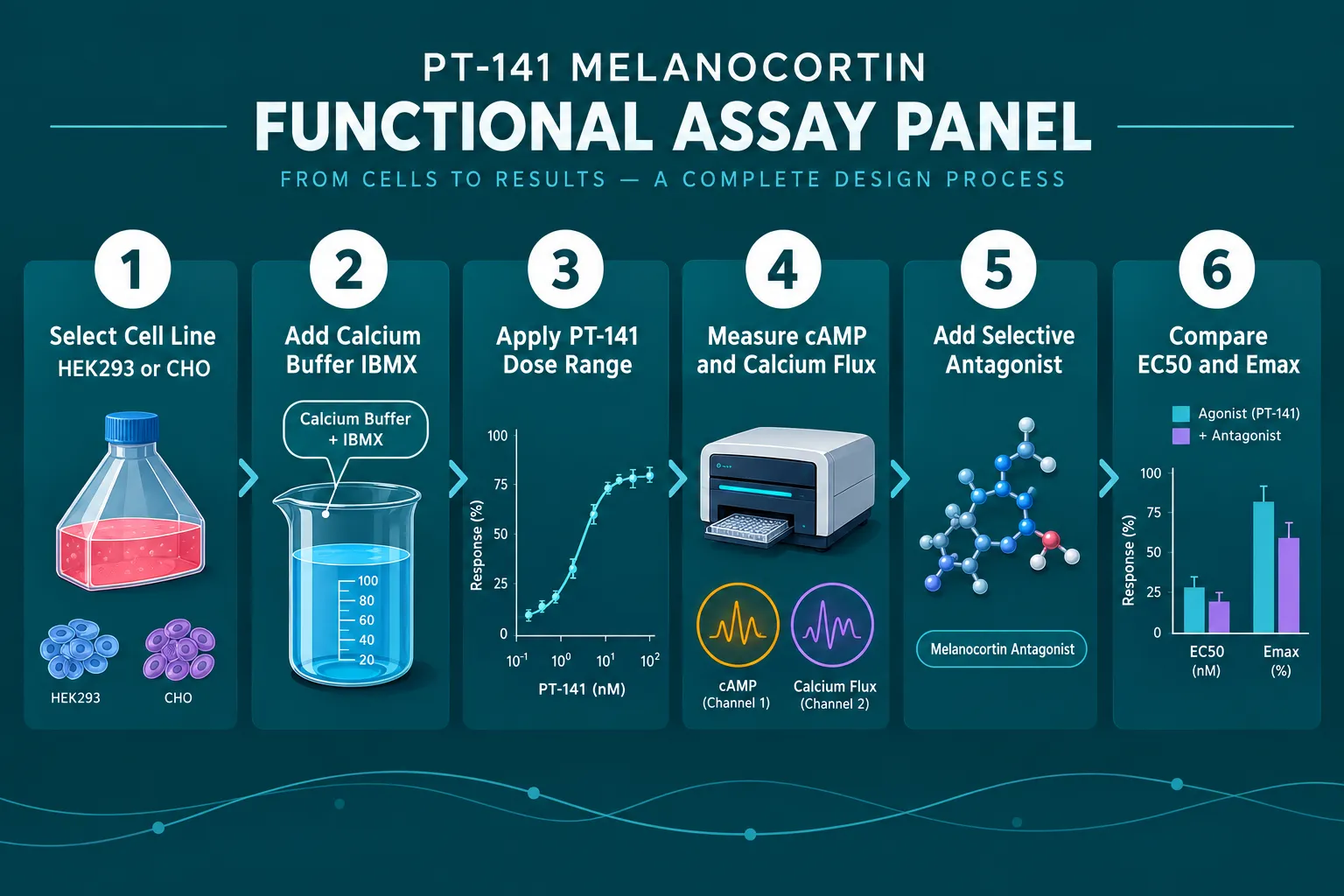
A complete PT-141 selectivity experiment in 2026 should include:

  1. Competitive binding at MC1R, MC3R, MC4R, and MC5R using [¹²⁵I]-NDP-alpha-MSH displacement to generate Ki values.
  2. cAMP functional assay in MC3R- and MC4R-transfected HEK293 or CHO cells, with IBMX added to prevent cAMP degradation, generating EC50 and Emax.
  3. Calcium flux assay in the same cell lines to capture non-cAMP signaling.
  4. Selective antagonist co-administration to confirm which receptor subtype drives the observed response, PT-141-induced cAMP elevation that is blocked by an MC4R-selective antagonist confirms MC4R functional expression.
  5. Comparator ligands (setmelanotide, MT-II, alpha-MSH) run in the same buffer and cell system on the same day.

Because PT-141 engages MC3R and MC4R with near-equivalent affinity, attributing a biological effect to one specific subtype without selective antagonist controls is methodologically unsound. This principle applies equally when PT-141 is used as a benchmark for structure-activity relationship work on novel melanocortin ligands.

Researchers sourcing reference peptides for such panels should prioritize verified purity. Resources such as guidance on where to buy research-grade Glow Blend peptide: evaluating purity illustrate the level of documentation, certificate of analysis, HPLC trace, mass spec confirmation, that should be expected for any compound used as an assay reference standard.


Conclusion

PT-141 melanocortin assays offer a powerful window into central melanocortin receptor pharmacology, but only when binding and functional data are collected and reported together. The key actionable steps for researchers in 2026 are clear:

  • Always pair Ki values with EC50 and Emax data. Binding affinity alone does not predict functional selectivity.
  • Use calcium-containing buffers in all agonist functional assays to avoid artificially suppressed efficacy readings.
  • Include selective antagonists to assign observed cAMP and calcium responses to specific receptor subtypes.
  • Run comparator ligands (MT-II, setmelanotide, alpha-MSH) in the same assay system to enable valid cross-compound selectivity comparisons.
  • Report receptor species, cell line, and buffer composition in all published or shared data to enable meaningful cross-laboratory comparisons.

As multiplexed platforms that simultaneously capture cAMP, calcium flux, and MAPK activation become more accessible, the standard for what constitutes a complete PT-141 functional characterization will continue to rise. Investing in rigorous assay design now produces receptor selectivity data that remains interpretable and reproducible well beyond the initial study.

https://www.puretestedpeptides.com/wp-content/uploads/2026/09/pt-141-melanocortin-assays-comparing-receptor-selectivity-calcium-signaling-and.webp 1024 1536 https://www.puretestedpeptides.com/wp-content/uploads/2026/01/buy-peptides-online.jpg 2026-09-29 13:04:062026-09-29 13:04:06PT-141 Melanocortin Assays: Comparing Receptor Selectivity, Calcium Signaling, and Functional Readouts
×

Helpful Links

  • My account
  • Cart
  • Checkout
  • Refund and Returns Policy
  • Privacy Policy
  • SMS Privacy Policy
  • Login
  • My Account
  • Logout

USA Made Lab Tested Peptides

All products are sold for research, laboratory, or analytical purposes only, and are not for human consumption


Pure Tested Peptides is a chemical supplier. Pure Tested Peptides is not a compounding / chemical compounding facility as defined under 503A of the Federal Food, Drug, and Cosmetic act. Pure Tested Peptides is not an outsourcing facility as defined under 503B of the Federal Food, Drug, and Cosmetic act.

The statements made within this website have not been evaluated by the US Food and Drug Administration. The products we offer are not intended to diagnose, treat, cure or prevent any disease.

Human/Animal Consumption Prohibited. Laboratory/In-Vitro Experimental Use Only

Scroll to top Scroll to top Scroll to top