Call or Text 727-513-9780
  • Shopping Cart Shopping Cart
    0Shopping Cart
Pure Tested Peptides | America's most trusted Peptides for sale online
  • Peptides for sale
    • Oral Peptides for sale
      • Peptide Capsules for sale
      • BPC 157 Capsules 1000mcg
      • SLU-PP-332 Capsules | 1000 mcg
      • 5-Amino-1MQ 50mg Capsules
      • Tesofensine 500mcg
    • All Peptides for sale
    • Peptide Sprays
      • BPC 157 Nasal Spray Kit
      • BPC-157 TB500 Nasal Spray Kit
      • Semax Nasal Spray 10mg
      • Selank – Nasal Spray Kit – 10mg
      • Epithalon 50MG Nasal Spray Kit
      • Ipamorelin 10mg Nasal Spray
      • Klow Nasal Spray (BPC-157 + TB-500 + GHK-Cu + KPV) | 80mg
      • Hulk Nasal Spray Tesa / Ipa Blend 6/3 MG
      • Klow Nasal Spray
      • NAD + 500 mg Nasal Spray
      • PT-141 Nasal Spray Kit
    • GHRH Peptides
      • Ipa Peptides
      • CJC-1295 Peptides
        • CJC-1295 with DAC 5 mg
        • CJC-1295 without DAC 5 mg
        • CJC-1295 Ipa 10mg
      • Tesa Peptides
        • Tesa Peptide
        • Tesa 20 mg
    • GHK-Cu Peptides
      • All GHK-Cu Peptides
      • GHK-Cu 100mg
      • KLOW Peptide Blend – Buy KLOW blend online
    • BPC Peptides
      • All BPC Peptides
      • BPC-157
      • BPC-157 TB-500
      • BPC 157 capsules 1000mcg
    • SLU-PP-332 Peptides
      • All SLU-PP-332 Peptides
      • SLU-PP-332 5mg
    • GLP3 Peptides
    • PT-141 Peptides
      • PT-141 Peptides for sale
      • PT-141 10mg
      • PT-141 Nasal Spray
    • CAG Peptides
      • Lipo-C Peptide Blend
      • CAG 5mg
      • CAG 10mg
    • MOTS-C Peptides
      • MOTS-C Peptides for sale
      • MOTS-c peptide
      • MOTS-c 10mg *6 pack*
    • 5 Amino 1MQ Peptides
      • 5 Amino 1MQ Peptides for sale
      • 5-Amino-1MQ 50mg Capsules
      • 5-Amino-1MQ 5mg
    • Epithalon Peptides
      • Epithalon Peptides for sale
      • Epithalon 10mg
      • Epithalon 50mg
  • Shop
    • GLPs
      • 5-Amino-1MQ 50mg Capsules
      • 5-Amino-1MQ 5mg
      • L-Carnitine 500mg/ml
      • Tesofensine 500mcg
      • SLU-PP-332 5mg
      • MOTS-c 10mg *6 pack*
    • Epithalon & BPC Peptides
      • Epithalon 10mg
      • Epithalon 50mg
      • BPC-157
      • BPC 157 capsules 1000mcg
      • BPC-157 TB-500
      • BPC-157 TB500 Nasal Spray Kit
      • BPC 157 Nasal Spray Kit
    • BPC TB-500 & NAD+ Peptides
      • NAD+ 500 mg
      • KLOW Peptide Blend – Buy KLOW blend online
      • GLOW Peptide Blend
      • TB 500 5mg
      • BPC 157 capsules 1000mcg – Supplement
      • BPC 157 Nasal Spray Kit
      • BPC-157
      • BPC-157 TB500 Nasal Spray Kit
      • BPC-157 TB-500
      • BPC 157 capsules 1000mcg
    • LL-37 Peptide
      • LL-37 10 mg
    • MOTS-C & Selank
      • MOTS-c peptide
      • Selank 10mg
    • GHK Peptides
      • GHK-Cu 100mg
      • GLOW Peptide Blend
      • KLOW Peptide Blend – Buy KLOW blend online
  • COAs
  • Wholesale
    • Wholesale Peptides for sale
  • PTP FAQ
  • Affiliates
    • Selank Peptide: Advanced Pharmacological Mechanisms Underlying Its Anxiolytic and Nootropic Effects in Research
      • 5-Amino-1MQ Peptide: Detailed Mechanisms of NNMT Inhibition and Its Impact on Cellular Metabolism Research
        • MOTS-C Peptide: Unraveling Its Role in Mitochondrial Dynamics and Energy Metabolism Research
          • Epithalon Peptide and Telomerase Regulation: Investigating Its Impact on Cellular Senescence and Lifespan Research Models
            • GLP2-T vs GLP2 Tirz Peptide: Understanding the Naming, Mechanistic Nuances, and Research Implications for Gut Health
      • Peptides and Polypeptides in Modern Pharmacology: What Research on Metoprolol, Prednisone, and Amlodipine Reveals
        • Polypeptide Peptides vs NSAIDs: What Naproxen and Diclofenac Teach Tissue-Repair Researchers About BPC‑157 and TB‑500
          • Peptides and Polypeptides in Endocrine Pharmacology: How GLP-1, GLP-2, and GLP-3 Retatrutide Differ From Classic Drugs Like Prednisone and Amlodipine
          • 5‑Amino‑1MQ Peptide and NNMT Inhibition: How It Compares With Statins Like Atorvastatin in Adipose and Lipid Metabolism Research
      • Enclomiphene, Estrogen Receptor Signaling, and Luteinizing Phase Biology: What Hormone Researchers Should Measure
        • Mesenchymal Stem Cells, BPC‑157, and GHK‑Cu: How Tissue Repair Peptides Compare With Classic NSAIDs Like Naproxen in Injury Models
          • Peptide Calculator Use Cases Beyond Growth Hormone: Working Through GLP‑3 Retatrutide, MOTS‑c, and BPC‑157 Research Dosing
        • Polypeptide Peptides in Endocrine and Metabolic Pharmacology: Lessons From Amlodipine, Prednisone, and Metoprolol
        • Peptides Calculator for Advanced Blends: Worked Examples for Tesamorelin, CJC‑1295, and Ipamorelin Stacks
          • Peptides and Polypeptides in Human Physiology: How Molecular Size Shapes Research Applications
            • Selank Peptide: Advanced Pharmacological Mechanisms Underlying Its Anxiolytic and Nootropic Effects in Research
          • 5-Amino-1MQ Peptide: Detailed Mechanisms of NNMT Inhibition and Its Impact on Cellular Metabolism Research
            • MOTS-C Peptide: Unraveling Its Role in Mitochondrial Dynamics and Energy Metabolism Research
              • Epithalon Peptide and Telomerase Regulation: Investigating Its Impact on Cellular Senescence and Lifespan Research Models
                • GLP2-T vs GLP2 Tirz Peptide: Understanding the Naming, Mechanistic Nuances, and Research Implications for Gut Health
                  • Peptides and Polypeptides in Endocrine Pharmacology: How GLP-1, GLP-2, and GLP-3 Retatrutide Differ From Classic Drugs Like Prednisone and Amlodipine
                    • Polypeptide Peptides vs NSAIDs: What Naproxen and Diclofenac Teach Tissue-Repair Researchers About BPC‑157 and TB‑500
                      • Peptides and Polypeptides in Modern Pharmacology: What Research on Metoprolol, Prednisone, and Amlodipine Reveals
                        • 5‑Amino‑1MQ Peptide and NNMT Inhibition: How It Compares With Statins Like Atorvastatin in Adipose and Lipid Metabolism Research
                        • Enclomiphene, Estrogen Receptor Signaling, and Luteinizing Phase Biology: What Hormone Researchers Should Measure
                        • Mesenchymal Stem Cells, BPC‑157, and GHK‑Cu: How Tissue Repair Peptides Compare With Classic NSAIDs Like Naproxen in Injury Models
                        • Peptide Calculator Use Cases Beyond Growth Hormone: Working Through GLP‑3 Retatrutide, MOTS‑c, and BPC‑157 Research Dosing
                        • Polypeptide Peptides in Endocrine and Metabolic Pharmacology: Lessons From Amlodipine, Prednisone, and Metoprolol
                        • Peptides Calculator for Advanced Blends: Worked Examples for Tesamorelin, CJC‑1295, and Ipamorelin Stacks
                        • Peptides and Polypeptides in Human Physiology: How Molecular Size Shapes Research Applications
                        • Selank Peptide: Advanced Pharmacological Mechanisms Underlying Its Anxiolytic and Nootropic Effects in Research
                        • MOTS-C Peptide: Unraveling Its Role in Mitochondrial Dynamics and Energy Metabolism Research
                        • Peptides and Polypeptides in Modern Pharmacology: What Research on Metoprolol, Prednisone, and Amlodipine Reveals
                        • Peptides and Polypeptides in Endocrine Pharmacology: How GLP-1, GLP-2, and GLP-3 Retatrutide Differ From Classic Drugs Like Prednisone and Amlodipine
                        • 5-Amino-1MQ Peptide: Detailed Mechanisms of NNMT Inhibition and Its Impact on Cellular Metabolism Research
                        • Mesenchymal Stem Cells, BPC‑157, and GHK‑Cu: How Tissue Repair Peptides Compare With Classic NSAIDs Like Naproxen in Injury Models
                        • Peptide Calculator Use Cases Beyond Growth Hormone: Working Through GLP‑3 Retatrutide, MOTS‑c, and BPC‑157 Research Dosing
                        • GLP2-T vs GLP2 Tirz Peptide: Understanding the Naming, Mechanistic Nuances, and Research Implications for Gut Health
                        • Polypeptide Peptides in Endocrine and Metabolic Pharmacology: Lessons From Amlodipine, Prednisone, and Metoprolol
                        • Polypeptide Peptides vs NSAIDs: What Naproxen and Diclofenac Teach Tissue-Repair Researchers About BPC‑157 and TB‑500
                        • Peptides and Polypeptides in Human Physiology: How Molecular Size Shapes Research Applications
                        • Peptides Calculator for Advanced Blends: Worked Examples for Tesamorelin, CJC‑1295, and Ipamorelin Stacks
                        • 5‑Amino‑1MQ Peptide and NNMT Inhibition: How It Compares With Statins Like Atorvastatin in Adipose and Lipid Metabolism Research
                        • Enclomiphene, Estrogen Receptor Signaling, and Luteinizing Phase Biology: What Hormone Researchers Should Measure
                        • Epithalon Peptide and Telomerase Regulation: Investigating Its Impact on Cellular Senescence and Lifespan Research Models
                        • Best research protocol Klow blend
                        • best time to take BPC-157
                        • best time to take DSIP (Delta Sleep Inducing Peptide)
                        • best time to take CJC-1295
                        • best time to take AOD-9604
                        • best time to take Follistatin 344
                        • best time to take Ipamorelin
                        • best time to take MK-677 (Ibutamoren)
                        • best time to take Ligandrol (LGD-4033) — research compound
                        • best time to take Ostarine (MK-2866) — research compound
                        • best time to take GHK-CU
                        • best time to take TB-500
                        • best time to take MOTS-c
                        • best time to take Semax
                        • best time to take RAD-140 (Testolone) — research compound
                        • best time to take Thymosin Alpha-1
                        • best time to take PEG-MGF
                        • Biolife Plasma, Octapharma Plasma, and Research Peptides: How Plasma Donation Labs Differ From Peptide Suppliers
                        • best time to take YK-11 — research compound
                        • best time to take PT-141 (Bremelanotide)
                        • Best research protocol Klow blend
                        • 5-Amino-1MQ and MOTS-C Synergy: Metabolic Signaling, Mitochondria, and Research Design
                        • BPC-157 and TB-500: Investigating Their Combined Effects on Angiogenesis and Cellular Migration in Tissue Repair Models
                        • BPC-157 Peptide: Gut Barrier Function, Inflammation, and Tissue-Recovery Research
                        • 5‑Amino‑1MQ and MOTS‑c Synergy in Metabolic Research: Designing NNMT and Mitochondrial Biogenesis Stacks
                        • CJC-1295 with DAC vs. Without DAC: Half-Life, Release Kinetics, and Research Implications
                        • CJC‑1295 with DAC vs. Without DAC: Expanding on Half‑Life Differences Using Tesamorelin and Ipamorelin Blend Case Studies
                        • Collagen Biology and Copper‑Binding Peptides: How GHK‑Cu, Glow Blend, and Klow Blend Interact with Skin and Connective Tissue
                        • Collagen Biology and Regenerative Peptides: How GHK‑Cu, Glow Blend, and Klow Blend Affect Extracellular Matrix Research
                    • DNA, Telomeres, and Longevity Peptides: Positioning Epithalon and MOTS‑c in Genetic Aging Research
                      • Enclomiphene Citrate: serm Mechanism, Testosterone Research, and Stack Compatibility
                        • Enclomiphene vs Enclomiphene Citrate: Formulation, Bioavailability, and Research Distinctions
                        • Epithalon Peptide Research: Telomerase Activation, Aging, and Pineal Gland Function
                        • Estrogen Receptor Signaling and Enclomiphene: How Selective Modulators Compare with Classic Polypeptide Hormones
                        • GHK-Cu Peptide: Advanced Mechanisms in Extracellular Matrix Remodeling and Wound Healing Research
                        • GHK-Cu Peptide: Collagen Synthesis, Wound Repair, and Skin-Barrier Research Models
                        • GLP-1 vs GLP-3 vs GLP-2: Peptide Classification and Research Applications
                        • GLP-2 Peptide Research Guide: Gut Barrier Function, Nutrient Absorption, and Intestinal Recovery Models
                        • GLP-3 Retatrutide vs. GLP-1 Drugs: What Triple-Agonist Biology Changes in Research Models
                        • Ipamorelin and Tesamorelin Combination: Synergistic GH Secretagogue Research and Dosing Protocols
                        • GLP2 Tirz Peptide: What It Is, Why the Name Exists, and How Researchers Should Interpret It
                        • Klow Blend Peptide Nasal Spray: What the Formulation Is Trying to Do in Cognitive Research
                        • Mitochondria, NNMT Inhibition, and Peptide Modulators: Where MOTS‑c and 5‑Amino‑1MQ Fit in Cellular Energy Research
                        • MOTS-c Peptide: Mitochondrial Function, Energy Metabolism, and What Researchers Measure
                        • MOTS-c vs. 5-Amino-1MQ: Which Metabolic Research Questions Each Compound Actually Answers
                        • Nasal Spray Peptides: Bioavailability, Administration, and Semax/Selank Research Applications
                        • PT-141 Peptide Research: Mechanism of Action and Melanocortin Receptor Signaling
                        • Retatrutide for Research: Mechanism, Structure, and GLP-1/GLP-3 Dual Action
                        • Retatrutide for Obesity and Type 2 Diabetes: What the Latest Trial Data Suggest
                        • Tesofensine Peptide Research: Mechanism, Appetite Suppression, and Neuropeptide Y Pathways
  • Contact
    • Contact Customer Service
    • Text Customer Support
  • About US
  • Shop all peptides
  • Affiliate Program
    • Affiliate Signup
  • Login / Register Login / Register Page Link Login / Register Page Link
  • Click to open the search input field Click to open the search input field Search
  • Menu Menu

Tag Archive for: nasal spray peptide delivery

Klow Nasal Spray Reviews for Research Use: How to Evaluate Four-Peptide Formulations Without Trusting Marketing Claims

Klow Nasal Spray Reviews for Research Use: How to Evaluate Four-Peptide Formulations Without Trusting Marketing Claims

October 31, 2026/0 Comments/in Uncategorized/by

Only one in five peptide product listings reviewed in a 2026 supplier audit included a downloadable, lot-specific certificate of analysis, meaning the majority of "reviews" circulating online describe formulations that have never been independently verified by the reader. For anyone conducting Klow nasal spray reviews for research use, that gap between marketing language and documented data is exactly where evaluation needs to start.

This article provides a formulation-first framework for assessing KLOW and comparable four-peptide nasal spray blends. It covers concentration disclosure, pump performance, stability records, and component-specific controls so that researchers can move past vendor claims and focus on what the documentation actually shows.

Key Takeaways

  • KLOW nasal spray is a four-peptide research blend (GHK-Cu, BPC-157, TB-500, KPV) delivered at roughly 1.4 mg per metered spray, for research use only.
  • No peer-reviewed clinical trials exist for the combined intranasal KLOW formulation as of 2026; evidence exists only for individual peptides in preclinical and cosmetic contexts.
  • Vendor descriptions of KLOW vary, some list it only as a vial, others as both a vial and nasal spray, making formulation verification essential before drawing conclusions from any review.
  • Reliable evaluation depends on four pillars: RUO labeling, per-component milligram disclosure, lot-level certificates of analysis, and citations to actual peptide literature.
  • Anecdotal reports and testimonials are uncontrolled observations, not evidence, and should be treated as hypothesis-generating at best.

Understanding the KLOW Four-Peptide Formulation
Understanding the KLOW Four-Peptide Formulation

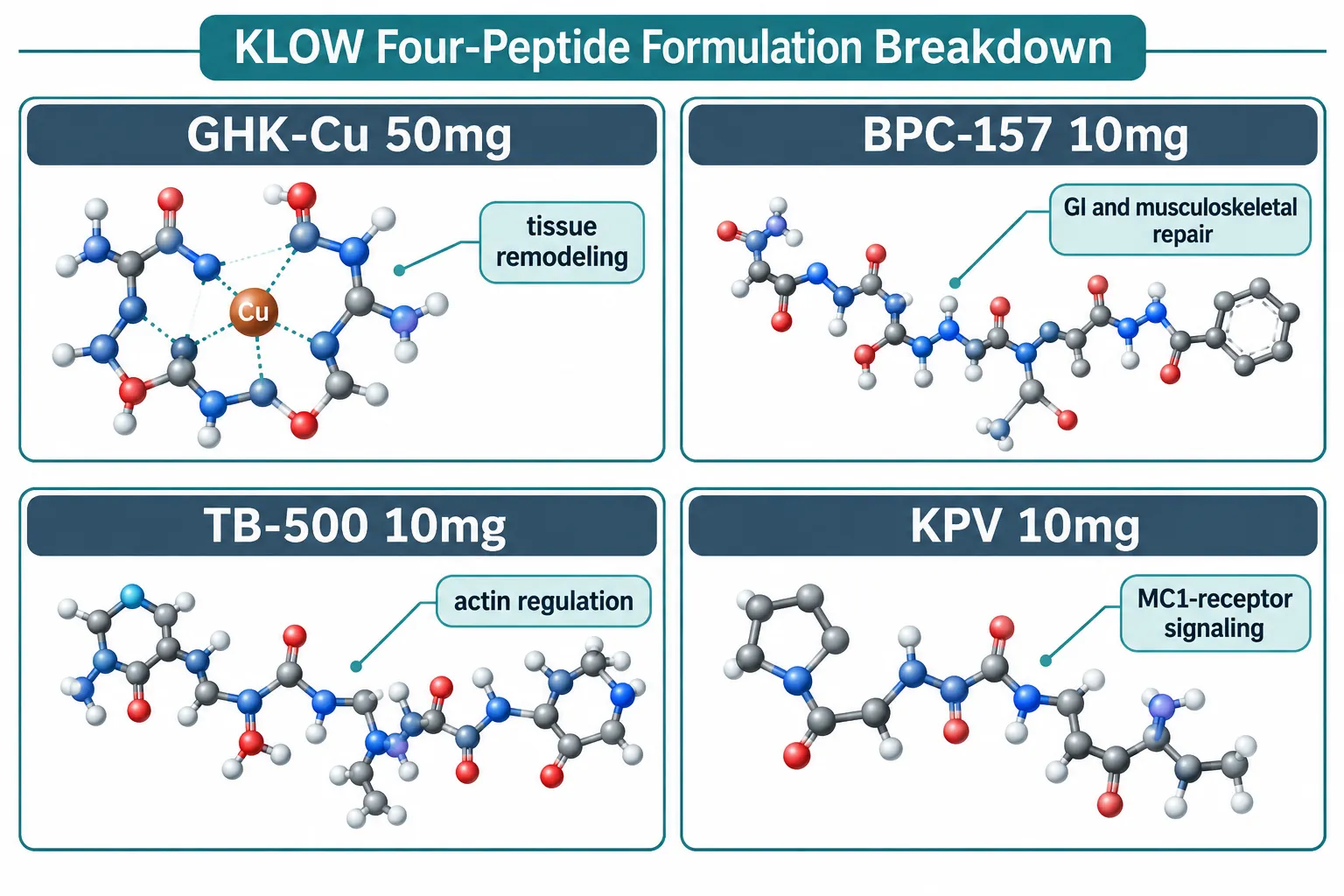
Before any meaningful Klow nasal spray review for research use can happen, the formulation itself must be mapped precisely. KLOW is described across multiple supplier pages as an 80 mg total peptide blend dissolved in 10 mL of sterile saline, yielding approximately 57 metered sprays per bottle. Each actuation delivers roughly 1.4 mg of combined peptide, broken down as follows:

Component Per Bottle Per Spray (approx.) Research Context
GHK-Cu 50 mg 875 mcg Tissue remodeling, extracellular matrix
BPC-157 10 mg 175 mcg GI and musculoskeletal repair models
TB-500 10 mg 175 mcg Actin regulation, tissue repair
KPV 10 mg 175 mcg MC1-receptor anti-inflammatory signaling

GHK-Cu is a copper-binding tripeptide with a well-documented presence in skin and connective tissue research. For sourcing context on this specific compound, the GHK-Cu peptide purchase and copper peptide research sourcing guide provides useful supplier-level detail.

BPC-157 is a synthetic pentadecapeptide studied in animal models for healing applications. Researchers new to this compound can consult the BPC-157 core peptides documentation and first research guide for a structured starting point.

TB-500 and KPV round out the stack. KPV, lysine-proline-valine, is a fragment derived from alpha-MSH and is explored for cytoprotective and anti-inflammatory effects in mucosal transport models. This mechanistic context is what positions the nasal spray format as a research delivery model rather than a consumer product.

Critical note: No peer-reviewed clinical trials or structured intranasal safety studies have been published on the combined KLOW four-peptide stack as of late 2026. All mechanistic claims extrapolate from preclinical or single-component data.


A Formulation-First Framework for Evaluating KLOW Nasal Spray Reviews
A Formulation-First Framework for Evaluating KLOW Nasal Spray Reviews

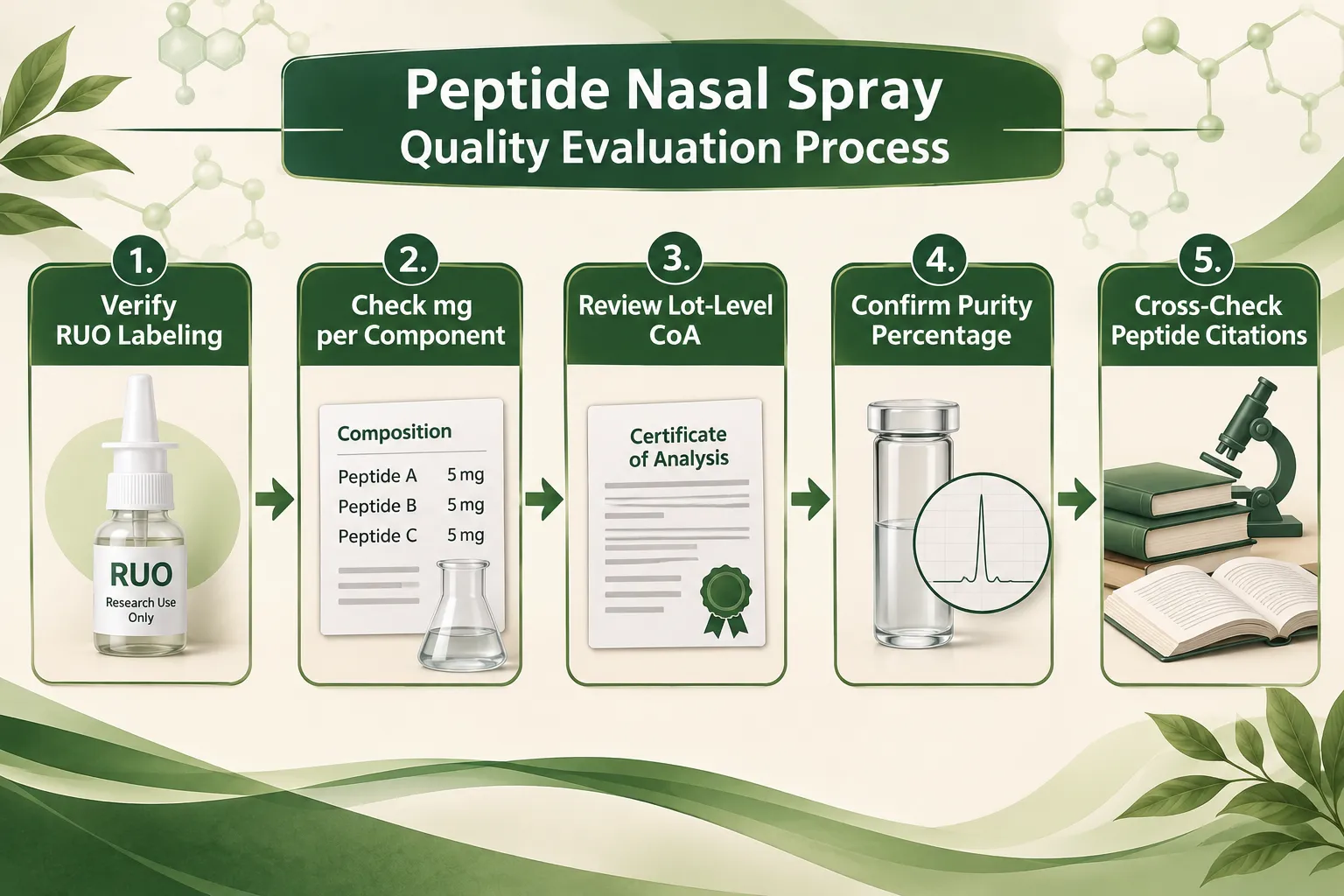
Applying rigorous Klow nasal spray reviews for research use means evaluating documentation systematically rather than reacting to product copy. Four pillars structure this process.

Pillar 1: RUO Labeling and Disclaimer Specificity

Any credible KLOW listing explicitly states "Research Use Only" and excludes human consumption, therapeutic use, veterinary use, and diagnostic purposes. Vague disclaimers, such as "not for human use" buried in fine print, are insufficient. Look for affirmative language that specifies laboratory and analytical applications as the sole intended context.

Pillar 2: Per-Component Concentration Disclosure

Total milligrams mean little without a component breakdown. A bottle labeled "80 mg peptide blend" could contain 79 mg of one inexpensive peptide and 1 mg of the three others. Legitimate suppliers list each peptide's individual milligram contribution, the total volume, and the resulting concentration in mg/mL, for KLOW, that is 8 mg/mL total.

Pump performance data should accompany this: spray volume per actuation, validated spray count, and whether the atomizer is metered or unmetered. Unvalidated pumps introduce meaningful dosing variability that undermines reproducibility in any research design.

Pillar 3: Lot-Level Certificates of Analysis

A certificate of analysis (CoA) that is not lot-specific is marketing material. Genuine quality documentation includes:

  • Lot or batch number matching the shipped product
  • Identity confirmation (HPLC or mass spectrometry)
  • Purity percentage, reputable suppliers report approximately 99.5% for individual peptides
  • Solvent and excipient profile, sterile saline, preservative presence or absence
  • Third-party testing lab name, not an in-house document

Cross-referencing supplier practices against independent peptide supplier comparison resources helps identify whether documentation standards are consistent across the market.

Pillar 4: Citation Quality in Product Descriptions

Marketing copy that references "studies" without linking to specific publications is not evidence. When evaluating any review, check whether the cited research is:

  • Specific to the individual peptide in question (not a generic claim)
  • Preclinical (animal or cell model) or clinical in design
  • Intranasal in route or based on parenteral administration

For related research on nasal-delivery peptide formats and how they compare to injectable routes, the Semax nasal spray literature provides a useful parallel case for mucosal transport modeling.


Navigating Vendor Inconsistencies and Component-Specific Controls
Navigating Vendor Inconsistencies and Component-Specific Controls

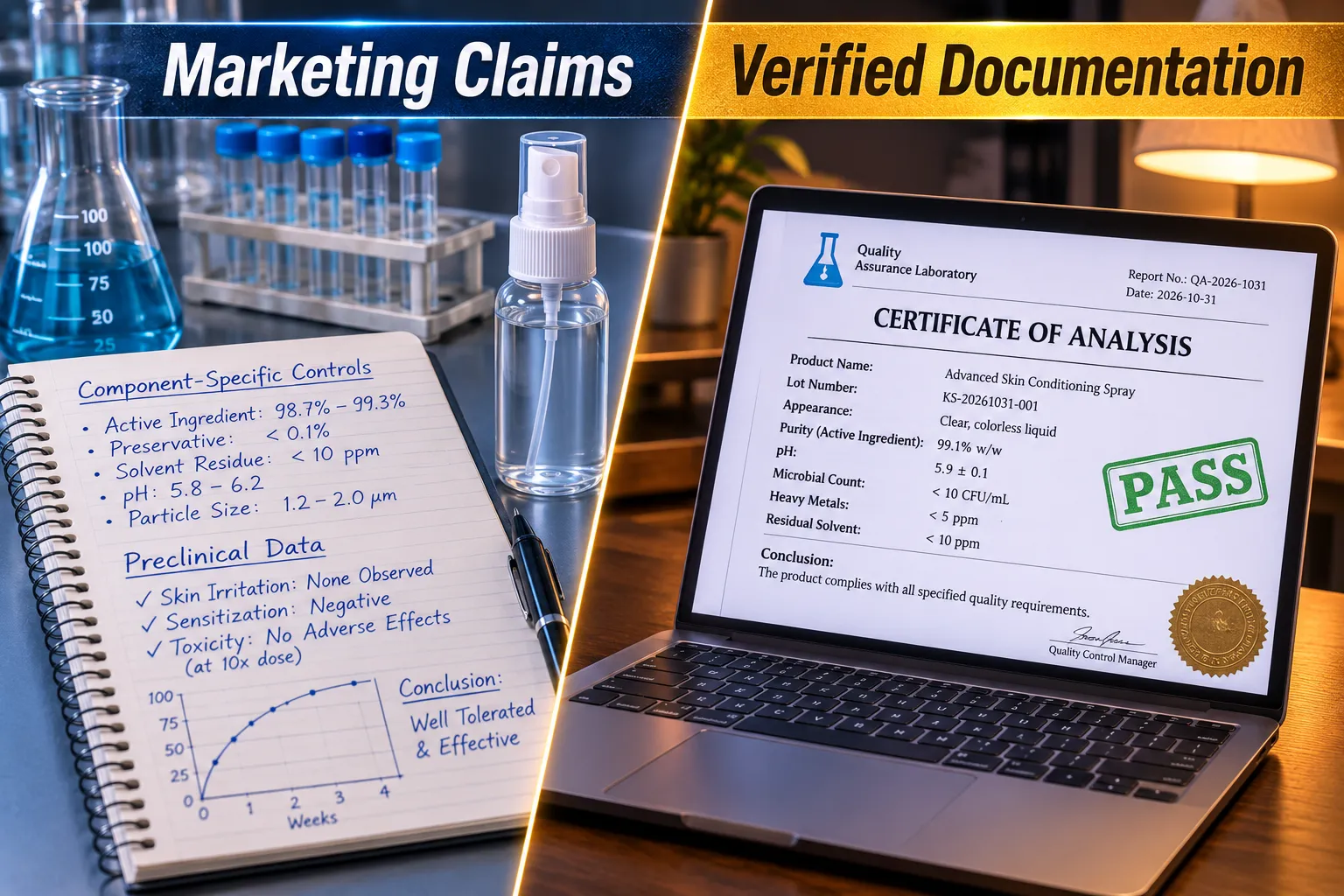
One complicating factor in any Klow nasal spray review for research use is that vendors do not agree on what KLOW is. Some suppliers list KLOW only as a lyophilized vial, explicitly noting there is no nasal spray version and directing researchers toward a related product, GLOW, which contains GHK-Cu, BPC-157, and TB-500 but omits KPV. Other suppliers offer KLOW as both a vial and a ready-mixed metered nasal spray with the same 80 mg total content.

This inconsistency has direct consequences:

  • A review of "KLOW nasal spray" from one supplier may describe an 80 mg four-peptide formulation; a review from another source may describe a three-peptide GLOW spray or a reconstituted vial.
  • Comparing outcomes or tolerability observations across these formats is not valid without confirming the exact composition reviewed.

For component-specific controls, researchers should establish independent baselines for each peptide before attributing observations to the stack. This means sourcing single-peptide reference materials and reviewing existing preclinical literature for each compound separately. For analogous mitochondria-targeted research blends that also require component-level scrutiny, the discussion around SS-31 mitochondrial research themes illustrates how component-specific data prevents over-attribution in multi-ingredient designs.

Similarly, for peptides delivered via nasal formats in metabolic and regulatory research, reviewing how GLP nasal spray formulations are evaluated provides a structural template for documentation standards in the intranasal peptide category.

Stability records are another area where marketing commonly outpaces documentation. Ready-mixed nasal sprays face greater stability challenges than lyophilized vials because peptides in aqueous solution are susceptible to hydrolysis, oxidation, and microbial contamination over time. A responsible supplier provides:

  • Shelf-life data for the liquid formulation
  • Storage temperature requirements (typically 2-8°C)
  • In-use stability window after first actuation
  • Preservative identity and concentration if used

Absence of these records does not mean the product is unstable, but it means researchers cannot rule instability out.


Conclusion

Klow nasal spray reviews for research use have genuine value when they are built on formulation data rather than marketing language. The four-peptide composition, GHK-Cu, BPC-157, TB-500, and KPV, represents a mechanistically interesting research blend, but the absence of combined intranasal clinical or safety data means every claim about the stack as a whole remains extrapolation.

Actionable next steps for researchers:

  1. Request a lot-specific CoA before purchasing, if the supplier cannot provide one, treat the product as unverified.
  2. Confirm whether the product is a nasal spray, a vial, or a reconstituted pen, and verify the per-component milligram breakdown explicitly.
  3. Establish component-specific literature controls using single-peptide preclinical data before designing any observational protocol around the full stack.
  4. Treat anecdotal testimonials and online reviews as hypothesis-generating signals only, not as replication-ready evidence.
  5. Verify RUO labeling and non-therapeutic disclaimers are affirmative and specific, not buried in fine print.

Documentation-first evaluation is not skepticism for its own sake. It is the standard that separates reproducible research from uncontrolled experimentation.

https://www.puretestedpeptides.com/wp-content/uploads/2026/10/klow-nasal-spray-reviews-for-research-use-how-to-evaluate-four-peptide-formulati.webp 1024 1536 https://www.puretestedpeptides.com/wp-content/uploads/2026/01/buy-peptides-online.jpg 2026-10-31 13:05:042026-10-31 13:05:04Klow Nasal Spray Reviews for Research Use: How to Evaluate Four-Peptide Formulations Without Trusting Marketing Claims
×

Helpful Links

  • My account
  • Cart
  • Checkout
  • Refund and Returns Policy
  • Privacy Policy
  • SMS Privacy Policy
  • Login
  • My Account
  • Logout

USA Made Lab Tested Peptides

All products are sold for research, laboratory, or analytical purposes only, and are not for human consumption


Pure Tested Peptides is a chemical supplier. Pure Tested Peptides is not a compounding / chemical compounding facility as defined under 503A of the Federal Food, Drug, and Cosmetic act. Pure Tested Peptides is not an outsourcing facility as defined under 503B of the Federal Food, Drug, and Cosmetic act.

The statements made within this website have not been evaluated by the US Food and Drug Administration. The products we offer are not intended to diagnose, treat, cure or prevent any disease.

Human/Animal Consumption Prohibited. Laboratory/In-Vitro Experimental Use Only

Scroll to top Scroll to top Scroll to top