Call or Text 727-513-9780
  • Shopping Cart Shopping Cart
    0Shopping Cart
Pure Tested Peptides | America's most trusted Peptides for sale online
  • Peptides for sale
    • Oral Peptides for sale
      • Peptide Capsules for sale
      • BPC 157 Capsules 1000mcg
      • SLU-PP-332 Capsules | 1000 mcg
      • 5-Amino-1MQ 50mg Capsules
      • Tesofensine 500mcg
    • All Peptides for sale
    • Peptide Sprays
      • BPC 157 Nasal Spray Kit
      • BPC-157 TB500 Nasal Spray Kit
      • Semax Nasal Spray 10mg
      • Selank – Nasal Spray Kit – 10mg
      • Epithalon 50MG Nasal Spray Kit
      • Ipamorelin 10mg Nasal Spray
      • Klow Nasal Spray (BPC-157 + TB-500 + GHK-Cu + KPV) | 80mg
      • Hulk Nasal Spray Tesa / Ipa Blend 6/3 MG
      • Klow Nasal Spray
      • NAD + 500 mg Nasal Spray
      • PT-141 Nasal Spray Kit
    • GHRH Peptides
      • Ipa Peptides
      • CJC-1295 Peptides
        • CJC-1295 with DAC 5 mg
        • CJC-1295 without DAC 5 mg
        • CJC-1295 Ipa 10mg
      • Tesa Peptides
        • Tesa Peptide
        • Tesa 20 mg
    • GHK-Cu Peptides
      • All GHK-Cu Peptides
      • GHK-Cu 100mg
      • KLOW Peptide Blend – Buy KLOW blend online
    • BPC Peptides
      • All BPC Peptides
      • BPC-157
      • BPC-157 TB-500
      • BPC 157 capsules 1000mcg
    • SLU-PP-332 Peptides
      • All SLU-PP-332 Peptides
      • SLU-PP-332 5mg
    • GLP3 Peptides
    • PT-141 Peptides
      • PT-141 Peptides for sale
      • PT-141 10mg
      • PT-141 Nasal Spray
    • CAG Peptides
      • Lipo-C Peptide Blend
      • CAG 5mg
      • CAG 10mg
    • MOTS-C Peptides
      • MOTS-C Peptides for sale
      • MOTS-c peptide
      • MOTS-c 10mg *6 pack*
    • 5 Amino 1MQ Peptides
      • 5 Amino 1MQ Peptides for sale
      • 5-Amino-1MQ 50mg Capsules
      • 5-Amino-1MQ 5mg
    • Epithalon Peptides
      • Epithalon Peptides for sale
      • Epithalon 10mg
      • Epithalon 50mg
  • Shop
    • GLPs
      • 5-Amino-1MQ 50mg Capsules
      • 5-Amino-1MQ 5mg
      • L-Carnitine 500mg/ml
      • Tesofensine 500mcg
      • SLU-PP-332 5mg
      • MOTS-c 10mg *6 pack*
    • Epithalon & BPC Peptides
      • Epithalon 10mg
      • Epithalon 50mg
      • BPC-157
      • BPC 157 capsules 1000mcg
      • BPC-157 TB-500
      • BPC-157 TB500 Nasal Spray Kit
      • BPC 157 Nasal Spray Kit
    • BPC TB-500 & NAD+ Peptides
      • NAD+ 500 mg
      • KLOW Peptide Blend – Buy KLOW blend online
      • GLOW Peptide Blend
      • TB 500 5mg
      • BPC 157 capsules 1000mcg – Supplement
      • BPC 157 Nasal Spray Kit
      • BPC-157
      • BPC-157 TB500 Nasal Spray Kit
      • BPC-157 TB-500
      • BPC 157 capsules 1000mcg
    • LL-37 Peptide
      • LL-37 10 mg
    • MOTS-C & Selank
      • MOTS-c peptide
      • Selank 10mg
    • GHK Peptides
      • GHK-Cu 100mg
      • GLOW Peptide Blend
      • KLOW Peptide Blend – Buy KLOW blend online
  • COAs
  • Wholesale
    • Wholesale Peptides for sale
  • PTP FAQ
  • Affiliates
    • Selank Peptide: Advanced Pharmacological Mechanisms Underlying Its Anxiolytic and Nootropic Effects in Research
      • 5-Amino-1MQ Peptide: Detailed Mechanisms of NNMT Inhibition and Its Impact on Cellular Metabolism Research
        • MOTS-C Peptide: Unraveling Its Role in Mitochondrial Dynamics and Energy Metabolism Research
          • Epithalon Peptide and Telomerase Regulation: Investigating Its Impact on Cellular Senescence and Lifespan Research Models
            • GLP2-T vs GLP2 Tirz Peptide: Understanding the Naming, Mechanistic Nuances, and Research Implications for Gut Health
      • Peptides and Polypeptides in Modern Pharmacology: What Research on Metoprolol, Prednisone, and Amlodipine Reveals
        • Polypeptide Peptides vs NSAIDs: What Naproxen and Diclofenac Teach Tissue-Repair Researchers About BPC‑157 and TB‑500
          • Peptides and Polypeptides in Endocrine Pharmacology: How GLP-1, GLP-2, and GLP-3 Retatrutide Differ From Classic Drugs Like Prednisone and Amlodipine
          • 5‑Amino‑1MQ Peptide and NNMT Inhibition: How It Compares With Statins Like Atorvastatin in Adipose and Lipid Metabolism Research
      • Enclomiphene, Estrogen Receptor Signaling, and Luteinizing Phase Biology: What Hormone Researchers Should Measure
        • Mesenchymal Stem Cells, BPC‑157, and GHK‑Cu: How Tissue Repair Peptides Compare With Classic NSAIDs Like Naproxen in Injury Models
          • Peptide Calculator Use Cases Beyond Growth Hormone: Working Through GLP‑3 Retatrutide, MOTS‑c, and BPC‑157 Research Dosing
        • Polypeptide Peptides in Endocrine and Metabolic Pharmacology: Lessons From Amlodipine, Prednisone, and Metoprolol
        • Peptides Calculator for Advanced Blends: Worked Examples for Tesamorelin, CJC‑1295, and Ipamorelin Stacks
          • Peptides and Polypeptides in Human Physiology: How Molecular Size Shapes Research Applications
            • Selank Peptide: Advanced Pharmacological Mechanisms Underlying Its Anxiolytic and Nootropic Effects in Research
          • 5-Amino-1MQ Peptide: Detailed Mechanisms of NNMT Inhibition and Its Impact on Cellular Metabolism Research
            • MOTS-C Peptide: Unraveling Its Role in Mitochondrial Dynamics and Energy Metabolism Research
              • Epithalon Peptide and Telomerase Regulation: Investigating Its Impact on Cellular Senescence and Lifespan Research Models
                • GLP2-T vs GLP2 Tirz Peptide: Understanding the Naming, Mechanistic Nuances, and Research Implications for Gut Health
                  • Peptides and Polypeptides in Endocrine Pharmacology: How GLP-1, GLP-2, and GLP-3 Retatrutide Differ From Classic Drugs Like Prednisone and Amlodipine
                    • Polypeptide Peptides vs NSAIDs: What Naproxen and Diclofenac Teach Tissue-Repair Researchers About BPC‑157 and TB‑500
                      • Peptides and Polypeptides in Modern Pharmacology: What Research on Metoprolol, Prednisone, and Amlodipine Reveals
                        • 5‑Amino‑1MQ Peptide and NNMT Inhibition: How It Compares With Statins Like Atorvastatin in Adipose and Lipid Metabolism Research
                        • Enclomiphene, Estrogen Receptor Signaling, and Luteinizing Phase Biology: What Hormone Researchers Should Measure
                        • Mesenchymal Stem Cells, BPC‑157, and GHK‑Cu: How Tissue Repair Peptides Compare With Classic NSAIDs Like Naproxen in Injury Models
                        • Peptide Calculator Use Cases Beyond Growth Hormone: Working Through GLP‑3 Retatrutide, MOTS‑c, and BPC‑157 Research Dosing
                        • Polypeptide Peptides in Endocrine and Metabolic Pharmacology: Lessons From Amlodipine, Prednisone, and Metoprolol
                        • Peptides Calculator for Advanced Blends: Worked Examples for Tesamorelin, CJC‑1295, and Ipamorelin Stacks
                        • Peptides and Polypeptides in Human Physiology: How Molecular Size Shapes Research Applications
                        • Selank Peptide: Advanced Pharmacological Mechanisms Underlying Its Anxiolytic and Nootropic Effects in Research
                        • MOTS-C Peptide: Unraveling Its Role in Mitochondrial Dynamics and Energy Metabolism Research
                        • Peptides and Polypeptides in Modern Pharmacology: What Research on Metoprolol, Prednisone, and Amlodipine Reveals
                        • Peptides and Polypeptides in Endocrine Pharmacology: How GLP-1, GLP-2, and GLP-3 Retatrutide Differ From Classic Drugs Like Prednisone and Amlodipine
                        • 5-Amino-1MQ Peptide: Detailed Mechanisms of NNMT Inhibition and Its Impact on Cellular Metabolism Research
                        • Mesenchymal Stem Cells, BPC‑157, and GHK‑Cu: How Tissue Repair Peptides Compare With Classic NSAIDs Like Naproxen in Injury Models
                        • Peptide Calculator Use Cases Beyond Growth Hormone: Working Through GLP‑3 Retatrutide, MOTS‑c, and BPC‑157 Research Dosing
                        • GLP2-T vs GLP2 Tirz Peptide: Understanding the Naming, Mechanistic Nuances, and Research Implications for Gut Health
                        • Polypeptide Peptides in Endocrine and Metabolic Pharmacology: Lessons From Amlodipine, Prednisone, and Metoprolol
                        • Polypeptide Peptides vs NSAIDs: What Naproxen and Diclofenac Teach Tissue-Repair Researchers About BPC‑157 and TB‑500
                        • Peptides and Polypeptides in Human Physiology: How Molecular Size Shapes Research Applications
                        • Peptides Calculator for Advanced Blends: Worked Examples for Tesamorelin, CJC‑1295, and Ipamorelin Stacks
                        • 5‑Amino‑1MQ Peptide and NNMT Inhibition: How It Compares With Statins Like Atorvastatin in Adipose and Lipid Metabolism Research
                        • Enclomiphene, Estrogen Receptor Signaling, and Luteinizing Phase Biology: What Hormone Researchers Should Measure
                        • Epithalon Peptide and Telomerase Regulation: Investigating Its Impact on Cellular Senescence and Lifespan Research Models
                        • Best research protocol Klow blend
                        • best time to take BPC-157
                        • best time to take DSIP (Delta Sleep Inducing Peptide)
                        • best time to take CJC-1295
                        • best time to take AOD-9604
                        • best time to take Follistatin 344
                        • best time to take Ipamorelin
                        • best time to take MK-677 (Ibutamoren)
                        • best time to take Ligandrol (LGD-4033) — research compound
                        • best time to take Ostarine (MK-2866) — research compound
                        • best time to take GHK-CU
                        • best time to take TB-500
                        • best time to take MOTS-c
                        • best time to take Semax
                        • best time to take RAD-140 (Testolone) — research compound
                        • best time to take Thymosin Alpha-1
                        • best time to take PEG-MGF
                        • Biolife Plasma, Octapharma Plasma, and Research Peptides: How Plasma Donation Labs Differ From Peptide Suppliers
                        • best time to take YK-11 — research compound
                        • best time to take PT-141 (Bremelanotide)
                        • Best research protocol Klow blend
                        • 5-Amino-1MQ and MOTS-C Synergy: Metabolic Signaling, Mitochondria, and Research Design
                        • BPC-157 and TB-500: Investigating Their Combined Effects on Angiogenesis and Cellular Migration in Tissue Repair Models
                        • BPC-157 Peptide: Gut Barrier Function, Inflammation, and Tissue-Recovery Research
                        • 5‑Amino‑1MQ and MOTS‑c Synergy in Metabolic Research: Designing NNMT and Mitochondrial Biogenesis Stacks
                        • CJC-1295 with DAC vs. Without DAC: Half-Life, Release Kinetics, and Research Implications
                        • CJC‑1295 with DAC vs. Without DAC: Expanding on Half‑Life Differences Using Tesamorelin and Ipamorelin Blend Case Studies
                        • Collagen Biology and Copper‑Binding Peptides: How GHK‑Cu, Glow Blend, and Klow Blend Interact with Skin and Connective Tissue
                        • Collagen Biology and Regenerative Peptides: How GHK‑Cu, Glow Blend, and Klow Blend Affect Extracellular Matrix Research
                    • DNA, Telomeres, and Longevity Peptides: Positioning Epithalon and MOTS‑c in Genetic Aging Research
                      • Enclomiphene Citrate: serm Mechanism, Testosterone Research, and Stack Compatibility
                        • Enclomiphene vs Enclomiphene Citrate: Formulation, Bioavailability, and Research Distinctions
                        • Epithalon Peptide Research: Telomerase Activation, Aging, and Pineal Gland Function
                        • Estrogen Receptor Signaling and Enclomiphene: How Selective Modulators Compare with Classic Polypeptide Hormones
                        • GHK-Cu Peptide: Advanced Mechanisms in Extracellular Matrix Remodeling and Wound Healing Research
                        • GHK-Cu Peptide: Collagen Synthesis, Wound Repair, and Skin-Barrier Research Models
                        • GLP-1 vs GLP-3 vs GLP-2: Peptide Classification and Research Applications
                        • GLP-2 Peptide Research Guide: Gut Barrier Function, Nutrient Absorption, and Intestinal Recovery Models
                        • GLP-3 Retatrutide vs. GLP-1 Drugs: What Triple-Agonist Biology Changes in Research Models
                        • Ipamorelin and Tesamorelin Combination: Synergistic GH Secretagogue Research and Dosing Protocols
                        • GLP2 Tirz Peptide: What It Is, Why the Name Exists, and How Researchers Should Interpret It
                        • Klow Blend Peptide Nasal Spray: What the Formulation Is Trying to Do in Cognitive Research
                        • Mitochondria, NNMT Inhibition, and Peptide Modulators: Where MOTS‑c and 5‑Amino‑1MQ Fit in Cellular Energy Research
                        • MOTS-c Peptide: Mitochondrial Function, Energy Metabolism, and What Researchers Measure
                        • MOTS-c vs. 5-Amino-1MQ: Which Metabolic Research Questions Each Compound Actually Answers
                        • Nasal Spray Peptides: Bioavailability, Administration, and Semax/Selank Research Applications
                        • PT-141 Peptide Research: Mechanism of Action and Melanocortin Receptor Signaling
                        • Retatrutide for Research: Mechanism, Structure, and GLP-1/GLP-3 Dual Action
                        • Retatrutide for Obesity and Type 2 Diabetes: What the Latest Trial Data Suggest
                        • Tesofensine Peptide Research: Mechanism, Appetite Suppression, and Neuropeptide Y Pathways
  • Contact
    • Contact Customer Service
    • Text Customer Support
  • About US
  • Shop all peptides
  • Affiliate Program
    • Affiliate Signup
  • Login / Register Login / Register Page Link Login / Register Page Link
  • Click to open the search input field Click to open the search input field Search
  • Menu Menu

Tag Archive for: net peptide content

Research Peptide Quality Control: How to Interpret COAs, HPLC Purity, Mass Spectrometry, Endotoxin, and Sterility Data

Research Peptide Quality Control: How to Interpret COAs, HPLC Purity, Mass Spectrometry, Endotoxin, and Sterility Data

September 23, 2026/0 Comments/in Uncategorized/by

Fewer than 30% of research peptide suppliers voluntarily publish all four core quality metrics on a single document, yet every one of those metrics answers a fundamentally different question about what is actually inside the vial. Understanding Research Peptide Quality Control: How to Interpret COAs, HPLC Purity, Mass Spectrometry, Endotoxin, and Sterility Data is not a matter of comparing numbers on a spec sheet; it is a matter of knowing what each test can prove, what it cannot, and where critical gaps remain.

Key Takeaways

  • A Certificate of Analysis (COA) is only as reliable as the tests it includes, always verify which assays were performed and by whom.
  • HPLC purity confirms the proportion of the target peptide but cannot confirm molecular identity or detect endotoxins.
  • Mass spectrometry confirms identity but does not quantify impurities or detect microbial contamination.
  • Endotoxin and sterility testing require entirely separate microbiological assays that HPLC and MS cannot replace.
  • Net peptide content, water, counterion load, and heavy metals are distinct from purity and must be reported separately.

What a Modern Peptide COA Should Contain
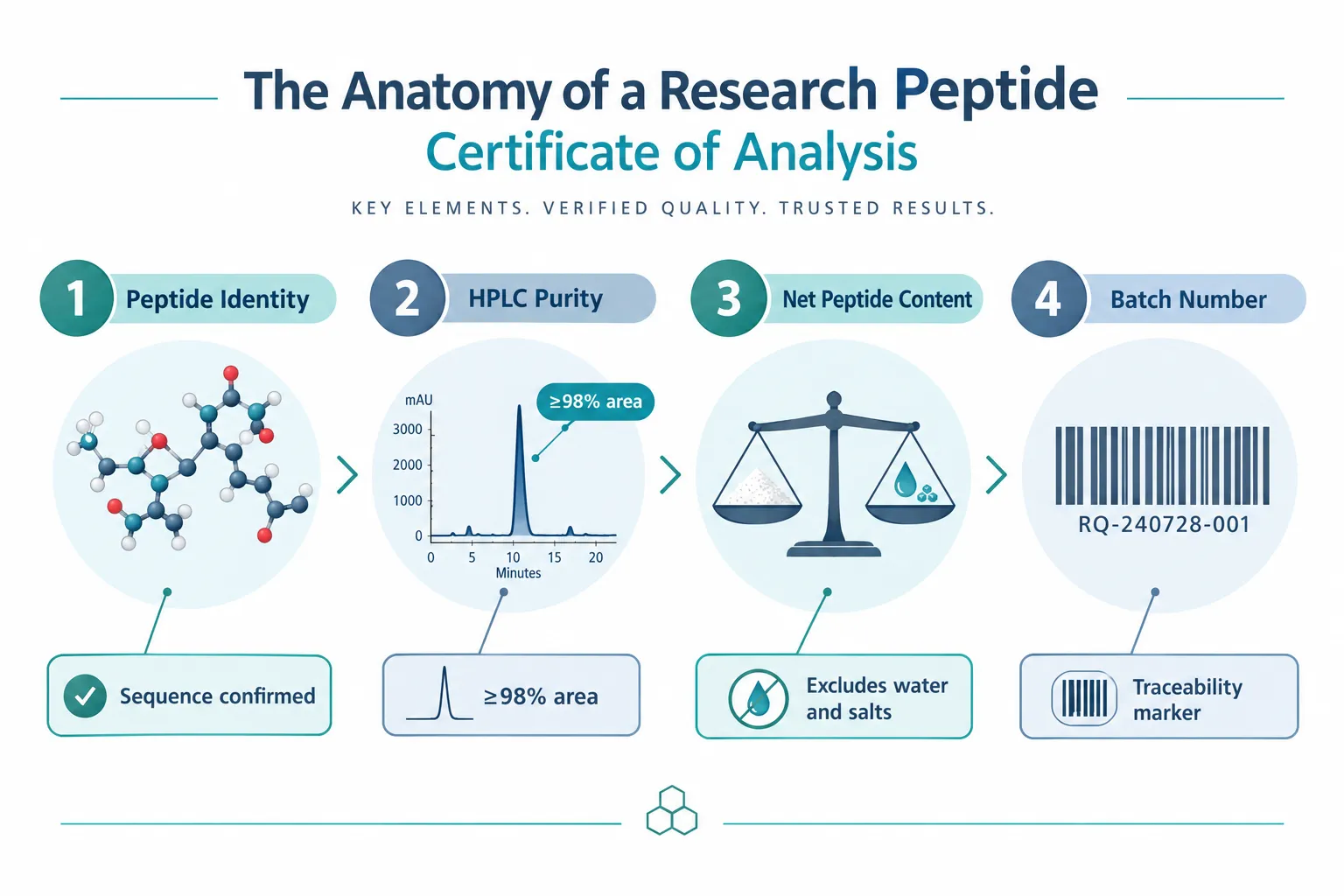
What a Modern Peptide COA Should Contain

A Certificate of Analysis is the primary quality document a researcher receives with a peptide order. In 2026, comprehensive supplier SOPs treat the COA as a multi-assay summary, not a single-number report. A well-constructed COA should include, at minimum:

COA Field What It Proves
Peptide sequence / identity Correct amino acid composition
HPLC purity (% area) Proportion of target compound
Molecular weight (MS confirmed) Correct molecular identity
Net peptide content (%) Actual peptide mass excluding water and salts
Endotoxin level (EU/mg or EU/mL) Bacterial contamination risk
Sterility / microbial limits Absence of viable microorganisms
Counterion and water content Accurate dosing calculation
Batch number and date Traceability and reproducibility

Four critical checks for any COA:

  1. Is the testing laboratory third-party or in-house? Third-party testing reduces conflict of interest.
  2. Are the test methods named (e.g., USP, ISO, LAL)? Named methods are reproducible and auditable.
  3. Does the document carry a batch-specific lot number? Generic COAs not tied to a specific lot are unreliable.
  4. Is net peptide content reported separately from HPLC purity? These are not the same figure.

When evaluating suppliers for specific compounds, such as those found in SS-31 10mg research peptide considerations or Ipamorelin peptide for sale listings, confirming all four checks before ordering is a baseline requirement.


Interpreting HPLC Purity and Mass Spectrometry Data
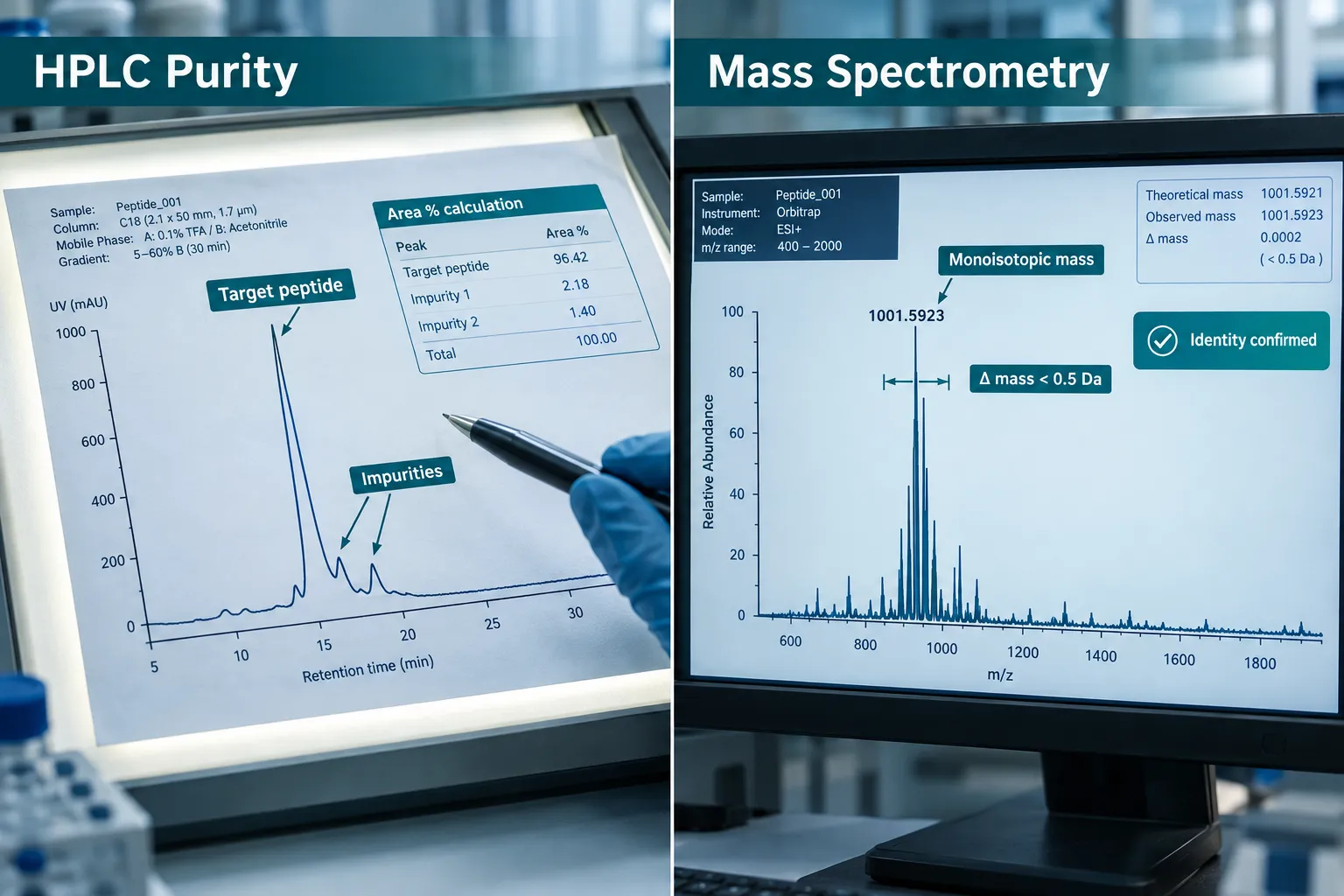
Interpreting HPLC Purity and Mass Spectrometry Data

HPLC Purity: What the Chromatogram Actually Measures

High-Performance Liquid Chromatography (HPLC) separates compounds by how they interact with a stationary phase. The resulting chromatogram shows peaks representing each component. Purity is reported as the area percentage of the target peak relative to all detected peaks.

Typical thresholds for research-grade peptides in 2026:

  • Greater than or equal to 98%, preferred for most in vitro and cell-based research
  • 95-97%, acceptable for some exploratory studies; impurity profile should still be disclosed
  • Below 95%, generally insufficient for publication-quality research

"HPLC purity tells you how much of the detected signal belongs to the target peptide. It does not tell you what the target peptide actually is."

This distinction matters. A degraded peptide fragment with a similar retention time can inflate the apparent purity figure. Oxidized methionine residues, truncated sequences, and epimers may co-elute with the parent compound depending on the column and gradient used.

Mass Spectrometry: Confirming Identity, Not Purity

Mass spectrometry (MS) measures the mass-to-charge ratio of ionized molecules. For peptide identity confirmation, the measured monoisotopic or average molecular weight is compared against the theoretical value calculated from the amino acid sequence.

Acceptable error windows in modern practice:

  • Electrospray ionization (ESI-MS): within ±0.5 Da or ±0.1% of theoretical mass, whichever is smaller
  • High-resolution MS: within ±5 ppm

MS confirms that a molecule of the correct mass is present. It does not quantify what fraction of the sample that molecule represents. This is why HPLC and MS are complementary, not interchangeable. Researchers sourcing compounds like MT-2 research peptide or GLP-3 peptides for sale should expect both tests on every COA, not one or the other.

Net Peptide Content: The Often-Overlooked Figure

Lyophilized peptides contain water (typically 5-15%) and counterions such as trifluoroacetate (TFA) or acetate. Net peptide content accounts for these and reports the actual mass of peptide per total mass of powder. A vial labeled "10 mg" with 75% net peptide content delivers only 7.5 mg of active compound. Accurate dosing in research depends on this figure.


Endotoxin Testing and Sterility Data in Research Peptide Quality Control
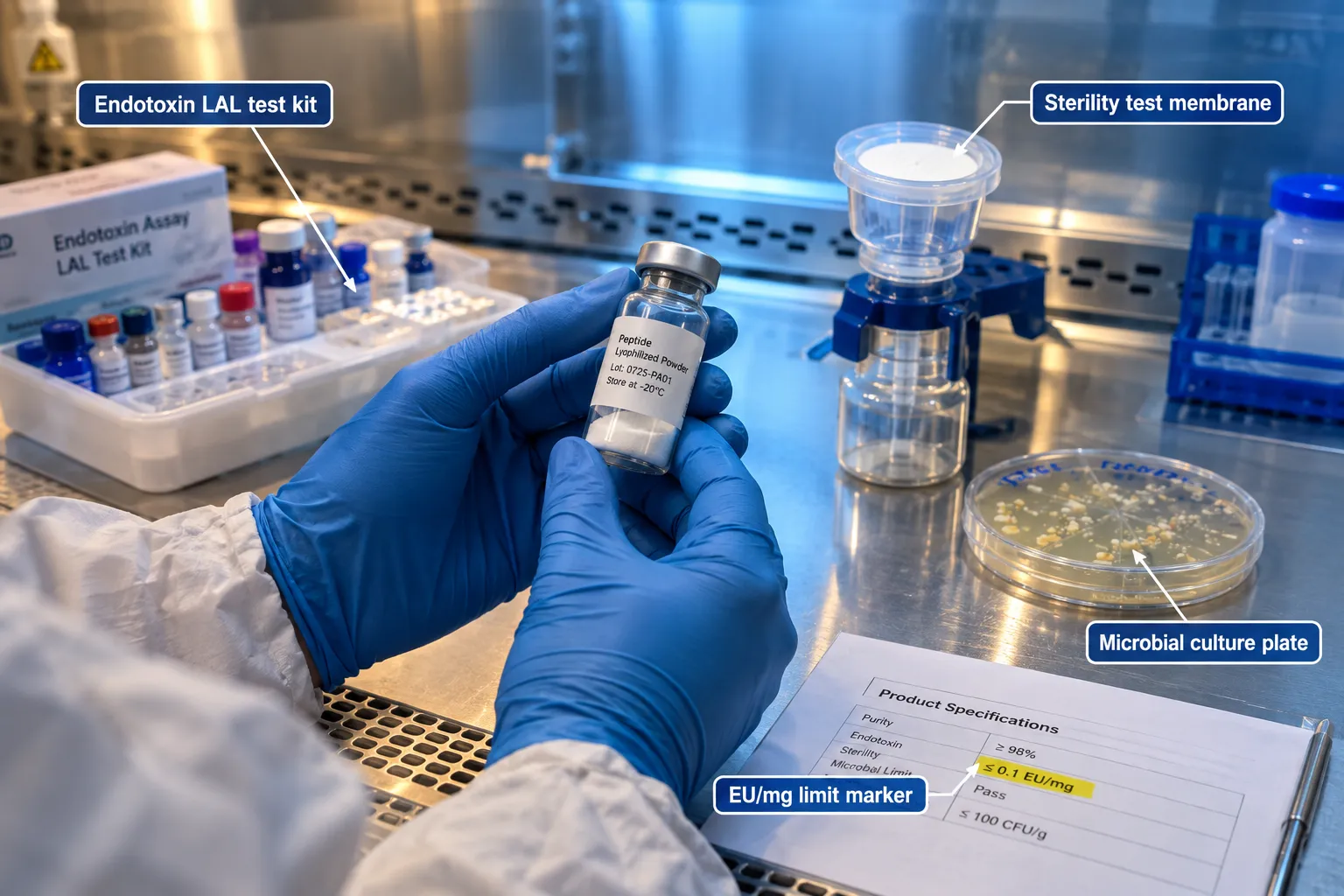
Endotoxin Testing and Sterility Data in Research Peptide Quality Control

Why HPLC and MS Cannot Address Contamination

This is one of the most consequential misunderstandings in peptide procurement. HPLC and MS detect chemical entities, they are blind to bacterial endotoxins, mycoplasma, and viable microorganisms. A peptide can show 99% HPLC purity and confirmed MS identity while carrying a significant endotoxin burden that invalidates cell-based assay results or causes inflammatory artifacts in animal models.

Endotoxin testing methods used by reputable suppliers include:

  • Limulus Amebocyte Lysate (LAL) assay, the established gold standard, with gel-clot, turbidimetric, and chromogenic variants
  • Recombinant Factor C (rFC) assay, increasingly adopted in 2026 as a sustainable alternative with comparable sensitivity

Understanding Endotoxin Limits

Context determines what endotoxin level is acceptable:

  • FDA clinical limits for parenteral drugs: 5 EU/kg/hour (approximately 0.5 EU/mL for most intravenous products)
  • Research-grade in vitro work: many suppliers target less than 1 EU/mg, though thresholds vary by application
  • In vivo animal research: stricter limits apply; even sub-clinical endotoxin loads can confound cytokine and metabolic endpoints

"Research-grade does not mean endotoxin-free. It means the supplier has characterized the contamination level, and the researcher must decide whether that level is acceptable for their specific model."

For studies involving compounds such as those discussed in SS-31 peptides for sale or IPA Sermorelin stack research, endotoxin data is especially relevant because these peptides are commonly used in models sensitive to inflammatory confounders.

Sterility Data: What "Research-Grade" Claims Actually Mean

Sterility testing under USP or ISO standards requires incubation of the sample in growth media for 14 days to detect viable organisms. Many research-grade suppliers do not perform full sterility testing; instead, they may report bioburden limits or microbial limits testing (MLT), which counts colony-forming units but does not guarantee sterility.

Researchers should distinguish between:

  • Sterility tested, full 14-day compendial test, result is pass/fail
  • Bioburden tested, quantitative count of viable organisms; not equivalent to sterility
  • No microbial data, the COA is silent on contamination; highest risk category

In 2026, a growing number of research suppliers are adopting routine endotoxin and bioburden testing as standard rather than optional. When evaluating a supplier's documentation for peptides like those in the where to buy research-grade Glow Blend peptide guide, confirming that endotoxin and microbial data appear on the COA, not just HPLC purity, separates rigorous suppliers from those providing incomplete documentation.


Conclusion

Evaluating Research Peptide Quality Control: How to Interpret COAs, HPLC Purity, Mass Spectrometry, Endotoxin, and Sterility Data requires treating each assay as a distinct lens on a different quality dimension. No single test is sufficient.

Actionable next steps for researchers:

  1. Request the full COA before ordering, not a sample or generic document. Confirm it is batch-specific.
  2. Verify that both HPLC and MS data are present, identity and purity must be confirmed independently.
  3. Check net peptide content, not just HPLC purity, for accurate dosing calculations.
  4. Demand endotoxin data expressed in EU/mg or EU/mL, with the test method named.
  5. Clarify sterility vs. bioburden, ask the supplier directly which test was performed and under what standard.
  6. Assess batch-to-batch consistency by requesting COAs from multiple lots when reproducibility matters to the study design.

Quality documentation is not a formality. It is the foundation on which valid research conclusions are built.

https://www.puretestedpeptides.com/wp-content/uploads/2026/09/research-peptide-quality-control-how-to-interpret-coas-hplc-purity-mass-spectrom.webp 1024 1536 https://www.puretestedpeptides.com/wp-content/uploads/2026/01/buy-peptides-online.jpg 2026-09-23 13:07:362026-09-23 13:07:36Research Peptide Quality Control: How to Interpret COAs, HPLC Purity, Mass Spectrometry, Endotoxin, and Sterility Data
×

Helpful Links

  • My account
  • Cart
  • Checkout
  • Refund and Returns Policy
  • Privacy Policy
  • SMS Privacy Policy
  • Login
  • My Account
  • Logout

USA Made Lab Tested Peptides

All products are sold for research, laboratory, or analytical purposes only, and are not for human consumption


Pure Tested Peptides is a chemical supplier. Pure Tested Peptides is not a compounding / chemical compounding facility as defined under 503A of the Federal Food, Drug, and Cosmetic act. Pure Tested Peptides is not an outsourcing facility as defined under 503B of the Federal Food, Drug, and Cosmetic act.

The statements made within this website have not been evaluated by the US Food and Drug Administration. The products we offer are not intended to diagnose, treat, cure or prevent any disease.

Human/Animal Consumption Prohibited. Laboratory/In-Vitro Experimental Use Only

Scroll to top Scroll to top Scroll to top