Call or Text 727-513-9780
  • Shopping Cart Shopping Cart
    0Shopping Cart
Pure Tested Peptides | America's most trusted Peptides for sale online
  • Peptides for sale
    • Oral Peptides for sale
      • Peptide Capsules for sale
      • BPC 157 Capsules 1000mcg
      • SLU-PP-332 Capsules | 1000 mcg
      • 5-Amino-1MQ 50mg Capsules
      • Tesofensine 500mcg
    • All Peptides for sale
    • Peptide Sprays
      • BPC 157 Nasal Spray Kit
      • BPC-157 TB500 Nasal Spray Kit
      • Semax Nasal Spray 10mg
      • Selank – Nasal Spray Kit – 10mg
      • Epithalon 50MG Nasal Spray Kit
      • Ipamorelin 10mg Nasal Spray
      • Klow Nasal Spray (BPC-157 + TB-500 + GHK-Cu + KPV) | 80mg
      • Hulk Nasal Spray Tesa / Ipa Blend 6/3 MG
      • Klow Nasal Spray
      • NAD + 500 mg Nasal Spray
      • PT-141 Nasal Spray Kit
    • GHRH Peptides
      • Ipa Peptides
      • CJC-1295 Peptides
        • CJC-1295 with DAC 5 mg
        • CJC-1295 without DAC 5 mg
        • CJC-1295 Ipa 10mg
      • Tesa Peptides
        • Tesa Peptide
        • Tesa 20 mg
    • GHK-Cu Peptides
      • All GHK-Cu Peptides
      • GHK-Cu 100mg
      • KLOW Peptide Blend – Buy KLOW blend online
    • BPC Peptides
      • All BPC Peptides
      • BPC-157
      • BPC-157 TB-500
      • BPC 157 capsules 1000mcg
    • SLU-PP-332 Peptides
      • All SLU-PP-332 Peptides
      • SLU-PP-332 5mg
    • GLP3 Peptides
    • PT-141 Peptides
      • PT-141 Peptides for sale
      • PT-141 10mg
      • PT-141 Nasal Spray
    • CAG Peptides
      • Lipo-C Peptide Blend
      • CAG 5mg
      • CAG 10mg
    • MOTS-C Peptides
      • MOTS-C Peptides for sale
      • MOTS-c peptide
      • MOTS-c 10mg *6 pack*
    • 5 Amino 1MQ Peptides
      • 5 Amino 1MQ Peptides for sale
      • 5-Amino-1MQ 50mg Capsules
      • 5-Amino-1MQ 5mg
    • Epithalon Peptides
      • Epithalon Peptides for sale
      • Epithalon 10mg
      • Epithalon 50mg
  • Shop
    • GLPs
      • 5-Amino-1MQ 50mg Capsules
      • 5-Amino-1MQ 5mg
      • L-Carnitine 500mg/ml
      • Tesofensine 500mcg
      • SLU-PP-332 5mg
      • MOTS-c 10mg *6 pack*
    • Epithalon & BPC Peptides
      • Epithalon 10mg
      • Epithalon 50mg
      • BPC-157
      • BPC 157 capsules 1000mcg
      • BPC-157 TB-500
      • BPC-157 TB500 Nasal Spray Kit
      • BPC 157 Nasal Spray Kit
    • BPC TB-500 & NAD+ Peptides
      • NAD+ 500 mg
      • KLOW Peptide Blend – Buy KLOW blend online
      • GLOW Peptide Blend
      • TB 500 5mg
      • BPC 157 capsules 1000mcg – Supplement
      • BPC 157 Nasal Spray Kit
      • BPC-157
      • BPC-157 TB500 Nasal Spray Kit
      • BPC-157 TB-500
      • BPC 157 capsules 1000mcg
    • LL-37 Peptide
      • LL-37 10 mg
    • MOTS-C & Selank
      • MOTS-c peptide
      • Selank 10mg
    • GHK Peptides
      • GHK-Cu 100mg
      • GLOW Peptide Blend
      • KLOW Peptide Blend – Buy KLOW blend online
  • COAs
  • Wholesale
    • Wholesale Peptides for sale
  • PTP FAQ
  • Affiliates
    • Selank Peptide: Advanced Pharmacological Mechanisms Underlying Its Anxiolytic and Nootropic Effects in Research
      • 5-Amino-1MQ Peptide: Detailed Mechanisms of NNMT Inhibition and Its Impact on Cellular Metabolism Research
        • MOTS-C Peptide: Unraveling Its Role in Mitochondrial Dynamics and Energy Metabolism Research
          • Epithalon Peptide and Telomerase Regulation: Investigating Its Impact on Cellular Senescence and Lifespan Research Models
            • GLP2-T vs GLP2 Tirz Peptide: Understanding the Naming, Mechanistic Nuances, and Research Implications for Gut Health
      • Peptides and Polypeptides in Modern Pharmacology: What Research on Metoprolol, Prednisone, and Amlodipine Reveals
        • Polypeptide Peptides vs NSAIDs: What Naproxen and Diclofenac Teach Tissue-Repair Researchers About BPC‑157 and TB‑500
          • Peptides and Polypeptides in Endocrine Pharmacology: How GLP-1, GLP-2, and GLP-3 Retatrutide Differ From Classic Drugs Like Prednisone and Amlodipine
          • 5‑Amino‑1MQ Peptide and NNMT Inhibition: How It Compares With Statins Like Atorvastatin in Adipose and Lipid Metabolism Research
      • Enclomiphene, Estrogen Receptor Signaling, and Luteinizing Phase Biology: What Hormone Researchers Should Measure
        • Mesenchymal Stem Cells, BPC‑157, and GHK‑Cu: How Tissue Repair Peptides Compare With Classic NSAIDs Like Naproxen in Injury Models
          • Peptide Calculator Use Cases Beyond Growth Hormone: Working Through GLP‑3 Retatrutide, MOTS‑c, and BPC‑157 Research Dosing
        • Polypeptide Peptides in Endocrine and Metabolic Pharmacology: Lessons From Amlodipine, Prednisone, and Metoprolol
        • Peptides Calculator for Advanced Blends: Worked Examples for Tesamorelin, CJC‑1295, and Ipamorelin Stacks
          • Peptides and Polypeptides in Human Physiology: How Molecular Size Shapes Research Applications
            • Selank Peptide: Advanced Pharmacological Mechanisms Underlying Its Anxiolytic and Nootropic Effects in Research
          • 5-Amino-1MQ Peptide: Detailed Mechanisms of NNMT Inhibition and Its Impact on Cellular Metabolism Research
            • MOTS-C Peptide: Unraveling Its Role in Mitochondrial Dynamics and Energy Metabolism Research
              • Epithalon Peptide and Telomerase Regulation: Investigating Its Impact on Cellular Senescence and Lifespan Research Models
                • GLP2-T vs GLP2 Tirz Peptide: Understanding the Naming, Mechanistic Nuances, and Research Implications for Gut Health
                  • Peptides and Polypeptides in Endocrine Pharmacology: How GLP-1, GLP-2, and GLP-3 Retatrutide Differ From Classic Drugs Like Prednisone and Amlodipine
                    • Polypeptide Peptides vs NSAIDs: What Naproxen and Diclofenac Teach Tissue-Repair Researchers About BPC‑157 and TB‑500
                      • Peptides and Polypeptides in Modern Pharmacology: What Research on Metoprolol, Prednisone, and Amlodipine Reveals
                        • 5‑Amino‑1MQ Peptide and NNMT Inhibition: How It Compares With Statins Like Atorvastatin in Adipose and Lipid Metabolism Research
                        • Enclomiphene, Estrogen Receptor Signaling, and Luteinizing Phase Biology: What Hormone Researchers Should Measure
                        • Mesenchymal Stem Cells, BPC‑157, and GHK‑Cu: How Tissue Repair Peptides Compare With Classic NSAIDs Like Naproxen in Injury Models
                        • Peptide Calculator Use Cases Beyond Growth Hormone: Working Through GLP‑3 Retatrutide, MOTS‑c, and BPC‑157 Research Dosing
                        • Polypeptide Peptides in Endocrine and Metabolic Pharmacology: Lessons From Amlodipine, Prednisone, and Metoprolol
                        • Peptides Calculator for Advanced Blends: Worked Examples for Tesamorelin, CJC‑1295, and Ipamorelin Stacks
                        • Peptides and Polypeptides in Human Physiology: How Molecular Size Shapes Research Applications
                        • Selank Peptide: Advanced Pharmacological Mechanisms Underlying Its Anxiolytic and Nootropic Effects in Research
                        • MOTS-C Peptide: Unraveling Its Role in Mitochondrial Dynamics and Energy Metabolism Research
                        • Peptides and Polypeptides in Modern Pharmacology: What Research on Metoprolol, Prednisone, and Amlodipine Reveals
                        • Peptides and Polypeptides in Endocrine Pharmacology: How GLP-1, GLP-2, and GLP-3 Retatrutide Differ From Classic Drugs Like Prednisone and Amlodipine
                        • 5-Amino-1MQ Peptide: Detailed Mechanisms of NNMT Inhibition and Its Impact on Cellular Metabolism Research
                        • Mesenchymal Stem Cells, BPC‑157, and GHK‑Cu: How Tissue Repair Peptides Compare With Classic NSAIDs Like Naproxen in Injury Models
                        • Peptide Calculator Use Cases Beyond Growth Hormone: Working Through GLP‑3 Retatrutide, MOTS‑c, and BPC‑157 Research Dosing
                        • GLP2-T vs GLP2 Tirz Peptide: Understanding the Naming, Mechanistic Nuances, and Research Implications for Gut Health
                        • Polypeptide Peptides in Endocrine and Metabolic Pharmacology: Lessons From Amlodipine, Prednisone, and Metoprolol
                        • Polypeptide Peptides vs NSAIDs: What Naproxen and Diclofenac Teach Tissue-Repair Researchers About BPC‑157 and TB‑500
                        • Peptides and Polypeptides in Human Physiology: How Molecular Size Shapes Research Applications
                        • Peptides Calculator for Advanced Blends: Worked Examples for Tesamorelin, CJC‑1295, and Ipamorelin Stacks
                        • 5‑Amino‑1MQ Peptide and NNMT Inhibition: How It Compares With Statins Like Atorvastatin in Adipose and Lipid Metabolism Research
                        • Enclomiphene, Estrogen Receptor Signaling, and Luteinizing Phase Biology: What Hormone Researchers Should Measure
                        • Epithalon Peptide and Telomerase Regulation: Investigating Its Impact on Cellular Senescence and Lifespan Research Models
                        • Best research protocol Klow blend
                        • best time to take BPC-157
                        • best time to take DSIP (Delta Sleep Inducing Peptide)
                        • best time to take CJC-1295
                        • best time to take AOD-9604
                        • best time to take Follistatin 344
                        • best time to take Ipamorelin
                        • best time to take MK-677 (Ibutamoren)
                        • best time to take Ligandrol (LGD-4033) — research compound
                        • best time to take Ostarine (MK-2866) — research compound
                        • best time to take GHK-CU
                        • best time to take TB-500
                        • best time to take MOTS-c
                        • best time to take Semax
                        • best time to take RAD-140 (Testolone) — research compound
                        • best time to take Thymosin Alpha-1
                        • best time to take PEG-MGF
                        • Biolife Plasma, Octapharma Plasma, and Research Peptides: How Plasma Donation Labs Differ From Peptide Suppliers
                        • best time to take YK-11 — research compound
                        • best time to take PT-141 (Bremelanotide)
                        • Best research protocol Klow blend
                        • 5-Amino-1MQ and MOTS-C Synergy: Metabolic Signaling, Mitochondria, and Research Design
                        • BPC-157 and TB-500: Investigating Their Combined Effects on Angiogenesis and Cellular Migration in Tissue Repair Models
                        • BPC-157 Peptide: Gut Barrier Function, Inflammation, and Tissue-Recovery Research
                        • 5‑Amino‑1MQ and MOTS‑c Synergy in Metabolic Research: Designing NNMT and Mitochondrial Biogenesis Stacks
                        • CJC-1295 with DAC vs. Without DAC: Half-Life, Release Kinetics, and Research Implications
                        • CJC‑1295 with DAC vs. Without DAC: Expanding on Half‑Life Differences Using Tesamorelin and Ipamorelin Blend Case Studies
                        • Collagen Biology and Copper‑Binding Peptides: How GHK‑Cu, Glow Blend, and Klow Blend Interact with Skin and Connective Tissue
                        • Collagen Biology and Regenerative Peptides: How GHK‑Cu, Glow Blend, and Klow Blend Affect Extracellular Matrix Research
                    • DNA, Telomeres, and Longevity Peptides: Positioning Epithalon and MOTS‑c in Genetic Aging Research
                      • Enclomiphene Citrate: serm Mechanism, Testosterone Research, and Stack Compatibility
                        • Enclomiphene vs Enclomiphene Citrate: Formulation, Bioavailability, and Research Distinctions
                        • Epithalon Peptide Research: Telomerase Activation, Aging, and Pineal Gland Function
                        • Estrogen Receptor Signaling and Enclomiphene: How Selective Modulators Compare with Classic Polypeptide Hormones
                        • GHK-Cu Peptide: Advanced Mechanisms in Extracellular Matrix Remodeling and Wound Healing Research
                        • GHK-Cu Peptide: Collagen Synthesis, Wound Repair, and Skin-Barrier Research Models
                        • GLP-1 vs GLP-3 vs GLP-2: Peptide Classification and Research Applications
                        • GLP-2 Peptide Research Guide: Gut Barrier Function, Nutrient Absorption, and Intestinal Recovery Models
                        • GLP-3 Retatrutide vs. GLP-1 Drugs: What Triple-Agonist Biology Changes in Research Models
                        • Ipamorelin and Tesamorelin Combination: Synergistic GH Secretagogue Research and Dosing Protocols
                        • GLP2 Tirz Peptide: What It Is, Why the Name Exists, and How Researchers Should Interpret It
                        • Klow Blend Peptide Nasal Spray: What the Formulation Is Trying to Do in Cognitive Research
                        • Mitochondria, NNMT Inhibition, and Peptide Modulators: Where MOTS‑c and 5‑Amino‑1MQ Fit in Cellular Energy Research
                        • MOTS-c Peptide: Mitochondrial Function, Energy Metabolism, and What Researchers Measure
                        • MOTS-c vs. 5-Amino-1MQ: Which Metabolic Research Questions Each Compound Actually Answers
                        • Nasal Spray Peptides: Bioavailability, Administration, and Semax/Selank Research Applications
                        • PT-141 Peptide Research: Mechanism of Action and Melanocortin Receptor Signaling
                        • Retatrutide for Research: Mechanism, Structure, and GLP-1/GLP-3 Dual Action
                        • Retatrutide for Obesity and Type 2 Diabetes: What the Latest Trial Data Suggest
                        • Tesofensine Peptide Research: Mechanism, Appetite Suppression, and Neuropeptide Y Pathways
  • Contact
    • Contact Customer Service
    • Text Customer Support
  • About US
  • Shop all peptides
  • Affiliate Program
    • Affiliate Signup
  • Login / Register Login / Register Page Link Login / Register Page Link
  • Click to open the search input field Click to open the search input field Search
  • Menu Menu

Tag Archive for: neuropeptides research

Semax vs Selank Nasal Spray: How to Choose a Research Formulation by Neuroinflammation, Stress, and Cognitive Endpoints

Semax vs Selank Nasal Spray: How to Choose a Research Formulation by Neuroinflammation, Stress, and Cognitive Endpoints

November 8, 2026/0 Comments/in Uncategorized/by

{"cover":"Professional landscape format (1536×1024) hero image with bold text overlay 'Semax vs Selank Nasal Spray' in crisp white sans-serif centered on a deep teal semi-transparent overlay panel, 8% safe margins from every edge, no character touches the border. Background: a clean laboratory setting with two glass nasal spray vials side by side on a reflective surface, soft blue and white studio lighting, microscopic neural network illustration subtly overlaid in the background, editorial pharmaceutical magazine aesthetic, high contrast, sharp focus.","content":["Four-panel labelled comparison infographic (1536×1024) on a clean white background with teal-and-navy palette: Panel 1 labeled 'Semax' shows a stylized neuron with callout lines pointing to labels 'BDNF upregulation', 'Pro-BDNF cleavage', 'Neuroinflammation marker reduction'; Panel 2 labeled 'Selank' shows a stylized stress-response pathway with callout labels 'GABAergic modulation', 'IL-6 downregulation', 'Enkephalin stabilization'; Panel 3 labeled 'Shared Route' shows a cross-section of a nasal cavity with callout arrows to 'Olfactory epithelium', 'Cribriform plate', 'CNS delivery'; Panel 4 labeled 'Endpoint Match' shows a simple decision tree with branches 'Neuroinflammation → Semax', 'Anxiety/Stress → Selank', 'Cognitive fatigue → Semax'. Clean medical-guide polish, thin callout lines, editorial infographic style.", "Split-screen editorial diagram (1536×1024): left panel titled 'Semax Mechanism' in navy text shows an illustrated brain cross-section with callout labels 'ACTH analog fragment', 'Microglial activation suppressed', 'BDNF pathway activated', 'Prefrontal cortex target'; right panel titled 'Selank Mechanism' shows a stylized hypothalamic-pituitary-adrenal axis illustration with callout labels 'Tuftsin-derived heptapeptide', 'Cortisol curve blunted', 'IL-6 reduced in plasma', 'Amygdala stress signaling'. Center divider is a clean white line with the label 'Mechanism Comparison'. Teal, navy, and warm amber accent palette, bright clinical lighting, annotated scientific diagram style, editorial quality.", "Numbered step-by-step research protocol flow diagram (1536×1024) on a light grey background with navy and teal accents: five sequential horizontal steps labeled Step 1 'Define Primary Endpoint' (sub-labels: neuroinflammation, stress, cognition), Step 2 'Select Peptide Formulation' (sub-labels: Semax 0.1%, Selank 0.15%), Step 3 'Confirm Delivery Parameters' (sub-labels: drop volume, pH, preservative), Step 4 'Set Biomarker Panel' (sub-labels: IL-6, BDNF, cortisol), Step 5 'Document Under Research Use Policy'. Arrows connecting each step, short callout labels inside 5% safe margin, clean sans-serif typography, clinical research workflow aesthetic, editorial polish."]
Professional landscape hero image () with a reading "Semax vs Selank Nasal Spray". CRITICAL TYPOGRAPHY RULES: render the

Two neuropeptides derived from entirely different parent molecules, one from adrenocorticotropic hormone, the other from tuftsin, are regularly compared as if they are interchangeable nootropics. They are not. Choosing between Semax vs Selank nasal spray for research comes down to target tissue, primary endpoint, and the inflammatory or behavioral markers a study protocol requires.

This guide offers a formulation-selection framework rooted in mechanism rather than anecdote.

Key Takeaways

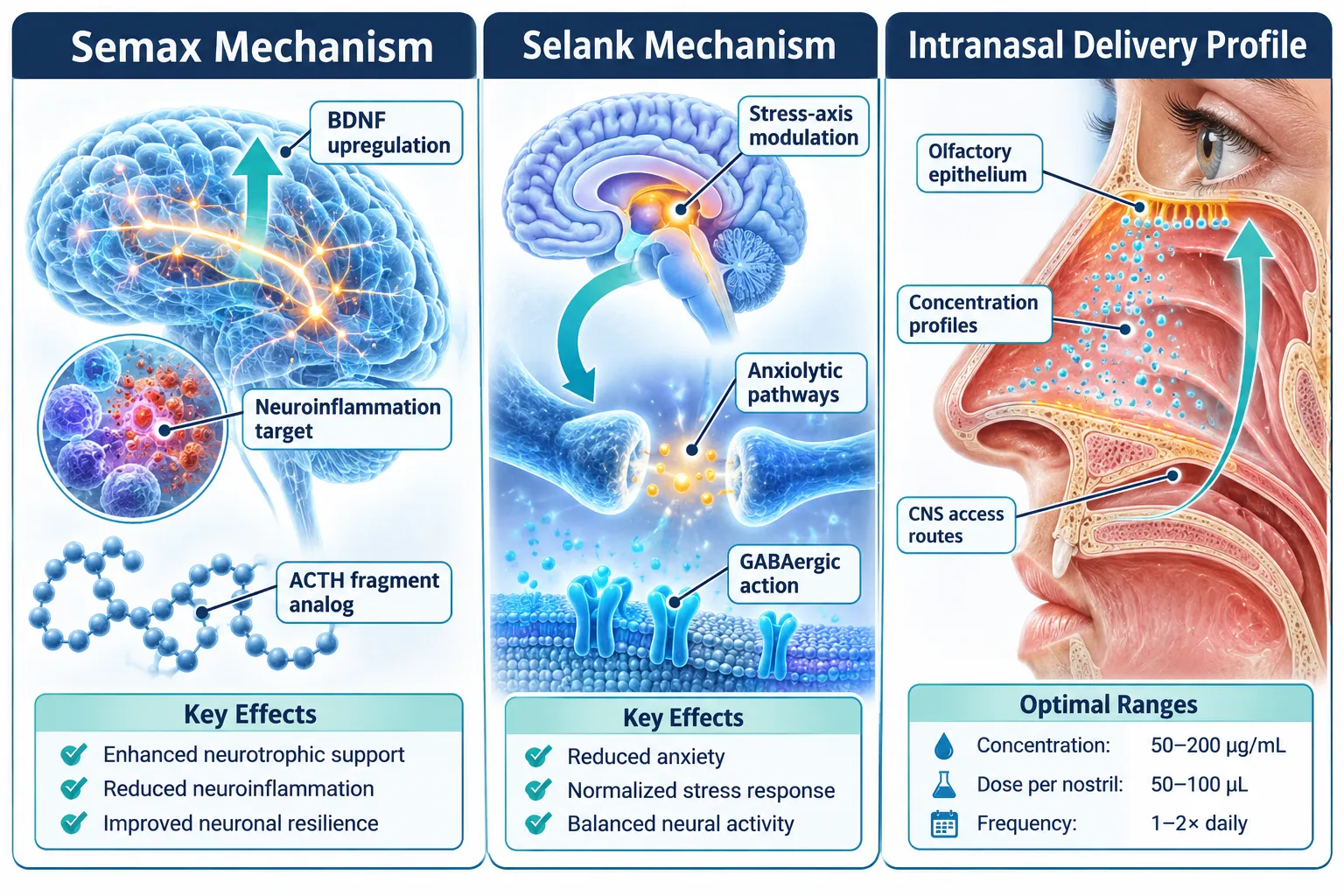
  • Semax targets neuroinflammation and neurotrophic signaling (BDNF upregulation); Selank targets stress-axis modulation and anxiolytic pathways.
  • Both are delivered intranasally, but their deposition profiles and optimal concentrations differ in research contexts.
  • Endpoint selection, not personal preference, should drive formulation choice.
  • Selank carries stronger direct human evidence for anxiety and IL-6 reduction; Semax has stronger mechanistic evidence for neuroinflammatory and cognitive-fatigue models.
  • Both remain research chemicals outside Russia and several CIS countries and must be handled under applicable regulatory frameworks.

Mechanistic Profiles: Where the Two Peptides Diverge
Mechanistic Profiles: Where the Two Peptides Diverge

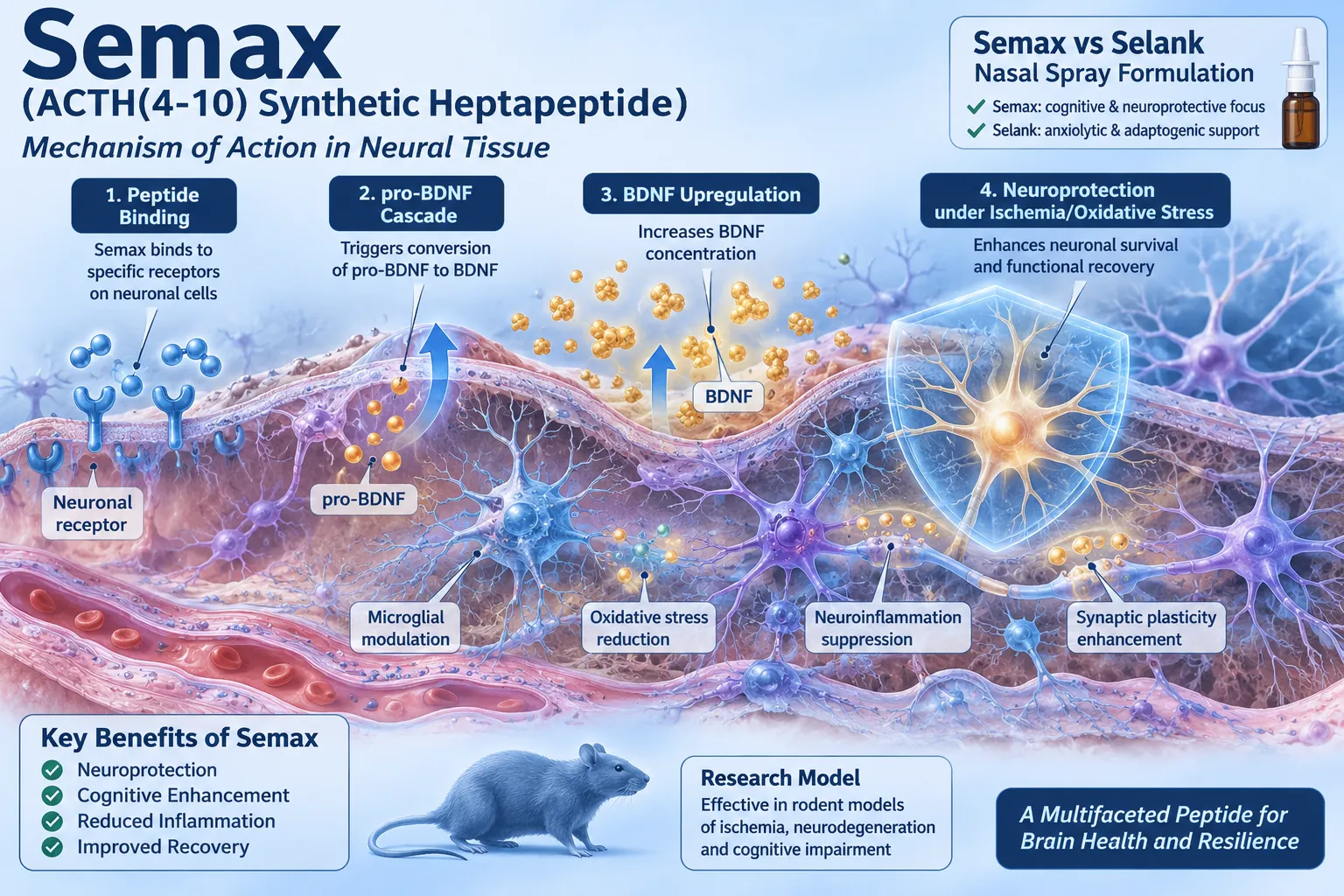
Semax is a synthetic heptapeptide analog of the ACTH(4-10) fragment. Its primary documented action involves upregulating brain-derived neurotrophic factor (BDNF) and its precursor pro-BDNF, particularly under conditions of ischemia, oxidative stress, or neuroinflammation. In animal models, Semax reduces microglial over-activation and lowers several pro-inflammatory cytokine markers in central nervous system tissue. These properties make Semax nasal spray formulations especially relevant for research protocols targeting neuroinflammatory endpoints.

Selank is a synthetic analog of tuftsin, a tetrapeptide with known immunomodulatory properties. Its mechanism is better characterized on the stress-response side: Selank appears to stabilize enkephalins (endogenous opioid peptides that break down rapidly under stress), attenuate hypothalamic-pituitary-adrenal (HPA) axis over-activity, and reduce circulating IL-6 in human subjects. Its anxiolytic effect has been documented in controlled clinical settings in Russia, where it holds registered drug status for anxiety disorders.

"The choice between these two compounds is fundamentally a question of endpoint biology, not of one being stronger than the other."


Comparing Endpoints: Neuroinflammation, Stress, and Cognition

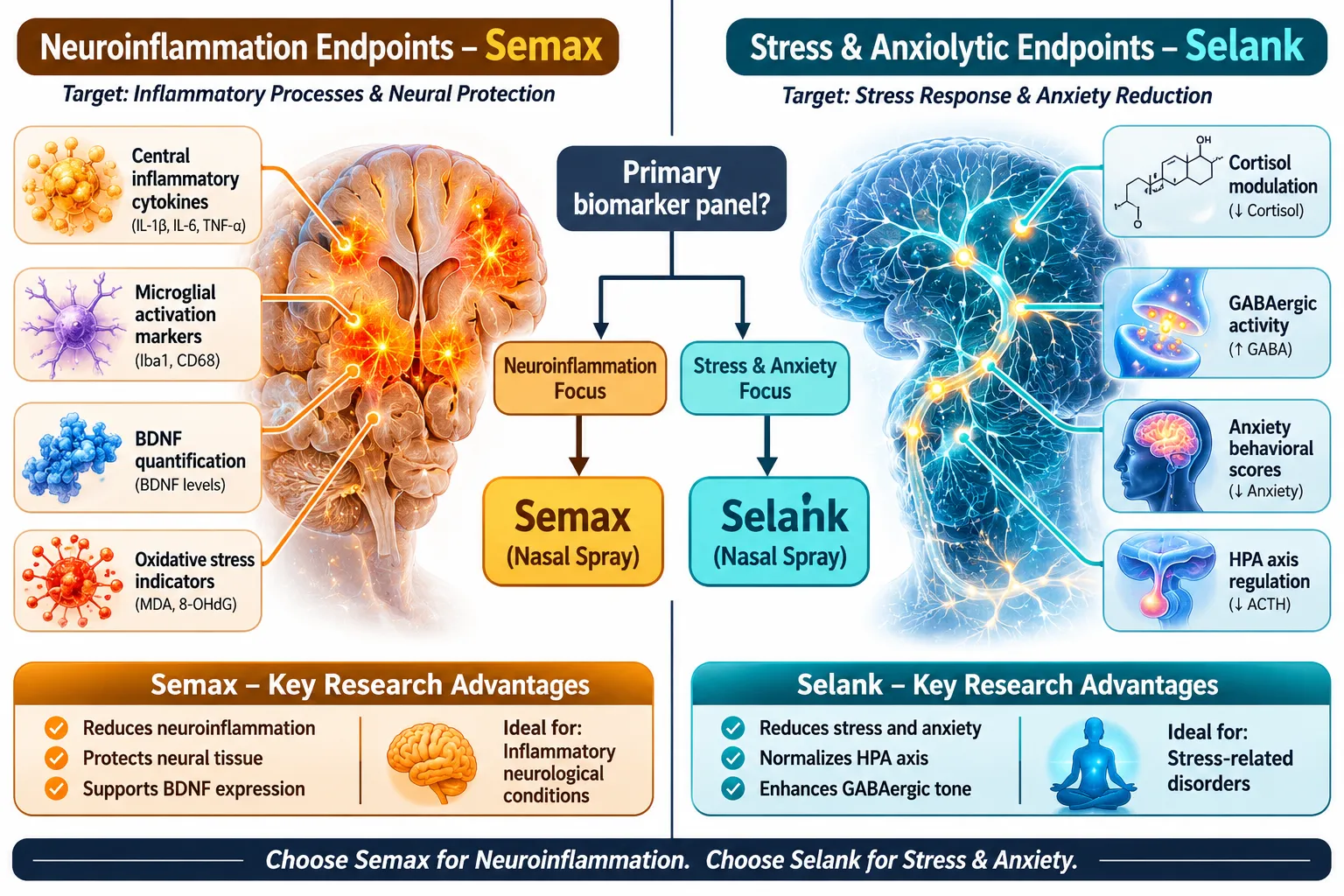
When evaluating Semax vs Selank nasal spray: how to choose a research formulation by neuroinflammation, stress, and cognitive endpoints, the clearest decision rule is matching the compound to the primary biomarker panel.

Neuroinflammation Endpoints

For protocols measuring central inflammatory markers, microglial activation, TNF-alpha, IL-1beta, or BDNF response, Semax is the better-supported candidate. Its ACTH-fragment structure interacts with melanocortin receptors in a way that modulates the inflammatory cascade downstream, and its neurotrophic effects are robust across multiple preclinical models.

Selank has demonstrated IL-6 reduction in peripheral blood in human anxiety trials, which is relevant to systemic neuroinflammation research, but its direct CNS anti-inflammatory mechanism is less characterized than Semax's.

Stress and Anxiety Endpoints

Selank holds the stronger evidence base here. Human data from registered clinical work in Russia showed statistically significant reductions in trait and state anxiety scores, alongside measurable blunting of cortisol response curves. For research protocols using validated stress-response assays, such as the Hamilton Anxiety Scale analog or salivary cortisol AUC, Selank is the more directly supported formulation.

Semax shows cognitive benefits in stressed or fatigued subjects but its anxiolytic signal is weaker and less consistent than Selank's.

Cognitive Endpoints

Cognitive Domain Semax Evidence Selank Evidence
Attention / Focus Moderate (stressed populations) Mild (secondary to anxiety reduction)
Memory Consolidation Moderate (BDNF-linked) Low direct evidence
Mental Fatigue Strong (fatigue-state subjects) Minimal evidence
Cognitive flexibility Preclinical only Preclinical only

An important caveat: neither compound shows reliable cognitive enhancement in healthy, non-stressed subjects with normal BDNF levels. Research protocols enrolling subjects with documented cognitive fatigue, elevated inflammatory markers, or high-stress conditions will see more meaningful signal than those enrolling optimally healthy volunteers.


Formulation and Nasal Delivery Considerations
Formulation and Nasal Delivery Considerations

Both peptides are typically formulated at concentrations suited for intranasal delivery, Semax commonly at 0.1% and Selank at 0.15% in aqueous solution with preservative. The nasal route is chosen for CNS access via the olfactory epithelium and trigeminal pathways, bypassing first-pass hepatic metabolism.

Key formulation variables that affect research reproducibility include:

  • pH stability, both peptides are sensitive to extremes; a range of 4.5-6.5 is standard
  • Preservative choice, benzalkonium chloride may affect mucosal integrity with repeated dosing cycles
  • Drop volume per actuation, typically 50-100 microliters; volume affects regional deposition
  • Cold chain requirements, peptide degradation accelerates above 8°C

For researchers sourcing nasal peptide formulations alongside other intranasal research agents, reviewing options like GLP nasal spray and GLP-R nasal formulations can provide useful context on delivery-system documentation standards.

Documentation quality matters. Research-grade suppliers should provide third-party purity certificates, mass spectrometry confirmation of sequence identity, and endotoxin testing results. The same documentation rigor applied to other research peptides, for example, the sourcing notes relevant to GLP-1 peptide sourcing concepts, applies equally here.


A Decision Framework for Selecting Between Semax and Selank
A Decision Framework for Selecting Between Semax and Selank

Applying the Semax vs Selank nasal spray: how to choose a research formulation by neuroinflammation, stress, and cognitive endpoints framework requires answering four sequential questions before ordering a formulation.

Step 1, What is the primary endpoint?
Neuroinflammatory markers or BDNF response: choose Semax. Anxiety scores, cortisol curve, or IL-6 in peripheral blood: choose Selank. Cognitive fatigue under stress load: lean Semax with secondary Selank arm if anxiety confounds are present.

Step 2, What is the subject population?
Subjects with documented neuroinflammatory burden or cognitive fatigue map better to Semax. Subjects with anxiety disorder diagnoses or high-stress occupational load map better to Selank.

Step 3, What is the biomarker panel?
If the assay panel includes CNS-derived BDNF, microglial markers, or pro-inflammatory cytokines in CSF or neuroimaging surrogates, Semax is the mechanistically aligned choice. If the panel centers on salivary cortisol, plasma IL-6, or validated psychometric stress instruments, Selank fits the biology.

Step 4, What is the regulatory context?
Both compounds sit outside approved drug frameworks in most Western jurisdictions. Research institutions must confirm IRB protocols, compound sourcing documentation, and storage compliance before initiating any study design.

For researchers exploring other investigational compounds alongside neuropeptide work, resources on SS-31 kidney health research illustrate how endpoint-driven documentation applies across diverse peptide categories.


Conclusion

The debate over Semax vs Selank nasal spray is best resolved not by ranking one above the other, but by matching compound to endpoint with precision. Semax earns its place in neuroinflammation and cognitive-fatigue protocols through its BDNF and microglial mechanisms. Selank earns its place in stress-axis and anxiety research through direct human data on HPA modulation and IL-6 reduction.

Actionable next steps for research teams:

  1. Define the primary endpoint and biomarker panel before sourcing any formulation.
  2. Request third-party purity certificates and mass spectrometry data from any supplier.
  3. Confirm cold-chain compliance and document storage conditions throughout the study.
  4. Build a secondary endpoint arm where endpoint overlap exists (e.g., stress-impaired cognition may warrant both compounds in separate study arms).
  5. Review all applicable regulatory and institutional requirements before beginning subject enrollment.

Choosing the right tool is always a function of knowing the job first.

https://www.puretestedpeptides.com/wp-content/uploads/2026/11/semax-vs-selank-nasal-spray-how-to-choose-a-research-formulation-by-neuroinflamm.webp 1024 1536 https://www.puretestedpeptides.com/wp-content/uploads/2026/01/buy-peptides-online.jpg 2026-11-08 14:04:422026-11-08 14:04:42Semax vs Selank Nasal Spray: How to Choose a Research Formulation by Neuroinflammation, Stress, and Cognitive Endpoints
×

Helpful Links

  • My account
  • Cart
  • Checkout
  • Refund and Returns Policy
  • Privacy Policy
  • SMS Privacy Policy
  • Login
  • My Account
  • Logout

USA Made Lab Tested Peptides

All products are sold for research, laboratory, or analytical purposes only, and are not for human consumption


Pure Tested Peptides is a chemical supplier. Pure Tested Peptides is not a compounding / chemical compounding facility as defined under 503A of the Federal Food, Drug, and Cosmetic act. Pure Tested Peptides is not an outsourcing facility as defined under 503B of the Federal Food, Drug, and Cosmetic act.

The statements made within this website have not been evaluated by the US Food and Drug Administration. The products we offer are not intended to diagnose, treat, cure or prevent any disease.

Human/Animal Consumption Prohibited. Laboratory/In-Vitro Experimental Use Only

Scroll to top Scroll to top Scroll to top