Call or Text 727-513-9780
  • Shopping Cart Shopping Cart
    0Shopping Cart
Pure Tested Peptides | America's most trusted Peptides for sale online
  • Peptides for sale
    • Oral Peptides for sale
      • Peptide Capsules for sale
      • BPC 157 Capsules 1000mcg
      • SLU-PP-332 Capsules | 1000 mcg
      • 5-Amino-1MQ 50mg Capsules
      • Tesofensine 500mcg
    • All Peptides for sale
    • Peptide Sprays
      • BPC 157 Nasal Spray Kit
      • BPC-157 TB500 Nasal Spray Kit
      • Semax Nasal Spray 10mg
      • Selank – Nasal Spray Kit – 10mg
      • Epithalon 50MG Nasal Spray Kit
      • Ipamorelin 10mg Nasal Spray
      • Klow Nasal Spray (BPC-157 + TB-500 + GHK-Cu + KPV) | 80mg
      • Hulk Nasal Spray Tesa / Ipa Blend 6/3 MG
      • Klow Nasal Spray
      • NAD + 500 mg Nasal Spray
      • PT-141 Nasal Spray Kit
    • GHRH Peptides
      • Ipa Peptides
      • CJC-1295 Peptides
        • CJC-1295 with DAC 5 mg
        • CJC-1295 without DAC 5 mg
        • CJC-1295 Ipa 10mg
      • Tesa Peptides
        • Tesa Peptide
        • Tesa 20 mg
    • GHK-Cu Peptides
      • All GHK-Cu Peptides
      • GHK-Cu 100mg
      • KLOW Peptide Blend – Buy KLOW blend online
    • BPC Peptides
      • All BPC Peptides
      • BPC-157
      • BPC-157 TB-500
      • BPC 157 capsules 1000mcg
    • SLU-PP-332 Peptides
      • All SLU-PP-332 Peptides
      • SLU-PP-332 5mg
    • GLP3 Peptides
    • PT-141 Peptides
      • PT-141 Peptides for sale
      • PT-141 10mg
      • PT-141 Nasal Spray
    • CAG Peptides
      • Lipo-C Peptide Blend
      • CAG 5mg
      • CAG 10mg
    • MOTS-C Peptides
      • MOTS-C Peptides for sale
      • MOTS-c peptide
      • MOTS-c 10mg *6 pack*
    • 5 Amino 1MQ Peptides
      • 5 Amino 1MQ Peptides for sale
      • 5-Amino-1MQ 50mg Capsules
      • 5-Amino-1MQ 5mg
    • Epithalon Peptides
      • Epithalon Peptides for sale
      • Epithalon 10mg
      • Epithalon 50mg
  • Shop
    • GLPs
      • 5-Amino-1MQ 50mg Capsules
      • 5-Amino-1MQ 5mg
      • L-Carnitine 500mg/ml
      • Tesofensine 500mcg
      • SLU-PP-332 5mg
      • MOTS-c 10mg *6 pack*
    • Epithalon & BPC Peptides
      • Epithalon 10mg
      • Epithalon 50mg
      • BPC-157
      • BPC 157 capsules 1000mcg
      • BPC-157 TB-500
      • BPC-157 TB500 Nasal Spray Kit
      • BPC 157 Nasal Spray Kit
    • BPC TB-500 & NAD+ Peptides
      • NAD+ 500 mg
      • KLOW Peptide Blend – Buy KLOW blend online
      • GLOW Peptide Blend
      • TB 500 5mg
      • BPC 157 capsules 1000mcg – Supplement
      • BPC 157 Nasal Spray Kit
      • BPC-157
      • BPC-157 TB500 Nasal Spray Kit
      • BPC-157 TB-500
      • BPC 157 capsules 1000mcg
    • LL-37 Peptide
      • LL-37 10 mg
    • MOTS-C & Selank
      • MOTS-c peptide
      • Selank 10mg
    • GHK Peptides
      • GHK-Cu 100mg
      • GLOW Peptide Blend
      • KLOW Peptide Blend – Buy KLOW blend online
  • COAs
  • Wholesale
    • Wholesale Peptides for sale
  • PTP FAQ
  • Affiliates
    • Selank Peptide: Advanced Pharmacological Mechanisms Underlying Its Anxiolytic and Nootropic Effects in Research
      • 5-Amino-1MQ Peptide: Detailed Mechanisms of NNMT Inhibition and Its Impact on Cellular Metabolism Research
        • MOTS-C Peptide: Unraveling Its Role in Mitochondrial Dynamics and Energy Metabolism Research
          • Epithalon Peptide and Telomerase Regulation: Investigating Its Impact on Cellular Senescence and Lifespan Research Models
            • GLP2-T vs GLP2 Tirz Peptide: Understanding the Naming, Mechanistic Nuances, and Research Implications for Gut Health
      • Peptides and Polypeptides in Modern Pharmacology: What Research on Metoprolol, Prednisone, and Amlodipine Reveals
        • Polypeptide Peptides vs NSAIDs: What Naproxen and Diclofenac Teach Tissue-Repair Researchers About BPC‑157 and TB‑500
          • Peptides and Polypeptides in Endocrine Pharmacology: How GLP-1, GLP-2, and GLP-3 Retatrutide Differ From Classic Drugs Like Prednisone and Amlodipine
          • 5‑Amino‑1MQ Peptide and NNMT Inhibition: How It Compares With Statins Like Atorvastatin in Adipose and Lipid Metabolism Research
      • Enclomiphene, Estrogen Receptor Signaling, and Luteinizing Phase Biology: What Hormone Researchers Should Measure
        • Mesenchymal Stem Cells, BPC‑157, and GHK‑Cu: How Tissue Repair Peptides Compare With Classic NSAIDs Like Naproxen in Injury Models
          • Peptide Calculator Use Cases Beyond Growth Hormone: Working Through GLP‑3 Retatrutide, MOTS‑c, and BPC‑157 Research Dosing
        • Polypeptide Peptides in Endocrine and Metabolic Pharmacology: Lessons From Amlodipine, Prednisone, and Metoprolol
        • Peptides Calculator for Advanced Blends: Worked Examples for Tesamorelin, CJC‑1295, and Ipamorelin Stacks
          • Peptides and Polypeptides in Human Physiology: How Molecular Size Shapes Research Applications
            • Selank Peptide: Advanced Pharmacological Mechanisms Underlying Its Anxiolytic and Nootropic Effects in Research
          • 5-Amino-1MQ Peptide: Detailed Mechanisms of NNMT Inhibition and Its Impact on Cellular Metabolism Research
            • MOTS-C Peptide: Unraveling Its Role in Mitochondrial Dynamics and Energy Metabolism Research
              • Epithalon Peptide and Telomerase Regulation: Investigating Its Impact on Cellular Senescence and Lifespan Research Models
                • GLP2-T vs GLP2 Tirz Peptide: Understanding the Naming, Mechanistic Nuances, and Research Implications for Gut Health
                  • Peptides and Polypeptides in Endocrine Pharmacology: How GLP-1, GLP-2, and GLP-3 Retatrutide Differ From Classic Drugs Like Prednisone and Amlodipine
                    • Polypeptide Peptides vs NSAIDs: What Naproxen and Diclofenac Teach Tissue-Repair Researchers About BPC‑157 and TB‑500
                      • Peptides and Polypeptides in Modern Pharmacology: What Research on Metoprolol, Prednisone, and Amlodipine Reveals
                        • 5‑Amino‑1MQ Peptide and NNMT Inhibition: How It Compares With Statins Like Atorvastatin in Adipose and Lipid Metabolism Research
                        • Enclomiphene, Estrogen Receptor Signaling, and Luteinizing Phase Biology: What Hormone Researchers Should Measure
                        • Mesenchymal Stem Cells, BPC‑157, and GHK‑Cu: How Tissue Repair Peptides Compare With Classic NSAIDs Like Naproxen in Injury Models
                        • Peptide Calculator Use Cases Beyond Growth Hormone: Working Through GLP‑3 Retatrutide, MOTS‑c, and BPC‑157 Research Dosing
                        • Polypeptide Peptides in Endocrine and Metabolic Pharmacology: Lessons From Amlodipine, Prednisone, and Metoprolol
                        • Peptides Calculator for Advanced Blends: Worked Examples for Tesamorelin, CJC‑1295, and Ipamorelin Stacks
                        • Peptides and Polypeptides in Human Physiology: How Molecular Size Shapes Research Applications
                        • Selank Peptide: Advanced Pharmacological Mechanisms Underlying Its Anxiolytic and Nootropic Effects in Research
                        • MOTS-C Peptide: Unraveling Its Role in Mitochondrial Dynamics and Energy Metabolism Research
                        • Peptides and Polypeptides in Modern Pharmacology: What Research on Metoprolol, Prednisone, and Amlodipine Reveals
                        • Peptides and Polypeptides in Endocrine Pharmacology: How GLP-1, GLP-2, and GLP-3 Retatrutide Differ From Classic Drugs Like Prednisone and Amlodipine
                        • 5-Amino-1MQ Peptide: Detailed Mechanisms of NNMT Inhibition and Its Impact on Cellular Metabolism Research
                        • Mesenchymal Stem Cells, BPC‑157, and GHK‑Cu: How Tissue Repair Peptides Compare With Classic NSAIDs Like Naproxen in Injury Models
                        • Peptide Calculator Use Cases Beyond Growth Hormone: Working Through GLP‑3 Retatrutide, MOTS‑c, and BPC‑157 Research Dosing
                        • GLP2-T vs GLP2 Tirz Peptide: Understanding the Naming, Mechanistic Nuances, and Research Implications for Gut Health
                        • Polypeptide Peptides in Endocrine and Metabolic Pharmacology: Lessons From Amlodipine, Prednisone, and Metoprolol
                        • Polypeptide Peptides vs NSAIDs: What Naproxen and Diclofenac Teach Tissue-Repair Researchers About BPC‑157 and TB‑500
                        • Peptides and Polypeptides in Human Physiology: How Molecular Size Shapes Research Applications
                        • Peptides Calculator for Advanced Blends: Worked Examples for Tesamorelin, CJC‑1295, and Ipamorelin Stacks
                        • 5‑Amino‑1MQ Peptide and NNMT Inhibition: How It Compares With Statins Like Atorvastatin in Adipose and Lipid Metabolism Research
                        • Enclomiphene, Estrogen Receptor Signaling, and Luteinizing Phase Biology: What Hormone Researchers Should Measure
                        • Epithalon Peptide and Telomerase Regulation: Investigating Its Impact on Cellular Senescence and Lifespan Research Models
                        • Best research protocol Klow blend
                        • best time to take BPC-157
                        • best time to take DSIP (Delta Sleep Inducing Peptide)
                        • best time to take CJC-1295
                        • best time to take AOD-9604
                        • best time to take Follistatin 344
                        • best time to take Ipamorelin
                        • best time to take MK-677 (Ibutamoren)
                        • best time to take Ligandrol (LGD-4033) — research compound
                        • best time to take Ostarine (MK-2866) — research compound
                        • best time to take GHK-CU
                        • best time to take TB-500
                        • best time to take MOTS-c
                        • best time to take Semax
                        • best time to take RAD-140 (Testolone) — research compound
                        • best time to take Thymosin Alpha-1
                        • best time to take PEG-MGF
                        • Biolife Plasma, Octapharma Plasma, and Research Peptides: How Plasma Donation Labs Differ From Peptide Suppliers
                        • best time to take YK-11 — research compound
                        • best time to take PT-141 (Bremelanotide)
                        • Best research protocol Klow blend
                        • 5-Amino-1MQ and MOTS-C Synergy: Metabolic Signaling, Mitochondria, and Research Design
                        • BPC-157 and TB-500: Investigating Their Combined Effects on Angiogenesis and Cellular Migration in Tissue Repair Models
                        • BPC-157 Peptide: Gut Barrier Function, Inflammation, and Tissue-Recovery Research
                        • 5‑Amino‑1MQ and MOTS‑c Synergy in Metabolic Research: Designing NNMT and Mitochondrial Biogenesis Stacks
                        • CJC-1295 with DAC vs. Without DAC: Half-Life, Release Kinetics, and Research Implications
                        • CJC‑1295 with DAC vs. Without DAC: Expanding on Half‑Life Differences Using Tesamorelin and Ipamorelin Blend Case Studies
                        • Collagen Biology and Copper‑Binding Peptides: How GHK‑Cu, Glow Blend, and Klow Blend Interact with Skin and Connective Tissue
                        • Collagen Biology and Regenerative Peptides: How GHK‑Cu, Glow Blend, and Klow Blend Affect Extracellular Matrix Research
                    • DNA, Telomeres, and Longevity Peptides: Positioning Epithalon and MOTS‑c in Genetic Aging Research
                      • Enclomiphene Citrate: serm Mechanism, Testosterone Research, and Stack Compatibility
                        • Enclomiphene vs Enclomiphene Citrate: Formulation, Bioavailability, and Research Distinctions
                        • Epithalon Peptide Research: Telomerase Activation, Aging, and Pineal Gland Function
                        • Estrogen Receptor Signaling and Enclomiphene: How Selective Modulators Compare with Classic Polypeptide Hormones
                        • GHK-Cu Peptide: Advanced Mechanisms in Extracellular Matrix Remodeling and Wound Healing Research
                        • GHK-Cu Peptide: Collagen Synthesis, Wound Repair, and Skin-Barrier Research Models
                        • GLP-1 vs GLP-3 vs GLP-2: Peptide Classification and Research Applications
                        • GLP-2 Peptide Research Guide: Gut Barrier Function, Nutrient Absorption, and Intestinal Recovery Models
                        • GLP-3 Retatrutide vs. GLP-1 Drugs: What Triple-Agonist Biology Changes in Research Models
                        • Ipamorelin and Tesamorelin Combination: Synergistic GH Secretagogue Research and Dosing Protocols
                        • GLP2 Tirz Peptide: What It Is, Why the Name Exists, and How Researchers Should Interpret It
                        • Klow Blend Peptide Nasal Spray: What the Formulation Is Trying to Do in Cognitive Research
                        • Mitochondria, NNMT Inhibition, and Peptide Modulators: Where MOTS‑c and 5‑Amino‑1MQ Fit in Cellular Energy Research
                        • MOTS-c Peptide: Mitochondrial Function, Energy Metabolism, and What Researchers Measure
                        • MOTS-c vs. 5-Amino-1MQ: Which Metabolic Research Questions Each Compound Actually Answers
                        • Nasal Spray Peptides: Bioavailability, Administration, and Semax/Selank Research Applications
                        • PT-141 Peptide Research: Mechanism of Action and Melanocortin Receptor Signaling
                        • Retatrutide for Research: Mechanism, Structure, and GLP-1/GLP-3 Dual Action
                        • Retatrutide for Obesity and Type 2 Diabetes: What the Latest Trial Data Suggest
                        • Tesofensine Peptide Research: Mechanism, Appetite Suppression, and Neuropeptide Y Pathways
  • Contact
    • Contact Customer Service
    • Text Customer Support
  • About US
  • Shop all peptides
  • Affiliate Program
    • Affiliate Signup
  • Login / Register Login / Register Page Link Login / Register Page Link
  • Click to open the search input field Click to open the search input field Search
  • Menu Menu

Tag Archive for: nitric oxide pathway

Tadalafil vs. PT-141 (Bremelanotide): Central Melanocortin Receptor Signaling vs. Peripheral Nitric Oxide Pathways

Tadalafil vs. PT-141 (Bremelanotide): Central Melanocortin Receptor Signaling vs. Peripheral Nitric Oxide Pathways

September 18, 2026/0 Comments/in Uncategorized/by

Nearly 322 million men worldwide are projected to experience erectile dysfunction by 2025, yet a growing body of research reveals that vascular insufficiency accounts for only part of the sexual dysfunction picture. Desire, motivation, and arousal originate in the brain, not the blood vessel, and that distinction is precisely what makes the comparison of Tadalafil vs. PT-141 (Bremelanotide): Central Melanocortin Receptor Signaling vs. Peripheral Nitric Oxide Pathways so valuable for researchers and clinicians designing targeted study protocols in 2026.

Key Takeaways

  • Tadalafil works peripherally by inhibiting PDE5, increasing cGMP, and relaxing vascular smooth muscle to improve blood flow.
  • PT-141 (bremelanotide) acts centrally via melanocortin-4 receptors in the hypothalamus to drive sexual desire and arousal.
  • These two compounds address fundamentally different biological problems and are not interchangeable.
  • PT-141 is FDA-approved only for premenopausal women with hypoactive sexual desire disorder; its use in men remains off-label.
  • Combining both pathways is an active area of research for subjects who fail monotherapy approaches.

How Each Mechanism Works: A Pathway-Level Breakdown

Understanding the pharmacology behind Tadalafil vs. PT-141 (Bremelanotide): Central Melanocortin Receptor Signaling vs. Peripheral Nitric Oxide Pathways starts with recognizing that these molecules never compete for the same receptor.
How Each Mechanism Works: A Pathway-Level Breakdown

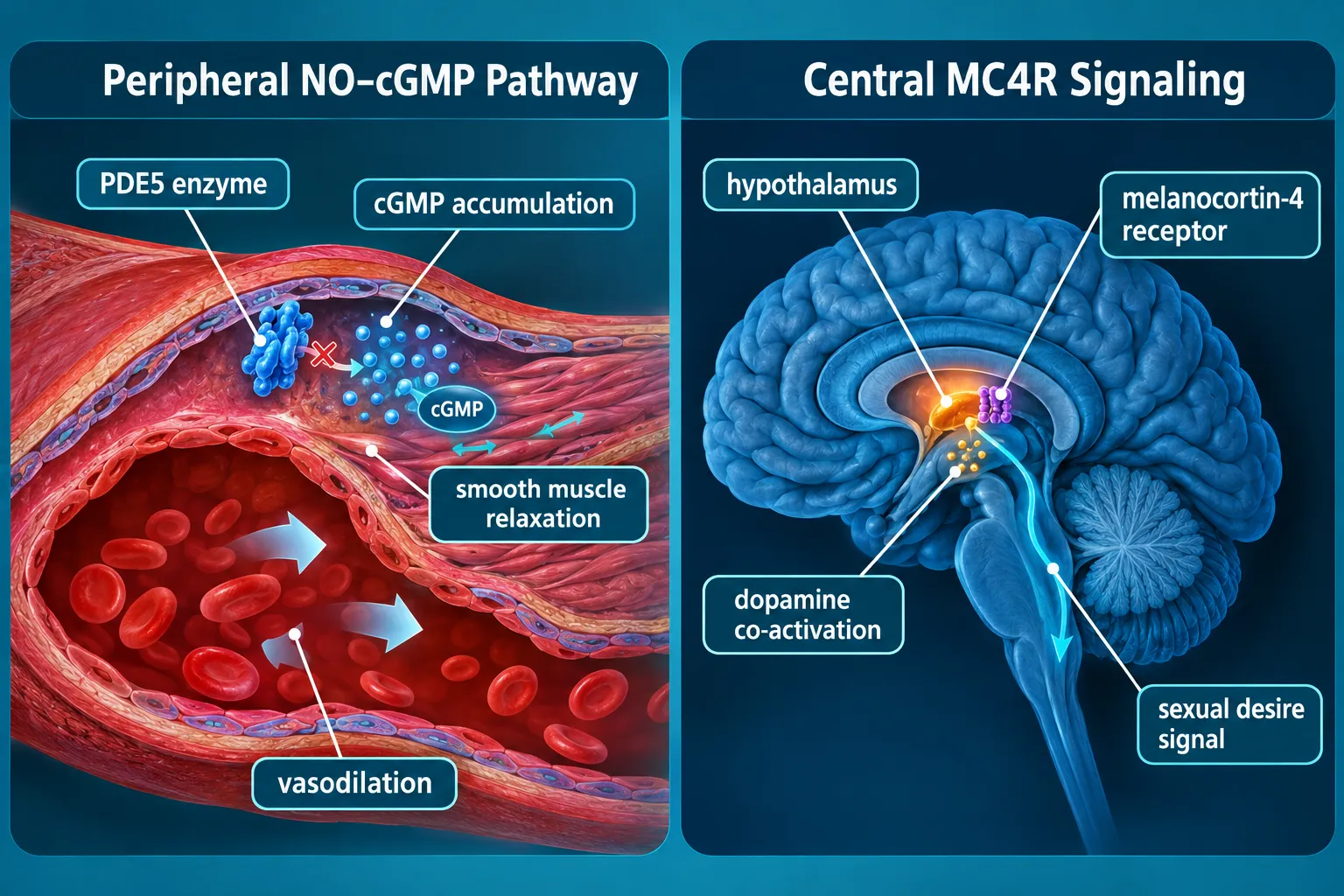
Tadalafil is a phosphodiesterase type 5 (PDE5) inhibitor. When sexual stimulation triggers nitric oxide (NO) release from endothelial cells, NO activates guanylate cyclase, which converts GTP into cyclic GMP (cGMP). Elevated cGMP relaxes smooth muscle in penile and clitoral vasculature, enabling engorgement. PDE5 normally degrades cGMP; tadalafil blocks this enzyme, prolonging the vasodilatory signal. This is an entirely peripheral, vascular mechanism, it requires prior sexual stimulation and depends on intact NO-producing endothelium.

PT-141 (bremelanotide), by contrast, is a synthetic melanocortin receptor agonist derived from the naturally occurring peptide alpha-melanocyte-stimulating hormone (alpha-MSH). It binds primarily to melanocortin-4 receptors (MC4R) concentrated in the hypothalamus and limbic system. This central nervous system activation increases dopaminergic signaling in reward and arousal circuits, generating spontaneous sexual motivation independent of peripheral vascular tone. For more on this peptide's research profile, see the detailed overview of PT-141 bremelanotide.

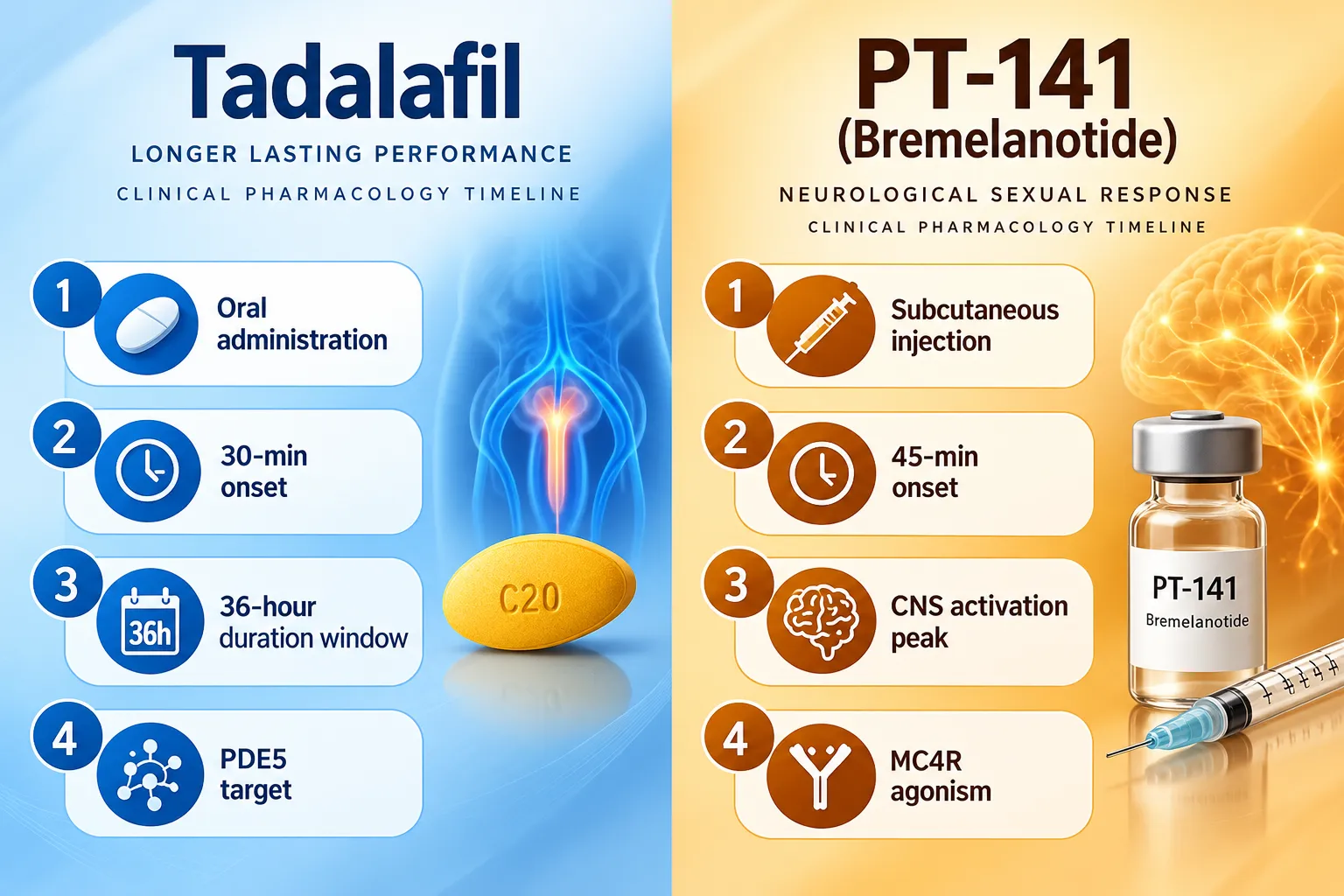
Feature Tadalafil PT-141 (Bremelanotide)
Primary target PDE5 enzyme MC4R / MC3R (CNS)
Pathway Peripheral NO, cGMP Central melanocortin
Route Oral Subcutaneous injection
Onset ~30 minutes ~45-60 minutes
Duration Up to 36 hours 6-12 hours
Stimulation required Yes No

Regulatory Status, Approved Indications, and Off-Label Use

The regulatory landscape for these two compounds diverges sharply, a fact that shapes every research and clinical protocol.
Regulatory Status, Approved Indications, and Off-Label Use

Tadalafil holds FDA approval for erectile dysfunction, benign prostatic hyperplasia (BPH), and pulmonary arterial hypertension. It is a first-line pharmacological option for male sexual dysfunction across most major clinical guidelines as of 2026. Its long half-life (~17.5 hours) and once-daily dosing option make it well-suited for both on-demand and chronic use study designs.

PT-141 received FDA approval in 2019 under the brand name Vyleesi, specifically for hypoactive sexual desire disorder (HSDD) in premenopausal women. Its use in men, including for erectile dysfunction or low libido, remains off-label as of 2026. This distinction is critical for research ethics review boards. Researchers exploring peptide-based CNS modulation may also find it useful to compare approaches such as Sermorelin, Ipamorelin, and CJC-1295 as reference points for CNS-active peptide protocols.

"PT-141 addresses the neurological origin of desire, while tadalafil addresses the vascular execution of arousal, treating these as equivalent is a fundamental category error."

Safety considerations differ meaningfully:

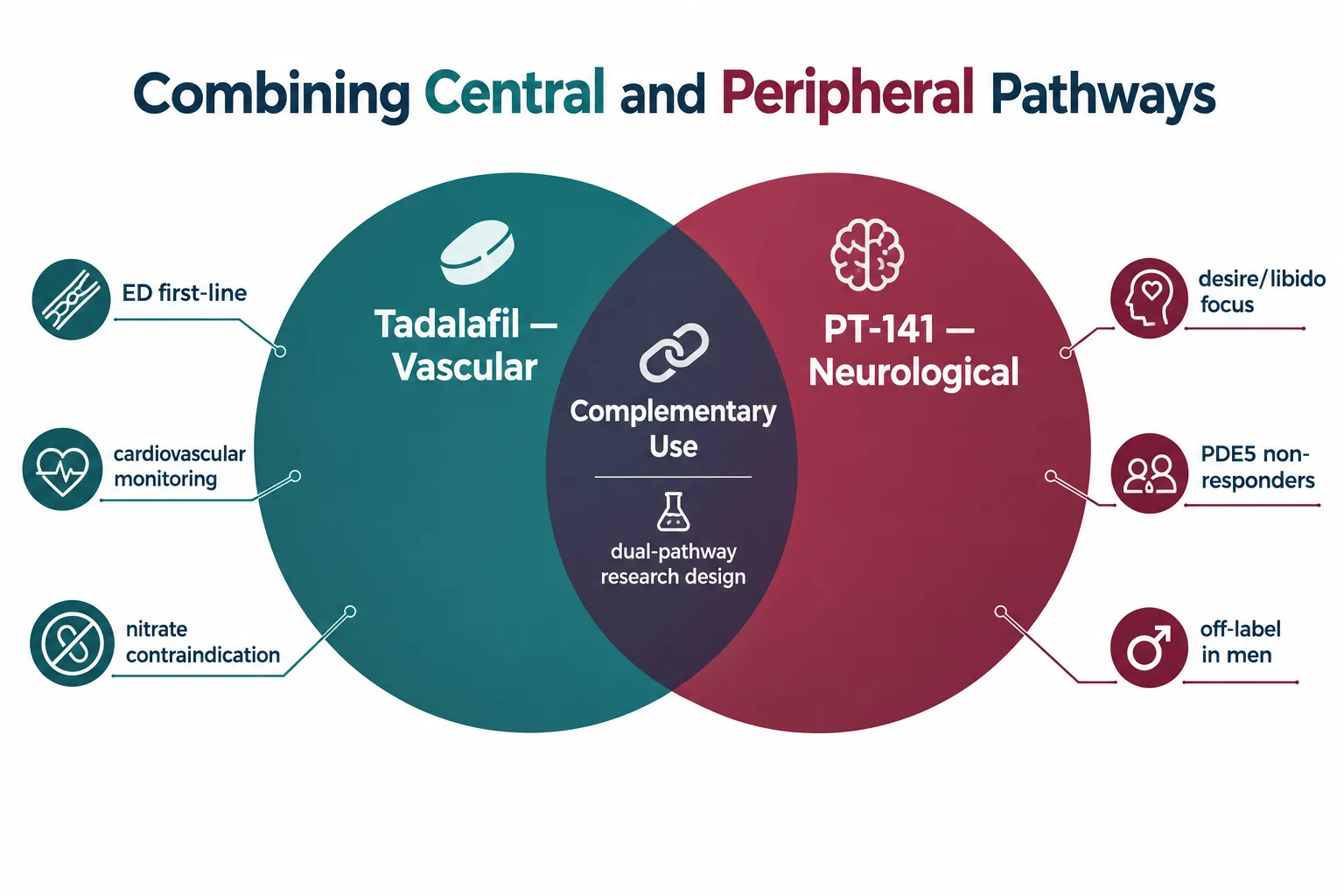
  • Tadalafil carries a hard contraindication with nitrate medications due to additive hypotension risk.
  • PT-141 is associated with transient nausea (reported in ~40% of subjects), flushing, and blood pressure fluctuations, including transient hypertension, requiring cardiovascular monitoring in study populations.
  • Neither compound should be used without proper medical oversight.

Combining Central and Peripheral Pathways: Research Design Implications

The most clinically compelling question in 2026 is not which compound is superior, but whether combining central melanocortin agonism with peripheral PDE5 inhibition produces additive or synergistic effects in subjects who fail monotherapy.
Combining Central and Peripheral Pathways: Research Design Implications

PDE5 non-responders, subjects with severe vascular damage, post-prostatectomy neuropathy, or diabetes-related endothelial dysfunction, often show limited response to tadalafil alone because the NO-generating machinery is compromised. In these populations, central MC4R activation via PT-141 may restore motivational drive and facilitate arousal through non-vascular neural pathways, potentially lowering the threshold for peripheral response.

Researchers designing dual-pathway studies should consider:

  • Baseline cardiovascular profiling before combining agents with opposing hemodynamic effects
  • Washout periods to isolate each compound's contribution to observed outcomes
  • Validated desire and arousal scales (e.g., FSFI, IIEF) alongside objective vascular measures
  • Dose-response titration given that PT-141's nausea profile is dose-dependent

For researchers interested in how other peptides modulate vascular and mitochondrial function alongside sexual health endpoints, the SS-31 mitochondrial research themes page offers relevant mechanistic context. Similarly, those studying growth hormone secretagogues in the same subject populations may benefit from reviewing Tesamorelin vs. Ipamorelin as a comparative peptide framework. Broader peptide stacking considerations are also discussed in the IPA Sermorelin stack research overview.

When each compound fits a research design:

  • Use tadalafil when the primary endpoint is vascular, penile blood flow, intracavernosal pressure, or endothelial function markers.
  • Use PT-141 when the primary endpoint is neurological, desire, motivation, CNS arousal circuitry, or MC4R-mediated behavioral outcomes.
  • Use both when studying the interaction between desire and vascular response, or when modeling treatment-resistant sexual dysfunction.

Conclusion

The comparison of Tadalafil vs. PT-141 (Bremelanotide): Central Melanocortin Receptor Signaling vs. Peripheral Nitric Oxide Pathways is not a question of which drug wins, it is a question of which biological problem a given study or clinical protocol is designed to address. Tadalafil remains the gold standard for vascular erectile dysfunction, supported by decades of safety data and broad regulatory approval. PT-141 opens a distinct research avenue into CNS-driven desire disorders, particularly in populations where the vascular pathway is intact but motivation is absent, or where PDE5 inhibition has failed.

Actionable next steps for researchers and clinicians in 2026:

  1. Define the primary endpoint clearly, vascular or neurological, before selecting a compound.
  2. Review cardiovascular contraindications for both agents before designing combination protocols.
  3. Use validated psychometric and physiological outcome tools to separate desire from arousal in data collection.
  4. Consult current regulatory guidance on off-label use of PT-141 in male subjects before IRB submission.
  5. Explore the PT-141 bremelanotide research profile for sourcing and purity documentation relevant to study-grade material.

Understanding both pathways, and their interaction, is essential for building the next generation of sexual medicine research.

https://www.puretestedpeptides.com/wp-content/uploads/2026/09/tadalafil-vs-pt-141-bremelanotide-central-melanocortin-receptor-signaling-vs-per.webp 1024 1536 https://www.puretestedpeptides.com/wp-content/uploads/2026/01/buy-peptides-online.jpg 2026-09-18 13:04:462026-09-18 13:04:46Tadalafil vs. PT-141 (Bremelanotide): Central Melanocortin Receptor Signaling vs. Peripheral Nitric Oxide Pathways
×

Helpful Links

  • My account
  • Cart
  • Checkout
  • Refund and Returns Policy
  • Privacy Policy
  • SMS Privacy Policy
  • Login
  • My Account
  • Logout

USA Made Lab Tested Peptides

All products are sold for research, laboratory, or analytical purposes only, and are not for human consumption


Pure Tested Peptides is a chemical supplier. Pure Tested Peptides is not a compounding / chemical compounding facility as defined under 503A of the Federal Food, Drug, and Cosmetic act. Pure Tested Peptides is not an outsourcing facility as defined under 503B of the Federal Food, Drug, and Cosmetic act.

The statements made within this website have not been evaluated by the US Food and Drug Administration. The products we offer are not intended to diagnose, treat, cure or prevent any disease.

Human/Animal Consumption Prohibited. Laboratory/In-Vitro Experimental Use Only

Scroll to top Scroll to top Scroll to top