Call or Text 727-513-9780
  • Shopping Cart Shopping Cart
    0Shopping Cart
Pure Tested Peptides | America's most trusted Peptides for sale online
  • Peptides for sale
    • Oral Peptides for sale
      • Peptide Capsules for sale
      • BPC 157 Capsules 1000mcg
      • SLU-PP-332 Capsules | 1000 mcg
      • 5-Amino-1MQ 50mg Capsules
      • Tesofensine 500mcg
    • All Peptides for sale
    • Peptide Sprays
      • BPC 157 Nasal Spray Kit
      • BPC-157 TB500 Nasal Spray Kit
      • Semax Nasal Spray 10mg
      • Selank – Nasal Spray Kit – 10mg
      • Epithalon 50MG Nasal Spray Kit
      • Ipamorelin 10mg Nasal Spray
      • Klow Nasal Spray (BPC-157 + TB-500 + GHK-Cu + KPV) | 80mg
      • Hulk Nasal Spray Tesa / Ipa Blend 6/3 MG
      • Klow Nasal Spray
      • NAD + 500 mg Nasal Spray
      • PT-141 Nasal Spray Kit
    • GHRH Peptides
      • Ipa Peptides
      • CJC-1295 Peptides
        • CJC-1295 with DAC 5 mg
        • CJC-1295 without DAC 5 mg
        • CJC-1295 Ipa 10mg
      • Tesa Peptides
        • Tesa Peptide
        • Tesa 20 mg
    • GHK-Cu Peptides
      • All GHK-Cu Peptides
      • GHK-Cu 100mg
      • KLOW Peptide Blend – Buy KLOW blend online
    • BPC Peptides
      • All BPC Peptides
      • BPC-157
      • BPC-157 TB-500
      • BPC 157 capsules 1000mcg
    • SLU-PP-332 Peptides
      • All SLU-PP-332 Peptides
      • SLU-PP-332 5mg
    • GLP3 Peptides
    • PT-141 Peptides
      • PT-141 Peptides for sale
      • PT-141 10mg
      • PT-141 Nasal Spray
    • CAG Peptides
      • Lipo-C Peptide Blend
      • CAG 5mg
      • CAG 10mg
    • MOTS-C Peptides
      • MOTS-C Peptides for sale
      • MOTS-c peptide
      • MOTS-c 10mg *6 pack*
    • 5 Amino 1MQ Peptides
      • 5 Amino 1MQ Peptides for sale
      • 5-Amino-1MQ 50mg Capsules
      • 5-Amino-1MQ 5mg
    • Epithalon Peptides
      • Epithalon Peptides for sale
      • Epithalon 10mg
      • Epithalon 50mg
  • Shop
    • GLPs
      • 5-Amino-1MQ 50mg Capsules
      • 5-Amino-1MQ 5mg
      • L-Carnitine 500mg/ml
      • Tesofensine 500mcg
      • SLU-PP-332 5mg
      • MOTS-c 10mg *6 pack*
    • Epithalon & BPC Peptides
      • Epithalon 10mg
      • Epithalon 50mg
      • BPC-157
      • BPC 157 capsules 1000mcg
      • BPC-157 TB-500
      • BPC-157 TB500 Nasal Spray Kit
      • BPC 157 Nasal Spray Kit
    • BPC TB-500 & NAD+ Peptides
      • NAD+ 500 mg
      • KLOW Peptide Blend – Buy KLOW blend online
      • GLOW Peptide Blend
      • TB 500 5mg
      • BPC 157 capsules 1000mcg – Supplement
      • BPC 157 Nasal Spray Kit
      • BPC-157
      • BPC-157 TB500 Nasal Spray Kit
      • BPC-157 TB-500
      • BPC 157 capsules 1000mcg
    • LL-37 Peptide
      • LL-37 10 mg
    • MOTS-C & Selank
      • MOTS-c peptide
      • Selank 10mg
    • GHK Peptides
      • GHK-Cu 100mg
      • GLOW Peptide Blend
      • KLOW Peptide Blend – Buy KLOW blend online
  • COAs
  • Wholesale
    • Wholesale Peptides for sale
  • PTP FAQ
  • Affiliates
    • Selank Peptide: Advanced Pharmacological Mechanisms Underlying Its Anxiolytic and Nootropic Effects in Research
      • 5-Amino-1MQ Peptide: Detailed Mechanisms of NNMT Inhibition and Its Impact on Cellular Metabolism Research
        • MOTS-C Peptide: Unraveling Its Role in Mitochondrial Dynamics and Energy Metabolism Research
          • Epithalon Peptide and Telomerase Regulation: Investigating Its Impact on Cellular Senescence and Lifespan Research Models
            • GLP2-T vs GLP2 Tirz Peptide: Understanding the Naming, Mechanistic Nuances, and Research Implications for Gut Health
      • Peptides and Polypeptides in Modern Pharmacology: What Research on Metoprolol, Prednisone, and Amlodipine Reveals
        • Polypeptide Peptides vs NSAIDs: What Naproxen and Diclofenac Teach Tissue-Repair Researchers About BPC‑157 and TB‑500
          • Peptides and Polypeptides in Endocrine Pharmacology: How GLP-1, GLP-2, and GLP-3 Retatrutide Differ From Classic Drugs Like Prednisone and Amlodipine
          • 5‑Amino‑1MQ Peptide and NNMT Inhibition: How It Compares With Statins Like Atorvastatin in Adipose and Lipid Metabolism Research
      • Enclomiphene, Estrogen Receptor Signaling, and Luteinizing Phase Biology: What Hormone Researchers Should Measure
        • Mesenchymal Stem Cells, BPC‑157, and GHK‑Cu: How Tissue Repair Peptides Compare With Classic NSAIDs Like Naproxen in Injury Models
          • Peptide Calculator Use Cases Beyond Growth Hormone: Working Through GLP‑3 Retatrutide, MOTS‑c, and BPC‑157 Research Dosing
        • Polypeptide Peptides in Endocrine and Metabolic Pharmacology: Lessons From Amlodipine, Prednisone, and Metoprolol
        • Peptides Calculator for Advanced Blends: Worked Examples for Tesamorelin, CJC‑1295, and Ipamorelin Stacks
          • Peptides and Polypeptides in Human Physiology: How Molecular Size Shapes Research Applications
            • Selank Peptide: Advanced Pharmacological Mechanisms Underlying Its Anxiolytic and Nootropic Effects in Research
          • 5-Amino-1MQ Peptide: Detailed Mechanisms of NNMT Inhibition and Its Impact on Cellular Metabolism Research
            • MOTS-C Peptide: Unraveling Its Role in Mitochondrial Dynamics and Energy Metabolism Research
              • Epithalon Peptide and Telomerase Regulation: Investigating Its Impact on Cellular Senescence and Lifespan Research Models
                • GLP2-T vs GLP2 Tirz Peptide: Understanding the Naming, Mechanistic Nuances, and Research Implications for Gut Health
                  • Peptides and Polypeptides in Endocrine Pharmacology: How GLP-1, GLP-2, and GLP-3 Retatrutide Differ From Classic Drugs Like Prednisone and Amlodipine
                    • Polypeptide Peptides vs NSAIDs: What Naproxen and Diclofenac Teach Tissue-Repair Researchers About BPC‑157 and TB‑500
                      • Peptides and Polypeptides in Modern Pharmacology: What Research on Metoprolol, Prednisone, and Amlodipine Reveals
                        • 5‑Amino‑1MQ Peptide and NNMT Inhibition: How It Compares With Statins Like Atorvastatin in Adipose and Lipid Metabolism Research
                        • Enclomiphene, Estrogen Receptor Signaling, and Luteinizing Phase Biology: What Hormone Researchers Should Measure
                        • Mesenchymal Stem Cells, BPC‑157, and GHK‑Cu: How Tissue Repair Peptides Compare With Classic NSAIDs Like Naproxen in Injury Models
                        • Peptide Calculator Use Cases Beyond Growth Hormone: Working Through GLP‑3 Retatrutide, MOTS‑c, and BPC‑157 Research Dosing
                        • Polypeptide Peptides in Endocrine and Metabolic Pharmacology: Lessons From Amlodipine, Prednisone, and Metoprolol
                        • Peptides Calculator for Advanced Blends: Worked Examples for Tesamorelin, CJC‑1295, and Ipamorelin Stacks
                        • Peptides and Polypeptides in Human Physiology: How Molecular Size Shapes Research Applications
                        • Selank Peptide: Advanced Pharmacological Mechanisms Underlying Its Anxiolytic and Nootropic Effects in Research
                        • MOTS-C Peptide: Unraveling Its Role in Mitochondrial Dynamics and Energy Metabolism Research
                        • Peptides and Polypeptides in Modern Pharmacology: What Research on Metoprolol, Prednisone, and Amlodipine Reveals
                        • Peptides and Polypeptides in Endocrine Pharmacology: How GLP-1, GLP-2, and GLP-3 Retatrutide Differ From Classic Drugs Like Prednisone and Amlodipine
                        • 5-Amino-1MQ Peptide: Detailed Mechanisms of NNMT Inhibition and Its Impact on Cellular Metabolism Research
                        • Mesenchymal Stem Cells, BPC‑157, and GHK‑Cu: How Tissue Repair Peptides Compare With Classic NSAIDs Like Naproxen in Injury Models
                        • Peptide Calculator Use Cases Beyond Growth Hormone: Working Through GLP‑3 Retatrutide, MOTS‑c, and BPC‑157 Research Dosing
                        • GLP2-T vs GLP2 Tirz Peptide: Understanding the Naming, Mechanistic Nuances, and Research Implications for Gut Health
                        • Polypeptide Peptides in Endocrine and Metabolic Pharmacology: Lessons From Amlodipine, Prednisone, and Metoprolol
                        • Polypeptide Peptides vs NSAIDs: What Naproxen and Diclofenac Teach Tissue-Repair Researchers About BPC‑157 and TB‑500
                        • Peptides and Polypeptides in Human Physiology: How Molecular Size Shapes Research Applications
                        • Peptides Calculator for Advanced Blends: Worked Examples for Tesamorelin, CJC‑1295, and Ipamorelin Stacks
                        • 5‑Amino‑1MQ Peptide and NNMT Inhibition: How It Compares With Statins Like Atorvastatin in Adipose and Lipid Metabolism Research
                        • Enclomiphene, Estrogen Receptor Signaling, and Luteinizing Phase Biology: What Hormone Researchers Should Measure
                        • Epithalon Peptide and Telomerase Regulation: Investigating Its Impact on Cellular Senescence and Lifespan Research Models
                        • Best research protocol Klow blend
                        • best time to take BPC-157
                        • best time to take DSIP (Delta Sleep Inducing Peptide)
                        • best time to take CJC-1295
                        • best time to take AOD-9604
                        • best time to take Follistatin 344
                        • best time to take Ipamorelin
                        • best time to take MK-677 (Ibutamoren)
                        • best time to take Ligandrol (LGD-4033) — research compound
                        • best time to take Ostarine (MK-2866) — research compound
                        • best time to take GHK-CU
                        • best time to take TB-500
                        • best time to take MOTS-c
                        • best time to take Semax
                        • best time to take RAD-140 (Testolone) — research compound
                        • best time to take Thymosin Alpha-1
                        • best time to take PEG-MGF
                        • Biolife Plasma, Octapharma Plasma, and Research Peptides: How Plasma Donation Labs Differ From Peptide Suppliers
                        • best time to take YK-11 — research compound
                        • best time to take PT-141 (Bremelanotide)
                        • Best research protocol Klow blend
                        • 5-Amino-1MQ and MOTS-C Synergy: Metabolic Signaling, Mitochondria, and Research Design
                        • BPC-157 and TB-500: Investigating Their Combined Effects on Angiogenesis and Cellular Migration in Tissue Repair Models
                        • BPC-157 Peptide: Gut Barrier Function, Inflammation, and Tissue-Recovery Research
                        • 5‑Amino‑1MQ and MOTS‑c Synergy in Metabolic Research: Designing NNMT and Mitochondrial Biogenesis Stacks
                        • CJC-1295 with DAC vs. Without DAC: Half-Life, Release Kinetics, and Research Implications
                        • CJC‑1295 with DAC vs. Without DAC: Expanding on Half‑Life Differences Using Tesamorelin and Ipamorelin Blend Case Studies
                        • Collagen Biology and Copper‑Binding Peptides: How GHK‑Cu, Glow Blend, and Klow Blend Interact with Skin and Connective Tissue
                        • Collagen Biology and Regenerative Peptides: How GHK‑Cu, Glow Blend, and Klow Blend Affect Extracellular Matrix Research
                    • DNA, Telomeres, and Longevity Peptides: Positioning Epithalon and MOTS‑c in Genetic Aging Research
                      • Enclomiphene Citrate: serm Mechanism, Testosterone Research, and Stack Compatibility
                        • Enclomiphene vs Enclomiphene Citrate: Formulation, Bioavailability, and Research Distinctions
                        • Epithalon Peptide Research: Telomerase Activation, Aging, and Pineal Gland Function
                        • Estrogen Receptor Signaling and Enclomiphene: How Selective Modulators Compare with Classic Polypeptide Hormones
                        • GHK-Cu Peptide: Advanced Mechanisms in Extracellular Matrix Remodeling and Wound Healing Research
                        • GHK-Cu Peptide: Collagen Synthesis, Wound Repair, and Skin-Barrier Research Models
                        • GLP-1 vs GLP-3 vs GLP-2: Peptide Classification and Research Applications
                        • GLP-2 Peptide Research Guide: Gut Barrier Function, Nutrient Absorption, and Intestinal Recovery Models
                        • GLP-3 Retatrutide vs. GLP-1 Drugs: What Triple-Agonist Biology Changes in Research Models
                        • Ipamorelin and Tesamorelin Combination: Synergistic GH Secretagogue Research and Dosing Protocols
                        • GLP2 Tirz Peptide: What It Is, Why the Name Exists, and How Researchers Should Interpret It
                        • Klow Blend Peptide Nasal Spray: What the Formulation Is Trying to Do in Cognitive Research
                        • Mitochondria, NNMT Inhibition, and Peptide Modulators: Where MOTS‑c and 5‑Amino‑1MQ Fit in Cellular Energy Research
                        • MOTS-c Peptide: Mitochondrial Function, Energy Metabolism, and What Researchers Measure
                        • MOTS-c vs. 5-Amino-1MQ: Which Metabolic Research Questions Each Compound Actually Answers
                        • Nasal Spray Peptides: Bioavailability, Administration, and Semax/Selank Research Applications
                        • PT-141 Peptide Research: Mechanism of Action and Melanocortin Receptor Signaling
                        • Retatrutide for Research: Mechanism, Structure, and GLP-1/GLP-3 Dual Action
                        • Retatrutide for Obesity and Type 2 Diabetes: What the Latest Trial Data Suggest
                        • Tesofensine Peptide Research: Mechanism, Appetite Suppression, and Neuropeptide Y Pathways
  • Contact
    • Contact Customer Service
    • Text Customer Support
  • About US
  • Shop all peptides
  • Affiliate Program
    • Affiliate Signup
  • Login / Register Login / Register Page Link Login / Register Page Link
  • Click to open the search input field Click to open the search input field Search
  • Menu Menu

Tag Archive for: omeprazole

Peptide Research and Omeprazole: What Acid-Suppressing Drugs Mean for GLP-2 and Gut-Focused Studies

Peptide Research and Omeprazole: What Acid-Suppressing Drugs Mean for GLP-2 and Gut-Focused Studies

September 14, 2026/0 Comments/in Uncategorized/by

More than 15 percent of adults in Western countries take a proton pump inhibitor (PPI) like omeprazole on a regular basis, yet this common medication rarely appears as a controlled variable in gut-focused peptide trials. That gap matters more than most researchers realize. Understanding peptide research and omeprazole interactions, especially what acid-suppressing drugs mean for GLP-2 and gut-focused studies, is quickly becoming a prerequisite for designing credible intestinal peptide protocols in 2026.

Key Takeaways

  • Omeprazole and other PPIs modestly improve gut barrier function, but GLP-2 peptides produce significantly larger gains in villus height and tight-junction integrity through distinct downstream mechanisms.
  • Pharmacokinetic data show omeprazole does not meaningfully blunt GLP-peptide exposure; any increase in drug absorption is small and clinically irrelevant.
  • Long-term PPI use reduces gut microbiota diversity, while GLP-2 therapy is linked to more favorable microbiota profiles, making PPI status a critical covariate in intestinal studies.
  • Oral peptide formulations should follow an empty-stomach dosing window, with PPI administration delayed by at least 30 minutes to protect bioavailability.
  • Future GLP-2 and teduglutide trials are expected to treat chronic PPI use as a pre-specified variable or exclusion criterion to isolate peptide-driven mucosal effects.

How Omeprazole Affects the Gut Environment Relevant to Peptide Research
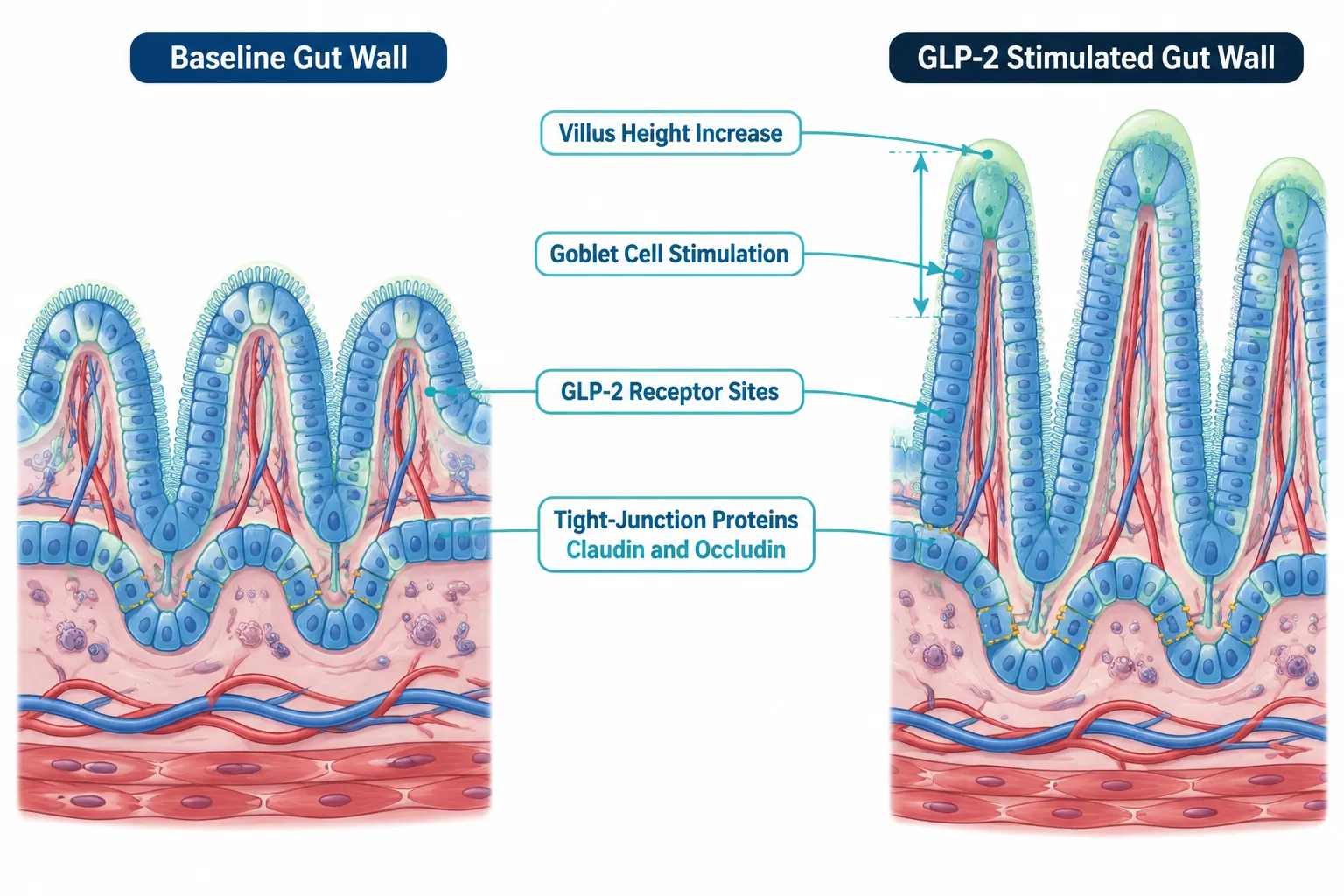
How Omeprazole Affects the Gut Environment Relevant to Peptide Research

Omeprazole works by irreversibly blocking the hydrogen-potassium ATPase enzyme in gastric parietal cells, suppressing acid output and raising gastric pH. That pH shift creates downstream changes throughout the gastrointestinal tract, changes that overlap with the very endpoints gut-focused peptide studies are designed to measure.

What PPIs do to the gut environment:

  • Modestly increase mucus layer thickness
  • Improve tight-junction integrity by reducing acid-driven mucosal injury
  • Raise gastric pH, which can affect the absorption window for orally administered compounds
  • With long-term use, reduce gut microbiota diversity, a recognized risk in chronic PPI therapy
  • Associate with a small but statistically significant increase in gastric cancer risk over 10 years (number needed to harm approximately 1,191 over a decade)

PPIs also carry documented risks including infection susceptibility and nutrient malabsorption. These effects are not trivial in a research context. When a participant is taking omeprazole daily, the baseline gut environment is already shifted, and that shift can confound mucosal endpoints in any gut-focused peptide study.

Key point: PPIs and GLP-2 peptides act on overlapping but not identical gut endpoints. Failing to account for PPI use in study design risks attributing PPI-driven changes to the peptide under investigation.

GLP-2 Mechanisms Compared to Acid Suppression
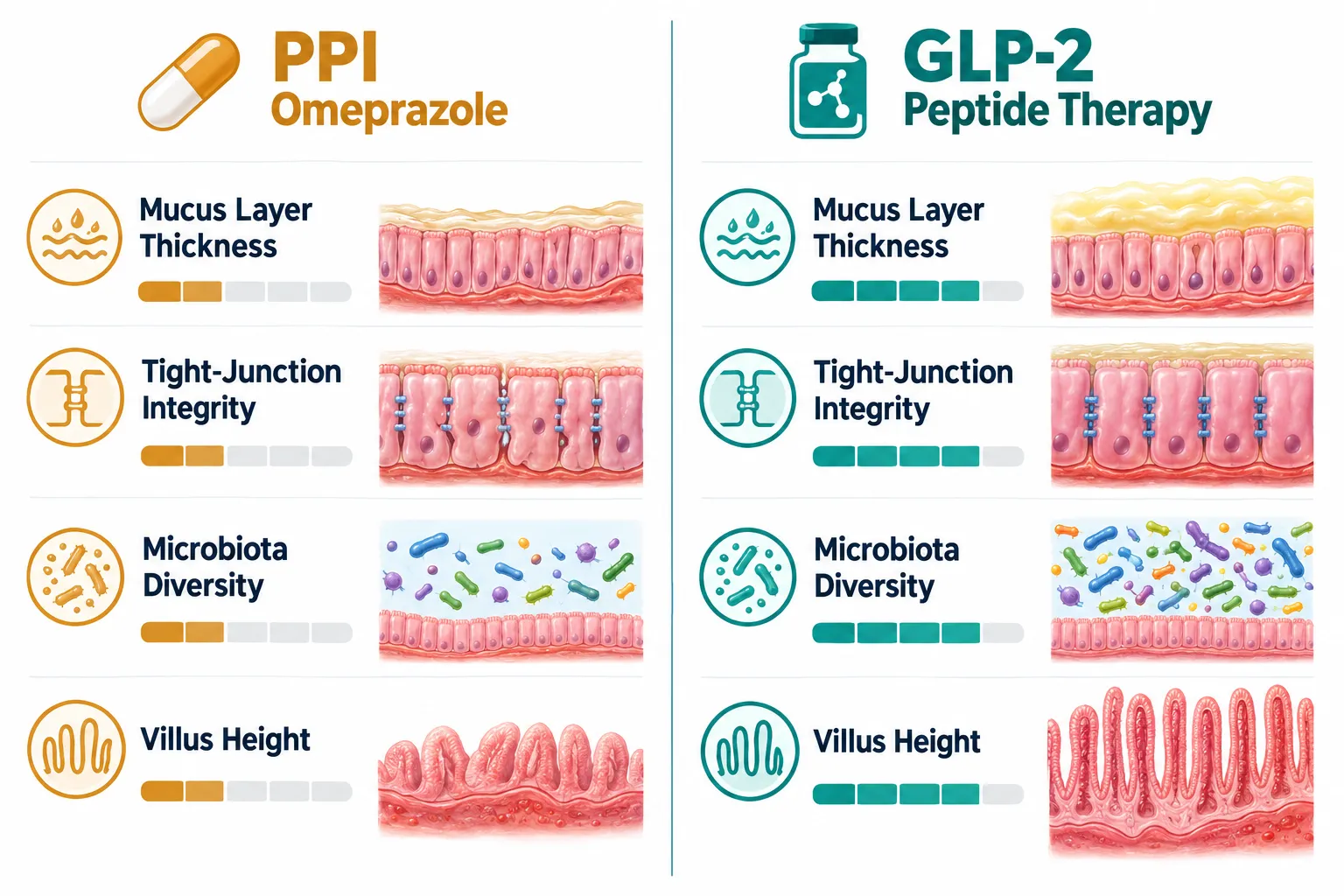
GLP-2 Mechanisms Compared to Acid Suppression

GLP-2 (glucagon-like peptide-2) and its clinical analog teduglutide (GLP-2-T) operate through mechanisms that are fundamentally different from acid suppression. Understanding this distinction is central to interpreting peptide research and omeprazole co-administration scenarios.

How GLP-2 remodels the intestinal mucosa:

  • Directly stimulates goblet cells to increase mucus production
  • Upregulates tight-junction proteins claudin and occludin, strengthening the epithelial barrier
  • Promotes enterocyte proliferation, producing measurable increases in villus height
  • Supports crypt cell survival and reduces apoptosis along the intestinal lining

Compared to the modest barrier improvements seen with PPIs, GLP-2 and GLP-2-T produce substantially larger gains in villus height and barrier function. Longitudinal data from 2025 link GLP-2-T therapy to improved barrier integrity and more favorable microbiota profiles, a meaningful contrast to the microbiota diversity losses associated with long-term PPI use.

For researchers exploring GLP-3 peptide variants and related proglucagon-derived compounds, this mechanistic separation is equally relevant. The mucosal effects of GLP-class peptides operate sufficiently downstream of acid secretion that elevated gastric pH from omeprazole does not appear to blunt their activity.

Those working with GLP-3 R peptide formulations should note that the structural similarities across proglucagon-derived peptides make these pharmacokinetic findings broadly applicable to the class.

Pharmacokinetics: Does Omeprazole Interfere With GLP-Peptide Absorption?

This is the practical question most researchers and clinicians ask first. The short answer, supported by pharmacokinetic data, is no, not in any clinically meaningful way.

Randomized pharmacokinetic studies using oral semaglutide as a structural proxy for proglucagon-derived peptides found only a small, non-statistically-significant increase in peptide exposure when omeprazole was co-administered. The AUC ratio was approximately 1.13 and the Cmax ratio approximately 1.16, changes deemed clinically irrelevant, with no dose adjustment required.

Updated guidance for oral semaglutide in 2026 confirms it can be safely combined with omeprazole, with one practical caveat: take the peptide first on an empty stomach and delay omeprazole by at least 30 minutes. This timing protocol protects bioavailability without requiring formulation changes.

Similar findings apply across the GLP class:

Peptide/Drug Omeprazole Interaction Dose Adjustment Needed?
Oral semaglutide Minor AUC increase (~13%) No
Tirzepatide No known PK or PD interaction No
Liraglutide Low-severity rating, no signal No

For labs sourcing research-grade GLP-3 peptides for gut-focused protocols, this data supports including omeprazole-using participants without automatic exclusion, provided PPI status is recorded and stratified in the analysis.

Study Design Implications: Treating PPI Use as a Covariate
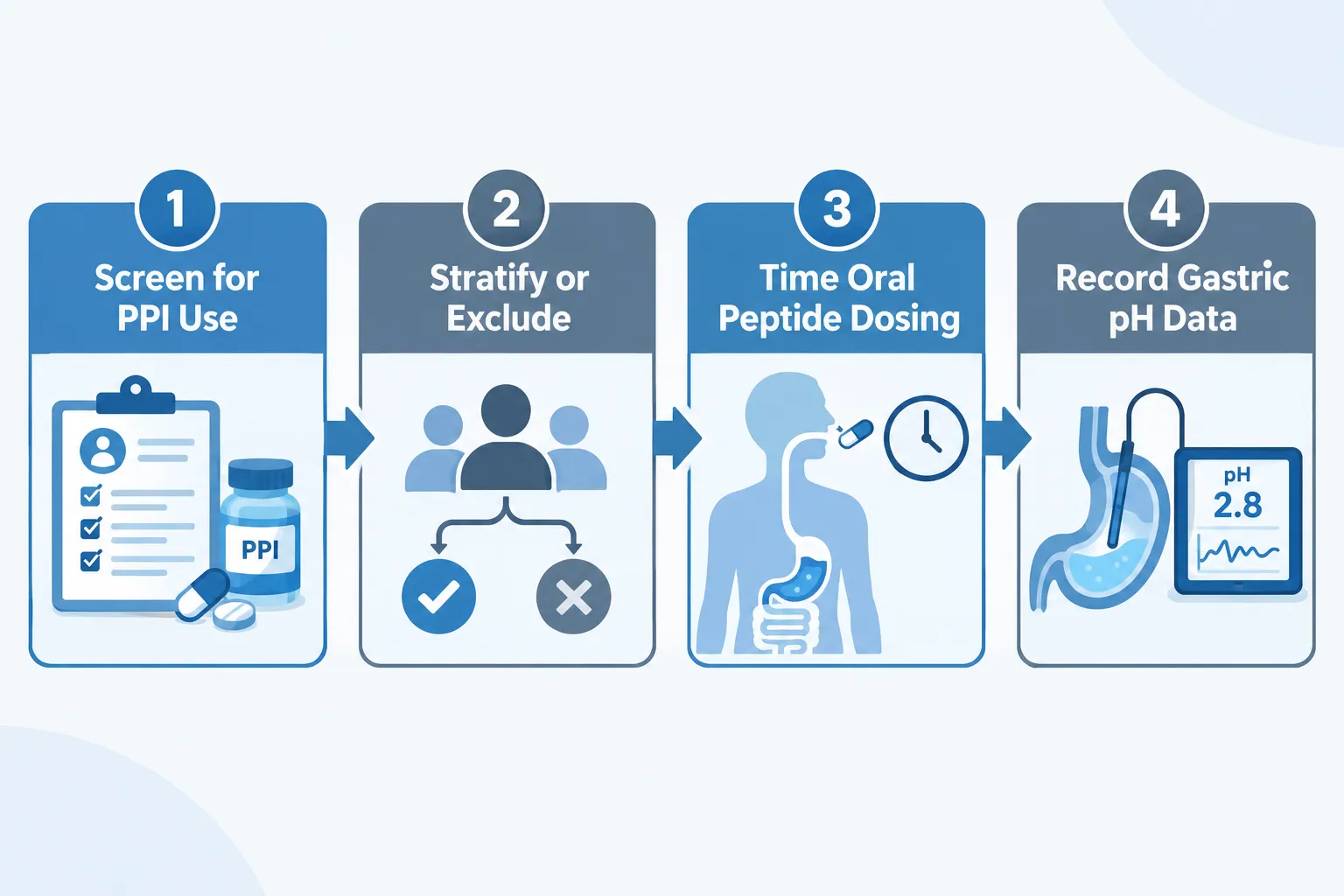
Study Design Implications: Treating PPI Use as a Covariate

The convergence of evidence in 2026 points toward a clear methodological standard for future GLP-2 and teduglutide trials: chronic PPI use must be treated as a pre-specified covariate or exclusion criterion.

The rationale is straightforward. PPIs independently affect:

  1. Mucus layer thickness
  2. Tight-junction protein expression
  3. Gut microbiota composition and diversity
  4. Gastric and intestinal cancer risk over time
  5. Glycemic markers, PPIs show modest HbA1c-lowering effects, likely via increased gastrin and downstream incretin activity

That last point is particularly relevant. Meta-analytic data through 2025-2026 suggest PPIs may modestly improve glycemic control in type 2 diabetes, with HbA1c reductions comparable to some incretin-based therapies. This creates a potential mild synergy, not antagonism, when PPIs are combined with GLP-1 receptor agonists or other gut-acting peptides.

For researchers also evaluating mitochondrial or systemic peptides alongside gut endpoints, resources such as the LL-37 versus SS-31 peptide comparison offer useful context on how peptide class affects study variable selection.

Labs sourcing lab-tested peptides for intestinal research should document participant PPI status at enrollment and consider stratified randomization by PPI use to prevent confounding at the analysis stage.

Recommended steps for GLP-2 trial design in 2026:

  1. Screen all participants for current PPI use at baseline
  2. Stratify or exclude chronic PPI users based on study endpoints
  3. For oral peptide arms, standardize the dosing window (empty stomach, 30-minute PPI delay)
  4. Record gastric pH data as a secondary variable where feasible
  5. Pre-specify PPI status as a covariate in the statistical analysis plan

As oral peptide formulations expand, following the template established by oral semaglutide, future GLP-2 analog trials are expected to mirror these protocols, optimizing dosing windows relative to PPIs while leveraging the finding that PPI-induced pH changes alone do not meaningfully suppress peptide exposure.

Conclusion

The relationship between peptide research and omeprazole is more nuanced than a simple drug interaction. Omeprazole does not meaningfully block GLP-2 or GLP-1 class peptide activity at the pharmacokinetic level, but it does independently alter the gut environment in ways that directly overlap with mucosal endpoints these peptides are designed to affect.

Actionable next steps for researchers and study designers:

  • Always document and stratify PPI use in gut-focused peptide protocols, do not treat it as background noise
  • Apply the 30-minute empty-stomach dosing rule for any oral peptide formulation when participants are on PPIs
  • Treat long-term PPI use as a potential confounder for microbiota, barrier integrity, and glycemic endpoints
  • Review updated 2026 guidance for oral GLP-class peptides before finalizing co-administration protocols
  • Consider pre-specifying PPI status as an exclusion criterion or stratification variable in GLP-2-T trials targeting villus height and tight-junction outcomes

Getting this variable right is not a minor methodological detail, it is the difference between clean data and results that cannot be replicated.

https://www.puretestedpeptides.com/wp-content/uploads/2026/09/peptide-research-and-omeprazole-what-acid-suppressing-drugs-mean-for-glp-2-and-g.webp 1024 1536 https://www.puretestedpeptides.com/wp-content/uploads/2026/01/buy-peptides-online.jpg 2026-09-14 13:05:452026-09-14 13:05:45Peptide Research and Omeprazole: What Acid-Suppressing Drugs Mean for GLP-2 and Gut-Focused Studies
×

Helpful Links

  • My account
  • Cart
  • Checkout
  • Refund and Returns Policy
  • Privacy Policy
  • SMS Privacy Policy
  • Login
  • My Account
  • Logout

USA Made Lab Tested Peptides

All products are sold for research, laboratory, or analytical purposes only, and are not for human consumption


Pure Tested Peptides is a chemical supplier. Pure Tested Peptides is not a compounding / chemical compounding facility as defined under 503A of the Federal Food, Drug, and Cosmetic act. Pure Tested Peptides is not an outsourcing facility as defined under 503B of the Federal Food, Drug, and Cosmetic act.

The statements made within this website have not been evaluated by the US Food and Drug Administration. The products we offer are not intended to diagnose, treat, cure or prevent any disease.

Human/Animal Consumption Prohibited. Laboratory/In-Vitro Experimental Use Only

Scroll to top Scroll to top Scroll to top