

What Are Polypeptide Peptides? From Collagen and Hormones to Advanced Research Compounds Like GLP-3 Retatrutide
Over 7,000 known peptide compounds have been identified in the human body, and researchers in 2026 are still discovering new ones. The question "What Are Polypeptide Peptides? From Collagen and Hormones to Advanced Research Compounds Like GLP-3 Retatrutide" sits at the intersection of foundational biology and frontier science. Understanding polypeptides means understanding the molecular language your body uses to build tissue, regulate metabolism, signal hormones, and potentially respond to next-generation therapeutic compounds.
Key Takeaways
- Polypeptides are chains of amino acids linked by peptide bonds; length and sequence determine their biological function.
- Natural polypeptides include structural proteins like collagen and signaling hormones like insulin and GLP-1.
- Advanced research compounds such as GLP-3 Retatrutide, CJC-1295, and SS-31 extend polypeptide science into metabolic and mitochondrial research.
- Peptide length, receptor specificity, and stability are the key variables that separate a dietary supplement from a research-grade compound.
- Research peptides are studied strictly in controlled settings; they are not approved drugs for human self-administration.
The Biology Behind Polypeptide Peptides: Amino Acids, Chains, and Function
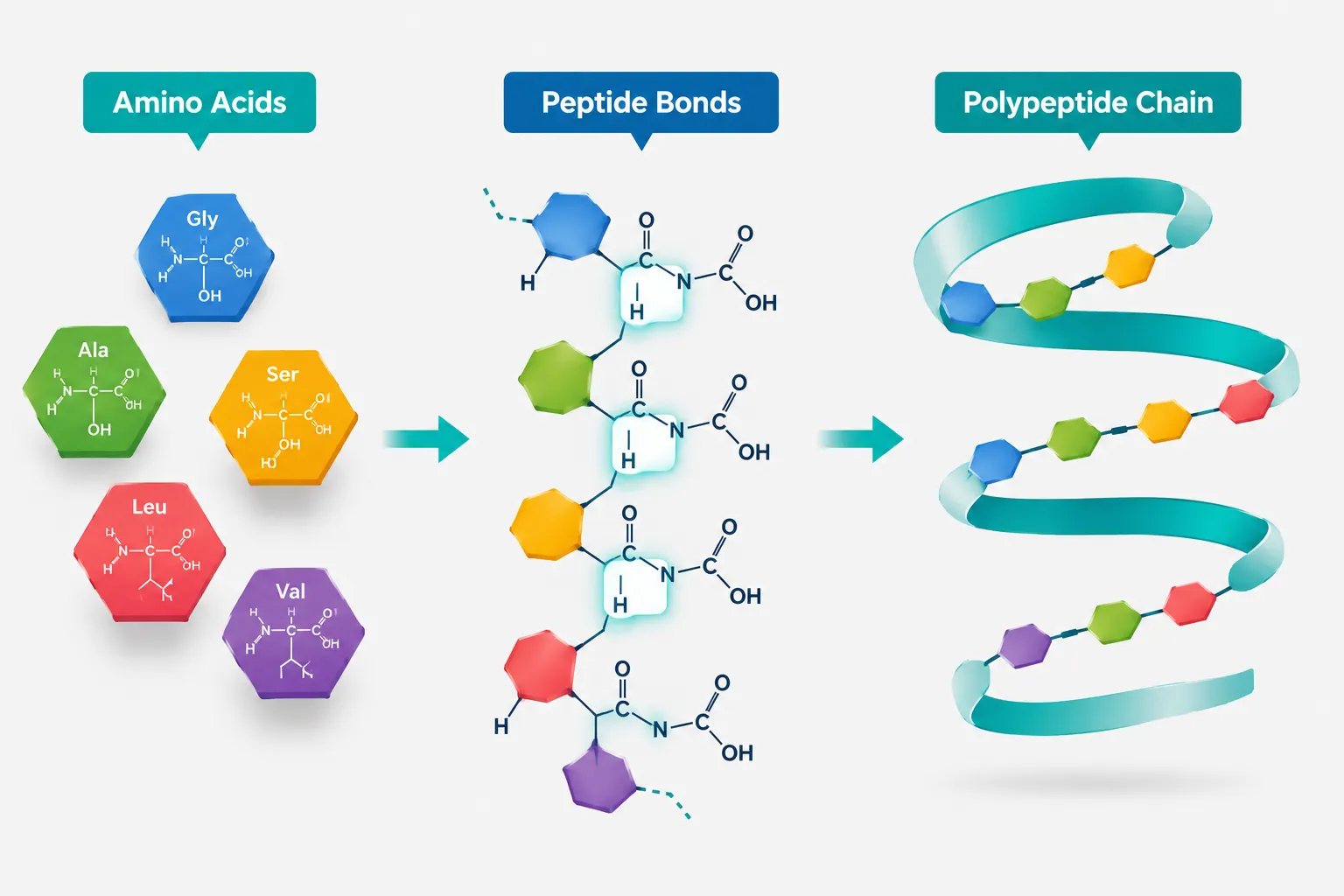
Every polypeptide begins with the same building block: an amino acid. When two amino acids join through a covalent bond between the carboxyl group of one and the amino group of another, a peptide bond forms. String together 2 to 49 amino acids and the result is a peptide. Cross the 50-amino-acid threshold and the molecule is conventionally called a polypeptide or protein.
Size classification at a glance:
| Term | Chain Length | Example |
|---|---|---|
| Dipeptide | 2 amino acids | Carnosine |
| Oligopeptide | 3-9 amino acids | GHK-Cu (3 AA) |
| Polypeptide | 10-49 amino acids | Glucagon (29 AA) |
| Protein | 50+ amino acids | Collagen alpha chain |
The sequence of amino acids, not just the length, dictates how the chain folds, which receptors it binds, and what biological effect it produces. A single substitution can transform a neutral peptide into a potent hormone agonist or render it biologically inert.
Collagen: The Body's Most Abundant Polypeptide
Collagen is the most abundant protein in the human body, accounting for roughly 30% of total protein mass. It is assembled from polypeptide alpha chains wound into a triple-helix structure. Collagen provides tensile strength to skin, tendons, cartilage, and bone. As the body ages, collagen synthesis declines, a fact that drives enormous interest in both dietary collagen peptides and topical copper peptide compounds like GHK-Cu, a naturally occurring tripeptide with documented roles in wound healing and tissue remodeling research.
Hormones as Polypeptides
Many of the body's most critical hormones are polypeptides. Insulin (51 amino acids) regulates blood glucose. Glucagon (29 amino acids) raises blood sugar when levels drop. Growth hormone (191 amino acids) governs cellular repair and metabolism. These molecules work by binding specific receptors on cell surfaces, triggering intracellular signaling cascades that produce measurable physiological effects.
From Natural Hormones to Research Peptides: The GLP Family and Beyond
The glucagon-like peptide (GLP) family illustrates how polypeptide science evolves from textbook biology to cutting-edge research. GLP-1 is a naturally secreted incretin hormone that stimulates insulin release and reduces appetite. Its clinical derivatives have transformed metabolic medicine. GLP-1 peptide research has expanded significantly, with researchers now examining multi-receptor agonists that target GLP-1, GIP, and glucagon receptors simultaneously.
GLP-2, a closely related peptide, plays a distinct role in intestinal mucosal growth and nutrient absorption. Researchers tracking GLP-2 peptide activity have noted its potential relevance in gut integrity studies.
What Is GLP-3 Retatrutide?
Retatrutide, sometimes referred to in research contexts as a GLP-3 class compound, represents one of the most studied advanced polypeptides in 2026. It is a triple-receptor agonist, designed to activate GLP-1R, GIPR, and glucagon receptors simultaneously. This multi-target mechanism is what separates it structurally and functionally from earlier single-agonist peptides.
For researchers exploring this compound, the GLP-3 Retatrutide peptide page provides detailed sourcing and specification information. Additional context on its nomenclature and classification is available through the GLP-3 name and classification resource.
"The shift from single-receptor peptides to multi-agonist polypeptides like Retatrutide represents a structural leap in research compound design, not just a pharmacological one."
Growth Hormone Secretagogues: CJC-1295 and Ipamorelin
CJC-1295 is a synthetic analog of growth hormone-releasing hormone (GHRH), engineered for extended half-life through drug affinity complex (DAC) technology. Paired with Ipamorelin, a selective growth hormone secretagogue, the combination produces a synergistic pulse of endogenous GH release. Researchers studying Ipamorelin vs. Sermorelin vs. Hexarelin can find comparative analysis of these secretagogue profiles in detail.
Mitochondrial Peptides: SS-31 and MOTS-c
Polypeptide research has reached subcellular territory. SS-31 (Elamipretide) is a tetrapeptide that targets the inner mitochondrial membrane, where it appears to stabilize cardiolipin and support electron transport chain efficiency. Research into SS-31 mitochondrial mechanisms is active across aging and metabolic dysfunction models. MOTS-c is a mitochondria-derived peptide encoded within mitochondrial DNA, a discovery that challenged the long-held assumption that all peptides are nuclear-gene products. Researchers can explore MOTS-c and Elamipretide research for current study summaries.
Tissue-Focused Peptides: TB-500 and BPC-157
TB-500 (Thymosin Beta-4 fragment) and BPC-157 (Body Protection Compound) are among the most studied tissue-repair polypeptides. TB-500 promotes actin regulation and angiogenesis in preclinical models. Researchers interested in TB-500 peptide research and those studying BPC-157 and TB-500 combined protocols will find detailed sourcing and study references available.
Key Factors That Define a Research-Grade Polypeptide

Not all peptides sold commercially meet the standards required for rigorous preclinical research. The following variables determine compound quality:
- Purity level: Research-grade peptides typically require 98%+ purity confirmed by HPLC analysis.
- Sequence fidelity: Mass spectrometry verification confirms the correct amino acid sequence was synthesized.
- Lyophilization stability: Freeze-dried (lyophilized) peptides maintain structural integrity far longer than liquid preparations.
- Sterility: Peptides intended for in vitro or in vivo research require sterile manufacturing environments.
- Third-party testing: Independent lab verification removes manufacturer bias from purity claims.
Researchers sourcing compounds should prioritize suppliers who provide certificates of analysis (CoA) for every batch. Browsing all peptides for sale with verified testing documentation is a practical starting point for building a compliant research inventory.
Important note: Research peptides are not approved pharmaceutical drugs. They are intended exclusively for laboratory research and are not approved for human therapeutic use outside of clinical trial frameworks.
Conclusion
Understanding what polypeptide peptides are, from the collagen scaffolding in skin to the triple-agonist architecture of GLP-3 Retatrutide, provides a foundation for interpreting both basic biology and advanced research literature. The field has moved well beyond single-target hormone analogs. In 2026, researchers are working with mitochondria-targeting tetrapeptides, multi-receptor metabolic agonists, and growth hormone secretagogue combinations that would have seemed speculative a decade ago.
Actionable next steps for researchers:
- Establish baseline knowledge of peptide bond chemistry and receptor pharmacology before evaluating research compounds.
- Review published preclinical literature for any compound before sourcing, PubMed and ClinicalTrials.gov are authoritative starting points.
- Source only from suppliers who provide third-party HPLC and mass spectrometry CoA documentation.
- Consult institutional review frameworks if research involves in vivo applications.
- Track the GLP family research pipeline closely, multi-agonist polypeptide science is advancing rapidly and new data emerges frequently.