Call or Text 727-513-9780
  • Shopping Cart Shopping Cart
    0Shopping Cart
Pure Tested Peptides | America's most trusted Peptides for sale online
  • Peptides for sale
    • Oral Peptides for sale
      • Peptide Capsules for sale
      • BPC 157 Capsules 1000mcg
      • SLU-PP-332 Capsules | 1000 mcg
      • 5-Amino-1MQ 50mg Capsules
      • Tesofensine 500mcg
    • All Peptides for sale
    • Peptide Sprays
      • BPC 157 Nasal Spray Kit
      • BPC-157 TB500 Nasal Spray Kit
      • Semax Nasal Spray 10mg
      • Selank – Nasal Spray Kit – 10mg
      • Epithalon 50MG Nasal Spray Kit
      • Ipamorelin 10mg Nasal Spray
      • Klow Nasal Spray (BPC-157 + TB-500 + GHK-Cu + KPV) | 80mg
      • Hulk Nasal Spray Tesa / Ipa Blend 6/3 MG
      • Klow Nasal Spray
      • NAD + 500 mg Nasal Spray
      • PT-141 Nasal Spray Kit
    • GHRH Peptides
      • Ipa Peptides
      • CJC-1295 Peptides
        • CJC-1295 with DAC 5 mg
        • CJC-1295 without DAC 5 mg
        • CJC-1295 Ipa 10mg
      • Tesa Peptides
        • Tesa Peptide
        • Tesa 20 mg
    • GHK-Cu Peptides
      • All GHK-Cu Peptides
      • GHK-Cu 100mg
      • KLOW Peptide Blend – Buy KLOW blend online
    • BPC Peptides
      • All BPC Peptides
      • BPC-157
      • BPC-157 TB-500
      • BPC 157 capsules 1000mcg
    • SLU-PP-332 Peptides
      • All SLU-PP-332 Peptides
      • SLU-PP-332 5mg
    • GLP3 Peptides
    • PT-141 Peptides
      • PT-141 Peptides for sale
      • PT-141 10mg
      • PT-141 Nasal Spray
    • CAG Peptides
      • Lipo-C Peptide Blend
      • CAG 5mg
      • CAG 10mg
    • MOTS-C Peptides
      • MOTS-C Peptides for sale
      • MOTS-c peptide
      • MOTS-c 10mg *6 pack*
    • 5 Amino 1MQ Peptides
      • 5 Amino 1MQ Peptides for sale
      • 5-Amino-1MQ 50mg Capsules
      • 5-Amino-1MQ 5mg
    • Epithalon Peptides
      • Epithalon Peptides for sale
      • Epithalon 10mg
      • Epithalon 50mg
  • Shop
    • GLPs
      • 5-Amino-1MQ 50mg Capsules
      • 5-Amino-1MQ 5mg
      • L-Carnitine 500mg/ml
      • Tesofensine 500mcg
      • SLU-PP-332 5mg
      • MOTS-c 10mg *6 pack*
    • Epithalon & BPC Peptides
      • Epithalon 10mg
      • Epithalon 50mg
      • BPC-157
      • BPC 157 capsules 1000mcg
      • BPC-157 TB-500
      • BPC-157 TB500 Nasal Spray Kit
      • BPC 157 Nasal Spray Kit
    • BPC TB-500 & NAD+ Peptides
      • NAD+ 500 mg
      • KLOW Peptide Blend – Buy KLOW blend online
      • GLOW Peptide Blend
      • TB 500 5mg
      • BPC 157 capsules 1000mcg – Supplement
      • BPC 157 Nasal Spray Kit
      • BPC-157
      • BPC-157 TB500 Nasal Spray Kit
      • BPC-157 TB-500
      • BPC 157 capsules 1000mcg
    • LL-37 Peptide
      • LL-37 10 mg
    • MOTS-C & Selank
      • MOTS-c peptide
      • Selank 10mg
    • GHK Peptides
      • GHK-Cu 100mg
      • GLOW Peptide Blend
      • KLOW Peptide Blend – Buy KLOW blend online
  • COAs
  • Wholesale
    • Wholesale Peptides for sale
  • PTP FAQ
  • Affiliates
    • Selank Peptide: Advanced Pharmacological Mechanisms Underlying Its Anxiolytic and Nootropic Effects in Research
      • 5-Amino-1MQ Peptide: Detailed Mechanisms of NNMT Inhibition and Its Impact on Cellular Metabolism Research
        • MOTS-C Peptide: Unraveling Its Role in Mitochondrial Dynamics and Energy Metabolism Research
          • Epithalon Peptide and Telomerase Regulation: Investigating Its Impact on Cellular Senescence and Lifespan Research Models
            • GLP2-T vs GLP2 Tirz Peptide: Understanding the Naming, Mechanistic Nuances, and Research Implications for Gut Health
      • Peptides and Polypeptides in Modern Pharmacology: What Research on Metoprolol, Prednisone, and Amlodipine Reveals
        • Polypeptide Peptides vs NSAIDs: What Naproxen and Diclofenac Teach Tissue-Repair Researchers About BPC‑157 and TB‑500
          • Peptides and Polypeptides in Endocrine Pharmacology: How GLP-1, GLP-2, and GLP-3 Retatrutide Differ From Classic Drugs Like Prednisone and Amlodipine
          • 5‑Amino‑1MQ Peptide and NNMT Inhibition: How It Compares With Statins Like Atorvastatin in Adipose and Lipid Metabolism Research
      • Enclomiphene, Estrogen Receptor Signaling, and Luteinizing Phase Biology: What Hormone Researchers Should Measure
        • Mesenchymal Stem Cells, BPC‑157, and GHK‑Cu: How Tissue Repair Peptides Compare With Classic NSAIDs Like Naproxen in Injury Models
          • Peptide Calculator Use Cases Beyond Growth Hormone: Working Through GLP‑3 Retatrutide, MOTS‑c, and BPC‑157 Research Dosing
        • Polypeptide Peptides in Endocrine and Metabolic Pharmacology: Lessons From Amlodipine, Prednisone, and Metoprolol
        • Peptides Calculator for Advanced Blends: Worked Examples for Tesamorelin, CJC‑1295, and Ipamorelin Stacks
          • Peptides and Polypeptides in Human Physiology: How Molecular Size Shapes Research Applications
            • Selank Peptide: Advanced Pharmacological Mechanisms Underlying Its Anxiolytic and Nootropic Effects in Research
          • 5-Amino-1MQ Peptide: Detailed Mechanisms of NNMT Inhibition and Its Impact on Cellular Metabolism Research
            • MOTS-C Peptide: Unraveling Its Role in Mitochondrial Dynamics and Energy Metabolism Research
              • Epithalon Peptide and Telomerase Regulation: Investigating Its Impact on Cellular Senescence and Lifespan Research Models
                • GLP2-T vs GLP2 Tirz Peptide: Understanding the Naming, Mechanistic Nuances, and Research Implications for Gut Health
                  • Peptides and Polypeptides in Endocrine Pharmacology: How GLP-1, GLP-2, and GLP-3 Retatrutide Differ From Classic Drugs Like Prednisone and Amlodipine
                    • Polypeptide Peptides vs NSAIDs: What Naproxen and Diclofenac Teach Tissue-Repair Researchers About BPC‑157 and TB‑500
                      • Peptides and Polypeptides in Modern Pharmacology: What Research on Metoprolol, Prednisone, and Amlodipine Reveals
                        • 5‑Amino‑1MQ Peptide and NNMT Inhibition: How It Compares With Statins Like Atorvastatin in Adipose and Lipid Metabolism Research
                        • Enclomiphene, Estrogen Receptor Signaling, and Luteinizing Phase Biology: What Hormone Researchers Should Measure
                        • Mesenchymal Stem Cells, BPC‑157, and GHK‑Cu: How Tissue Repair Peptides Compare With Classic NSAIDs Like Naproxen in Injury Models
                        • Peptide Calculator Use Cases Beyond Growth Hormone: Working Through GLP‑3 Retatrutide, MOTS‑c, and BPC‑157 Research Dosing
                        • Polypeptide Peptides in Endocrine and Metabolic Pharmacology: Lessons From Amlodipine, Prednisone, and Metoprolol
                        • Peptides Calculator for Advanced Blends: Worked Examples for Tesamorelin, CJC‑1295, and Ipamorelin Stacks
                        • Peptides and Polypeptides in Human Physiology: How Molecular Size Shapes Research Applications
                        • Selank Peptide: Advanced Pharmacological Mechanisms Underlying Its Anxiolytic and Nootropic Effects in Research
                        • MOTS-C Peptide: Unraveling Its Role in Mitochondrial Dynamics and Energy Metabolism Research
                        • Peptides and Polypeptides in Modern Pharmacology: What Research on Metoprolol, Prednisone, and Amlodipine Reveals
                        • Peptides and Polypeptides in Endocrine Pharmacology: How GLP-1, GLP-2, and GLP-3 Retatrutide Differ From Classic Drugs Like Prednisone and Amlodipine
                        • 5-Amino-1MQ Peptide: Detailed Mechanisms of NNMT Inhibition and Its Impact on Cellular Metabolism Research
                        • Mesenchymal Stem Cells, BPC‑157, and GHK‑Cu: How Tissue Repair Peptides Compare With Classic NSAIDs Like Naproxen in Injury Models
                        • Peptide Calculator Use Cases Beyond Growth Hormone: Working Through GLP‑3 Retatrutide, MOTS‑c, and BPC‑157 Research Dosing
                        • GLP2-T vs GLP2 Tirz Peptide: Understanding the Naming, Mechanistic Nuances, and Research Implications for Gut Health
                        • Polypeptide Peptides in Endocrine and Metabolic Pharmacology: Lessons From Amlodipine, Prednisone, and Metoprolol
                        • Polypeptide Peptides vs NSAIDs: What Naproxen and Diclofenac Teach Tissue-Repair Researchers About BPC‑157 and TB‑500
                        • Peptides and Polypeptides in Human Physiology: How Molecular Size Shapes Research Applications
                        • Peptides Calculator for Advanced Blends: Worked Examples for Tesamorelin, CJC‑1295, and Ipamorelin Stacks
                        • 5‑Amino‑1MQ Peptide and NNMT Inhibition: How It Compares With Statins Like Atorvastatin in Adipose and Lipid Metabolism Research
                        • Enclomiphene, Estrogen Receptor Signaling, and Luteinizing Phase Biology: What Hormone Researchers Should Measure
                        • Epithalon Peptide and Telomerase Regulation: Investigating Its Impact on Cellular Senescence and Lifespan Research Models
                        • Best research protocol Klow blend
                        • best time to take BPC-157
                        • best time to take DSIP (Delta Sleep Inducing Peptide)
                        • best time to take CJC-1295
                        • best time to take AOD-9604
                        • best time to take Follistatin 344
                        • best time to take Ipamorelin
                        • best time to take MK-677 (Ibutamoren)
                        • best time to take Ligandrol (LGD-4033) — research compound
                        • best time to take Ostarine (MK-2866) — research compound
                        • best time to take GHK-CU
                        • best time to take TB-500
                        • best time to take MOTS-c
                        • best time to take Semax
                        • best time to take RAD-140 (Testolone) — research compound
                        • best time to take Thymosin Alpha-1
                        • best time to take PEG-MGF
                        • Biolife Plasma, Octapharma Plasma, and Research Peptides: How Plasma Donation Labs Differ From Peptide Suppliers
                        • best time to take YK-11 — research compound
                        • best time to take PT-141 (Bremelanotide)
                        • Best research protocol Klow blend
                        • 5-Amino-1MQ and MOTS-C Synergy: Metabolic Signaling, Mitochondria, and Research Design
                        • BPC-157 and TB-500: Investigating Their Combined Effects on Angiogenesis and Cellular Migration in Tissue Repair Models
                        • BPC-157 Peptide: Gut Barrier Function, Inflammation, and Tissue-Recovery Research
                        • 5‑Amino‑1MQ and MOTS‑c Synergy in Metabolic Research: Designing NNMT and Mitochondrial Biogenesis Stacks
                        • CJC-1295 with DAC vs. Without DAC: Half-Life, Release Kinetics, and Research Implications
                        • CJC‑1295 with DAC vs. Without DAC: Expanding on Half‑Life Differences Using Tesamorelin and Ipamorelin Blend Case Studies
                        • Collagen Biology and Copper‑Binding Peptides: How GHK‑Cu, Glow Blend, and Klow Blend Interact with Skin and Connective Tissue
                        • Collagen Biology and Regenerative Peptides: How GHK‑Cu, Glow Blend, and Klow Blend Affect Extracellular Matrix Research
                    • DNA, Telomeres, and Longevity Peptides: Positioning Epithalon and MOTS‑c in Genetic Aging Research
                      • Enclomiphene Citrate: serm Mechanism, Testosterone Research, and Stack Compatibility
                        • Enclomiphene vs Enclomiphene Citrate: Formulation, Bioavailability, and Research Distinctions
                        • Epithalon Peptide Research: Telomerase Activation, Aging, and Pineal Gland Function
                        • Estrogen Receptor Signaling and Enclomiphene: How Selective Modulators Compare with Classic Polypeptide Hormones
                        • GHK-Cu Peptide: Advanced Mechanisms in Extracellular Matrix Remodeling and Wound Healing Research
                        • GHK-Cu Peptide: Collagen Synthesis, Wound Repair, and Skin-Barrier Research Models
                        • GLP-1 vs GLP-3 vs GLP-2: Peptide Classification and Research Applications
                        • GLP-2 Peptide Research Guide: Gut Barrier Function, Nutrient Absorption, and Intestinal Recovery Models
                        • GLP-3 Retatrutide vs. GLP-1 Drugs: What Triple-Agonist Biology Changes in Research Models
                        • Ipamorelin and Tesamorelin Combination: Synergistic GH Secretagogue Research and Dosing Protocols
                        • GLP2 Tirz Peptide: What It Is, Why the Name Exists, and How Researchers Should Interpret It
                        • Klow Blend Peptide Nasal Spray: What the Formulation Is Trying to Do in Cognitive Research
                        • Mitochondria, NNMT Inhibition, and Peptide Modulators: Where MOTS‑c and 5‑Amino‑1MQ Fit in Cellular Energy Research
                        • MOTS-c Peptide: Mitochondrial Function, Energy Metabolism, and What Researchers Measure
                        • MOTS-c vs. 5-Amino-1MQ: Which Metabolic Research Questions Each Compound Actually Answers
                        • Nasal Spray Peptides: Bioavailability, Administration, and Semax/Selank Research Applications
                        • PT-141 Peptide Research: Mechanism of Action and Melanocortin Receptor Signaling
                        • Retatrutide for Research: Mechanism, Structure, and GLP-1/GLP-3 Dual Action
                        • Retatrutide for Obesity and Type 2 Diabetes: What the Latest Trial Data Suggest
                        • Tesofensine Peptide Research: Mechanism, Appetite Suppression, and Neuropeptide Y Pathways
  • Contact
    • Contact Customer Service
    • Text Customer Support
  • About US
  • Shop all peptides
  • Affiliate Program
    • Affiliate Signup
  • Login / Register Login / Register Page Link Login / Register Page Link
  • Click to open the search input field Click to open the search input field Search
  • Menu Menu

Tag Archive for: peptide analytical records

Research-Use Peptides in 2026: How Regulatory Classification Changes COA, Labeling, and Laboratory-Only Controls

Research-Use Peptides in 2026: How Regulatory Classification Changes COA, Labeling, and Laboratory-Only Controls

October 15, 2026/0 Comments/in Uncategorized/by

Fewer than a third of research peptide vendors currently supply a Certificate of Analysis that meets the documentation standards regulators now expect, and that gap is no longer a minor administrative issue. In 2026, the regulatory environment surrounding research-use peptides has shifted decisively, turning what were once informal labeling conventions into enforceable compliance expectations. Understanding how peptide structure, mechanisms, and regulatory status intersect is now essential for any laboratory that procures these compounds.

Key Takeaways

  • Regulators now treat "Research Use Only" disclaimers as largely irrelevant to legal status; intended use and distribution patterns determine enforcement exposure.
  • COA quality for research peptides is under heightened scrutiny, requiring HPLC traces, mass spectrometry confirmation, lot numbers, and clear intended-use language.
  • Laboratory-only controls, including labeling, segregated storage, and chain-of-custody records, are being formalized by compliant suppliers and expected by regulators.
  • GLP-1 and related peptides have become primary enforcement targets, with recent FDA warning letters establishing clear precedent.
  • Importation controls now focus on intended use rather than label language, making documentation the primary line of defense for legitimate research operations.

Why "Research Use Only" No Longer Means What It Used To
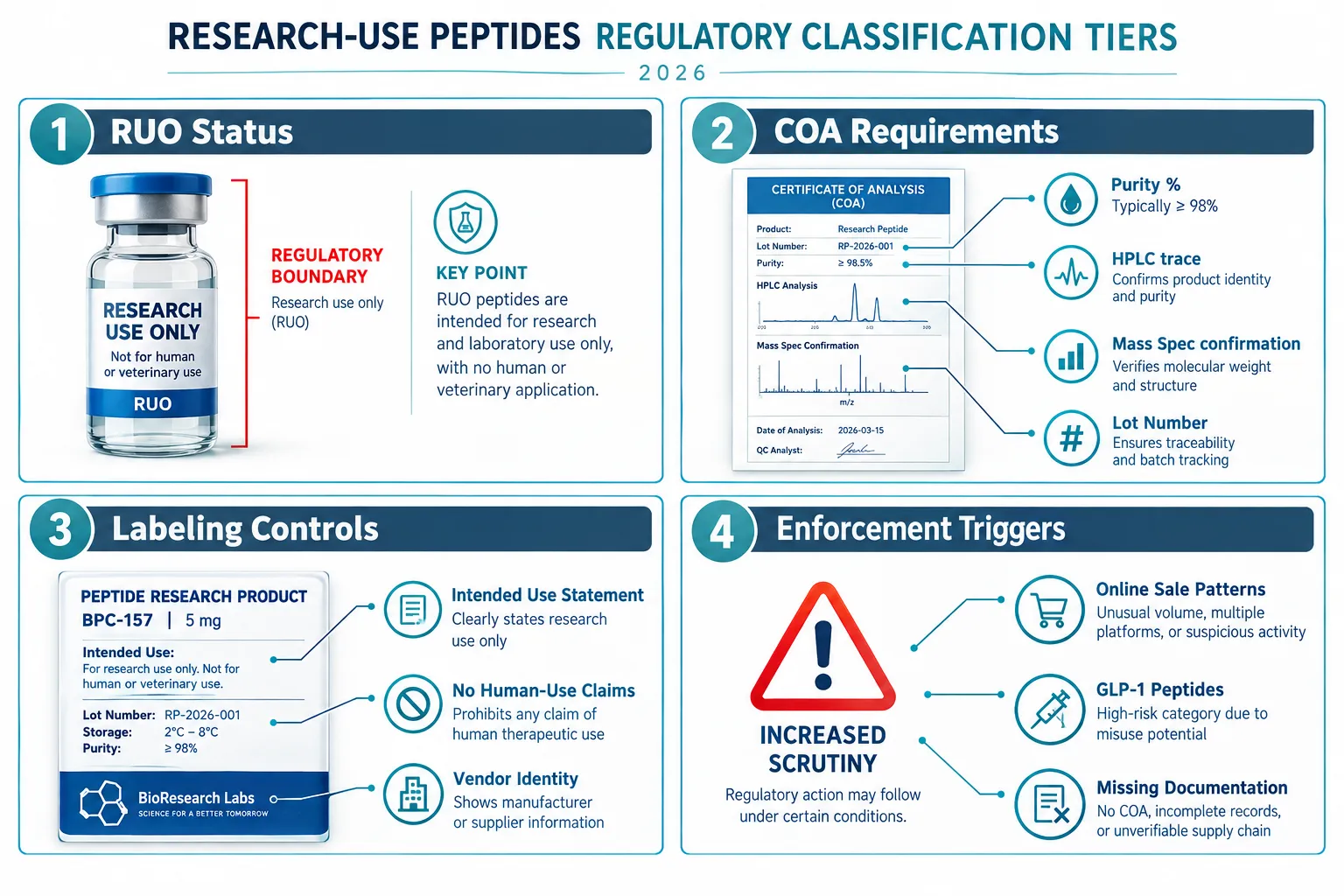
Why "Research Use Only" No Longer Means What It Used To

For years, affixing a "Research Use Only" (RUO) sticker to a peptide vial was treated as a legal firewall. That assumption has been dismantled. Regulatory agencies, particularly the FDA, now evaluate the totality of circumstances, marketing language, distribution channels, pricing, and customer communications, rather than accepting label disclaimers at face value.

The Swiss Chems enforcement action made this explicit. A vendor selling GLP-1 peptides online could not shield itself from regulatory action simply because its labels carried RUO language. The FDA's pattern of warning letters targeting online peptide sellers demonstrates that the agency looks at whether a product is effectively marketed for human use, regardless of what the label technically states.

This matters practically for laboratories. Purchasing from a vendor whose distribution model resembles a consumer health channel creates downstream documentation risk for the buyer, not just the seller. Customs and importation controls have similarly shifted toward assessing intended use from shipping records, order quantities, and accompanying documentation rather than relying on label language alone.

What this means for lab procurement teams: Vendor selection now requires due diligence on the supplier's entire compliance posture, not just the product specification sheet.


How Regulatory Classification Changes COA, Labeling, and Laboratory-Only Controls in Practice
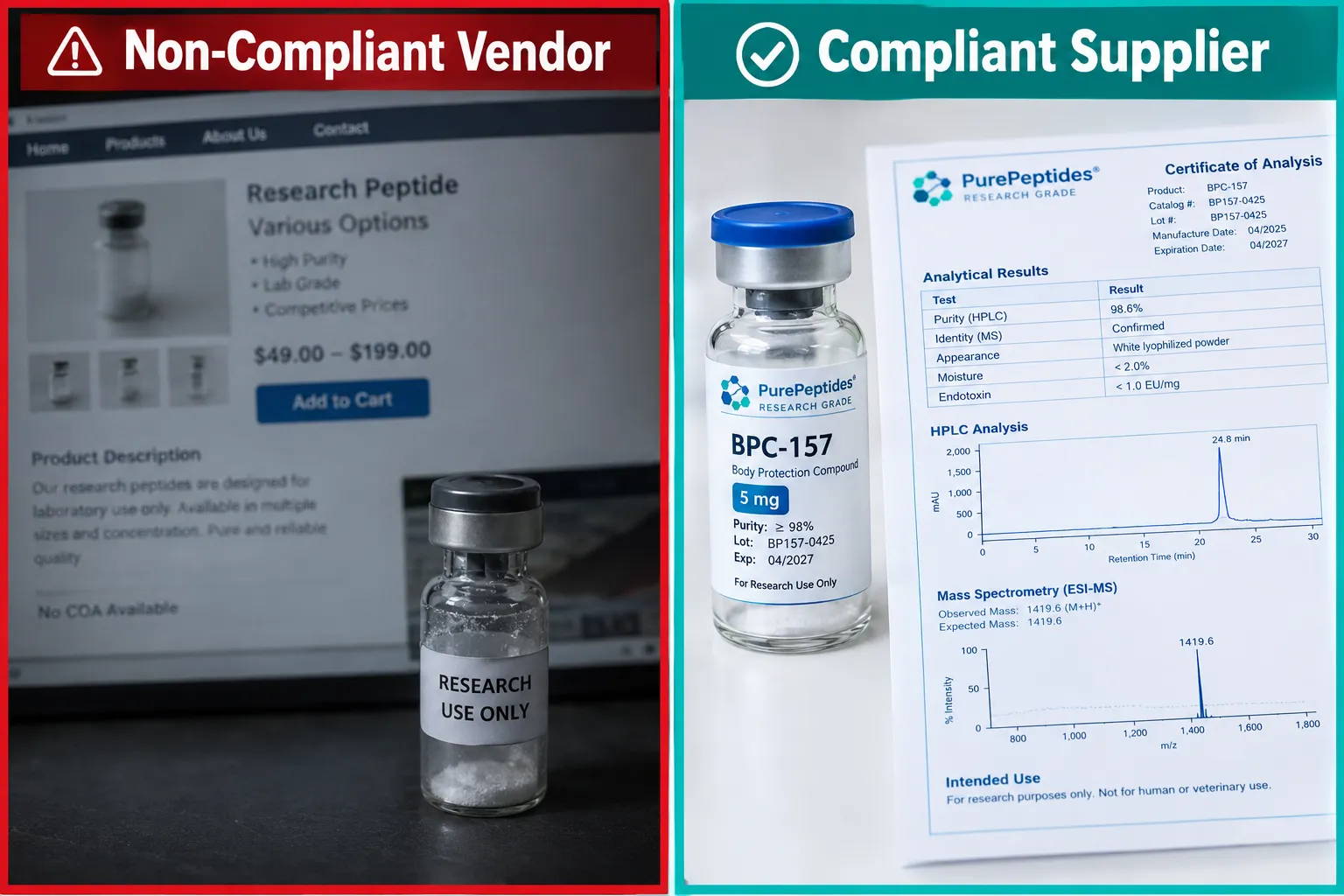
How Regulatory Classification Changes COA, Labeling, and Laboratory-Only Controls in Practice

The practical consequence of tightened regulatory classification is a specific, elevated set of documentation expectations. A compliant COA for a research-use peptide in 2026 is no longer a single-page purity declaration. Reputable suppliers now provide:

COA Element Minimum Standard
Purity percentage Confirmed by HPLC, typically greater than 98%
Mass spectrometry data Molecular weight confirmation, sequence verification
Lot number Unique, traceable to synthesis batch
Intended-use statement Explicit laboratory/research language, no therapeutic claims
Storage conditions Temperature, light, and moisture specifications
Vendor identity Full legal name, contact, and country of origin

Labeling on the vial itself must mirror the COA. Any mismatch between the COA lot number and the physical label is a red flag during regulatory inspection. Vendors who supply AOD-9604 with documented storage and traceability protocols exemplify the standard now expected across the category.

"The COA is no longer a formality, it is the primary instrument through which a research operation demonstrates that a compound was procured, handled, and used within the bounds of legitimate scientific inquiry."

For GLP-1 class peptides specifically, the documentation bar is higher still. Public-interest groups and enforcement bodies have flagged compounds such as retatrutide as priority concerns, meaning any laboratory working with these molecules should maintain exceptionally detailed procurement and usage records.


Building a Laboratory-Only Control Framework: Chain of Custody and Analytical Records
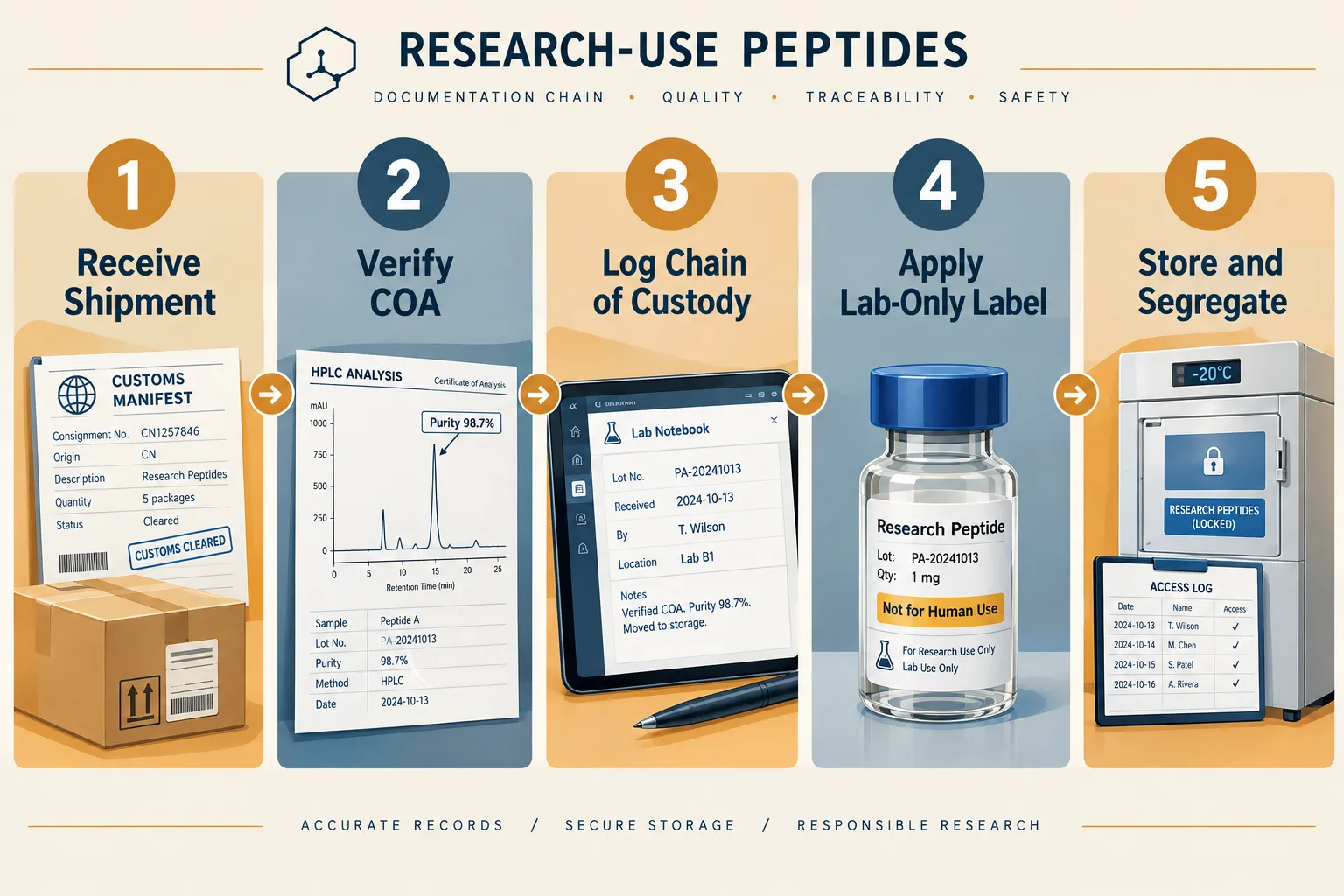
Building a Laboratory-Only Control Framework: Chain of Custody and Analytical Records

Laboratory-only controls are the operational layer that translates regulatory classification into daily practice. These controls serve two functions: they protect the institution during any regulatory inquiry, and they ensure research integrity by maintaining compound identity throughout the experiment lifecycle.

A functional framework includes four components:

  1. Intake verification, Upon receipt, confirm that the physical vial label matches the COA exactly. Log the lot number, receipt date, and storage location in a dedicated analytical record.
  2. Segregated storage, Research-use peptides must be physically separated from any compounds that could be misconstrued as clinical or patient-use materials. Locked refrigeration with an access log is the current best practice.
  3. Chain-of-custody log, Every transfer of a compound, from storage to bench, from one researcher to another, should be recorded with date, quantity, and purpose.
  4. Intended-use documentation, Each experiment using the peptide should reference the specific lot number and include a brief statement of research purpose. This creates an auditable link between procurement and use.

Laboratories sourcing compounds like SS-31 for mitochondrial research or exploring SS-31 in kidney health research should apply these controls uniformly, regardless of the peptide's perceived regulatory risk level. Consistency is itself a compliance signal.


What 2026 Enforcement Trends Mean for Research Operations

The 2025-2026 guidance tightening compounding pharmacy access to non-pharmaceutical-grade peptides has had a secondary effect: it has pushed more scrutiny onto the research-use supply chain. Clinics and prescribers have been explicitly warned against using RUO-grade peptides in patients, which means any vendor whose customer base blurs that line is now a higher-risk procurement source for legitimate researchers.

For laboratories, the actionable implication is straightforward: the vendor's compliance posture is part of your compliance posture. Purchasing from a supplier that maintains rigorous COA standards, clear intended-use labeling, and documented lot traceability, such as those offering GLP-3 peptides with full analytical documentation, reduces institutional risk materially.

The trajectory for the remainder of 2026 and beyond points toward further formalization. Regulatory bodies are expected to issue more specific guidance on RUO documentation requirements, and enforcement actions are likely to increase in frequency. Laboratories that have already built robust chain-of-custody and analytical record systems will be positioned to adapt quickly.


Conclusion

Research-use peptides in 2026 operate within a fundamentally different regulatory environment than they did even two years ago. The core shift is this: classification is now determined by conduct and documentation, not by label language. For laboratory operations, that means COA quality, intended-use labeling, chain-of-custody records, and segregated storage are no longer optional best practices, they are the practical expression of regulatory compliance.

Actionable next steps for research teams:

  • Audit current vendor COAs against the six-element minimum standard outlined above.
  • Implement a lot-number-linked intake and chain-of-custody log for all research peptide procurement.
  • Review storage arrangements to ensure physical segregation from any clinical or patient-adjacent materials.
  • Confirm that all peptide labels on-hand carry explicit intended-use language and match their corresponding COA.
  • Prioritize suppliers who proactively publish analytical data and maintain transparent traceability practices.

Laboratories that treat documentation as a scientific discipline, not an administrative burden, will be best positioned as regulatory expectations continue to tighten.

https://www.puretestedpeptides.com/wp-content/uploads/2026/10/research-use-peptides-in-2026-how-regulatory-classification-changes-coa-labeling.webp 1024 1536 https://www.puretestedpeptides.com/wp-content/uploads/2026/01/buy-peptides-online.jpg 2026-10-15 13:07:122026-10-15 13:07:12Research-Use Peptides in 2026: How Regulatory Classification Changes COA, Labeling, and Laboratory-Only Controls
×

Helpful Links

  • My account
  • Cart
  • Checkout
  • Refund and Returns Policy
  • Privacy Policy
  • SMS Privacy Policy
  • Login
  • My Account
  • Logout

USA Made Lab Tested Peptides

All products are sold for research, laboratory, or analytical purposes only, and are not for human consumption


Pure Tested Peptides is a chemical supplier. Pure Tested Peptides is not a compounding / chemical compounding facility as defined under 503A of the Federal Food, Drug, and Cosmetic act. Pure Tested Peptides is not an outsourcing facility as defined under 503B of the Federal Food, Drug, and Cosmetic act.

The statements made within this website have not been evaluated by the US Food and Drug Administration. The products we offer are not intended to diagnose, treat, cure or prevent any disease.

Human/Animal Consumption Prohibited. Laboratory/In-Vitro Experimental Use Only

Scroll to top Scroll to top Scroll to top