Call or Text 727-513-9780
  • Shopping Cart Shopping Cart
    0Shopping Cart
Pure Tested Peptides | America's most trusted Peptides for sale online
  • Peptides for sale
    • Oral Peptides for sale
      • Peptide Capsules for sale
      • BPC 157 Capsules 1000mcg
      • SLU-PP-332 Capsules | 1000 mcg
      • 5-Amino-1MQ 50mg Capsules
      • Tesofensine 500mcg
    • All Peptides for sale
    • Peptide Sprays
      • BPC 157 Nasal Spray Kit
      • BPC-157 TB500 Nasal Spray Kit
      • Semax Nasal Spray 10mg
      • Selank – Nasal Spray Kit – 10mg
      • Epithalon 50MG Nasal Spray Kit
      • Ipamorelin 10mg Nasal Spray
      • Klow Nasal Spray (BPC-157 + TB-500 + GHK-Cu + KPV) | 80mg
      • Hulk Nasal Spray Tesa / Ipa Blend 6/3 MG
      • Klow Nasal Spray
      • NAD + 500 mg Nasal Spray
      • PT-141 Nasal Spray Kit
    • GHRH Peptides
      • Ipa Peptides
      • CJC-1295 Peptides
        • CJC-1295 with DAC 5 mg
        • CJC-1295 without DAC 5 mg
        • CJC-1295 Ipa 10mg
      • Tesa Peptides
        • Tesa Peptide
        • Tesa 20 mg
    • GHK-Cu Peptides
      • All GHK-Cu Peptides
      • GHK-Cu 100mg
      • KLOW Peptide Blend – Buy KLOW blend online
    • BPC Peptides
      • All BPC Peptides
      • BPC-157
      • BPC-157 TB-500
      • BPC 157 capsules 1000mcg
    • SLU-PP-332 Peptides
      • All SLU-PP-332 Peptides
      • SLU-PP-332 5mg
    • GLP3 Peptides
      • GLP3-R
      • GLP3-R CAG 10mg
      • GLP3-R 20mg
    • PT-141 Peptides
      • PT-141 Peptides for sale
      • PT-141 10mg
      • PT-141 Nasal Spray
    • CAG Peptides
      • Lipo-C Peptide Blend
      • CAG 5mg
      • CAG 10mg
    • MOTS-C Peptides
      • MOTS-C Peptides for sale
      • MOTS-c peptide
      • MOTS-c 10mg *6 pack*
    • 5 Amino 1MQ Peptides
      • 5 Amino 1MQ Peptides for sale
      • 5-Amino-1MQ 50mg Capsules
      • 5-Amino-1MQ 5mg
    • Epithalon Peptides
      • Epithalon Peptides for sale
      • Epithalon 10mg
      • Epithalon 50mg
  • Shop
    • GLPs
      • 5-Amino-1MQ 50mg Capsules
      • 5-Amino-1MQ 5mg
      • GLP3-Reta
      • L-Carnitine 500mg/ml
      • Tesofensine 500mcg
      • SLU-PP-332 5mg
      • MOTS-c 10mg *6 pack*
    • Epithalon & BPC Peptides
      • Epithalon 10mg
      • Epithalon 50mg
      • BPC-157
      • BPC 157 capsules 1000mcg
      • BPC-157 TB-500
      • BPC-157 TB500 Nasal Spray Kit
      • BPC 157 Nasal Spray Kit
    • BPC TB-500 & NAD+ Peptides
      • NAD+ 500 mg
      • KLOW Peptide Blend – Buy KLOW blend online
      • GLOW Peptide Blend
      • TB 500 5mg
      • BPC 157 capsules 1000mcg – Supplement
      • BPC 157 Nasal Spray Kit
      • BPC-157
      • BPC-157 TB500 Nasal Spray Kit
      • BPC-157 TB-500
      • BPC 157 capsules 1000mcg
    • LL-37 Peptide
      • LL-37 10 mg
    • MOTS-C & Selank
      • MOTS-c peptide
      • Selank 10mg
    • GHK Peptides
      • GHK-Cu 100mg
      • GLOW Peptide Blend
      • KLOW Peptide Blend – Buy KLOW blend online
  • COAs
  • Wholesale
    • Wholesale Peptides for sale
  • PTP FAQ
  • Affiliates
    • Selank Peptide: Advanced Pharmacological Mechanisms Underlying Its Anxiolytic and Nootropic Effects in Research
      • 5-Amino-1MQ Peptide: Detailed Mechanisms of NNMT Inhibition and Its Impact on Cellular Metabolism Research
        • MOTS-C Peptide: Unraveling Its Role in Mitochondrial Dynamics and Energy Metabolism Research
          • Epithalon Peptide and Telomerase Regulation: Investigating Its Impact on Cellular Senescence and Lifespan Research Models
            • GLP2-T vs GLP2 Tirz Peptide: Understanding the Naming, Mechanistic Nuances, and Research Implications for Gut Health
      • Peptides and Polypeptides in Modern Pharmacology: What Research on Metoprolol, Prednisone, and Amlodipine Reveals
        • Polypeptide Peptides vs NSAIDs: What Naproxen and Diclofenac Teach Tissue-Repair Researchers About BPC‑157 and TB‑500
          • Peptides and Polypeptides in Endocrine Pharmacology: How GLP-1, GLP-2, and GLP-3 Retatrutide Differ From Classic Drugs Like Prednisone and Amlodipine
          • 5‑Amino‑1MQ Peptide and NNMT Inhibition: How It Compares With Statins Like Atorvastatin in Adipose and Lipid Metabolism Research
      • Enclomiphene, Estrogen Receptor Signaling, and Luteinizing Phase Biology: What Hormone Researchers Should Measure
        • Mesenchymal Stem Cells, BPC‑157, and GHK‑Cu: How Tissue Repair Peptides Compare With Classic NSAIDs Like Naproxen in Injury Models
          • Peptide Calculator Use Cases Beyond Growth Hormone: Working Through GLP‑3 Retatrutide, MOTS‑c, and BPC‑157 Research Dosing
        • Polypeptide Peptides in Endocrine and Metabolic Pharmacology: Lessons From Amlodipine, Prednisone, and Metoprolol
        • Peptides Calculator for Advanced Blends: Worked Examples for Tesamorelin, CJC‑1295, and Ipamorelin Stacks
          • Peptides and Polypeptides in Human Physiology: How Molecular Size Shapes Research Applications
            • Selank Peptide: Advanced Pharmacological Mechanisms Underlying Its Anxiolytic and Nootropic Effects in Research
          • 5-Amino-1MQ Peptide: Detailed Mechanisms of NNMT Inhibition and Its Impact on Cellular Metabolism Research
            • MOTS-C Peptide: Unraveling Its Role in Mitochondrial Dynamics and Energy Metabolism Research
              • Epithalon Peptide and Telomerase Regulation: Investigating Its Impact on Cellular Senescence and Lifespan Research Models
                • GLP2-T vs GLP2 Tirz Peptide: Understanding the Naming, Mechanistic Nuances, and Research Implications for Gut Health
                  • Peptides and Polypeptides in Endocrine Pharmacology: How GLP-1, GLP-2, and GLP-3 Retatrutide Differ From Classic Drugs Like Prednisone and Amlodipine
                    • Polypeptide Peptides vs NSAIDs: What Naproxen and Diclofenac Teach Tissue-Repair Researchers About BPC‑157 and TB‑500
                      • Peptides and Polypeptides in Modern Pharmacology: What Research on Metoprolol, Prednisone, and Amlodipine Reveals
                        • 5‑Amino‑1MQ Peptide and NNMT Inhibition: How It Compares With Statins Like Atorvastatin in Adipose and Lipid Metabolism Research
                        • Enclomiphene, Estrogen Receptor Signaling, and Luteinizing Phase Biology: What Hormone Researchers Should Measure
                        • Mesenchymal Stem Cells, BPC‑157, and GHK‑Cu: How Tissue Repair Peptides Compare With Classic NSAIDs Like Naproxen in Injury Models
                        • Peptide Calculator Use Cases Beyond Growth Hormone: Working Through GLP‑3 Retatrutide, MOTS‑c, and BPC‑157 Research Dosing
                        • Polypeptide Peptides in Endocrine and Metabolic Pharmacology: Lessons From Amlodipine, Prednisone, and Metoprolol
                        • Peptides Calculator for Advanced Blends: Worked Examples for Tesamorelin, CJC‑1295, and Ipamorelin Stacks
                        • Peptides and Polypeptides in Human Physiology: How Molecular Size Shapes Research Applications
                        • Selank Peptide: Advanced Pharmacological Mechanisms Underlying Its Anxiolytic and Nootropic Effects in Research
                        • MOTS-C Peptide: Unraveling Its Role in Mitochondrial Dynamics and Energy Metabolism Research
                        • Peptides and Polypeptides in Modern Pharmacology: What Research on Metoprolol, Prednisone, and Amlodipine Reveals
                        • Peptides and Polypeptides in Endocrine Pharmacology: How GLP-1, GLP-2, and GLP-3 Retatrutide Differ From Classic Drugs Like Prednisone and Amlodipine
                        • 5-Amino-1MQ Peptide: Detailed Mechanisms of NNMT Inhibition and Its Impact on Cellular Metabolism Research
                        • Mesenchymal Stem Cells, BPC‑157, and GHK‑Cu: How Tissue Repair Peptides Compare With Classic NSAIDs Like Naproxen in Injury Models
                        • Peptide Calculator Use Cases Beyond Growth Hormone: Working Through GLP‑3 Retatrutide, MOTS‑c, and BPC‑157 Research Dosing
                        • GLP2-T vs GLP2 Tirz Peptide: Understanding the Naming, Mechanistic Nuances, and Research Implications for Gut Health
                        • Polypeptide Peptides in Endocrine and Metabolic Pharmacology: Lessons From Amlodipine, Prednisone, and Metoprolol
                        • Polypeptide Peptides vs NSAIDs: What Naproxen and Diclofenac Teach Tissue-Repair Researchers About BPC‑157 and TB‑500
                        • Peptides and Polypeptides in Human Physiology: How Molecular Size Shapes Research Applications
                        • Peptides Calculator for Advanced Blends: Worked Examples for Tesamorelin, CJC‑1295, and Ipamorelin Stacks
                        • 5‑Amino‑1MQ Peptide and NNMT Inhibition: How It Compares With Statins Like Atorvastatin in Adipose and Lipid Metabolism Research
                        • Enclomiphene, Estrogen Receptor Signaling, and Luteinizing Phase Biology: What Hormone Researchers Should Measure
                        • Epithalon Peptide and Telomerase Regulation: Investigating Its Impact on Cellular Senescence and Lifespan Research Models
                        • Best research protocol Klow blend
                        • best time to take BPC-157
                        • best time to take DSIP (Delta Sleep Inducing Peptide)
                        • best time to take CJC-1295
                        • best time to take AOD-9604
                        • best time to take Follistatin 344
                        • best time to take Ipamorelin
                        • best time to take MK-677 (Ibutamoren)
                        • best time to take Ligandrol (LGD-4033) — research compound
                        • best time to take Ostarine (MK-2866) — research compound
                        • best time to take GHK-CU
                        • best time to take TB-500
                        • best time to take MOTS-c
                        • best time to take Semax
                        • best time to take RAD-140 (Testolone) — research compound
                        • best time to take Thymosin Alpha-1
                        • best time to take PEG-MGF
                        • Biolife Plasma, Octapharma Plasma, and Research Peptides: How Plasma Donation Labs Differ From Peptide Suppliers
                        • best time to take YK-11 — research compound
                        • best time to take PT-141 (Bremelanotide)
                        • Best research protocol Klow blend
                        • 5-Amino-1MQ and MOTS-C Synergy: Metabolic Signaling, Mitochondria, and Research Design
                        • BPC-157 and TB-500: Investigating Their Combined Effects on Angiogenesis and Cellular Migration in Tissue Repair Models
                        • BPC-157 Peptide: Gut Barrier Function, Inflammation, and Tissue-Recovery Research
                        • 5‑Amino‑1MQ and MOTS‑c Synergy in Metabolic Research: Designing NNMT and Mitochondrial Biogenesis Stacks
                        • CJC-1295 with DAC vs. Without DAC: Half-Life, Release Kinetics, and Research Implications
                        • CJC‑1295 with DAC vs. Without DAC: Expanding on Half‑Life Differences Using Tesamorelin and Ipamorelin Blend Case Studies
                        • Collagen Biology and Copper‑Binding Peptides: How GHK‑Cu, Glow Blend, and Klow Blend Interact with Skin and Connective Tissue
                        • Collagen Biology and Regenerative Peptides: How GHK‑Cu, Glow Blend, and Klow Blend Affect Extracellular Matrix Research
                    • DNA, Telomeres, and Longevity Peptides: Positioning Epithalon and MOTS‑c in Genetic Aging Research
                      • Enclomiphene Citrate: serm Mechanism, Testosterone Research, and Stack Compatibility
                        • Enclomiphene vs Enclomiphene Citrate: Formulation, Bioavailability, and Research Distinctions
                        • Epithalon Peptide Research: Telomerase Activation, Aging, and Pineal Gland Function
                        • Estrogen Receptor Signaling and Enclomiphene: How Selective Modulators Compare with Classic Polypeptide Hormones
                        • GHK-Cu Peptide: Advanced Mechanisms in Extracellular Matrix Remodeling and Wound Healing Research
                        • GHK-Cu Peptide: Collagen Synthesis, Wound Repair, and Skin-Barrier Research Models
                        • GLP-1 vs GLP-3 vs GLP-2: Peptide Classification and Research Applications
                        • GLP-2 Peptide Research Guide: Gut Barrier Function, Nutrient Absorption, and Intestinal Recovery Models
                        • GLP-3 Retatrutide vs. GLP-1 Drugs: What Triple-Agonist Biology Changes in Research Models
                        • Ipamorelin and Tesamorelin Combination: Synergistic GH Secretagogue Research and Dosing Protocols
                        • GLP2 Tirz Peptide: What It Is, Why the Name Exists, and How Researchers Should Interpret It
                        • Klow Blend Peptide Nasal Spray: What the Formulation Is Trying to Do in Cognitive Research
                        • Mitochondria, NNMT Inhibition, and Peptide Modulators: Where MOTS‑c and 5‑Amino‑1MQ Fit in Cellular Energy Research
                        • MOTS-c Peptide: Mitochondrial Function, Energy Metabolism, and What Researchers Measure
                        • MOTS-c vs. 5-Amino-1MQ: Which Metabolic Research Questions Each Compound Actually Answers
                        • Nasal Spray Peptides: Bioavailability, Administration, and Semax/Selank Research Applications
                        • PT-141 Peptide Research: Mechanism of Action and Melanocortin Receptor Signaling
                        • Retatrutide for Research: Mechanism, Structure, and GLP-1/GLP-3 Dual Action
                        • Retatrutide for Obesity and Type 2 Diabetes: What the Latest Trial Data Suggest
                        • Tesofensine Peptide Research: Mechanism, Appetite Suppression, and Neuropeptide Y Pathways
  • Contact
    • Contact Customer Service
    • Text Customer Support
  • About US
  • Shop all peptides
  • Affiliate Program
    • Affiliate Signup
  • Login / Register Login / Register Page Link Login / Register Page Link
  • Click to open the search input field Click to open the search input field Search
  • Menu Menu

Tag Archive for: peptide blend research

CJC‑1295 with DAC vs. Without DAC: Expanding on Half‑Life Differences Using Tesamorelin and Ipamorelin Blend Case Studies

CJC‑1295 with DAC vs. Without DAC: Expanding on Half‑Life Differences Using Tesamorelin and Ipamorelin Blend Case Studies

July 22, 2026/0 Comments/by Pure Tested

Swapping CJC-1295 with DAC for its non-DAC counterpart in a research stack is not a minor formulation tweak, it fundamentally rewrites the pharmacokinetic story. The half-life difference between these two peptides spans roughly five to eight days versus thirty minutes, a gap wide enough to change dosing schedules, alter GH pulsatility, and reshape how researchers design and interpret blend studies. Understanding CJC-1295 with DAC vs. Without DAC: Expanding on Half-Life Differences Using Tesamorelin and Ipamorelin Blend Case Studies is therefore essential before drawing any conclusions from multi-peptide stacks.
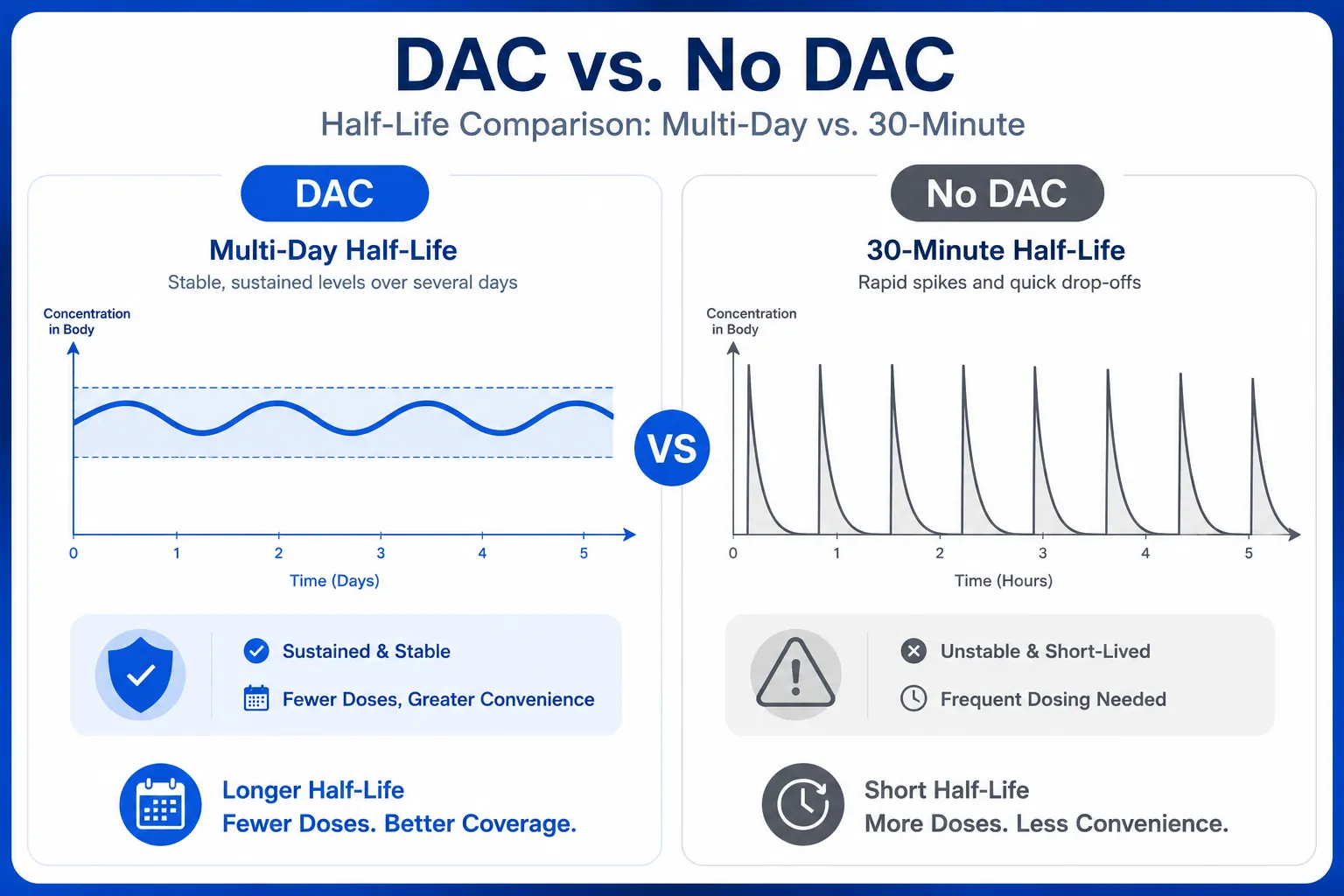
Split-screen infographic illustration () in bright clinical white and cobalt blue: left panel shows a smooth, sustained sine

Key Takeaways

  • CJC-1295 with DAC achieves a half-life of approximately 5.8 to 8.1 days through covalent albumin binding; the non-DAC form lasts roughly 30 minutes in plasma.
  • The DAC moiety uses a maleimidopropionic acid linker to "hitchhike" on serum albumin, which itself persists for 19 to 21 days in humans.
  • No published human pharmacokinetic profile exists for CJC-1295 without DAC; its half-life is inferred rather than directly measured.
  • In tesa-CJC-1295-ipamorelin blend research, the choice of DAC or non-DAC form determines whether GH output is a sustained basal elevation or a series of short pulses.
  • Dosing frequency, study design, and safety monitoring must be adapted separately for each form, data from DAC trials cannot be applied to non-DAC protocols.

The Mechanism Behind the Half-Life Gap

The entire pharmacokinetic difference between the two forms traces back to a single chemical addition: the Drug Affinity Complex (DAC) moiety. This maleimidopropionic acid linker covalently binds to serum albumin after injection. Because albumin circulates in the bloodstream for 19 to 21 days, any peptide attached to it inherits a dramatically extended lifespan. The result is a half-life of 5.8 to 8.1 days for CJC-1295 with DAC in healthy adults, compared with roughly 30 minutes for the non-DAC peptide.

The non-DAC form, structurally similar to tetrasubstituted modified GRF 1-29, does carry amino acid substitutions that resist dipeptidyl peptidase-4 (DPP-4) cleavage. This resistance extends its survival beyond native GHRH's two-minute plasma half-life, but without albumin binding, clearance still occurs within half an hour. Critically, no direct human pharmacokinetic measurement for CJC-1295 without DAC has been published as of mid-2026. The 30-minute estimate is inferred from DPP-4 resistance data and the known absence of albumin binding, not from a controlled PK trial.

For a detailed breakdown of the albumin-binding mechanism and its downstream effects on IGF-1, see this deeper dive into CJC-1295 with DAC research findings.

"Extrapolating DAC-trial data to the non-DAC peptide is pharmacokinetically invalid, the multi-day duration is unique to the DAC modification."

Modeling Pharmacokinetics in Common Research Stacks

CJC-1295 with DAC vs. Without DAC: How the Tesamorelin and Ipamorelin Blend Changes the Picture
CJC-1295 with DAC vs. Without DAC: How the Tesamorelin and Ipamorelin Blend Changes the Picture

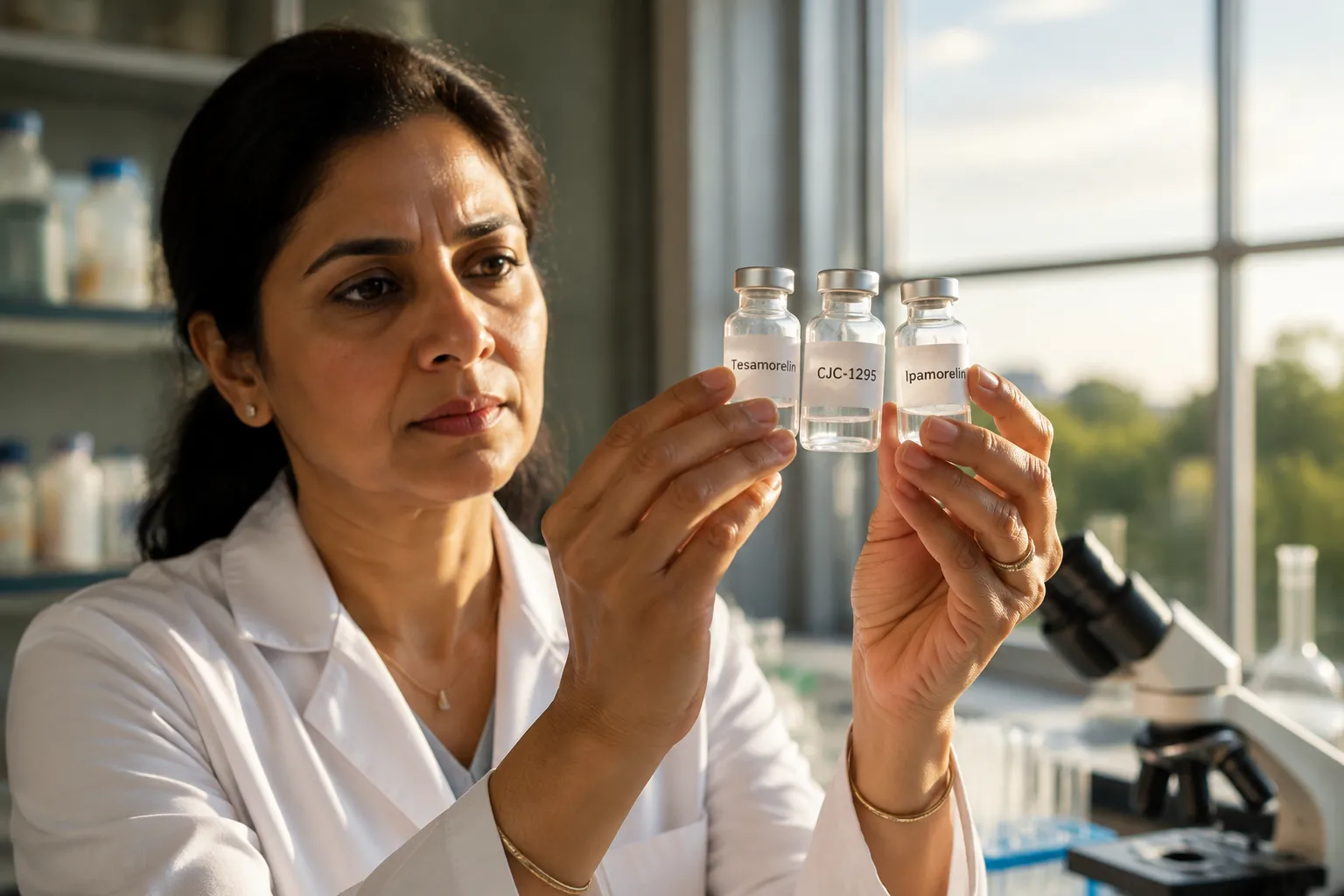
Tesamorelin is an FDA-approved GHRH analog with a relatively short plasma half-life, making it a useful pharmacokinetic comparator when modeling blend behavior. In a tesa-CJC-1295-ipamorelin stack, the choice of DAC or non-DAC CJC-1295 produces two very different GH output profiles.

With DAC in the blend:

  • CJC-1295 with DAC provides a continuous, low-level GHRH signal lasting several days per injection.
  • Ipamorelin, a selective GHRP with a half-life of roughly two hours, adds superimposed short pulses on top of this basal elevation.
  • The combined effect is a sustained GH baseline with intermittent amplified peaks.
  • IGF-1 can remain above baseline for up to 28 days after multiple doses, which has significant implications for study endpoints and washout periods.

Without DAC in the blend:

  • Non-DAC CJC-1295 acts as a brief GHRH burst, peaking and clearing within 30 minutes.
  • Ipamorelin's pulses align temporally with these short GHRH windows, creating a synchronized but transient GH spike.
  • The overall GH profile more closely resembles physiologic pulsatility.
  • Researchers studying tesa alongside this form are effectively comparing two short-acting GHRH analogs rather than a long-acting versus short-acting pair.

For researchers exploring blend formulations, the tesa-CJC-1295-ipamorelin 12mg blend and the tesa-AOD9604-CJC-1295-ipamorelin blend illustrate how component selection shapes the overall protocol design.

A comparison of tesa's standalone pharmacokinetics versus ipamorelin's is also covered in this ipamorelin vs. tesa overview, which helps contextualize blend behavior further.

Dosing Schedules, GH Pulsatility, and Study Design Implications

Applying CJC-1295 with DAC vs. Without DAC Half-Life Differences to Protocol Planning
Applying CJC-1295 with DAC vs. Without DAC Half-Life Differences to Protocol Planning

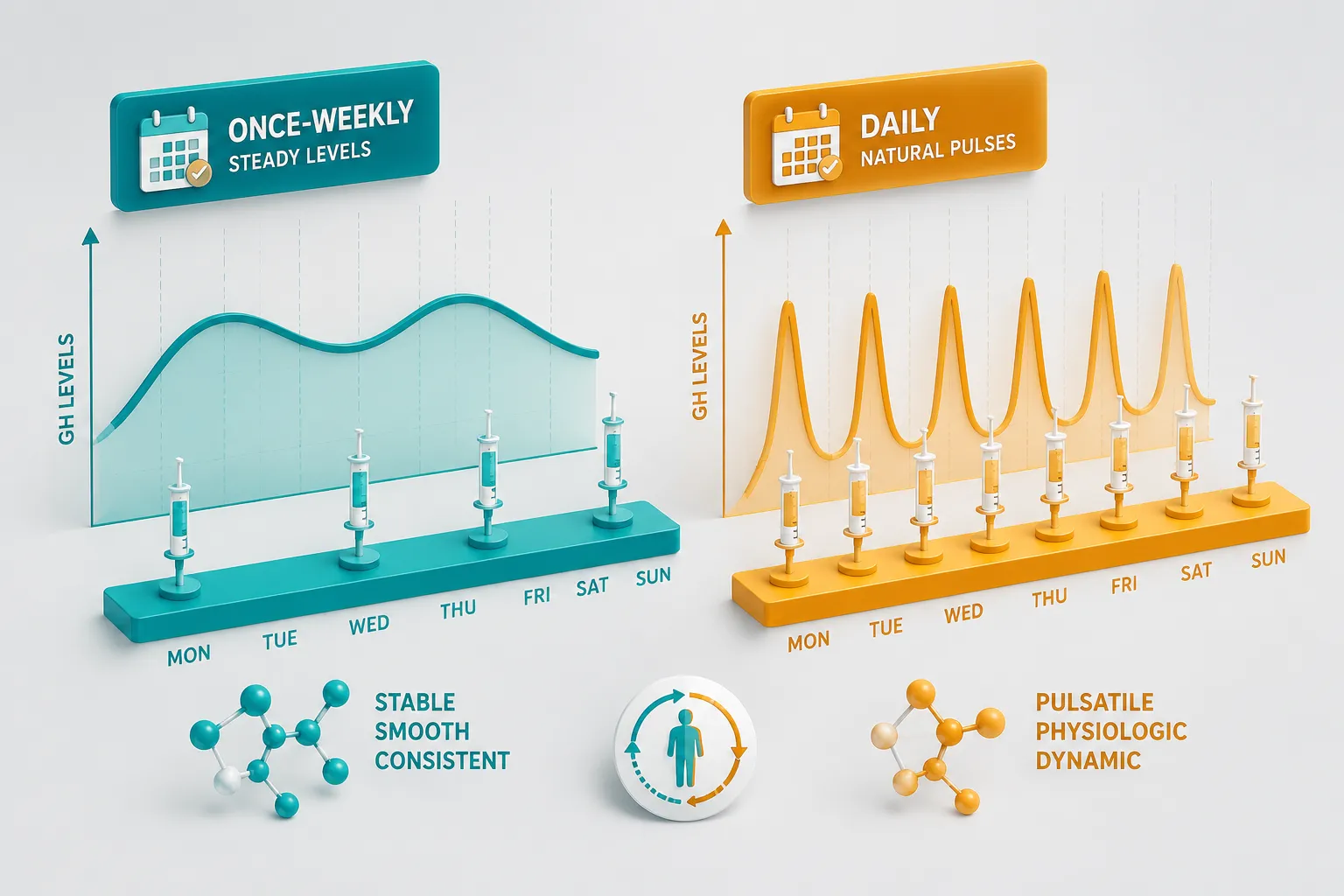
The half-life gap directly dictates dosing frequency. CJC-1295 with DAC supports once- or twice-weekly injection schedules while maintaining sustained GH and IGF-1 elevation between doses. Non-DAC CJC-1295, by contrast, requires daily or multiple-daily dosing to maintain any meaningful GHRH presence.

Feature CJC-1295 with DAC CJC-1295 without DAC
Plasma half-life 5.8 to 8.1 days Approx. 30 minutes (inferred)
Albumin binding Yes (covalent) No
GH output pattern Sustained basal elevation Short pulsatile burst
Recommended dosing frequency Once or twice weekly Daily or multiple times daily
Human PK data available Yes (Phase 1 trial data) No direct measurement

Key study design considerations include:

  • Washout periods: The DAC form requires washout periods of several weeks due to prolonged IGF-1 elevation; non-DAC washout is far shorter.
  • Pulsatility preservation: Researchers prioritizing physiologic GH pulse patterns should favor non-DAC CJC-1295 or tesa as the GHRH component.
  • Blunted pulsatility risk: The sustained flat GH signal from CJC-1295 with DAC may suppress normal GH pulsatility, an endocrinological consideration absent from short-acting protocols.
  • Endpoint timing: IGF-1 measurements taken at 24 hours post-dose will reflect very different biological states depending on which form is used.

For researchers examining the CJC-1295 with DAC profile in greater depth, this CJC-1295 with DAC deeper dive and the sermorelin-ipamorelin-CJC-1295 combination overview provide additional context on how half-life interacts with GHRP co-administration.

Conclusion

The core lesson from examining CJC-1295 with DAC vs. Without DAC: Expanding on Half-Life Differences Using Tesamorelin and Ipamorelin Blend Case Studies is straightforward: these are not interchangeable peptides with minor formulation differences. The DAC moiety transforms a 30-minute compound into a multi-day one, and that transformation cascades into every aspect of blend design, from dosing frequency and GH pulsatility to washout periods and safety monitoring.

Actionable next steps for researchers:

  1. Define the desired GH output pattern first, sustained basal elevation or pulsatile bursts, before selecting the CJC-1295 form.
  2. Never apply DAC-derived pharmacokinetic data to non-DAC protocols; treat them as separate compounds.
  3. When designing tesa-CJC-1295-ipamorelin blend studies, account for the dramatically different washout requirements between DAC and non-DAC variants.
  4. Consult current tesa dosing and pharmacokinetic guidance to calibrate expectations when tesa serves as the GHRH comparator.
  5. Review the GH axis product line overview for a broader perspective on how each component fits within a well-structured research protocol.

Rigorous protocol design begins with understanding the pharmacokinetics of each component individually, only then can blend behavior be accurately modeled and interpreted.

https://www.puretestedpeptides.com/wp-content/uploads/2026/07/cjc-1295-with-dac-vs-without-dac-expanding-on-half-life-differences-using-tesamo.webp 1024 1536 Pure Tested https://www.puretestedpeptides.com/wp-content/uploads/2026/01/buy-peptides-online.jpg Pure Tested2026-07-22 13:05:412026-07-27 13:32:21CJC‑1295 with DAC vs. Without DAC: Expanding on Half‑Life Differences Using Tesamorelin and Ipamorelin Blend Case Studies
×

Helpful Links

  • My account
  • Cart
  • Checkout
  • Refund and Returns Policy
  • Privacy Policy
  • SMS Privacy Policy
  • Login
  • My Account
  • Logout

USA Made Lab Tested Peptides

All products are sold for research, laboratory, or analytical purposes only, and are not for human consumption


Pure Tested Peptides is a chemical supplier. Pure Tested Peptides is not a compounding / chemical compounding facility as defined under 503A of the Federal Food, Drug, and Cosmetic act. Pure Tested Peptides is not an outsourcing facility as defined under 503B of the Federal Food, Drug, and Cosmetic act.

The statements made within this website have not been evaluated by the US Food and Drug Administration. The products we offer are not intended to diagnose, treat, cure or prevent any disease.

Human/Animal Consumption Prohibited. Laboratory/In-Vitro Experimental Use Only

Scroll to top Scroll to top Scroll to top