Call or Text 727-513-9780
  • Shopping Cart Shopping Cart
    0Shopping Cart
Pure Tested Peptides | America's most trusted Peptides for sale online
  • Peptides for sale
    • Oral Peptides for sale
      • Peptide Capsules for sale
      • BPC 157 Capsules 1000mcg
      • SLU-PP-332 Capsules | 1000 mcg
      • 5-Amino-1MQ 50mg Capsules
      • Tesofensine 500mcg
    • All Peptides for sale
    • Peptide Sprays
      • BPC 157 Nasal Spray Kit
      • BPC-157 TB500 Nasal Spray Kit
      • Semax Nasal Spray 10mg
      • Selank – Nasal Spray Kit – 10mg
      • Epithalon 50MG Nasal Spray Kit
      • Ipamorelin 10mg Nasal Spray
      • Klow Nasal Spray (BPC-157 + TB-500 + GHK-Cu + KPV) | 80mg
      • Hulk Nasal Spray Tesa / Ipa Blend 6/3 MG
      • Klow Nasal Spray
      • NAD + 500 mg Nasal Spray
      • PT-141 Nasal Spray Kit
    • GHRH Peptides
      • Ipa Peptides
      • CJC-1295 Peptides
        • CJC-1295 with DAC 5 mg
        • CJC-1295 without DAC 5 mg
        • CJC-1295 Ipa 10mg
      • Tesa Peptides
        • Tesa Peptide
        • Tesa 20 mg
    • GHK-Cu Peptides
      • All GHK-Cu Peptides
      • GHK-Cu 100mg
      • KLOW Peptide Blend – Buy KLOW blend online
    • BPC Peptides
      • All BPC Peptides
      • BPC-157
      • BPC-157 TB-500
      • BPC 157 capsules 1000mcg
    • SLU-PP-332 Peptides
      • All SLU-PP-332 Peptides
      • SLU-PP-332 5mg
    • GLP3 Peptides
      • GLP3-R
      • GLP3-R CAG 10mg
      • GLP3-R 20mg
    • PT-141 Peptides
      • PT-141 Peptides for sale
      • PT-141 10mg
      • PT-141 Nasal Spray
    • CAG Peptides
      • Lipo-C Peptide Blend
      • CAG 5mg
      • CAG 10mg
    • MOTS-C Peptides
      • MOTS-C Peptides for sale
      • MOTS-c peptide
      • MOTS-c 10mg *6 pack*
    • 5 Amino 1MQ Peptides
      • 5 Amino 1MQ Peptides for sale
      • 5-Amino-1MQ 50mg Capsules
      • 5-Amino-1MQ 5mg
    • Epithalon Peptides
      • Epithalon Peptides for sale
      • Epithalon 10mg
      • Epithalon 50mg
  • Shop
    • GLPs
      • 5-Amino-1MQ 50mg Capsules
      • 5-Amino-1MQ 5mg
      • GLP3-Reta
      • L-Carnitine 500mg/ml
      • Tesofensine 500mcg
      • SLU-PP-332 5mg
      • MOTS-c 10mg *6 pack*
    • Epithalon & BPC Peptides
      • Epithalon 10mg
      • Epithalon 50mg
      • BPC-157
      • BPC 157 capsules 1000mcg
      • BPC-157 TB-500
      • BPC-157 TB500 Nasal Spray Kit
      • BPC 157 Nasal Spray Kit
    • BPC TB-500 & NAD+ Peptides
      • NAD+ 500 mg
      • KLOW Peptide Blend – Buy KLOW blend online
      • GLOW Peptide Blend
      • TB 500 5mg
      • BPC 157 capsules 1000mcg – Supplement
      • BPC 157 Nasal Spray Kit
      • BPC-157
      • BPC-157 TB500 Nasal Spray Kit
      • BPC-157 TB-500
      • BPC 157 capsules 1000mcg
    • LL-37 Peptide
      • LL-37 10 mg
    • MOTS-C & Selank
      • MOTS-c peptide
      • Selank 10mg
    • GHK Peptides
      • GHK-Cu 100mg
      • GLOW Peptide Blend
      • KLOW Peptide Blend – Buy KLOW blend online
  • COAs
  • Wholesale
    • Wholesale Peptides for sale
  • PTP FAQ
  • Affiliates
    • Selank Peptide: Advanced Pharmacological Mechanisms Underlying Its Anxiolytic and Nootropic Effects in Research
      • 5-Amino-1MQ Peptide: Detailed Mechanisms of NNMT Inhibition and Its Impact on Cellular Metabolism Research
        • MOTS-C Peptide: Unraveling Its Role in Mitochondrial Dynamics and Energy Metabolism Research
          • Epithalon Peptide and Telomerase Regulation: Investigating Its Impact on Cellular Senescence and Lifespan Research Models
            • GLP2-T vs GLP2 Tirz Peptide: Understanding the Naming, Mechanistic Nuances, and Research Implications for Gut Health
      • Peptides and Polypeptides in Modern Pharmacology: What Research on Metoprolol, Prednisone, and Amlodipine Reveals
        • Polypeptide Peptides vs NSAIDs: What Naproxen and Diclofenac Teach Tissue-Repair Researchers About BPC‑157 and TB‑500
          • Peptides and Polypeptides in Endocrine Pharmacology: How GLP-1, GLP-2, and GLP-3 Retatrutide Differ From Classic Drugs Like Prednisone and Amlodipine
          • 5‑Amino‑1MQ Peptide and NNMT Inhibition: How It Compares With Statins Like Atorvastatin in Adipose and Lipid Metabolism Research
      • Enclomiphene, Estrogen Receptor Signaling, and Luteinizing Phase Biology: What Hormone Researchers Should Measure
        • Mesenchymal Stem Cells, BPC‑157, and GHK‑Cu: How Tissue Repair Peptides Compare With Classic NSAIDs Like Naproxen in Injury Models
          • Peptide Calculator Use Cases Beyond Growth Hormone: Working Through GLP‑3 Retatrutide, MOTS‑c, and BPC‑157 Research Dosing
        • Polypeptide Peptides in Endocrine and Metabolic Pharmacology: Lessons From Amlodipine, Prednisone, and Metoprolol
        • Peptides Calculator for Advanced Blends: Worked Examples for Tesamorelin, CJC‑1295, and Ipamorelin Stacks
          • Peptides and Polypeptides in Human Physiology: How Molecular Size Shapes Research Applications
            • Selank Peptide: Advanced Pharmacological Mechanisms Underlying Its Anxiolytic and Nootropic Effects in Research
          • 5-Amino-1MQ Peptide: Detailed Mechanisms of NNMT Inhibition and Its Impact on Cellular Metabolism Research
            • MOTS-C Peptide: Unraveling Its Role in Mitochondrial Dynamics and Energy Metabolism Research
              • Epithalon Peptide and Telomerase Regulation: Investigating Its Impact on Cellular Senescence and Lifespan Research Models
                • GLP2-T vs GLP2 Tirz Peptide: Understanding the Naming, Mechanistic Nuances, and Research Implications for Gut Health
                  • Peptides and Polypeptides in Endocrine Pharmacology: How GLP-1, GLP-2, and GLP-3 Retatrutide Differ From Classic Drugs Like Prednisone and Amlodipine
                    • Polypeptide Peptides vs NSAIDs: What Naproxen and Diclofenac Teach Tissue-Repair Researchers About BPC‑157 and TB‑500
                      • Peptides and Polypeptides in Modern Pharmacology: What Research on Metoprolol, Prednisone, and Amlodipine Reveals
                        • 5‑Amino‑1MQ Peptide and NNMT Inhibition: How It Compares With Statins Like Atorvastatin in Adipose and Lipid Metabolism Research
                        • Enclomiphene, Estrogen Receptor Signaling, and Luteinizing Phase Biology: What Hormone Researchers Should Measure
                        • Mesenchymal Stem Cells, BPC‑157, and GHK‑Cu: How Tissue Repair Peptides Compare With Classic NSAIDs Like Naproxen in Injury Models
                        • Peptide Calculator Use Cases Beyond Growth Hormone: Working Through GLP‑3 Retatrutide, MOTS‑c, and BPC‑157 Research Dosing
                        • Polypeptide Peptides in Endocrine and Metabolic Pharmacology: Lessons From Amlodipine, Prednisone, and Metoprolol
                        • Peptides Calculator for Advanced Blends: Worked Examples for Tesamorelin, CJC‑1295, and Ipamorelin Stacks
                        • Peptides and Polypeptides in Human Physiology: How Molecular Size Shapes Research Applications
                        • Selank Peptide: Advanced Pharmacological Mechanisms Underlying Its Anxiolytic and Nootropic Effects in Research
                        • MOTS-C Peptide: Unraveling Its Role in Mitochondrial Dynamics and Energy Metabolism Research
                        • Peptides and Polypeptides in Modern Pharmacology: What Research on Metoprolol, Prednisone, and Amlodipine Reveals
                        • Peptides and Polypeptides in Endocrine Pharmacology: How GLP-1, GLP-2, and GLP-3 Retatrutide Differ From Classic Drugs Like Prednisone and Amlodipine
                        • 5-Amino-1MQ Peptide: Detailed Mechanisms of NNMT Inhibition and Its Impact on Cellular Metabolism Research
                        • Mesenchymal Stem Cells, BPC‑157, and GHK‑Cu: How Tissue Repair Peptides Compare With Classic NSAIDs Like Naproxen in Injury Models
                        • Peptide Calculator Use Cases Beyond Growth Hormone: Working Through GLP‑3 Retatrutide, MOTS‑c, and BPC‑157 Research Dosing
                        • GLP2-T vs GLP2 Tirz Peptide: Understanding the Naming, Mechanistic Nuances, and Research Implications for Gut Health
                        • Polypeptide Peptides in Endocrine and Metabolic Pharmacology: Lessons From Amlodipine, Prednisone, and Metoprolol
                        • Polypeptide Peptides vs NSAIDs: What Naproxen and Diclofenac Teach Tissue-Repair Researchers About BPC‑157 and TB‑500
                        • Peptides and Polypeptides in Human Physiology: How Molecular Size Shapes Research Applications
                        • Peptides Calculator for Advanced Blends: Worked Examples for Tesamorelin, CJC‑1295, and Ipamorelin Stacks
                        • 5‑Amino‑1MQ Peptide and NNMT Inhibition: How It Compares With Statins Like Atorvastatin in Adipose and Lipid Metabolism Research
                        • Enclomiphene, Estrogen Receptor Signaling, and Luteinizing Phase Biology: What Hormone Researchers Should Measure
                        • Epithalon Peptide and Telomerase Regulation: Investigating Its Impact on Cellular Senescence and Lifespan Research Models
                        • Best research protocol Klow blend
                        • best time to take BPC-157
                        • best time to take DSIP (Delta Sleep Inducing Peptide)
                        • best time to take CJC-1295
                        • best time to take AOD-9604
                        • best time to take Follistatin 344
                        • best time to take Ipamorelin
                        • best time to take MK-677 (Ibutamoren)
                        • best time to take Ligandrol (LGD-4033) — research compound
                        • best time to take Ostarine (MK-2866) — research compound
                        • best time to take GHK-CU
                        • best time to take TB-500
                        • best time to take MOTS-c
                        • best time to take Semax
                        • best time to take RAD-140 (Testolone) — research compound
                        • best time to take Thymosin Alpha-1
                        • best time to take PEG-MGF
                        • Biolife Plasma, Octapharma Plasma, and Research Peptides: How Plasma Donation Labs Differ From Peptide Suppliers
                        • best time to take YK-11 — research compound
                        • best time to take PT-141 (Bremelanotide)
                        • Best research protocol Klow blend
                        • 5-Amino-1MQ and MOTS-C Synergy: Metabolic Signaling, Mitochondria, and Research Design
                        • BPC-157 and TB-500: Investigating Their Combined Effects on Angiogenesis and Cellular Migration in Tissue Repair Models
                        • BPC-157 Peptide: Gut Barrier Function, Inflammation, and Tissue-Recovery Research
                        • 5‑Amino‑1MQ and MOTS‑c Synergy in Metabolic Research: Designing NNMT and Mitochondrial Biogenesis Stacks
                        • CJC-1295 with DAC vs. Without DAC: Half-Life, Release Kinetics, and Research Implications
                        • CJC‑1295 with DAC vs. Without DAC: Expanding on Half‑Life Differences Using Tesamorelin and Ipamorelin Blend Case Studies
                        • Collagen Biology and Copper‑Binding Peptides: How GHK‑Cu, Glow Blend, and Klow Blend Interact with Skin and Connective Tissue
                        • Collagen Biology and Regenerative Peptides: How GHK‑Cu, Glow Blend, and Klow Blend Affect Extracellular Matrix Research
                    • DNA, Telomeres, and Longevity Peptides: Positioning Epithalon and MOTS‑c in Genetic Aging Research
                      • Enclomiphene Citrate: serm Mechanism, Testosterone Research, and Stack Compatibility
                        • Enclomiphene vs Enclomiphene Citrate: Formulation, Bioavailability, and Research Distinctions
                        • Epithalon Peptide Research: Telomerase Activation, Aging, and Pineal Gland Function
                        • Estrogen Receptor Signaling and Enclomiphene: How Selective Modulators Compare with Classic Polypeptide Hormones
                        • GHK-Cu Peptide: Advanced Mechanisms in Extracellular Matrix Remodeling and Wound Healing Research
                        • GHK-Cu Peptide: Collagen Synthesis, Wound Repair, and Skin-Barrier Research Models
                        • GLP-1 vs GLP-3 vs GLP-2: Peptide Classification and Research Applications
                        • GLP-2 Peptide Research Guide: Gut Barrier Function, Nutrient Absorption, and Intestinal Recovery Models
                        • GLP-3 Retatrutide vs. GLP-1 Drugs: What Triple-Agonist Biology Changes in Research Models
                        • Ipamorelin and Tesamorelin Combination: Synergistic GH Secretagogue Research and Dosing Protocols
                        • GLP2 Tirz Peptide: What It Is, Why the Name Exists, and How Researchers Should Interpret It
                        • Klow Blend Peptide Nasal Spray: What the Formulation Is Trying to Do in Cognitive Research
                        • Mitochondria, NNMT Inhibition, and Peptide Modulators: Where MOTS‑c and 5‑Amino‑1MQ Fit in Cellular Energy Research
                        • MOTS-c Peptide: Mitochondrial Function, Energy Metabolism, and What Researchers Measure
                        • MOTS-c vs. 5-Amino-1MQ: Which Metabolic Research Questions Each Compound Actually Answers
                        • Nasal Spray Peptides: Bioavailability, Administration, and Semax/Selank Research Applications
                        • PT-141 Peptide Research: Mechanism of Action and Melanocortin Receptor Signaling
                        • Retatrutide for Research: Mechanism, Structure, and GLP-1/GLP-3 Dual Action
                        • Retatrutide for Obesity and Type 2 Diabetes: What the Latest Trial Data Suggest
                        • Tesofensine Peptide Research: Mechanism, Appetite Suppression, and Neuropeptide Y Pathways
  • Contact
    • Contact Customer Service
    • Text Customer Support
  • About US
  • Shop all peptides
  • Affiliate Program
    • Affiliate Signup
  • Login / Register Login / Register Page Link Login / Register Page Link
  • Click to open the search input field Click to open the search input field Search
  • Menu Menu

Tag Archive for: pituitary somatotrophs

Tesamorelin and Ipamorelin: Differentiating Their GHRH Mimetic Activity and Receptor Binding in Research

Tesamorelin and Ipamorelin: Differentiating Their GHRH Mimetic Activity and Receptor Binding in Research

July 13, 2026/0 Comments/by Pure Tested

Two peptides can both raise growth hormone levels yet work through entirely different receptor systems, and that distinction changes everything about how researchers design their studies. Understanding the contrast between Tesamorelin and Ipamorelin: Differentiating Their GHRH Mimetic Activity and Receptor Binding in Research is not just an academic exercise. It shapes which experimental models are appropriate, which endpoints are meaningful, and how the two compounds might interact when combined.
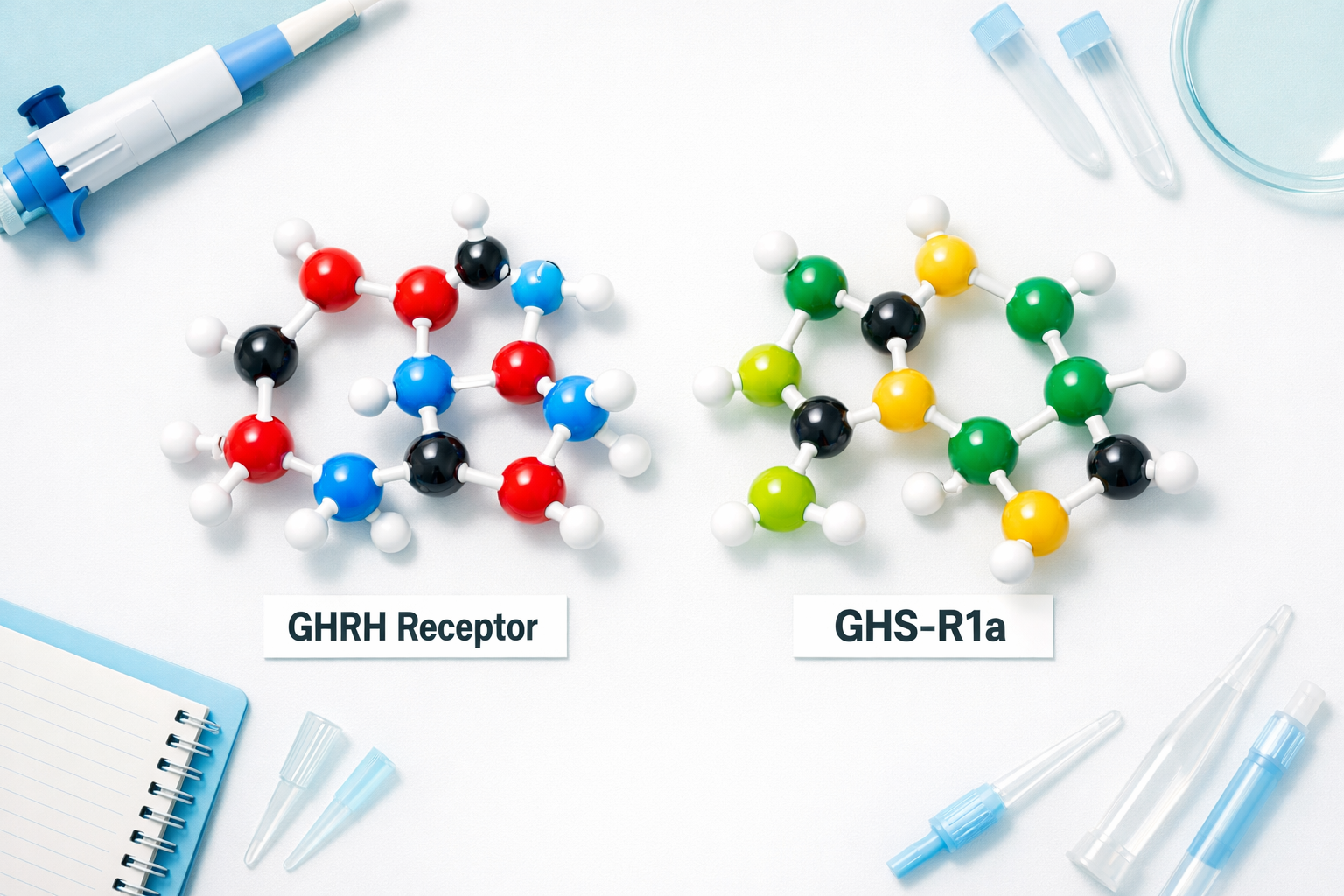
Bright editorial flat-lay landscape (): overhead studio shot of two distinct peptide molecular structure models side by side

Key Takeaways

  • Tesamorelin is a structural analog of GHRH that binds directly to GHRH receptors on pituitary somatotrophs, triggering the cAMP/PKA signaling cascade.
  • Ipamorelin is a selective GHS-R1a agonist that mimics ghrelin's receptor, producing GH release without significant cortisol or prolactin elevation.
  • Tesamorelin carries a trans-3-hexenoic acid modification that extends its half-life to roughly 26 minutes, far beyond native GHRH's sub-two-minute window.
  • Combining both peptides in research models can produce amplified GH secretion because they activate distinct, complementary receptor pathways.
  • Tesamorelin holds FDA approval for HIV-associated lipodystrophy; Ipamorelin remains a research compound as of 2026.

Distinct Receptor Targets: The Core of Differentiating GHRH Mimetic Activity

The most important distinction between these two peptides is where they bind.

Tesamorelin is a synthetic analog of endogenous human GHRH. It binds to GHRH receptors (GHRHR) located on somatotroph cells in the anterior pituitary. Once bound, it activates the cyclic AMP / protein kinase A (cAMP/PKA) pathway, which directly stimulates both GH synthesis and pulsatile GH release. Because it mirrors the body's own GHRH signal, its downstream effects closely replicate physiological GH secretion patterns.

Ipamorelin, by contrast, is a selective agonist of the growth hormone secretagogue receptor 1a (GHS-R1a), the same receptor that endogenous ghrelin activates. This is a fundamentally different binding site. The GHS-R1a pathway operates through a separate intracellular mechanism, and its activation produces GH release without the off-target hormonal effects seen with earlier secretagogues. Specifically, Ipamorelin does not meaningfully raise cortisol, ACTH, or prolactin levels, which makes it a cleaner research tool when isolating GH-specific outcomes.

For a deeper look at how Ipamorelin functions as a secretagogue, the IPA GHRH secretagogue research overview provides useful context.


Structural Modifications and Receptor Binding Kinetics

Structural Modifications and Receptor Binding Kinetics

Receptor binding is only part of the story. Binding kinetics, how long a peptide stays active, determine its practical utility in research protocols.

Native GHRH has a plasma half-life of under two minutes because it is rapidly degraded by dipeptidyl peptidase IV (DPP-IV). Tesamorelin addresses this through a structural addition: a trans-3-hexenoic acid group attached to its N-terminus. This modification confers resistance to enzymatic cleavage, extending its half-life to approximately 26 minutes. That is a roughly 13-fold improvement, allowing sustained receptor engagement and a more prolonged GH pulse.

Ipamorelin is a pentapeptide, just five amino acids, and its compact structure contributes to its receptor selectivity. Its binding affinity for GHS-R1a is high, and its small size reduces the likelihood of cross-reactivity with other receptor families. This selectivity is precisely why Ipamorelin became a benchmark compound in GH secretagogue research.

Feature Tesamorelin Ipamorelin
Receptor Target GHRHR (pituitary) GHS-R1a (ghrelin receptor)
Signaling Pathway cAMP/PKA Separate GHS pathway
Approximate Half-Life ~26 minutes Short (minutes)
Cortisol/Prolactin Effect Minimal Minimal to none
FDA Approval Status Yes (lipodystrophy) No (research only)

Researchers exploring how these kinetics translate to experimental design may also find value in reviewing CJC-1295 and Ipamorelin GH axis research, which examines related GHRH-class combinations.


Synergistic Research Applications and Practical Implications

Because Tesamorelin and Ipamorelin act on different receptors, their combined use in research models produces additive, and in some study designs, synergistic, GH release. This dual-pathway activation is the scientific rationale behind blended peptide formulations studied in preclinical settings.

From a research planning perspective, this complementarity is significant:

  • Tesamorelin drives GH release through the GHRH axis, closely mimicking natural pituitary stimulation.
  • Ipamorelin amplifies that signal through the ghrelin receptor axis, adding a second, independent GH secretion trigger.
  • Together, they may help researchers model more robust GH secretion states without resorting to exogenous GH administration.

Those interested in blended formulation research can explore the Tesamorelin, CJC-1295, and Ipamorelin blend reconstitution resource for technical preparation details.

Tesamorelin's clinical track record also distinguishes it. Approved by the FDA in 2010 under the brand name Egrifta for HIV-associated lipodystrophy, it remains the only GHRH analog to achieve that regulatory milestone. Researchers can review the broader Tesamorelin benefits profile and compare it with related analogs through the Tesamorelin vs. Sermorelin comparison to contextualize its position among GHRH-class peptides.

Ipamorelin, despite its strong selectivity profile and favorable tolerability data in preclinical models, has not received FDA approval for any clinical indication as of 2026. It remains classified as a research compound. For researchers sourcing it, the Ipamorelin research peptide catalog offers relevant product information.

"The receptor-level distinction between Tesamorelin and Ipamorelin is not a minor technical detail, it is the foundation for understanding why their combined use in research produces effects neither achieves independently."

For researchers also exploring metabolic endpoints alongside GH axis modulation, the metabolic modulation research lines overview provides a broader framework for study design.


Conclusion

Differentiating Tesamorelin and Ipamorelin: Differentiating Their GHRH Mimetic Activity and Receptor Binding in Research comes down to one foundational fact: they do not compete for the same receptor. Tesamorelin engages the GHRH receptor via cAMP/PKA signaling with an extended half-life enabled by structural modification. Ipamorelin selectively activates GHS-R1a without off-target hormonal effects. Each compound offers a distinct mechanistic lens for studying GH secretion.

Actionable next steps for researchers:

  • Define your receptor target before selecting a compound, GHRHR vs. GHS-R1a studies require different controls.
  • Consider dual-pathway protocols when studying maximal GH secretion states.
  • Review Tesamorelin's FDA-approved clinical data as a validated reference point for GHRH analog research.
  • Consult current literature on GHS-R1a selectivity when designing Ipamorelin studies to leverage its clean hormonal profile.

Selecting the right peptide for a given research question is not about which compound is "better", it is about which receptor system best models the biological question at hand.

https://www.puretestedpeptides.com/wp-content/uploads/2026/07/tesa-and-ipamorelin-differentiating-their-ghrh-mimetic-activity-and-recep.webp 1024 1536 Pure Tested https://www.puretestedpeptides.com/wp-content/uploads/2026/01/buy-peptides-online.jpg Pure Tested2026-07-13 13:19:352026-07-20 15:00:12Tesamorelin and Ipamorelin: Differentiating Their GHRH Mimetic Activity and Receptor Binding in Research
×

Helpful Links

  • My account
  • Cart
  • Checkout
  • Refund and Returns Policy
  • Privacy Policy
  • SMS Privacy Policy
  • Login
  • My Account
  • Logout

USA Made Lab Tested Peptides

All products are sold for research, laboratory, or analytical purposes only, and are not for human consumption


Pure Tested Peptides is a chemical supplier. Pure Tested Peptides is not a compounding / chemical compounding facility as defined under 503A of the Federal Food, Drug, and Cosmetic act. Pure Tested Peptides is not an outsourcing facility as defined under 503B of the Federal Food, Drug, and Cosmetic act.

The statements made within this website have not been evaluated by the US Food and Drug Administration. The products we offer are not intended to diagnose, treat, cure or prevent any disease.

Human/Animal Consumption Prohibited. Laboratory/In-Vitro Experimental Use Only

Scroll to top Scroll to top Scroll to top