

GLP-3 Retatrutide Research Models: How to Separate GLP-1, GIP, and Glucagon Receptor Contributions
Retatrutide activates three distinct hormone receptors simultaneously, yet most published analyses treat its effects as a single pharmacological event. That framing obscures the mechanistic picture and limits the design of better molecules. The real scientific challenge is attribution: which receptor drives appetite suppression, which governs energy expenditure, and which fine-tunes insulin secretion? Applying rigorous GLP-3 Retatrutide Research Models to separate GLP-1, GIP, and glucagon receptor contributions is now a central priority in metabolic pharmacology.
Key Takeaways
- Retatrutide is intentionally engineered with higher potency at GIPR and reduced potency at GLP-1R and GCGR relative to native ligands, encoding a separable receptor "weighting" that can be exploited in mechanistic studies.
- GLP-1R blockade or knockout primarily blunts appetite suppression and gastric emptying delay; GCGR disruption mainly reduces energy expenditure, lipid oxidation, and natriuresis.
- Single-receptor cell lines measuring cAMP and beta-arrestin recruitment provide the cleanest in vitro separation of each receptor's signaling contribution.
- Cryo-EM structures reveal receptor-specific conformations at ECL1 and TM1, enabling rational design of chimeric and mutant receptors for mechanistic dissection.
- Orthogonal biomarker panels, indirect calorimetry, hepatic MRI-PDFF, gastric emptying scintigraphy, and glucagon/ketone profiles, allow investigators to attribute clinical endpoints to specific receptor arms.
Understanding Retatrutide's Engineered Receptor Weighting
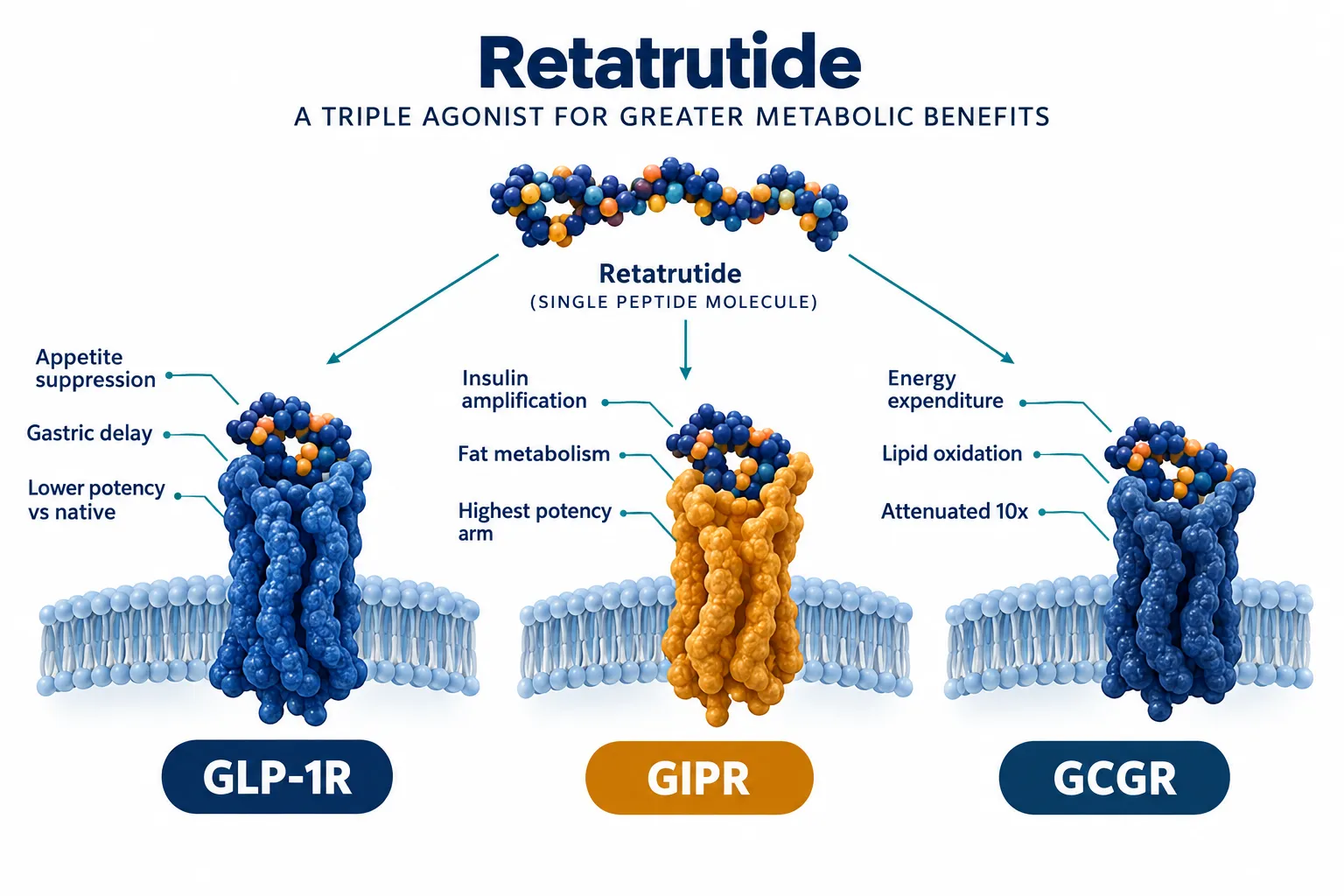
Retatrutide (LY3437943) is a synthetic fatty diacid-conjugated peptide that co-activates GLP-1R, GIPR, and GCGR. Its design is deliberately asymmetric. In human receptor assays, it shows several-fold greater potency at GIPR than endogenous GIP itself, while displaying lower potency than native GLP-1 at GLP-1R and lower potency than native glucagon at GCGR. Glucagon receptor activity is intentionally attenuated to roughly one-tenth of GLP-1R activity.
This asymmetry is not incidental, it is the foundation for receptor-deconvolution research. Because each arm operates at a different intrinsic potency, dose-response experiments can be designed to selectively saturate one receptor while leaving others sub-maximally engaged. Researchers exploring GLP-1 Retatrutide activity profiles will recognize this tiered potency as a built-in experimental lever.
Why this matters for modeling: A molecule with equal potency at all three receptors would make attribution nearly impossible. Retatrutide's intentional imbalance means that incremental dose increases will disproportionately engage the highest-affinity receptor first, allowing investigators to map which effects emerge at low, medium, and high occupancy.
Core Experimental Strategies in GLP-3 Retatrutide Research Models: How to Separate GLP-1, GIP, and Glucagon Receptor Contributions
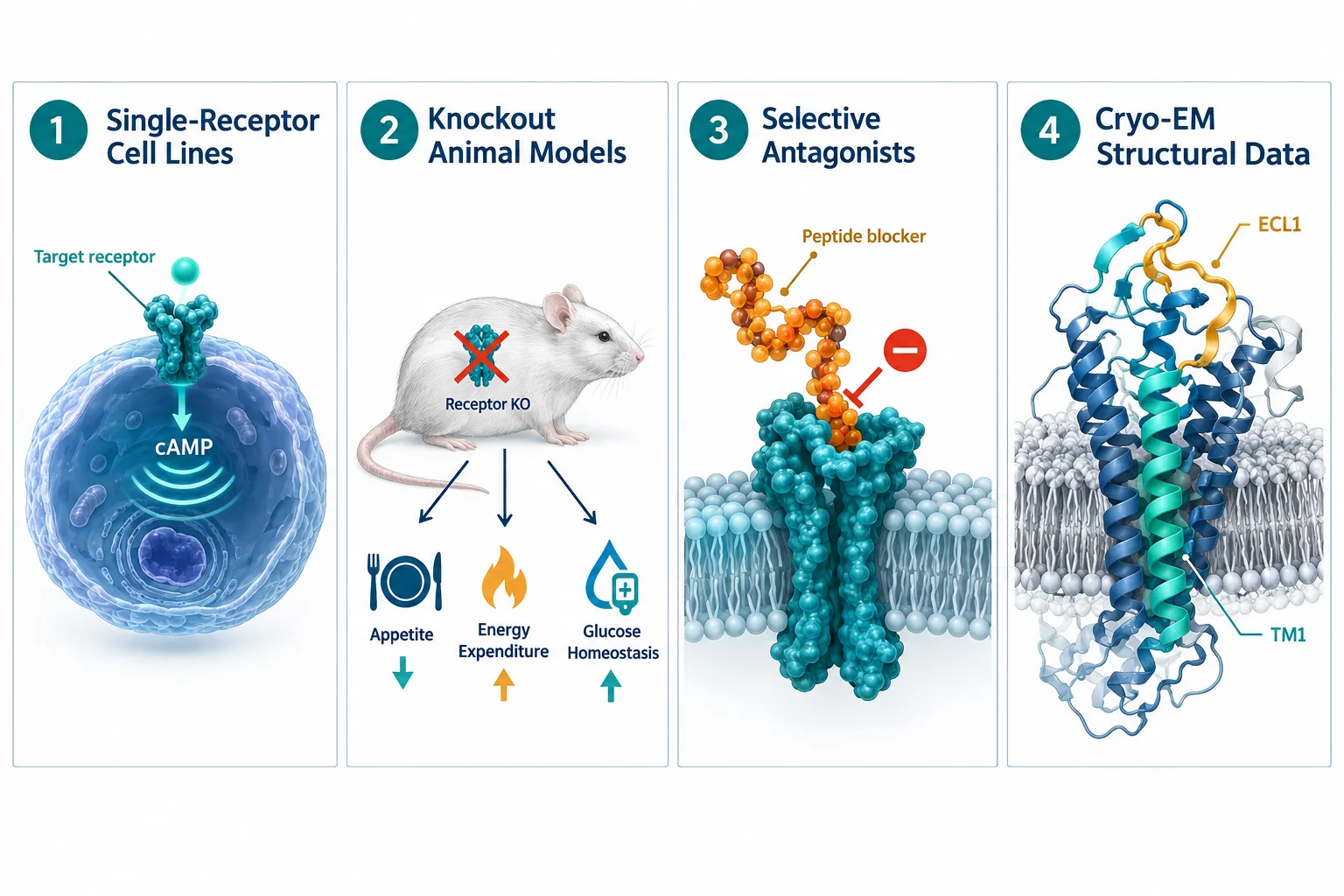
Single-Receptor Cell Lines and In Vitro Signaling Assays
The cleanest starting point for receptor attribution is a cell system expressing only one receptor. By exposing GLP-1R-only, GIPR-only, or GCGR-only cell lines to retatrutide and measuring:
- cAMP accumulation (primary Gs-coupled readout)
- Beta-arrestin recruitment (biased signaling indicator)
- Receptor internalization kinetics
…investigators generate EC50 and Emax values for each receptor in isolation. Comparing these values against native ligand benchmarks quantifies how much of the molecule's activity "belongs" to each receptor arm. This approach directly supports the broader goal of GLP-3 Retatrutide Research Models to separate GLP-1, GIP, and glucagon receptor contributions at the molecular level.
Cryo-EM Structural Models as a Design Blueprint
High-resolution cryo-EM structures of retatrutide bound separately to GLP-1R, GIPR, and GCGR reveal a single continuous alpha-helix penetrating the transmembrane core. The N-terminal segment (residues 1-13) drives receptor activation, while the C-terminal helix engages the extracellular domain and ECL1.
Critically, receptor-specific conformational differences appear at ECL1 and the extracellular tip of TM1. These structural distinctions provide a rational basis for:
- Introducing point mutations at receptor-peptide contact sites
- Building chimeric receptors that swap ECL1 regions between GLP-1R and GCGR
- Designing analogs with altered N-terminal sequences to bias activation toward one receptor
These tools allow researchers to test how specific peptide-receptor contacts govern signaling, turning structural data into functional attribution experiments.
Preclinical Knockout and Antagonist Models
Animal models remain the gold standard for whole-organism receptor attribution:
| Intervention | Primary Effect Reduced | Preserved Effects |
|---|---|---|
| GLP-1R knockout or blockade | Appetite suppression, gastric emptying delay | Glucose lowering, energy expenditure |
| GCGR knockout or antagonism | Energy expenditure, lipid oxidation, natriuresis | Appetite suppression, insulin secretion |
| GIPR deficiency | Insulin secretory response, adipose metabolism | Appetite effects largely intact |
This table reflects a consistent pattern across multiple preclinical studies: each receptor arm has a dominant physiological role that becomes visible only when the other arms are silenced. For researchers sourcing materials for such studies, options like buy Retatrutide peptide and GLP-3 Retatrutide buy online USA provide access to research-grade material.
Orthogonal Biomarker Panels and Clinical Attribution Frameworks
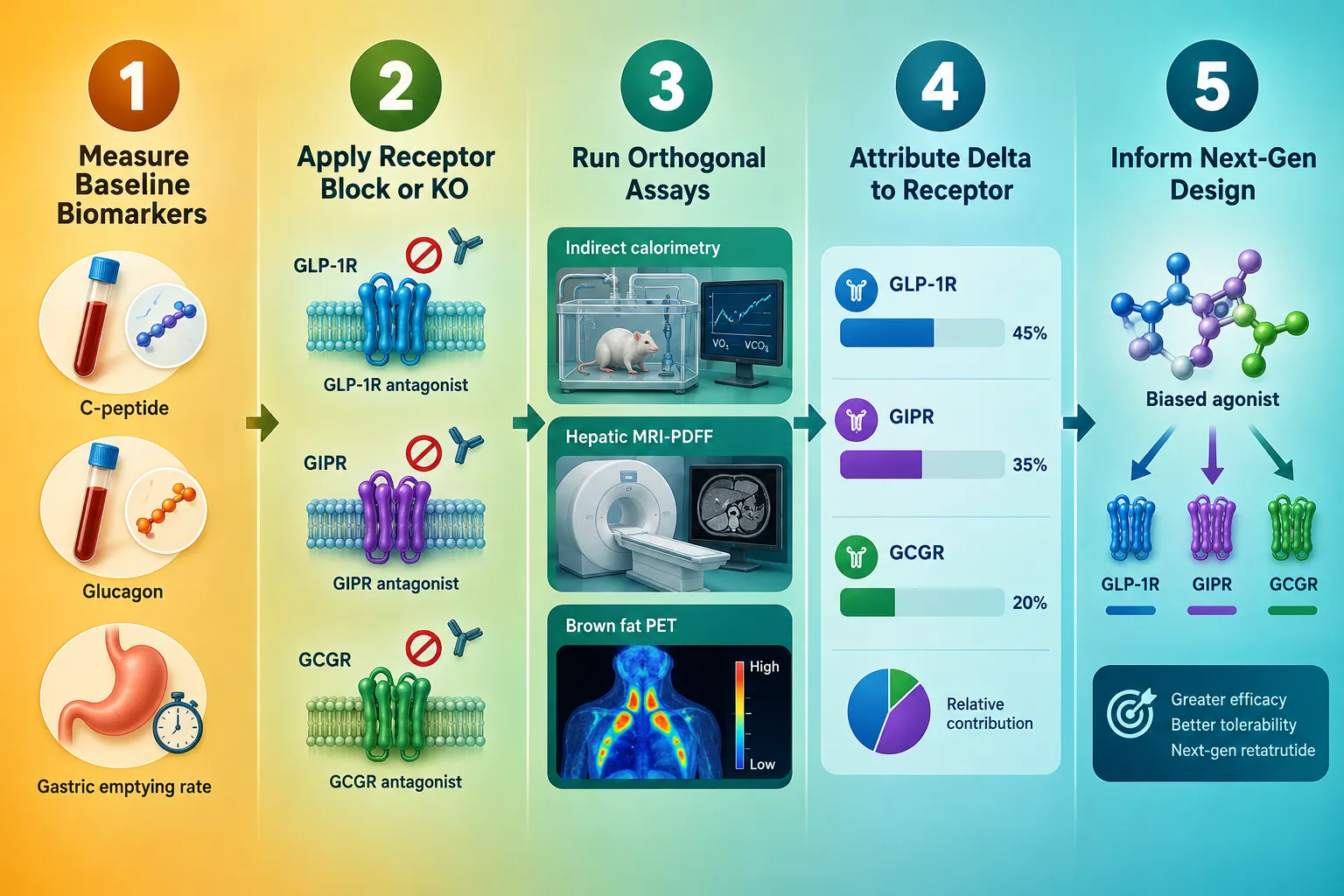
Preclinical knockout data only goes so far. In clinical and translational settings, receptor-specific attribution relies on orthogonal biomarker panels, multiple independent readouts that each correlate preferentially with one receptor arm.
GLP-1R-dominant biomarkers:
- Gastric emptying scintigraphy (delayed emptying tracks GLP-1R engagement)
- Nausea and vomiting incidence (GI adverse events mirror GLP-1 agonist patterns)
- Appetite visual analog scores
GIPR-dominant biomarkers:
- Insulin/C-peptide ratios during mixed-meal tolerance tests
- Adipose tissue lipolysis markers
- Musculoskeletal symptom patterns in adverse-event monitoring
GCGR-dominant biomarkers:
- Indirect calorimetry (resting energy expenditure and respiratory quotient)
- Hepatic MRI-PDFF for liver fat quantification
- Brown adipose tissue activity via PET imaging
- Glucagon and ketone body profiles
- Natriuresis and renal hemodynamic measures
"By comparing retatrutide's weight and HbA1c outcomes to those of GLP-1 mono-agonists and GLP-1/GIP dual agonists in meta-analyses, modeling studies apportion the incremental 3-5% additional weight loss and greater hepatic fat reduction largely to the glucagon receptor component."
This comparative framework, triagonist versus dual agonist versus mono-agonist, functions as a clinical receptor-subtraction model. The "extra" efficacy beyond what tirzepatide or semaglutide achieves is attributed to the GCGR arm by difference. Researchers interested in the broader cardiometabolic context can explore polypeptide peptides in cardiometabolic models for additional comparative context.
Pharmacokinetic Modeling as a Temporal Lever
Retatrutide's fatty diacid conjugation produces a half-life of approximately six days, enabling once-weekly dosing. Because GLP-1R, GIPR, and GCGR differ in internalization and desensitization kinetics, PK/PD time-course modeling reveals how receptor contributions shift across the dosing interval. GLP-1R and GIPR effects tend to dominate early satiety and postprandial glucose control, while sustained GCGR engagement drives ongoing energy expenditure and lipid oxidation later in the cycle. This temporal separation adds another dimension to the attribution toolkit.
For researchers sourcing high-purity material for PK/PD studies, GLP-3 Reta 20mg and Reta 20mg for sale options are available with third-party purity verification.
Future Directions: Biased Agonism and Next-Generation Attribution Tools
The 2026 research landscape points toward increasingly precise receptor-deconvolution strategies. Several developments are expected to advance the field:
- Biased agonist analogs, GCGR-biased molecules for NASH research; GLP-1/GIP-biased analogs for pure glycemic control, will allow prospective attribution rather than retrospective subtraction
- Tissue-targeted delivery, hepatic-targeted GCGR agonism to isolate liver-specific effects from systemic thermogenesis
- Receptor-selective biomarker panels in phase 3 trials, systematic collection of indirect calorimetry, hepatic imaging, and renal endpoints to formally decompose triagonist effects
- Chimeric receptor mutagenesis panels, expanded use of ECL1-swapped and TM1-mutant constructs informed by cryo-EM data
These approaches collectively move the field from descriptive pharmacology toward quantitative receptor attribution, the ultimate goal of rigorous GLP-3 Retatrutide Research Models that separate GLP-1, GIP, and glucagon receptor contributions with experimental precision. Researchers building these models can also reference IPA Sermorelin stack research for comparative multi-peptide experimental design strategies.
Conclusion
Separating the individual receptor contributions of retatrutide is not merely an academic exercise, it directly informs the design of safer, more targeted metabolic therapies. The practical framework involves four complementary layers: engineered potency asymmetry as a built-in experimental lever, single-receptor cell assays and cryo-EM structural data for molecular-level attribution, knockout and antagonist animal models for whole-organism validation, and orthogonal biomarker panels for clinical translation.
Actionable next steps for researchers in 2026:
- Establish single-receptor cell lines expressing GLP-1R, GIPR, or GCGR individually before running multi-receptor assays
- Pair every in vivo retatrutide experiment with at least one receptor-selective antagonist arm to generate subtraction data
- Include indirect calorimetry and hepatic imaging endpoints alongside glycemic measures to capture GCGR-specific signals
- Use PK/PD time-course sampling at 24h, 72h, and 144h post-dose to capture temporal shifts in receptor dominance
- Cross-reference findings against published triagonist versus dual-agonist comparator data to validate receptor attribution estimates
For research teams sourcing verified material, buy GLP-3 peptide 10mg 99% pure third-party tested options ensure experimental reproducibility from the starting point.