Call or Text 727-513-9780
  • Shopping Cart Shopping Cart
    0Shopping Cart
Pure Tested Peptides | America's most trusted Peptides for sale online
  • Peptides for sale
    • Oral Peptides for sale
      • Peptide Capsules for sale
      • BPC 157 Capsules 1000mcg
      • SLU-PP-332 Capsules | 1000 mcg
      • 5-Amino-1MQ 50mg Capsules
      • Tesofensine 500mcg
    • All Peptides for sale
    • Peptide Sprays
      • BPC 157 Nasal Spray Kit
      • BPC-157 TB500 Nasal Spray Kit
      • Semax Nasal Spray 10mg
      • Selank – Nasal Spray Kit – 10mg
      • Epithalon 50MG Nasal Spray Kit
      • Ipamorelin 10mg Nasal Spray
      • Klow Nasal Spray (BPC-157 + TB-500 + GHK-Cu + KPV) | 80mg
      • Hulk Nasal Spray Tesa / Ipa Blend 6/3 MG
      • Klow Nasal Spray
      • NAD + 500 mg Nasal Spray
      • PT-141 Nasal Spray Kit
    • GHRH Peptides
      • Ipa Peptides
      • CJC-1295 Peptides
        • CJC-1295 with DAC 5 mg
        • CJC-1295 without DAC 5 mg
        • CJC-1295 Ipa 10mg
      • Tesa Peptides
        • Tesa Peptide
        • Tesa 20 mg
    • GHK-Cu Peptides
      • All GHK-Cu Peptides
      • GHK-Cu 100mg
      • KLOW Peptide Blend – Buy KLOW blend online
    • BPC Peptides
      • All BPC Peptides
      • BPC-157
      • BPC-157 TB-500
      • BPC 157 capsules 1000mcg
    • SLU-PP-332 Peptides
      • All SLU-PP-332 Peptides
      • SLU-PP-332 5mg
    • GLP3 Peptides
      • GLP3-R
      • GLP3-R CAG 10mg
      • GLP3-R 20mg
    • PT-141 Peptides
      • PT-141 Peptides for sale
      • PT-141 10mg
      • PT-141 Nasal Spray
    • CAG Peptides
      • Lipo-C Peptide Blend
      • CAG 5mg
      • CAG 10mg
    • MOTS-C Peptides
      • MOTS-C Peptides for sale
      • MOTS-c peptide
      • MOTS-c 10mg *6 pack*
    • 5 Amino 1MQ Peptides
      • 5 Amino 1MQ Peptides for sale
      • 5-Amino-1MQ 50mg Capsules
      • 5-Amino-1MQ 5mg
    • Epithalon Peptides
      • Epithalon Peptides for sale
      • Epithalon 10mg
      • Epithalon 50mg
  • Shop
    • GLPs
      • 5-Amino-1MQ 50mg Capsules
      • 5-Amino-1MQ 5mg
      • GLP3-Reta
      • L-Carnitine 500mg/ml
      • Tesofensine 500mcg
      • SLU-PP-332 5mg
      • MOTS-c 10mg *6 pack*
    • Epithalon & BPC Peptides
      • Epithalon 10mg
      • Epithalon 50mg
      • BPC-157
      • BPC 157 capsules 1000mcg
      • BPC-157 TB-500
      • BPC-157 TB500 Nasal Spray Kit
      • BPC 157 Nasal Spray Kit
    • BPC TB-500 & NAD+ Peptides
      • NAD+ 500 mg
      • KLOW Peptide Blend – Buy KLOW blend online
      • GLOW Peptide Blend
      • TB 500 5mg
      • BPC 157 capsules 1000mcg – Supplement
      • BPC 157 Nasal Spray Kit
      • BPC-157
      • BPC-157 TB500 Nasal Spray Kit
      • BPC-157 TB-500
      • BPC 157 capsules 1000mcg
    • LL-37 Peptide
      • LL-37 10 mg
    • MOTS-C & Selank
      • MOTS-c peptide
      • Selank 10mg
    • GHK Peptides
      • GHK-Cu 100mg
      • GLOW Peptide Blend
      • KLOW Peptide Blend – Buy KLOW blend online
  • COAs
  • Wholesale
    • Wholesale Peptides for sale
  • PTP FAQ
  • Affiliates
    • Selank Peptide: Advanced Pharmacological Mechanisms Underlying Its Anxiolytic and Nootropic Effects in Research
      • 5-Amino-1MQ Peptide: Detailed Mechanisms of NNMT Inhibition and Its Impact on Cellular Metabolism Research
        • MOTS-C Peptide: Unraveling Its Role in Mitochondrial Dynamics and Energy Metabolism Research
          • Epithalon Peptide and Telomerase Regulation: Investigating Its Impact on Cellular Senescence and Lifespan Research Models
            • GLP2-T vs GLP2 Tirz Peptide: Understanding the Naming, Mechanistic Nuances, and Research Implications for Gut Health
      • Peptides and Polypeptides in Modern Pharmacology: What Research on Metoprolol, Prednisone, and Amlodipine Reveals
        • Polypeptide Peptides vs NSAIDs: What Naproxen and Diclofenac Teach Tissue-Repair Researchers About BPC‑157 and TB‑500
          • Peptides and Polypeptides in Endocrine Pharmacology: How GLP-1, GLP-2, and GLP-3 Retatrutide Differ From Classic Drugs Like Prednisone and Amlodipine
          • 5‑Amino‑1MQ Peptide and NNMT Inhibition: How It Compares With Statins Like Atorvastatin in Adipose and Lipid Metabolism Research
      • Enclomiphene, Estrogen Receptor Signaling, and Luteinizing Phase Biology: What Hormone Researchers Should Measure
        • Mesenchymal Stem Cells, BPC‑157, and GHK‑Cu: How Tissue Repair Peptides Compare With Classic NSAIDs Like Naproxen in Injury Models
          • Peptide Calculator Use Cases Beyond Growth Hormone: Working Through GLP‑3 Retatrutide, MOTS‑c, and BPC‑157 Research Dosing
        • Polypeptide Peptides in Endocrine and Metabolic Pharmacology: Lessons From Amlodipine, Prednisone, and Metoprolol
        • Peptides Calculator for Advanced Blends: Worked Examples for Tesamorelin, CJC‑1295, and Ipamorelin Stacks
          • Peptides and Polypeptides in Human Physiology: How Molecular Size Shapes Research Applications
            • Selank Peptide: Advanced Pharmacological Mechanisms Underlying Its Anxiolytic and Nootropic Effects in Research
          • 5-Amino-1MQ Peptide: Detailed Mechanisms of NNMT Inhibition and Its Impact on Cellular Metabolism Research
            • MOTS-C Peptide: Unraveling Its Role in Mitochondrial Dynamics and Energy Metabolism Research
              • Epithalon Peptide and Telomerase Regulation: Investigating Its Impact on Cellular Senescence and Lifespan Research Models
                • GLP2-T vs GLP2 Tirz Peptide: Understanding the Naming, Mechanistic Nuances, and Research Implications for Gut Health
                  • Peptides and Polypeptides in Endocrine Pharmacology: How GLP-1, GLP-2, and GLP-3 Retatrutide Differ From Classic Drugs Like Prednisone and Amlodipine
                    • Polypeptide Peptides vs NSAIDs: What Naproxen and Diclofenac Teach Tissue-Repair Researchers About BPC‑157 and TB‑500
                      • Peptides and Polypeptides in Modern Pharmacology: What Research on Metoprolol, Prednisone, and Amlodipine Reveals
                        • 5‑Amino‑1MQ Peptide and NNMT Inhibition: How It Compares With Statins Like Atorvastatin in Adipose and Lipid Metabolism Research
                        • Enclomiphene, Estrogen Receptor Signaling, and Luteinizing Phase Biology: What Hormone Researchers Should Measure
                        • Mesenchymal Stem Cells, BPC‑157, and GHK‑Cu: How Tissue Repair Peptides Compare With Classic NSAIDs Like Naproxen in Injury Models
                        • Peptide Calculator Use Cases Beyond Growth Hormone: Working Through GLP‑3 Retatrutide, MOTS‑c, and BPC‑157 Research Dosing
                        • Polypeptide Peptides in Endocrine and Metabolic Pharmacology: Lessons From Amlodipine, Prednisone, and Metoprolol
                        • Peptides Calculator for Advanced Blends: Worked Examples for Tesamorelin, CJC‑1295, and Ipamorelin Stacks
                        • Peptides and Polypeptides in Human Physiology: How Molecular Size Shapes Research Applications
                        • Selank Peptide: Advanced Pharmacological Mechanisms Underlying Its Anxiolytic and Nootropic Effects in Research
                        • MOTS-C Peptide: Unraveling Its Role in Mitochondrial Dynamics and Energy Metabolism Research
                        • Peptides and Polypeptides in Modern Pharmacology: What Research on Metoprolol, Prednisone, and Amlodipine Reveals
                        • Peptides and Polypeptides in Endocrine Pharmacology: How GLP-1, GLP-2, and GLP-3 Retatrutide Differ From Classic Drugs Like Prednisone and Amlodipine
                        • 5-Amino-1MQ Peptide: Detailed Mechanisms of NNMT Inhibition and Its Impact on Cellular Metabolism Research
                        • Mesenchymal Stem Cells, BPC‑157, and GHK‑Cu: How Tissue Repair Peptides Compare With Classic NSAIDs Like Naproxen in Injury Models
                        • Peptide Calculator Use Cases Beyond Growth Hormone: Working Through GLP‑3 Retatrutide, MOTS‑c, and BPC‑157 Research Dosing
                        • GLP2-T vs GLP2 Tirz Peptide: Understanding the Naming, Mechanistic Nuances, and Research Implications for Gut Health
                        • Polypeptide Peptides in Endocrine and Metabolic Pharmacology: Lessons From Amlodipine, Prednisone, and Metoprolol
                        • Polypeptide Peptides vs NSAIDs: What Naproxen and Diclofenac Teach Tissue-Repair Researchers About BPC‑157 and TB‑500
                        • Peptides and Polypeptides in Human Physiology: How Molecular Size Shapes Research Applications
                        • Peptides Calculator for Advanced Blends: Worked Examples for Tesamorelin, CJC‑1295, and Ipamorelin Stacks
                        • 5‑Amino‑1MQ Peptide and NNMT Inhibition: How It Compares With Statins Like Atorvastatin in Adipose and Lipid Metabolism Research
                        • Enclomiphene, Estrogen Receptor Signaling, and Luteinizing Phase Biology: What Hormone Researchers Should Measure
                        • Epithalon Peptide and Telomerase Regulation: Investigating Its Impact on Cellular Senescence and Lifespan Research Models
                        • Best research protocol Klow blend
                        • best time to take BPC-157
                        • best time to take DSIP (Delta Sleep Inducing Peptide)
                        • best time to take CJC-1295
                        • best time to take AOD-9604
                        • best time to take Follistatin 344
                        • best time to take Ipamorelin
                        • best time to take MK-677 (Ibutamoren)
                        • best time to take Ligandrol (LGD-4033) — research compound
                        • best time to take Ostarine (MK-2866) — research compound
                        • best time to take GHK-CU
                        • best time to take TB-500
                        • best time to take MOTS-c
                        • best time to take Semax
                        • best time to take RAD-140 (Testolone) — research compound
                        • best time to take Thymosin Alpha-1
                        • best time to take PEG-MGF
                        • Biolife Plasma, Octapharma Plasma, and Research Peptides: How Plasma Donation Labs Differ From Peptide Suppliers
                        • best time to take YK-11 — research compound
                        • best time to take PT-141 (Bremelanotide)
                        • Best research protocol Klow blend
                        • 5-Amino-1MQ and MOTS-C Synergy: Metabolic Signaling, Mitochondria, and Research Design
                        • BPC-157 and TB-500: Investigating Their Combined Effects on Angiogenesis and Cellular Migration in Tissue Repair Models
                        • BPC-157 Peptide: Gut Barrier Function, Inflammation, and Tissue-Recovery Research
                        • 5‑Amino‑1MQ and MOTS‑c Synergy in Metabolic Research: Designing NNMT and Mitochondrial Biogenesis Stacks
                        • CJC-1295 with DAC vs. Without DAC: Half-Life, Release Kinetics, and Research Implications
                        • CJC‑1295 with DAC vs. Without DAC: Expanding on Half‑Life Differences Using Tesamorelin and Ipamorelin Blend Case Studies
                        • Collagen Biology and Copper‑Binding Peptides: How GHK‑Cu, Glow Blend, and Klow Blend Interact with Skin and Connective Tissue
                        • Collagen Biology and Regenerative Peptides: How GHK‑Cu, Glow Blend, and Klow Blend Affect Extracellular Matrix Research
                    • DNA, Telomeres, and Longevity Peptides: Positioning Epithalon and MOTS‑c in Genetic Aging Research
                      • Enclomiphene Citrate: serm Mechanism, Testosterone Research, and Stack Compatibility
                        • Enclomiphene vs Enclomiphene Citrate: Formulation, Bioavailability, and Research Distinctions
                        • Epithalon Peptide Research: Telomerase Activation, Aging, and Pineal Gland Function
                        • Estrogen Receptor Signaling and Enclomiphene: How Selective Modulators Compare with Classic Polypeptide Hormones
                        • GHK-Cu Peptide: Advanced Mechanisms in Extracellular Matrix Remodeling and Wound Healing Research
                        • GHK-Cu Peptide: Collagen Synthesis, Wound Repair, and Skin-Barrier Research Models
                        • GLP-1 vs GLP-3 vs GLP-2: Peptide Classification and Research Applications
                        • GLP-2 Peptide Research Guide: Gut Barrier Function, Nutrient Absorption, and Intestinal Recovery Models
                        • GLP-3 Retatrutide vs. GLP-1 Drugs: What Triple-Agonist Biology Changes in Research Models
                        • Ipamorelin and Tesamorelin Combination: Synergistic GH Secretagogue Research and Dosing Protocols
                        • GLP2 Tirz Peptide: What It Is, Why the Name Exists, and How Researchers Should Interpret It
                        • Klow Blend Peptide Nasal Spray: What the Formulation Is Trying to Do in Cognitive Research
                        • Mitochondria, NNMT Inhibition, and Peptide Modulators: Where MOTS‑c and 5‑Amino‑1MQ Fit in Cellular Energy Research
                        • MOTS-c Peptide: Mitochondrial Function, Energy Metabolism, and What Researchers Measure
                        • MOTS-c vs. 5-Amino-1MQ: Which Metabolic Research Questions Each Compound Actually Answers
                        • Nasal Spray Peptides: Bioavailability, Administration, and Semax/Selank Research Applications
                        • PT-141 Peptide Research: Mechanism of Action and Melanocortin Receptor Signaling
                        • Retatrutide for Research: Mechanism, Structure, and GLP-1/GLP-3 Dual Action
                        • Retatrutide for Obesity and Type 2 Diabetes: What the Latest Trial Data Suggest
                        • Tesofensine Peptide Research: Mechanism, Appetite Suppression, and Neuropeptide Y Pathways
  • Contact
    • Contact Customer Service
    • Text Customer Support
  • About US
  • Shop all peptides
  • Affiliate Program
    • Affiliate Signup
  • Login / Register Login / Register Page Link Login / Register Page Link
  • Click to open the search input field Click to open the search input field Search
  • Menu Menu

Tag Archive for: salt correction factor

Where Researchers Compare Enclomiphene vs Enclomiphene Citrate in Lab-Use Planning

Where Researchers Compare Enclomiphene vs Enclomiphene Citrate in Lab-Use Planning

August 12, 2026/0 Comments/in Uncategorized/by

Roughly 30% of published peptide and small-molecule research studies report compound identity issues that affect reproducibility, and selective estrogen receptor modulator (serm) research is no exception. When researchers plan experiments around enclomiphene, a naming inconsistency can quietly distort dose calculations, purity expectations, and cross-study comparisons before a single assay runs. Understanding where researchers compare enclomiphene vs enclomiphene citrate in lab-use planning is not a minor administrative detail; it is a foundational step in experimental design.
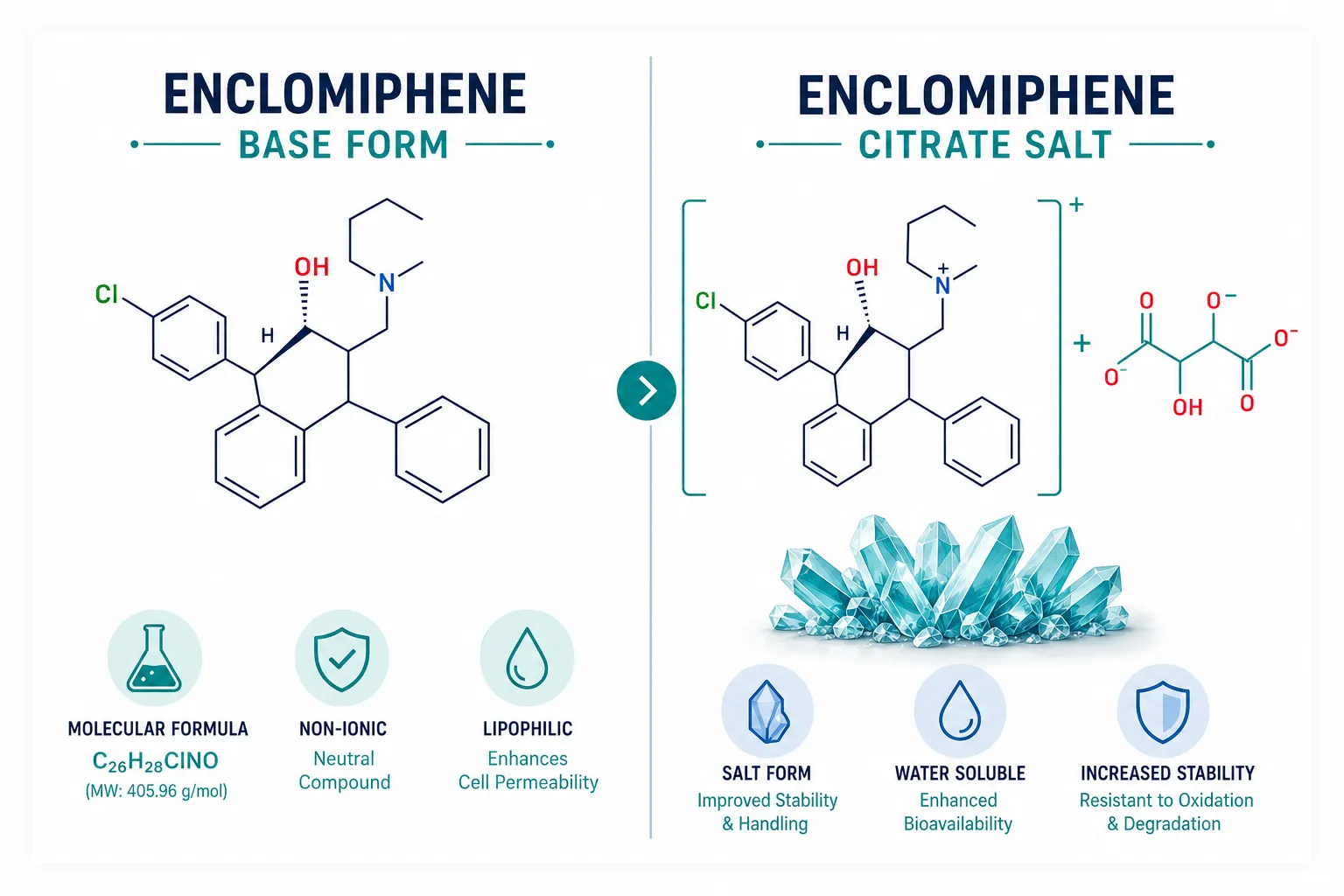
Split-screen editorial illustration (): left half shows a clean molecular diagram of enclomiphene base compound with short

Key Takeaways

  • Enclomiphene is the active trans-isomer base compound; enclomiphene citrate is a salt form that includes citric acid, affecting molecular weight and effective dose calculations.
  • The two names are sometimes used interchangeably by vendors, which can introduce dosing errors in lab-use planning.
  • Researchers should verify the exact chemical form listed on a Certificate of Analysis (CoA) before designing protocols.
  • Salt correction factors must be applied when converting between base and citrate weights to maintain experimental accuracy.
  • Sourcing from suppliers that clearly distinguish form, purity grade, and CoA documentation reduces inter-study variability.

Understanding the Chemical Distinction Between Enclomiphene and Enclomiphene Citrate

Enclomiphene is the trans-isomer of clomiphene. It acts as a selective estrogen receptor antagonist at the hypothalamic level, which is why it draws interest in research models focused on the hypothalamic-pituitary-gonadal (HPG) axis. For a deeper look at how this compound interfaces with estrogen receptor biology, see Peptides and Polypeptides in Endocrine Pharmacology: How Enclomiphene Interfaces with Estrogen Receptor Biology.

Enclomiphene citrate is the same molecule bound to citric acid as a counter-ion to form a more stable, water-soluble salt. This is a common pharmaceutical formulation strategy. The critical point for researchers: the two forms have different molecular weights.

Form Approximate Molecular Weight
Enclomiphene (free base) ~406 g/mol
Enclomiphene citrate (salt) ~598 g/mol

This difference means that 10 mg of enclomiphene citrate does not deliver 10 mg of active enclomiphene. The free base content is approximately 68% of the citrate salt weight. Ignoring this conversion is one of the most common sources of dosing error in serm-related lab protocols.

Why Vendor Labels Complicate the Comparison

Many research chemical suppliers use the two names without consistent distinction. A product labeled "enclomiphene" may actually be the citrate salt, and vice versa. This is where researchers compare enclomiphene vs enclomiphene citrate in lab-use planning most critically, at the sourcing stage, before any reagent is weighed.

The practical solution is straightforward: always request and review the Certificate of Analysis (CoA) from the supplier. The CoA should state:

  • Exact chemical name (including salt form if applicable)
  • CAS number (enclomiphene free base: 15690-57-0; enclomiphene citrate: 7599-79-3)
  • Purity percentage by HPLC
  • Isomeric ratio confirmation (trans vs. cis content)

For guidance on sourcing compounds with proper purity documentation, Where to Buy Research-Grade Enclomiphene and Enclomiphene Citrate provides a detailed breakdown of what to look for in supplier documentation.

How Form Identification Shapes Lab-Use Planning
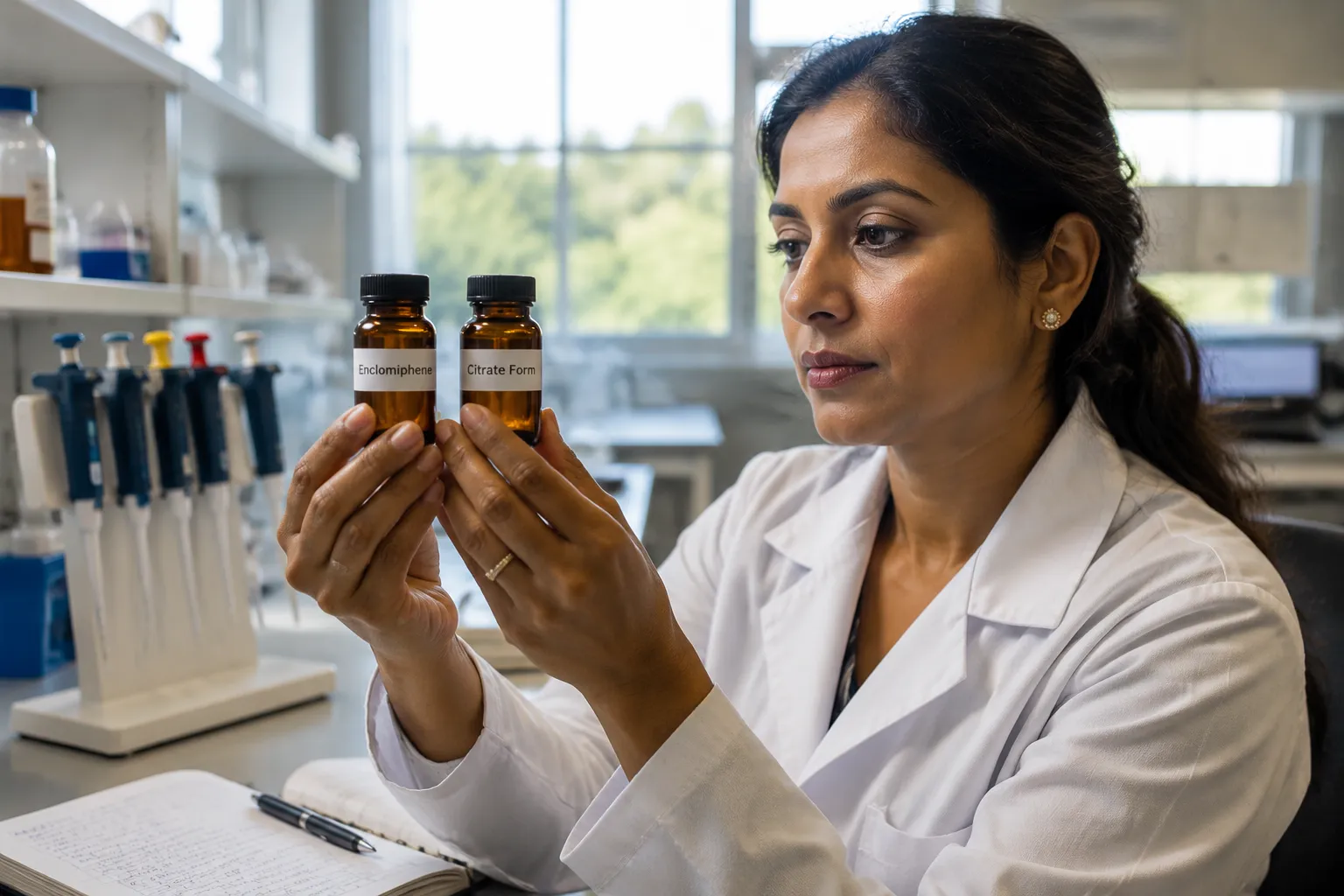
How Form Identification Shapes Lab-Use Planning

Once the chemical form is confirmed, researchers can apply the correct salt correction factor to their protocols. This step is not optional, it directly affects:

  • Stock solution concentration calculations
  • In vitro cell culture dosing accuracy
  • Cross-study comparability when referencing published literature

"A compound that is 98% pure as a citrate salt is not the same as 98% pure enclomiphene free base. Both numbers are accurate, but they describe different things."

Most published mechanistic studies on enclomiphene use the free base form or explicitly state the salt form with a correction factor applied. When researchers compare enclomiphene vs enclomiphene citrate in lab-use planning, aligning with the form used in reference literature prevents systematic bias.

Solubility and Stability Considerations

The citrate salt form generally offers better aqueous solubility, which can be advantageous for certain assay formats. The free base may require DMSO or ethanol as a vehicle solvent, which introduces its own set of experimental controls.

Key solubility planning points:

  • Citrate salt: higher aqueous solubility, suitable for buffer-based assays
  • Free base: typically requires organic co-solvents; vehicle controls are essential
  • Both forms: store desiccated, away from light, at -20°C for long-term stability

Researchers working on related endocrine axis compounds may find useful parallel context in Peptides and Polypeptides in Modern Research: How Molecular Size Shapes Function, Stability, and Experimental Design, which covers how molecular form affects experimental outcomes across compound classes.

Practical Sourcing Decisions: Where Researchers Compare Enclomiphene vs Enclomiphene Citrate in Lab-Use Planning
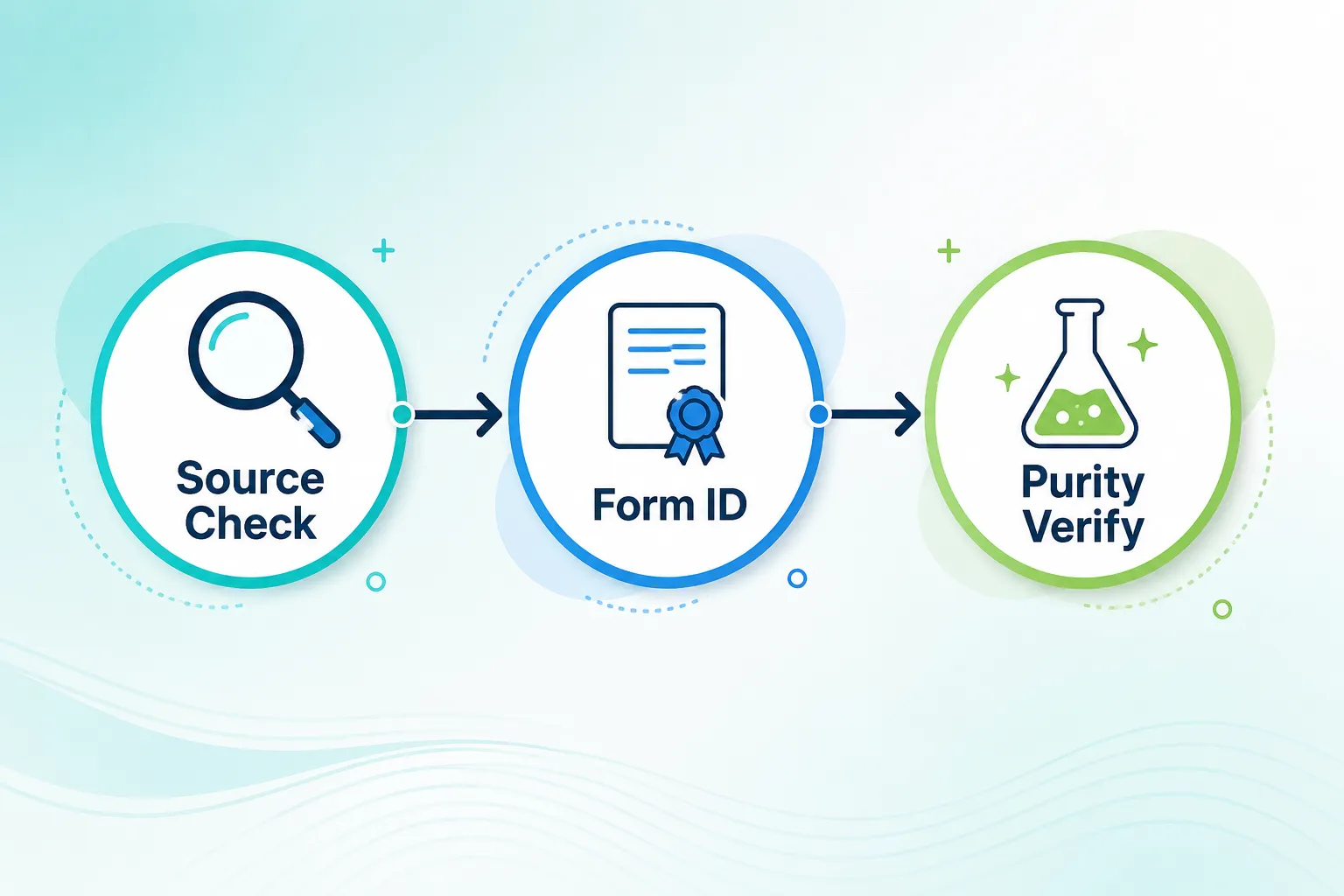
Practical Sourcing Decisions: Where Researchers Compare Enclomiphene vs Enclomiphene Citrate in Lab-Use Planning

The comparison between forms ultimately becomes a sourcing and documentation decision. Researchers should approach supplier evaluation with a structured checklist:

  1. Confirm the exact chemical form listed on the product page and CoA
  2. Verify the CAS number matches the intended compound
  3. Check isomeric purity, enclomiphene should be predominantly the trans-isomer
  4. Review HPLC data for purity confirmation above 98%
  5. Assess the supplier's testing transparency, third-party testing is a strong indicator of reliability

Researchers planning broader endocrine or metabolic research programs may also find value in reviewing how other research-grade compounds are evaluated for purity and sourcing, such as in Where to Buy Research-Grade Glow Blend Peptide: Evaluating Purity, Copper Complexes, and Skin Model Compatibility, which applies similar CoA evaluation principles to a different compound class.

For researchers building multi-compound protocols, understanding how other small molecules and peptides are characterized can strengthen the overall experimental framework. Resources such as GHK-Cu Peptide: Copper Complex Chemistry, Research Stability, and Lab Use Considerations illustrate how compound-specific chemistry affects storage, stability, and assay design, principles that apply equally to serm research.

Conclusion

The distinction between enclomiphene and enclomiphene citrate is not a branding difference, it is a chemistry difference with direct consequences for experimental accuracy. Researchers who take time to confirm the exact form, apply the appropriate salt correction factor, and source from suppliers with transparent CoA documentation will produce more reproducible, comparable data.

Actionable next steps for researchers:

  • Request the full CoA before purchasing any enclomiphene product
  • Cross-reference the CAS number against the intended form
  • Apply the molecular weight correction factor in all dose calculations
  • Document the exact form used in all experimental records and publications
  • Prioritize suppliers who provide third-party HPLC and isomeric purity data

These steps take minutes but protect months of research effort from silent, form-related errors.

References

  • Wiehle, R., Cunningham, G. R., Pitteloud, N., Wike, J., Hsu, K., Fontenot, G. K., Rosner, M., Dwyer, A., & Podolski, J. (2013). Testosterone restoration by enclomiphene citrate in men with secondary hypogonadism: Pharmacodynamics and pharmacokinetics. BJU International, 112(8), 1188-1200.
  • Kim, E. D., McCullough, A., & Kaminetsky, J. (2016). Oral enclomiphene citrate raises testosterone and preserves sperm counts in obese hypogonadal men, unlike topical testosterone: Restoration instead of replacement. BJU International, 117(4), 677-685.
  • Roth, M. Y., & Amory, J. K. (2011). Beyond the condom: Frontiers in male contraception. Seminars in Reproductive Medicine, 29(3), 233-241.
  • Guay, A. T., Jacobson, J., Perez, J. B., Hodge, M. B., & Velasquez, E. (2003). Clomiphene increases free testosterone levels in men with both secondary hypogonadism and erectile dysfunction: Who does and does not benefit? International Journal of Impotence Research, 15(3), 156-165.
https://www.puretestedpeptides.com/wp-content/uploads/2026/08/where-researchers-compare-enclomiphene-vs-enclomiphene-citrate-in-lab-use-planni.webp 1024 1536 https://www.puretestedpeptides.com/wp-content/uploads/2026/01/buy-peptides-online.jpg 2026-08-12 13:03:522026-08-12 13:03:52Where Researchers Compare Enclomiphene vs Enclomiphene Citrate in Lab-Use Planning
×

Helpful Links

  • My account
  • Cart
  • Checkout
  • Refund and Returns Policy
  • Privacy Policy
  • SMS Privacy Policy
  • Login
  • My Account
  • Logout

USA Made Lab Tested Peptides

All products are sold for research, laboratory, or analytical purposes only, and are not for human consumption


Pure Tested Peptides is a chemical supplier. Pure Tested Peptides is not a compounding / chemical compounding facility as defined under 503A of the Federal Food, Drug, and Cosmetic act. Pure Tested Peptides is not an outsourcing facility as defined under 503B of the Federal Food, Drug, and Cosmetic act.

The statements made within this website have not been evaluated by the US Food and Drug Administration. The products we offer are not intended to diagnose, treat, cure or prevent any disease.

Human/Animal Consumption Prohibited. Laboratory/In-Vitro Experimental Use Only

Scroll to top Scroll to top Scroll to top