Call or Text 727-513-9780
  • Shopping Cart Shopping Cart
    0Shopping Cart
Pure Tested Peptides | America's most trusted Peptides for sale online
  • Peptides for sale
    • Oral Peptides for sale
      • Peptide Capsules for sale
      • BPC 157 Capsules 1000mcg
      • SLU-PP-332 Capsules | 1000 mcg
      • 5-Amino-1MQ 50mg Capsules
      • Tesofensine 500mcg
    • All Peptides for sale
    • Peptide Sprays
      • BPC 157 Nasal Spray Kit
      • BPC-157 TB500 Nasal Spray Kit
      • Semax Nasal Spray 10mg
      • Selank – Nasal Spray Kit – 10mg
      • Epithalon 50MG Nasal Spray Kit
      • Ipamorelin 10mg Nasal Spray
      • Klow Nasal Spray (BPC-157 + TB-500 + GHK-Cu + KPV) | 80mg
      • Hulk Nasal Spray Tesa / Ipa Blend 6/3 MG
      • Klow Nasal Spray
      • NAD + 500 mg Nasal Spray
      • PT-141 Nasal Spray Kit
    • GHRH Peptides
      • Ipa Peptides
      • CJC-1295 Peptides
        • CJC-1295 with DAC 5 mg
        • CJC-1295 without DAC 5 mg
        • CJC-1295 Ipa 10mg
      • Tesa Peptides
        • Tesa Peptide
        • Tesa 20 mg
    • GHK-Cu Peptides
      • All GHK-Cu Peptides
      • GHK-Cu 100mg
      • KLOW Peptide Blend – Buy KLOW blend online
    • BPC Peptides
      • All BPC Peptides
      • BPC-157
      • BPC-157 TB-500
      • BPC 157 capsules 1000mcg
    • SLU-PP-332 Peptides
      • All SLU-PP-332 Peptides
      • SLU-PP-332 5mg
    • GLP3 Peptides
    • PT-141 Peptides
      • PT-141 Peptides for sale
      • PT-141 10mg
      • PT-141 Nasal Spray
    • CAG Peptides
      • Lipo-C Peptide Blend
      • CAG 5mg
      • CAG 10mg
    • MOTS-C Peptides
      • MOTS-C Peptides for sale
      • MOTS-c peptide
      • MOTS-c 10mg *6 pack*
    • 5 Amino 1MQ Peptides
      • 5 Amino 1MQ Peptides for sale
      • 5-Amino-1MQ 50mg Capsules
      • 5-Amino-1MQ 5mg
    • Epithalon Peptides
      • Epithalon Peptides for sale
      • Epithalon 10mg
      • Epithalon 50mg
  • Shop
    • GLPs
      • 5-Amino-1MQ 50mg Capsules
      • 5-Amino-1MQ 5mg
      • L-Carnitine 500mg/ml
      • Tesofensine 500mcg
      • SLU-PP-332 5mg
      • MOTS-c 10mg *6 pack*
    • Epithalon & BPC Peptides
      • Epithalon 10mg
      • Epithalon 50mg
      • BPC-157
      • BPC 157 capsules 1000mcg
      • BPC-157 TB-500
      • BPC-157 TB500 Nasal Spray Kit
      • BPC 157 Nasal Spray Kit
    • BPC TB-500 & NAD+ Peptides
      • NAD+ 500 mg
      • KLOW Peptide Blend – Buy KLOW blend online
      • GLOW Peptide Blend
      • TB 500 5mg
      • BPC 157 capsules 1000mcg – Supplement
      • BPC 157 Nasal Spray Kit
      • BPC-157
      • BPC-157 TB500 Nasal Spray Kit
      • BPC-157 TB-500
      • BPC 157 capsules 1000mcg
    • LL-37 Peptide
      • LL-37 10 mg
    • MOTS-C & Selank
      • MOTS-c peptide
      • Selank 10mg
    • GHK Peptides
      • GHK-Cu 100mg
      • GLOW Peptide Blend
      • KLOW Peptide Blend – Buy KLOW blend online
  • COAs
  • Wholesale
    • Wholesale Peptides for sale
  • PTP FAQ
  • Affiliates
    • Selank Peptide: Advanced Pharmacological Mechanisms Underlying Its Anxiolytic and Nootropic Effects in Research
      • 5-Amino-1MQ Peptide: Detailed Mechanisms of NNMT Inhibition and Its Impact on Cellular Metabolism Research
        • MOTS-C Peptide: Unraveling Its Role in Mitochondrial Dynamics and Energy Metabolism Research
          • Epithalon Peptide and Telomerase Regulation: Investigating Its Impact on Cellular Senescence and Lifespan Research Models
            • GLP2-T vs GLP2 Tirz Peptide: Understanding the Naming, Mechanistic Nuances, and Research Implications for Gut Health
      • Peptides and Polypeptides in Modern Pharmacology: What Research on Metoprolol, Prednisone, and Amlodipine Reveals
        • Polypeptide Peptides vs NSAIDs: What Naproxen and Diclofenac Teach Tissue-Repair Researchers About BPC‑157 and TB‑500
          • Peptides and Polypeptides in Endocrine Pharmacology: How GLP-1, GLP-2, and GLP-3 Retatrutide Differ From Classic Drugs Like Prednisone and Amlodipine
          • 5‑Amino‑1MQ Peptide and NNMT Inhibition: How It Compares With Statins Like Atorvastatin in Adipose and Lipid Metabolism Research
      • Enclomiphene, Estrogen Receptor Signaling, and Luteinizing Phase Biology: What Hormone Researchers Should Measure
        • Mesenchymal Stem Cells, BPC‑157, and GHK‑Cu: How Tissue Repair Peptides Compare With Classic NSAIDs Like Naproxen in Injury Models
          • Peptide Calculator Use Cases Beyond Growth Hormone: Working Through GLP‑3 Retatrutide, MOTS‑c, and BPC‑157 Research Dosing
        • Polypeptide Peptides in Endocrine and Metabolic Pharmacology: Lessons From Amlodipine, Prednisone, and Metoprolol
        • Peptides Calculator for Advanced Blends: Worked Examples for Tesamorelin, CJC‑1295, and Ipamorelin Stacks
          • Peptides and Polypeptides in Human Physiology: How Molecular Size Shapes Research Applications
            • Selank Peptide: Advanced Pharmacological Mechanisms Underlying Its Anxiolytic and Nootropic Effects in Research
          • 5-Amino-1MQ Peptide: Detailed Mechanisms of NNMT Inhibition and Its Impact on Cellular Metabolism Research
            • MOTS-C Peptide: Unraveling Its Role in Mitochondrial Dynamics and Energy Metabolism Research
              • Epithalon Peptide and Telomerase Regulation: Investigating Its Impact on Cellular Senescence and Lifespan Research Models
                • GLP2-T vs GLP2 Tirz Peptide: Understanding the Naming, Mechanistic Nuances, and Research Implications for Gut Health
                  • Peptides and Polypeptides in Endocrine Pharmacology: How GLP-1, GLP-2, and GLP-3 Retatrutide Differ From Classic Drugs Like Prednisone and Amlodipine
                    • Polypeptide Peptides vs NSAIDs: What Naproxen and Diclofenac Teach Tissue-Repair Researchers About BPC‑157 and TB‑500
                      • Peptides and Polypeptides in Modern Pharmacology: What Research on Metoprolol, Prednisone, and Amlodipine Reveals
                        • 5‑Amino‑1MQ Peptide and NNMT Inhibition: How It Compares With Statins Like Atorvastatin in Adipose and Lipid Metabolism Research
                        • Enclomiphene, Estrogen Receptor Signaling, and Luteinizing Phase Biology: What Hormone Researchers Should Measure
                        • Mesenchymal Stem Cells, BPC‑157, and GHK‑Cu: How Tissue Repair Peptides Compare With Classic NSAIDs Like Naproxen in Injury Models
                        • Peptide Calculator Use Cases Beyond Growth Hormone: Working Through GLP‑3 Retatrutide, MOTS‑c, and BPC‑157 Research Dosing
                        • Polypeptide Peptides in Endocrine and Metabolic Pharmacology: Lessons From Amlodipine, Prednisone, and Metoprolol
                        • Peptides Calculator for Advanced Blends: Worked Examples for Tesamorelin, CJC‑1295, and Ipamorelin Stacks
                        • Peptides and Polypeptides in Human Physiology: How Molecular Size Shapes Research Applications
                        • Selank Peptide: Advanced Pharmacological Mechanisms Underlying Its Anxiolytic and Nootropic Effects in Research
                        • MOTS-C Peptide: Unraveling Its Role in Mitochondrial Dynamics and Energy Metabolism Research
                        • Peptides and Polypeptides in Modern Pharmacology: What Research on Metoprolol, Prednisone, and Amlodipine Reveals
                        • Peptides and Polypeptides in Endocrine Pharmacology: How GLP-1, GLP-2, and GLP-3 Retatrutide Differ From Classic Drugs Like Prednisone and Amlodipine
                        • 5-Amino-1MQ Peptide: Detailed Mechanisms of NNMT Inhibition and Its Impact on Cellular Metabolism Research
                        • Mesenchymal Stem Cells, BPC‑157, and GHK‑Cu: How Tissue Repair Peptides Compare With Classic NSAIDs Like Naproxen in Injury Models
                        • Peptide Calculator Use Cases Beyond Growth Hormone: Working Through GLP‑3 Retatrutide, MOTS‑c, and BPC‑157 Research Dosing
                        • GLP2-T vs GLP2 Tirz Peptide: Understanding the Naming, Mechanistic Nuances, and Research Implications for Gut Health
                        • Polypeptide Peptides in Endocrine and Metabolic Pharmacology: Lessons From Amlodipine, Prednisone, and Metoprolol
                        • Polypeptide Peptides vs NSAIDs: What Naproxen and Diclofenac Teach Tissue-Repair Researchers About BPC‑157 and TB‑500
                        • Peptides and Polypeptides in Human Physiology: How Molecular Size Shapes Research Applications
                        • Peptides Calculator for Advanced Blends: Worked Examples for Tesamorelin, CJC‑1295, and Ipamorelin Stacks
                        • 5‑Amino‑1MQ Peptide and NNMT Inhibition: How It Compares With Statins Like Atorvastatin in Adipose and Lipid Metabolism Research
                        • Enclomiphene, Estrogen Receptor Signaling, and Luteinizing Phase Biology: What Hormone Researchers Should Measure
                        • Epithalon Peptide and Telomerase Regulation: Investigating Its Impact on Cellular Senescence and Lifespan Research Models
                        • Best research protocol Klow blend
                        • best time to take BPC-157
                        • best time to take DSIP (Delta Sleep Inducing Peptide)
                        • best time to take CJC-1295
                        • best time to take AOD-9604
                        • best time to take Follistatin 344
                        • best time to take Ipamorelin
                        • best time to take MK-677 (Ibutamoren)
                        • best time to take Ligandrol (LGD-4033) — research compound
                        • best time to take Ostarine (MK-2866) — research compound
                        • best time to take GHK-CU
                        • best time to take TB-500
                        • best time to take MOTS-c
                        • best time to take Semax
                        • best time to take RAD-140 (Testolone) — research compound
                        • best time to take Thymosin Alpha-1
                        • best time to take PEG-MGF
                        • Biolife Plasma, Octapharma Plasma, and Research Peptides: How Plasma Donation Labs Differ From Peptide Suppliers
                        • best time to take YK-11 — research compound
                        • best time to take PT-141 (Bremelanotide)
                        • Best research protocol Klow blend
                        • 5-Amino-1MQ and MOTS-C Synergy: Metabolic Signaling, Mitochondria, and Research Design
                        • BPC-157 and TB-500: Investigating Their Combined Effects on Angiogenesis and Cellular Migration in Tissue Repair Models
                        • BPC-157 Peptide: Gut Barrier Function, Inflammation, and Tissue-Recovery Research
                        • 5‑Amino‑1MQ and MOTS‑c Synergy in Metabolic Research: Designing NNMT and Mitochondrial Biogenesis Stacks
                        • CJC-1295 with DAC vs. Without DAC: Half-Life, Release Kinetics, and Research Implications
                        • CJC‑1295 with DAC vs. Without DAC: Expanding on Half‑Life Differences Using Tesamorelin and Ipamorelin Blend Case Studies
                        • Collagen Biology and Copper‑Binding Peptides: How GHK‑Cu, Glow Blend, and Klow Blend Interact with Skin and Connective Tissue
                        • Collagen Biology and Regenerative Peptides: How GHK‑Cu, Glow Blend, and Klow Blend Affect Extracellular Matrix Research
                    • DNA, Telomeres, and Longevity Peptides: Positioning Epithalon and MOTS‑c in Genetic Aging Research
                      • Enclomiphene Citrate: serm Mechanism, Testosterone Research, and Stack Compatibility
                        • Enclomiphene vs Enclomiphene Citrate: Formulation, Bioavailability, and Research Distinctions
                        • Epithalon Peptide Research: Telomerase Activation, Aging, and Pineal Gland Function
                        • Estrogen Receptor Signaling and Enclomiphene: How Selective Modulators Compare with Classic Polypeptide Hormones
                        • GHK-Cu Peptide: Advanced Mechanisms in Extracellular Matrix Remodeling and Wound Healing Research
                        • GHK-Cu Peptide: Collagen Synthesis, Wound Repair, and Skin-Barrier Research Models
                        • GLP-1 vs GLP-3 vs GLP-2: Peptide Classification and Research Applications
                        • GLP-2 Peptide Research Guide: Gut Barrier Function, Nutrient Absorption, and Intestinal Recovery Models
                        • GLP-3 Retatrutide vs. GLP-1 Drugs: What Triple-Agonist Biology Changes in Research Models
                        • Ipamorelin and Tesamorelin Combination: Synergistic GH Secretagogue Research and Dosing Protocols
                        • GLP2 Tirz Peptide: What It Is, Why the Name Exists, and How Researchers Should Interpret It
                        • Klow Blend Peptide Nasal Spray: What the Formulation Is Trying to Do in Cognitive Research
                        • Mitochondria, NNMT Inhibition, and Peptide Modulators: Where MOTS‑c and 5‑Amino‑1MQ Fit in Cellular Energy Research
                        • MOTS-c Peptide: Mitochondrial Function, Energy Metabolism, and What Researchers Measure
                        • MOTS-c vs. 5-Amino-1MQ: Which Metabolic Research Questions Each Compound Actually Answers
                        • Nasal Spray Peptides: Bioavailability, Administration, and Semax/Selank Research Applications
                        • PT-141 Peptide Research: Mechanism of Action and Melanocortin Receptor Signaling
                        • Retatrutide for Research: Mechanism, Structure, and GLP-1/GLP-3 Dual Action
                        • Retatrutide for Obesity and Type 2 Diabetes: What the Latest Trial Data Suggest
                        • Tesofensine Peptide Research: Mechanism, Appetite Suppression, and Neuropeptide Y Pathways
  • Contact
    • Contact Customer Service
    • Text Customer Support
  • About US
  • Shop all peptides
  • Affiliate Program
    • Affiliate Signup
  • Login / Register Login / Register Page Link Login / Register Page Link
  • Click to open the search input field Click to open the search input field Search
  • Menu Menu

Tag Archive for: salt form comparison

Enclomiphene Base vs Enclomiphene Citrate: Solubility, Counterion Effects, and Analytical Comparability

Enclomiphene Base vs Enclomiphene Citrate: Solubility, Counterion Effects, and Analytical Comparability

October 2, 2026/0 Comments/in Uncategorized/by

Salt form selection is not a footnote in pharmaceutical development, it determines whether two batches of the same active molecule will dissolve identically, measure identically, and dose identically. When researchers and formulators encounter enclomiphene base vs enclomiphene citrate: solubility, counterion effects, and analytical comparability, the differences between these two forms reach far beyond a simple name change. A mass discrepancy of roughly 47% between the freebase and salt forms means that a researcher who ignores salt-form identity risks systematic dosing errors, failed dissolution tests, and misinterpreted analytical results, all without any obvious red flag in the raw data.


Key Takeaways

  • Enclomiphene base (MW ~405.9 g/mol) and enclomiphene citrate (MW ~598.1 g/mol) differ by approximately 47% in molecular weight, requiring a dose conversion factor for any potency-based calculation.
  • The citrate counterion substantially increases aqueous solubility compared to the freebase form, which is nearly insoluble at physiological pH.
  • pH-dependent solubility profiles differ sharply between the two forms, with critical implications for dissolution testing and oral formulation design.
  • Chromatographic and spectroscopic identity tests must be calibrated to the specific salt form in use; otherwise, retention times, response factors, and concentration calculations will be systematically offset.
  • Batch-to-batch comparability studies must confirm salt form identity before interpreting any apparent potency or purity discrepancy.

Chemical Identity and the Molecular Weight Gap
Chemical Identity and the Molecular Weight Gap

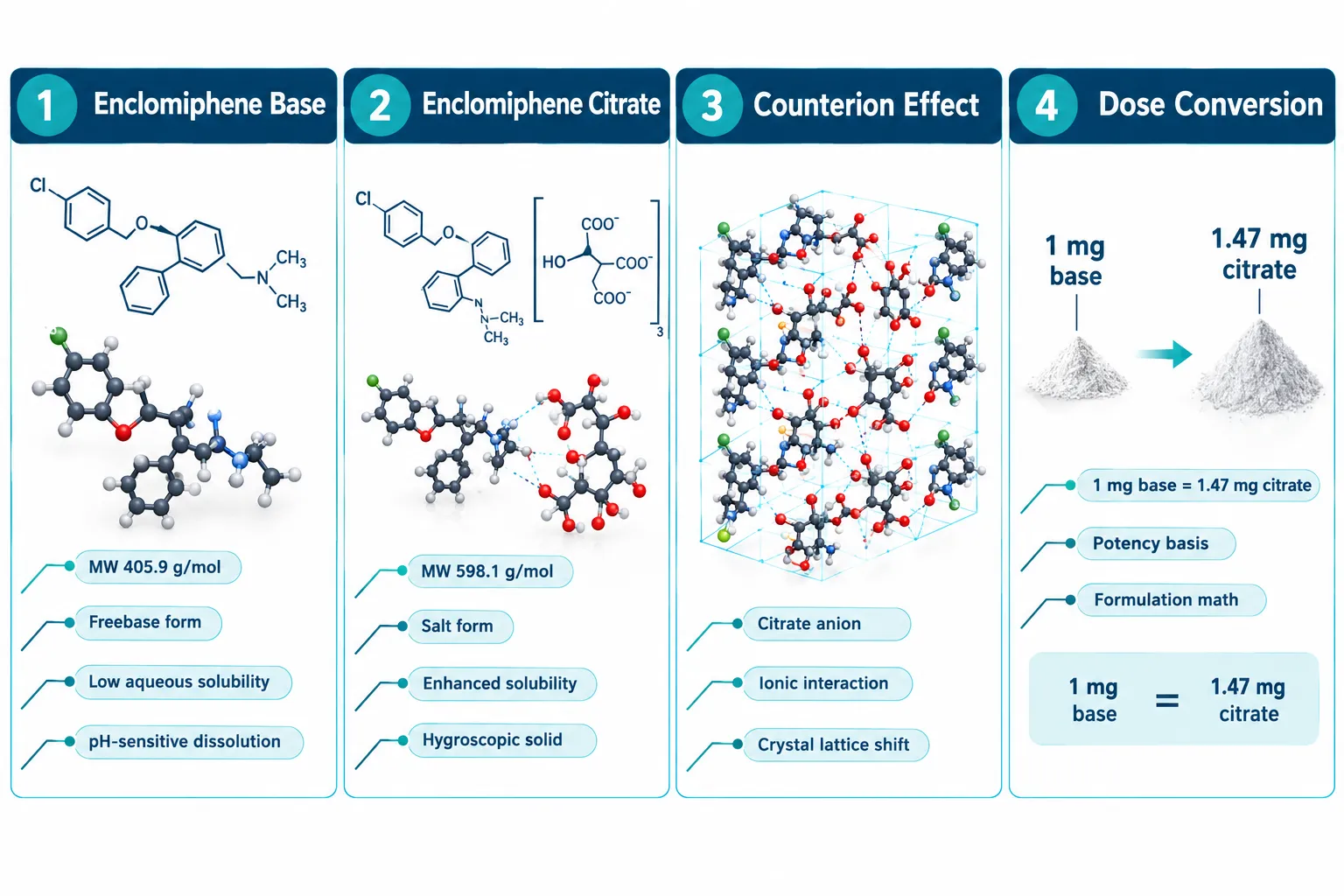
Enclomiphene is the trans-isomer of clomiphene, a selective estrogen receptor modulator (serm). In its freebase state, enclomiphene carries a molecular weight of approximately 405.9 g/mol. When combined with citric acid to form enclomiphene citrate, the resulting salt reaches approximately 598.1 g/mol, an increase of roughly 192 g/mol attributable entirely to the citrate counterion.

This gap has immediate practical consequences. A 25 mg dose expressed as the base equivalent requires approximately 36.8 mg of the citrate salt to deliver the same molar quantity of active compound. The conversion factor (citrate MW divided by base MW, approximately 1.47) must be applied consistently across:

  • Label claims on research-grade materials
  • Stock solution preparation for in vitro assays
  • Dissolution specifications in quality control testing
  • Comparative potency calculations across studies using different salt forms

Failure to apply this factor is one of the most common sources of apparent "potency discrepancy" between batches that are, in chemical terms, identical. Researchers sourcing a serm 10mg product, for example, should always confirm whether the stated weight reflects the base or the salt form before preparing working concentrations.


Solubility Profiles and the Role of the Citrate Counterion
Solubility Profiles and the Role of the Citrate Counterion

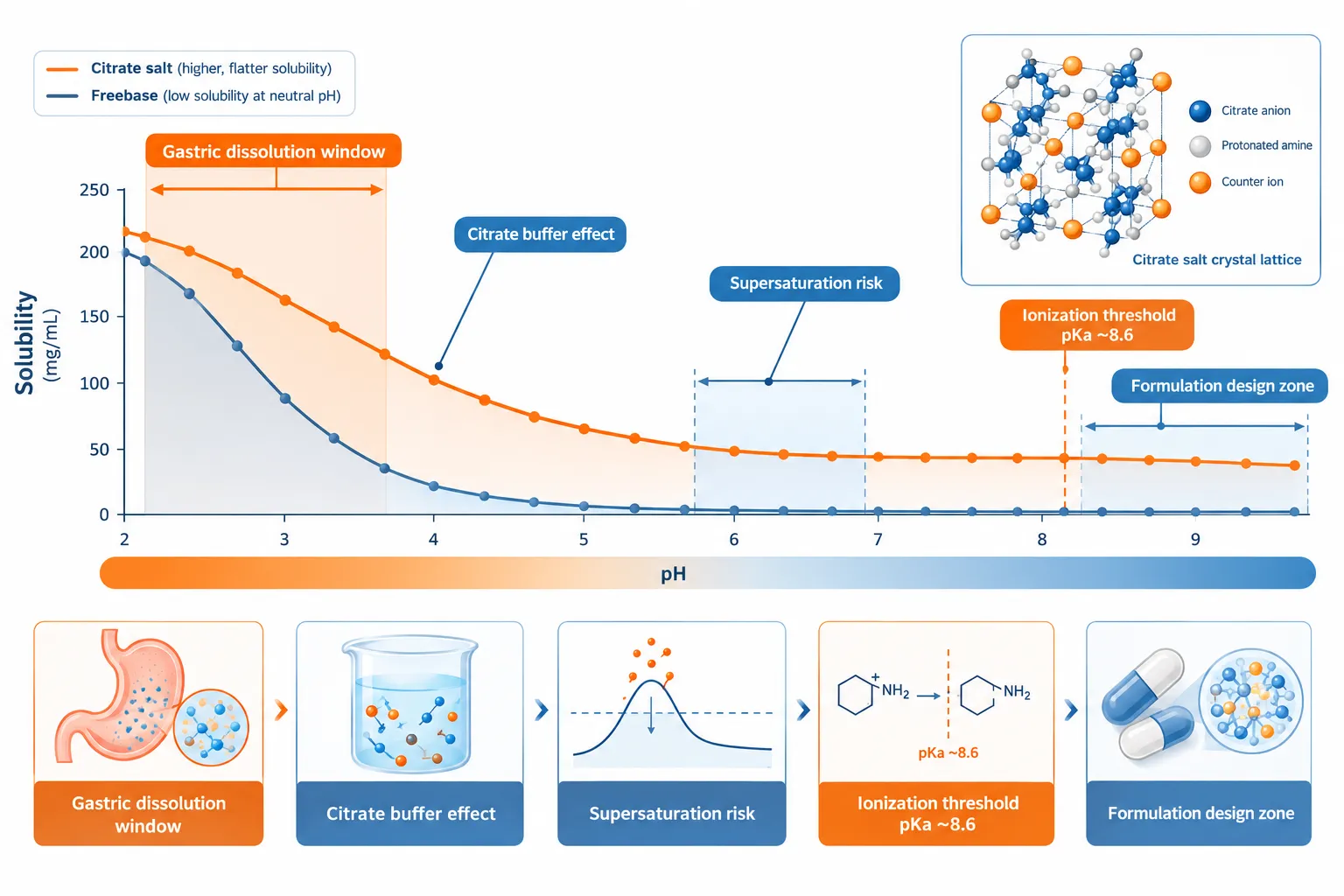
The phrase enclomiphene base vs enclomiphene citrate: solubility, counterion effects, and analytical comparability captures a genuine formulation challenge. Enclomiphene freebase is classified as practically insoluble in water at neutral to basic pH. Its ionization pKa sits near 8.6, meaning that at physiological pH (approximately 7.4), the molecule exists predominantly in its unionized, lipophilic form, a state that strongly limits aqueous dissolution.

The citrate salt changes this picture in two ways:

  1. Direct counterion solubilization: The citrate anion creates an ionic lattice that disrupts the hydrophobic crystal packing of the freebase, allowing water molecules to penetrate more readily.
  2. Microenvironmental pH buffering: Citric acid is a weak triprotic acid. As the salt dissolves, the local microenvironment becomes mildly acidic, which promotes ionization of the enclomiphene amine and further drives dissolution.

"The counterion is not an inert passenger, it actively shapes the thermodynamic and kinetic solubility of the active molecule."

pH-dependent solubility comparison:

pH Enclomiphene Base Enclomiphene Citrate
1.2 (gastric) Moderate High
4.5 (intestinal) Low Moderate-High
6.8 (intestinal) Very Low Moderate
7.4 (physiological) Practically Insoluble Low-Moderate

This profile explains why oral formulations almost universally use the citrate salt. The freebase form would require solubilization strategies, co-solvents, surfactants, or amorphous dispersion, to achieve comparable bioavailability. Hygroscopicity is a related concern: enclomiphene citrate absorbs atmospheric moisture more readily than the freebase, which affects storage conditions, weighing accuracy, and long-term stability. Proper desiccant storage and tightly sealed containers are non-negotiable for the citrate form.


Analytical Comparability: Where Salt Form Errors Become Data Errors

Understanding enclomiphene base vs enclomiphene citrate: solubility, counterion effects, and analytical comparability in an analytical context requires examining three distinct testing domains.
Analytical Comparability: Where Salt Form Errors Become Data Errors

Chromatographic Methods (HPLC/UPLC)

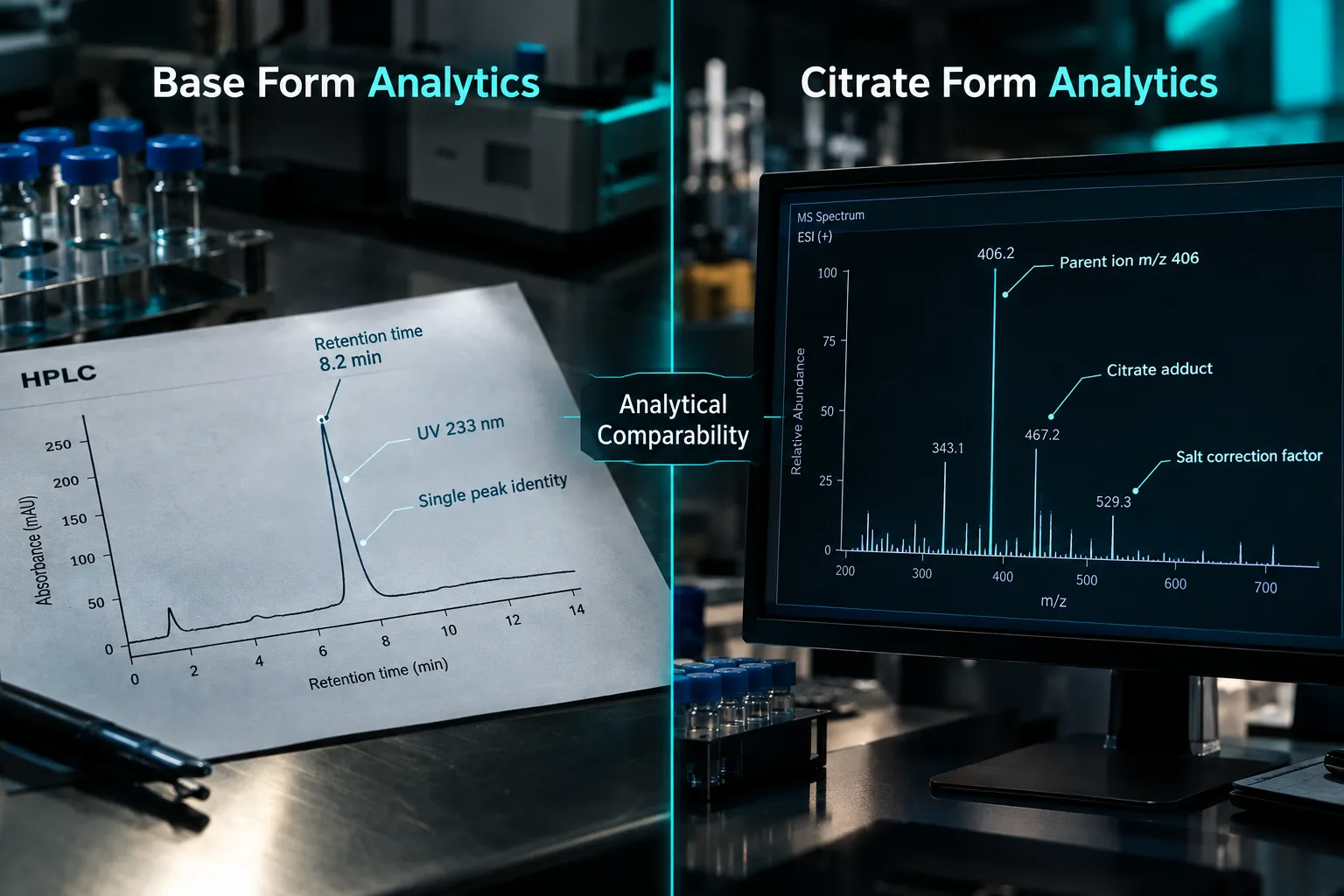
Both forms share the same enclomiphene chromophore and will produce UV absorbance at approximately 233 nm. However, the response factor, the relationship between peak area and concentration, must be calculated against a reference standard of matching salt form. Using a base-form reference standard to quantify a citrate-form sample introduces a systematic ~32% underestimation of true enclomiphene content (since the citrate sample contains proportionally less active molecule per unit mass).

Retention time is not affected by salt form under standard reversed-phase conditions, because the citrate counterion dissociates in aqueous mobile phases. This can mislead analysts into assuming the methods are fully interchangeable when they are not.

Mass Spectrometry

Electrospray ionization (ESI-MS) detects the enclomiphene molecular ion at m/z 406 regardless of salt form, since ionization strips the counterion. However, citrate adducts ([M + citrate]) can appear in negative-ion mode and may confuse automated library matching if the spectral database entry was built from the freebase.

Identity and Purity Testing

Infrared (IR) spectroscopy and X-ray powder diffraction (XRPD) will produce distinctly different spectra for the base and citrate forms. These are not interchangeable reference standards. A batch submitted with a base-form certificate of analysis but tested against a citrate-form IR reference will fail identity, not because the material is impure, but because the wrong reference was applied.

This is why well-designed analytical methods, much like the purity evaluation frameworks discussed in research-grade peptide purity evaluation, must explicitly state the salt form in every specification and reference standard description.

Stability and Forced Degradation

Enclomiphene citrate generates citric acid as a degradation-related impurity under hydrolytic stress conditions. This impurity is absent from freebase degradation profiles. Any forced degradation study or shelf-life specification must account for this difference, or citrate-derived impurities will be incorrectly flagged as enclomiphene-related degradants.


Practical Guidance for Batch Comparability

When two batches of enclomiphene appear to differ in potency or purity, the first diagnostic step is confirming salt form identity, not re-running the assay. A structured comparability checklist should include:

  • Confirm salt form via IR or XRPD before any quantitative comparison
  • Apply the correct MW conversion factor (base to citrate: multiply by 1.47; citrate to base: multiply by 0.679)
  • Match reference standards to the salt form of the test article
  • Adjust dissolution specifications to reflect the expected solubility profile of the specific form
  • Document hygroscopicity controls (desiccant storage, equilibration time before weighing)

Researchers working with peptide-based compounds face analogous salt-form and counterion considerations. Resources such as SS-31 10mg research peptide considerations and what is ideal dosage of SS31 illustrate how molecular weight and salt form affect concentration calculations across compound classes. Similarly, dosing frameworks for growth hormone secretagogues, such as those covered in tesa dosage for fat loss and tesa vs sermorelin, demonstrate how salt-form awareness is a universal analytical discipline, not specific to any single molecule.


Conclusion

The comparison of enclomiphene base vs enclomiphene citrate: solubility, counterion effects, and analytical comparability resolves into a single actionable principle: salt form is a primary analytical variable, not a secondary label detail. The ~47% molecular weight difference demands a consistent conversion factor in every concentration calculation. The citrate counterion's buffering and solubilization effects must be reflected in dissolution specifications and formulation design. And every analytical method, from HPLC quantitation to IR identity testing, must be explicitly validated against the salt form actually in use.

Actionable next steps for researchers and formulators in 2026:

  1. Audit all existing enclomiphene reference standards and certificates of analysis to confirm explicit salt form declaration.
  2. Recalculate any historical concentration data using the correct MW conversion factor for the form used.
  3. Establish separate XRPD or IR identity specifications for base and citrate forms and never cross-apply them.
  4. Implement moisture-control procedures specific to the hygroscopic citrate salt.
  5. Flag any batch comparability discrepancy for salt-form verification before concluding a purity or potency failure.

Treating these two forms as analytically equivalent is the fastest route to systematic, invisible error. Treating them as distinct chemical entities, which they are, is the foundation of reliable enclomiphene research.

https://www.puretestedpeptides.com/wp-content/uploads/2026/10/enclomiphene-base-vs-enclomiphene-citrate-solubility-counterion-effects-and-anal.webp 1024 1536 https://www.puretestedpeptides.com/wp-content/uploads/2026/01/buy-peptides-online.jpg 2026-10-02 13:04:102026-10-02 13:04:10Enclomiphene Base vs Enclomiphene Citrate: Solubility, Counterion Effects, and Analytical Comparability
×

Helpful Links

  • My account
  • Cart
  • Checkout
  • Refund and Returns Policy
  • Privacy Policy
  • SMS Privacy Policy
  • Login
  • My Account
  • Logout

USA Made Lab Tested Peptides

All products are sold for research, laboratory, or analytical purposes only, and are not for human consumption


Pure Tested Peptides is a chemical supplier. Pure Tested Peptides is not a compounding / chemical compounding facility as defined under 503A of the Federal Food, Drug, and Cosmetic act. Pure Tested Peptides is not an outsourcing facility as defined under 503B of the Federal Food, Drug, and Cosmetic act.

The statements made within this website have not been evaluated by the US Food and Drug Administration. The products we offer are not intended to diagnose, treat, cure or prevent any disease.

Human/Animal Consumption Prohibited. Laboratory/In-Vitro Experimental Use Only

Scroll to top Scroll to top Scroll to top