Call or Text 727-513-9780
  • Shopping Cart Shopping Cart
    0Shopping Cart
Pure Tested Peptides | America's most trusted Peptides for sale online
  • Peptides for sale
    • Oral Peptides for sale
      • Peptide Capsules for sale
      • BPC 157 Capsules 1000mcg
      • SLU-PP-332 Capsules | 1000 mcg
      • 5-Amino-1MQ 50mg Capsules
      • Tesofensine 500mcg
    • All Peptides for sale
    • Peptide Sprays
      • BPC 157 Nasal Spray Kit
      • BPC-157 TB500 Nasal Spray Kit
      • Semax Nasal Spray 10mg
      • Selank – Nasal Spray Kit – 10mg
      • Epithalon 50MG Nasal Spray Kit
      • Ipamorelin 10mg Nasal Spray
      • Klow Nasal Spray (BPC-157 + TB-500 + GHK-Cu + KPV) | 80mg
      • Hulk Nasal Spray Tesa / Ipa Blend 6/3 MG
      • Klow Nasal Spray
      • NAD + 500 mg Nasal Spray
      • PT-141 Nasal Spray Kit
    • GHRH Peptides
      • Ipa Peptides
      • CJC-1295 Peptides
        • CJC-1295 with DAC 5 mg
        • CJC-1295 without DAC 5 mg
        • CJC-1295 Ipa 10mg
      • Tesa Peptides
        • Tesa Peptide
        • Tesa 20 mg
    • GHK-Cu Peptides
      • All GHK-Cu Peptides
      • GHK-Cu 100mg
      • KLOW Peptide Blend – Buy KLOW blend online
    • BPC Peptides
      • All BPC Peptides
      • BPC-157
      • BPC-157 TB-500
      • BPC 157 capsules 1000mcg
    • SLU-PP-332 Peptides
      • All SLU-PP-332 Peptides
      • SLU-PP-332 5mg
    • GLP3 Peptides
    • PT-141 Peptides
      • PT-141 Peptides for sale
      • PT-141 10mg
      • PT-141 Nasal Spray
    • CAG Peptides
      • Lipo-C Peptide Blend
      • CAG 5mg
      • CAG 10mg
    • MOTS-C Peptides
      • MOTS-C Peptides for sale
      • MOTS-c peptide
      • MOTS-c 10mg *6 pack*
    • 5 Amino 1MQ Peptides
      • 5 Amino 1MQ Peptides for sale
      • 5-Amino-1MQ 50mg Capsules
      • 5-Amino-1MQ 5mg
    • Epithalon Peptides
      • Epithalon Peptides for sale
      • Epithalon 10mg
      • Epithalon 50mg
  • Shop
    • GLPs
      • 5-Amino-1MQ 50mg Capsules
      • 5-Amino-1MQ 5mg
      • L-Carnitine 500mg/ml
      • Tesofensine 500mcg
      • SLU-PP-332 5mg
      • MOTS-c 10mg *6 pack*
    • Epithalon & BPC Peptides
      • Epithalon 10mg
      • Epithalon 50mg
      • BPC-157
      • BPC 157 capsules 1000mcg
      • BPC-157 TB-500
      • BPC-157 TB500 Nasal Spray Kit
      • BPC 157 Nasal Spray Kit
    • BPC TB-500 & NAD+ Peptides
      • NAD+ 500 mg
      • KLOW Peptide Blend – Buy KLOW blend online
      • GLOW Peptide Blend
      • TB 500 5mg
      • BPC 157 capsules 1000mcg – Supplement
      • BPC 157 Nasal Spray Kit
      • BPC-157
      • BPC-157 TB500 Nasal Spray Kit
      • BPC-157 TB-500
      • BPC 157 capsules 1000mcg
    • LL-37 Peptide
      • LL-37 10 mg
    • MOTS-C & Selank
      • MOTS-c peptide
      • Selank 10mg
    • GHK Peptides
      • GHK-Cu 100mg
      • GLOW Peptide Blend
      • KLOW Peptide Blend – Buy KLOW blend online
  • COAs
  • Wholesale
    • Wholesale Peptides for sale
  • PTP FAQ
  • Affiliates
    • Selank Peptide: Advanced Pharmacological Mechanisms Underlying Its Anxiolytic and Nootropic Effects in Research
      • 5-Amino-1MQ Peptide: Detailed Mechanisms of NNMT Inhibition and Its Impact on Cellular Metabolism Research
        • MOTS-C Peptide: Unraveling Its Role in Mitochondrial Dynamics and Energy Metabolism Research
          • Epithalon Peptide and Telomerase Regulation: Investigating Its Impact on Cellular Senescence and Lifespan Research Models
            • GLP2-T vs GLP2 Tirz Peptide: Understanding the Naming, Mechanistic Nuances, and Research Implications for Gut Health
      • Peptides and Polypeptides in Modern Pharmacology: What Research on Metoprolol, Prednisone, and Amlodipine Reveals
        • Polypeptide Peptides vs NSAIDs: What Naproxen and Diclofenac Teach Tissue-Repair Researchers About BPC‑157 and TB‑500
          • Peptides and Polypeptides in Endocrine Pharmacology: How GLP-1, GLP-2, and GLP-3 Retatrutide Differ From Classic Drugs Like Prednisone and Amlodipine
          • 5‑Amino‑1MQ Peptide and NNMT Inhibition: How It Compares With Statins Like Atorvastatin in Adipose and Lipid Metabolism Research
      • Enclomiphene, Estrogen Receptor Signaling, and Luteinizing Phase Biology: What Hormone Researchers Should Measure
        • Mesenchymal Stem Cells, BPC‑157, and GHK‑Cu: How Tissue Repair Peptides Compare With Classic NSAIDs Like Naproxen in Injury Models
          • Peptide Calculator Use Cases Beyond Growth Hormone: Working Through GLP‑3 Retatrutide, MOTS‑c, and BPC‑157 Research Dosing
        • Polypeptide Peptides in Endocrine and Metabolic Pharmacology: Lessons From Amlodipine, Prednisone, and Metoprolol
        • Peptides Calculator for Advanced Blends: Worked Examples for Tesamorelin, CJC‑1295, and Ipamorelin Stacks
          • Peptides and Polypeptides in Human Physiology: How Molecular Size Shapes Research Applications
            • Selank Peptide: Advanced Pharmacological Mechanisms Underlying Its Anxiolytic and Nootropic Effects in Research
          • 5-Amino-1MQ Peptide: Detailed Mechanisms of NNMT Inhibition and Its Impact on Cellular Metabolism Research
            • MOTS-C Peptide: Unraveling Its Role in Mitochondrial Dynamics and Energy Metabolism Research
              • Epithalon Peptide and Telomerase Regulation: Investigating Its Impact on Cellular Senescence and Lifespan Research Models
                • GLP2-T vs GLP2 Tirz Peptide: Understanding the Naming, Mechanistic Nuances, and Research Implications for Gut Health
                  • Peptides and Polypeptides in Endocrine Pharmacology: How GLP-1, GLP-2, and GLP-3 Retatrutide Differ From Classic Drugs Like Prednisone and Amlodipine
                    • Polypeptide Peptides vs NSAIDs: What Naproxen and Diclofenac Teach Tissue-Repair Researchers About BPC‑157 and TB‑500
                      • Peptides and Polypeptides in Modern Pharmacology: What Research on Metoprolol, Prednisone, and Amlodipine Reveals
                        • 5‑Amino‑1MQ Peptide and NNMT Inhibition: How It Compares With Statins Like Atorvastatin in Adipose and Lipid Metabolism Research
                        • Enclomiphene, Estrogen Receptor Signaling, and Luteinizing Phase Biology: What Hormone Researchers Should Measure
                        • Mesenchymal Stem Cells, BPC‑157, and GHK‑Cu: How Tissue Repair Peptides Compare With Classic NSAIDs Like Naproxen in Injury Models
                        • Peptide Calculator Use Cases Beyond Growth Hormone: Working Through GLP‑3 Retatrutide, MOTS‑c, and BPC‑157 Research Dosing
                        • Polypeptide Peptides in Endocrine and Metabolic Pharmacology: Lessons From Amlodipine, Prednisone, and Metoprolol
                        • Peptides Calculator for Advanced Blends: Worked Examples for Tesamorelin, CJC‑1295, and Ipamorelin Stacks
                        • Peptides and Polypeptides in Human Physiology: How Molecular Size Shapes Research Applications
                        • Selank Peptide: Advanced Pharmacological Mechanisms Underlying Its Anxiolytic and Nootropic Effects in Research
                        • MOTS-C Peptide: Unraveling Its Role in Mitochondrial Dynamics and Energy Metabolism Research
                        • Peptides and Polypeptides in Modern Pharmacology: What Research on Metoprolol, Prednisone, and Amlodipine Reveals
                        • Peptides and Polypeptides in Endocrine Pharmacology: How GLP-1, GLP-2, and GLP-3 Retatrutide Differ From Classic Drugs Like Prednisone and Amlodipine
                        • 5-Amino-1MQ Peptide: Detailed Mechanisms of NNMT Inhibition and Its Impact on Cellular Metabolism Research
                        • Mesenchymal Stem Cells, BPC‑157, and GHK‑Cu: How Tissue Repair Peptides Compare With Classic NSAIDs Like Naproxen in Injury Models
                        • Peptide Calculator Use Cases Beyond Growth Hormone: Working Through GLP‑3 Retatrutide, MOTS‑c, and BPC‑157 Research Dosing
                        • GLP2-T vs GLP2 Tirz Peptide: Understanding the Naming, Mechanistic Nuances, and Research Implications for Gut Health
                        • Polypeptide Peptides in Endocrine and Metabolic Pharmacology: Lessons From Amlodipine, Prednisone, and Metoprolol
                        • Polypeptide Peptides vs NSAIDs: What Naproxen and Diclofenac Teach Tissue-Repair Researchers About BPC‑157 and TB‑500
                        • Peptides and Polypeptides in Human Physiology: How Molecular Size Shapes Research Applications
                        • Peptides Calculator for Advanced Blends: Worked Examples for Tesamorelin, CJC‑1295, and Ipamorelin Stacks
                        • 5‑Amino‑1MQ Peptide and NNMT Inhibition: How It Compares With Statins Like Atorvastatin in Adipose and Lipid Metabolism Research
                        • Enclomiphene, Estrogen Receptor Signaling, and Luteinizing Phase Biology: What Hormone Researchers Should Measure
                        • Epithalon Peptide and Telomerase Regulation: Investigating Its Impact on Cellular Senescence and Lifespan Research Models
                        • Best research protocol Klow blend
                        • best time to take BPC-157
                        • best time to take DSIP (Delta Sleep Inducing Peptide)
                        • best time to take CJC-1295
                        • best time to take AOD-9604
                        • best time to take Follistatin 344
                        • best time to take Ipamorelin
                        • best time to take MK-677 (Ibutamoren)
                        • best time to take Ligandrol (LGD-4033) — research compound
                        • best time to take Ostarine (MK-2866) — research compound
                        • best time to take GHK-CU
                        • best time to take TB-500
                        • best time to take MOTS-c
                        • best time to take Semax
                        • best time to take RAD-140 (Testolone) — research compound
                        • best time to take Thymosin Alpha-1
                        • best time to take PEG-MGF
                        • Biolife Plasma, Octapharma Plasma, and Research Peptides: How Plasma Donation Labs Differ From Peptide Suppliers
                        • best time to take YK-11 — research compound
                        • best time to take PT-141 (Bremelanotide)
                        • Best research protocol Klow blend
                        • 5-Amino-1MQ and MOTS-C Synergy: Metabolic Signaling, Mitochondria, and Research Design
                        • BPC-157 and TB-500: Investigating Their Combined Effects on Angiogenesis and Cellular Migration in Tissue Repair Models
                        • BPC-157 Peptide: Gut Barrier Function, Inflammation, and Tissue-Recovery Research
                        • 5‑Amino‑1MQ and MOTS‑c Synergy in Metabolic Research: Designing NNMT and Mitochondrial Biogenesis Stacks
                        • CJC-1295 with DAC vs. Without DAC: Half-Life, Release Kinetics, and Research Implications
                        • CJC‑1295 with DAC vs. Without DAC: Expanding on Half‑Life Differences Using Tesamorelin and Ipamorelin Blend Case Studies
                        • Collagen Biology and Copper‑Binding Peptides: How GHK‑Cu, Glow Blend, and Klow Blend Interact with Skin and Connective Tissue
                        • Collagen Biology and Regenerative Peptides: How GHK‑Cu, Glow Blend, and Klow Blend Affect Extracellular Matrix Research
                    • DNA, Telomeres, and Longevity Peptides: Positioning Epithalon and MOTS‑c in Genetic Aging Research
                      • Enclomiphene Citrate: serm Mechanism, Testosterone Research, and Stack Compatibility
                        • Enclomiphene vs Enclomiphene Citrate: Formulation, Bioavailability, and Research Distinctions
                        • Epithalon Peptide Research: Telomerase Activation, Aging, and Pineal Gland Function
                        • Estrogen Receptor Signaling and Enclomiphene: How Selective Modulators Compare with Classic Polypeptide Hormones
                        • GHK-Cu Peptide: Advanced Mechanisms in Extracellular Matrix Remodeling and Wound Healing Research
                        • GHK-Cu Peptide: Collagen Synthesis, Wound Repair, and Skin-Barrier Research Models
                        • GLP-1 vs GLP-3 vs GLP-2: Peptide Classification and Research Applications
                        • GLP-2 Peptide Research Guide: Gut Barrier Function, Nutrient Absorption, and Intestinal Recovery Models
                        • GLP-3 Retatrutide vs. GLP-1 Drugs: What Triple-Agonist Biology Changes in Research Models
                        • Ipamorelin and Tesamorelin Combination: Synergistic GH Secretagogue Research and Dosing Protocols
                        • GLP2 Tirz Peptide: What It Is, Why the Name Exists, and How Researchers Should Interpret It
                        • Klow Blend Peptide Nasal Spray: What the Formulation Is Trying to Do in Cognitive Research
                        • Mitochondria, NNMT Inhibition, and Peptide Modulators: Where MOTS‑c and 5‑Amino‑1MQ Fit in Cellular Energy Research
                        • MOTS-c Peptide: Mitochondrial Function, Energy Metabolism, and What Researchers Measure
                        • MOTS-c vs. 5-Amino-1MQ: Which Metabolic Research Questions Each Compound Actually Answers
                        • Nasal Spray Peptides: Bioavailability, Administration, and Semax/Selank Research Applications
                        • PT-141 Peptide Research: Mechanism of Action and Melanocortin Receptor Signaling
                        • Retatrutide for Research: Mechanism, Structure, and GLP-1/GLP-3 Dual Action
                        • Retatrutide for Obesity and Type 2 Diabetes: What the Latest Trial Data Suggest
                        • Tesofensine Peptide Research: Mechanism, Appetite Suppression, and Neuropeptide Y Pathways
  • Contact
    • Contact Customer Service
    • Text Customer Support
  • About US
  • Shop all peptides
  • Affiliate Program
    • Affiliate Signup
  • Login / Register Login / Register Page Link Login / Register Page Link
  • Click to open the search input field Click to open the search input field Search
  • Menu Menu

Tag Archive for: sermorelin

Growth-Hormone Secretagogue Research Design: Comparing Tesamorelin, CJC-1295, Ipamorelin, and Sermorelin by Signal Duration

Growth-Hormone Secretagogue Research Design: Comparing Tesamorelin, CJC-1295, Ipamorelin, and Sermorelin by Signal Duration

September 24, 2026/0 Comments/in Uncategorized/by

Fewer than 4% of a subcutaneous tesa dose reaches systemic circulation, yet that brief plasma exposure, peaking in under 10 minutes and clearing within roughly half an hour, is enough to drive measurable reductions in visceral fat in HIV-associated lipodystrophy. That pharmacokinetic reality sits at the core of Growth-Hormone Secretagogue Research Design: Comparing Tesamorelin, CJC-1295, Ipamorelin, and Sermorelin by Signal Duration: the duration of a peptide's plasma signal is not a side note, it is the primary variable that determines assay timing, endpoint selection, and the validity of any IGF-1 interpretation.

Key Takeaways

  • Tesamorelin and sermorelin are ultra-short GHRH analogs (half-lives of roughly 11-38 minutes and 10-12 minutes, respectively); assay windows must open within minutes of dosing.
  • Ipamorelin acts at a different receptor (GHS-R1a, not the GHRH receptor), carries an approximately 2-hour half-life, and generates a longer but still transient GH pulse.
  • CJC-1295 with DAC is a depot GHRH analog with a half-life of 5.8-8.1 days; it converts a single injection into a week-long endocrine signal, which fundamentally changes the experimental question.
  • DAC status is a design-level variable for CJC-1295 studies, without DAC, the half-life collapses to minutes; with DAC, it extends to days.
  • No completed human randomized trial has evaluated the CJC-1295 plus ipamorelin combination, so signal-duration synergy claims remain extrapolated from single-agent data.

Pulse Architecture: How Signal Duration Defines the Experiment
Pulse Architecture: How Signal Duration Defines the Experiment

Every GH secretagogue study is, at its foundation, a study of pulse architecture. The hypothalamic-pituitary axis releases GH in discrete bursts. Secretagogues either mimic or amplify those bursts. The key question for research design is: how long does the secretagogue's plasma signal last, and what does that mean for when you measure?

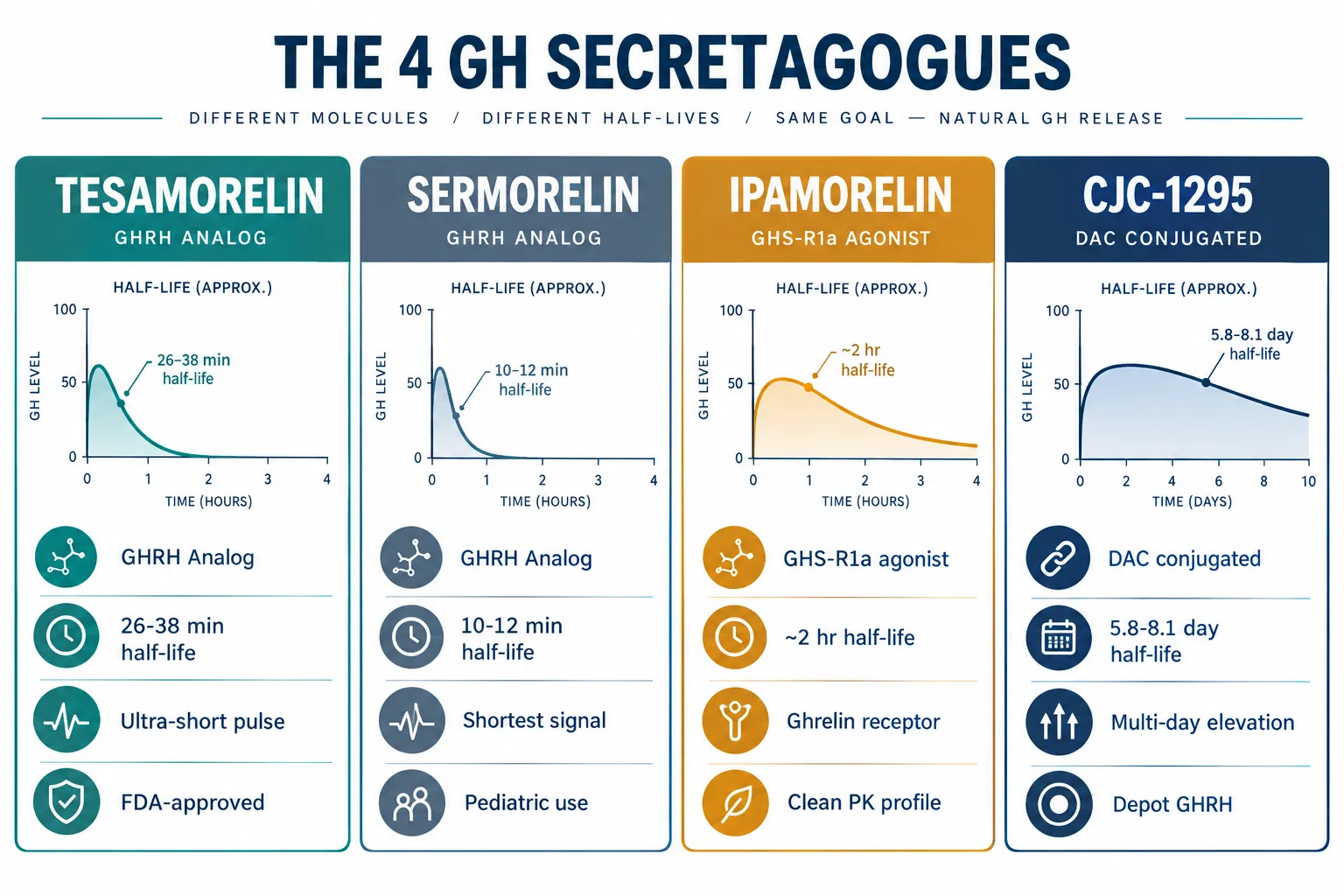
The four agents in this comparison span roughly four orders of magnitude in signal duration:

Agent Receptor Target Approximate Half-Life Signal Category
Sermorelin GHRH receptor 10-12 minutes Ultra-short
Tesamorelin GHRH receptor 11-38 minutes Ultra-short
Ipamorelin GHS-R1a (ghrelin receptor) ~2 hours Short
CJC-1295 with DAC GHRH receptor 5.8-8.1 days Long (depot)

Sermorelin is a truncated GHRH analog. Its plasma half-life of roughly 10-12 minutes means a GH pulse is triggered almost immediately after injection, and the secretagogue itself is largely cleared before most clinical blood draws are even processed. Sermorelin remains primarily used in pediatric growth hormone deficiency contexts and carries no FDA approval for adult indications, which limits the pool of controlled adult trial data.

Tesamorelin, the FDA-approved GHRH analog marketed as EGRIFTA and EGRIFTA WR, has a median time to peak plasma concentration of about 0.15 hours and a mean elimination half-life of 26-38 minutes under repeated dosing. In healthy subjects, that half-life compresses to roughly 11 minutes. Updated prescribing data for the newer EGRIFTA WR formulation confirm that reformulation did not meaningfully extend signal duration, systemic exposure (Cmax and AUC) remained comparable to the original product. For those designing studies around this agent, the science behind tesa provides useful background on its receptor-level mechanism.

"A short plasma signal does not mean a short biological effect, it means the downstream cascade, including GH secretion and IGF-1 synthesis, must be measured on a timeline that respects the signal's architecture."


Receptor-Level Intent and the Ipamorelin Distinction
Receptor-Level Intent and the Ipamorelin Distinction

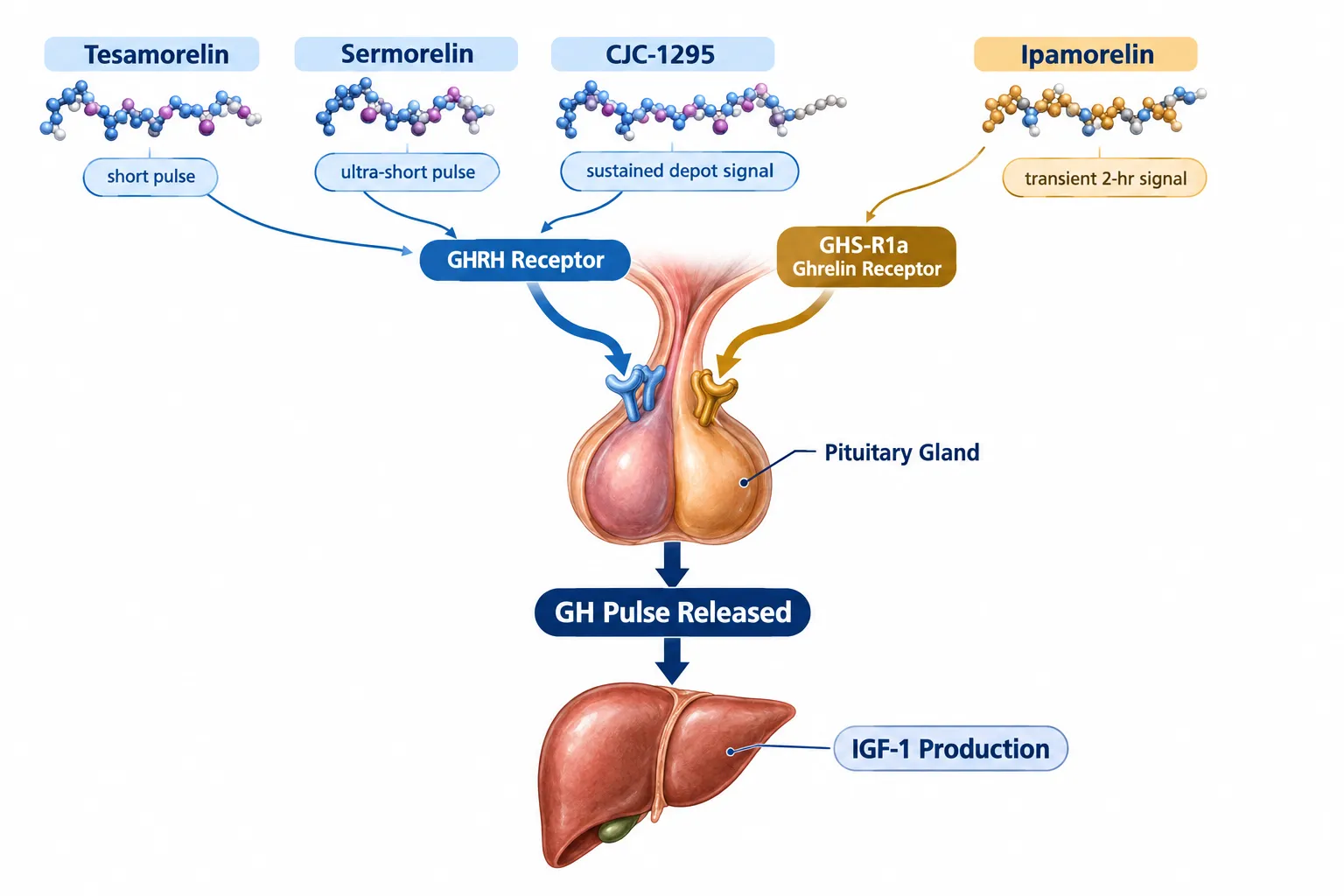
One of the most consequential design errors in secretagogue research is treating ipamorelin as interchangeable with GHRH analogs. It is not. Ipamorelin activates GHS-R1a, the ghrelin receptor, not the GHRH receptor. This receptor-level distinction has direct implications for combination protocols and signal-duration comparisons.

Ipamorelin's PK profile is notably cleaner than that of older GHRPs. Its terminal half-life sits around 2 hours, clearance is approximately 0.078 L/h/kg, and its volume of distribution at steady state is about 0.22 L/kg. The dose-proportional kinetics make it a tractable agent for controlled studies. Researchers interested in sourcing this compound for preclinical work can review options under buy ipamorelin online.

Because ipamorelin works through a separate receptor, combining it with a GHRH analog is theoretically additive, each agent hits a distinct node in the GH-release pathway. However, no completed human randomized controlled trial has tested the CJC-1295 plus ipamorelin stack. Signal-duration synergy claims for this combination are extrapolated from single-agent PK/PD data, not direct combination evidence. Any research protocol treating this combination as established is building on an incomplete evidentiary foundation.

For studies using multi-agent blends, the Sermorelin Ipamorelin CJC-1295 blend page outlines how these agents are commonly combined in research contexts, while the Tesamorelin AOD9604 CJC-1295 Ipamorelin 12mg blend illustrates multi-peptide formulation approaches.


DAC Status, Assay Timing, and IGF-1 Interpretation
DAC Status, Assay Timing, and IGF-1 Interpretation

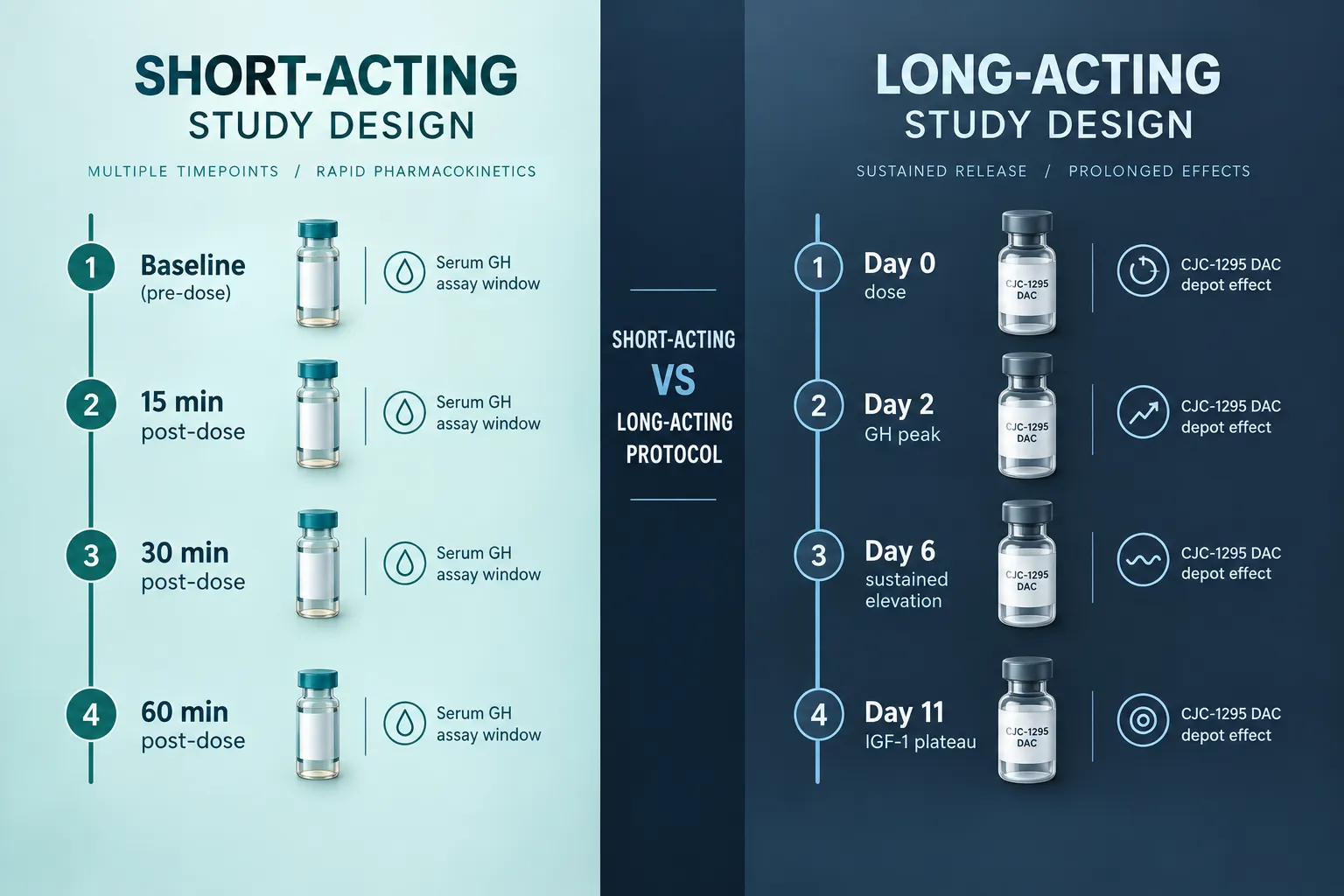
The DAC (Drug Affinity Complex) modification on CJC-1295 is not a minor formulation detail, it changes the fundamental experimental question. Without DAC, CJC-1295 behaves similarly to sermorelin: a short-acting GHRH analog cleared within minutes. With DAC, the half-life extends to 5.8-8.1 days, and a single subcutaneous injection produces GH elevations of roughly 2- to 10-fold for at least 6 days, with IGF-1 increases of approximately 1.5- to 3-fold persisting for 9-11 days.

This transforms the research design in three ways:

  1. Dosing frequency shifts from daily to weekly or biweekly.
  2. Assay timing must capture multi-day kinetics rather than a 30-60 minute post-dose window.
  3. IGF-1 as an endpoint becomes more meaningful because sustained GH elevation is required to drive meaningful IGF-1 synthesis; ultra-short agents like sermorelin or tesa generate IGF-1 changes through repeated daily pulses, not a single sustained signal.

For detailed pharmacokinetic comparisons of CJC-1295 with and without DAC, the dedicated CJC-1295 mechanism and pharmacokinetic comparison article is a primary reference.

When designing assay protocols, the following timing framework applies:

  • Sermorelin / Tesamorelin: Serum GH sampling at 15, 30, and 60 minutes post-dose; IGF-1 measured after at least 4 weeks of daily dosing.
  • Ipamorelin: Serum GH sampling at 30, 60, and 120 minutes post-dose; IGF-1 measured after sustained multi-week exposure.
  • CJC-1295 with DAC: Serum GH at 24, 48, and 96 hours post-dose; IGF-1 at days 7, 14, and 28 to capture accumulation across doses.

Misaligning assay windows with signal duration is one of the most common sources of false-negative results in secretagogue research. A study measuring GH at 4 hours post-tesa dose will miss the peak entirely.

Population PK/PD data from tesa trials in HIV-infected patients show approximately 34% higher systemic AUC compared with healthy subjects, despite similar Cmax and Tmax values. This exposure difference does not change the pulse-type time profile, it means downstream GH and IGF-1 responses may be amplified in certain populations, which must be accounted for in between-group comparisons. Researchers exploring tesa dosage parameters will find this population-level variability relevant to protocol calibration.


Conclusion

Growth-Hormone Secretagogue Research Design: Comparing Tesamorelin, CJC-1295, Ipamorelin, and Sermorelin by Signal Duration is ultimately a question of matching measurement strategy to mechanism. Each agent operates on a distinct timeline and at a distinct receptor, and treating them as interchangeable leads to flawed assay design and uninterpretable data.

Actionable next steps for researchers in 2026:

  • Classify agents by signal tier first, ultra-short (sermorelin, tesa), short (ipamorelin), or long-acting depot (CJC-1295 with DAC), before selecting endpoints or dosing intervals.
  • Confirm DAC status on any CJC-1295 source before designing a protocol; the presence or absence of DAC changes the experimental question entirely.
  • Align GH assay windows with each agent's Tmax and half-life; misaligned sampling is the most preventable source of false-negative results.
  • Treat IGF-1 as a cumulative marker, not an acute one; interpret it only in the context of dosing duration and frequency appropriate to each agent's signal length.
  • Avoid overstating combination evidence for CJC-1295 plus ipamorelin stacks until human randomized trial data are available.

Rigorous secretagogue research depends less on which peptide is chosen and more on whether the study design respects the biology of how each signal is generated, sustained, and cleared.

https://www.puretestedpeptides.com/wp-content/uploads/2026/09/growth-hormone-secretagogue-research-design-comparing-tesa-cjc-1295-ipamo.webp 1024 1536 https://www.puretestedpeptides.com/wp-content/uploads/2026/01/buy-peptides-online.jpg 2026-09-24 13:04:162026-09-24 13:04:16Growth-Hormone Secretagogue Research Design: Comparing Tesamorelin, CJC-1295, Ipamorelin, and Sermorelin by Signal Duration
×

Helpful Links

  • My account
  • Cart
  • Checkout
  • Refund and Returns Policy
  • Privacy Policy
  • SMS Privacy Policy
  • Login
  • My Account
  • Logout

USA Made Lab Tested Peptides

All products are sold for research, laboratory, or analytical purposes only, and are not for human consumption


Pure Tested Peptides is a chemical supplier. Pure Tested Peptides is not a compounding / chemical compounding facility as defined under 503A of the Federal Food, Drug, and Cosmetic act. Pure Tested Peptides is not an outsourcing facility as defined under 503B of the Federal Food, Drug, and Cosmetic act.

The statements made within this website have not been evaluated by the US Food and Drug Administration. The products we offer are not intended to diagnose, treat, cure or prevent any disease.

Human/Animal Consumption Prohibited. Laboratory/In-Vitro Experimental Use Only

Scroll to top Scroll to top Scroll to top