

Collagen Research Peptides: Where GHK-Cu, Glow Blend, and Skin-Focused Formulas Fit in Laboratory Models
Copper-binding tripeptide GHK-Cu has appeared in peer-reviewed literature for more than five decades, yet its role inside modern laboratory frameworks is still evolving rapidly. As of 2026, the compound sits at the center of a broader conversation about collagen research peptides: where GHK-Cu, Glow Blend, and skin-focused formulas fit in laboratory models, a question that matters to researchers who want to understand what the data actually supports versus what is extrapolated from single-peptide studies.
This article compares the major research frameworks, clarifies how multi-peptide "glow" stacks are positioned relative to direct clinical evidence, and outlines what distinguishes rigorous laboratory models from commercially motivated formulations.
Key Takeaways
- GHK-Cu has the strongest direct preclinical and emerging clinical evidence among collagen-focused peptides in 2026.
- Glow blends are multi-peptide stacks that extrapolate from single-peptide data rather than carrying independent clinical trial support.
- Epigenetic and gene-expression profiling is reshaping how researchers understand GHK-Cu's mechanism in aging skin.
- Laboratory models distinguish between peptides with direct ECM evidence and those relying on mechanistic synergy arguments.
- All glow blend and GHK-Cu formulations discussed here are research-grade compounds, not approved therapeutics.
GHK-Cu: The Anchor of Collagen Peptide Research
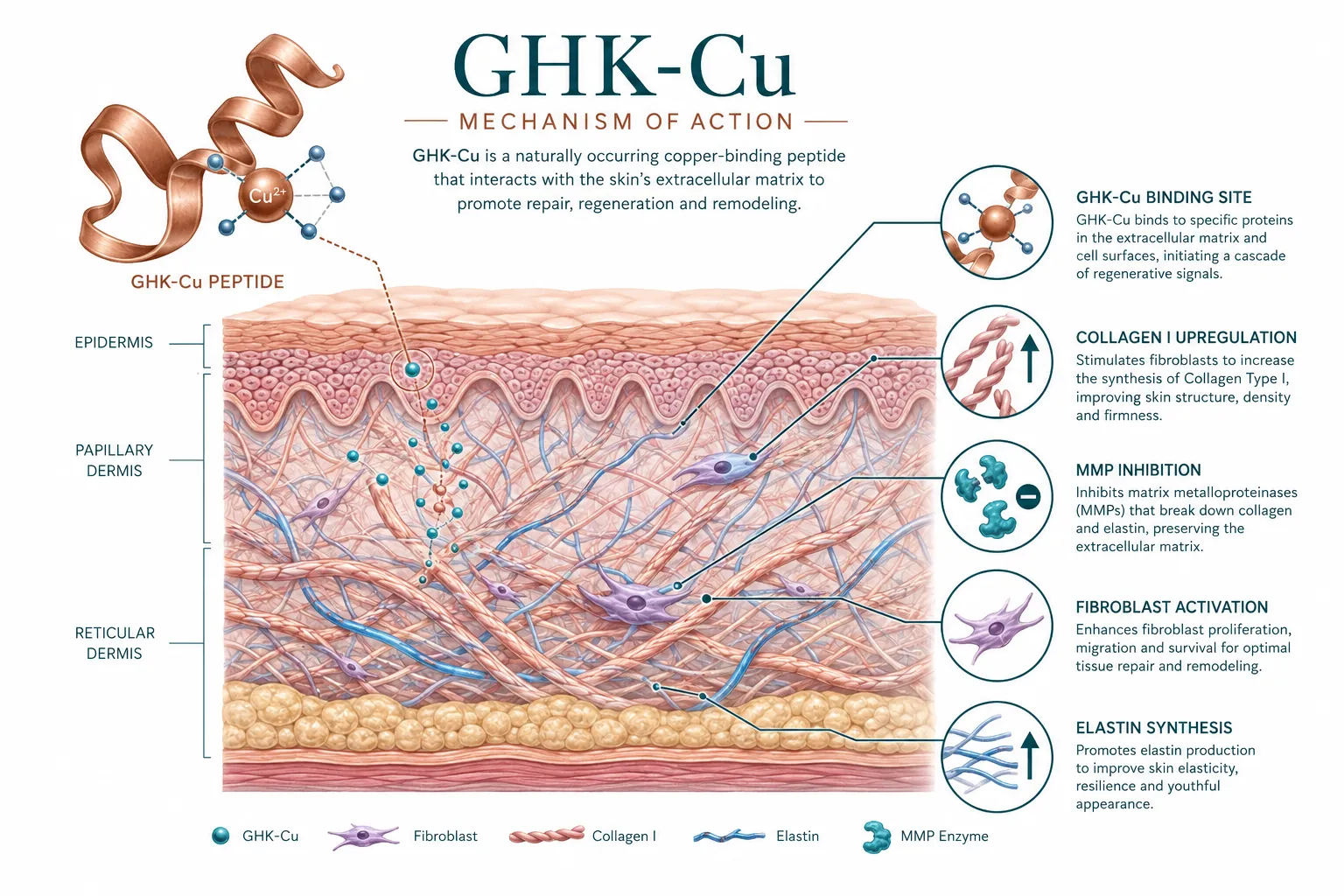
GHK-Cu (glycyl-L-histidyl-L-lysine copper complex) is a naturally occurring tripeptide found in human plasma, saliva, and urine. Its concentration declines with age, and that decline correlates with measurable reductions in skin collagen density. This biological context makes it the logical anchor for any discussion of collagen research peptides in laboratory settings.
In preclinical models, GHK-Cu consistently demonstrates several well-documented actions:
- Upregulation of collagen I and III synthesis in dermal fibroblasts
- Inhibition of matrix metalloproteinases (MMPs), the enzymes that degrade the extracellular matrix (ECM)
- Stimulation of elastin and glycosaminoglycan production
- Antioxidant and anti-inflammatory signaling through copper-dependent pathways
What makes 2026 research particularly compelling is the shift toward epigenetic profiling. Recent studies have moved beyond simple protein expression assays to examine how GHK-Cu modulates gene networks associated with aging skin. This mechanistic depth gives researchers a more complete picture of why the peptide affects collagen turnover rather than just confirming that it does.
A Phase 2 clinical trial currently underway is testing a topical GHK-Cu gel specifically for acute wound re-epithelialization, marking a significant step from preclinical evidence toward controlled human data. Additionally, modified GHK constructs embedded in hydrogel scaffolds have shown enhanced wound repair in diabetic animal models, broadening the peptide's research scope beyond cosmetic applications.
For researchers sourcing this compound, the GHK-Cu peptide purchase and copper peptide research sourcing guide provides practical guidance on purity standards and documentation requirements.
Glow Blends: How Multi-Peptide Stacks Are Positioned in Lab Discussions
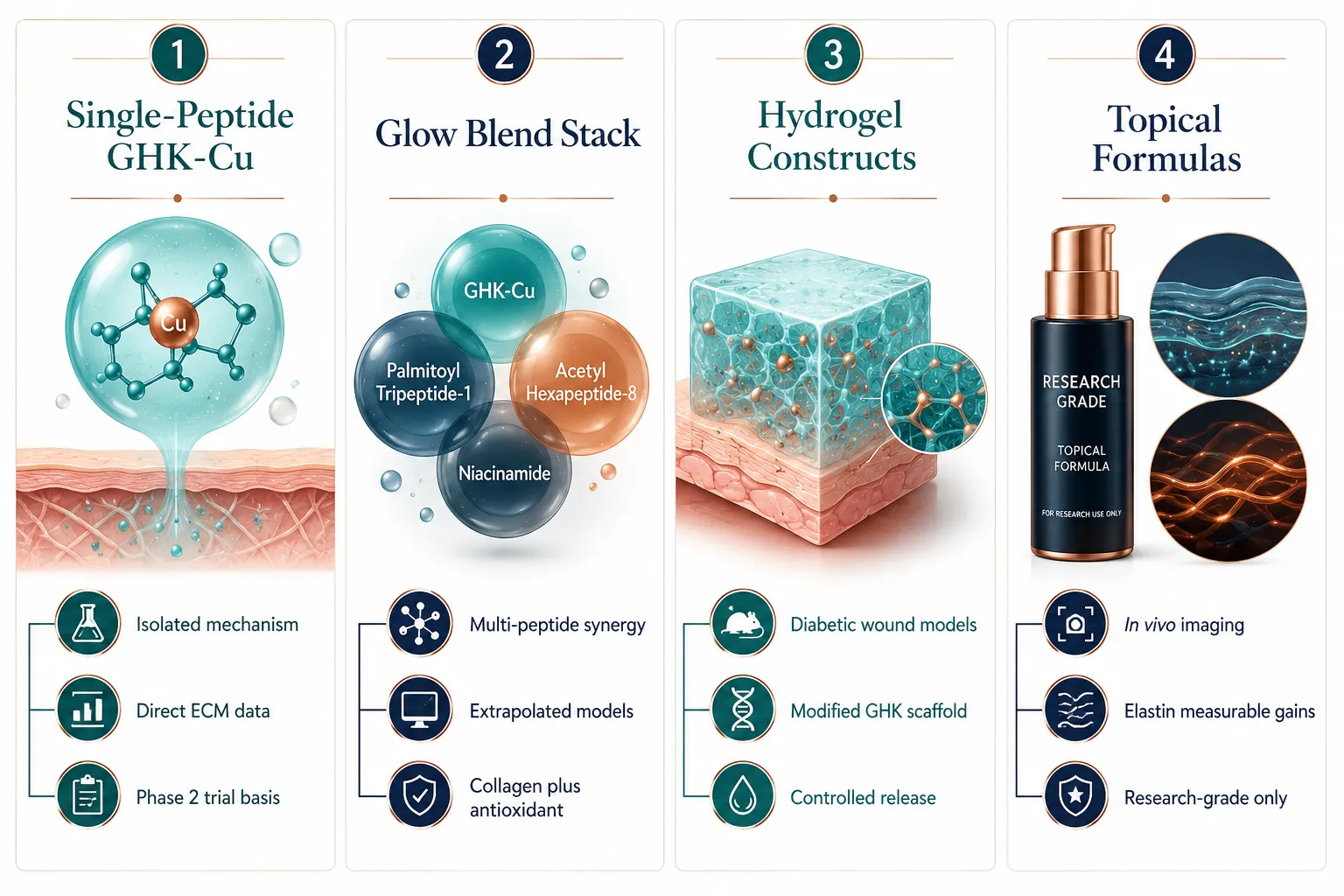
The term "glow blend" refers to standardized multi-peptide stacks built around GHK-Cu, typically combined with complementary compounds such as matrikines, antioxidant peptides, or growth-factor analogs. These formulations are designed to address multiple pathways in collagen synthesis and ECM maintenance simultaneously.
How glow blends differ from single-peptide models:
| Feature | Single-Peptide GHK-Cu | Glow Blend Stack |
|---|---|---|
| Clinical evidence base | Direct RCT and preclinical data | Extrapolated from component studies |
| Mechanism clarity | Well-characterized | Synergy assumed, not always tested |
| Research utility | Mechanistic endpoint studies | Exploratory multi-pathway screening |
| Regulatory status | Research-grade | Research-grade |
The critical distinction is that glow blends extrapolate from existing single-peptide data rather than carrying independent clinical trial support. Commercially available "Glow Mix" formulations in 2026 emphasize mechanistic synergy, the idea that combining peptides with complementary targets produces additive or synergistic ECM effects. This is a scientifically reasonable hypothesis, but it is not the same as demonstrated clinical efficacy.
In laboratory discussions, this matters because researchers need to know whether they are working with a validated model or a plausible construct. Glow blends are best understood as exploratory frameworks for multi-pathway screening rather than as replacements for single-peptide mechanistic studies.
This is consistent with how other multi-peptide research blends are evaluated. Researchers familiar with stacks like the Tesamorelin CJC-1295 Ipamorelin 12mg blend will recognize the same principle: combining peptides with complementary mechanisms requires careful interpretation of which component drives which endpoint.
Skin-Focused Formulas and the Evolving Laboratory Framework
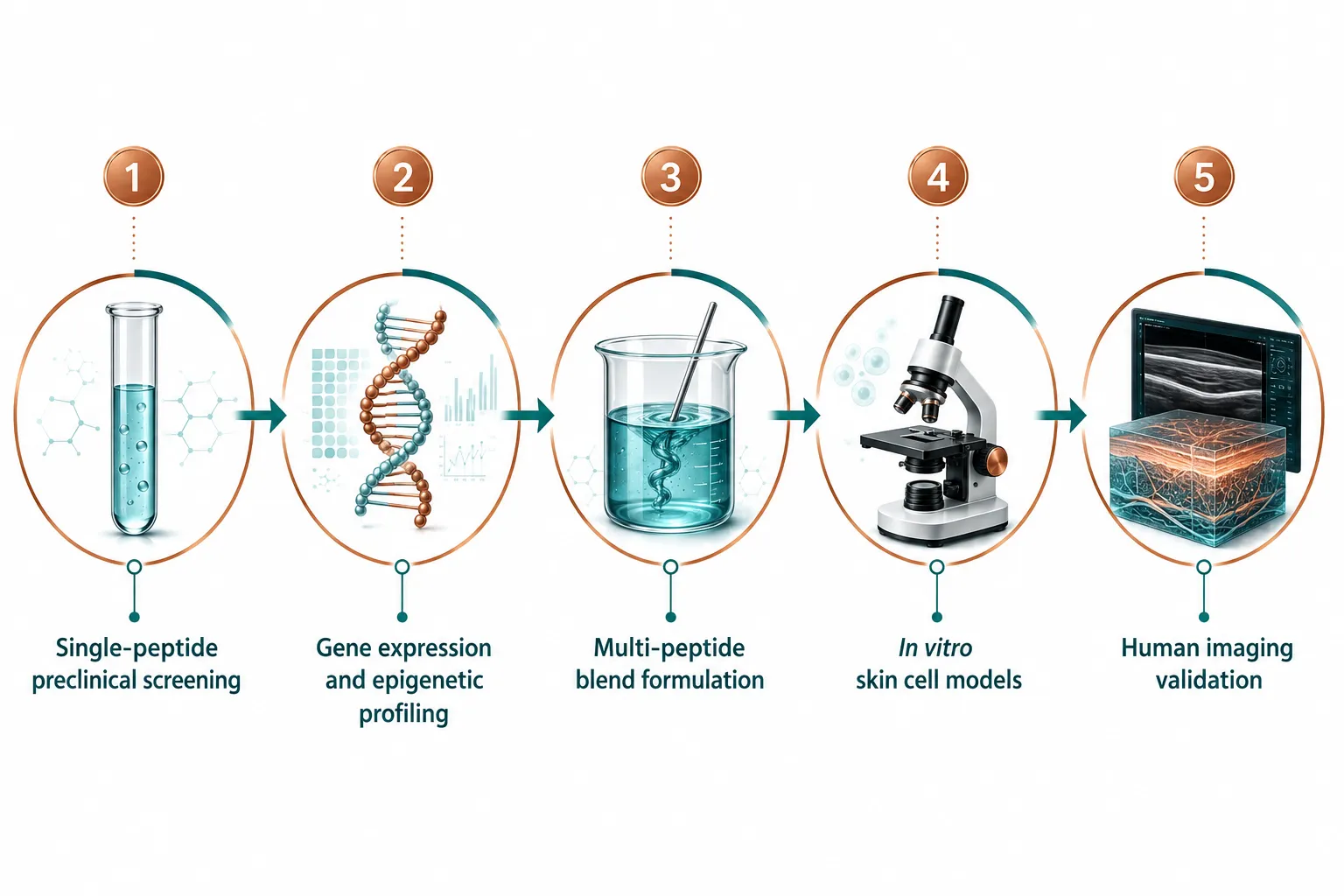
Skin-focused peptide research in 2024 through 2026 has been consolidating smaller randomized controlled trials into more comprehensive summaries. Human imaging studies, including high-frequency ultrasound and reflectance confocal microscopy, have linked GHK-Cu formulations to measurable gains in collagen and elastin density in vivo, providing a bridge between cell culture data and real-world skin biology.
This consolidation is reshaping how laboratory models are structured. Key developments include:
- Gene-expression profiling as a standard endpoint alongside protein assays
- Epigenetic markers of skin aging used to assess peptide efficacy over time
- Hydrogel and scaffold delivery systems that improve peptide stability and localized concentration
- Diabetic wound models as a secondary research context for GHK-Cu constructs
The industry sentiment in 2026 reflects a "growth surge" in GHK-Cu interest, driven partly by its anti-aging positioning and partly by the accumulating mechanistic data. However, researchers are advised to maintain clear boundaries between compounds with direct evidence and those whose benefits are inferred.
For broader context on how purity and sourcing affect research validity, the lab tested peptides resource and the high purity peptide sourcing tag page offer relevant quality benchmarks. Researchers exploring adjacent metabolic peptide frameworks may also find value in the top 5 research peptides for metabolic health buyer's guide.
A note on regulatory context: All glow blend and GHK-Cu formulations discussed in this article are sold as research-grade compounds. They are not approved therapeutics, and findings from laboratory models should not be extrapolated to human clinical use without appropriate trial design and regulatory oversight.
Conclusion
The landscape of collagen research peptides in 2026 is more nuanced than a simple ranking of compounds. GHK-Cu holds the strongest direct evidence base, supported by decades of preclinical work, emerging Phase 2 clinical data, and increasingly sophisticated epigenetic profiling. Glow blends occupy a legitimate but distinct space, useful for exploratory multi-pathway research, but dependent on extrapolated rather than independent clinical evidence.
Actionable next steps for researchers:
- Prioritize single-peptide GHK-Cu models when mechanistic clarity is the goal
- Use glow blends for hypothesis-generating, multi-pathway screening protocols
- Verify purity documentation and third-party testing before incorporating any compound into a study
- Follow ongoing Phase 2 trial data on topical GHK-Cu to understand how preclinical findings translate to human endpoints
- Distinguish between ECM-direct evidence and synergy-based arguments when evaluating formulation claims
Understanding where each formula sits within the evidence hierarchy is not a minor detail, it determines the validity of every endpoint a laboratory model is designed to measure.