Call or Text 727-513-9780
  • Shopping Cart Shopping Cart
    0Shopping Cart
Pure Tested Peptides | America's most trusted Peptides for sale online
  • Peptides for sale
    • Oral Peptides for sale
      • Peptide Capsules for sale
      • BPC 157 Capsules 1000mcg
      • SLU-PP-332 Capsules | 1000 mcg
      • 5-Amino-1MQ 50mg Capsules
      • Tesofensine 500mcg
    • All Peptides for sale
    • Peptide Sprays
      • BPC 157 Nasal Spray Kit
      • BPC-157 TB500 Nasal Spray Kit
      • Semax Nasal Spray 10mg
      • Selank – Nasal Spray Kit – 10mg
      • Epithalon 50MG Nasal Spray Kit
      • Ipamorelin 10mg Nasal Spray
      • Klow Nasal Spray (BPC-157 + TB-500 + GHK-Cu + KPV) | 80mg
      • Hulk Nasal Spray Tesa / Ipa Blend 6/3 MG
      • Klow Nasal Spray
      • NAD + 500 mg Nasal Spray
      • PT-141 Nasal Spray Kit
    • GHRH Peptides
      • Ipa Peptides
      • CJC-1295 Peptides
        • CJC-1295 with DAC 5 mg
        • CJC-1295 without DAC 5 mg
        • CJC-1295 Ipa 10mg
      • Tesa Peptides
        • Tesa Peptide
        • Tesa 20 mg
    • GHK-Cu Peptides
      • All GHK-Cu Peptides
      • GHK-Cu 100mg
      • KLOW Peptide Blend – Buy KLOW blend online
    • BPC Peptides
      • All BPC Peptides
      • BPC-157
      • BPC-157 TB-500
      • BPC 157 capsules 1000mcg
    • SLU-PP-332 Peptides
      • All SLU-PP-332 Peptides
      • SLU-PP-332 5mg
    • GLP3 Peptides
    • PT-141 Peptides
      • PT-141 Peptides for sale
      • PT-141 10mg
      • PT-141 Nasal Spray
    • CAG Peptides
      • Lipo-C Peptide Blend
      • CAG 5mg
      • CAG 10mg
    • MOTS-C Peptides
      • MOTS-C Peptides for sale
      • MOTS-c peptide
      • MOTS-c 10mg *6 pack*
    • 5 Amino 1MQ Peptides
      • 5 Amino 1MQ Peptides for sale
      • 5-Amino-1MQ 50mg Capsules
      • 5-Amino-1MQ 5mg
    • Epithalon Peptides
      • Epithalon Peptides for sale
      • Epithalon 10mg
      • Epithalon 50mg
  • Shop
    • GLPs
      • 5-Amino-1MQ 50mg Capsules
      • 5-Amino-1MQ 5mg
      • L-Carnitine 500mg/ml
      • Tesofensine 500mcg
      • SLU-PP-332 5mg
      • MOTS-c 10mg *6 pack*
    • Epithalon & BPC Peptides
      • Epithalon 10mg
      • Epithalon 50mg
      • BPC-157
      • BPC 157 capsules 1000mcg
      • BPC-157 TB-500
      • BPC-157 TB500 Nasal Spray Kit
      • BPC 157 Nasal Spray Kit
    • BPC TB-500 & NAD+ Peptides
      • NAD+ 500 mg
      • KLOW Peptide Blend – Buy KLOW blend online
      • GLOW Peptide Blend
      • TB 500 5mg
      • BPC 157 capsules 1000mcg – Supplement
      • BPC 157 Nasal Spray Kit
      • BPC-157
      • BPC-157 TB500 Nasal Spray Kit
      • BPC-157 TB-500
      • BPC 157 capsules 1000mcg
    • LL-37 Peptide
      • LL-37 10 mg
    • MOTS-C & Selank
      • MOTS-c peptide
      • Selank 10mg
    • GHK Peptides
      • GHK-Cu 100mg
      • GLOW Peptide Blend
      • KLOW Peptide Blend – Buy KLOW blend online
  • COAs
  • Wholesale
    • Wholesale Peptides for sale
  • PTP FAQ
  • Affiliates
    • Selank Peptide: Advanced Pharmacological Mechanisms Underlying Its Anxiolytic and Nootropic Effects in Research
      • 5-Amino-1MQ Peptide: Detailed Mechanisms of NNMT Inhibition and Its Impact on Cellular Metabolism Research
        • MOTS-C Peptide: Unraveling Its Role in Mitochondrial Dynamics and Energy Metabolism Research
          • Epithalon Peptide and Telomerase Regulation: Investigating Its Impact on Cellular Senescence and Lifespan Research Models
            • GLP2-T vs GLP2 Tirz Peptide: Understanding the Naming, Mechanistic Nuances, and Research Implications for Gut Health
      • Peptides and Polypeptides in Modern Pharmacology: What Research on Metoprolol, Prednisone, and Amlodipine Reveals
        • Polypeptide Peptides vs NSAIDs: What Naproxen and Diclofenac Teach Tissue-Repair Researchers About BPC‑157 and TB‑500
          • Peptides and Polypeptides in Endocrine Pharmacology: How GLP-1, GLP-2, and GLP-3 Retatrutide Differ From Classic Drugs Like Prednisone and Amlodipine
          • 5‑Amino‑1MQ Peptide and NNMT Inhibition: How It Compares With Statins Like Atorvastatin in Adipose and Lipid Metabolism Research
      • Enclomiphene, Estrogen Receptor Signaling, and Luteinizing Phase Biology: What Hormone Researchers Should Measure
        • Mesenchymal Stem Cells, BPC‑157, and GHK‑Cu: How Tissue Repair Peptides Compare With Classic NSAIDs Like Naproxen in Injury Models
          • Peptide Calculator Use Cases Beyond Growth Hormone: Working Through GLP‑3 Retatrutide, MOTS‑c, and BPC‑157 Research Dosing
        • Polypeptide Peptides in Endocrine and Metabolic Pharmacology: Lessons From Amlodipine, Prednisone, and Metoprolol
        • Peptides Calculator for Advanced Blends: Worked Examples for Tesamorelin, CJC‑1295, and Ipamorelin Stacks
          • Peptides and Polypeptides in Human Physiology: How Molecular Size Shapes Research Applications
            • Selank Peptide: Advanced Pharmacological Mechanisms Underlying Its Anxiolytic and Nootropic Effects in Research
          • 5-Amino-1MQ Peptide: Detailed Mechanisms of NNMT Inhibition and Its Impact on Cellular Metabolism Research
            • MOTS-C Peptide: Unraveling Its Role in Mitochondrial Dynamics and Energy Metabolism Research
              • Epithalon Peptide and Telomerase Regulation: Investigating Its Impact on Cellular Senescence and Lifespan Research Models
                • GLP2-T vs GLP2 Tirz Peptide: Understanding the Naming, Mechanistic Nuances, and Research Implications for Gut Health
                  • Peptides and Polypeptides in Endocrine Pharmacology: How GLP-1, GLP-2, and GLP-3 Retatrutide Differ From Classic Drugs Like Prednisone and Amlodipine
                    • Polypeptide Peptides vs NSAIDs: What Naproxen and Diclofenac Teach Tissue-Repair Researchers About BPC‑157 and TB‑500
                      • Peptides and Polypeptides in Modern Pharmacology: What Research on Metoprolol, Prednisone, and Amlodipine Reveals
                        • 5‑Amino‑1MQ Peptide and NNMT Inhibition: How It Compares With Statins Like Atorvastatin in Adipose and Lipid Metabolism Research
                        • Enclomiphene, Estrogen Receptor Signaling, and Luteinizing Phase Biology: What Hormone Researchers Should Measure
                        • Mesenchymal Stem Cells, BPC‑157, and GHK‑Cu: How Tissue Repair Peptides Compare With Classic NSAIDs Like Naproxen in Injury Models
                        • Peptide Calculator Use Cases Beyond Growth Hormone: Working Through GLP‑3 Retatrutide, MOTS‑c, and BPC‑157 Research Dosing
                        • Polypeptide Peptides in Endocrine and Metabolic Pharmacology: Lessons From Amlodipine, Prednisone, and Metoprolol
                        • Peptides Calculator for Advanced Blends: Worked Examples for Tesamorelin, CJC‑1295, and Ipamorelin Stacks
                        • Peptides and Polypeptides in Human Physiology: How Molecular Size Shapes Research Applications
                        • Selank Peptide: Advanced Pharmacological Mechanisms Underlying Its Anxiolytic and Nootropic Effects in Research
                        • MOTS-C Peptide: Unraveling Its Role in Mitochondrial Dynamics and Energy Metabolism Research
                        • Peptides and Polypeptides in Modern Pharmacology: What Research on Metoprolol, Prednisone, and Amlodipine Reveals
                        • Peptides and Polypeptides in Endocrine Pharmacology: How GLP-1, GLP-2, and GLP-3 Retatrutide Differ From Classic Drugs Like Prednisone and Amlodipine
                        • 5-Amino-1MQ Peptide: Detailed Mechanisms of NNMT Inhibition and Its Impact on Cellular Metabolism Research
                        • Mesenchymal Stem Cells, BPC‑157, and GHK‑Cu: How Tissue Repair Peptides Compare With Classic NSAIDs Like Naproxen in Injury Models
                        • Peptide Calculator Use Cases Beyond Growth Hormone: Working Through GLP‑3 Retatrutide, MOTS‑c, and BPC‑157 Research Dosing
                        • GLP2-T vs GLP2 Tirz Peptide: Understanding the Naming, Mechanistic Nuances, and Research Implications for Gut Health
                        • Polypeptide Peptides in Endocrine and Metabolic Pharmacology: Lessons From Amlodipine, Prednisone, and Metoprolol
                        • Polypeptide Peptides vs NSAIDs: What Naproxen and Diclofenac Teach Tissue-Repair Researchers About BPC‑157 and TB‑500
                        • Peptides and Polypeptides in Human Physiology: How Molecular Size Shapes Research Applications
                        • Peptides Calculator for Advanced Blends: Worked Examples for Tesamorelin, CJC‑1295, and Ipamorelin Stacks
                        • 5‑Amino‑1MQ Peptide and NNMT Inhibition: How It Compares With Statins Like Atorvastatin in Adipose and Lipid Metabolism Research
                        • Enclomiphene, Estrogen Receptor Signaling, and Luteinizing Phase Biology: What Hormone Researchers Should Measure
                        • Epithalon Peptide and Telomerase Regulation: Investigating Its Impact on Cellular Senescence and Lifespan Research Models
                        • Best research protocol Klow blend
                        • best time to take BPC-157
                        • best time to take DSIP (Delta Sleep Inducing Peptide)
                        • best time to take CJC-1295
                        • best time to take AOD-9604
                        • best time to take Follistatin 344
                        • best time to take Ipamorelin
                        • best time to take MK-677 (Ibutamoren)
                        • best time to take Ligandrol (LGD-4033) — research compound
                        • best time to take Ostarine (MK-2866) — research compound
                        • best time to take GHK-CU
                        • best time to take TB-500
                        • best time to take MOTS-c
                        • best time to take Semax
                        • best time to take RAD-140 (Testolone) — research compound
                        • best time to take Thymosin Alpha-1
                        • best time to take PEG-MGF
                        • Biolife Plasma, Octapharma Plasma, and Research Peptides: How Plasma Donation Labs Differ From Peptide Suppliers
                        • best time to take YK-11 — research compound
                        • best time to take PT-141 (Bremelanotide)
                        • Best research protocol Klow blend
                        • 5-Amino-1MQ and MOTS-C Synergy: Metabolic Signaling, Mitochondria, and Research Design
                        • BPC-157 and TB-500: Investigating Their Combined Effects on Angiogenesis and Cellular Migration in Tissue Repair Models
                        • BPC-157 Peptide: Gut Barrier Function, Inflammation, and Tissue-Recovery Research
                        • 5‑Amino‑1MQ and MOTS‑c Synergy in Metabolic Research: Designing NNMT and Mitochondrial Biogenesis Stacks
                        • CJC-1295 with DAC vs. Without DAC: Half-Life, Release Kinetics, and Research Implications
                        • CJC‑1295 with DAC vs. Without DAC: Expanding on Half‑Life Differences Using Tesamorelin and Ipamorelin Blend Case Studies
                        • Collagen Biology and Copper‑Binding Peptides: How GHK‑Cu, Glow Blend, and Klow Blend Interact with Skin and Connective Tissue
                        • Collagen Biology and Regenerative Peptides: How GHK‑Cu, Glow Blend, and Klow Blend Affect Extracellular Matrix Research
                    • DNA, Telomeres, and Longevity Peptides: Positioning Epithalon and MOTS‑c in Genetic Aging Research
                      • Enclomiphene Citrate: serm Mechanism, Testosterone Research, and Stack Compatibility
                        • Enclomiphene vs Enclomiphene Citrate: Formulation, Bioavailability, and Research Distinctions
                        • Epithalon Peptide Research: Telomerase Activation, Aging, and Pineal Gland Function
                        • Estrogen Receptor Signaling and Enclomiphene: How Selective Modulators Compare with Classic Polypeptide Hormones
                        • GHK-Cu Peptide: Advanced Mechanisms in Extracellular Matrix Remodeling and Wound Healing Research
                        • GHK-Cu Peptide: Collagen Synthesis, Wound Repair, and Skin-Barrier Research Models
                        • GLP-1 vs GLP-3 vs GLP-2: Peptide Classification and Research Applications
                        • GLP-2 Peptide Research Guide: Gut Barrier Function, Nutrient Absorption, and Intestinal Recovery Models
                        • GLP-3 Retatrutide vs. GLP-1 Drugs: What Triple-Agonist Biology Changes in Research Models
                        • Ipamorelin and Tesamorelin Combination: Synergistic GH Secretagogue Research and Dosing Protocols
                        • GLP2 Tirz Peptide: What It Is, Why the Name Exists, and How Researchers Should Interpret It
                        • Klow Blend Peptide Nasal Spray: What the Formulation Is Trying to Do in Cognitive Research
                        • Mitochondria, NNMT Inhibition, and Peptide Modulators: Where MOTS‑c and 5‑Amino‑1MQ Fit in Cellular Energy Research
                        • MOTS-c Peptide: Mitochondrial Function, Energy Metabolism, and What Researchers Measure
                        • MOTS-c vs. 5-Amino-1MQ: Which Metabolic Research Questions Each Compound Actually Answers
                        • Nasal Spray Peptides: Bioavailability, Administration, and Semax/Selank Research Applications
                        • PT-141 Peptide Research: Mechanism of Action and Melanocortin Receptor Signaling
                        • Retatrutide for Research: Mechanism, Structure, and GLP-1/GLP-3 Dual Action
                        • Retatrutide for Obesity and Type 2 Diabetes: What the Latest Trial Data Suggest
                        • Tesofensine Peptide Research: Mechanism, Appetite Suppression, and Neuropeptide Y Pathways
  • Contact
    • Contact Customer Service
    • Text Customer Support
  • About US
  • Shop all peptides
  • Affiliate Program
    • Affiliate Signup
  • Login / Register Login / Register Page Link Login / Register Page Link
  • Click to open the search input field Click to open the search input field Search
  • Menu Menu

Tag Archive for: skin model endpoints

GHK-Cu, Glow Blend, and Klow Blend: Choosing Skin-Model Endpoints for Matrix Remodeling Research

GHK-Cu, Glow Blend, and Klow Blend: Choosing Skin-Model Endpoints for Matrix Remodeling Research

October 18, 2026/0 Comments/in Uncategorized/by

Collagen synthesis assays alone account for the majority of published peptide skin-model endpoints, yet they capture less than half of the biological story when copper-dependent signaling is involved. For researchers working with GHK-Cu, Glow Blend, and Klow Blend: Choosing Skin-Model Endpoints for Matrix Remodeling Research is not just a protocol question, it is a question of scientific validity. Conflating blend-level claims with copper-specific mechanisms produces noisy data, and the field is beginning to demand better.

Key Takeaways

  • GHK-Cu drives matrix remodeling through copper-dependent gene activation, distinct from blend-level synergistic effects.
  • Glow Blend and Klow Blend target overlapping but meaningfully different ECM pathways, requiring separate endpoint strategies.
  • Collagen deposition and MMP modulation are necessary but insufficient endpoints; fiber architecture and mechanical properties are the next frontier.
  • Distinguishing the peptide form from the copper complex form of GHK-Cu is essential for reproducible results.
  • Standardizing exposure conditions and species selection will determine whether 2026 research findings translate into reliable protocols.

What GHK-Cu Actually Does at the Matrix Level

GHK-Cu (glycyl-L-histidyl-L-lysine copper complex) is a naturally occurring tripeptide-copper chelate with a documented gene-level footprint spanning more than 4,000 human genes. Its matrix remodeling activity operates through several converging pathways.
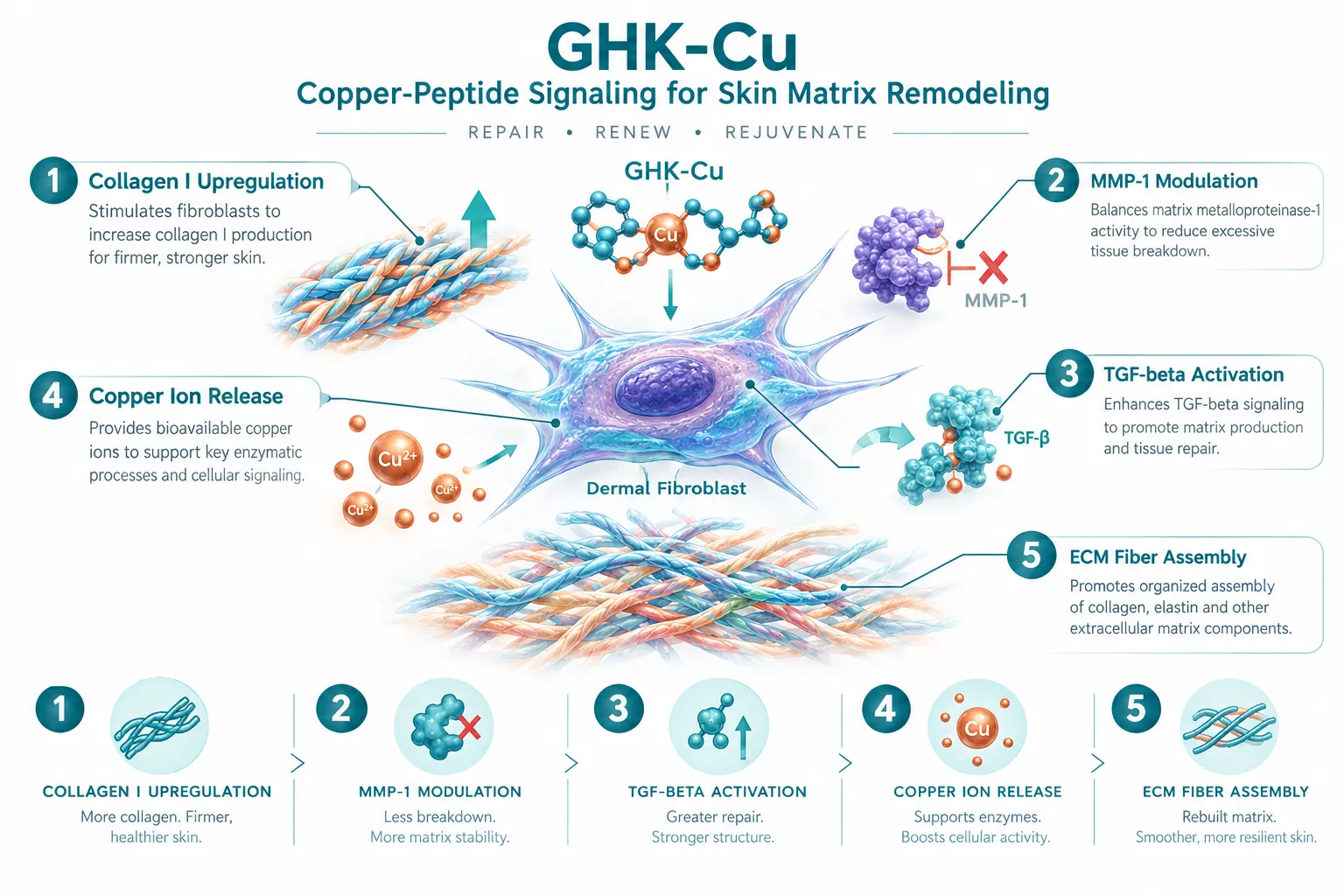
What GHK-Cu Actually Does at the Matrix Level

Core mechanisms include:

  • Upregulation of collagen I and III synthesis via TGF-beta pathway activation
  • Bidirectional modulation of matrix metalloproteinases (MMPs), particularly MMP-1 and MMP-2
  • Stimulation of glycosaminoglycan (GAG) production, supporting the ground substance of the dermis
  • Promotion of fibroblast proliferation and migration into wound sites
  • Antioxidant activity mediated by copper's role in superoxide dismutase (SOD) function

A critical distinction that researchers often overlook: the peptide form (GHK alone) and the copper complex form (GHK-Cu) produce different downstream effects. GHK without copper shows reduced potency in collagen induction assays. Failing to specify which entity is under study is one of the most common sources of inter-laboratory variability in 2026 skin-model literature.

"The copper moiety is not incidental, it is mechanistically load-bearing. Endpoint selection must reflect which form of the molecule is present in the experimental system."

For researchers exploring related peptide systems, the documentation-first approach outlined in the BPC-157 core peptides research guide offers a useful methodological parallel.


Glow Blend and Klow Blend: Composition and Mechanistic Framing

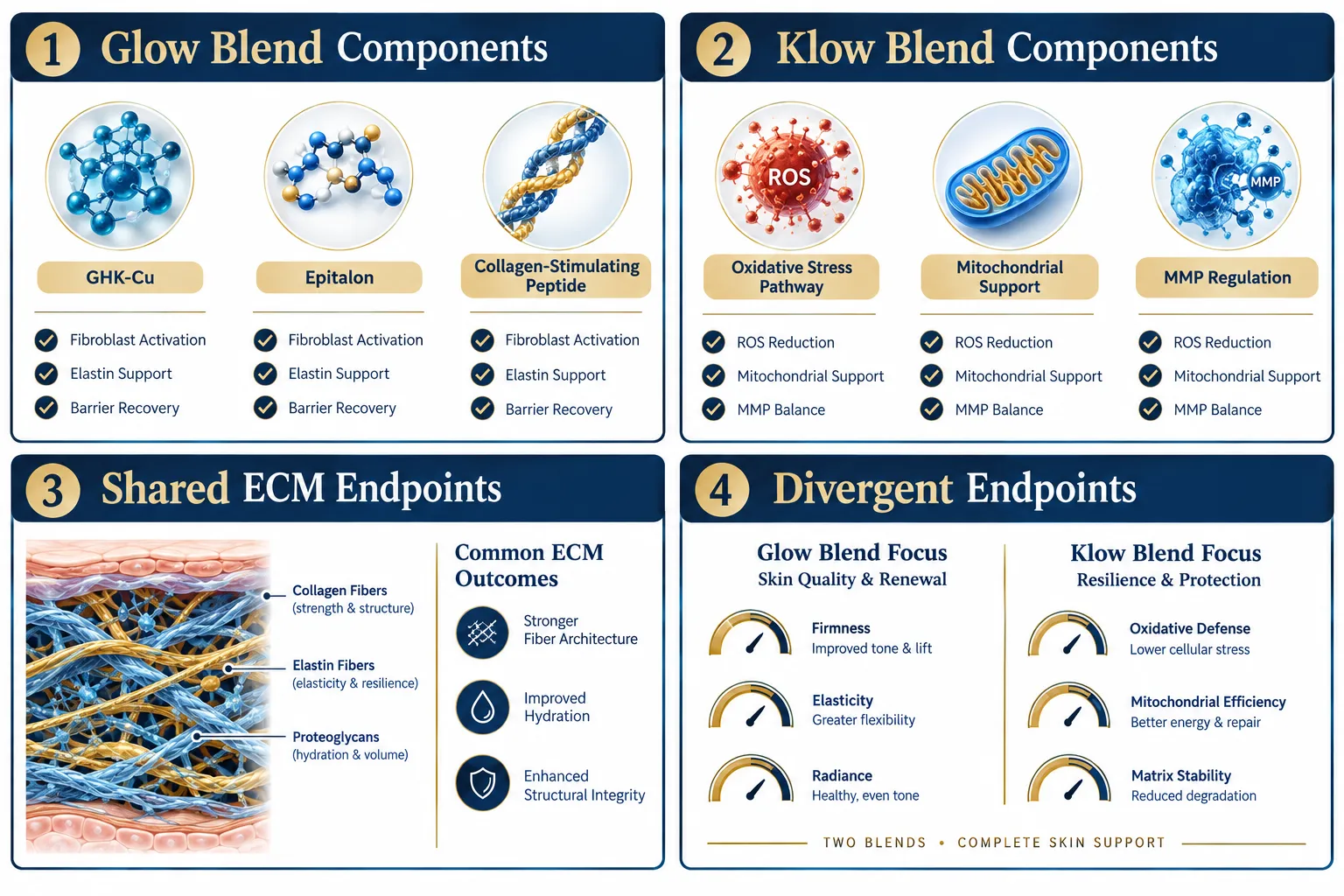
As of late 2026, multi-peptide ECM stacks have become standard tools in dermal research. Glow Blend and Klow Blend represent two distinct formulation philosophies within this trend.

Glow Blend is structured around anabolic ECM activity. Its composition typically centers on GHK-Cu paired with peptides that support fibroblast viability and collagen fiber organization. The primary research orientation is toward net matrix deposition, making it suited to models studying skin aging, wound healing, and dermal thickness.

Klow Blend is oriented toward matrix homeostasis under oxidative stress conditions. It incorporates components that address reactive oxygen species (ROS) load alongside matrix turnover regulation. This makes it more appropriate for models simulating photoaged or environmentally stressed skin.

Endpoint Alignment at a Glance

Endpoint Glow Blend Focus Klow Blend Focus
Collagen I/III deposition Primary Secondary
Elastin fiber density Primary Moderate
Barrier recovery (TEWL) Moderate Secondary
Oxidative stress markers Low Primary
Fibroblast viability Primary Moderate
MMP-1 / MMP-2 balance Secondary Primary

This divergence matters enormously when designing skin-model experiments. Applying Glow Blend endpoints to a Klow Blend study, or vice versa, will systematically underreport the blend's actual activity.

Researchers interested in how peptide combinations interact at the signaling level may also find value in reviewing SS31 mitochondrial dynamics research, which addresses oxidative pathway modulation in a different tissue context.


Choosing Skin-Model Endpoints for GHK-Cu, Glow Blend, and Klow Blend Research

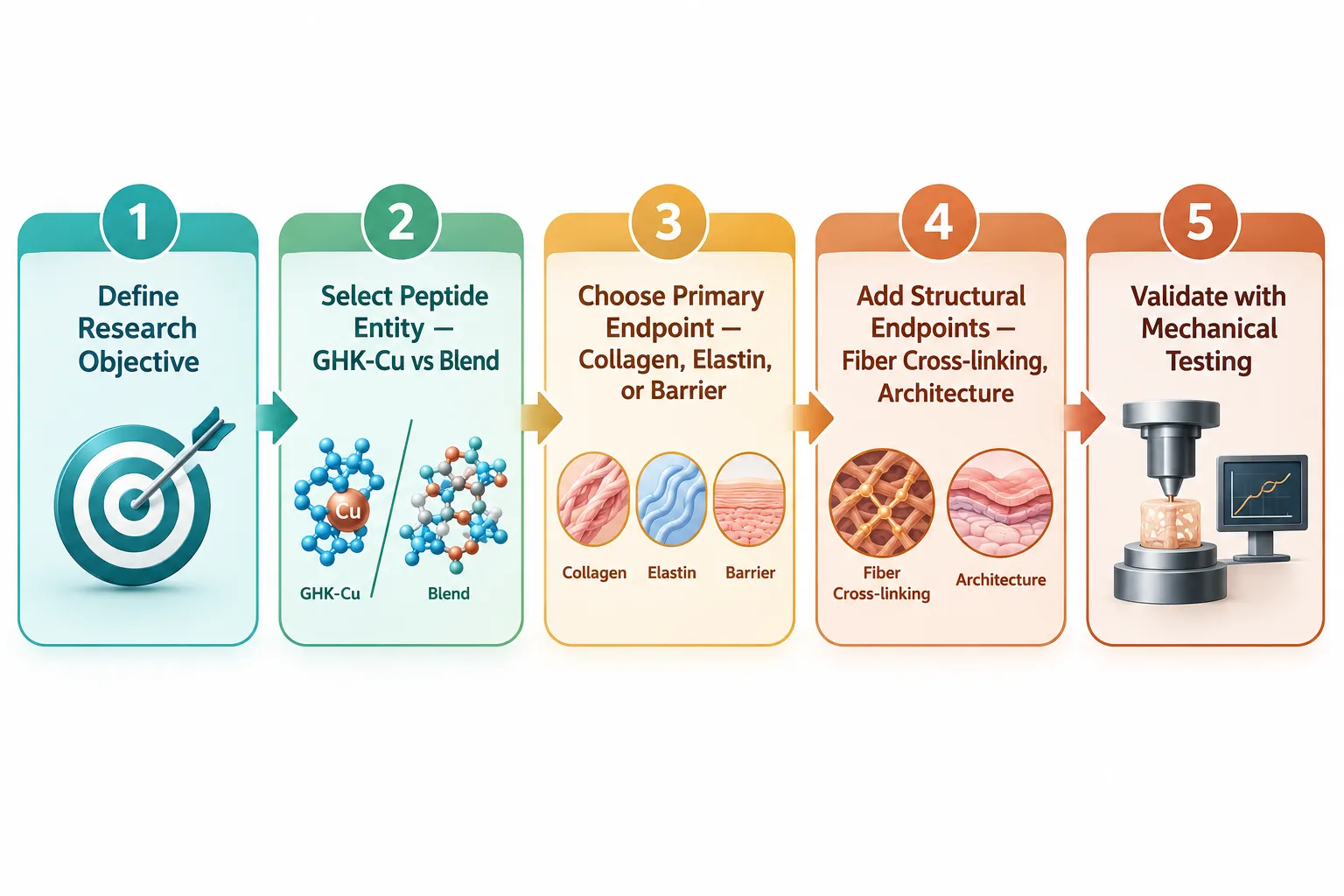
When approaching GHK-Cu, Glow Blend, and Klow Blend: Choosing Skin-Model Endpoints for Matrix Remodeling Research, the endpoint selection process should follow a structured hierarchy.
Choosing Skin-Model Endpoints for GHK-Cu, Glow Blend, and Klow Blend Research

Tier 1: Biomarker Endpoints (Necessary but Insufficient)

These are the most commonly reported endpoints and remain essential for baseline characterization:

  • Collagen I and III quantification (ELISA or immunofluorescence)
  • GAG content (dimethylmethylene blue assay)
  • MMP-1, MMP-2, MMP-9 activity (zymography or activity assays)
  • Fibroblast viability (MTT or live/dead staining)
  • Elastin protein levels (Western blot or ELISA)

Tier 2: Structural Endpoints (Increasingly Required)

The academic critique emerging in 2026 is clear: biomarker increases do not confirm functional matrix improvement. Structural endpoints are now expected in high-quality publications:

  • Fiber organization assessed by second-harmonic generation (SHG) microscopy
  • Collagen cross-linking density via hydroxylysylpyridinoline quantification
  • Matrix architecture scoring using confocal or transmission electron microscopy

Tier 3: Mechanical Property Endpoints (Emerging Standard)

The most rigorous current protocols add direct mechanical testing:

  • Tensile strength and elasticity of 3D skin equivalents
  • Atomic force microscopy (AFM) for nanoscale stiffness mapping
  • Viscoelastic profiling under cyclic loading

For researchers building multi-peptide protocols, the dosing frameworks discussed in resources like CJC-1295 IPA 10mg and sermorelin ipamorelin CJC-1295 dosage illustrate how concentration and timing decisions shape endpoint interpretability in blended systems.

Practical Protocol Checklist

Before finalizing a skin-model protocol for Glow or Klow research, confirm the following:

  1. Is the GHK-Cu entity specified as peptide-only or copper complex?
  2. Are exposure concentrations within the physiologically relevant range (typically 1 nM to 10 uM)?
  3. Has the species and cell source been standardized across experimental runs?
  4. Are both Tier 1 and at least one Tier 2 endpoint included?
  5. Is the control condition matched for copper ion concentration to isolate peptide-specific effects?

Researchers sourcing verified reference material can review available GHK-Cu for sale options to ensure purity specifications meet research-grade standards.


Standardization Gaps and the Path Forward

The most significant methodological gap in current GHK-Cu, Glow Blend, and Klow Blend skin-model research is the absence of standardized protocols across laboratories. Three areas require immediate attention in 2026 and beyond.
Standardization Gaps and the Path Forward

First, species and cell-source heterogeneity. Studies using primary human dermal fibroblasts, immortalized cell lines, and reconstructed human epidermis (RHE) models are not directly comparable. Protocols should specify passage number, donor age, and culture conditions.

Second, the copper control problem. Many studies fail to include a copper-only control, making it impossible to attribute observed effects to the peptide backbone versus the metal ion. This is particularly relevant when comparing Glow Blend (which contains GHK-Cu) against Klow Blend formulations.

Third, the move beyond biomarker endpoints to direct matrix architecture assessment. Fiber organization, cross-linking density, and mechanical properties are the endpoints that will determine whether these peptide systems translate from bench models to meaningful dermal outcomes.

For broader context on how peptide research protocols are evolving, the SS31 and MOTS-C research area demonstrates how multi-target peptide systems are being evaluated with increasingly sophisticated endpoint hierarchies.


Conclusion

Choosing the right endpoints for GHK-Cu, Glow Blend, and Klow Blend matrix remodeling research is not a minor procedural detail, it determines whether a study generates actionable knowledge or adds to the noise. The actionable steps are clear.

Researchers should:

  • Specify the exact GHK-Cu entity (peptide vs. copper complex) in every protocol
  • Align endpoint selection with the mechanistic orientation of the specific blend being studied
  • Advance beyond Tier 1 biomarkers to include structural and mechanical endpoints
  • Include copper-only controls to isolate peptide-specific contributions
  • Standardize species, passage, and exposure conditions to enable cross-study comparison

The field is moving toward multi-peptide ECM stacks as standard research tools. The laboratories that invest in rigorous endpoint design now will produce the reference datasets that define the field for the next decade.

https://www.puretestedpeptides.com/wp-content/uploads/2026/10/ghk-cu-glow-blend-and-klow-blend-choosing-skin-model-endpoints-for-matrix-remode.webp 1024 1536 https://www.puretestedpeptides.com/wp-content/uploads/2026/01/buy-peptides-online.jpg 2026-10-18 13:03:332026-10-18 13:03:33GHK-Cu, Glow Blend, and Klow Blend: Choosing Skin-Model Endpoints for Matrix Remodeling Research
×

Helpful Links

  • My account
  • Cart
  • Checkout
  • Refund and Returns Policy
  • Privacy Policy
  • SMS Privacy Policy
  • Login
  • My Account
  • Logout

USA Made Lab Tested Peptides

All products are sold for research, laboratory, or analytical purposes only, and are not for human consumption


Pure Tested Peptides is a chemical supplier. Pure Tested Peptides is not a compounding / chemical compounding facility as defined under 503A of the Federal Food, Drug, and Cosmetic act. Pure Tested Peptides is not an outsourcing facility as defined under 503B of the Federal Food, Drug, and Cosmetic act.

The statements made within this website have not been evaluated by the US Food and Drug Administration. The products we offer are not intended to diagnose, treat, cure or prevent any disease.

Human/Animal Consumption Prohibited. Laboratory/In-Vitro Experimental Use Only

Scroll to top Scroll to top Scroll to top