

Klow Blend and Glow Blend Peptides: Comparing Skin-Focused Peptide Formulations in Research Settings
Researchers studying skin biology now have access to multi-peptide blends specifically designed to target collagen synthesis, tissue repair, and cellular aging simultaneously. Among the most discussed options in 2026 are the GLOW and KLOW formulations. Understanding the differences between Klow Blend and Glow Blend peptides: comparing skin-focused peptide formulations in research settings is essential for any lab selecting the right tool for a specific experimental endpoint.
Key Takeaways
- GLOW Blend is a 70 mg multi-peptide formulation targeting skin collagen, repair, and anti-aging pathways.
- KLOW Blend is an expanded 80 mg version of GLOW, incorporating additional peptides for broader multi-pathway coverage.
- Both blends are strictly for research use only and are not approved for human therapeutic application.
- Component peptides such as GHK-Cu and BPC-157 variants each contribute distinct mechanistic roles within these formulations.
- Lab selection between GLOW and KLOW depends on the research endpoint, the number of pathways under investigation, and experimental design requirements.
Understanding GLOW Blend: Composition and Research Rationale
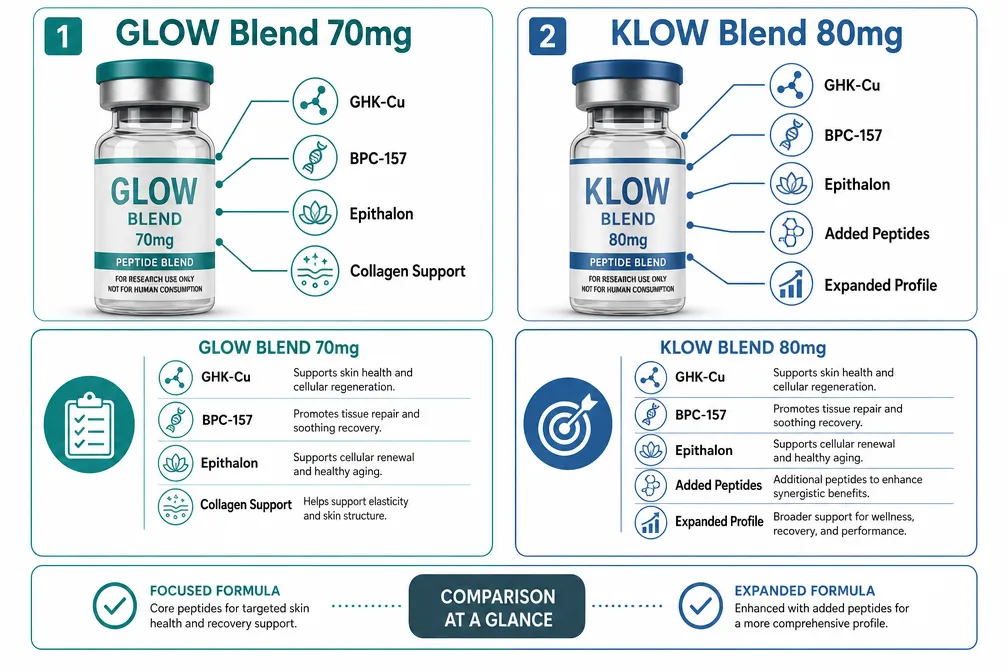
The GLOW Blend is a 70 mg formulation built around peptides that have been studied for their roles in skin structure, collagen remodeling, and cellular longevity. Its core components typically include GHK-Cu (copper peptide), BPC-157, and Epithalon, each selected for a distinct mechanistic contribution.
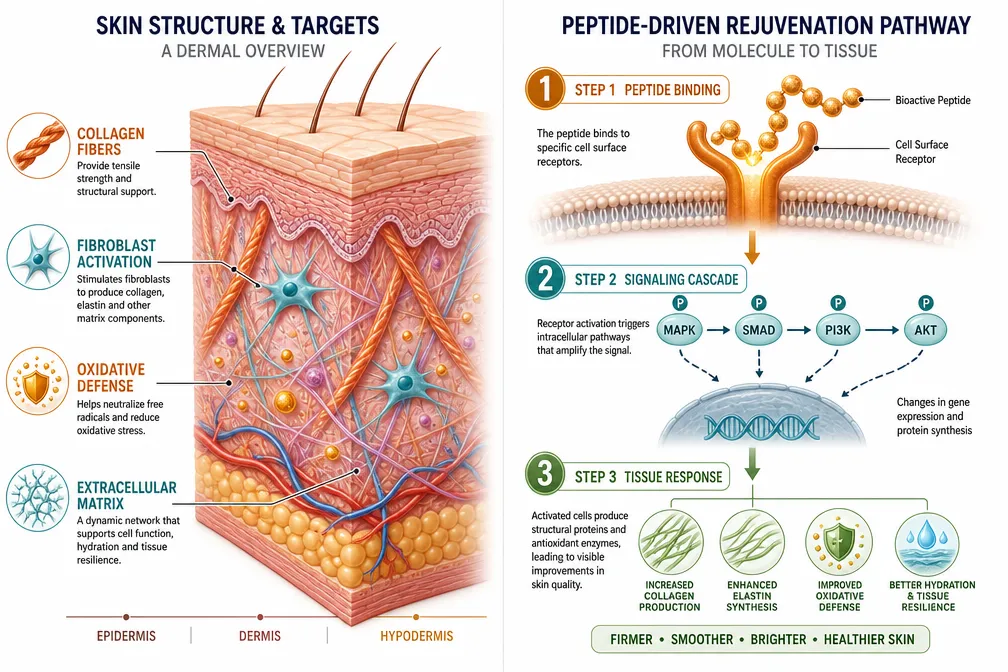
GHK-Cu is among the most researched copper-binding peptides in skin biology. Studies have examined its ability to upregulate collagen and glycosaminoglycan synthesis in fibroblasts, making it a logical anchor for any skin-focused blend. For labs interested in sourcing copper peptide compounds, reviewing a copper peptide research sourcing guide can clarify purity and documentation standards.
BPC-157 contributes to the GLOW formulation through its well-documented role in tissue repair signaling. Research has explored its influence on growth factor expression and angiogenesis, both relevant to skin wound healing models. Labs new to this compound can consult BPC-157 core peptides documentation for foundational research context.
Epithalon (also spelled Epitalon) rounds out the GLOW core by targeting telomere-related aging mechanisms. Research suggests it may influence telomerase activity, which is relevant in studies examining cellular senescence in dermal tissue.
"The GLOW Blend's 70 mg format is designed to give researchers a defined, reproducible starting point for multi-pathway skin research without introducing excessive formulation complexity."
The 70 mg total weight is distributed across these components in a fixed ratio, allowing consistent dosing across experimental replicates. All GLOW Blend products are produced under research-use-only conditions, with third-party purity testing and certificate of analysis documentation available.
KLOW Blend: An Expanded Formulation for Broader Endpoint Coverage
The KLOW Blend builds directly on the GLOW framework, expanding to an 80 mg total formulation. This additional 10 mg accommodates supplementary peptides that extend the blend's mechanistic reach beyond the GLOW core.
The expanded profile of KLOW is designed for research scenarios where investigators need to probe multiple skin-related pathways in a single experimental arm. In addition to GHK-Cu, BPC-157, and Epithalon, the KLOW formulation incorporates peptides targeting oxidative stress defense and extracellular matrix support.
Key quantitative differences between GLOW and KLOW:
| Feature | GLOW Blend | KLOW Blend |
|---|---|---|
| Total weight | 70 mg | 80 mg |
| Core peptides | 3 primary | 3 primary + additional |
| Research scope | Focused skin/collagen | Multi-pathway expanded |
| Ideal use case | Single-endpoint studies | Broad-panel investigations |
This expanded scope makes KLOW particularly relevant for labs running whole-tissue models or multi-marker assays. However, the added complexity also means researchers must account for potential interaction effects between peptide components when interpreting results.
It is critical to distinguish both GLOW and KLOW research blends from compounded clinical injectables that share similar naming conventions in some compounding pharmacy contexts. The research formulations discussed here are not pharmaceutical-grade clinical products and carry no therapeutic approval.
Comparing Klow Blend and Glow Blend Peptides: Selecting the Right Formulation for Research Settings
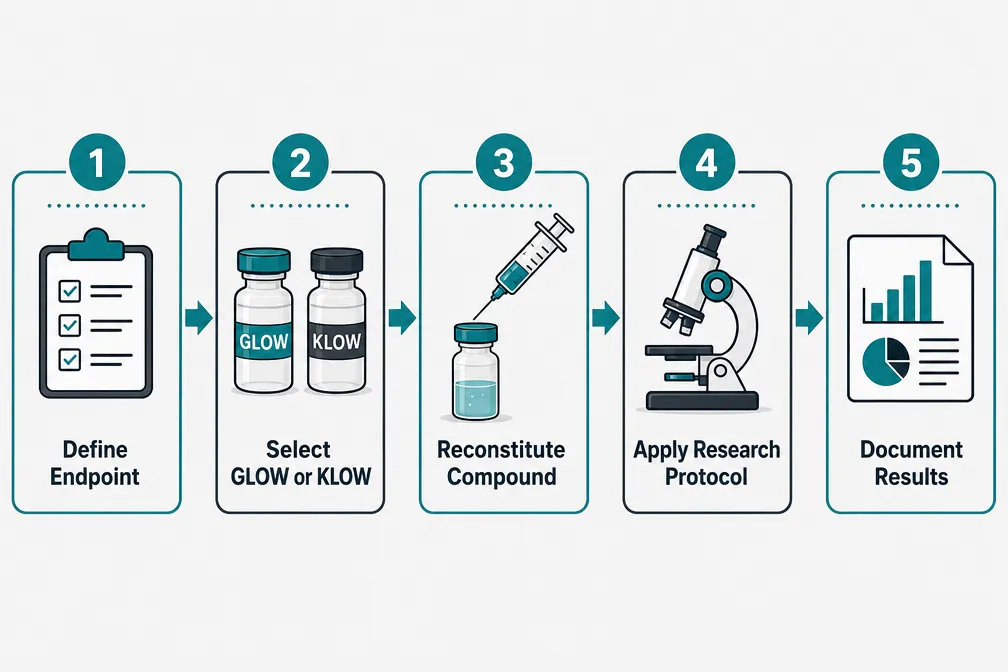
When comparing Klow Blend and Glow Blend peptides across skin-focused peptide formulations in research settings, the decision ultimately comes down to experimental design requirements.
Choose GLOW Blend when:
- The study focuses on a single primary endpoint such as collagen synthesis or fibroblast proliferation
- Simpler formulation control is needed to isolate the effect of individual peptide classes
- Budget or sample constraints favor a lower-weight, lower-complexity blend
Choose KLOW Blend when:
- The protocol requires simultaneous assessment of collagen remodeling, oxidative defense, and matrix integrity
- The lab is running multi-marker panels where broader peptide coverage strengthens the data set
- Researchers are exploring synergistic interactions between peptide pathways
For labs already working with multi-peptide growth hormone-axis blends, the logic of combining complementary peptides is familiar. Resources on tesa, CJC-1295, and ipamorelin 12mg blend reconstitution offer parallel documentation practices applicable to GLOW and KLOW handling.
Purity standards matter equally for both formulations. Researchers should request HPLC and mass spectrometry data before incorporating any blend into a study. Labs browsing the full range of available research compounds can explore all peptides for sale to compare documentation standards across product lines.
Documentation updates released between June and August 2026 have refined reconstitution guidance and storage recommendations for both GLOW and KLOW blends, emphasizing cold-chain integrity and single-use aliquoting to preserve peptide stability.
Looking ahead, the use of multi-pathway blends in skin research is expected to grow as investigators seek more efficient models for studying complex dermal biology. The GLOW and KLOW frameworks represent an early but well-structured example of this trend.
Conclusion
Selecting between GLOW and KLOW blends is not a matter of one being superior to the other. It is a matter of matching formulation complexity to research scope. GLOW's 70 mg, three-peptide core suits focused, single-endpoint investigations. KLOW's 80 mg expanded profile serves labs that need broader multi-pathway data from a single experimental arm.
Actionable next steps for research teams:
- Define the primary and secondary endpoints before selecting a blend.
- Request full certificates of analysis, including HPLC purity data, from the supplier.
- Review the June-August 2026 updated reconstitution and storage documentation for both formulations.
- Consult the BPC-157 core peptides documentation guide and the copper peptide research sourcing guide for component-level background.
- Treat all materials as research-use-only compounds in full compliance with applicable institutional and regulatory guidelines.
Rigorous documentation, verified purity, and a clearly defined experimental design are the foundations of credible peptide research regardless of which blend is selected.

