

Understanding DNA, Telomeres, and Epithalon: How Genetic and Telomeric Markers Are Used in Peptide Longevity Research
Every time a human cell divides, it loses a small segment of its chromosomal tips, and that countdown may be one of the most measurable clocks in biology. This article explores understanding DNA, telomeres, and Epithalon: how genetic and telomeric markers are used in peptide longevity research, tracing the science from chromosome structure all the way to preclinical peptide trials.
Key Takeaways
- Telomeres are protective DNA caps that shorten with each cell division, serving as measurable biological aging markers.
- Epithalon is a synthetic tetrapeptide studied for its ability to activate telomerase, the enzyme that rebuilds telomere length.
- Preclinical and early human observational data suggest Epithalon may influence lifespan and immune markers, though independent large-scale trials are lacking.
- Genetic and epigenetic endpoints, including telomere length assays, are central tools in modern peptide longevity research.
- Epithalon remains a research compound with no FDA approval; its findings should be interpreted within strict scientific context.
What Are Telomeres and Why Do They Matter in Longevity Research
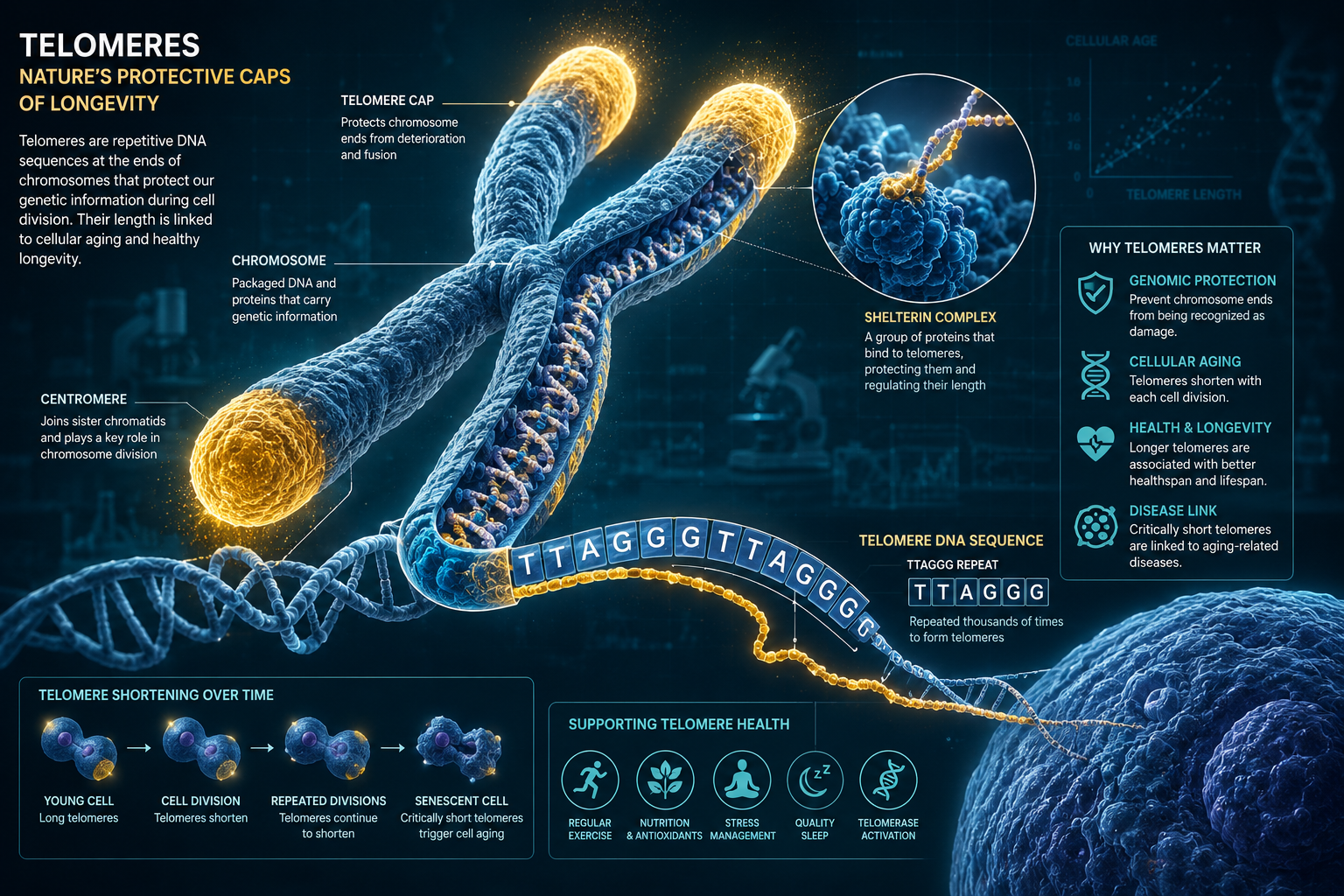
Telomeres are repetitive nucleotide sequences (TTAGGG) that cap the ends of every chromosome, functioning much like the plastic tips on shoelaces. Their job is structural: they prevent chromosome ends from being recognized as damaged DNA and stop chromosomes from fusing with one another.
With each round of cell replication, telomeres shorten. When they become critically short, the cell enters a state called senescence, it stops dividing and begins secreting inflammatory signals. This process is now recognized as a core driver of tissue aging.
Why this matters for research:
- Telomere length can be measured in blood samples using quantitative PCR or flow-FISH techniques.
- Short telomeres correlate with increased risk of cardiovascular disease, immune dysfunction, and all-cause mortality.
- Telomerase, the enzyme that adds telomeric repeats back onto chromosome ends, is normally suppressed in adult somatic cells but active in stem cells and cancer cells.
Researchers studying longevity peptides use telomere length as a quantifiable genomic endpoint. This makes it possible to compare treated versus untreated cell cultures and animal cohorts in a standardized, reproducible way.
How Epithalon Targets Telomerase: The Molecular Mechanism
Epithalon (Ala-Glu-Asp-Gly) is a synthetic four-amino-acid peptide derived from epithalamin, a natural compound produced by the pineal gland. Its primary studied mechanism centers on activating telomerase by upregulating hTERT, the catalytic subunit that drives telomere elongation.
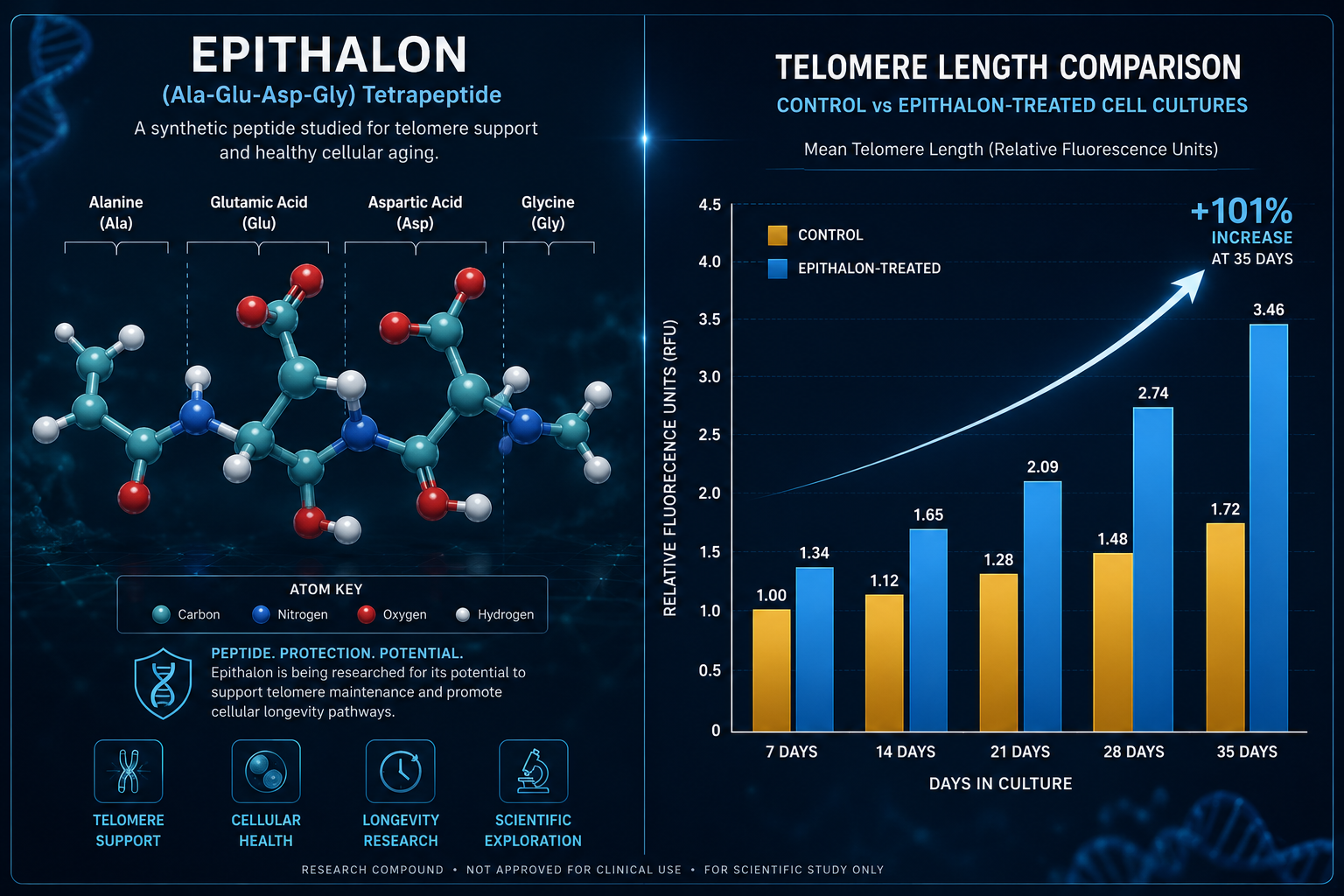
A 2025 study demonstrated dose-dependent telomere elongation in normal human cell lines following Epithalon exposure, supporting the hTERT upregulation hypothesis. In animal models, monthly Epithalon injections in female SHR mice increased mean lifespan and inhibited leukemia development sixfold compared to controls.
A 6-to-8-year observational study of 266 elderly patients treated with epithalamin reported a 1.6-to-1.8-fold decrease in mortality and a 2.0-to-2.4-fold reduction in acute respiratory disease incidence. These are notable figures, though the study design limits causal conclusions.
Additional effects observed in research settings include:
- Improved sleep quality and circadian rhythm regulation, likely mediated through melatonin pathway interactions
- Modulation of neuroendocrine signaling consistent with pineal gland activity
- Potential synergies with tissue-repair peptides such as GHK-Cu, though this remains speculative
For a broader comparison of Epithalon against other longevity-focused compounds, the Epithalon vs. NAD evidence review provides useful context on mechanism differences.
"Telomere length is not destiny, but it is data. Peptide researchers treat it as one genomic signal among many, not a standalone verdict on biological age."
Understanding DNA, Telomeres, and Epithalon in the Context of Research Limitations and Comparisons
No honest account of understanding DNA, telomeres, and Epithalon, how genetic and telomeric markers are used in peptide longevity research, is complete without addressing the evidence gaps.
Key limitations of current Epithalon research:
| Limitation | Detail |
|---|---|
| Source concentration | Most findings originate from a single laboratory group |
| Trial design | No large-scale, double-blind, placebo-controlled human trials |
| Regulatory status | Not FDA-approved for any indication |
| Reproducibility | Independent replication remains limited |
By contrast, SS-31 (Elamipretide), a peptide that targets cardiolipin stabilization in the mitochondrial inner membrane, received FDA approval for Barth syndrome in 2025. Researchers interested in mitochondrial longevity focus will find the mechanistic contrast between these two compounds instructive.
For those exploring broader peptide families, the Vesugen, Vilon, and Chonluten longevity peptide series and Epithalon longevity signals research offer additional genomic and tissue-level endpoints worth examining.
Researchers also studying cellular protection pathways may find the Humanin cellular protection research relevant, as Humanin interacts with mitochondrial stress pathways that overlap with telomere-associated senescence signaling.
For a wider view of research-grade compounds available in this space, the simple peptides overview provides a structured starting point.
Conclusion
Understanding DNA, telomeres, and Epithalon, how genetic and telomeric markers are used in peptide longevity research, requires holding two ideas simultaneously: the science is genuinely compelling, and the evidence base is still maturing.
Actionable next steps for researchers and informed readers in 2026:
- Prioritize endpoint clarity. When evaluating any longevity peptide study, confirm which genomic markers were measured, telomere length, hTERT expression, or epigenetic clocks, and how they were validated.
- Assess study independence. Single-group findings, however promising, require independent replication before conclusions can be generalized.
- Compare mechanisms across peptide classes. Telomerase activation (Epithalon), mitochondrial membrane stabilization (SS-31), and tissue remodeling (GHK-Cu) address different nodes of the aging process and may eventually be studied in combination.
- Follow regulatory developments. The FDA approval landscape for longevity peptides is evolving; monitoring approval status is essential for any responsible research framework.
The telomere clock is one of biology's most measurable aging signals. Peptides like Epithalon represent a serious, if still early-stage, attempt to influence that clock at the molecular level.