Call or Text 727-513-9780
  • Shopping Cart Shopping Cart
    0Shopping Cart
Pure Tested Peptides | America's most trusted Peptides for sale online
  • Peptides for sale
    • Oral Peptides for sale
      • Peptide Capsules for sale
      • BPC 157 Capsules 1000mcg
      • SLU-PP-332 Capsules | 1000 mcg
      • 5-Amino-1MQ 50mg Capsules
      • Tesofensine 500mcg
    • All Peptides for sale
    • Peptide Sprays
      • BPC 157 Nasal Spray Kit
      • BPC-157 TB500 Nasal Spray Kit
      • Semax Nasal Spray 10mg
      • Selank – Nasal Spray Kit – 10mg
      • Epithalon 50MG Nasal Spray Kit
      • Ipamorelin 10mg Nasal Spray
      • Klow Nasal Spray (BPC-157 + TB-500 + GHK-Cu + KPV) | 80mg
      • Hulk Nasal Spray Tesa / Ipa Blend 6/3 MG
      • Klow Nasal Spray
      • NAD + 500 mg Nasal Spray
      • PT-141 Nasal Spray Kit
    • GHRH Peptides
      • Ipa Peptides
      • CJC-1295 Peptides
        • CJC-1295 with DAC 5 mg
        • CJC-1295 without DAC 5 mg
        • CJC-1295 Ipa 10mg
      • Tesa Peptides
        • Tesa Peptide
        • Tesa 20 mg
    • GHK-Cu Peptides
      • All GHK-Cu Peptides
      • GHK-Cu 100mg
      • KLOW Peptide Blend – Buy KLOW blend online
    • BPC Peptides
      • All BPC Peptides
      • BPC-157
      • BPC-157 TB-500
      • BPC 157 capsules 1000mcg
    • SLU-PP-332 Peptides
      • All SLU-PP-332 Peptides
      • SLU-PP-332 5mg
    • GLP3 Peptides
    • PT-141 Peptides
      • PT-141 Peptides for sale
      • PT-141 10mg
      • PT-141 Nasal Spray
    • CAG Peptides
      • Lipo-C Peptide Blend
      • CAG 5mg
      • CAG 10mg
    • MOTS-C Peptides
      • MOTS-C Peptides for sale
      • MOTS-c peptide
      • MOTS-c 10mg *6 pack*
    • 5 Amino 1MQ Peptides
      • 5 Amino 1MQ Peptides for sale
      • 5-Amino-1MQ 50mg Capsules
      • 5-Amino-1MQ 5mg
    • Epithalon Peptides
      • Epithalon Peptides for sale
      • Epithalon 10mg
      • Epithalon 50mg
  • Shop
    • GLPs
      • 5-Amino-1MQ 50mg Capsules
      • 5-Amino-1MQ 5mg
      • L-Carnitine 500mg/ml
      • Tesofensine 500mcg
      • SLU-PP-332 5mg
      • MOTS-c 10mg *6 pack*
    • Epithalon & BPC Peptides
      • Epithalon 10mg
      • Epithalon 50mg
      • BPC-157
      • BPC 157 capsules 1000mcg
      • BPC-157 TB-500
      • BPC-157 TB500 Nasal Spray Kit
      • BPC 157 Nasal Spray Kit
    • BPC TB-500 & NAD+ Peptides
      • NAD+ 500 mg
      • KLOW Peptide Blend – Buy KLOW blend online
      • GLOW Peptide Blend
      • TB 500 5mg
      • BPC 157 capsules 1000mcg – Supplement
      • BPC 157 Nasal Spray Kit
      • BPC-157
      • BPC-157 TB500 Nasal Spray Kit
      • BPC-157 TB-500
      • BPC 157 capsules 1000mcg
    • LL-37 Peptide
      • LL-37 10 mg
    • MOTS-C & Selank
      • MOTS-c peptide
      • Selank 10mg
    • GHK Peptides
      • GHK-Cu 100mg
      • GLOW Peptide Blend
      • KLOW Peptide Blend – Buy KLOW blend online
  • COAs
  • Wholesale
    • Wholesale Peptides for sale
  • PTP FAQ
  • Affiliates
    • Selank Peptide: Advanced Pharmacological Mechanisms Underlying Its Anxiolytic and Nootropic Effects in Research
      • 5-Amino-1MQ Peptide: Detailed Mechanisms of NNMT Inhibition and Its Impact on Cellular Metabolism Research
        • MOTS-C Peptide: Unraveling Its Role in Mitochondrial Dynamics and Energy Metabolism Research
          • Epithalon Peptide and Telomerase Regulation: Investigating Its Impact on Cellular Senescence and Lifespan Research Models
            • GLP2-T vs GLP2 Tirz Peptide: Understanding the Naming, Mechanistic Nuances, and Research Implications for Gut Health
      • Peptides and Polypeptides in Modern Pharmacology: What Research on Metoprolol, Prednisone, and Amlodipine Reveals
        • Polypeptide Peptides vs NSAIDs: What Naproxen and Diclofenac Teach Tissue-Repair Researchers About BPC‑157 and TB‑500
          • Peptides and Polypeptides in Endocrine Pharmacology: How GLP-1, GLP-2, and GLP-3 Retatrutide Differ From Classic Drugs Like Prednisone and Amlodipine
          • 5‑Amino‑1MQ Peptide and NNMT Inhibition: How It Compares With Statins Like Atorvastatin in Adipose and Lipid Metabolism Research
      • Enclomiphene, Estrogen Receptor Signaling, and Luteinizing Phase Biology: What Hormone Researchers Should Measure
        • Mesenchymal Stem Cells, BPC‑157, and GHK‑Cu: How Tissue Repair Peptides Compare With Classic NSAIDs Like Naproxen in Injury Models
          • Peptide Calculator Use Cases Beyond Growth Hormone: Working Through GLP‑3 Retatrutide, MOTS‑c, and BPC‑157 Research Dosing
        • Polypeptide Peptides in Endocrine and Metabolic Pharmacology: Lessons From Amlodipine, Prednisone, and Metoprolol
        • Peptides Calculator for Advanced Blends: Worked Examples for Tesamorelin, CJC‑1295, and Ipamorelin Stacks
          • Peptides and Polypeptides in Human Physiology: How Molecular Size Shapes Research Applications
            • Selank Peptide: Advanced Pharmacological Mechanisms Underlying Its Anxiolytic and Nootropic Effects in Research
          • 5-Amino-1MQ Peptide: Detailed Mechanisms of NNMT Inhibition and Its Impact on Cellular Metabolism Research
            • MOTS-C Peptide: Unraveling Its Role in Mitochondrial Dynamics and Energy Metabolism Research
              • Epithalon Peptide and Telomerase Regulation: Investigating Its Impact on Cellular Senescence and Lifespan Research Models
                • GLP2-T vs GLP2 Tirz Peptide: Understanding the Naming, Mechanistic Nuances, and Research Implications for Gut Health
                  • Peptides and Polypeptides in Endocrine Pharmacology: How GLP-1, GLP-2, and GLP-3 Retatrutide Differ From Classic Drugs Like Prednisone and Amlodipine
                    • Polypeptide Peptides vs NSAIDs: What Naproxen and Diclofenac Teach Tissue-Repair Researchers About BPC‑157 and TB‑500
                      • Peptides and Polypeptides in Modern Pharmacology: What Research on Metoprolol, Prednisone, and Amlodipine Reveals
                        • 5‑Amino‑1MQ Peptide and NNMT Inhibition: How It Compares With Statins Like Atorvastatin in Adipose and Lipid Metabolism Research
                        • Enclomiphene, Estrogen Receptor Signaling, and Luteinizing Phase Biology: What Hormone Researchers Should Measure
                        • Mesenchymal Stem Cells, BPC‑157, and GHK‑Cu: How Tissue Repair Peptides Compare With Classic NSAIDs Like Naproxen in Injury Models
                        • Peptide Calculator Use Cases Beyond Growth Hormone: Working Through GLP‑3 Retatrutide, MOTS‑c, and BPC‑157 Research Dosing
                        • Polypeptide Peptides in Endocrine and Metabolic Pharmacology: Lessons From Amlodipine, Prednisone, and Metoprolol
                        • Peptides Calculator for Advanced Blends: Worked Examples for Tesamorelin, CJC‑1295, and Ipamorelin Stacks
                        • Peptides and Polypeptides in Human Physiology: How Molecular Size Shapes Research Applications
                        • Selank Peptide: Advanced Pharmacological Mechanisms Underlying Its Anxiolytic and Nootropic Effects in Research
                        • MOTS-C Peptide: Unraveling Its Role in Mitochondrial Dynamics and Energy Metabolism Research
                        • Peptides and Polypeptides in Modern Pharmacology: What Research on Metoprolol, Prednisone, and Amlodipine Reveals
                        • Peptides and Polypeptides in Endocrine Pharmacology: How GLP-1, GLP-2, and GLP-3 Retatrutide Differ From Classic Drugs Like Prednisone and Amlodipine
                        • 5-Amino-1MQ Peptide: Detailed Mechanisms of NNMT Inhibition and Its Impact on Cellular Metabolism Research
                        • Mesenchymal Stem Cells, BPC‑157, and GHK‑Cu: How Tissue Repair Peptides Compare With Classic NSAIDs Like Naproxen in Injury Models
                        • Peptide Calculator Use Cases Beyond Growth Hormone: Working Through GLP‑3 Retatrutide, MOTS‑c, and BPC‑157 Research Dosing
                        • GLP2-T vs GLP2 Tirz Peptide: Understanding the Naming, Mechanistic Nuances, and Research Implications for Gut Health
                        • Polypeptide Peptides in Endocrine and Metabolic Pharmacology: Lessons From Amlodipine, Prednisone, and Metoprolol
                        • Polypeptide Peptides vs NSAIDs: What Naproxen and Diclofenac Teach Tissue-Repair Researchers About BPC‑157 and TB‑500
                        • Peptides and Polypeptides in Human Physiology: How Molecular Size Shapes Research Applications
                        • Peptides Calculator for Advanced Blends: Worked Examples for Tesamorelin, CJC‑1295, and Ipamorelin Stacks
                        • 5‑Amino‑1MQ Peptide and NNMT Inhibition: How It Compares With Statins Like Atorvastatin in Adipose and Lipid Metabolism Research
                        • Enclomiphene, Estrogen Receptor Signaling, and Luteinizing Phase Biology: What Hormone Researchers Should Measure
                        • Epithalon Peptide and Telomerase Regulation: Investigating Its Impact on Cellular Senescence and Lifespan Research Models
                        • Best research protocol Klow blend
                        • best time to take BPC-157
                        • best time to take DSIP (Delta Sleep Inducing Peptide)
                        • best time to take CJC-1295
                        • best time to take AOD-9604
                        • best time to take Follistatin 344
                        • best time to take Ipamorelin
                        • best time to take MK-677 (Ibutamoren)
                        • best time to take Ligandrol (LGD-4033) — research compound
                        • best time to take Ostarine (MK-2866) — research compound
                        • best time to take GHK-CU
                        • best time to take TB-500
                        • best time to take MOTS-c
                        • best time to take Semax
                        • best time to take RAD-140 (Testolone) — research compound
                        • best time to take Thymosin Alpha-1
                        • best time to take PEG-MGF
                        • Biolife Plasma, Octapharma Plasma, and Research Peptides: How Plasma Donation Labs Differ From Peptide Suppliers
                        • best time to take YK-11 — research compound
                        • best time to take PT-141 (Bremelanotide)
                        • Best research protocol Klow blend
                        • 5-Amino-1MQ and MOTS-C Synergy: Metabolic Signaling, Mitochondria, and Research Design
                        • BPC-157 and TB-500: Investigating Their Combined Effects on Angiogenesis and Cellular Migration in Tissue Repair Models
                        • BPC-157 Peptide: Gut Barrier Function, Inflammation, and Tissue-Recovery Research
                        • 5‑Amino‑1MQ and MOTS‑c Synergy in Metabolic Research: Designing NNMT and Mitochondrial Biogenesis Stacks
                        • CJC-1295 with DAC vs. Without DAC: Half-Life, Release Kinetics, and Research Implications
                        • CJC‑1295 with DAC vs. Without DAC: Expanding on Half‑Life Differences Using Tesamorelin and Ipamorelin Blend Case Studies
                        • Collagen Biology and Copper‑Binding Peptides: How GHK‑Cu, Glow Blend, and Klow Blend Interact with Skin and Connective Tissue
                        • Collagen Biology and Regenerative Peptides: How GHK‑Cu, Glow Blend, and Klow Blend Affect Extracellular Matrix Research
                    • DNA, Telomeres, and Longevity Peptides: Positioning Epithalon and MOTS‑c in Genetic Aging Research
                      • Enclomiphene Citrate: serm Mechanism, Testosterone Research, and Stack Compatibility
                        • Enclomiphene vs Enclomiphene Citrate: Formulation, Bioavailability, and Research Distinctions
                        • Epithalon Peptide Research: Telomerase Activation, Aging, and Pineal Gland Function
                        • Estrogen Receptor Signaling and Enclomiphene: How Selective Modulators Compare with Classic Polypeptide Hormones
                        • GHK-Cu Peptide: Advanced Mechanisms in Extracellular Matrix Remodeling and Wound Healing Research
                        • GHK-Cu Peptide: Collagen Synthesis, Wound Repair, and Skin-Barrier Research Models
                        • GLP-1 vs GLP-3 vs GLP-2: Peptide Classification and Research Applications
                        • GLP-2 Peptide Research Guide: Gut Barrier Function, Nutrient Absorption, and Intestinal Recovery Models
                        • GLP-3 Retatrutide vs. GLP-1 Drugs: What Triple-Agonist Biology Changes in Research Models
                        • Ipamorelin and Tesamorelin Combination: Synergistic GH Secretagogue Research and Dosing Protocols
                        • GLP2 Tirz Peptide: What It Is, Why the Name Exists, and How Researchers Should Interpret It
                        • Klow Blend Peptide Nasal Spray: What the Formulation Is Trying to Do in Cognitive Research
                        • Mitochondria, NNMT Inhibition, and Peptide Modulators: Where MOTS‑c and 5‑Amino‑1MQ Fit in Cellular Energy Research
                        • MOTS-c Peptide: Mitochondrial Function, Energy Metabolism, and What Researchers Measure
                        • MOTS-c vs. 5-Amino-1MQ: Which Metabolic Research Questions Each Compound Actually Answers
                        • Nasal Spray Peptides: Bioavailability, Administration, and Semax/Selank Research Applications
                        • PT-141 Peptide Research: Mechanism of Action and Melanocortin Receptor Signaling
                        • Retatrutide for Research: Mechanism, Structure, and GLP-1/GLP-3 Dual Action
                        • Retatrutide for Obesity and Type 2 Diabetes: What the Latest Trial Data Suggest
                        • Tesofensine Peptide Research: Mechanism, Appetite Suppression, and Neuropeptide Y Pathways
  • Contact
    • Contact Customer Service
    • Text Customer Support
  • About US
  • Shop all peptides
  • Affiliate Program
    • Affiliate Signup
  • Login / Register Login / Register Page Link Login / Register Page Link
  • Click to open the search input field Click to open the search input field Search
  • Menu Menu

Tag Archive for: tb-500 inflammation

Naproxen and Peptide Tissue-Repair Models: COX Inhibition, Inflammation Timing, and Recovery-Endpoint Selection

Naproxen and Peptide Tissue-Repair Models: COX Inhibition, Inflammation Timing, and Recovery-Endpoint Selection

October 14, 2026/0 Comments/in Uncategorized/by

Prostaglandins do not simply cause pain, they also direct the cellular traffic of tissue repair. When naproxen blocks cyclooxygenase enzymes and suppresses prostaglandin synthesis, it simultaneously alters the signaling environment that peptides like BPC-157 and TB-500 depend on to drive regeneration. Understanding the intersection of Naproxen and Peptide Tissue-Repair Models: COX Inhibition, Inflammation Timing, and Recovery-Endpoint Selection is therefore essential for designing controls and interpreting outcomes in preclinical research.

Key Takeaways

  • Naproxen suppresses COX-1 and COX-2, reducing prostaglandin-driven inflammation but also disrupting reparative signaling that tissue-repair peptides rely on.
  • The timing of NSAID exposure relative to the inflammatory peak is the single most consequential variable in rodent tendon and muscle repair models.
  • Early COX inhibition (days 1-3 post-injury) consistently impairs myosatellite activation and collagen scaffold remodeling in preclinical models.
  • BPC-157 and TB-500 experiments require naproxen-treated control arms to isolate peptide-specific effects from background anti-inflammatory noise.
  • Recovery-endpoint selection must match the tissue type, repair phase, and peptide mechanism, histological, biochemical, and functional endpoints each capture different dimensions of healing.

How COX Inhibition Reshapes the Prostaglandin Landscape
How COX Inhibition Reshapes the Prostaglandin Landscape

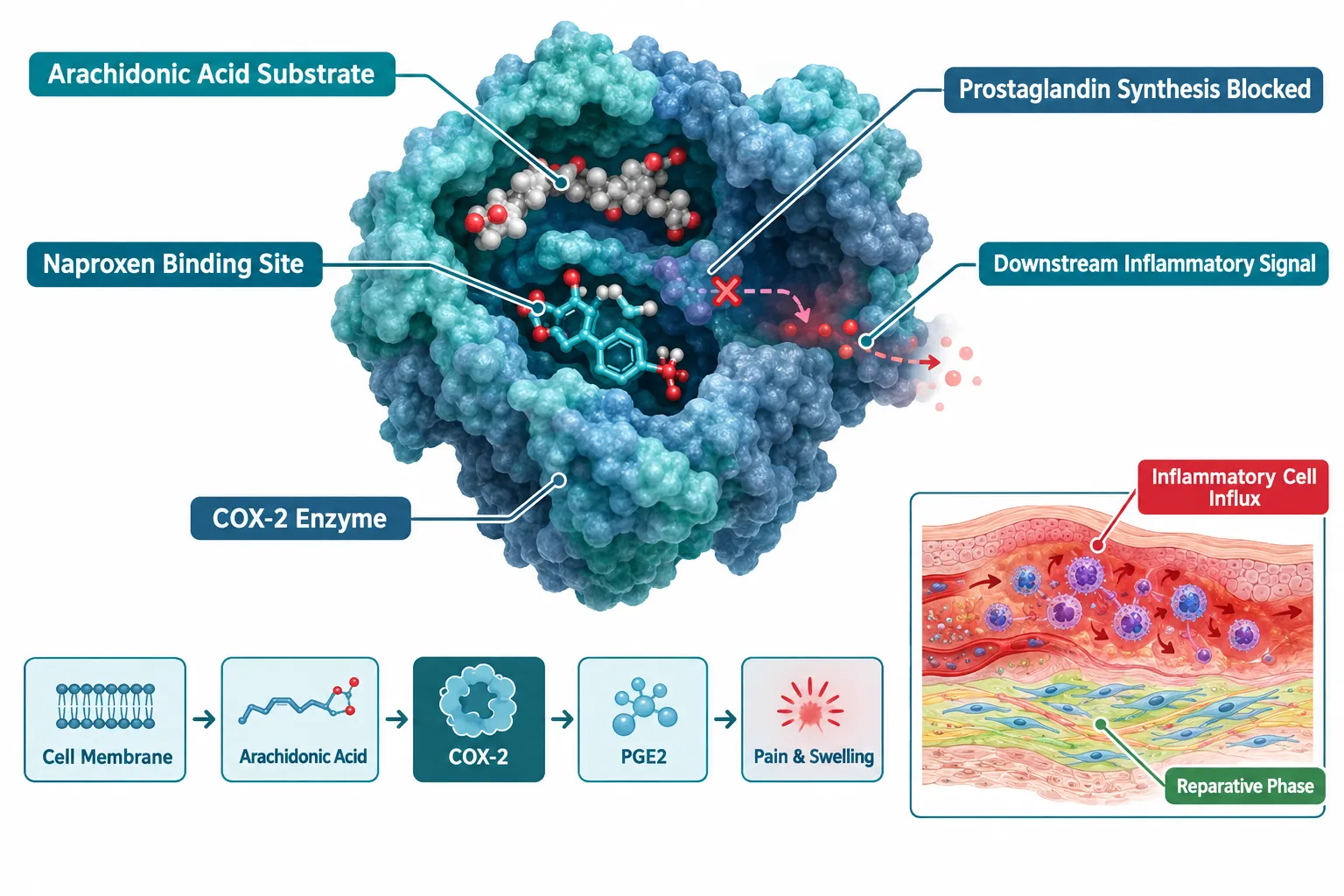
Naproxen is a non-selective NSAID that competitively inhibits both COX-1 and COX-2 isoforms, blocking the conversion of arachidonic acid into prostaglandins, thromboxanes, and prostacyclins. In the context of tissue injury, this matters because prostaglandin E2 (PGE2) is not merely a pain mediator, it recruits macrophages, activates satellite cells in muscle, and upregulates growth factor receptors in tendon fibroblasts.

When naproxen suppresses PGE2 during the first 72 hours after injury, inflammatory cell influx decreases measurably. Neutrophil and macrophage counts in injured tissue drop, which reduces the release of pro-inflammatory cytokines such as IL-6 and TNF-alpha. On the surface, this looks beneficial. In practice, it removes a critical early signal that coordinates the transition from inflammation to proliferative repair.

Researchers working with the NpxFFK naproxen-peptide hydrogel platform have demonstrated that localized COX-2 inhibition can be spatially controlled, offering a useful model for isolating the enzyme's role without systemic suppression. This approach helps distinguish between the anti-inflammatory and anti-regenerative consequences of COX blockade, a distinction that matters enormously when peptide co-treatments are introduced.

For research teams sourcing tissue-repair peptides, the BPC-157 core peptides documentation and first research guide provides a useful framework for understanding how this peptide's angiogenic and collagen-stimulating properties interact with the prostaglandin-depleted environment naproxen creates.


Inflammation Timing: The Critical Variable in Naproxen and Peptide Tissue-Repair Models
Inflammation Timing: The Critical Variable in Naproxen and Peptide Tissue-Repair Models

Across rodent Achilles tendon and skeletal muscle repair models, the timing of naproxen administration relative to the inflammatory peak produces dramatically different outcomes. This is the central design challenge in Naproxen and Peptide Tissue-Repair Models: COX Inhibition, Inflammation Timing, and Recovery-Endpoint Selection.

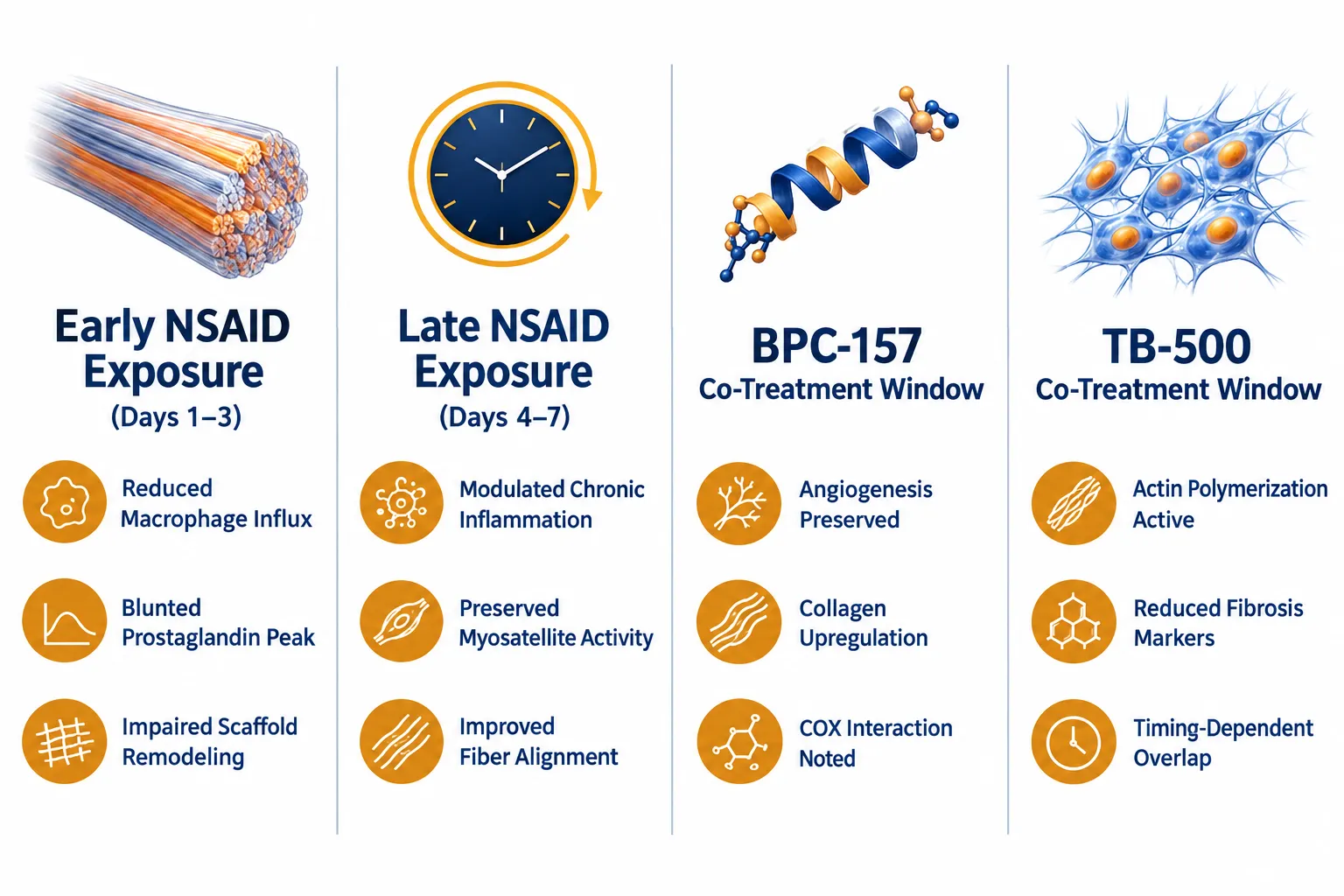
Early exposure (days 1-3): COX inhibition during peak inflammation consistently impairs repair. Myosatellite cell activation is blunted, collagen cross-linking is reduced, and the mechanical strength of healing tendons at 4 weeks is measurably lower than in untreated controls. The reparative macrophage phenotype (M2 polarization) that drives scaffold remodeling is particularly sensitive to early prostaglandin suppression.

Late exposure (days 4-7 onward): Naproxen introduced after the initial inflammatory surge shows a more favorable profile. Chronic, maladaptive inflammation, characterized by persistent neutrophil presence and fibrotic collagen deposition, is reduced without disrupting the early reparative signals that have already been delivered.

"The difference between a reparative and a maladaptive inflammatory response often comes down to a 48-hour window, and naproxen's half-life of 12-17 hours makes dosing schedule a precision variable, not a background detail."

This timing dependency has direct implications for BPC-157 and TB-500 co-treatment experiments. BPC-157 promotes angiogenesis and upregulates growth hormone receptors partly through prostaglandin-dependent pathways. If naproxen is administered simultaneously, the peptide's mechanism of action is partially blocked, confounding outcome data. Researchers should therefore design naproxen control arms with staggered dosing windows rather than concurrent administration.

TB-500, which drives actin polymerization and reduces fibrosis, appears less prostaglandin-dependent in its primary mechanism, but its downstream effects on inflammatory cell migration overlap with COX-2 pathways. The SS-31 peptide benefits literature offers a parallel example of how mitochondrial-targeted peptides navigate the NSAID-altered inflammatory environment, a useful methodological reference.

Chronotherapy data from human postoperative recovery studies adds another layer: NSAIDs administered in the morning show different pharmacodynamic profiles than evening doses, reflecting circadian variation in COX-2 expression. Animal models designed to mirror clinical naproxen use should account for light-cycle-dependent dosing schedules.


Recovery-Endpoint Selection for COX-Inhibited Tissue-Repair Experiments
Recovery-Endpoint Selection for COX-Inhibited Tissue-Repair Experiments

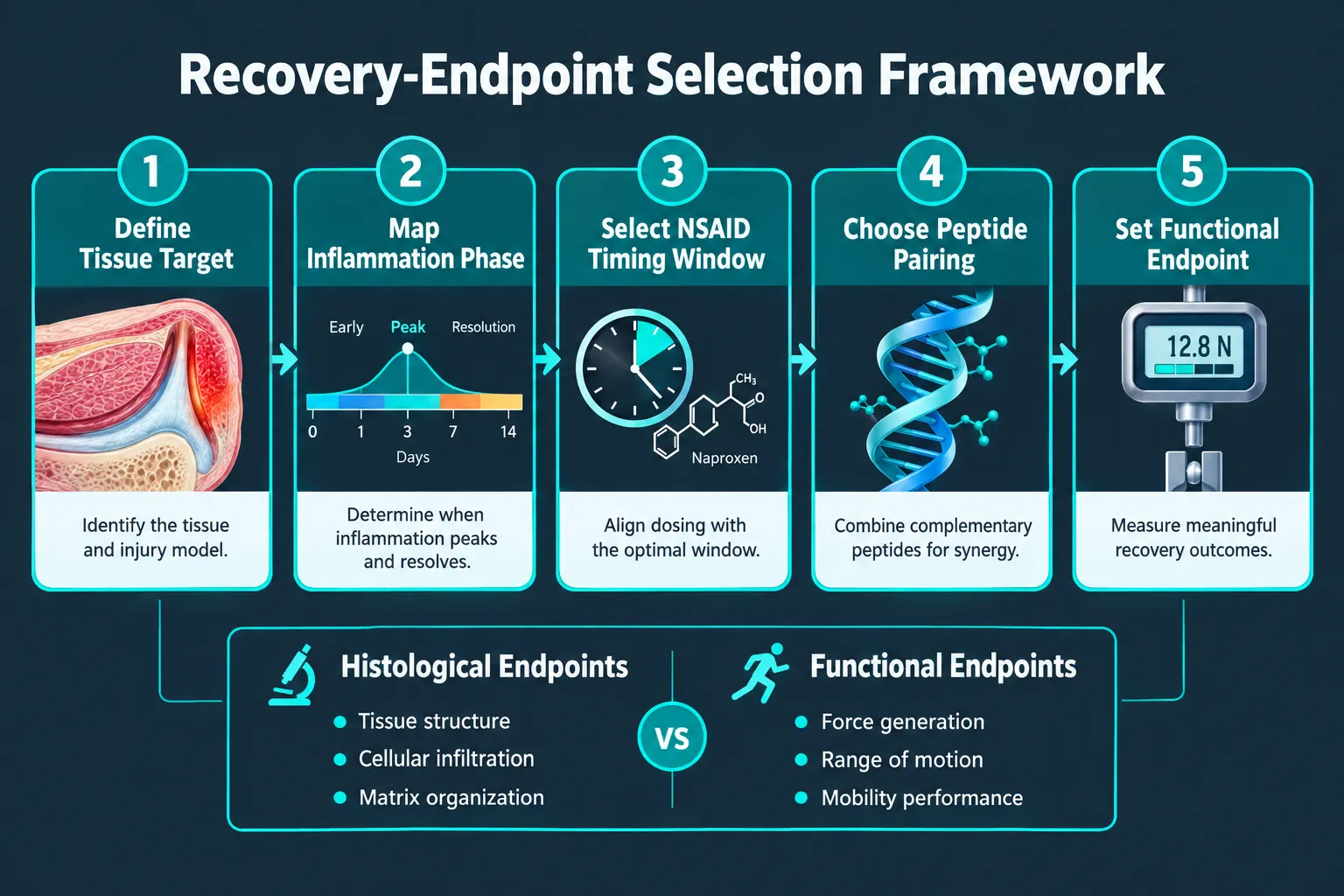
Choosing the wrong endpoint is one of the most common sources of false-negative results in peptide tissue-repair research. Naproxen and Peptide Tissue-Repair Models: COX Inhibition, Inflammation Timing, and Recovery-Endpoint Selection demands a multi-dimensional approach because naproxen affects different aspects of repair at different timepoints.

Recommended endpoint categories:

Endpoint Type What It Captures Best Timepoint
Histological Cell composition, collagen architecture Days 7, 14, 28
Biochemical PGE2, IL-6, TNF-alpha, hydroxyproline Days 3, 7, 14
Mechanical Tensile strength, load-to-failure Days 21, 42
Functional Gait analysis, grip strength, swim test Days 14, 28

For BPC-157 experiments, hydroxyproline content (a collagen maturity marker) combined with vascular density staining captures the peptide's dual angiogenic-collagen mechanism. Naproxen-treated controls will show reduced hydroxyproline at day 14, providing a clear baseline against which BPC-157's effect can be measured.

For TB-500 experiments, actin filament density and fibrosis scoring (Masson's trichrome staining) are the most sensitive endpoints. Because TB-500 primarily acts on actin dynamics rather than prostaglandin synthesis, its effects may be partially preserved even in naproxen-treated tissue, making it a useful positive control for separating COX-dependent from COX-independent repair mechanisms.

Pre-emptive COX-2 inhibition studies using celecoxib have shown that wound-healing dynamics are most disrupted when COX blockade precedes injury rather than following it, reinforcing the importance of injury-relative timing in endpoint interpretation.

Researchers sourcing peptides for these models should consult the GHK-Cu peptide purchase and copper peptide research sourcing guide for purity standards applicable to co-treatment protocols, and review research-grade Glow Blend peptide evaluation methods for quality benchmarks in skin and connective-tissue models. For mitochondrial endpoint controls, SS-31 peptide sourcing options provide a validated comparator peptide for oxidative stress endpoints in NSAID-treated tissue.


Conclusion

The relationship between naproxen and peptide tissue-repair models is not adversarial, it is architectural. COX inhibition reshapes the prostaglandin landscape that peptides like BPC-157 and TB-500 navigate, and that reshaping is highly time-dependent. Researchers who treat naproxen as a simple background variable will produce confounded data; those who treat it as a precision timing instrument will generate clean, interpretable results.

Actionable next steps for research design:

  • Define the inflammatory phase map for the target tissue before assigning naproxen dosing windows.
  • Use staggered rather than concurrent naproxen and peptide administration to isolate mechanism-specific effects.
  • Select at least one biochemical endpoint (PGE2 or IL-6), one structural endpoint (collagen content or fiber alignment), and one functional endpoint per experiment.
  • Validate peptide purity and lot consistency before initiating multi-arm NSAID co-treatment studies.
  • Review chronotherapy data to align dosing schedules with circadian COX-2 expression patterns in the animal model used.

Precision in timing and endpoint selection is what separates publishable data from ambiguous results in this research space.

https://www.puretestedpeptides.com/wp-content/uploads/2026/10/naproxen-and-peptide-tissue-repair-models-cox-inhibition-inflammation-timing-and.webp 672 1008 https://www.puretestedpeptides.com/wp-content/uploads/2026/01/buy-peptides-online.jpg 2026-10-14 13:09:022026-10-14 13:09:02Naproxen and Peptide Tissue-Repair Models: COX Inhibition, Inflammation Timing, and Recovery-Endpoint Selection
×

Helpful Links

  • My account
  • Cart
  • Checkout
  • Refund and Returns Policy
  • Privacy Policy
  • SMS Privacy Policy
  • Login
  • My Account
  • Logout

USA Made Lab Tested Peptides

All products are sold for research, laboratory, or analytical purposes only, and are not for human consumption


Pure Tested Peptides is a chemical supplier. Pure Tested Peptides is not a compounding / chemical compounding facility as defined under 503A of the Federal Food, Drug, and Cosmetic act. Pure Tested Peptides is not an outsourcing facility as defined under 503B of the Federal Food, Drug, and Cosmetic act.

The statements made within this website have not been evaluated by the US Food and Drug Administration. The products we offer are not intended to diagnose, treat, cure or prevent any disease.

Human/Animal Consumption Prohibited. Laboratory/In-Vitro Experimental Use Only

Scroll to top Scroll to top Scroll to top