

GLP-2-T vs GLP-2 Tirz: Gut Barrier Biology, Nutrient Absorption, and Naming Confusion in Research
Researchers searching for information on GLP-2 gut biology in 2026 frequently land in the wrong place — not because the science is inaccessible, but because two very different compounds share dangerously similar shorthand labels. The debate around GLP-2-T vs GLP-2 Tirz: Gut Barrier Biology, Nutrient Absorption, and Naming Confusion in Research is less about advanced pharmacology and more about a fundamental labeling problem that derails literature searches and misguides early-stage research decisions.
Key Takeaways
- GLP-2-T most commonly refers to teduglutide, a GLP-2 analog engineered for intestinal trophic effects.
- GLP-2 Tirz is informal shorthand sometimes applied to tirzepatide's secondary GLP-2-like activity, though tirzepatide is primarily a GIP/GLP-1 dual agonist.
- These two compounds act through different primary receptors and serve distinct research purposes.
- Gut barrier integrity and nutrient absorption are central to GLP-2-T research; metabolic signaling is central to tirzepatide research.
- Naming clarity is essential before selecting peptides for any gut-focused research protocol.
Understanding the Two Compounds at the Center of the Confusion
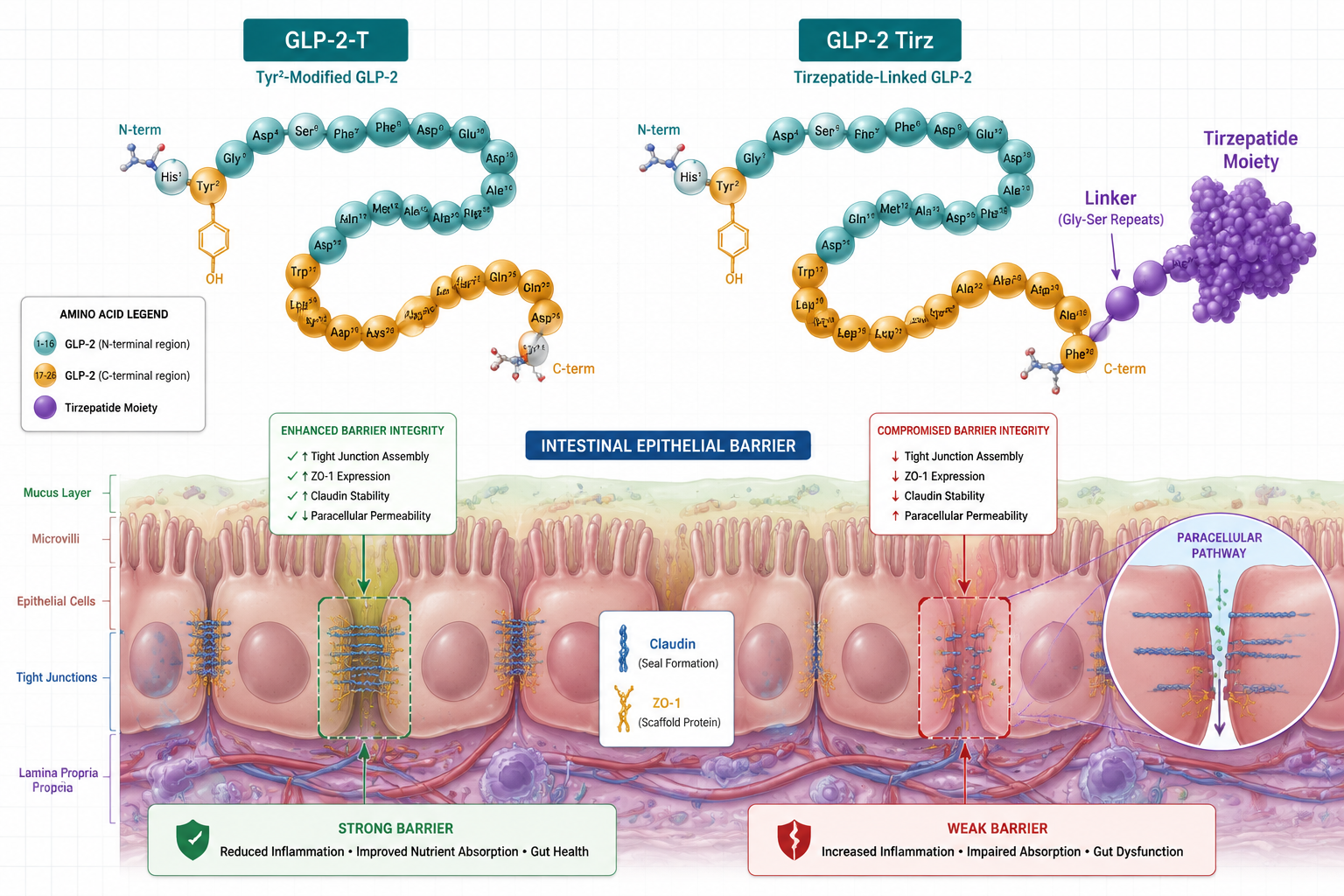
The shorthand "GLP-2-T" most reliably points to teduglutide, a 33-amino-acid GLP-2 analog developed specifically for its intestinotrophic properties. It was engineered by substituting alanine at position 2 with glycine, which protects it from rapid degradation by dipeptidyl peptidase-4 (DPP-4). This modification extends its half-life and amplifies its action at the GLP-2 receptor (GLP-2R), which is expressed primarily on intestinal subepithelial myofibroblasts and enteric neurons.
"GLP-2 Tirz," by contrast, is informal community shorthand sometimes applied to tirzepatide when discussing its reported secondary effects on intestinal function. Tirzepatide is a dual GIP receptor and GLP-1 receptor agonist. It does not act primarily through the GLP-2 receptor. Any GLP-2-like intestinal effects observed in tirzepatide research are likely downstream or indirect, not receptor-mediated in the same way as teduglutide.
| Feature | GLP-2-T (Teduglutide) | GLP-2 Tirz (Tirzepatide context) |
|---|---|---|
| Primary receptor target | GLP-2R | GIP-R / GLP-1R |
| Structural basis | GLP-2 analog | GIP/GLP-1 hybrid peptide |
| Primary research focus | Gut barrier, intestinal growth | Metabolic regulation, body weight |
| DPP-4 resistance | Yes (engineered) | Yes (fatty acid conjugation) |
| GLP-2R direct agonism | Direct | Not established |
For researchers exploring multi-pathway peptide biology, the GIP receptor and its importance provides useful context on how GIP-axis signaling intersects with gut and metabolic function.
Gut Barrier Biology and Nutrient Absorption in GLP-2-T vs GLP-2 Tirz Research
The gut barrier is a single-cell-thick layer of enterocytes held together by tight junction proteins including claudin, occludin, and ZO-1. When this barrier is compromised, luminal antigens and bacteria translocate into systemic circulation — a process linked to inflammatory and metabolic disease.
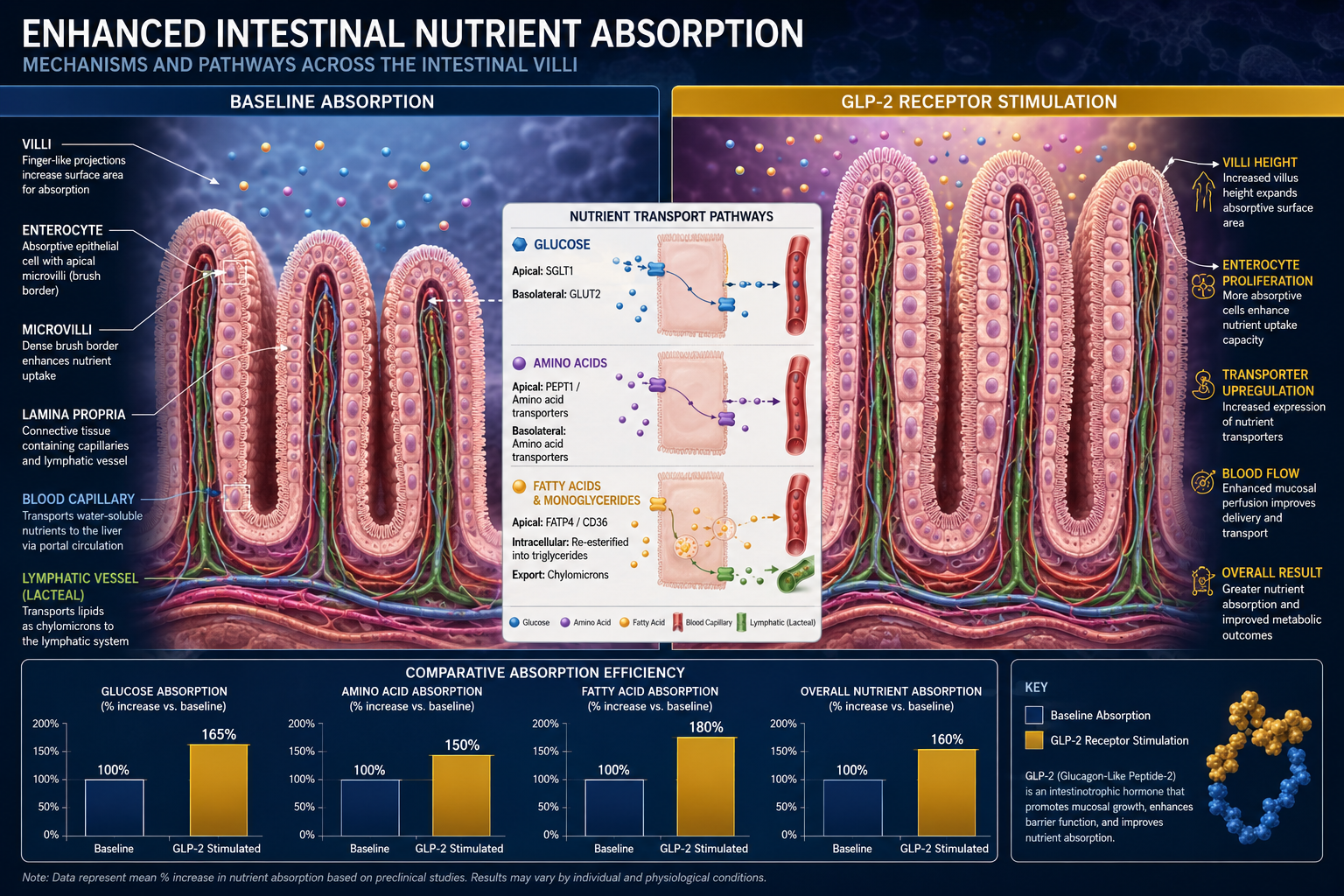
GLP-2-T (teduglutide) has a well-characterized mechanism for supporting this barrier. Activation of GLP-2R on subepithelial myofibroblasts triggers release of growth factors including keratinocyte growth factor (KGF) and insulin-like growth factor-1 (IGF-1). These promote:
- Crypt cell proliferation and villus elongation
- Increased tight junction protein expression
- Enhanced mucosal blood flow
- Reduced intestinal permeability
This makes teduglutide one of the most direct tools in gut barrier research. Its effects on nutrient absorption are a direct consequence: longer villi mean greater absorptive surface area.
Tirzepatide's relationship with gut barrier biology is less direct. GLP-1 receptor agonism is known to slow gastric emptying and modulate intestinal motility, which can influence nutrient absorption timing. Some preclinical data suggest GLP-1 signaling may have modest barrier-supportive effects, but these are not equivalent to direct GLP-2R activation.
Researchers working on gut-healing peptide combinations may also find the BPC-157 research themes relevant, as BPC-157 has been studied for its own effects on mucosal integrity through separate mechanisms. Similarly, BPC-157 and TB-500 combination research explores complementary tissue repair pathways.
Resolving the Naming Confusion in GLP-2-T vs GLP-2 Tirz Research

The naming confusion in GLP-2-T vs GLP-2 Tirz: Gut Barrier Biology, Nutrient Absorption, and Naming Confusion in Research stems from three overlapping problems:
- Abbreviation collision — "GLP-2-T" is used for teduglutide in clinical literature but occasionally appears as shorthand for "GLP-2 component of tirzepatide" in community forums.
- Receptor family conflation — GLP-1, GLP-2, and GIP are all incretin-related peptides, making cross-labeling common among non-specialist readers.
- Secondary effects misattributed as primary mechanisms — When tirzepatide produces gut-related outcomes, some researchers incorrectly attribute this to GLP-2 receptor activity.
A practical rule: if a study is examining intestinal villus height, crypt depth, tight junction protein expression, or short bowel syndrome models, it is almost certainly using GLP-2-T (teduglutide). If the study examines insulin secretion, body weight, or lipid metabolism, the compound is more likely tirzepatide or a GLP-1/GIP agonist.
For broader context on how multi-receptor peptide compounds are categorized, the GLP-1 peptides product tag and the GLP-3 / retatrutide research page offer useful comparative framing. Researchers interested in how innovative delivery systems affect peptide receptor selectivity may also benefit from reviewing innovative peptide delivery systems.
Conclusion
The confusion surrounding GLP-2-T vs GLP-2 Tirz: Gut Barrier Biology, Nutrient Absorption, and Naming Confusion in Research is solvable with precise language. Teduglutide (GLP-2-T) is a direct GLP-2 receptor agonist with established research applications in gut barrier biology and nutrient absorption. Tirzepatide, regardless of informal "GLP-2 Tirz" labeling, is a GIP/GLP-1 dual agonist with metabolic rather than intestinotrophic primary mechanisms.
Actionable next steps for researchers:
- Always verify the receptor target before selecting a compound for gut-focused protocols.
- Cross-reference abbreviations against the compound's structural class, not just its name.
- When reviewing community discussions, treat "GLP-2 Tirz" as an informal label that requires verification against primary literature.
- Consult verified sourcing platforms that provide certificates of analysis to confirm compound identity before any research use, such as those found at quality testing protocols.
Naming precision is not a minor detail in peptide research — it is the foundation on which valid experimental design is built.
References
- Jeppesen, P. B., et al. (2012). Teduglutide reduces need for parenteral support among patients with short bowel syndrome with intestinal failure. Gastroenterology, 143(6), 1473-1481.
- Drucker, D. J. (2002). Biological actions and therapeutic potential of the glucagon-like peptides. Gastroenterology, 122(2), 531-544.
- Frampton, J. E. (2012). Teduglutide: a review of its use in the management of short bowel syndrome. Drugs, 72(9), 1209-1220.
- Frias, J. P., et al. (2021). Tirzepatide versus semaglutide once weekly in patients with type 2 diabetes. New England Journal of Medicine, 385(6), 503-515.
- Cani, P. D., et al. (2009). Changes in gut microbiota control inflammation in obese mice through a mechanism involving GLP-2-driven improvement of gut permeability. Gut, 58(8), 1091-1103.