Call or Text 727-513-9780
  • Shopping Cart Shopping Cart
    0Shopping Cart
Pure Tested Peptides | America's most trusted Peptides for sale online
  • Peptides for sale
    • Oral Peptides for sale
      • Peptide Capsules for sale
      • BPC 157 Capsules 1000mcg
      • SLU-PP-332 Capsules | 1000 mcg
      • 5-Amino-1MQ 50mg Capsules
      • Tesofensine 500mcg
    • All Peptides for sale
    • Peptide Sprays
      • BPC 157 Nasal Spray Kit
      • BPC-157 TB500 Nasal Spray Kit
      • Semax Nasal Spray 10mg
      • Selank – Nasal Spray Kit – 10mg
      • Epithalon 50MG Nasal Spray Kit
      • Ipamorelin 10mg Nasal Spray
      • Klow Nasal Spray (BPC-157 + TB-500 + GHK-Cu + KPV) | 80mg
      • Hulk Nasal Spray Tesa / Ipa Blend 6/3 MG
      • Klow Nasal Spray
      • NAD + 500 mg Nasal Spray
      • PT-141 Nasal Spray Kit
    • GHRH Peptides
      • Ipa Peptides
      • CJC-1295 Peptides
        • CJC-1295 with DAC 5 mg
        • CJC-1295 without DAC 5 mg
        • CJC-1295 Ipa 10mg
      • Tesa Peptides
        • Tesa Peptide
        • Tesa 20 mg
    • GHK-Cu Peptides
      • All GHK-Cu Peptides
      • GHK-Cu 100mg
      • KLOW Peptide Blend – Buy KLOW blend online
    • BPC Peptides
      • All BPC Peptides
      • BPC-157
      • BPC-157 TB-500
      • BPC 157 capsules 1000mcg
    • SLU-PP-332 Peptides
      • All SLU-PP-332 Peptides
      • SLU-PP-332 5mg
    • GLP3 Peptides
      • GLP3-R
      • GLP3-R CAG 10mg
      • GLP3-R 20mg
    • PT-141 Peptides
      • PT-141 Peptides for sale
      • PT-141 10mg
      • PT-141 Nasal Spray
    • CAG Peptides
      • Lipo-C Peptide Blend
      • CAG 5mg
      • CAG 10mg
    • MOTS-C Peptides
      • MOTS-C Peptides for sale
      • MOTS-c peptide
      • MOTS-c 10mg *6 pack*
    • 5 Amino 1MQ Peptides
      • 5 Amino 1MQ Peptides for sale
      • 5-Amino-1MQ 50mg Capsules
      • 5-Amino-1MQ 5mg
    • Epithalon Peptides
      • Epithalon Peptides for sale
      • Epithalon 10mg
      • Epithalon 50mg
  • Shop
    • GLPs
      • 5-Amino-1MQ 50mg Capsules
      • 5-Amino-1MQ 5mg
      • GLP3-Reta
      • L-Carnitine 500mg/ml
      • Tesofensine 500mcg
      • SLU-PP-332 5mg
      • MOTS-c 10mg *6 pack*
    • Epithalon & BPC Peptides
      • Epithalon 10mg
      • Epithalon 50mg
      • BPC-157
      • BPC 157 capsules 1000mcg
      • BPC-157 TB-500
      • BPC-157 TB500 Nasal Spray Kit
      • BPC 157 Nasal Spray Kit
    • BPC TB-500 & NAD+ Peptides
      • NAD+ 500 mg
      • KLOW Peptide Blend – Buy KLOW blend online
      • GLOW Peptide Blend
      • TB 500 5mg
      • BPC 157 capsules 1000mcg – Supplement
      • BPC 157 Nasal Spray Kit
      • BPC-157
      • BPC-157 TB500 Nasal Spray Kit
      • BPC-157 TB-500
      • BPC 157 capsules 1000mcg
    • LL-37 Peptide
      • LL-37 10 mg
    • MOTS-C & Selank
      • MOTS-c peptide
      • Selank 10mg
    • GHK Peptides
      • GHK-Cu 100mg
      • GLOW Peptide Blend
      • KLOW Peptide Blend – Buy KLOW blend online
  • COAs
  • Wholesale
    • Wholesale Peptides for sale
  • PTP FAQ
  • Affiliates
    • Selank Peptide: Advanced Pharmacological Mechanisms Underlying Its Anxiolytic and Nootropic Effects in Research
      • 5-Amino-1MQ Peptide: Detailed Mechanisms of NNMT Inhibition and Its Impact on Cellular Metabolism Research
        • MOTS-C Peptide: Unraveling Its Role in Mitochondrial Dynamics and Energy Metabolism Research
          • Epithalon Peptide and Telomerase Regulation: Investigating Its Impact on Cellular Senescence and Lifespan Research Models
            • GLP2-T vs GLP2 Tirz Peptide: Understanding the Naming, Mechanistic Nuances, and Research Implications for Gut Health
      • Peptides and Polypeptides in Modern Pharmacology: What Research on Metoprolol, Prednisone, and Amlodipine Reveals
        • Polypeptide Peptides vs NSAIDs: What Naproxen and Diclofenac Teach Tissue-Repair Researchers About BPC‑157 and TB‑500
          • Peptides and Polypeptides in Endocrine Pharmacology: How GLP-1, GLP-2, and GLP-3 Retatrutide Differ From Classic Drugs Like Prednisone and Amlodipine
          • 5‑Amino‑1MQ Peptide and NNMT Inhibition: How It Compares With Statins Like Atorvastatin in Adipose and Lipid Metabolism Research
      • Enclomiphene, Estrogen Receptor Signaling, and Luteinizing Phase Biology: What Hormone Researchers Should Measure
        • Mesenchymal Stem Cells, BPC‑157, and GHK‑Cu: How Tissue Repair Peptides Compare With Classic NSAIDs Like Naproxen in Injury Models
          • Peptide Calculator Use Cases Beyond Growth Hormone: Working Through GLP‑3 Retatrutide, MOTS‑c, and BPC‑157 Research Dosing
        • Polypeptide Peptides in Endocrine and Metabolic Pharmacology: Lessons From Amlodipine, Prednisone, and Metoprolol
        • Peptides Calculator for Advanced Blends: Worked Examples for Tesamorelin, CJC‑1295, and Ipamorelin Stacks
          • Peptides and Polypeptides in Human Physiology: How Molecular Size Shapes Research Applications
            • Selank Peptide: Advanced Pharmacological Mechanisms Underlying Its Anxiolytic and Nootropic Effects in Research
          • 5-Amino-1MQ Peptide: Detailed Mechanisms of NNMT Inhibition and Its Impact on Cellular Metabolism Research
            • MOTS-C Peptide: Unraveling Its Role in Mitochondrial Dynamics and Energy Metabolism Research
              • Epithalon Peptide and Telomerase Regulation: Investigating Its Impact on Cellular Senescence and Lifespan Research Models
                • GLP2-T vs GLP2 Tirz Peptide: Understanding the Naming, Mechanistic Nuances, and Research Implications for Gut Health
                  • Peptides and Polypeptides in Endocrine Pharmacology: How GLP-1, GLP-2, and GLP-3 Retatrutide Differ From Classic Drugs Like Prednisone and Amlodipine
                    • Polypeptide Peptides vs NSAIDs: What Naproxen and Diclofenac Teach Tissue-Repair Researchers About BPC‑157 and TB‑500
                      • Peptides and Polypeptides in Modern Pharmacology: What Research on Metoprolol, Prednisone, and Amlodipine Reveals
                        • 5‑Amino‑1MQ Peptide and NNMT Inhibition: How It Compares With Statins Like Atorvastatin in Adipose and Lipid Metabolism Research
                        • Enclomiphene, Estrogen Receptor Signaling, and Luteinizing Phase Biology: What Hormone Researchers Should Measure
                        • Mesenchymal Stem Cells, BPC‑157, and GHK‑Cu: How Tissue Repair Peptides Compare With Classic NSAIDs Like Naproxen in Injury Models
                        • Peptide Calculator Use Cases Beyond Growth Hormone: Working Through GLP‑3 Retatrutide, MOTS‑c, and BPC‑157 Research Dosing
                        • Polypeptide Peptides in Endocrine and Metabolic Pharmacology: Lessons From Amlodipine, Prednisone, and Metoprolol
                        • Peptides Calculator for Advanced Blends: Worked Examples for Tesamorelin, CJC‑1295, and Ipamorelin Stacks
                        • Peptides and Polypeptides in Human Physiology: How Molecular Size Shapes Research Applications
                        • Selank Peptide: Advanced Pharmacological Mechanisms Underlying Its Anxiolytic and Nootropic Effects in Research
                        • MOTS-C Peptide: Unraveling Its Role in Mitochondrial Dynamics and Energy Metabolism Research
                        • Peptides and Polypeptides in Modern Pharmacology: What Research on Metoprolol, Prednisone, and Amlodipine Reveals
                        • Peptides and Polypeptides in Endocrine Pharmacology: How GLP-1, GLP-2, and GLP-3 Retatrutide Differ From Classic Drugs Like Prednisone and Amlodipine
                        • 5-Amino-1MQ Peptide: Detailed Mechanisms of NNMT Inhibition and Its Impact on Cellular Metabolism Research
                        • Mesenchymal Stem Cells, BPC‑157, and GHK‑Cu: How Tissue Repair Peptides Compare With Classic NSAIDs Like Naproxen in Injury Models
                        • Peptide Calculator Use Cases Beyond Growth Hormone: Working Through GLP‑3 Retatrutide, MOTS‑c, and BPC‑157 Research Dosing
                        • GLP2-T vs GLP2 Tirz Peptide: Understanding the Naming, Mechanistic Nuances, and Research Implications for Gut Health
                        • Polypeptide Peptides in Endocrine and Metabolic Pharmacology: Lessons From Amlodipine, Prednisone, and Metoprolol
                        • Polypeptide Peptides vs NSAIDs: What Naproxen and Diclofenac Teach Tissue-Repair Researchers About BPC‑157 and TB‑500
                        • Peptides and Polypeptides in Human Physiology: How Molecular Size Shapes Research Applications
                        • Peptides Calculator for Advanced Blends: Worked Examples for Tesamorelin, CJC‑1295, and Ipamorelin Stacks
                        • 5‑Amino‑1MQ Peptide and NNMT Inhibition: How It Compares With Statins Like Atorvastatin in Adipose and Lipid Metabolism Research
                        • Enclomiphene, Estrogen Receptor Signaling, and Luteinizing Phase Biology: What Hormone Researchers Should Measure
                        • Epithalon Peptide and Telomerase Regulation: Investigating Its Impact on Cellular Senescence and Lifespan Research Models
                        • Best research protocol Klow blend
                        • best time to take BPC-157
                        • best time to take DSIP (Delta Sleep Inducing Peptide)
                        • best time to take CJC-1295
                        • best time to take AOD-9604
                        • best time to take Follistatin 344
                        • best time to take Ipamorelin
                        • best time to take MK-677 (Ibutamoren)
                        • best time to take Ligandrol (LGD-4033) — research compound
                        • best time to take Ostarine (MK-2866) — research compound
                        • best time to take GHK-CU
                        • best time to take TB-500
                        • best time to take MOTS-c
                        • best time to take Semax
                        • best time to take RAD-140 (Testolone) — research compound
                        • best time to take Thymosin Alpha-1
                        • best time to take PEG-MGF
                        • Biolife Plasma, Octapharma Plasma, and Research Peptides: How Plasma Donation Labs Differ From Peptide Suppliers
                        • best time to take YK-11 — research compound
                        • best time to take PT-141 (Bremelanotide)
                        • Best research protocol Klow blend
                        • 5-Amino-1MQ and MOTS-C Synergy: Metabolic Signaling, Mitochondria, and Research Design
                        • BPC-157 and TB-500: Investigating Their Combined Effects on Angiogenesis and Cellular Migration in Tissue Repair Models
                        • BPC-157 Peptide: Gut Barrier Function, Inflammation, and Tissue-Recovery Research
                        • 5‑Amino‑1MQ and MOTS‑c Synergy in Metabolic Research: Designing NNMT and Mitochondrial Biogenesis Stacks
                        • CJC-1295 with DAC vs. Without DAC: Half-Life, Release Kinetics, and Research Implications
                        • CJC‑1295 with DAC vs. Without DAC: Expanding on Half‑Life Differences Using Tesamorelin and Ipamorelin Blend Case Studies
                        • Collagen Biology and Copper‑Binding Peptides: How GHK‑Cu, Glow Blend, and Klow Blend Interact with Skin and Connective Tissue
                        • Collagen Biology and Regenerative Peptides: How GHK‑Cu, Glow Blend, and Klow Blend Affect Extracellular Matrix Research
                    • DNA, Telomeres, and Longevity Peptides: Positioning Epithalon and MOTS‑c in Genetic Aging Research
                      • Enclomiphene Citrate: serm Mechanism, Testosterone Research, and Stack Compatibility
                        • Enclomiphene vs Enclomiphene Citrate: Formulation, Bioavailability, and Research Distinctions
                        • Epithalon Peptide Research: Telomerase Activation, Aging, and Pineal Gland Function
                        • Estrogen Receptor Signaling and Enclomiphene: How Selective Modulators Compare with Classic Polypeptide Hormones
                        • GHK-Cu Peptide: Advanced Mechanisms in Extracellular Matrix Remodeling and Wound Healing Research
                        • GHK-Cu Peptide: Collagen Synthesis, Wound Repair, and Skin-Barrier Research Models
                        • GLP-1 vs GLP-3 vs GLP-2: Peptide Classification and Research Applications
                        • GLP-2 Peptide Research Guide: Gut Barrier Function, Nutrient Absorption, and Intestinal Recovery Models
                        • GLP-3 Retatrutide vs. GLP-1 Drugs: What Triple-Agonist Biology Changes in Research Models
                        • Ipamorelin and Tesamorelin Combination: Synergistic GH Secretagogue Research and Dosing Protocols
                        • GLP2 Tirz Peptide: What It Is, Why the Name Exists, and How Researchers Should Interpret It
                        • Klow Blend Peptide Nasal Spray: What the Formulation Is Trying to Do in Cognitive Research
                        • Mitochondria, NNMT Inhibition, and Peptide Modulators: Where MOTS‑c and 5‑Amino‑1MQ Fit in Cellular Energy Research
                        • MOTS-c Peptide: Mitochondrial Function, Energy Metabolism, and What Researchers Measure
                        • MOTS-c vs. 5-Amino-1MQ: Which Metabolic Research Questions Each Compound Actually Answers
                        • Nasal Spray Peptides: Bioavailability, Administration, and Semax/Selank Research Applications
                        • PT-141 Peptide Research: Mechanism of Action and Melanocortin Receptor Signaling
                        • Retatrutide for Research: Mechanism, Structure, and GLP-1/GLP-3 Dual Action
                        • Retatrutide for Obesity and Type 2 Diabetes: What the Latest Trial Data Suggest
                        • Tesofensine Peptide Research: Mechanism, Appetite Suppression, and Neuropeptide Y Pathways
  • Contact
    • Contact Customer Service
    • Text Customer Support
  • About US
  • Shop all peptides
  • Affiliate Program
    • Affiliate Signup
  • Login / Register Login / Register Page Link Login / Register Page Link
  • Click to open the search input field Click to open the search input field Search
  • Menu Menu

Tag Archive for: u-100 syringe conversion

Peptide Calculators in Research: How Labs Estimate Dosing, Concentration, and Reconstitution

Peptide Calculators in Research: How Labs Estimate Dosing, Concentration, and Reconstitution

August 15, 2026/0 Comments/in Uncategorized/by

A single miscalculation in peptide reconstitution can render an entire experiment invalid, yet the math behind it is straightforward once researchers understand the core formulas. Peptide calculators in research: how labs estimate dosing, concentration, and reconstitution has become a central workflow topic in 2026, with multiple platforms releasing or updating dedicated calculation tools to support bench scientists working with compounds such as CJC-1295, Tesamorelin, and GLP-class molecules. This article is a technical tutorial for research use only, covering the underlying math, practical workflows, and common error-checking steps that modern peptide calculators are built around.

Key Takeaways

  • The core concentration formula is: Concentration (mg/mL) = Vial Mass (mg) / Diluent Volume (mL)
  • Converting between mg and mcg (1 mg = 1,000 mcg) is the most common source of calculation error
  • U-100 insulin syringes require an additional unit conversion: 1 IU = 0.01 mL
  • Modern peptide calculators use 3-4 step workflows and include error-checking to validate syringe capacity
  • All calculations assume uniform dissolution of the peptide in bacteriostatic water

The Core Math Behind Peptide Concentration Calculations
The Core Math Behind Peptide Concentration Calculations

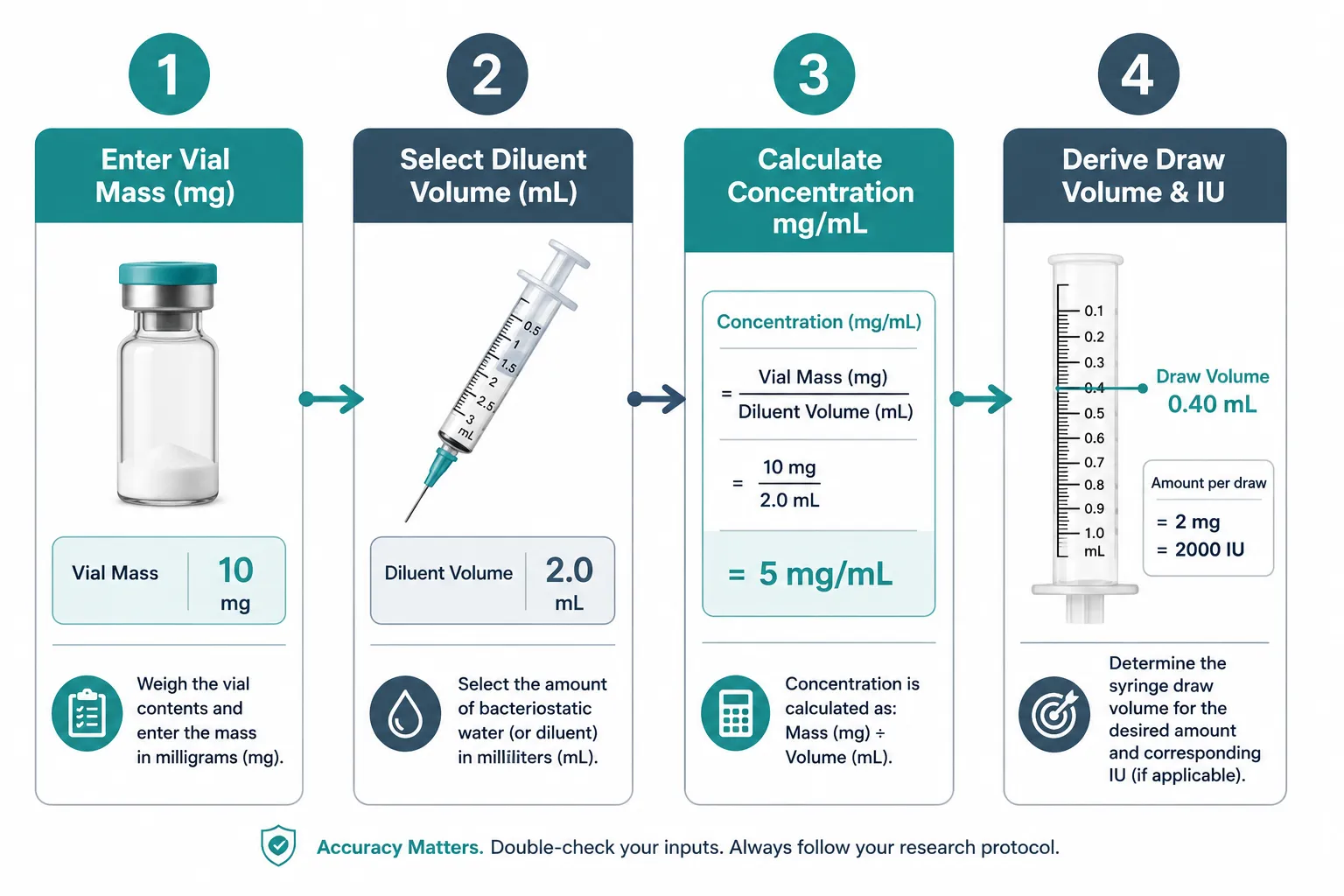
Every peptide calculator in research begins with one foundational equation. Once a lyophilized peptide is reconstituted in bacteriostatic water (BW), the resulting solution is assumed to be uniformly dissolved throughout the vial. This assumption makes the concentration formula clean and reliable:

Concentration (mg/mL) = Vial Mass (mg) / Reconstitution Volume (mL)

For example, a 5 mg vial of CJC-1295 reconstituted with 2.5 mL of bacteriostatic water yields a concentration of 2 mg/mL. If a researcher needs outputs in micrograms per milliliter, common in cell culture and assay protocols, the formula adjusts:

Concentration (mcg/mL) = (Vial Mass in mg × 1,000) / Diluent Volume (mL)

Using the same example: (5 × 1,000) / 2.5 = 2,000 mcg/mL.

The relationship 1 mg = 1,000 mcg is highlighted repeatedly in calculator documentation because it is the most frequent source of dosing errors. Researchers working with compounds like Tesamorelin and Ipamorelin combination protocols must pay particular attention to this conversion, as both compounds are often dosed in the low-microgram range.

Deriving Injection Volume from Concentration

Once concentration is established, the draw volume for a target dose follows directly:

Draw Volume (mL) = Target Dose (mg or mcg) / Concentration (mg/mL or mcg/mL)

If the target research dose is 1 mg and the concentration is 2 mg/mL, the draw volume is 0.5 mL. This simple division is the backbone of every peptide dosing calculator available in 2026.

Syringe Unit Conversion: Translating mL Into IU on a U-100 Scale
Syringe Unit Conversion: Translating mL Into IU on a U-100 Scale

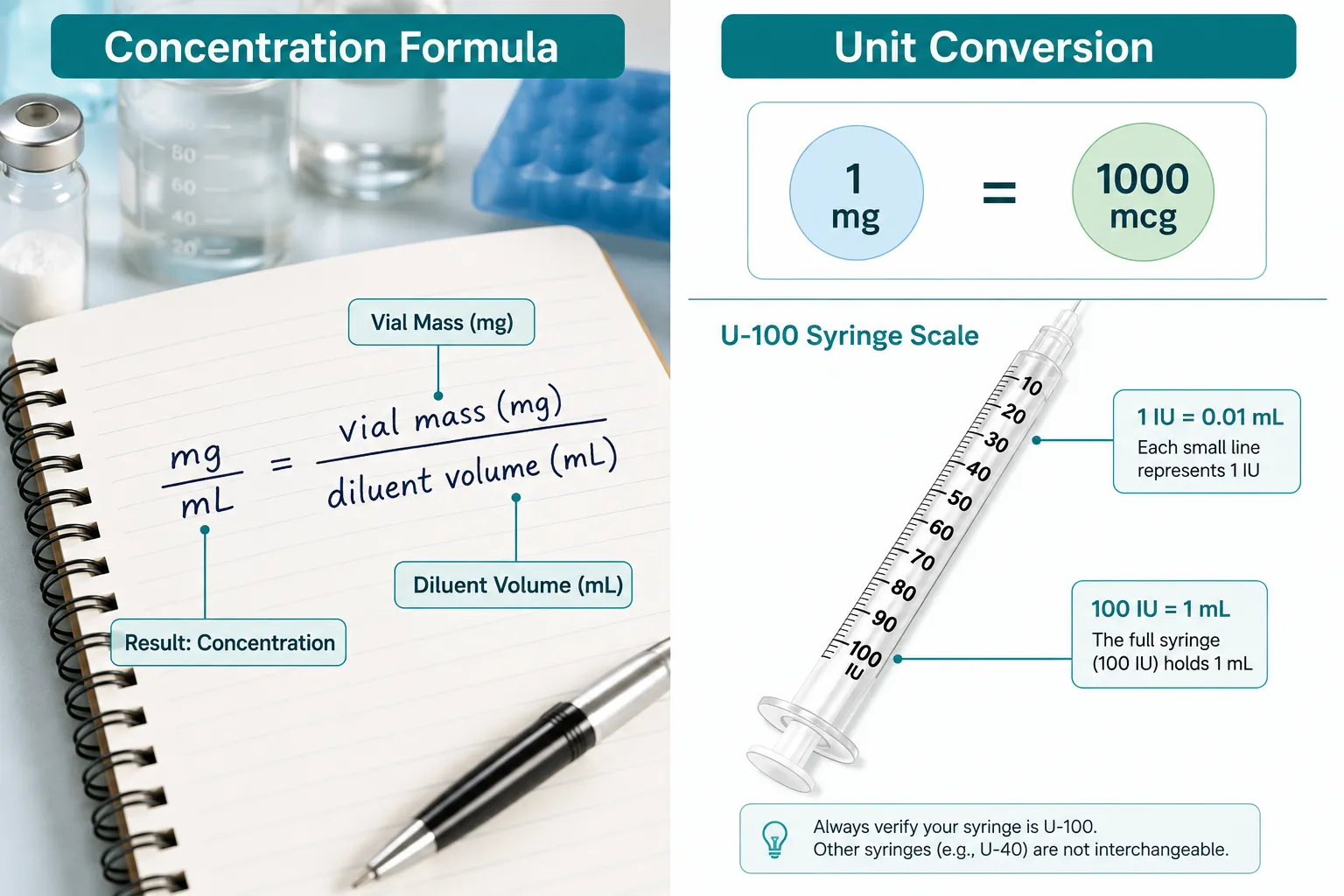
Most research labs use U-100 insulin syringes for subcutaneous peptide administration in animal models. These syringes are calibrated in International Units (IU), not milliliters, which introduces a conversion step that peptide calculators in research consistently address.

The key relationship is:

Measurement Equivalent
1 mL 100 IU
1 IU 0.01 mL
0.5 mL 50 IU
0.1 mL 10 IU

To convert a draw volume in mL to syringe units:

Syringe Units (IU) = Draw Volume (mL) × 100

Using the earlier example: 0.5 mL × 100 = 50 IU on the syringe scale.

Modern calculators present this as part of a guided 4-step workflow:

  1. Enter vial mass (mg)
  2. Enter bacteriostatic water volume (mL)
  3. Enter target dose (mg or mcg)
  4. Receive draw volume in mL and IU

Some tools include visual syringe meters that animate exactly where to stop drawing on the scale, a practical feature for labs running high-throughput assays with compounds like those explored in SS-31 mechanism and research.

Error-Checking and Capacity Validation

A notable feature in 2026 calculator updates is capacity validation, the tool checks whether the calculated draw volume exceeds the selected syringe's maximum capacity. If a researcher selects a 0.3 mL syringe but the calculation returns 0.45 mL, the calculator flags the mismatch before any solution is drawn. Back-check logic also allows users to confirm that concentration, dose, and syringe units are internally consistent, reducing the risk of compounding errors across multi-compound protocols.

Applying Peptide Calculators to GLP-Class and Advanced Research Compounds
Applying Peptide Calculators to GLP-Class and Advanced Research Compounds

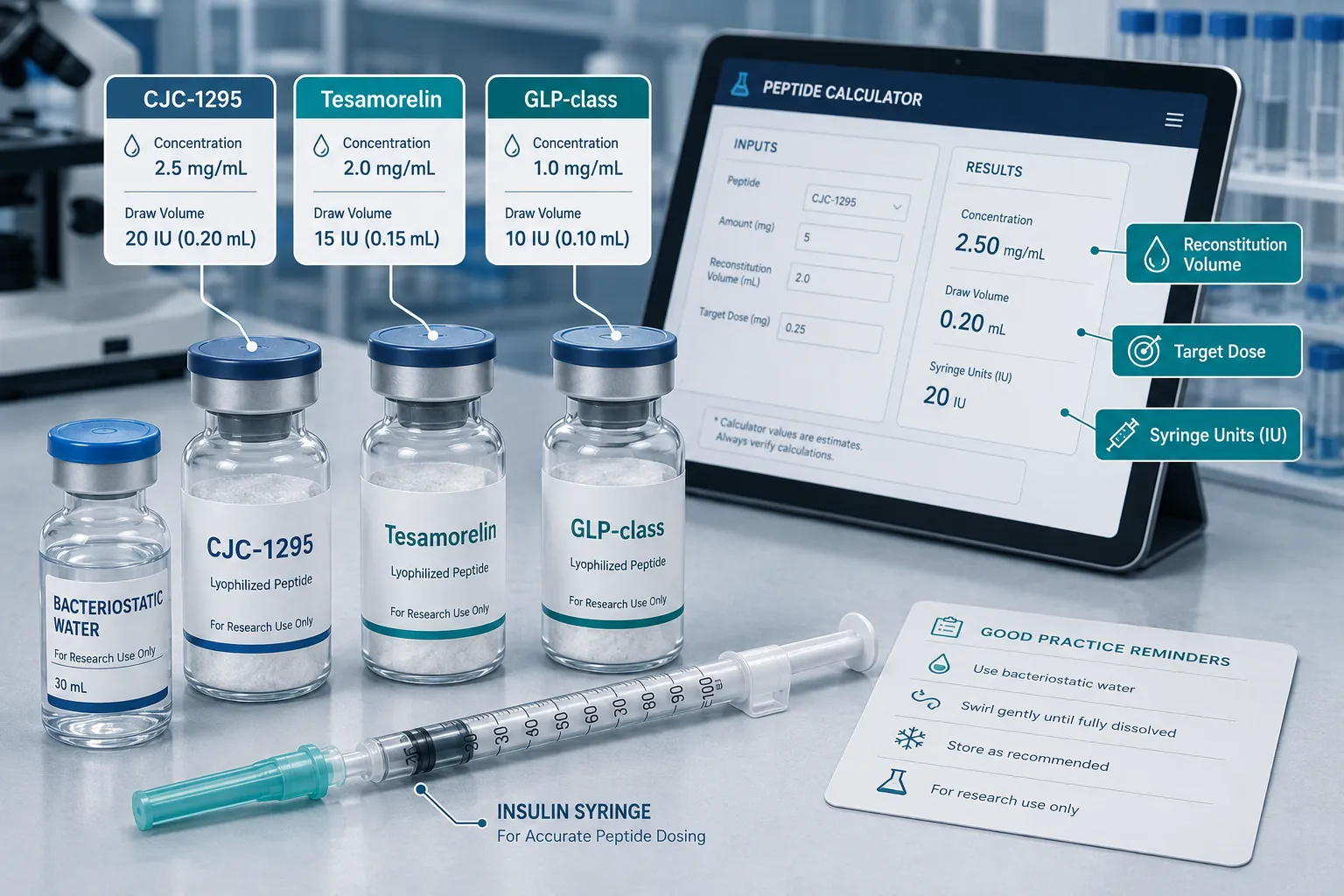
The same mg/mL concentration logic that governs classic research peptides applies directly to GLP-1 agonists, GLP-3 class molecules, and adjunct compounds like NAD+. This consistency has driven broad adoption of standardized peptide calculators across metabolic and longevity research programs.

For a GLP-class compound supplied as a 10 mg vial, reconstituted with 5 mL of bacteriostatic water:

  • Concentration = 10 / 5 = 2 mg/mL (or 2,000 mcg/mL)
  • Target dose of 0.5 mg = draw volume of 0.25 mL (25 IU on a U-100 syringe)

Researchers studying compounds such as those reviewed in Selank peptide research benefits and dosing concepts or MOTS-c mitochondrial signaling and metabolic research apply identical formulas, adjusting only the vial mass and target dose inputs.

For in-vitro protocols, such as cell culture or enzyme assays, calculators offer fields labeled "research amount" and "volume of reconstituted solution used in your experiment," returning outputs in mg/mL, mcg/mL, and IU. This makes the same tool useful across both in-vivo animal model work and bench-based assay preparation.

"The uniformity assumption, that a reconstituted peptide is evenly dissolved throughout the vial, is what makes the mg/mL formula reliable and repeatable across research contexts."

Labs sourcing compounds like GHK-Cu copper peptides or PT-141 in research context QA and controls benefit from pairing supplier documentation with a validated calculator workflow to ensure concentration consistency across experimental batches.

Quick Reference: Common Reconstitution Scenarios

Vial Size BW Added Concentration 0.5 mg Dose Draw
2 mg 1 mL 2 mg/mL 0.25 mL / 25 IU
5 mg 2.5 mL 2 mg/mL 0.25 mL / 25 IU
10 mg 5 mL 2 mg/mL 0.25 mL / 25 IU
5 mg 5 mL 1 mg/mL 0.5 mL / 50 IU

Conclusion

Peptide calculators in research: how labs estimate dosing, concentration, and reconstitution comes down to three sequential calculations, concentration from vial mass and diluent volume, draw volume from concentration and target dose, and syringe units from draw volume and the U-100 scale. The math is accessible, but the consequences of skipping steps or mishandling unit conversions are significant in a research context.

Actionable next steps for research teams:

  • Standardize on a single reconstitution volume per compound to keep concentration consistent across experimental runs
  • Always verify the mg-to-mcg conversion before entering values into any calculator
  • Use a calculator with capacity validation to confirm syringe selection before drawing
  • Document concentration, draw volume, and IU for every batch in the lab notebook
  • Cross-reference calculator outputs against the underlying formula manually at least once per new compound

For labs working with a broad compound library, pairing a validated peptide calculator with high-purity, lab-tested peptides and reliable supplier documentation is the most effective way to maintain experimental integrity across studies.

https://www.puretestedpeptides.com/wp-content/uploads/2026/08/peptide-calculators-in-research-how-labs-estimate-dosing-concentration-and-recon.webp 1024 1536 https://www.puretestedpeptides.com/wp-content/uploads/2026/01/buy-peptides-online.jpg 2026-08-15 13:04:532026-08-15 13:04:53Peptide Calculators in Research: How Labs Estimate Dosing, Concentration, and Reconstitution
×

Helpful Links

  • My account
  • Cart
  • Checkout
  • Refund and Returns Policy
  • Privacy Policy
  • SMS Privacy Policy
  • Login
  • My Account
  • Logout

USA Made Lab Tested Peptides

All products are sold for research, laboratory, or analytical purposes only, and are not for human consumption


Pure Tested Peptides is a chemical supplier. Pure Tested Peptides is not a compounding / chemical compounding facility as defined under 503A of the Federal Food, Drug, and Cosmetic act. Pure Tested Peptides is not an outsourcing facility as defined under 503B of the Federal Food, Drug, and Cosmetic act.

The statements made within this website have not been evaluated by the US Food and Drug Administration. The products we offer are not intended to diagnose, treat, cure or prevent any disease.

Human/Animal Consumption Prohibited. Laboratory/In-Vitro Experimental Use Only

Scroll to top Scroll to top Scroll to top