

PT-141 Peptide vs Sildenafil: Choosing Receptor, Vascular, and Behavioral Readouts
Roughly 30% of men who use PDE5 inhibitors report inadequate responses, a figure that has quietly driven researchers toward a fundamentally different class of compounds. The comparison of PT-141 Peptide vs Sildenafil: Choosing Receptor, Vascular, and Behavioral Readouts is not simply a question of which drug works better. It is a question of which assay, which endpoint, and which biological pathway a given study is actually designed to measure.
Key Takeaways
- PT-141 (bremelanotide) acts centrally on melanocortin receptors (MC3R/MC4R); sildenafil acts peripherally on the PDE5 enzyme in vascular smooth muscle.
- Sildenafil depends heavily on intact endothelial nitric oxide signaling; PT-141 is relatively independent of this pathway, making it useful in vascular-compromised models.
- Behavioral readouts, desire, distress, and satisfying sexual events, are primary endpoints for PT-141 research, especially in female models.
- RigiScan studies provide objective erectile rigidity data that can isolate the vascular contribution of each compound or their combination.
- Emerging research positions PT-141 as an adjunct for PDE5 non-responders, with combination studies showing additive effects and specific blood-pressure monitoring requirements.
Receptor-Level Contrast: Melanocortin Agonism vs PDE5 Inhibition
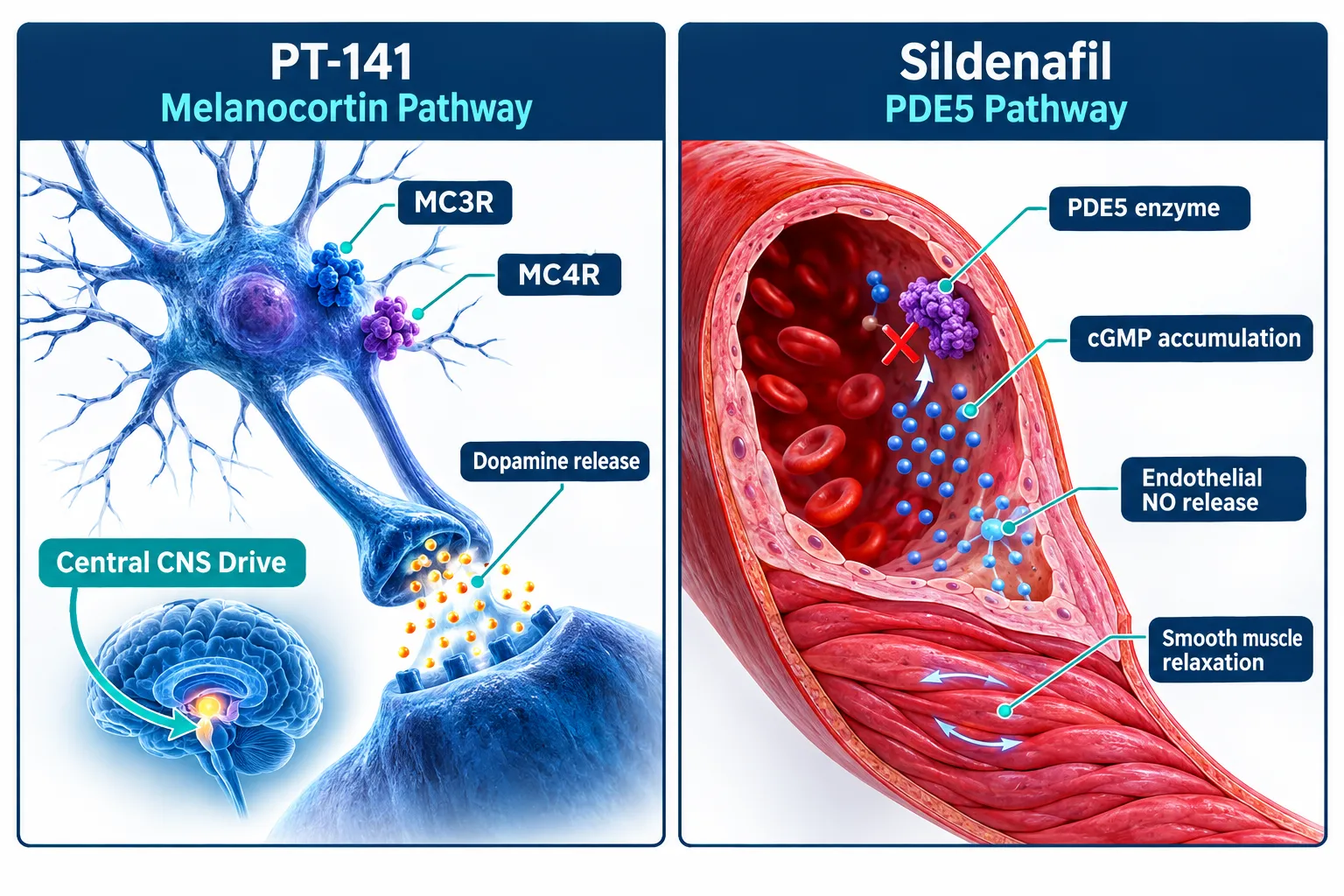
Understanding the PT-141 Peptide vs Sildenafil: Choosing Receptor, Vascular, and Behavioral Readouts debate starts at the receptor. These two compounds do not compete on the same biological terrain.
PT-141 is a cyclic heptapeptide analog of alpha-melanocyte-stimulating hormone. It binds melanocortin receptors, primarily MC3R and MC4R, located in the central nervous system. Activation of these receptors triggers dopaminergic and oxytocinergic signaling in the hypothalamus, generating a neurally mediated drive toward sexual behavior. This is a top-down mechanism: the brain initiates the signal.
Sildenafil, by contrast, is a phosphodiesterase type 5 (PDE5) inhibitor. It works peripherally by blocking the enzyme that degrades cyclic guanosine monophosphate (cGMP) in vascular smooth muscle. The result is prolonged smooth muscle relaxation and increased blood flow to erectile tissue. This is a bottom-up mechanism: the vasculature responds to an existing neural signal.
| Feature | PT-141 (Bremelanotide) | Sildenafil |
|---|---|---|
| Primary target | MC3R / MC4R (CNS) | PDE5 (vascular) |
| Mechanism direction | Central to peripheral | Peripheral only |
| NO-pathway dependency | Low | High |
| Onset (research models) | 45-60 minutes | 30-60 minutes |
| Primary readout type | Behavioral / desire | Vascular / rigidity |
For researchers selecting assays, this distinction is critical. A study using only penile blood flow as its endpoint will undervalue PT-141's contribution. A study using only desire questionnaires will undervalue sildenafil's.
Researchers exploring other centrally and peripherally acting peptides, such as those reviewing MT-2 research peptide data, will recognize that melanocortin agonism produces a distinct pharmacological fingerprint worth isolating in study design.
Vascular Readouts and Nitric Oxide Controls

The most important confounding variable when comparing these two compounds in vascular assays is endothelial nitric oxide (NO) availability. Sildenafil amplifies the cGMP signal that NO produces. If endothelial NO synthesis is impaired, as it is in diabetes, hypertension, or aging models, sildenafil's efficacy drops substantially. PT-141 bypasses this bottleneck entirely.
This makes NO-pathway integrity a required control variable in any head-to-head vascular study. Researchers should document:
- Baseline endothelial function (flow-mediated dilation or equivalent)
- Nitric oxide synthase (NOS) activity in the model
- Presence of vascular comorbidities that would suppress cGMP signaling
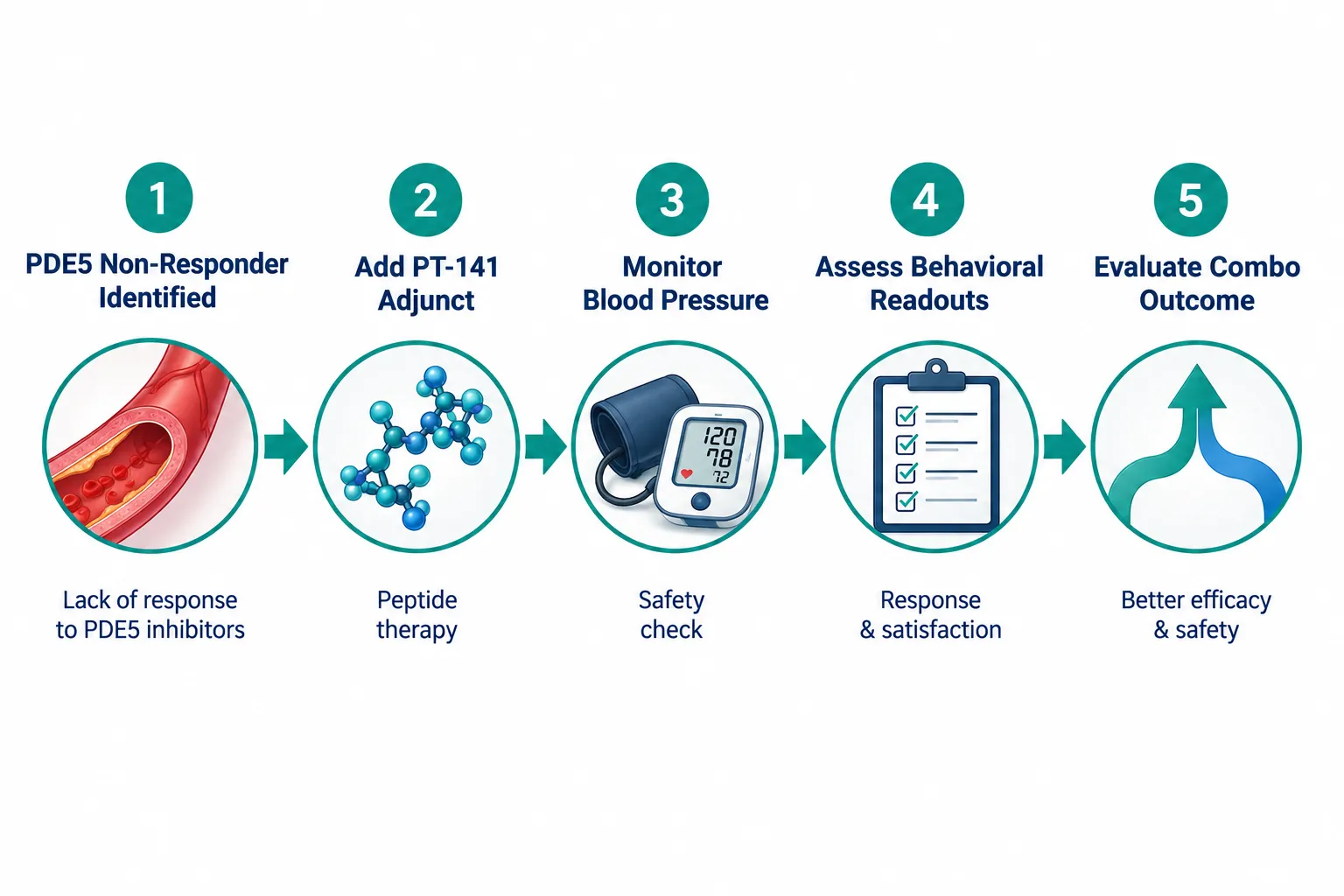
RigiScan studies, which measure tip and base rigidity continuously during sleep or stimulation, have been used to generate objective erectile rigidity data for both compounds. These studies show that PT-141 alone produces measurable rigidity increases, and that combining it with a PDE5 inhibitor in non-responder models produces additive effects beyond either agent alone. The combination appears to engage both the central drive and the peripheral vascular amplification simultaneously.
"The additive effect observed in combination models suggests that central melanocortin activation and peripheral PDE5 inhibition operate on non-overlapping rate-limiting steps."
For researchers already working with mitochondria-targeted peptides such as SS31 peptide, which addresses oxidative stress in endothelial cells, the intersection of vascular health and peptide pharmacology is a relevant parallel. Endothelial protection may restore the NO-pathway sensitivity that sildenafil requires, while PT-141 remains active regardless.
Safety note on combination use: Blood pressure monitoring is non-negotiable in combination protocols. PT-141 produces transient blood pressure increases (primarily through melanocortin-mediated vasoconstriction), while sildenafil produces decreases. The net hemodynamic effect is partially offsetting but unpredictable across individuals, requiring careful titration and monitoring in any research protocol.
Behavioral Readouts: Desire, Distress, and Satisfying Sexual Events
The PT-141 Peptide vs Sildenafil: Choosing Receptor, Vascular, and Behavioral Readouts comparison becomes most distinct when female models are included. Sildenafil has shown limited efficacy in female sexual dysfunction research, largely because genital blood flow is a less reliable proxy for subjective desire in women than in men.
PT-141's FDA approval for hypoactive sexual desire disorder (HSDD) in premenopausal women was built on three validated behavioral endpoints:
- Desire score, measured via the Female Sexual Function Index (FSFI) desire subscale
- Distress score, measured via the Female Sexual Distress Scale-Revised (FSDS-R)
- Satisfying sexual events (SSEs), a diary-based count of encounters rated as satisfying by the participant
These endpoints capture the neurally mediated, motivational dimension of sexual function that vascular assays miss entirely. For researchers designing studies that include female subjects or that target desire rather than performance, these behavioral readouts are primary, not secondary, outcomes.
In male models, SSEs and desire scores remain useful adjunct readouts alongside RigiScan data. A 2026 subcutaneous bremelanotide safety study in men confirmed cardiovascular tolerability at standard doses while reinforcing that behavioral self-report metrics add meaningful signal beyond objective rigidity measurements alone.
Researchers building comprehensive protocols may also find value in reviewing how other peptide classes are evaluated for behavioral and metabolic endpoints, such as those covered in resources on GLP-1 peptide research concepts and sourcing, where endpoint selection similarly determines what a study can and cannot conclude.
For researchers sourcing compounds for these protocols, documentation standards matter as much as purity. The principles outlined in the BPC-157 core peptides documentation first research guide apply broadly to any peptide research program requiring traceable, reproducible results.
Conclusion
Selecting between PT-141 and sildenafil, or designing a study that uses both, requires clarity about what is actually being measured. Vascular assays with NO-pathway controls favor sildenafil as the primary variable. Behavioral assays using desire, distress, and SSE endpoints favor PT-141. Combination protocols targeting PDE5 non-responders need both objective rigidity data and behavioral self-report, with mandatory hemodynamic monitoring.
Actionable next steps for researchers:
- Define the primary endpoint before selecting the compound, receptor-level, vascular, or behavioral.
- Include endothelial NO-pathway status as a baseline covariate in any vascular study.
- Use validated scales (FSFI, FSDS-R, SSE diary) alongside RigiScan data in combination studies.
- Monitor blood pressure at all timepoints in PT-141 plus PDE5 inhibitor protocols.
- Review the emerging 2026 male safety data before finalizing dosing parameters for subcutaneous bremelanotide protocols.
The field is moving toward recognizing PT-141 not as a replacement for sildenafil but as a mechanistically distinct adjunct, one that fills the gap where vascular amplification alone is insufficient.