Call or Text 727-513-9780
  • Shopping Cart Shopping Cart
    0Shopping Cart
Pure Tested Peptides | America's most trusted Peptides for sale online
  • Peptides for sale
    • Oral Peptides for sale
      • Peptide Capsules for sale
      • BPC 157 Capsules 1000mcg
      • SLU-PP-332 Capsules | 1000 mcg
      • 5-Amino-1MQ 50mg Capsules
      • Tesofensine 500mcg
    • All Peptides for sale
    • Peptide Sprays
      • BPC 157 Nasal Spray Kit
      • BPC-157 TB500 Nasal Spray Kit
      • Semax Nasal Spray 10mg
      • Selank – Nasal Spray Kit – 10mg
      • Epithalon 50MG Nasal Spray Kit
      • Ipamorelin 10mg Nasal Spray
      • Klow Nasal Spray (BPC-157 + TB-500 + GHK-Cu + KPV) | 80mg
      • Hulk Nasal Spray Tesa / Ipa Blend 6/3 MG
      • Klow Nasal Spray
      • NAD + 500 mg Nasal Spray
      • PT-141 Nasal Spray Kit
    • GHRH Peptides
      • Ipa Peptides
      • CJC-1295 Peptides
        • CJC-1295 with DAC 5 mg
        • CJC-1295 without DAC 5 mg
        • CJC-1295 Ipa 10mg
      • Tesa Peptides
        • Tesa Peptide
        • Tesa 20 mg
    • GHK-Cu Peptides
      • All GHK-Cu Peptides
      • GHK-Cu 100mg
      • KLOW Peptide Blend – Buy KLOW blend online
    • BPC Peptides
      • All BPC Peptides
      • BPC-157
      • BPC-157 TB-500
      • BPC 157 capsules 1000mcg
    • SLU-PP-332 Peptides
      • All SLU-PP-332 Peptides
      • SLU-PP-332 5mg
    • GLP3 Peptides
    • PT-141 Peptides
      • PT-141 Peptides for sale
      • PT-141 10mg
      • PT-141 Nasal Spray
    • CAG Peptides
      • Lipo-C Peptide Blend
      • CAG 5mg
      • CAG 10mg
    • MOTS-C Peptides
      • MOTS-C Peptides for sale
      • MOTS-c peptide
      • MOTS-c 10mg *6 pack*
    • 5 Amino 1MQ Peptides
      • 5 Amino 1MQ Peptides for sale
      • 5-Amino-1MQ 50mg Capsules
      • 5-Amino-1MQ 5mg
    • Epithalon Peptides
      • Epithalon Peptides for sale
      • Epithalon 10mg
      • Epithalon 50mg
  • Shop
    • GLPs
      • 5-Amino-1MQ 50mg Capsules
      • 5-Amino-1MQ 5mg
      • L-Carnitine 500mg/ml
      • Tesofensine 500mcg
      • SLU-PP-332 5mg
      • MOTS-c 10mg *6 pack*
    • Epithalon & BPC Peptides
      • Epithalon 10mg
      • Epithalon 50mg
      • BPC-157
      • BPC 157 capsules 1000mcg
      • BPC-157 TB-500
      • BPC-157 TB500 Nasal Spray Kit
      • BPC 157 Nasal Spray Kit
    • BPC TB-500 & NAD+ Peptides
      • NAD+ 500 mg
      • KLOW Peptide Blend – Buy KLOW blend online
      • GLOW Peptide Blend
      • TB 500 5mg
      • BPC 157 capsules 1000mcg – Supplement
      • BPC 157 Nasal Spray Kit
      • BPC-157
      • BPC-157 TB500 Nasal Spray Kit
      • BPC-157 TB-500
      • BPC 157 capsules 1000mcg
    • LL-37 Peptide
      • LL-37 10 mg
    • MOTS-C & Selank
      • MOTS-c peptide
      • Selank 10mg
    • GHK Peptides
      • GHK-Cu 100mg
      • GLOW Peptide Blend
      • KLOW Peptide Blend – Buy KLOW blend online
  • COAs
  • Wholesale
    • Wholesale Peptides for sale
  • PTP FAQ
  • Affiliates
    • Selank Peptide: Advanced Pharmacological Mechanisms Underlying Its Anxiolytic and Nootropic Effects in Research
      • 5-Amino-1MQ Peptide: Detailed Mechanisms of NNMT Inhibition and Its Impact on Cellular Metabolism Research
        • MOTS-C Peptide: Unraveling Its Role in Mitochondrial Dynamics and Energy Metabolism Research
          • Epithalon Peptide and Telomerase Regulation: Investigating Its Impact on Cellular Senescence and Lifespan Research Models
            • GLP2-T vs GLP2 Tirz Peptide: Understanding the Naming, Mechanistic Nuances, and Research Implications for Gut Health
      • Peptides and Polypeptides in Modern Pharmacology: What Research on Metoprolol, Prednisone, and Amlodipine Reveals
        • Polypeptide Peptides vs NSAIDs: What Naproxen and Diclofenac Teach Tissue-Repair Researchers About BPC‑157 and TB‑500
          • Peptides and Polypeptides in Endocrine Pharmacology: How GLP-1, GLP-2, and GLP-3 Retatrutide Differ From Classic Drugs Like Prednisone and Amlodipine
          • 5‑Amino‑1MQ Peptide and NNMT Inhibition: How It Compares With Statins Like Atorvastatin in Adipose and Lipid Metabolism Research
      • Enclomiphene, Estrogen Receptor Signaling, and Luteinizing Phase Biology: What Hormone Researchers Should Measure
        • Mesenchymal Stem Cells, BPC‑157, and GHK‑Cu: How Tissue Repair Peptides Compare With Classic NSAIDs Like Naproxen in Injury Models
          • Peptide Calculator Use Cases Beyond Growth Hormone: Working Through GLP‑3 Retatrutide, MOTS‑c, and BPC‑157 Research Dosing
        • Polypeptide Peptides in Endocrine and Metabolic Pharmacology: Lessons From Amlodipine, Prednisone, and Metoprolol
        • Peptides Calculator for Advanced Blends: Worked Examples for Tesamorelin, CJC‑1295, and Ipamorelin Stacks
          • Peptides and Polypeptides in Human Physiology: How Molecular Size Shapes Research Applications
            • Selank Peptide: Advanced Pharmacological Mechanisms Underlying Its Anxiolytic and Nootropic Effects in Research
          • 5-Amino-1MQ Peptide: Detailed Mechanisms of NNMT Inhibition and Its Impact on Cellular Metabolism Research
            • MOTS-C Peptide: Unraveling Its Role in Mitochondrial Dynamics and Energy Metabolism Research
              • Epithalon Peptide and Telomerase Regulation: Investigating Its Impact on Cellular Senescence and Lifespan Research Models
                • GLP2-T vs GLP2 Tirz Peptide: Understanding the Naming, Mechanistic Nuances, and Research Implications for Gut Health
                  • Peptides and Polypeptides in Endocrine Pharmacology: How GLP-1, GLP-2, and GLP-3 Retatrutide Differ From Classic Drugs Like Prednisone and Amlodipine
                    • Polypeptide Peptides vs NSAIDs: What Naproxen and Diclofenac Teach Tissue-Repair Researchers About BPC‑157 and TB‑500
                      • Peptides and Polypeptides in Modern Pharmacology: What Research on Metoprolol, Prednisone, and Amlodipine Reveals
                        • 5‑Amino‑1MQ Peptide and NNMT Inhibition: How It Compares With Statins Like Atorvastatin in Adipose and Lipid Metabolism Research
                        • Enclomiphene, Estrogen Receptor Signaling, and Luteinizing Phase Biology: What Hormone Researchers Should Measure
                        • Mesenchymal Stem Cells, BPC‑157, and GHK‑Cu: How Tissue Repair Peptides Compare With Classic NSAIDs Like Naproxen in Injury Models
                        • Peptide Calculator Use Cases Beyond Growth Hormone: Working Through GLP‑3 Retatrutide, MOTS‑c, and BPC‑157 Research Dosing
                        • Polypeptide Peptides in Endocrine and Metabolic Pharmacology: Lessons From Amlodipine, Prednisone, and Metoprolol
                        • Peptides Calculator for Advanced Blends: Worked Examples for Tesamorelin, CJC‑1295, and Ipamorelin Stacks
                        • Peptides and Polypeptides in Human Physiology: How Molecular Size Shapes Research Applications
                        • Selank Peptide: Advanced Pharmacological Mechanisms Underlying Its Anxiolytic and Nootropic Effects in Research
                        • MOTS-C Peptide: Unraveling Its Role in Mitochondrial Dynamics and Energy Metabolism Research
                        • Peptides and Polypeptides in Modern Pharmacology: What Research on Metoprolol, Prednisone, and Amlodipine Reveals
                        • Peptides and Polypeptides in Endocrine Pharmacology: How GLP-1, GLP-2, and GLP-3 Retatrutide Differ From Classic Drugs Like Prednisone and Amlodipine
                        • 5-Amino-1MQ Peptide: Detailed Mechanisms of NNMT Inhibition and Its Impact on Cellular Metabolism Research
                        • Mesenchymal Stem Cells, BPC‑157, and GHK‑Cu: How Tissue Repair Peptides Compare With Classic NSAIDs Like Naproxen in Injury Models
                        • Peptide Calculator Use Cases Beyond Growth Hormone: Working Through GLP‑3 Retatrutide, MOTS‑c, and BPC‑157 Research Dosing
                        • GLP2-T vs GLP2 Tirz Peptide: Understanding the Naming, Mechanistic Nuances, and Research Implications for Gut Health
                        • Polypeptide Peptides in Endocrine and Metabolic Pharmacology: Lessons From Amlodipine, Prednisone, and Metoprolol
                        • Polypeptide Peptides vs NSAIDs: What Naproxen and Diclofenac Teach Tissue-Repair Researchers About BPC‑157 and TB‑500
                        • Peptides and Polypeptides in Human Physiology: How Molecular Size Shapes Research Applications
                        • Peptides Calculator for Advanced Blends: Worked Examples for Tesamorelin, CJC‑1295, and Ipamorelin Stacks
                        • 5‑Amino‑1MQ Peptide and NNMT Inhibition: How It Compares With Statins Like Atorvastatin in Adipose and Lipid Metabolism Research
                        • Enclomiphene, Estrogen Receptor Signaling, and Luteinizing Phase Biology: What Hormone Researchers Should Measure
                        • Epithalon Peptide and Telomerase Regulation: Investigating Its Impact on Cellular Senescence and Lifespan Research Models
                        • Best research protocol Klow blend
                        • best time to take BPC-157
                        • best time to take DSIP (Delta Sleep Inducing Peptide)
                        • best time to take CJC-1295
                        • best time to take AOD-9604
                        • best time to take Follistatin 344
                        • best time to take Ipamorelin
                        • best time to take MK-677 (Ibutamoren)
                        • best time to take Ligandrol (LGD-4033) — research compound
                        • best time to take Ostarine (MK-2866) — research compound
                        • best time to take GHK-CU
                        • best time to take TB-500
                        • best time to take MOTS-c
                        • best time to take Semax
                        • best time to take RAD-140 (Testolone) — research compound
                        • best time to take Thymosin Alpha-1
                        • best time to take PEG-MGF
                        • Biolife Plasma, Octapharma Plasma, and Research Peptides: How Plasma Donation Labs Differ From Peptide Suppliers
                        • best time to take YK-11 — research compound
                        • best time to take PT-141 (Bremelanotide)
                        • Best research protocol Klow blend
                        • 5-Amino-1MQ and MOTS-C Synergy: Metabolic Signaling, Mitochondria, and Research Design
                        • BPC-157 and TB-500: Investigating Their Combined Effects on Angiogenesis and Cellular Migration in Tissue Repair Models
                        • BPC-157 Peptide: Gut Barrier Function, Inflammation, and Tissue-Recovery Research
                        • 5‑Amino‑1MQ and MOTS‑c Synergy in Metabolic Research: Designing NNMT and Mitochondrial Biogenesis Stacks
                        • CJC-1295 with DAC vs. Without DAC: Half-Life, Release Kinetics, and Research Implications
                        • CJC‑1295 with DAC vs. Without DAC: Expanding on Half‑Life Differences Using Tesamorelin and Ipamorelin Blend Case Studies
                        • Collagen Biology and Copper‑Binding Peptides: How GHK‑Cu, Glow Blend, and Klow Blend Interact with Skin and Connective Tissue
                        • Collagen Biology and Regenerative Peptides: How GHK‑Cu, Glow Blend, and Klow Blend Affect Extracellular Matrix Research
                    • DNA, Telomeres, and Longevity Peptides: Positioning Epithalon and MOTS‑c in Genetic Aging Research
                      • Enclomiphene Citrate: serm Mechanism, Testosterone Research, and Stack Compatibility
                        • Enclomiphene vs Enclomiphene Citrate: Formulation, Bioavailability, and Research Distinctions
                        • Epithalon Peptide Research: Telomerase Activation, Aging, and Pineal Gland Function
                        • Estrogen Receptor Signaling and Enclomiphene: How Selective Modulators Compare with Classic Polypeptide Hormones
                        • GHK-Cu Peptide: Advanced Mechanisms in Extracellular Matrix Remodeling and Wound Healing Research
                        • GHK-Cu Peptide: Collagen Synthesis, Wound Repair, and Skin-Barrier Research Models
                        • GLP-1 vs GLP-3 vs GLP-2: Peptide Classification and Research Applications
                        • GLP-2 Peptide Research Guide: Gut Barrier Function, Nutrient Absorption, and Intestinal Recovery Models
                        • GLP-3 Retatrutide vs. GLP-1 Drugs: What Triple-Agonist Biology Changes in Research Models
                        • Ipamorelin and Tesamorelin Combination: Synergistic GH Secretagogue Research and Dosing Protocols
                        • GLP2 Tirz Peptide: What It Is, Why the Name Exists, and How Researchers Should Interpret It
                        • Klow Blend Peptide Nasal Spray: What the Formulation Is Trying to Do in Cognitive Research
                        • Mitochondria, NNMT Inhibition, and Peptide Modulators: Where MOTS‑c and 5‑Amino‑1MQ Fit in Cellular Energy Research
                        • MOTS-c Peptide: Mitochondrial Function, Energy Metabolism, and What Researchers Measure
                        • MOTS-c vs. 5-Amino-1MQ: Which Metabolic Research Questions Each Compound Actually Answers
                        • Nasal Spray Peptides: Bioavailability, Administration, and Semax/Selank Research Applications
                        • PT-141 Peptide Research: Mechanism of Action and Melanocortin Receptor Signaling
                        • Retatrutide for Research: Mechanism, Structure, and GLP-1/GLP-3 Dual Action
                        • Retatrutide for Obesity and Type 2 Diabetes: What the Latest Trial Data Suggest
                        • Tesofensine Peptide Research: Mechanism, Appetite Suppression, and Neuropeptide Y Pathways
  • Contact
    • Contact Customer Service
    • Text Customer Support
  • About US
  • Shop all peptides
  • Affiliate Program
    • Affiliate Signup
  • Login / Register Login / Register Page Link Login / Register Page Link
  • Click to open the search input field Click to open the search input field Search
  • Menu Menu

Tag Archive for: vegf signaling

Meloxicam and BPC-157 Research Models: Separating COX Inhibition From Barrier, Angiogenesis, and Repair Signals

Meloxicam and BPC-157 Research Models: Separating COX Inhibition From Barrier, Angiogenesis, and Repair Signals

October 16, 2026/0 Comments/in Uncategorized/by

Selective COX-2 inhibition can reduce myofiber cross-sectional area by up to 33% in the first three weeks after muscle injury, a finding that forces researchers to ask a sharper question: when an NSAID quiets inflammation, what else does it silence? That question is precisely where Meloxicam and BPC-157 Research Models: Separating COX Inhibition From Barrier, Angiogenesis, and Repair Signals becomes a productive experimental framework rather than a simple drug-versus-peptide comparison.

Key Takeaways

  • Meloxicam is a preferential COX-2 inhibitor that suppresses prostaglandin E2-driven inflammatory cascades but may simultaneously blunt early regenerative signaling in muscle, bone, and tendon models.
  • BPC-157 activates FAK-paxillin, PI3K/Akt, VEGF, and eNOS pathways, functioning as a "signal-upregulating" repair agent rather than an anti-inflammatory compound.
  • Gastrointestinal barrier models show that BPC-157 can restore mucosal integrity even when NSAID-driven COX inhibition has already disrupted prostaglandin synthesis.
  • BPC-157's angiogenic effects are context-dependent: pro-angiogenic in wound and musculoskeletal models, anti-angiogenic in pathological settings such as liver cirrhosis.
  • All BPC-157 data remain preclinical as of 2026; no peer-reviewed controlled human trials exist, making rigorous experimental design essential.

How Meloxicam Defines the COX-Inhibition Arm of These Research Models
How Meloxicam Defines the COX-Inhibition Arm of These Research Models

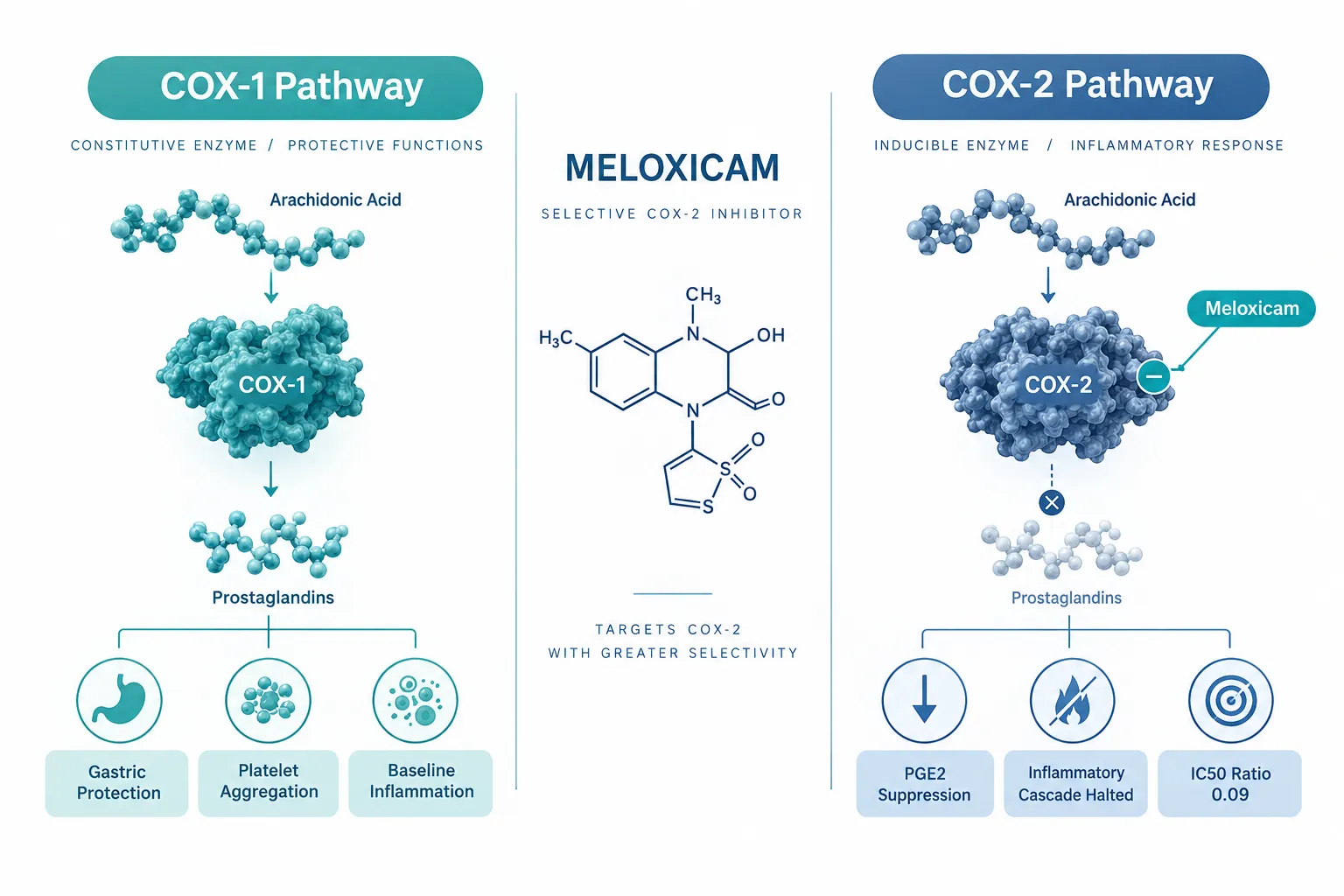
Meloxicam occupies a specific mechanistic lane. Its COX-2:COX-1 IC50 ratio sits at approximately 0.09 in human whole-blood assays, meaning COX-2 is inhibited at concentrations far below those needed to meaningfully affect COX-1. At therapeutic doses, this translates to strong suppression of prostaglandin E2 and related COX-2-dependent mediators that drive the classical redness, heat, and swelling of acute tissue injury.

That selectivity is valuable for isolating variables in a research model. When meloxicam is used as the COX-inhibition comparator, investigators can attribute downstream changes in inflammatory cytokines, edema volume, or pain behavior specifically to the prostaglandin axis rather than to broader cyclooxygenase disruption.

The trade-off, however, is regenerative. Prostaglandins are not only inflammatory mediators, they also coordinate satellite cell activation, osteoblast recruitment, and tendon fibroblast proliferation. Models that apply meloxicam-class COX-2 inhibition during the first weeks of healing consistently show reduced regenerative output alongside reduced inflammation. This creates a measurable "repair deficit" that serves as a useful baseline against which a repair-promoting agent can be tested.

Meloxicam Mechanism Research Utility Observed Limitation
Preferential COX-2 blockade Isolates prostaglandin axis Blunts satellite cell and fibroblast signaling
PGE2 suppression Reduces inflammatory noise in assays May delay bone and tendon callus formation
Low COX-1 interference Preserves gastric baseline prostaglandins Does not address vascular remodeling readouts

BPC-157 as the Repair and Barrier Comparator in Meloxicam and BPC-157 Research Models
BPC-157 as the Repair and Barrier Comparator in Meloxicam and BPC-157 Research Models

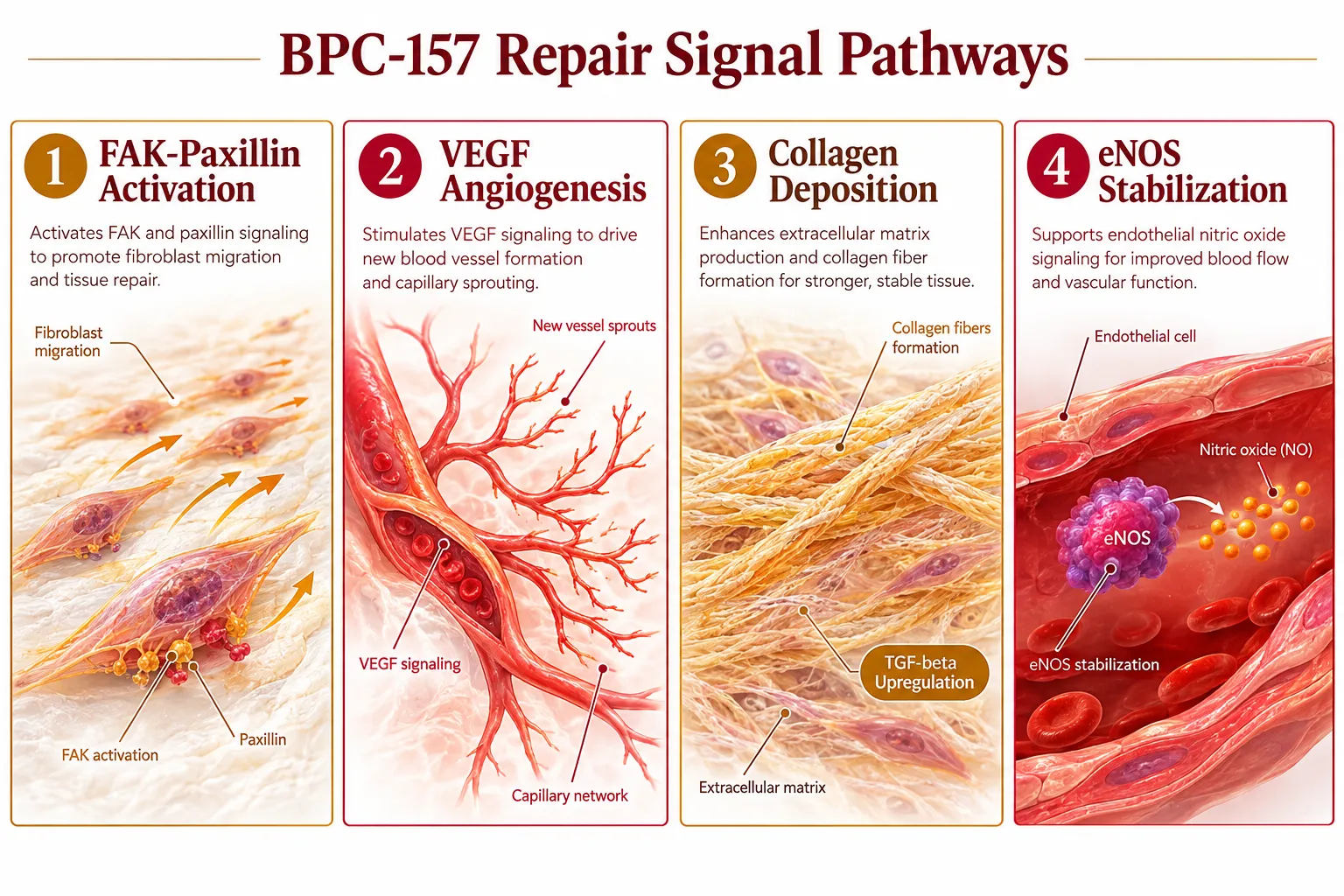
BPC-157 is a stable synthetic pentadecapeptide derived from a gastric protein sequence. Its mechanistic profile is essentially the inverse of meloxicam's: rather than suppressing a signaling cascade, it amplifies several repair programs simultaneously.

Core pathways activated by BPC-157 include:

  • FAK-paxillin signaling, which accelerates fibroblast migration and attachment
  • PI3K/Akt, which promotes cell survival and proliferation
  • VEGF and VEGFR2, which drive new capillary formation
  • TGF-beta, which upregulates collagen synthesis and extracellular matrix remodeling
  • eNOS stabilization, which maintains endothelial nitric oxide output and microvascular tone

More than 150 preclinical studies, predominantly rodent models, document pro-healing effects across muscle, tendon, ligament, bone, and gastrointestinal tissue. Researchers exploring wound healing mechanisms will recognize BPC-157 as a benchmark agent for angiogenesis and collagen-deposition assays.

Crucially, BPC-157 has also been shown to reduce COX-2 expression, myeloperoxidase activity, and pro-inflammatory cytokines such as IL-6 and TNF-alpha in gastrointestinal inflammation models. This partial overlap with NSAID-like outcomes occurs through modulation of inflammatory signaling rather than direct enzyme inhibition, a distinction that matters enormously when designing assays intended to separate mechanisms.

"Meloxicam turns down prostaglandin-mediated inflammatory cascades; BPC-157 turns up repair programs in fibroblasts, endothelial cells, and extracellular matrix. These are complementary but non-equivalent actions."


Separating COX Inhibition From Barrier, Angiogenesis, and Repair Signals: Key Experimental Readouts
Separating COX Inhibition From Barrier, Angiogenesis, and Repair Signals: Key Experimental Readouts

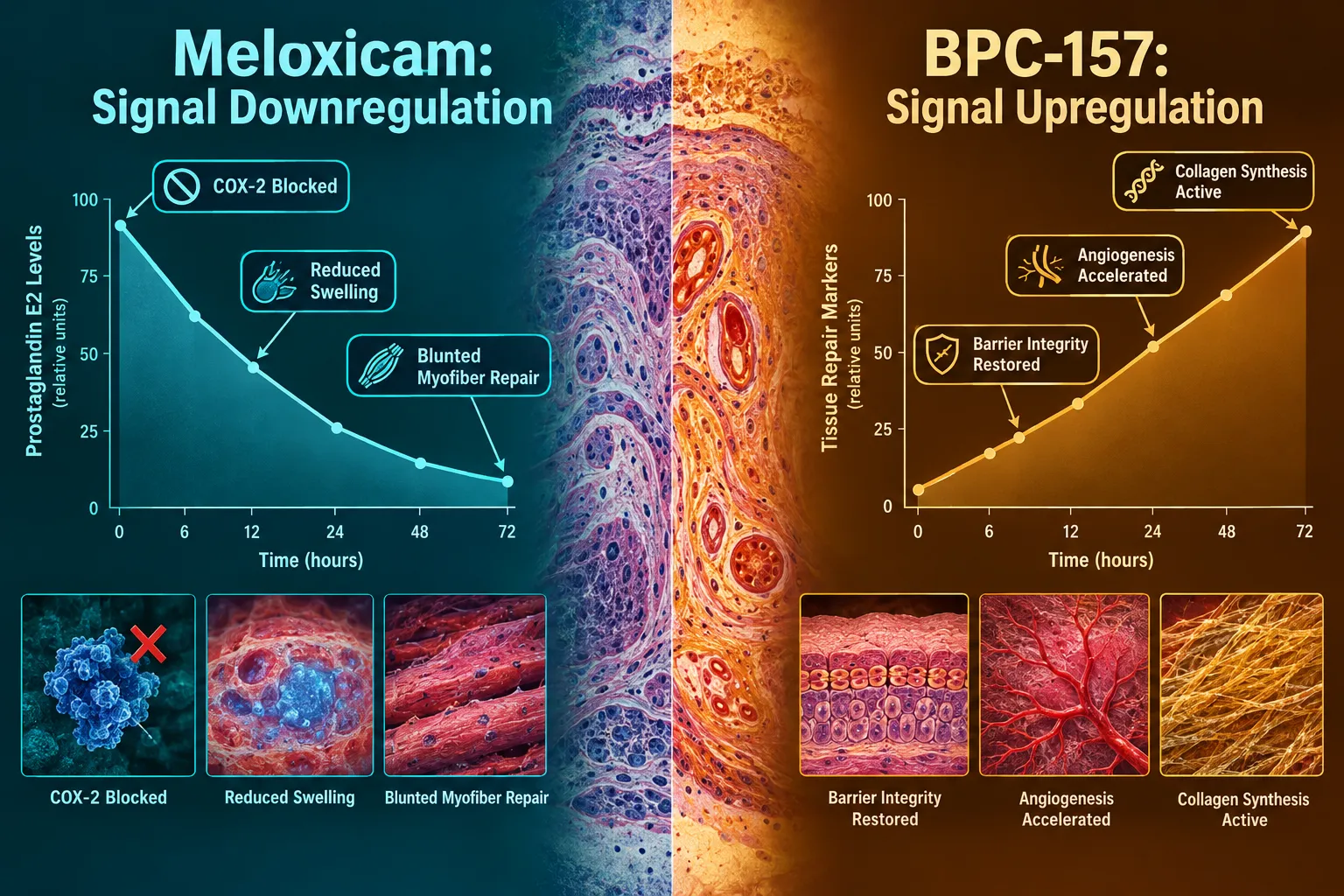
The most informative use of Meloxicam and BPC-157 Research Models: Separating COX Inhibition From Barrier, Angiogenesis, and Repair Signals lies in assigning distinct readout categories to each agent.

Timing windows matter. Meloxicam's effects are most pronounced during the acute inflammatory phase (days 1-5 post-injury). BPC-157's angiogenic and barrier effects accumulate over days 3-21, making sequential or overlapping dosing protocols necessary to capture both mechanisms without conflation.

Vascular readouts require specific assays. BPC-157 drives angiogenesis through VEGFR2-PI3K-Akt-eNOS and Src-caveolin-1-eNOS pathways. A 2026 study identified FBXO22-dependent stabilization of the transcription factor BACH1 as an additional angiogenic driver. Meloxicam does not meaningfully engage these pathways, so CD31 staining, microvessel density counts, and Doppler perfusion measures will reflect BPC-157 activity without NSAID interference.

Barrier integrity assays are particularly diagnostic. In gastrointestinal models using indomethacin- or aspirin-induced ulceration, co-administration of BPC-157 reduces mucosal hemorrhage, lowers ulcer index scores, and helps maintain local prostaglandin levels despite upstream COX inhibition. This demonstrates that barrier repair can proceed through peptide-driven pathways even when prostaglandin synthesis is suppressed, a clean mechanistic separation.

Context-dependent angiogenesis is a critical nuance. In wound and musculoskeletal models, BPC-157 is pro-angiogenic. In liver cirrhosis and portal hypertension models, it suppresses pathological angiogenesis and normalizes NO signaling. Researchers must define the vascular pathology context before interpreting angiogenesis data.

For investigators comparing peptide repair mechanisms, related mitochondrial and cellular energy research, such as SS-31 mitochondrial research themes, offers useful parallel frameworks for understanding how peptides modulate tissue recovery at the cellular level. Similarly, copper peptide research documented in the GHK-Cu copper peptide research sourcing guide provides additional context for collagen and angiogenesis assay design.

Recommended assay matrix for separating mechanisms:

  • PGE2 ELISA, meloxicam-sensitive, BPC-157-independent
  • Microvessel density (CD31 IHC), BPC-157-sensitive, meloxicam-independent
  • Transepithelial electrical resistance (TEER), barrier integrity, BPC-157 primary driver
  • Myofiber cross-sectional area (H&E morphometry), detects NSAID-induced regenerative deficit
  • Collagen content (Sirius Red staining), BPC-157 upregulated, not NSAID-dependent
  • eNOS phosphorylation (Western blot), BPC-157 pathway marker

Researchers sourcing peptide compounds for these protocols should consult resources such as the PT-141 peptide research context QA and controls guide for quality and control benchmarks applicable across peptide research settings.

A 2026 Cambridge-affiliated review on BPC-157's role in tissue repair and pain management underscores that its pleiotropic effects, spanning angiogenesis, collagen synthesis, fibroblast activity, and nitric oxide modulation, could carry off-target risks if translated to humans. Rigorous dose-finding, toxicity screening, and long-term safety trials remain prerequisites before any clinical application. All current conclusions are strictly preclinical.


Conclusion

Meloxicam and BPC-157 Research Models: Separating COX Inhibition From Barrier, Angiogenesis, and Repair Signals is most valuable when investigators move beyond a binary NSAID-versus-peptide framing and instead assign each agent to specific mechanistic readouts at defined time windows. Meloxicam reliably controls the prostaglandin axis and creates a measurable regenerative deficit that quantifies the cost of COX-2 suppression. BPC-157 provides a parallel track of vascular, barrier, and matrix repair signals that operate largely independently of COX enzyme activity.

Actionable next steps for research teams:

  1. Define the injury phase (acute vs. proliferative) and select assay timing accordingly before combining agents in a single protocol.
  2. Use PGE2 ELISA as the meloxicam-specific readout and microvessel density plus TEER as BPC-157-specific readouts to prevent cross-mechanism attribution errors.
  3. Specify the vascular pathology context when interpreting angiogenesis data, given BPC-157's demonstrated context-dependent pro- and anti-angiogenic behavior.
  4. Treat all BPC-157 findings as preclinical until controlled human trial data are available; design protocols with appropriate safety and toxicity checkpoints.
  5. Consult established sourcing and quality-control frameworks, including resources on GHK-Cu for sale and related peptide compound standards, to ensure reagent integrity across experimental runs.

Separating these mechanisms with precision is not merely an academic exercise. It is the foundation on which any future translational work in tissue repair, barrier biology, and vascular remodeling will need to stand.

https://www.puretestedpeptides.com/wp-content/uploads/2026/10/meloxicam-and-bpc-157-research-models-separating-cox-inhibition-from-barrier-ang.webp 1024 1536 https://www.puretestedpeptides.com/wp-content/uploads/2026/01/buy-peptides-online.jpg 2026-10-16 13:05:162026-10-16 13:05:16Meloxicam and BPC-157 Research Models: Separating COX Inhibition From Barrier, Angiogenesis, and Repair Signals
×

Helpful Links

  • My account
  • Cart
  • Checkout
  • Refund and Returns Policy
  • Privacy Policy
  • SMS Privacy Policy
  • Login
  • My Account
  • Logout

USA Made Lab Tested Peptides

All products are sold for research, laboratory, or analytical purposes only, and are not for human consumption


Pure Tested Peptides is a chemical supplier. Pure Tested Peptides is not a compounding / chemical compounding facility as defined under 503A of the Federal Food, Drug, and Cosmetic act. Pure Tested Peptides is not an outsourcing facility as defined under 503B of the Federal Food, Drug, and Cosmetic act.

The statements made within this website have not been evaluated by the US Food and Drug Administration. The products we offer are not intended to diagnose, treat, cure or prevent any disease.

Human/Animal Consumption Prohibited. Laboratory/In-Vitro Experimental Use Only

Scroll to top Scroll to top Scroll to top