

Best Research Peptides for Weight Management: Comparing GLP-3 Retatrutide, MOTS-c, and 5-Amino-1MQ
Obesity affects more than one billion people worldwide, yet fewer than five percent of those with clinically significant excess weight achieve durable fat loss through lifestyle changes alone. That gap has pushed researchers toward a new generation of metabolic compounds. Among the most closely watched are three distinct agents: Retatrutide, MOTS-c, and 5-Amino-1MQ. This comparative guide on the best research peptides for weight management — comparing GLP-3 Retatrutide, MOTS-c, and 5-Amino-1MQ — examines what each compound does, how far the science has advanced, and what distinguishes them from one another.
Key Takeaways
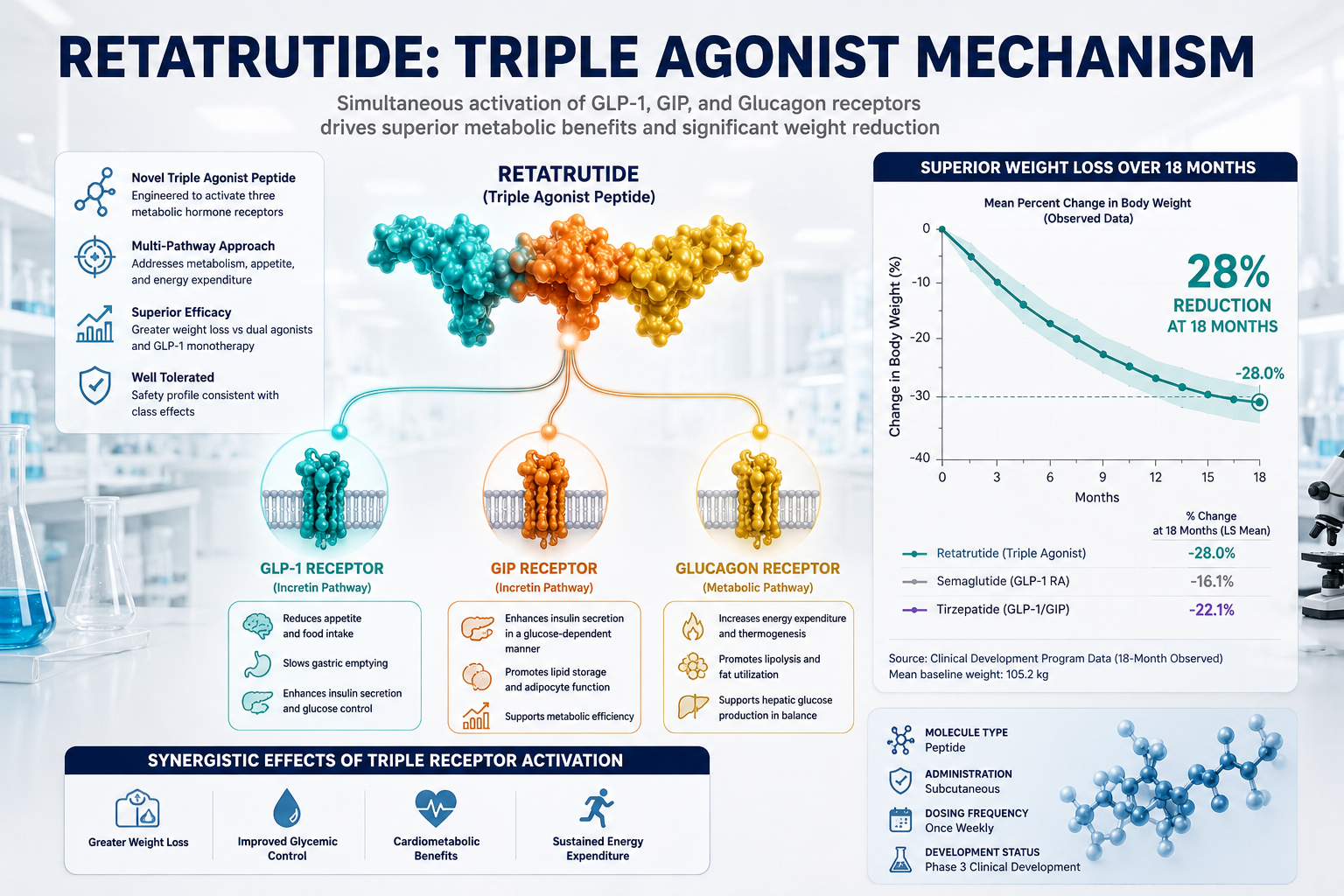
- Retatrutide is a triple agonist (GLP-1, GIP, glucagon) that produced roughly 28% average weight loss over 18 months in Phase 3 trials — comparable to bariatric surgery outcomes.
- MOTS-c is a mitochondria-derived peptide that activates the AMPK pathway, improving insulin sensitivity and metabolic flexibility in preclinical models.
- 5-Amino-1MQ inhibits the NNMT enzyme to enhance cellular metabolism, but human trial data remain limited.
- All three compounds are currently research-stage agents; none carries full FDA approval for weight management as of 2026.
- Mechanism, research maturity, and target pathway differ significantly across the three, making direct comparison essential for informed research planning.
Retatrutide: The Triple Agonist Redefining Weight Loss Research
Retatrutide represents the most clinically advanced entry among the best research peptides for weight management. It functions as a triple agonist, simultaneously activating GLP-1, GIP, and glucagon receptors. This three-pronged approach does something no single-receptor agent can match: it enhances satiety through GLP-1 signaling, boosts energy expenditure via glucagon activation, and improves glycemic control through GIP engagement.
The clinical data behind Retatrutide are striking. In a Phase 3 trial conducted by Eli Lilly, participants achieved an average body weight reduction of approximately 28% over 18 months. That figure places Retatrutide in the same efficacy range as bariatric surgery — a threshold no oral or injectable anti-obesity medication had previously crossed. Eli Lilly is pursuing FDA approval, with late-stage trial completion targeted for 2026.
Side effects reported in trials were primarily gastrointestinal: nausea, vomiting, and diarrhea. These effects were dose-dependent and generally mild to moderate, consistent with the GLP-1 drug class profile.
For researchers sourcing this compound, the GLP-3 Retatrutide product page provides catalog navigation and research planning context. Additional receptor-level background is available through the GIP receptor mechanism overview.
"A 28% average weight reduction over 18 months positions Retatrutide as potentially the most efficacious pharmacological weight loss agent studied to date."
MOTS-c and 5-Amino-1MQ: Mitochondrial and Enzymatic Pathways
MOTS-c: Mitochondria-Derived Metabolic Regulation
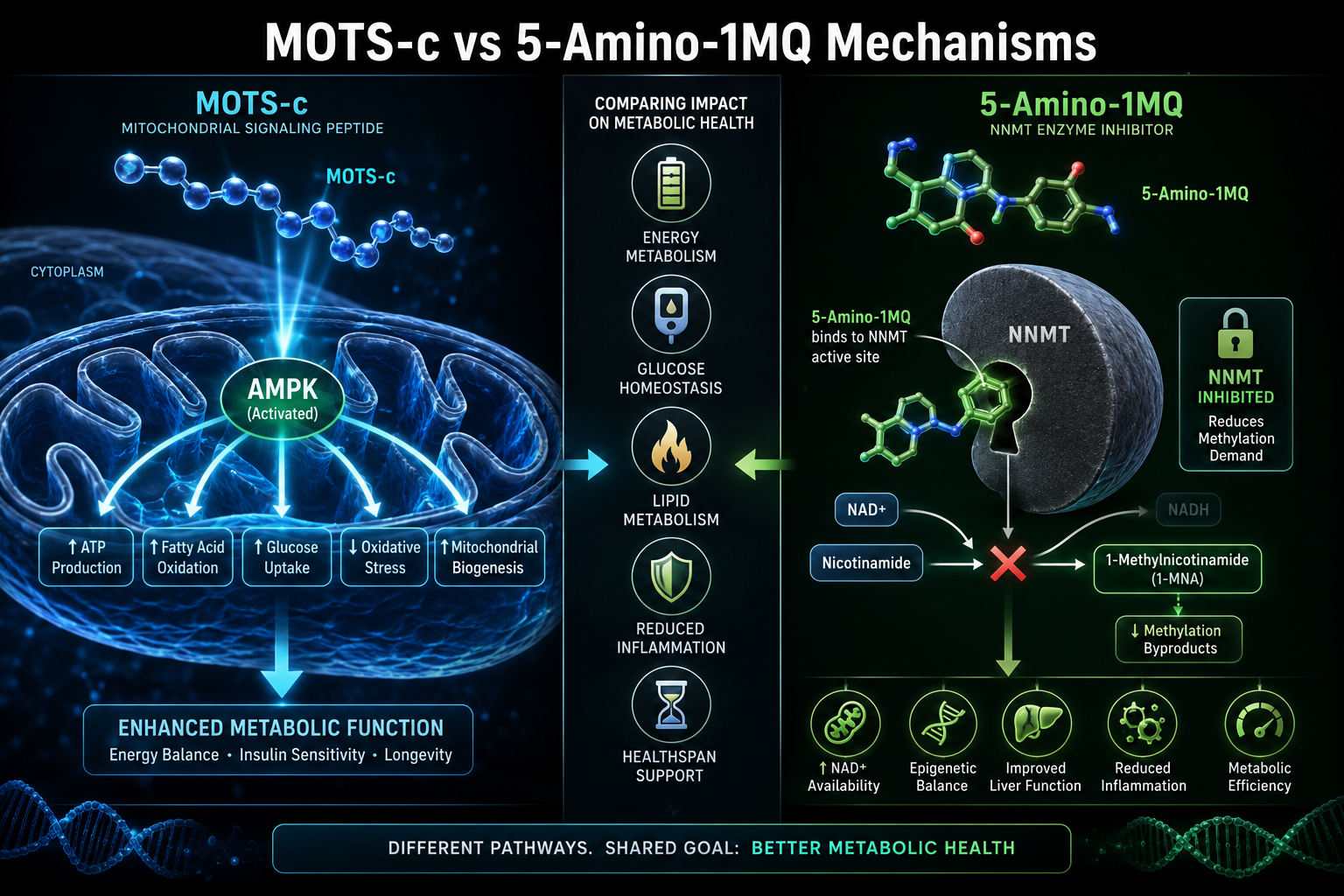
MOTS-c is a 16-amino-acid peptide encoded within mitochondrial DNA — an unusual origin that sets it apart from conventional peptide therapeutics. Under metabolic stress, it translocates from the mitochondria to the cell nucleus, where it activates the AMPK pathway and modulates mTOR and folate-cycle-linked processes.
In animal models, MOTS-c has demonstrated:
- Approximately 30% improvement in insulin sensitivity
- 12-15% enhancement in exercise performance
- Improved mitochondrial function and lipid metabolism
These findings make MOTS-c a compelling candidate for metabolic research, particularly in contexts involving insulin resistance or age-related metabolic decline. Researchers can explore detailed mechanistic studies through the MOTS-c mitochondrial dynamics research page and the MOTS-c metabolic stress research overview.
However, MOTS-c has not received FDA approval. Human trial data remain limited to early-phase studies, meaning its efficacy and safety profile in clinical populations are not yet fully established.
5-Amino-1MQ: NNMT Inhibition and Cellular Metabolism
5-Amino-1MQ takes a fundamentally different approach. Rather than acting on gut hormones or mitochondrial signaling, it inhibits nicotinamide N-methyltransferase (NNMT) — an enzyme that plays a regulatory role in cellular energy metabolism. By blocking NNMT, 5-Amino-1MQ is theorized to raise intracellular NAD+ precursor availability and shift cells toward greater metabolic activity.
Preclinical data suggest potential for fat cell reduction and improved metabolic rate, but published human trial data for 5-Amino-1MQ remain sparse as of 2026. Researchers interested in this compound can find sourcing and research context at the 5-Amino-1MQ research page. For broader NAD+ pathway context, the NAD+ energetics and longevity research overview offers relevant background.
Comparing the Three: A Research-Stage Summary

The table below summarizes the key distinctions across the best research peptides for weight management: comparing GLP-3 Retatrutide, MOTS-c, and 5-Amino-1MQ.
| Feature | Retatrutide | MOTS-c | 5-Amino-1MQ |
|---|---|---|---|
| Primary Target | GLP-1, GIP, Glucagon receptors | AMPK / mitochondrial pathway | NNMT enzyme inhibition |
| Research Stage | Phase 3 clinical trials | Early-phase human trials | Preclinical / limited human data |
| Key Efficacy Signal | 28% weight loss (18 months) | 30% insulin sensitivity gain (animal) | Metabolic rate improvement (preclinical) |
| FDA Status | Approval pending | Not approved | Not approved |
| Side Effect Profile | GI-related, dose-dependent | Not well established in humans | Limited data |
Researchers evaluating these compounds should also consider how they fit within broader metabolic research stacks. For context on GLP-1 class compounds more broadly, the GLP-1 peptide research and sourcing guide provides useful framing. Those exploring what is emerging across the peptide research landscape can consult the latest peptide research updates.
Conclusion
The comparison of GLP-3 Retatrutide, MOTS-c, and 5-Amino-1MQ reveals three agents at very different stages of scientific maturity. Retatrutide leads on clinical evidence, with Phase 3 data showing surgery-level weight loss and a near-term FDA approval pathway. MOTS-c offers a compelling mitochondrial mechanism with strong preclinical signals but requires more human data. 5-Amino-1MQ presents an intriguing enzymatic target, though its research base is the thinnest of the three.
Actionable next steps for researchers:
- Review the full mechanistic profiles of each compound before designing protocols.
- Source compounds exclusively from verified, tested suppliers to ensure purity and research integrity.
- Monitor ongoing trial registries for MOTS-c and Retatrutide updates throughout 2026.
- Cross-reference metabolic pathway research — particularly AMPK and NAD+ signaling — to identify potential complementary compounds.
- Consult the comprehensive peptide catalog to assess current availability and documentation standards.