Call or Text 727-513-9780
  • Shopping Cart Shopping Cart
    0Shopping Cart
Pure Tested Peptides | America's most trusted Peptides for sale online
  • Peptides for sale
    • Oral Peptides for sale
      • Peptide Capsules for sale
      • BPC 157 Capsules 1000mcg
      • SLU-PP-332 Capsules | 1000 mcg
      • 5-Amino-1MQ 50mg Capsules
      • Tesofensine 500mcg
    • All Peptides for sale
    • Peptide Sprays
      • BPC 157 Nasal Spray Kit
      • BPC-157 TB500 Nasal Spray Kit
      • Semax Nasal Spray 10mg
      • Selank – Nasal Spray Kit – 10mg
      • Epithalon 50MG Nasal Spray Kit
      • Ipamorelin 10mg Nasal Spray
      • Klow Nasal Spray (BPC-157 + TB-500 + GHK-Cu + KPV) | 80mg
      • Hulk Nasal Spray Tesa / Ipa Blend 6/3 MG
      • Klow Nasal Spray
      • NAD + 500 mg Nasal Spray
      • PT-141 Nasal Spray Kit
    • GHRH Peptides
      • Ipa Peptides
      • CJC-1295 Peptides
        • CJC-1295 with DAC 5 mg
        • CJC-1295 without DAC 5 mg
        • CJC-1295 Ipa 10mg
      • Tesa Peptides
        • Tesa Peptide
        • Tesa 20 mg
    • GHK-Cu Peptides
      • All GHK-Cu Peptides
      • GHK-Cu 100mg
      • KLOW Peptide Blend – Buy KLOW blend online
    • BPC Peptides
      • All BPC Peptides
      • BPC-157
      • BPC-157 TB-500
      • BPC 157 capsules 1000mcg
    • SLU-PP-332 Peptides
      • All SLU-PP-332 Peptides
      • SLU-PP-332 5mg
    • GLP3 Peptides
      • GLP3-R
      • GLP3-R CAG 10mg
      • GLP3-R 20mg
    • PT-141 Peptides
      • PT-141 Peptides for sale
      • PT-141 10mg
      • PT-141 Nasal Spray
    • CAG Peptides
      • Lipo-C Peptide Blend
      • CAG 5mg
      • CAG 10mg
    • MOTS-C Peptides
      • MOTS-C Peptides for sale
      • MOTS-c peptide
      • MOTS-c 10mg *6 pack*
    • 5 Amino 1MQ Peptides
      • 5 Amino 1MQ Peptides for sale
      • 5-Amino-1MQ 50mg Capsules
      • 5-Amino-1MQ 5mg
    • Epithalon Peptides
      • Epithalon Peptides for sale
      • Epithalon 10mg
      • Epithalon 50mg
  • Shop
    • GLPs
      • 5-Amino-1MQ 50mg Capsules
      • 5-Amino-1MQ 5mg
      • GLP3-Reta
      • L-Carnitine 500mg/ml
      • Tesofensine 500mcg
      • SLU-PP-332 5mg
      • MOTS-c 10mg *6 pack*
    • Epithalon & BPC Peptides
      • Epithalon 10mg
      • Epithalon 50mg
      • BPC-157
      • BPC 157 capsules 1000mcg
      • BPC-157 TB-500
      • BPC-157 TB500 Nasal Spray Kit
      • BPC 157 Nasal Spray Kit
    • BPC TB-500 & NAD+ Peptides
      • NAD+ 500 mg
      • KLOW Peptide Blend – Buy KLOW blend online
      • GLOW Peptide Blend
      • TB 500 5mg
      • BPC 157 capsules 1000mcg – Supplement
      • BPC 157 Nasal Spray Kit
      • BPC-157
      • BPC-157 TB500 Nasal Spray Kit
      • BPC-157 TB-500
      • BPC 157 capsules 1000mcg
    • LL-37 Peptide
      • LL-37 10 mg
    • MOTS-C & Selank
      • MOTS-c peptide
      • Selank 10mg
    • GHK Peptides
      • GHK-Cu 100mg
      • GLOW Peptide Blend
      • KLOW Peptide Blend – Buy KLOW blend online
  • COAs
  • Wholesale
    • Wholesale Peptides for sale
  • PTP FAQ
  • Affiliates
    • Selank Peptide: Advanced Pharmacological Mechanisms Underlying Its Anxiolytic and Nootropic Effects in Research
      • 5-Amino-1MQ Peptide: Detailed Mechanisms of NNMT Inhibition and Its Impact on Cellular Metabolism Research
        • MOTS-C Peptide: Unraveling Its Role in Mitochondrial Dynamics and Energy Metabolism Research
          • Epithalon Peptide and Telomerase Regulation: Investigating Its Impact on Cellular Senescence and Lifespan Research Models
            • GLP2-T vs GLP2 Tirz Peptide: Understanding the Naming, Mechanistic Nuances, and Research Implications for Gut Health
      • Peptides and Polypeptides in Modern Pharmacology: What Research on Metoprolol, Prednisone, and Amlodipine Reveals
        • Polypeptide Peptides vs NSAIDs: What Naproxen and Diclofenac Teach Tissue-Repair Researchers About BPC‑157 and TB‑500
          • Peptides and Polypeptides in Endocrine Pharmacology: How GLP-1, GLP-2, and GLP-3 Retatrutide Differ From Classic Drugs Like Prednisone and Amlodipine
          • 5‑Amino‑1MQ Peptide and NNMT Inhibition: How It Compares With Statins Like Atorvastatin in Adipose and Lipid Metabolism Research
      • Enclomiphene, Estrogen Receptor Signaling, and Luteinizing Phase Biology: What Hormone Researchers Should Measure
        • Mesenchymal Stem Cells, BPC‑157, and GHK‑Cu: How Tissue Repair Peptides Compare With Classic NSAIDs Like Naproxen in Injury Models
          • Peptide Calculator Use Cases Beyond Growth Hormone: Working Through GLP‑3 Retatrutide, MOTS‑c, and BPC‑157 Research Dosing
        • Polypeptide Peptides in Endocrine and Metabolic Pharmacology: Lessons From Amlodipine, Prednisone, and Metoprolol
        • Peptides Calculator for Advanced Blends: Worked Examples for Tesamorelin, CJC‑1295, and Ipamorelin Stacks
          • Peptides and Polypeptides in Human Physiology: How Molecular Size Shapes Research Applications
            • Selank Peptide: Advanced Pharmacological Mechanisms Underlying Its Anxiolytic and Nootropic Effects in Research
          • 5-Amino-1MQ Peptide: Detailed Mechanisms of NNMT Inhibition and Its Impact on Cellular Metabolism Research
            • MOTS-C Peptide: Unraveling Its Role in Mitochondrial Dynamics and Energy Metabolism Research
              • Epithalon Peptide and Telomerase Regulation: Investigating Its Impact on Cellular Senescence and Lifespan Research Models
                • GLP2-T vs GLP2 Tirz Peptide: Understanding the Naming, Mechanistic Nuances, and Research Implications for Gut Health
                  • Peptides and Polypeptides in Endocrine Pharmacology: How GLP-1, GLP-2, and GLP-3 Retatrutide Differ From Classic Drugs Like Prednisone and Amlodipine
                    • Polypeptide Peptides vs NSAIDs: What Naproxen and Diclofenac Teach Tissue-Repair Researchers About BPC‑157 and TB‑500
                      • Peptides and Polypeptides in Modern Pharmacology: What Research on Metoprolol, Prednisone, and Amlodipine Reveals
                        • 5‑Amino‑1MQ Peptide and NNMT Inhibition: How It Compares With Statins Like Atorvastatin in Adipose and Lipid Metabolism Research
                        • Enclomiphene, Estrogen Receptor Signaling, and Luteinizing Phase Biology: What Hormone Researchers Should Measure
                        • Mesenchymal Stem Cells, BPC‑157, and GHK‑Cu: How Tissue Repair Peptides Compare With Classic NSAIDs Like Naproxen in Injury Models
                        • Peptide Calculator Use Cases Beyond Growth Hormone: Working Through GLP‑3 Retatrutide, MOTS‑c, and BPC‑157 Research Dosing
                        • Polypeptide Peptides in Endocrine and Metabolic Pharmacology: Lessons From Amlodipine, Prednisone, and Metoprolol
                        • Peptides Calculator for Advanced Blends: Worked Examples for Tesamorelin, CJC‑1295, and Ipamorelin Stacks
                        • Peptides and Polypeptides in Human Physiology: How Molecular Size Shapes Research Applications
                        • Selank Peptide: Advanced Pharmacological Mechanisms Underlying Its Anxiolytic and Nootropic Effects in Research
                        • MOTS-C Peptide: Unraveling Its Role in Mitochondrial Dynamics and Energy Metabolism Research
                        • Peptides and Polypeptides in Modern Pharmacology: What Research on Metoprolol, Prednisone, and Amlodipine Reveals
                        • Peptides and Polypeptides in Endocrine Pharmacology: How GLP-1, GLP-2, and GLP-3 Retatrutide Differ From Classic Drugs Like Prednisone and Amlodipine
                        • 5-Amino-1MQ Peptide: Detailed Mechanisms of NNMT Inhibition and Its Impact on Cellular Metabolism Research
                        • Mesenchymal Stem Cells, BPC‑157, and GHK‑Cu: How Tissue Repair Peptides Compare With Classic NSAIDs Like Naproxen in Injury Models
                        • Peptide Calculator Use Cases Beyond Growth Hormone: Working Through GLP‑3 Retatrutide, MOTS‑c, and BPC‑157 Research Dosing
                        • GLP2-T vs GLP2 Tirz Peptide: Understanding the Naming, Mechanistic Nuances, and Research Implications for Gut Health
                        • Polypeptide Peptides in Endocrine and Metabolic Pharmacology: Lessons From Amlodipine, Prednisone, and Metoprolol
                        • Polypeptide Peptides vs NSAIDs: What Naproxen and Diclofenac Teach Tissue-Repair Researchers About BPC‑157 and TB‑500
                        • Peptides and Polypeptides in Human Physiology: How Molecular Size Shapes Research Applications
                        • Peptides Calculator for Advanced Blends: Worked Examples for Tesamorelin, CJC‑1295, and Ipamorelin Stacks
                        • 5‑Amino‑1MQ Peptide and NNMT Inhibition: How It Compares With Statins Like Atorvastatin in Adipose and Lipid Metabolism Research
                        • Enclomiphene, Estrogen Receptor Signaling, and Luteinizing Phase Biology: What Hormone Researchers Should Measure
                        • Epithalon Peptide and Telomerase Regulation: Investigating Its Impact on Cellular Senescence and Lifespan Research Models
                        • Best research protocol Klow blend
                        • best time to take BPC-157
                        • best time to take DSIP (Delta Sleep Inducing Peptide)
                        • best time to take CJC-1295
                        • best time to take AOD-9604
                        • best time to take Follistatin 344
                        • best time to take Ipamorelin
                        • best time to take MK-677 (Ibutamoren)
                        • best time to take Ligandrol (LGD-4033) — research compound
                        • best time to take Ostarine (MK-2866) — research compound
                        • best time to take GHK-CU
                        • best time to take TB-500
                        • best time to take MOTS-c
                        • best time to take Semax
                        • best time to take RAD-140 (Testolone) — research compound
                        • best time to take Thymosin Alpha-1
                        • best time to take PEG-MGF
                        • Biolife Plasma, Octapharma Plasma, and Research Peptides: How Plasma Donation Labs Differ From Peptide Suppliers
                        • best time to take YK-11 — research compound
                        • best time to take PT-141 (Bremelanotide)
                        • Best research protocol Klow blend
                        • 5-Amino-1MQ and MOTS-C Synergy: Metabolic Signaling, Mitochondria, and Research Design
                        • BPC-157 and TB-500: Investigating Their Combined Effects on Angiogenesis and Cellular Migration in Tissue Repair Models
                        • BPC-157 Peptide: Gut Barrier Function, Inflammation, and Tissue-Recovery Research
                        • 5‑Amino‑1MQ and MOTS‑c Synergy in Metabolic Research: Designing NNMT and Mitochondrial Biogenesis Stacks
                        • CJC-1295 with DAC vs. Without DAC: Half-Life, Release Kinetics, and Research Implications
                        • CJC‑1295 with DAC vs. Without DAC: Expanding on Half‑Life Differences Using Tesamorelin and Ipamorelin Blend Case Studies
                        • Collagen Biology and Copper‑Binding Peptides: How GHK‑Cu, Glow Blend, and Klow Blend Interact with Skin and Connective Tissue
                        • Collagen Biology and Regenerative Peptides: How GHK‑Cu, Glow Blend, and Klow Blend Affect Extracellular Matrix Research
                    • DNA, Telomeres, and Longevity Peptides: Positioning Epithalon and MOTS‑c in Genetic Aging Research
                      • Enclomiphene Citrate: serm Mechanism, Testosterone Research, and Stack Compatibility
                        • Enclomiphene vs Enclomiphene Citrate: Formulation, Bioavailability, and Research Distinctions
                        • Epithalon Peptide Research: Telomerase Activation, Aging, and Pineal Gland Function
                        • Estrogen Receptor Signaling and Enclomiphene: How Selective Modulators Compare with Classic Polypeptide Hormones
                        • GHK-Cu Peptide: Advanced Mechanisms in Extracellular Matrix Remodeling and Wound Healing Research
                        • GHK-Cu Peptide: Collagen Synthesis, Wound Repair, and Skin-Barrier Research Models
                        • GLP-1 vs GLP-3 vs GLP-2: Peptide Classification and Research Applications
                        • GLP-2 Peptide Research Guide: Gut Barrier Function, Nutrient Absorption, and Intestinal Recovery Models
                        • GLP-3 Retatrutide vs. GLP-1 Drugs: What Triple-Agonist Biology Changes in Research Models
                        • Ipamorelin and Tesamorelin Combination: Synergistic GH Secretagogue Research and Dosing Protocols
                        • GLP2 Tirz Peptide: What It Is, Why the Name Exists, and How Researchers Should Interpret It
                        • Klow Blend Peptide Nasal Spray: What the Formulation Is Trying to Do in Cognitive Research
                        • Mitochondria, NNMT Inhibition, and Peptide Modulators: Where MOTS‑c and 5‑Amino‑1MQ Fit in Cellular Energy Research
                        • MOTS-c Peptide: Mitochondrial Function, Energy Metabolism, and What Researchers Measure
                        • MOTS-c vs. 5-Amino-1MQ: Which Metabolic Research Questions Each Compound Actually Answers
                        • Nasal Spray Peptides: Bioavailability, Administration, and Semax/Selank Research Applications
                        • PT-141 Peptide Research: Mechanism of Action and Melanocortin Receptor Signaling
                        • Retatrutide for Research: Mechanism, Structure, and GLP-1/GLP-3 Dual Action
                        • Retatrutide for Obesity and Type 2 Diabetes: What the Latest Trial Data Suggest
                        • Tesofensine Peptide Research: Mechanism, Appetite Suppression, and Neuropeptide Y Pathways
  • Contact
    • Contact Customer Service
    • Text Customer Support
  • About US
  • Shop all peptides
  • Affiliate Program
    • Affiliate Signup
  • Login / Register Login / Register Page Link Login / Register Page Link
  • Click to open the search input field Click to open the search input field Search
  • Menu Menu

Tag Archive for: wound healing peptide

GHK-Cu Peptide: Its Role in Copper Transport, Wound Healing, and Anti-Aging Research

GHK-Cu Peptide: Its Role in Copper Transport, Wound Healing, and Anti-Aging Research

August 24, 2026/0 Comments/in Uncategorized/by

A tripeptide first isolated from human plasma in 1973 has quietly become one of the most studied molecules in regenerative biology. Glycyl-L-histidyl-L-lysine copper complex, better known as GHK-Cu, circulates at high concentrations in young adults and drops sharply with age, a pattern that has driven decades of research into what this small molecule actually does. Understanding GHK-Cu Peptide: Its Role in Copper Transport, Wound Healing, and Anti-Aging Research requires looking at three interlocking stories: how it moves copper into cells, how it accelerates tissue repair, and what that means for slowing biological aging.

Key Takeaways

  • GHK-Cu is a naturally occurring tripeptide-copper complex whose plasma levels decline significantly after age 60.
  • Its primary biochemical function is chaperoning copper ions into cells, activating copper-dependent enzymes critical for tissue repair.
  • Preclinical and early clinical data support accelerated wound closure, collagen synthesis, and angiogenesis.
  • Multiple small randomized controlled trials show measurable improvements in skin thickness, elasticity, and wrinkle depth.
  • As of 2026, topical GHK-Cu formulations hold a strong safety profile; injectable use remains confined to research settings.

How GHK-Cu Peptide Works: Copper Transport and Cellular Activation
How GHK-Cu Peptide Works: Copper Transport and Cellular Activation

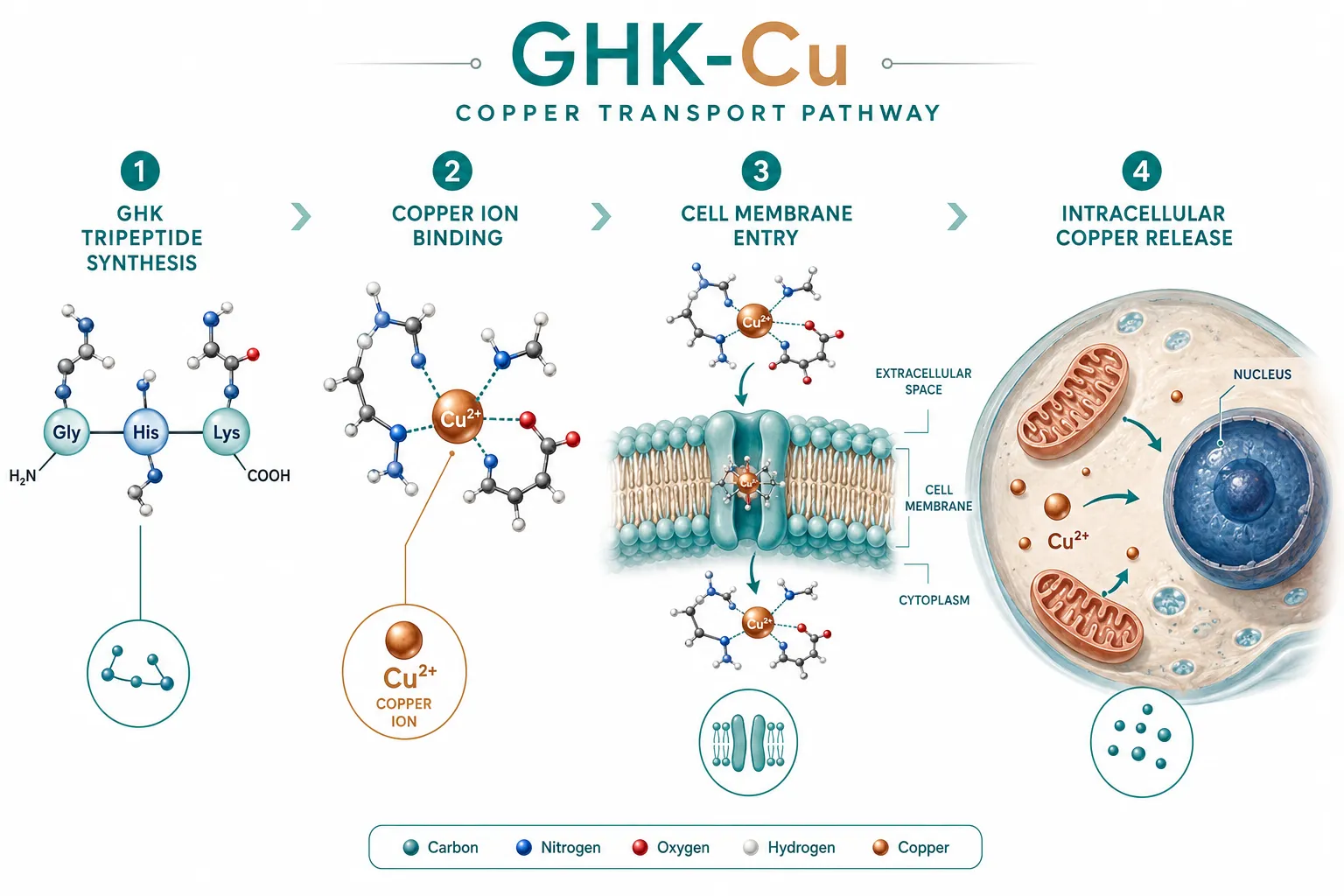
Copper is essential for dozens of enzymatic reactions, yet free copper ions are toxic. The body solves this problem with copper chaperones, proteins and peptides that bind copper and deliver it safely to target sites. GHK-Cu is among the most efficient of these chaperones. The tripeptide sequence glycine-histidine-lysine forms a square-planar coordination complex with Cu(II), holding the ion in a stable but readily transferable configuration.

Once inside or adjacent to a cell, GHK-Cu activates several copper-dependent enzymes:

  • Lysyl oxidase, cross-links collagen and elastin fibers, strengthening connective tissue
  • Cytochrome c oxidase, supports mitochondrial energy production
  • Superoxide dismutase (SOD), neutralizes free radicals, reducing oxidative stress
  • Ceruloplasmin, regulates iron metabolism and antioxidant defense

Beyond direct enzyme activation, GHK-Cu modulates gene expression. Studies using microarray analysis have shown it influences over 4,000 human genes, upregulating repair pathways and downregulating inflammation and cancer-related genes. This broad genomic reach explains why researchers studying hormone research compounds and cellular signaling have increasingly included GHK-Cu in comparative peptide frameworks.

The peptide also stimulates nerve growth factor (NGF) and brain-derived neurotrophic factor (BDNF), adding a neurological dimension to its profile that is still being mapped in 2026 research programs.

GHK-Cu Peptide in Wound Healing and Tissue Regeneration
GHK-Cu Peptide in Wound Healing and Tissue Regeneration

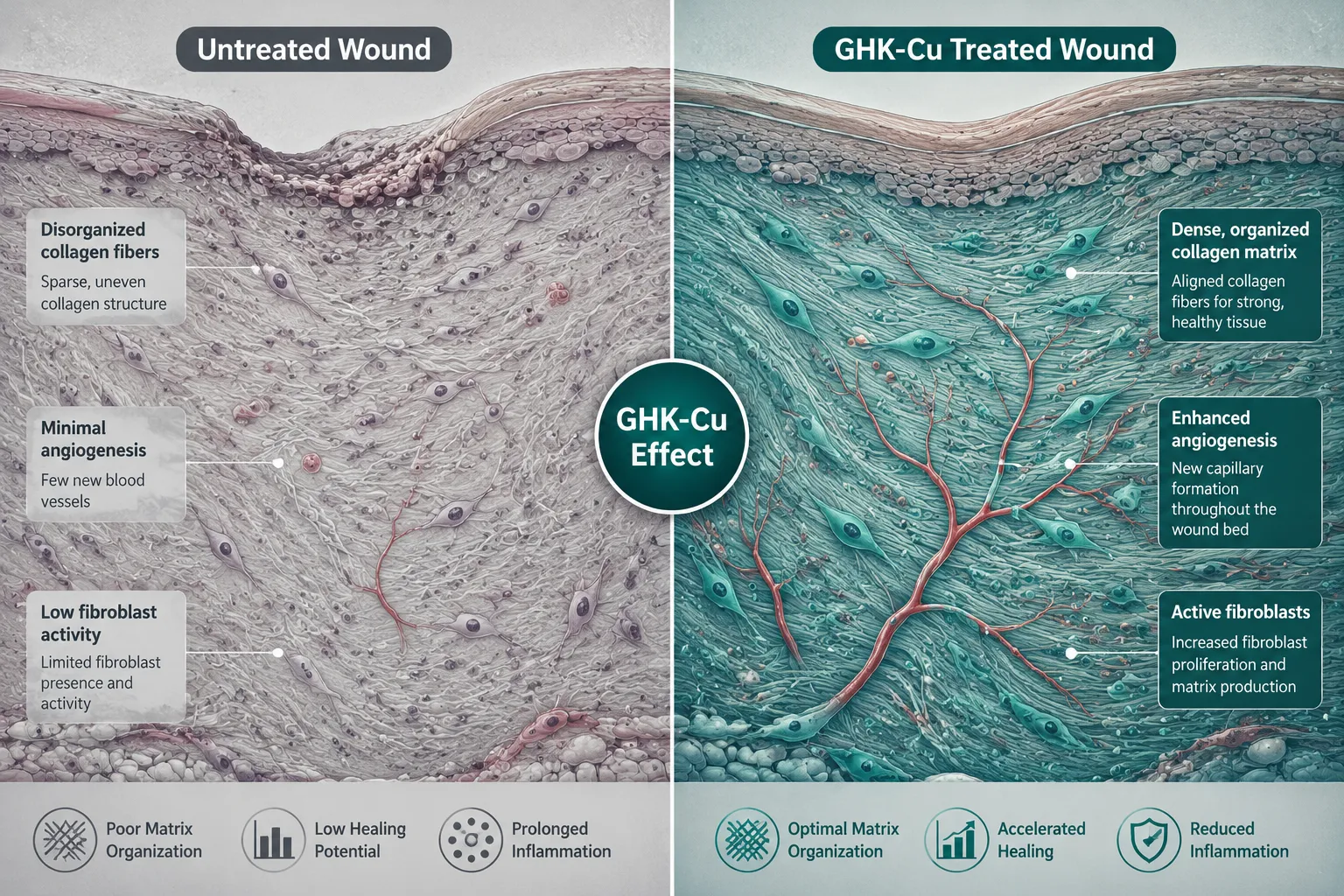
The wound-healing evidence for GHK-Cu is among the most robust in peptide research. Preclinical models consistently show three key effects:

Biological Effect Mechanism
Accelerated wound closure Fibroblast migration and proliferation
Collagen synthesis Upregulation of collagen I and III genes
Angiogenesis VEGF pathway activation
Anti-inflammatory action Downregulation of TNF-alpha and IL-6

In animal models, topical GHK-Cu reduced wound closure time by 30-40% compared to controls. Importantly, the collagen deposited was well-organized rather than scar-like, suggesting the peptide guides quality tissue repair rather than simply accelerating it.

Human data has lagged behind preclinical findings, a common challenge in peptide translation. However, a 2026 acute-wound trial examining post-surgical incision sites found statistically significant improvements in wound tensile strength and reduced inflammatory markers at day 14 in the GHK-Cu group versus placebo. This aligns with earlier smaller studies and strengthens the translational case.

For researchers tracking purity and traceability in wound-healing peptide studies, resources on peptide certificate of analysis standards are particularly relevant when sourcing GHK-Cu for controlled experiments. Similarly, understanding peptide measurement protocols is critical for dosing accuracy in tissue-repair research designs.

The peptide's role in nerve regeneration adds another layer. GHK-Cu has demonstrated the ability to stimulate axonal sprouting in peripheral nerve injury models, a finding that opens potential applications beyond dermal wound care.

Anti-Aging Research: Skin, Collagen, and Beyond
Anti-Aging Research: Skin, Collagen, and Beyond

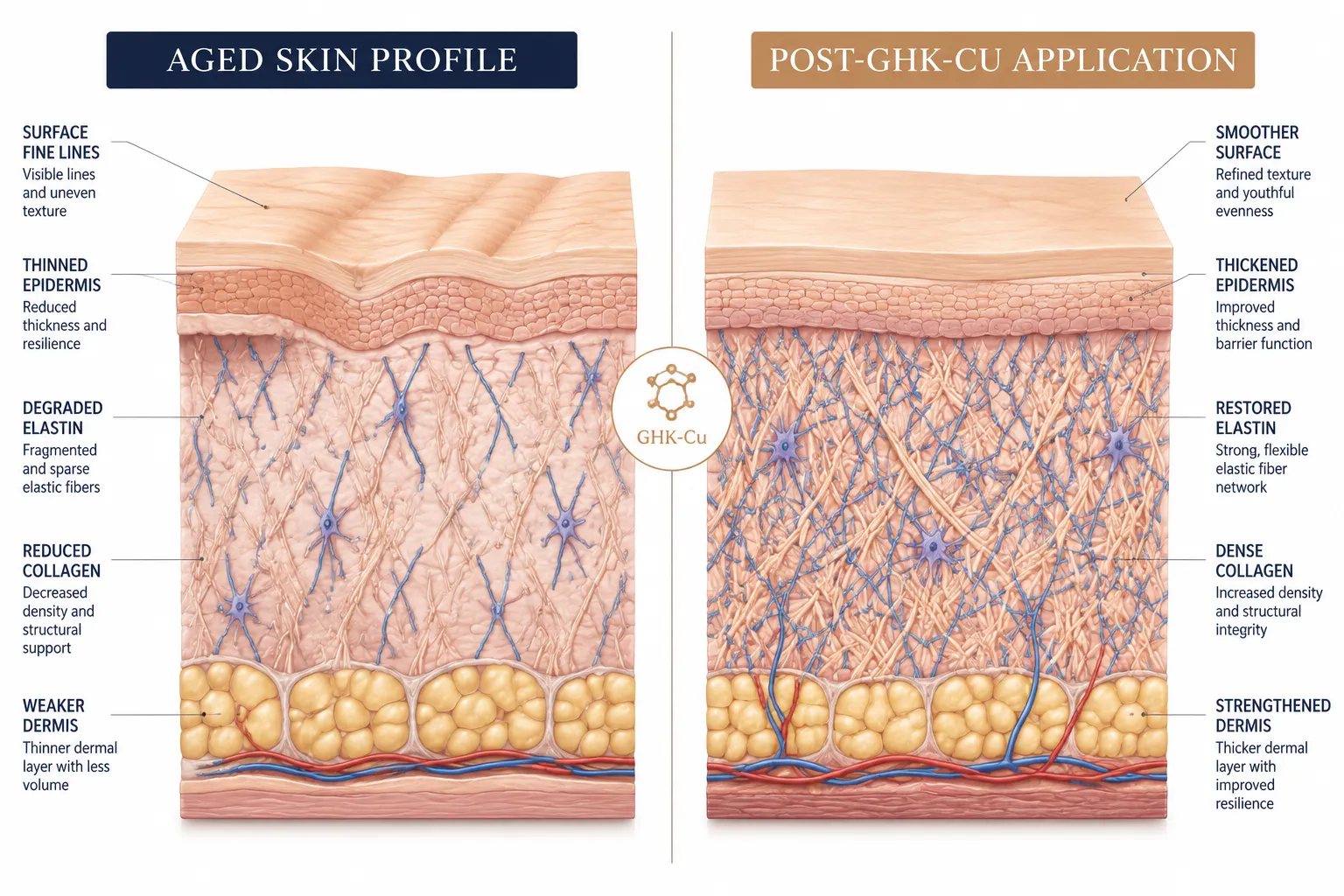
The anti-aging dimension of GHK-Cu Peptide: Its Role in Copper Transport, Wound Healing, and Anti-Aging Research is where commercial interest and scientific inquiry most visibly intersect. Plasma GHK levels fall from roughly 200 ng/mL in young adults to under 80 ng/mL after age 60. This decline correlates with reduced skin thickness, slower wound repair, and decreased collagen density, all hallmarks of biological aging.

Multiple small randomized controlled trials conducted between 2018 and 2024 have examined topical GHK-Cu in aging skin:

  • Skin thickness: Increases of 8-15% measured by ultrasound after 12 weeks
  • Wrinkle depth: Reductions of 15-30% in periorbital and forehead regions
  • Skin elasticity: Measurable improvements in cutometer readings
  • Hyperpigmentation: Modest reduction in melanin index scores

A 2026 updated systematic review consolidating these trials noted consistent directional benefits, though effect sizes varied with formulation and delivery method.

Formulation remains a key challenge. GHK-Cu has poor skin penetration in standard aqueous solutions due to its hydrophilic nature and molecular charge. Researchers in 2026 are actively testing:

  • Nanoparticle encapsulation (lipid nanoparticles, polymeric carriers)
  • Microneedle patch delivery
  • Peptide-lipid conjugates for enhanced transdermal flux

These advances are expected to significantly improve bioavailability in topical applications, potentially closing the gap between preclinical efficacy and real-world outcomes.

For researchers comparing GHK-Cu to other regenerative peptides, reviewing work on SS-31 mitochondrial research themes provides useful context, as both peptides target oxidative stress pathways through distinct mechanisms. Likewise, those exploring broader peptide stacks may find the IPA Sermorelin stack research overview informative for understanding how regenerative peptides are combined in research protocols.

Regulatory and safety status as of 2026: Topical GHK-Cu is widely available in cosmetic formulations and carries a strong safety record with no significant adverse events reported in clinical literature. Injectable GHK-Cu remains strictly within research settings and is not approved for human therapeutic use by the FDA or EMA. Researchers sourcing compounds should consult resources on building robust peptide benchmarks to ensure reference-grade material for valid experimental outcomes.

Conclusion

The science behind GHK-Cu Peptide: Its Role in Copper Transport, Wound Healing, and Anti-Aging Research has moved well beyond early promise. Its copper-chaperoning function, broad genomic influence, and consistent tissue-repair outcomes make it one of the most mechanistically interesting peptides in current research.

Actionable next steps for researchers and practitioners:

  1. Prioritize formulation quality. Verify purity via certificate of analysis and use validated measurement protocols before designing any experiment.
  2. Match delivery method to research goal. Topical nanoparticle formulations are advancing rapidly; select the delivery system appropriate for the tissue target.
  3. Monitor the 2026 clinical pipeline. The acute-wound trial data and updated systematic reviews provide a stronger evidence base for designing human-relevant study protocols.
  4. Compare mechanisms across peptide classes. Contextualizing GHK-Cu alongside mitochondria-targeting and growth-hormone-related peptides sharpens experimental design.
  5. Respect regulatory boundaries. Confine injectable use to approved research contexts and stay current with evolving guidance from regulatory bodies.

GHK-Cu is not a finished story. The 2026 research landscape suggests that improved delivery technology and larger clinical trials will define the next chapter, and the foundational science already in place makes that chapter worth watching closely.

https://www.puretestedpeptides.com/wp-content/uploads/2026/08/ghk-cu-peptide-its-role-in-copper-transport-wound-healing-and-anti-aging-researc.webp 1024 1536 https://www.puretestedpeptides.com/wp-content/uploads/2026/01/buy-peptides-online.jpg 2026-08-24 13:04:162026-08-24 13:04:16GHK-Cu Peptide: Its Role in Copper Transport, Wound Healing, and Anti-Aging Research
×

Helpful Links

  • My account
  • Cart
  • Checkout
  • Refund and Returns Policy
  • Privacy Policy
  • SMS Privacy Policy
  • Login
  • My Account
  • Logout

USA Made Lab Tested Peptides

All products are sold for research, laboratory, or analytical purposes only, and are not for human consumption


Pure Tested Peptides is a chemical supplier. Pure Tested Peptides is not a compounding / chemical compounding facility as defined under 503A of the Federal Food, Drug, and Cosmetic act. Pure Tested Peptides is not an outsourcing facility as defined under 503B of the Federal Food, Drug, and Cosmetic act.

The statements made within this website have not been evaluated by the US Food and Drug Administration. The products we offer are not intended to diagnose, treat, cure or prevent any disease.

Human/Animal Consumption Prohibited. Laboratory/In-Vitro Experimental Use Only

Scroll to top Scroll to top Scroll to top