Call or Text 727-513-9780
  • Shopping Cart Shopping Cart
    0Shopping Cart
Pure Tested Peptides | America's most trusted Peptides for sale online
  • Peptides for sale
    • Oral Peptides for sale
      • Peptide Capsules for sale
      • BPC 157 Capsules 1000mcg
      • SLU-PP-332 Capsules | 1000 mcg
      • 5-Amino-1MQ 50mg Capsules
      • Tesofensine 500mcg
    • All Peptides for sale
    • Peptide Sprays
      • BPC 157 Nasal Spray Kit
      • BPC-157 TB500 Nasal Spray Kit
      • Semax Nasal Spray 10mg
      • Selank – Nasal Spray Kit – 10mg
      • Epithalon 50MG Nasal Spray Kit
      • Ipamorelin 10mg Nasal Spray
      • Klow Nasal Spray (BPC-157 + TB-500 + GHK-Cu + KPV) | 80mg
      • Hulk Nasal Spray Tesa / Ipa Blend 6/3 MG
      • Klow Nasal Spray
      • NAD + 500 mg Nasal Spray
      • PT-141 Nasal Spray Kit
    • GHRH Peptides
      • Ipa Peptides
      • CJC-1295 Peptides
        • CJC-1295 with DAC 5 mg
        • CJC-1295 without DAC 5 mg
        • CJC-1295 Ipa 10mg
      • Tesa Peptides
        • Tesa Peptide
        • Tesa 20 mg
    • GHK-Cu Peptides
      • All GHK-Cu Peptides
      • GHK-Cu 100mg
      • KLOW Peptide Blend – Buy KLOW blend online
    • BPC Peptides
      • All BPC Peptides
      • BPC-157
      • BPC-157 TB-500
      • BPC 157 capsules 1000mcg
    • SLU-PP-332 Peptides
      • All SLU-PP-332 Peptides
      • SLU-PP-332 5mg
    • GLP3 Peptides
      • GLP3-R
      • GLP3-R CAG 10mg
      • GLP3-R 20mg
    • PT-141 Peptides
      • PT-141 Peptides for sale
      • PT-141 10mg
      • PT-141 Nasal Spray
    • CAG Peptides
      • Lipo-C Peptide Blend
      • CAG 5mg
      • CAG 10mg
    • MOTS-C Peptides
      • MOTS-C Peptides for sale
      • MOTS-c peptide
      • MOTS-c 10mg *6 pack*
    • 5 Amino 1MQ Peptides
      • 5 Amino 1MQ Peptides for sale
      • 5-Amino-1MQ 50mg Capsules
      • 5-Amino-1MQ 5mg
    • Epithalon Peptides
      • Epithalon Peptides for sale
      • Epithalon 10mg
      • Epithalon 50mg
  • Shop
    • GLPs
      • 5-Amino-1MQ 50mg Capsules
      • 5-Amino-1MQ 5mg
      • GLP3-Reta
      • L-Carnitine 500mg/ml
      • Tesofensine 500mcg
      • SLU-PP-332 5mg
      • MOTS-c 10mg *6 pack*
    • Epithalon & BPC Peptides
      • Epithalon 10mg
      • Epithalon 50mg
      • BPC-157
      • BPC 157 capsules 1000mcg
      • BPC-157 TB-500
      • BPC-157 TB500 Nasal Spray Kit
      • BPC 157 Nasal Spray Kit
    • BPC TB-500 & NAD+ Peptides
      • NAD+ 500 mg
      • KLOW Peptide Blend – Buy KLOW blend online
      • GLOW Peptide Blend
      • TB 500 5mg
      • BPC 157 capsules 1000mcg – Supplement
      • BPC 157 Nasal Spray Kit
      • BPC-157
      • BPC-157 TB500 Nasal Spray Kit
      • BPC-157 TB-500
      • BPC 157 capsules 1000mcg
    • LL-37 Peptide
      • LL-37 10 mg
    • MOTS-C & Selank
      • MOTS-c peptide
      • Selank 10mg
    • GHK Peptides
      • GHK-Cu 100mg
      • GLOW Peptide Blend
      • KLOW Peptide Blend – Buy KLOW blend online
  • COAs
  • Wholesale
    • Wholesale Peptides for sale
  • PTP FAQ
  • Affiliates
    • Selank Peptide: Advanced Pharmacological Mechanisms Underlying Its Anxiolytic and Nootropic Effects in Research
      • 5-Amino-1MQ Peptide: Detailed Mechanisms of NNMT Inhibition and Its Impact on Cellular Metabolism Research
        • MOTS-C Peptide: Unraveling Its Role in Mitochondrial Dynamics and Energy Metabolism Research
          • Epithalon Peptide and Telomerase Regulation: Investigating Its Impact on Cellular Senescence and Lifespan Research Models
            • GLP2-T vs GLP2 Tirz Peptide: Understanding the Naming, Mechanistic Nuances, and Research Implications for Gut Health
      • Peptides and Polypeptides in Modern Pharmacology: What Research on Metoprolol, Prednisone, and Amlodipine Reveals
        • Polypeptide Peptides vs NSAIDs: What Naproxen and Diclofenac Teach Tissue-Repair Researchers About BPC‑157 and TB‑500
          • Peptides and Polypeptides in Endocrine Pharmacology: How GLP-1, GLP-2, and GLP-3 Retatrutide Differ From Classic Drugs Like Prednisone and Amlodipine
          • 5‑Amino‑1MQ Peptide and NNMT Inhibition: How It Compares With Statins Like Atorvastatin in Adipose and Lipid Metabolism Research
      • Enclomiphene, Estrogen Receptor Signaling, and Luteinizing Phase Biology: What Hormone Researchers Should Measure
        • Mesenchymal Stem Cells, BPC‑157, and GHK‑Cu: How Tissue Repair Peptides Compare With Classic NSAIDs Like Naproxen in Injury Models
          • Peptide Calculator Use Cases Beyond Growth Hormone: Working Through GLP‑3 Retatrutide, MOTS‑c, and BPC‑157 Research Dosing
        • Polypeptide Peptides in Endocrine and Metabolic Pharmacology: Lessons From Amlodipine, Prednisone, and Metoprolol
        • Peptides Calculator for Advanced Blends: Worked Examples for Tesamorelin, CJC‑1295, and Ipamorelin Stacks
          • Peptides and Polypeptides in Human Physiology: How Molecular Size Shapes Research Applications
            • Selank Peptide: Advanced Pharmacological Mechanisms Underlying Its Anxiolytic and Nootropic Effects in Research
          • 5-Amino-1MQ Peptide: Detailed Mechanisms of NNMT Inhibition and Its Impact on Cellular Metabolism Research
            • MOTS-C Peptide: Unraveling Its Role in Mitochondrial Dynamics and Energy Metabolism Research
              • Epithalon Peptide and Telomerase Regulation: Investigating Its Impact on Cellular Senescence and Lifespan Research Models
                • GLP2-T vs GLP2 Tirz Peptide: Understanding the Naming, Mechanistic Nuances, and Research Implications for Gut Health
                  • Peptides and Polypeptides in Endocrine Pharmacology: How GLP-1, GLP-2, and GLP-3 Retatrutide Differ From Classic Drugs Like Prednisone and Amlodipine
                    • Polypeptide Peptides vs NSAIDs: What Naproxen and Diclofenac Teach Tissue-Repair Researchers About BPC‑157 and TB‑500
                      • Peptides and Polypeptides in Modern Pharmacology: What Research on Metoprolol, Prednisone, and Amlodipine Reveals
                        • 5‑Amino‑1MQ Peptide and NNMT Inhibition: How It Compares With Statins Like Atorvastatin in Adipose and Lipid Metabolism Research
                        • Enclomiphene, Estrogen Receptor Signaling, and Luteinizing Phase Biology: What Hormone Researchers Should Measure
                        • Mesenchymal Stem Cells, BPC‑157, and GHK‑Cu: How Tissue Repair Peptides Compare With Classic NSAIDs Like Naproxen in Injury Models
                        • Peptide Calculator Use Cases Beyond Growth Hormone: Working Through GLP‑3 Retatrutide, MOTS‑c, and BPC‑157 Research Dosing
                        • Polypeptide Peptides in Endocrine and Metabolic Pharmacology: Lessons From Amlodipine, Prednisone, and Metoprolol
                        • Peptides Calculator for Advanced Blends: Worked Examples for Tesamorelin, CJC‑1295, and Ipamorelin Stacks
                        • Peptides and Polypeptides in Human Physiology: How Molecular Size Shapes Research Applications
                        • Selank Peptide: Advanced Pharmacological Mechanisms Underlying Its Anxiolytic and Nootropic Effects in Research
                        • MOTS-C Peptide: Unraveling Its Role in Mitochondrial Dynamics and Energy Metabolism Research
                        • Peptides and Polypeptides in Modern Pharmacology: What Research on Metoprolol, Prednisone, and Amlodipine Reveals
                        • Peptides and Polypeptides in Endocrine Pharmacology: How GLP-1, GLP-2, and GLP-3 Retatrutide Differ From Classic Drugs Like Prednisone and Amlodipine
                        • 5-Amino-1MQ Peptide: Detailed Mechanisms of NNMT Inhibition and Its Impact on Cellular Metabolism Research
                        • Mesenchymal Stem Cells, BPC‑157, and GHK‑Cu: How Tissue Repair Peptides Compare With Classic NSAIDs Like Naproxen in Injury Models
                        • Peptide Calculator Use Cases Beyond Growth Hormone: Working Through GLP‑3 Retatrutide, MOTS‑c, and BPC‑157 Research Dosing
                        • GLP2-T vs GLP2 Tirz Peptide: Understanding the Naming, Mechanistic Nuances, and Research Implications for Gut Health
                        • Polypeptide Peptides in Endocrine and Metabolic Pharmacology: Lessons From Amlodipine, Prednisone, and Metoprolol
                        • Polypeptide Peptides vs NSAIDs: What Naproxen and Diclofenac Teach Tissue-Repair Researchers About BPC‑157 and TB‑500
                        • Peptides and Polypeptides in Human Physiology: How Molecular Size Shapes Research Applications
                        • Peptides Calculator for Advanced Blends: Worked Examples for Tesamorelin, CJC‑1295, and Ipamorelin Stacks
                        • 5‑Amino‑1MQ Peptide and NNMT Inhibition: How It Compares With Statins Like Atorvastatin in Adipose and Lipid Metabolism Research
                        • Enclomiphene, Estrogen Receptor Signaling, and Luteinizing Phase Biology: What Hormone Researchers Should Measure
                        • Epithalon Peptide and Telomerase Regulation: Investigating Its Impact on Cellular Senescence and Lifespan Research Models
                        • Best research protocol Klow blend
                        • best time to take BPC-157
                        • best time to take DSIP (Delta Sleep Inducing Peptide)
                        • best time to take CJC-1295
                        • best time to take AOD-9604
                        • best time to take Follistatin 344
                        • best time to take Ipamorelin
                        • best time to take MK-677 (Ibutamoren)
                        • best time to take Ligandrol (LGD-4033) — research compound
                        • best time to take Ostarine (MK-2866) — research compound
                        • best time to take GHK-CU
                        • best time to take TB-500
                        • best time to take MOTS-c
                        • best time to take Semax
                        • best time to take RAD-140 (Testolone) — research compound
                        • best time to take Thymosin Alpha-1
                        • best time to take PEG-MGF
                        • Biolife Plasma, Octapharma Plasma, and Research Peptides: How Plasma Donation Labs Differ From Peptide Suppliers
                        • best time to take YK-11 — research compound
                        • best time to take PT-141 (Bremelanotide)
                        • Best research protocol Klow blend
  • Contact
    • Contact Customer Service
    • Text Customer Support
  • About US
  • Shop all peptides
  • Affiliate Program
    • Affiliate Signup
  • Login / Register Login / Register Page Link Login / Register Page Link
  • Click to open the search input field Click to open the search input field Search
  • Menu Menu

Tag Archive for: wound repair peptides

GHK-Cu Peptide: Collagen Synthesis, Wound Repair, and Skin-Barrier Research Models

GHK-Cu Peptide: Collagen Synthesis, Wound Repair, and Skin-Barrier Research Models

July 26, 2026/0 Comments/in Uncategorized/by

Copper is essential to nearly every stage of connective tissue repair, and a tripeptide discovered in human plasma decades ago turns out to be one of the most efficient carriers of copper into that process. Research into GHK-Cu Peptide: Collagen Synthesis, Wound Repair, and Skin-Barrier Research Models has expanded steadily since the compound was first isolated, revealing a mechanistic profile that makes it a compelling subject for extracellular matrix (ECM) and dermal regeneration studies.

Key Takeaways

  • GHK-Cu is a naturally occurring tripeptide-copper complex that upregulates collagen and ECM gene expression in preclinical models.
  • Preclinical wound studies show accelerated closure, increased connective tissue accumulation, and improved tensile strength at injury sites.
  • Dimeric GHK hydrogel formulations improve copper coordination stability and represent an active area of delivery research.
  • Human clinical evidence remains limited; one older diabetic ulcer trial showed positive signals, but large randomized controlled trials are absent.
  • Researchers sourcing peptides for lab work should prioritize lab-tested peptides with verified purity documentation.
Key Takeaways

Mechanistic Profile: How GHK-Cu Drives Collagen Synthesis and ECM Remodeling

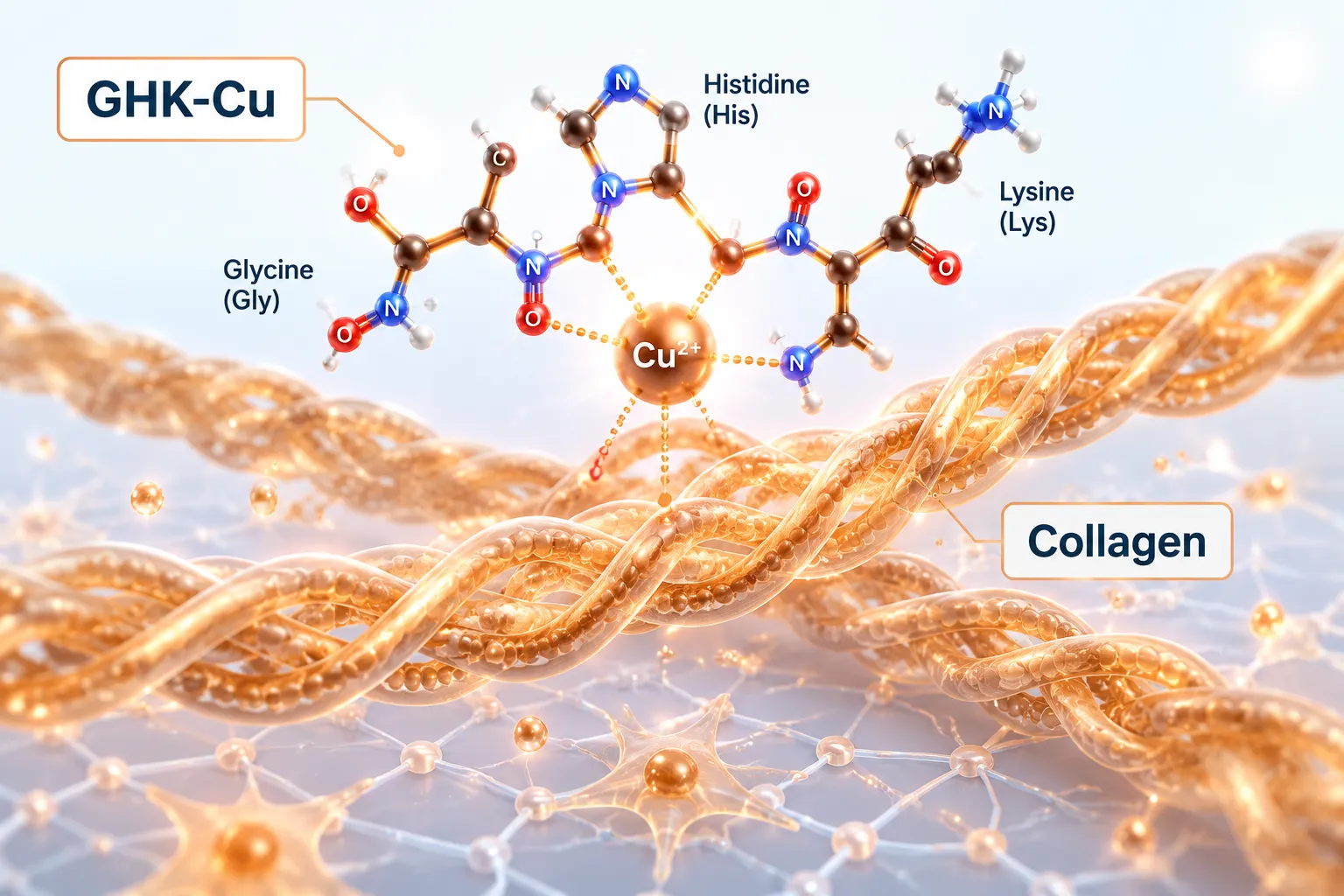
The tripeptide glycyl-L-histidyl-L-lysine (GHK) was first identified in human albumin fractions. When complexed with a copper (II) ion, it becomes GHK-Cu, a bioactive compound with a well-documented ability to modulate gene expression in fibroblasts and keratinocytes.

Collagen Gene Upregulation

At the molecular level, GHK-Cu activates transcription factors that drive production of:

  • Collagen types I and III, the primary structural proteins of dermal ECM
  • Elastin, responsible for skin elasticity and recoil
  • Fibronectin, a glycoprotein critical for cell adhesion and migration during wound repair
  • Decorin and versican, proteoglycans that organize collagen fibril architecture

This upregulation is not simply additive. Research in fibroblast culture models shows GHK-Cu simultaneously suppresses matrix metalloproteinases (MMPs), enzymes that degrade collagen, while increasing tissue inhibitors of metalloproteinases (TIMPs). The net result is a shift in ECM balance toward synthesis and deposition rather than breakdown.

Copper Coordination and Antioxidant Activity

The copper ion in GHK-Cu is not passive. It participates directly in lysyl oxidase activation, the enzyme responsible for cross-linking collagen and elastin fibers into mechanically stable structures. Additionally, the complex modulates superoxide dismutase activity, reducing oxidative stress at wound sites, a factor that often delays healing in chronic injury models.

"The dual role of GHK-Cu as both a gene-expression modulator and a copper delivery vehicle makes it mechanistically distinct from most synthetic wound-repair compounds under investigation."

Researchers exploring related peptides with mitochondrial or tissue-repair orientations may find useful context in studies on BPC-157 and TB-500 peptides, which target overlapping regenerative pathways through different mechanisms.
Copper Coordination and Antioxidant Activity

Preclinical Wound Repair and Skin-Barrier Research Models

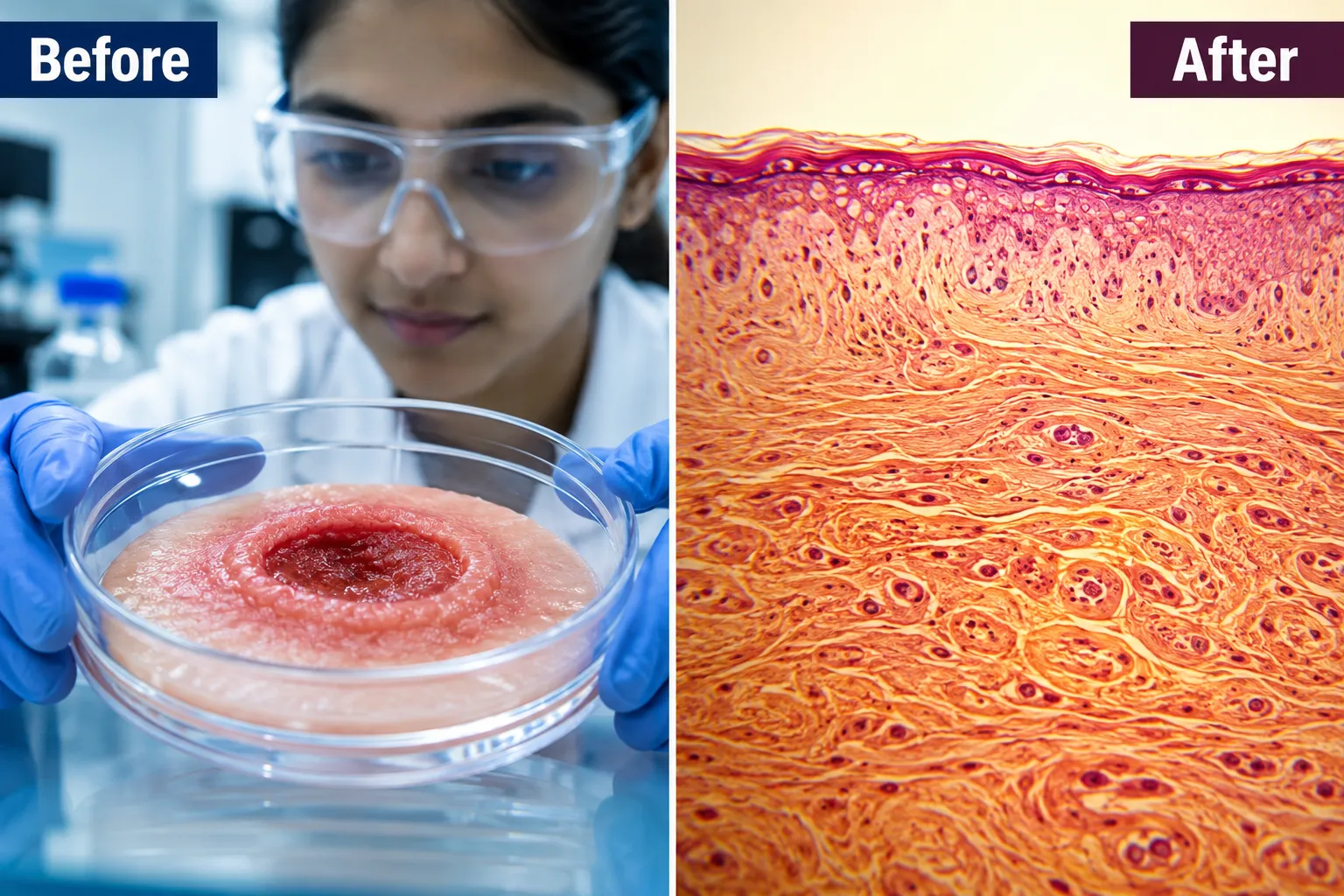
The bulk of controlled evidence for GHK-Cu Peptide: Collagen Synthesis, Wound Repair, and Skin-Barrier Research Models comes from animal studies using standardized dermal injury protocols.

In Vivo Wound Closure Data

In rodent excisional and incisional wound models, topical or injected GHK-Cu consistently produces:

Endpoint Observed Effect in Preclinical Models
Wound closure rate Accelerated re-epithelialization vs. vehicle control
Collagen content Increased hydroxyproline levels in wound tissue
Tensile strength Higher breaking strength at healed incision sites
Inflammatory markers Reduced pro-inflammatory cytokine expression
Angiogenesis Increased capillary density in granulation tissue

These findings hold across multiple species and wound types, strengthening the translational argument for further study.

Dimeric GHK Hydrogel Dressings

A more recent research direction involves dimeric GHK constructs embedded in hydrogel matrices. Standard GHK-Cu can dissociate in aqueous environments, releasing copper prematurely. Dimeric formulations improve copper coordination stability, extend release kinetics, and maintain bioactivity over longer application windows, a meaningful advantage for chronic wound models where sustained signaling is needed.

Skin-Barrier Endpoints

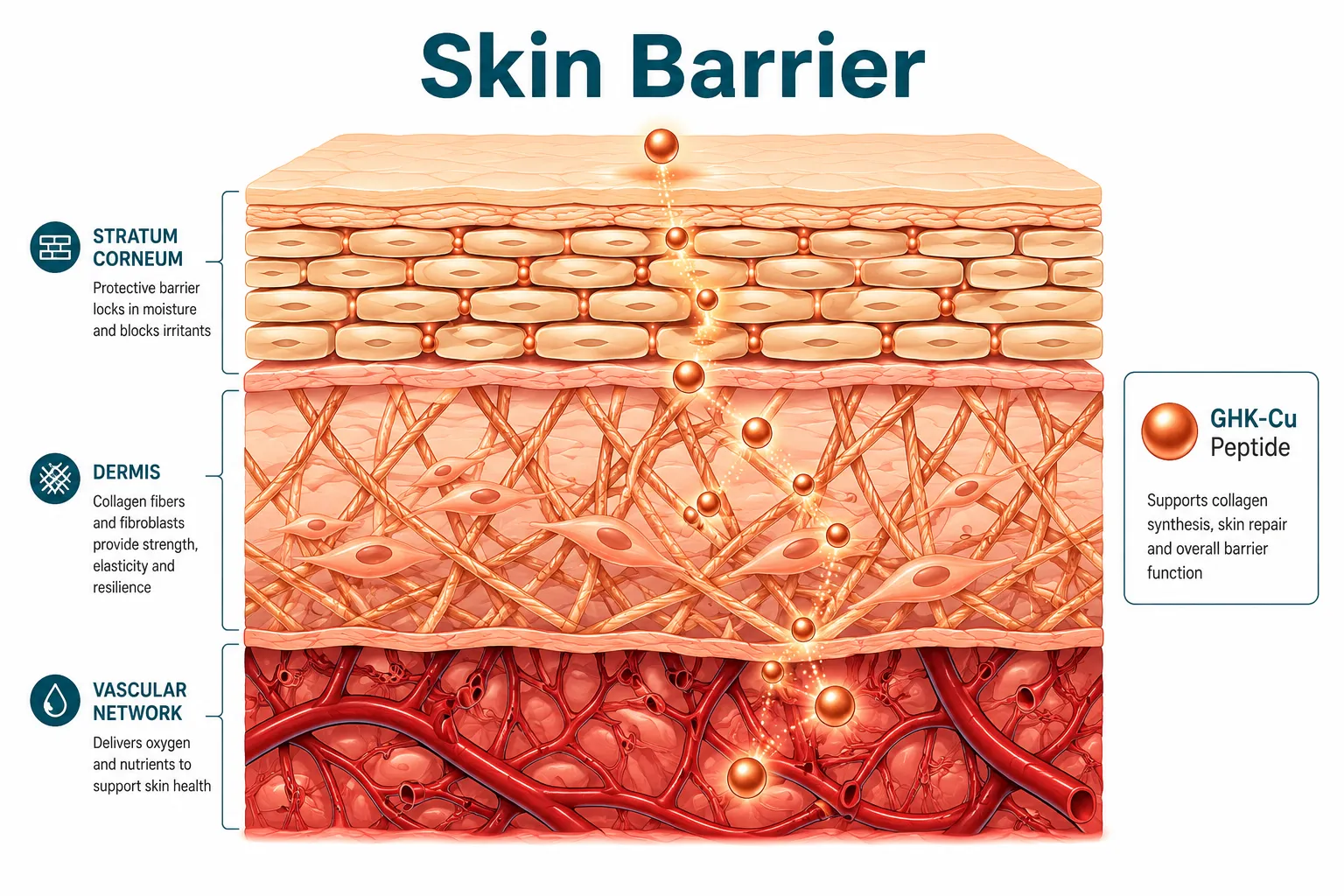
Beyond wound closure, GHK-Cu research models have examined barrier function. Studies using transepidermal water loss (TEWL) measurements and tight-junction protein expression show that GHK-Cu supports keratinocyte differentiation and barrier competence. This positions the compound as relevant not only for acute wound research but also for models of impaired barrier function such as atopic dermatitis and aged skin.

Researchers working with other regenerative compounds may also want to review TB-500 benefits and research considerations for comparative context on tissue repair peptides.
Skin-Barrier Endpoints

Human Clinical Evidence and Research Gaps

What the Clinical Record Shows

Human data for GHK-Cu Peptide: Collagen Synthesis, Wound Repair, and Skin-Barrier Research Models is sparse but not absent. One controlled trial in diabetic patients with chronic lower-leg ulcers reported significantly improved wound closure rates compared to standard care. The study used a topical GHK-Cu formulation and tracked outcomes over several weeks, with histological confirmation of increased collagen deposition.

However, this trial is older, relatively small, and has not been replicated in a large modern randomized controlled trial (RCT). The absence of Phase II or Phase III human data means the compound remains firmly in the research domain.

Key Research Gaps in 2026

  • No large-scale RCTs in non-diabetic wound populations
  • Limited pharmacokinetic data on systemic absorption from topical models
  • Insufficient comparative data against standard-of-care wound treatments
  • Minimal data on optimal dosing windows and concentration thresholds

Researchers designing new protocols should consult resources on research-only peptides to understand sourcing standards and documentation requirements before initiating studies.

For those building broader peptide research panels, reviewing compounds like Epithalon and Motsc peptide may provide useful mechanistic comparisons in aging and cellular repair models.

Conclusion

GHK-Cu occupies a well-defined and mechanistically credible position in ECM remodeling and wound-repair research. Its ability to upregulate collagen gene expression, suppress MMPs, activate lysyl oxidase, and support skin-barrier integrity gives it a multifactorial profile that few single compounds match. Preclinical evidence across multiple wound models is consistent and reproducible. The primary gap is human clinical scale, a gap that makes rigorous, well-documented preclinical work all the more important right now.

Actionable next steps for researchers:

  1. Prioritize purity-verified, third-party tested GHK-Cu from documented suppliers, explore peptide stores with verified sourcing before procurement.
  2. Design wound models that include both collagen quantification (hydroxyproline assay) and barrier function endpoints (TEWL, tight-junction markers) to capture the full mechanistic range.
  3. Consider dimeric hydrogel delivery formats for chronic wound models where sustained copper release is a variable.
  4. Document all experimental parameters thoroughly to support future translational work as clinical interest in this compound grows.
https://www.puretestedpeptides.com/wp-content/uploads/2026/07/ghk-cu-peptide-collagen-synthesis-wound-repair-and-skin-barrier-research-models.webp 1024 1536 https://www.puretestedpeptides.com/wp-content/uploads/2026/01/buy-peptides-online.jpg 2026-07-26 13:05:072026-07-26 13:05:07GHK-Cu Peptide: Collagen Synthesis, Wound Repair, and Skin-Barrier Research Models
×

Helpful Links

  • My account
  • Cart
  • Checkout
  • Refund and Returns Policy
  • Privacy Policy
  • SMS Privacy Policy
  • Login
  • My Account
  • Logout

USA Made Lab Tested Peptides

All products are sold for research, laboratory, or analytical purposes only, and are not for human consumption


Pure Tested Peptides is a chemical supplier. Pure Tested Peptides is not a compounding / chemical compounding facility as defined under 503A of the Federal Food, Drug, and Cosmetic act. Pure Tested Peptides is not an outsourcing facility as defined under 503B of the Federal Food, Drug, and Cosmetic act.

The statements made within this website have not been evaluated by the US Food and Drug Administration. The products we offer are not intended to diagnose, treat, cure or prevent any disease.

Human/Animal Consumption Prohibited. Laboratory/In-Vitro Experimental Use Only

Scroll to top Scroll to top Scroll to top