

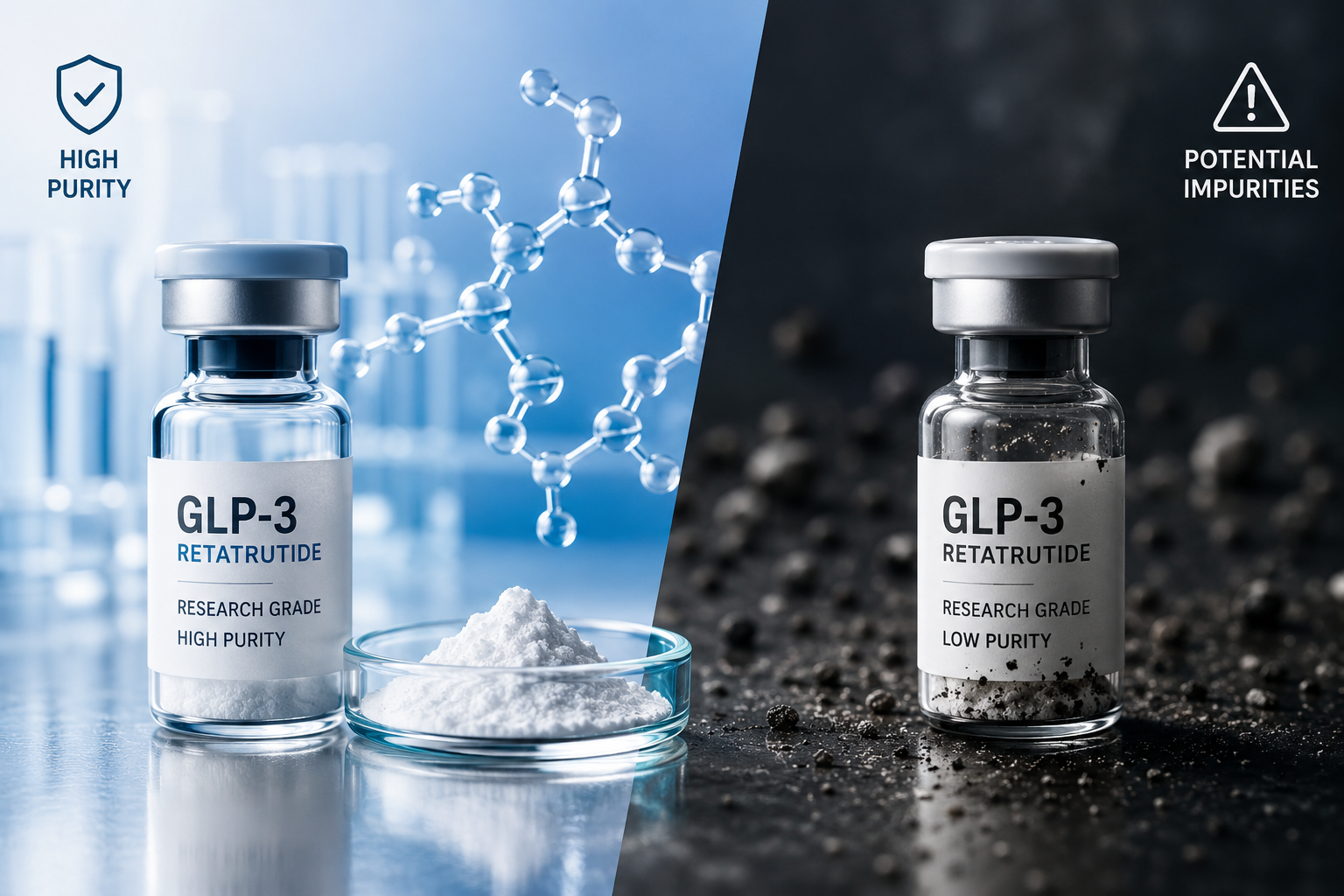
Fewer than 30% of research failures involving synthetic peptides are traced back to protocol errors, the majority stem from compromised compound quality that was never detected before the experiment began. For researchers working with complex triple-agonist molecules, understanding peptide purity and impurities: a guide for research-grade GLP-3 Retatrutide is not optional reading. It is a prerequisite for generating data that holds up to scrutiny.
Key Takeaways
- Peptide purity directly affects experimental reproducibility and the validity of research outcomes.
- Common impurities in synthetic peptides include deletion sequences, oxidized residues, and residual solvents.
- A Certificate of Analysis (COA) is the primary tool for evaluating research-grade peptide quality.
- HPLC purity of 98% or greater is the accepted benchmark for reliable research-grade peptides.
- Proper storage and handling preserve purity after the vial leaves the manufacturer.

What Makes Peptide Purity Critical for GLP-3 Retatrutide Research
Retatrutide is a 39-amino-acid peptide that simultaneously targets GLP-1, GIP, and glucagon receptors. Its structural complexity makes it more susceptible to synthesis-related impurities than shorter, simpler peptides. Even minor contaminants can bind off-target receptors, alter dose-response curves, or trigger inflammatory artifacts in cell-based assays.
Researchers sourcing material for in vitro or preclinical work should treat purity as a primary variable, not an afterthought. For context on how reference standards and benchmarks are established across the peptide research field, the resource on Bachem and reference standards for peptide benchmarks provides a useful foundation.
The 98% Purity Threshold
The research community broadly accepts 98% HPLC purity as the minimum standard for peptides used in quantitative assays. Below this threshold:
- Impurities may represent 1 in 50 molecules in solution
- Biological activity measurements become unreliable
- Batch-to-batch reproducibility drops significantly
For a peptide as structurally demanding as Retatrutide, some researchers prefer 99%+ purity to reduce noise in receptor-binding studies.
Common Impurities Found in Synthetic Peptides
Understanding peptide purity and impurities in research-grade GLP-3 Retatrutide requires knowing exactly what contaminants to look for. Impurities in synthetic peptides fall into three main categories:
| Impurity Type | Origin | Risk to Research |
|---|---|---|
| Deletion sequences | Incomplete coupling during synthesis | Altered receptor binding |
| Oxidized residues | Methionine/tryptophan oxidation | Reduced biological activity |
| Residual solvents | Incomplete purification | Cytotoxicity in cell assays |
| Aggregates | Improper lyophilization | Inconsistent solubility |
| Acetylation artifacts | Capping reagent carryover | False activity signals |
Deletion sequences are the most common impurity. They arise when a single amino acid coupling step fails during solid-phase synthesis, producing a truncated chain that is one or more residues shorter than the target molecule.
Oxidized methionine is particularly relevant for Retatrutide because oxidation can occur during storage if the peptide is exposed to moisture or oxygen. This is one reason proper lyophilization and cold-chain storage matter as much as the synthesis itself.
Researchers working with other peptide classes such as AOD-9604 research methods and storage will recognize that these same impurity categories apply broadly across synthetic peptides.
How to Read a COA for Research-Grade GLP-3 Retatrutide
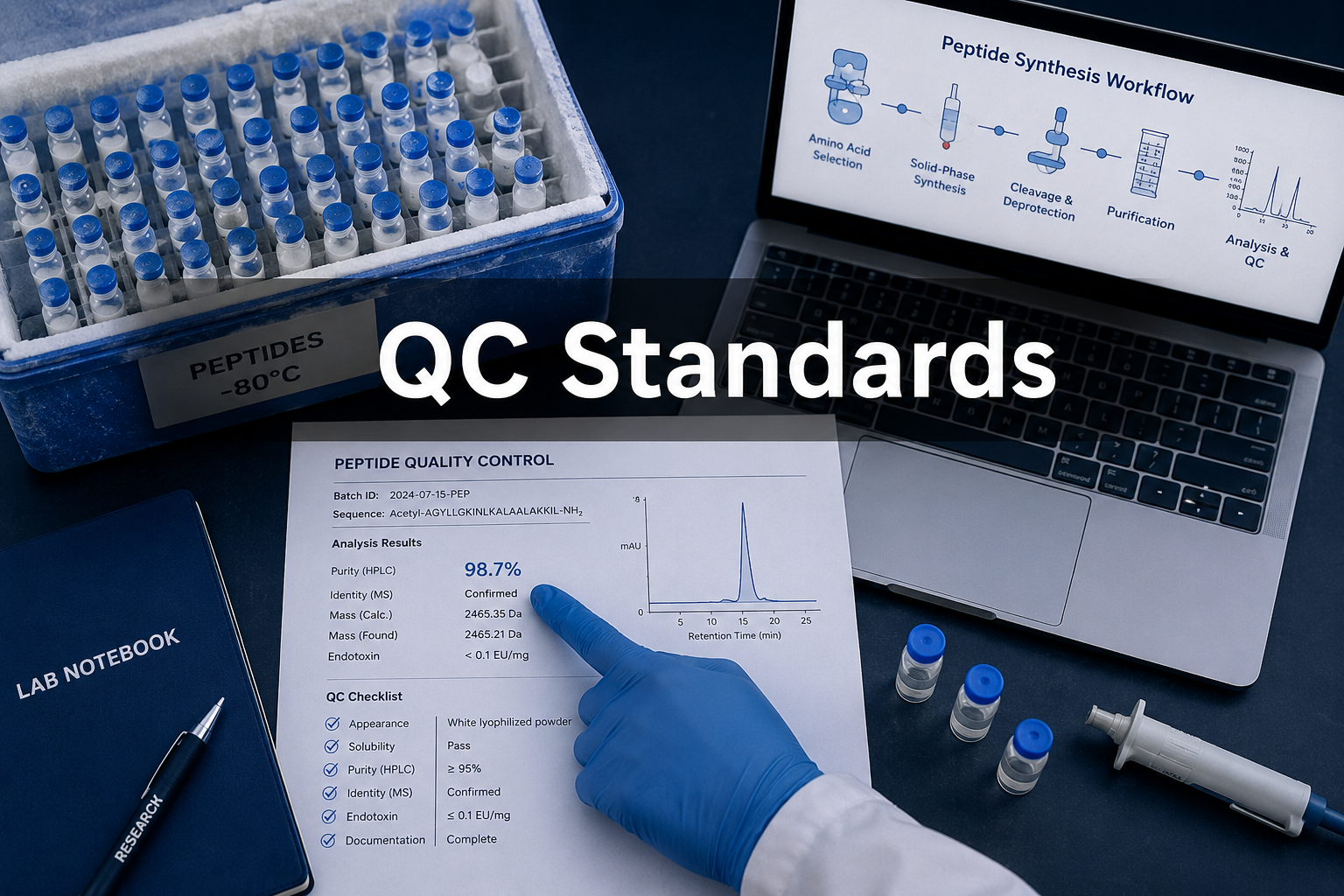
A Certificate of Analysis (COA) is the primary quality document for any research peptide. When evaluating a COA for Retatrutide, look for these specific data points:
- HPLC chromatogram, The main peak area percentage should be clearly stated and visually dominant. Request the raw chromatogram, not just a number.
- Mass spectrometry confirmation, The observed molecular weight should match the theoretical mass of Retatrutide (approximately 4,531 Da). This confirms the correct sequence was synthesized.
- Water content (Karl Fischer), Lyophilized peptides typically contain 5-12% water by weight. High water content reduces the effective peptide dose per milligram.
- Residual solvent testing, Confirms that acetonitrile and TFA from the purification process have been removed to safe levels.
- Lot-specific data, A legitimate COA is lot-specific, not a generic document reused across batches.
"A COA without a lot number is not a COA, it is a marketing document."
Researchers can review verified COA documentation standards to understand what a properly formatted quality document should contain.
For additional context on how purity standards apply to other research peptides, the GLP-1 Retatrutide product page and the Reta 10mg product tag offer relevant sourcing information.
Storage Conditions That Preserve Purity
Even a 99% pure peptide degrades rapidly under poor storage conditions. Follow these guidelines:
- Store lyophilized peptide at -20C or colder
- Avoid repeated freeze-thaw cycles (aliquot before first use)
- Reconstitute only the volume needed for immediate use
- Use sterile bacteriostatic water or DMSO as appropriate for the assay
These principles apply across the research peptide category. For example, the same cold-chain logic governs SS-31 peptide research considerations and other sensitive compounds.
Sourcing and Verification Best Practices
Understanding peptide purity and impurities in a guide for research-grade GLP-3 Retatrutide ultimately comes down to sourcing decisions. Researchers should apply the following checklist before committing to a supplier:
- Does the supplier provide lot-specific COAs with HPLC and MS data?
- Is the synthesis performed under GMP-aligned conditions?
- Are third-party analytical results available on request?
- Does the supplier use HPLC-grade solvents and validated purification columns?
Researchers planning multi-peptide protocols, such as those combining GLP-class compounds with growth hormone secretagogues, should also review resources like the IPA-Sermorelin stack research guide to understand how purity standards interact across compound combinations.
For those evaluating broader catalog options, the GLP-3 for sale research planning guide provides practical sourcing and planning context specific to triple-agonist peptides.
Conclusion
Peptide purity is not a background variable, it is a core experimental parameter. For researchers working with structurally complex molecules like Retatrutide, even a 2-3% impurity burden can introduce confounding signals that invalidate assay results. The actionable steps are clear: demand lot-specific COAs with both HPLC and mass spectrometry data, verify the molecular weight against the theoretical value, confirm proper storage conditions from synthesis through delivery, and aliquot immediately upon receipt to prevent degradation. Treating purity verification as a standard pre-experiment step, alongside buffer preparation and calibration, is what separates reproducible research from wasted resources.
Leave a Reply
Want to join the discussion?Feel free to contribute!