
Ideal Dose and Dosing for 5-Amino-1-MQ: A Comprehensive 2026 Guide

Finding the ideal dose and dosing for 5-amino-1-mq can feel overwhelming when navigating the emerging world of metabolic peptides. This small molecule has captured attention in research communities and among fitness enthusiasts seeking metabolic optimization, yet dosing protocols remain a topic of ongoing investigation. With emerging research data and anecdotal reports from researchers worldwide, understanding proper administration becomes crucial for anyone considering this compound for experimental purposes.
The compound 5-amino-1-methylquinolinium (5-amino-1-MQ) works by inhibiting the nicotinamide N-methyltransferase (NNMT) enzyme, which plays a significant role in cellular metabolism and energy regulation. As interest grows in 5-amino-1-mq peptide research, establishing evidence-based dosing guidelines becomes increasingly important for researchers, medi-spa professionals, and fitness enthusiasts exploring metabolic compounds.
Key Takeaways
- Standard research dosing for 5-amino-1-MQ typically ranges from 50-100mg daily, with some protocols extending to 200mg based on body weight and research objectives
- Administration routes include oral capsules, sublingual tablets, and injectable forms, each with different bioavailability profiles
- Timing protocols generally recommend split dosing (morning and evening) or single morning administration for optimal metabolic enzyme inhibition
- Cycle length in research settings commonly spans 8-12 weeks with appropriate monitoring and evaluation periods
- Individual factors such as body composition, metabolic rate, and research goals significantly influence optimal dosing strategies
Understanding 5-Amino-1-MQ and Its Mechanism
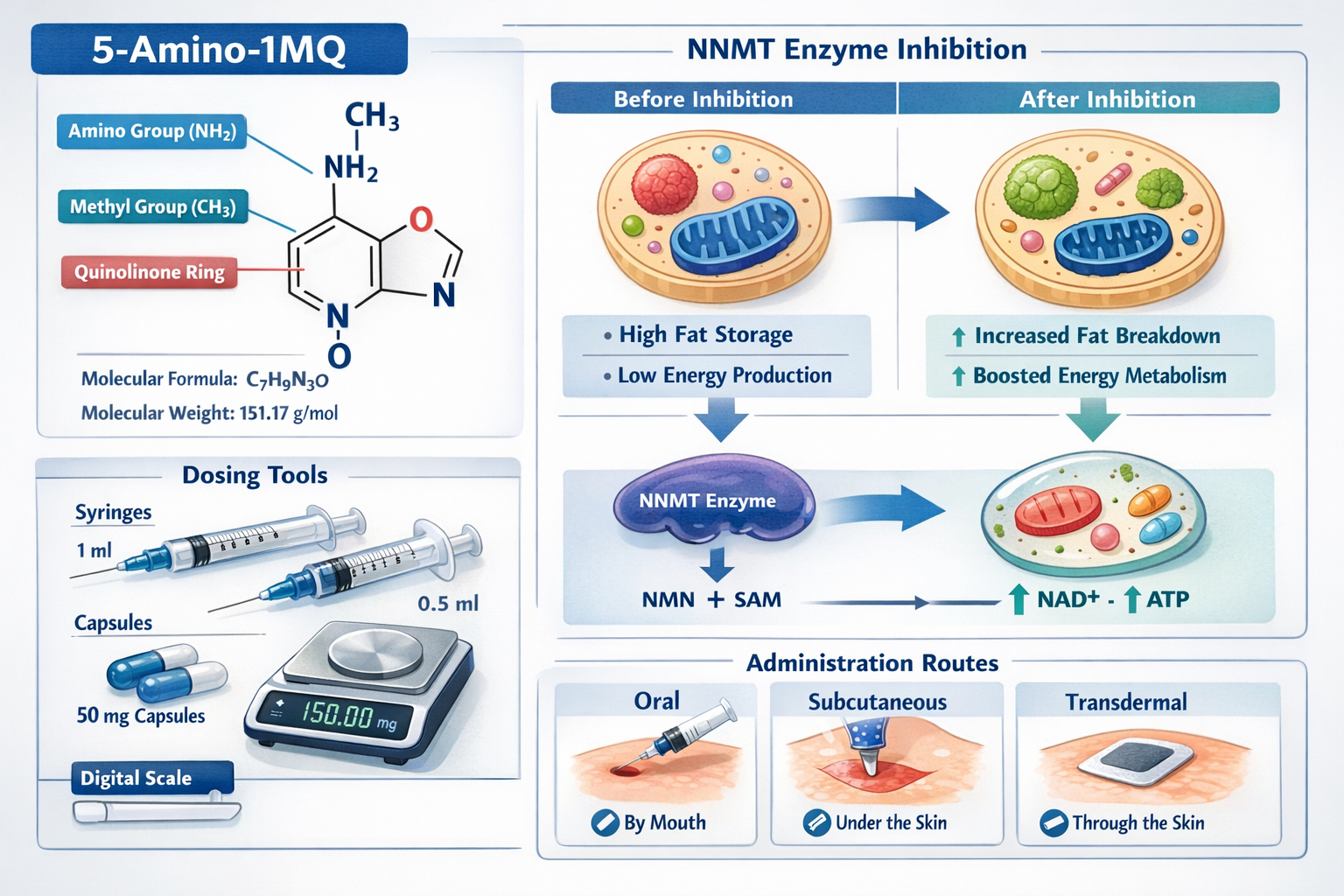
Before diving into dosing protocols, understanding how 5-amino-1-MQ functions provides essential context for determining appropriate administration strategies. This compound represents a relatively new area of metabolic research with mechanisms distinct from traditional peptides.
What Is 5-Amino-1-MQ?
5-Amino-1-methylquinolinium is a small molecule NNMT inhibitor that influences cellular metabolism through a unique pathway. Unlike growth hormone secretagogues or other peptide compounds, 5-amino-1-MQ works by blocking the NNMT enzyme, which methylates nicotinamide (a form of vitamin B3) and reduces the availability of NAD+ (nicotinamide adenine dinucleotide) in cells.
Research published in biochemical journals has demonstrated that NNMT inhibition can lead to:
- Increased cellular NAD+ levels
- Enhanced mitochondrial function
- Improved metabolic flexibility
- Potential changes in fat metabolism
- Altered gene expression related to energy utilization
The 5-amino-1-mq compound has shown promise in preclinical models, though human research remains limited. This makes establishing ideal dosing protocols particularly challenging, as researchers must balance theoretical mechanisms with practical application data.
Why Dosing Matters for Research Outcomes
Proper dosing significantly impacts research outcomes and safety profiles. Unlike some compounds with wide therapeutic windows, metabolic modulators require precision to achieve intended effects while minimizing potential adverse responses. For those exploring all available peptide products, understanding compound-specific dosing becomes paramount.
Key factors influenced by dosing include:
- Enzyme inhibition threshold: Insufficient doses may not adequately inhibit NNMT activity
- Duration of effect: Dosing frequency affects sustained enzyme suppression
- Metabolic response: Individual metabolic rates influence compound clearance and effectiveness
- Safety margins: Excessive dosing may produce unwanted effects without additional benefits
Ideal Dose and Dosing for 5-Amino-1-MQ: Research Protocols
Current research protocols for 5-amino-1-MQ dosing draw from limited published studies, animal model data, and anecdotal reports from research communities. While no FDA-approved human dosing guidelines exist, several patterns have emerged from experimental use.
Standard Dosing Ranges
Research discussions and experimental protocols typically reference these dosing ranges:
| Dosing Level | Daily Amount | Typical Use Case | Administration |
|---|---|---|---|
| Conservative | 50mg | Initial research, lower body weight | Once daily |
| Moderate | 100mg | Standard protocols, average body weight | Once or split dosing |
| Advanced | 150-200mg | Higher body weight, extended research | Split dosing preferred |
| Upper Range | 200mg+ | Rarely used, specific research contexts | Multiple daily doses |
Most researchers begin with 50-100mg daily to assess individual response before considering adjustments. This conservative approach allows monitoring of metabolic changes and any unexpected reactions.
For those considering 5-amino-1-mq dosage protocols, body weight calculations often guide initial dosing decisions. A common formula suggests approximately 1-2mg per kilogram of body weight, though this remains an experimental guideline rather than an established standard.
Body Weight-Based Calculations
Calculating doses based on body composition provides a more personalized approach:
Example calculations:
- 70kg individual: 70-140mg daily (1-2mg/kg)
- 85kg individual: 85-170mg daily (1-2mg/kg)
- 100kg individual: 100-200mg daily (1-2mg/kg)
These calculations represent starting points rather than rigid prescriptions. Individual metabolic factors, research objectives, and response patterns should guide adjustments. When sourcing materials from trusted peptide suppliers, accurate dosing becomes more achievable with properly labeled concentrations.
Timing and Frequency Protocols
The ideal dose and dosing for 5-amino-1-mq extends beyond total daily amounts to include timing considerations. NNMT enzyme activity follows circadian patterns, suggesting strategic timing may enhance effectiveness.
Common timing protocols include:
Single Daily Dose (Morning)
- ✅ Simplifies administration routine
- ✅ Aligns with peak metabolic activity
- ✅ Easier to maintain consistency
- ⚠️ May not provide sustained enzyme inhibition
Split Dosing (Morning and Evening)
- ✅ Maintains more consistent enzyme inhibition
- ✅ May reduce peak concentration effects
- ✅ Potentially smoother metabolic response
- ⚠️ Requires more disciplined scheduling
Multiple Daily Doses (3x daily)
- ✅ Maximum enzyme suppression consistency
- ✅ Lower peak concentrations
- ⚠️ Complex administration schedule
- ⚠️ May be unnecessary for most research goals
Most researchers find split dosing (twice daily) offers the best balance between convenience and sustained effect. Taking 50mg in the morning and 50mg in the evening, for example, maintains more consistent NNMT inhibition throughout the 24-hour cycle.
Administration Routes and Bioavailability
The method of administration significantly impacts the ideal dose and dosing for 5-amino-1-mq due to varying bioavailability across different routes. Understanding these differences helps researchers select appropriate forms and adjust doses accordingly.
Oral Capsule Administration
5-amino-1-mq capsules represent the most common administration method due to convenience and ease of use. Oral bioavailability for this compound appears reasonable, though precise measurements in humans remain limited.
Oral capsule considerations:
📊 Estimated bioavailability: 60-80% (based on molecular properties)
⏱️ Time to peak effect: 1-2 hours post-administration
⌛ Duration of action: 4-8 hours (approximate)
🍽️ Food interaction: May be taken with or without food, though consistent timing recommended
Dosing adjustments for oral route:
- Standard doses (50-100mg) typically used without modification
- Absorption may vary based on digestive factors
- Consistent timing relative to meals improves reproducibility
Sublingual Administration
Some researchers prefer sublingual (under the tongue) administration for potentially enhanced absorption and faster onset. This route bypasses first-pass hepatic metabolism, theoretically improving bioavailability.
Sublingual protocol specifics:
- Place compound under tongue for 60-90 seconds
- Avoid swallowing during absorption period
- May require slightly lower doses (80-90% of oral dose)
- Faster onset of action (30-60 minutes)
Injectable Forms
While less common for 5-amino-1-MQ, injectable administration offers the highest bioavailability. Researchers exploring various peptide forms should note that injectable 5-amino-1-MQ requires different dosing considerations.
Injectable dosing adjustments:
- Reduce dose by 20-30% compared to oral administration
- Subcutaneous injection typically used
- More precise dose control
- Requires proper reconstitution and sterile technique
Cycle Length and Research Duration
Determining optimal cycle length represents another crucial aspect of the ideal dose and dosing for 5-amino-1-mq. Unlike some compounds used continuously, metabolic modulators often follow cyclical protocols.
Recommended Cycle Structures
Standard Research Cycle:
- Duration: 8-12 weeks active administration
- Off period: 4-8 weeks between cycles
- Rationale: Allows metabolic adaptation assessment and prevents tolerance development
Extended Research Cycle:
- Duration: 12-16 weeks active administration
- Off period: 6-12 weeks between cycles
- Rationale: Longer observation of sustained metabolic changes
Short Exploratory Cycle:
- Duration: 4-6 weeks active administration
- Off period: 4 weeks minimum
- Rationale: Initial assessment of individual response
Most researchers find 8-12 week cycles provide sufficient time to observe meaningful metabolic changes while maintaining safety margins. The off-period allows natural enzyme function to resume and provides baseline comparison data.
Progressive Dosing Strategies
Some research protocols employ progressive dosing rather than fixed amounts throughout the cycle:
Week 1-2: Start at lower range (50mg daily)
Week 3-4: Increase to moderate range (75-100mg daily)
Week 5-8: Maintain target dose based on response
Week 9-12: Optional continuation or taper
This approach allows gradual metabolic adaptation and helps identify individual optimal doses. When sourcing compounds from reputable peptide sources, having flexibility in dosing becomes more practical with various concentration options.
Factors Influencing Individual Dosing Needs
The ideal dose and dosing for 5-amino-1-mq varies significantly between individuals due to multiple physiological and lifestyle factors. Personalization based on these variables optimizes research outcomes.
Body Composition and Metabolic Rate
Body composition significantly influences appropriate dosing:
🏋️ Higher muscle mass: May require doses toward upper range due to increased metabolic activity
🧬 Metabolic rate variations: Individuals with faster metabolism may need higher doses or more frequent administration
📊 Body fat percentage: May influence distribution and clearance patterns
Age-Related Considerations
Age affects metabolic enzyme activity and compound processing:
- Younger researchers (20-35): Standard dosing protocols typically appropriate
- Middle-aged researchers (35-50): May benefit from moderate doses with careful monitoring
- Older researchers (50+): Conservative approach recommended with lower starting doses
Concurrent Research Protocols
When combining 5-amino-1-MQ with other research compounds, dosing adjustments may be necessary. Researchers exploring comprehensive peptide protocols should consider potential interactions:
Synergistic compounds:
- MOTS-C: May enhance mitochondrial effects
- NAD+ precursors: Potentially complementary mechanisms
- Metabolic peptides: Careful monitoring required
Compounds requiring caution:
- Other NNMT modulators: Avoid concurrent use
- Strong metabolic stimulants: May amplify effects
- Medications affecting NAD+ metabolism: Consult research guidelines
Safety Considerations and Monitoring
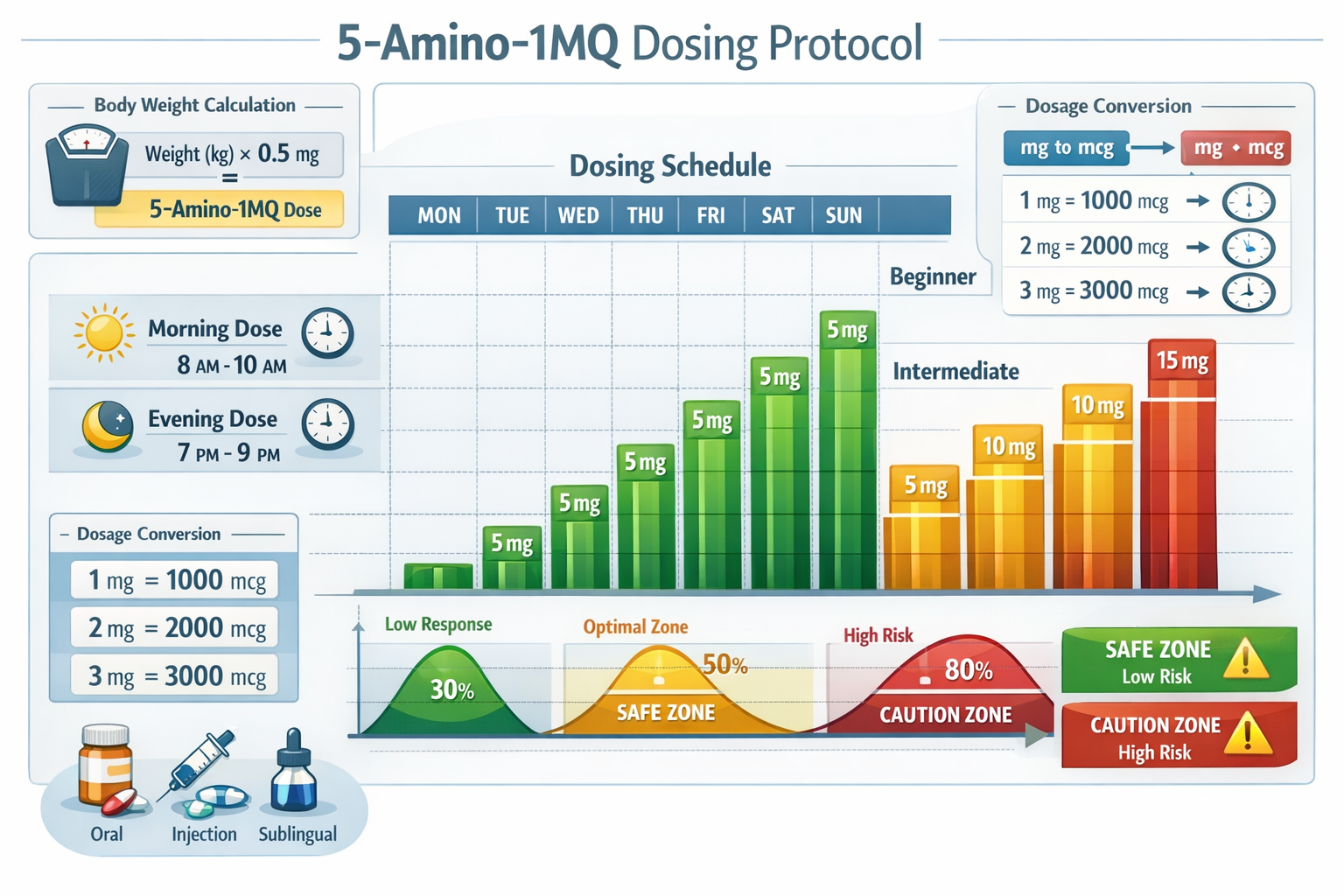
Responsible research with 5-amino-1-MQ requires attention to safety protocols and appropriate monitoring strategies. While research suggests relatively good tolerability, individual responses vary.
Common Response Patterns
Research communities report various response patterns with 5-amino-1-MQ administration:
Frequently reported observations:
- ✅ Increased energy levels
- ✅ Changes in appetite regulation
- ✅ Improved exercise recovery
- ✅ Enhanced mental clarity
- ⚠️ Occasional digestive adjustments
- ⚠️ Sleep pattern changes (if dosed too late)
Monitoring Protocols
Comprehensive monitoring helps optimize dosing and identify any concerning patterns:
Baseline measurements (before starting):
- Body composition analysis
- Metabolic rate assessment
- Energy level documentation
- Sleep quality tracking
Ongoing monitoring (during research):
- Weekly body composition checks
- Daily subjective energy ratings
- Sleep quality logs
- Any unusual responses
Post-cycle assessment:
- Compare to baseline measurements
- Evaluate sustained changes
- Plan subsequent research protocols
For researchers working with various peptide compounds, maintaining detailed logs helps identify optimal protocols and dosing strategies across different substances.
Optimizing Results Through Lifestyle Factors
The ideal dose and dosing for 5-amino-1-mq represents only one component of comprehensive metabolic research. Supporting lifestyle factors significantly influence outcomes.
Nutritional Considerations
Dietary patterns interact with 5-amino-1-MQ's metabolic effects:
Recommended nutritional approaches:
- 🥗 Adequate protein intake (1.6-2.2g per kg body weight)
- 🥑 Balanced macronutrient distribution
- 💧 Proper hydration (minimum 3 liters daily)
- 🍎 Whole food emphasis over processed options
- ⏰ Consistent meal timing for metabolic stability
NAD+ precursor support:
- Nicotinamide riboside supplementation
- Niacin-rich foods (when appropriate)
- B-vitamin complex consideration
Exercise Integration
Physical activity patterns influence 5-amino-1-MQ effectiveness:
Optimal exercise timing:
- Morning cardio sessions (fasted or fed based on preference)
- Resistance training 3-5 times weekly
- Active recovery on rest days
- Avoid intense exercise immediately after dosing
Sleep and Recovery
Quality sleep supports metabolic optimization:
- 🌙 7-9 hours nightly sleep target
- 😴 Consistent sleep-wake schedule
- 🚫 Avoid late-evening dosing if sleep disruption occurs
- 📵 Sleep hygiene practices
Comparing 5-Amino-1-MQ Dosing to Related Compounds
Understanding how the ideal dose and dosing for 5-amino-1-mq compares to other metabolic compounds provides valuable context for researchers exploring multiple options.
Dosing Comparison Table
| Compound | Typical Daily Dose | Administration Frequency | Cycle Length |
|---|---|---|---|
| 5-Amino-1-MQ | 50-200mg | 1-2x daily | 8-12 weeks |
| MOTS-C | 5-10mg | 2-3x weekly (injectable) | 4-8 weeks |
| Tesofensine | 0.25-1mg | Once daily | 8-12 weeks |
| AOD-9604 | 300-600mcg | Once daily | 8-12 weeks |
These comparisons highlight that 5-amino-1-MQ requires higher absolute doses than many peptides due to its small molecule structure and oral bioavailability considerations. Researchers interested in comprehensive peptide research benefit from understanding these distinctions.
Synergistic Protocol Considerations
Some researchers explore combining 5-amino-1-MQ with complementary compounds:
Potential synergistic combinations:
- 5-Amino-1-MQ + MOTS-C: Complementary mitochondrial support
- 5-Amino-1-MQ + NAD+ precursors: Enhanced NAD+ optimization
- 5-Amino-1-MQ + metabolic peptides: Comprehensive metabolic modulation
When combining compounds, conservative dosing of each component is recommended initially, with gradual adjustments based on response.
Common Dosing Mistakes and How to Avoid Them
Even experienced researchers sometimes make dosing errors that compromise research quality or safety. Understanding common pitfalls helps optimize protocols.
Mistake #1: Starting Too High
The error: Beginning with maximum doses (150-200mg) without assessing individual response
The consequence: Increased likelihood of unwanted effects, difficulty identifying optimal dose
The solution: Start with 50-75mg daily for 1-2 weeks, then adjust based on response
Mistake #2: Inconsistent Timing
The error: Taking doses at varying times each day without establishing routine
The consequence: Irregular enzyme inhibition patterns, difficulty assessing true effects
The solution: Set specific dosing times (e.g., 8 AM and 8 PM) and maintain consistency
Mistake #3: Neglecting Cycle Breaks
The error: Continuous administration without off-periods for metabolic assessment
The consequence: Potential tolerance development, inability to measure sustained changes
The solution: Follow structured cycles with appropriate off-periods (4-8 weeks minimum)
Mistake #4: Ignoring Individual Response
The error: Rigidly following generic protocols despite clear individual response patterns
The consequence: Suboptimal results or unnecessary continuation of ineffective doses
The solution: Adjust based on monitoring data and subjective response patterns
Mistake #5: Poor Source Quality
The error: Using compounds from unverified sources without quality assurance
The consequence: Inconsistent dosing due to variable purity and concentration
The solution: Source from reputable peptide suppliers with third-party testing
Advanced Dosing Strategies for Experienced Researchers
Researchers with experience using 5-amino-1-MQ may explore more sophisticated dosing approaches based on specific objectives and previous response patterns.
Pulsed Dosing Protocols
Rather than daily administration, some researchers experiment with pulsed dosing:
5-days-on, 2-days-off protocol:
- Monday-Friday: Standard dose (100mg)
- Saturday-Sunday: No administration
- Rationale: Prevents continuous enzyme suppression, may reduce tolerance
Alternating dose protocol:
- High dose days (100mg): Monday, Wednesday, Friday
- Low dose days (50mg): Tuesday, Thursday, Saturday
- Off day: Sunday
- Rationale: Variable enzyme inhibition may optimize metabolic flexibility
Time-Restricted Dosing Windows
Aligning dosing with circadian metabolic patterns:
Morning-focused protocol:
- Single 100mg dose upon waking
- Capitalizes on peak morning metabolic activity
- May enhance daytime energy utilization
Pre-exercise dosing:
- 50mg dose 60-90 minutes before training
- May enhance exercise-induced metabolic effects
- Requires consistent training schedule
Responsive Dosing Adjustments
Experienced researchers may adjust doses based on real-time monitoring:
Indicators for dose increase:
- Diminished energy effects after initial response
- Stable body composition despite compliance
- Well-tolerated current dose with room for adjustment
Indicators for dose reduction:
- Sleep disruption patterns
- Excessive stimulation effects
- Achievement of research objectives at lower dose
Practical Implementation Guide
Translating dosing knowledge into practical application requires systematic planning and execution. This implementation guide provides actionable steps for researchers beginning 5-amino-1-MQ protocols.
Step 1: Establish Baseline Measurements
Before beginning any protocol, document baseline metrics:
📊 Physical measurements:
- Body weight and composition
- Circumference measurements (waist, hips, etc.)
- Progress photographs
📝 Subjective assessments:
- Energy level ratings (1-10 scale)
- Sleep quality scores
- Recovery perception
- Mental clarity ratings
🔬 Optional laboratory work:
- Metabolic panel (if accessible)
- Body composition analysis (DEXA, InBody, etc.)
Step 2: Select Initial Dosing Protocol
Based on individual factors, choose starting parameters:
For beginners (first time with 5-amino-1-MQ):
- Dose: 50mg daily
- Frequency: Once daily (morning)
- Duration: 2 weeks assessment period
For experienced researchers (previous peptide/compound experience):
- Dose: 75-100mg daily
- Frequency: Split dosing (morning and evening)
- Duration: 8-12 week cycle
For advanced researchers (multiple previous cycles):
- Dose: 100-150mg daily
- Frequency: Optimized based on previous response
- Duration: Customized based on objectives
Step 3: Source Quality Compounds
Obtaining pharmaceutical-grade materials ensures accurate dosing:
✅ Verify third-party testing certificates
✅ Confirm proper concentration labeling
✅ Check storage and handling requirements
✅ Ensure proper packaging and sealing
Researchers can explore verified 5-amino-1-mq sources that provide quality assurance documentation.
Step 4: Implement Monitoring System
Create a simple tracking system:
Daily log entries:
- Dose amount and timing
- Energy level (1-10)
- Sleep quality (1-10)
- Notable observations
Weekly assessments:
- Body weight
- Circumference measurements
- Progress photographs
- Subjective progress evaluation
Monthly reviews:
- Comprehensive comparison to baseline
- Protocol adjustment decisions
- Safety assessment
Step 5: Adjust and Optimize
After 2-4 weeks, evaluate and adjust:
If experiencing positive response:
- Continue current protocol
- Consider minor dose optimization
- Maintain monitoring consistency
If experiencing minimal effects:
- Increase dose by 25-50mg
- Adjust timing (try split dosing)
- Evaluate lifestyle factors
If experiencing unwanted effects:
- Reduce dose by 25-50%
- Adjust timing (avoid evening doses)
- Ensure proper hydration and nutrition
Frequently Discussed Topics in Research Communities
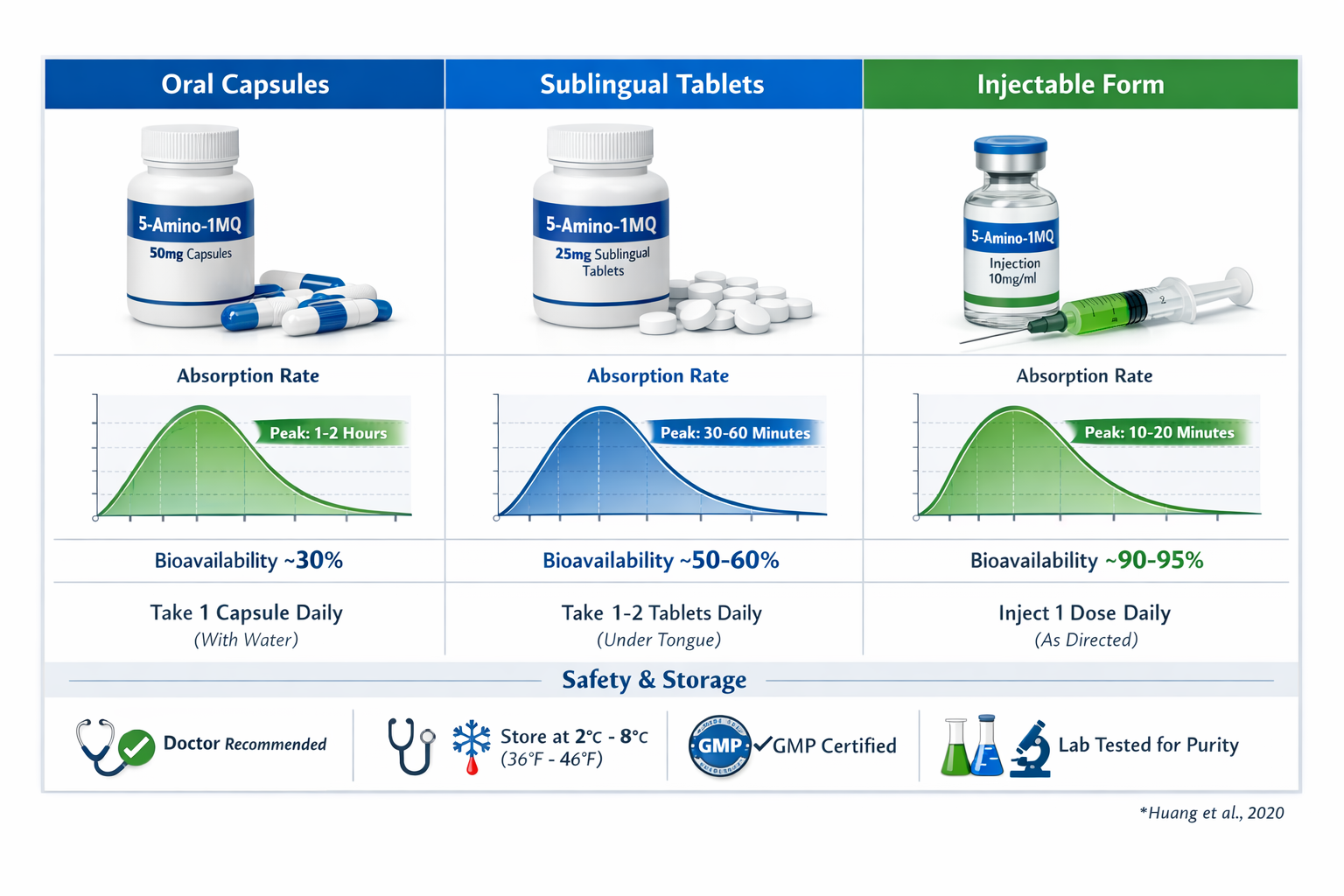
Online research communities, including discussions on 5-amino-1-mq Reddit forums, frequently address specific dosing questions. Understanding these common topics helps researchers navigate practical challenges.
"Should I dose with food or fasted?"
Research communities report varied experiences:
Fasted dosing advocates report:
- Potentially faster absorption
- More noticeable energy effects
- Better morning metabolic activation
Fed dosing advocates report:
- Reduced digestive discomfort
- More stable energy patterns
- Better compliance with routine
Evidence-based recommendation: Both approaches appear effective. Choose based on individual tolerance and lifestyle convenience, then maintain consistency.
"Can I take 5-amino-1-MQ with coffee?"
Caffeine and 5-amino-1-MQ combination is commonly discussed:
- ☕ No known contraindications
- 🔋 May produce synergistic energy effects
- ⚠️ Some report excessive stimulation when combined
- 💡 Consider reducing caffeine intake initially to assess individual response
"How quickly should I see results?"
Timeline expectations vary based on research objectives:
Energy and mental clarity: 1-2 weeks
Body composition changes: 4-8 weeks
Metabolic adaptations: 6-12 weeks
Setting realistic expectations prevents premature protocol abandonment or unnecessary dose escalation.
"Do I need to cycle off?"
Cycling remains a debated topic:
Arguments for cycling:
- Prevents potential tolerance development
- Allows assessment of sustained changes
- Provides metabolic reset periods
Arguments against strict cycling:
- Limited evidence of tolerance in short-term use
- Metabolic benefits may compound with longer use
- Individual response varies significantly
Balanced recommendation: Initial cycles of 8-12 weeks with 4-8 week breaks allow comprehensive assessment while maintaining conservative safety margins.
Quality and Sourcing Considerations
The ideal dose and dosing for 5-amino-1-mq assumes pharmaceutical-grade compounds with accurate labeling. Quality variations significantly impact dosing accuracy and research outcomes.
Identifying Quality Sources
Reputable suppliers demonstrate several key characteristics:
🔬 Third-party testing: Independent laboratory verification of purity and concentration
📋 Certificates of Analysis (COA): Detailed documentation for each batch
📦 Proper packaging: Sealed, labeled, and stored appropriately
🏢 Transparent operations: Clear contact information and customer support
⭐ Research community reputation: Positive feedback from experienced users
When exploring peptide purchasing options, these quality indicators help ensure dosing accuracy.
Understanding Concentration Labels
Proper interpretation of product labels prevents dosing errors:
Common labeling formats:
- "5-Amino-1-MQ 50mg capsules" = 50mg per capsule
- "5-Amino-1-MQ 1000mg powder" = 1000mg total, requires measuring
- "5-Amino-1-MQ 100mg/ml solution" = 100mg per milliliter
Verification steps:
- Confirm concentration units (mg, mcg, mg/ml)
- Calculate total product amount
- Determine appropriate serving size
- Cross-reference with COA documentation
Storage and Handling
Proper storage maintains compound integrity and dosing accuracy:
Storage recommendations:
- 🌡️ Temperature: Cool, dry location (15-25°C)
- 💧 Humidity: Low moisture environment
- ☀️ Light: Protected from direct sunlight
- 📅 Shelf life: Typically 1-2 years when properly stored
- 🔒 Security: Stored safely away from unauthorized access
Degraded compounds may deliver inconsistent doses, compromising research quality.
Legal and Ethical Research Considerations
Responsible research with 5-amino-1-MQ includes understanding the legal and ethical context of compound use.
Regulatory Status
As of 2026, 5-amino-1-MQ occupies a complex regulatory position:
- ⚖️ Not FDA-approved for human consumption
- 🔬 Available for research purposes
- 📋 Regulatory status varies by jurisdiction
- 🏛️ Subject to evolving legal frameworks
Researchers should understand applicable regulations in their location and ensure compliance with local laws.
Research vs. Clinical Use
Important distinctions exist between research and clinical applications:
Research context:
- Self-directed exploration of compounds
- Personal responsibility for outcomes
- No medical supervision required (though advisable)
- Educational and experimental objectives
Clinical context:
- Medical professional oversight
- Therapeutic intent for specific conditions
- Regulatory approval required
- Insurance and legal protections
5-Amino-1-MQ remains in the research category, without established clinical protocols or medical indications.
Informed Decision-Making
Responsible research requires comprehensive understanding:
✅ Review available scientific literature
✅ Understand mechanism of action
✅ Recognize limitations of current evidence
✅ Acknowledge potential risks and unknowns
✅ Maintain detailed documentation
✅ Consider professional consultation when appropriate
Future Directions in 5-Amino-1-MQ Research
The field of NNMT inhibition and metabolic modulation continues evolving, with implications for future dosing protocols and applications.
Emerging Research Areas
Current research directions include:
Metabolic disease applications:
- Obesity and weight management
- Type 2 diabetes and insulin sensitivity
- Metabolic syndrome components
- Age-related metabolic decline
Longevity and healthspan:
- NAD+ optimization strategies
- Mitochondrial function enhancement
- Cellular energy metabolism
- Epigenetic modifications
Athletic performance:
- Exercise metabolism optimization
- Recovery enhancement
- Body composition modification
- Endurance capacity
Potential Protocol Refinements
As research advances, dosing protocols may evolve:
Personalized dosing algorithms:
- Genetic markers for NNMT activity
- Metabolic phenotype-based protocols
- Real-time biomarker monitoring
- Adaptive dosing systems
Combination therapies:
- Synergistic compound identification
- Optimized multi-compound protocols
- Sequential vs. concurrent administration
- Targeted metabolic pathway modulation
Enhanced delivery systems:
- Improved bioavailability formulations
- Extended-release preparations
- Targeted delivery mechanisms
- Transdermal applications
Conclusion: Implementing Your Optimal Dosing Strategy
Understanding the ideal dose and dosing for 5-amino-1-mq requires integrating scientific principles, practical considerations, and individual response patterns. While research continues to evolve, current evidence and community experience provide reasonable guidance for researchers exploring this metabolic compound.
Key Implementation Principles
Start conservatively: Begin with 50-75mg daily to assess individual tolerance and response patterns before escalating doses.
Maintain consistency: Establish regular dosing times and routines to ensure stable enzyme inhibition and reproducible results.
Monitor comprehensively: Track both objective measurements (body composition, weight) and subjective experiences (energy, sleep, recovery) throughout research protocols.
Adjust responsively: Modify doses based on individual response rather than rigidly following generic protocols that may not suit personal physiology.
Cycle appropriately: Implement structured on/off periods (8-12 weeks on, 4-8 weeks off) to prevent tolerance and assess sustained metabolic changes.
Source quality compounds: Obtain materials from reputable suppliers with third-party testing to ensure accurate dosing and compound purity.
Next Steps for Researchers
For those ready to begin 5-amino-1-MQ research:
1️⃣ Establish baseline measurements: Document starting body composition, energy levels, and metabolic markers
2️⃣ Select initial protocol: Choose conservative starting dose (50-100mg) based on body weight and experience level
3️⃣ Source quality materials: Obtain pharmaceutical-grade 5-amino-1-mq compounds with proper documentation
4️⃣ Implement monitoring system: Create simple tracking methods for daily and weekly assessments
5️⃣ Commit to full cycle: Complete minimum 8-week protocol before making final effectiveness determinations
6️⃣ Evaluate and adjust: Review comprehensive data after initial cycle to optimize subsequent protocols
Final Thoughts
The ideal dose and dosing for 5-amino-1-mq ultimately proves highly individual, influenced by body composition, metabolic rate, research objectives, and personal response patterns. While general guidelines suggest 50-200mg daily administered in single or split doses over 8-12 week cycles, optimal protocols emerge through careful self-monitoring and responsive adjustments.
As metabolic research continues advancing, dosing protocols will likely become more refined and personalized. For now, researchers benefit from conservative approaches, comprehensive monitoring, and quality sourcing practices that ensure safe and effective exploration of this promising metabolic compound.
Those interested in exploring 5-amino-1-MQ alongside other metabolic compounds can review comprehensive peptide options to develop integrated research protocols that address multiple aspects of metabolic optimization.
Remember that responsible research prioritizes safety, documentation, and evidence-based decision-making over aggressive dosing or unrealistic expectations. The most successful researchers approach 5-amino-1-MQ as one component of comprehensive metabolic optimization strategies that include proper nutrition, exercise, sleep, and lifestyle factors.
<!DOCTYPE html>
<html lang="en">
<head>
    <meta charset="UTF-8">
    <meta name="viewport" content="width=device-width, initial-scale=1.0">
    <title>5-Amino-1-MQ Dosing Calculator</title>
    <style>
        * {
            margin: 0;
            padding: 0;
            box-sizing: border-box;
        }

        .cg-element-calculator-container {
            font-family: -apple-system, BlinkMacSystemFont, 'Segoe UI', Roboto, Oxygen, Ubuntu, Cantarell, sans-serif;
            max-width: 800px;
            margin: 20px auto;
            background: linear-gradient(135deg, #667eea 0%, #764ba2 100%);
            border-radius: 16px;
            padding: 2px;
            box-shadow: 0 10px 40px rgba(0,0,0,0.2);
        }

        .cg-element-calculator-inner {
            background: white;
            border-radius: 14px;
            padding: 30px;
        }

        .cg-element-calculator-header {
            text-align: center;
            margin-bottom: 30px;
        }

        .cg-element-calculator-title {
            font-size: 28px;
            font-weight: 700;
            color: #2d3748;
            margin-bottom: 10px;
        }

        .cg-element-calculator-subtitle {
            font-size: 14px;
            color: #718096;
            line-height: 1.6;
        }

        .cg-element-input-section {
            background: #f7fafc;
            border-radius: 12px;
            padding: 25px;
            margin-bottom: 25px;
        }

        .cg-element-input-group {
            margin-bottom: 20px;
        }

        .cg-element-input-group:last-child {
            margin-bottom: 0;
        }

        .cg-element-label {
            display: block;
            font-size: 14px;
            font-weight: 600;
            color: #4a5568;
            margin-bottom: 8px;
        }

        .cg-element-input {
            width: 100%;
            padding: 12px 16px;
            font-size: 16px;
            border: 2px solid #e2e8f0;
            border-radius: 8px;
            transition: all 0.3s ease;
            background: white;
        }

        .cg-element-input:focus {
            outline: none;
            border-color: #667eea;
            box-shadow: 0 0 0 3px rgba(102, 126, 234, 0.1);
        }

        .cg-element-select {
            width: 100%;
            padding: 12px 16px;
            font-size: 16px;
            border: 2px solid #e2e8f0;
            border-radius: 8px;
            background: white;
            cursor: pointer;
            transition: all 0.3s ease;
        }

        .cg-element-select:focus {
            outline: none;
            border-color: #667eea;
            box-shadow: 0 0 0 3px rgba(102, 126, 234, 0.1);
        }

        .cg-element-radio-group {
            display: flex;
            gap: 15px;
            flex-wrap: wrap;
        }

        .cg-element-radio-label {
            display: flex;
            align-items: center;
            cursor: pointer;
            font-size: 14px;
            color: #4a5568;
        }

        .cg-element-radio-input {
            margin-right: 6px;
            cursor: pointer;
        }

        .cg-element-calculate-btn {
            width: 100%;
            padding: 16px;
            font-size: 18px;
            font-weight: 600;
            color: white;
            background: linear-gradient(135deg, #667eea 0%, #764ba2 100%);
            border: none;
            border-radius: 10px;
            cursor: pointer;
            transition: transform 0.2s ease, box-shadow 0.2s ease;
            margin-bottom: 25px;
        }

        .cg-element-calculate-btn:hover {
            transform: translateY(-2px);
            box-shadow: 0 6px 20px rgba(102, 126, 234, 0.4);
        }

        .cg-element-calculate-btn:active {
            transform: translateY(0);
        }

        .cg-element-results {
            display: none;
            background: linear-gradient(135deg, #f6f8fb 0%, #e9ecef 100%);
            border-radius: 12px;
            padding: 25px;
        }

        .cg-element-results.cg-element-show {
            display: block;
            animation: cg-element-slideIn 0.4s ease;
        }

        @keyframes cg-element-slideIn {
            from {
                opacity: 0;
                transform: translateY(10px);
            }
            to {
                opacity: 1;
                transform: translateY(0);
            }
        }

        .cg-element-result-header {
            font-size: 20px;
            font-weight: 700;
            color: #2d3748;
            margin-bottom: 20px;
            text-align: center;
        }

        .cg-element-result-card {
            background: white;
            border-radius: 10px;
            padding: 20px;
            margin-bottom: 15px;
            border-left: 4px solid #667eea;
        }

        .cg-element-result-card:last-child {
            margin-bottom: 0;
        }

        .cg-element-result-label {
            font-size: 13px;
            font-weight: 600;
            color: #718096;
            text-transform: uppercase;
            letter-spacing: 0.5px;
            margin-bottom: 8px;
        }

        .cg-element-result-value {
            font-size: 24px;
            font-weight: 700;
            color: #667eea;
            margin-bottom: 8px;
        }

        .cg-element-result-description {
            font-size: 14px;
            color: #4a5568;
            line-height: 1.6;
        }

        .cg-element-warning {
            background: #fff5f5;
            border-left: 4px solid #fc8181;
            padding: 15px;
            border-radius: 8px;
            margin-top: 20px;
        }

        .cg-element-warning-text {
            font-size: 13px;
            color: #742a2a;
            line-height: 1.6;
        }

        @media (max-width: 600px) {
            .cg-element-calculator-inner {
                padding: 20px;
            }

            .cg-element-calculator-title {
                font-size: 24px;
            }

            .cg-element-result-value {
                font-size: 20px;
            }
        }
    </style>
</head>
<body>
    <div class="cg-element-calculator-container">
        <div class="cg-element-calculator-inner">
            <div class="cg-element-calculator-header">
                <h2 class="cg-element-calculator-title">💊 5-Amino-1-MQ Dosing Calculator</h2>
                <p class="cg-element-calculator-subtitle">Calculate your personalized research dosing protocol based on body weight and experience level</p>
            </div>

            <div class="cg-element-input-section">
                <div class="cg-element-input-group">
                    <label class="cg-element-label" for="cg-element-weight">Body Weight</label>
                    <input
                        type="number"
                        id="cg-element-weight"
                        class="cg-element-input"
                        placeholder="Enter your weight"
                        min="40"
                        max="200"
                    >
                </div>

                <div class="cg-element-input-group">
                    <label class="cg-element-label" for="cg-element-unit">Weight Unit</label>
                    <select id="cg-element-unit" class="cg-element-select">
                        <option value="kg">Kilograms (kg)</option>
                        <option value="lbs">Pounds (lbs)</option>
                    </select>
                </div>

                <div class="cg-element-input-group">
                    <label class="cg-element-label">Experience Level</label>
                    <div class="cg-element-radio-group">
                        <label class="cg-element-radio-label">
                            <input type="radio" name="experience" value="beginner" class="cg-element-radio-input" checked>
                            Beginner
                        </label>
                        <label class="cg-element-radio-label">
                            <input type="radio" name="experience" value="intermediate" class="cg-element-radio-input">
                            Intermediate
                        </label>
                        <label class="cg-element-radio-label">
                            <input type="radio" name="experience" value="advanced" class="cg-element-radio-input">
                            Advanced
                        </label>
                    </div>
                </div>

                <div class="cg-element-input-group">
                    <label class="cg-element-label" for="cg-element-frequency">Dosing Frequency</label>
                    <select id="cg-element-frequency" class="cg-element-select">
                        <option value="once">Once Daily</option>
                        <option value="split">Split Dosing (2x daily)</option>
                    </select>
                </div>
            </div>

            <button class="cg-element-calculate-btn" onclick="calculateDose()">Calculate Recommended Dose</button>

            <div class="cg-element-results" id="cg-element-results">
                <h3 class="cg-element-result-header">📊 Your Personalized Dosing Protocol</h3>

                <div class="cg-element-result-card">
                    <div class="cg-element-result-label">Recommended Daily Dose</div>
                    <div class="cg-element-result-value" id="cg-element-daily-dose">--</div>
                    <div class="cg-element-result-description" id="cg-element-daily-description">--</div>
                </div>

                <div class="cg-element-result-card">
                    <div class="cg-element-result-label">Per-Dose Amount</div>
                    <div class="cg-element-result-value" id="cg-element-per-dose">--</div>
                    <div class="cg-element-result-description" id="cg-element-timing-description">--</div>
                </div>

                <div class="cg-element-result-card">
                    <div class="cg-element-result-label">Recommended Cycle Length</div>
                    <div class="cg-element-result-value" id="cg-element-cycle-length">--</div>
                    <div class="cg-element-result-description">Followed by 4-8 weeks off-cycle for metabolic assessment and recovery</div>
                </div>

                <div class="cg-element-warning">
                    <p class="cg-element-warning-text">
                        ⚠️ <strong>Important:</strong> These calculations are for research purposes only and based on body weight formulas (1-2mg/kg). Individual responses vary significantly. Start with conservative doses and adjust based on personal tolerance and monitoring. This calculator does not constitute medical advice.
                    </p>
                </div>
            </div>
        </div>
    </div>

    <script>
        function calculateDose() {
            // Get input values
            const weight = parseFloat(document.getElementById('cg-element-weight').value);
            const unit = document.getElementById('cg-element-unit').value;
            const experience = document.querySelector('input[name="experience"]:checked').value;
            const frequency = document.getElementById('cg-element-frequency').value;

            // Validate input
            if (!weight || weight <= 0) {
                alert('Please enter a valid body weight');
                return;
            }

            // Convert to kg if needed
            let weightKg = weight;
            if (unit === 'lbs') {
                weightKg = weight / 2.20462;
            }

            // Calculate base dose (mg per kg)
            let dosePerKg;
            let cycleWeeks;

            switch(experience) {
                case 'beginner':
                    dosePerKg = 1.0; // Conservative 1mg/kg
                    cycleWeeks = '8-10';
                    break;
                case 'intermediate':
                    dosePerKg = 1.5; // Moderate 1.5mg/kg
                    cycleWeeks = '10-12';
                    break;
                case 'advanced':
                    dosePerKg = 2.0; // Upper range 2mg/kg
                    cycleWeeks = '12';
                    break;
            }

            // Calculate total daily dose
            let dailyDose = Math.round(weightKg * dosePerKg);

            // Ensure within reasonable bounds
            dailyDose = Math.max(50, Math.min(200, dailyDose));

            // Calculate per-dose amount
            let perDose = frequency === 'split' ? Math.round(dailyDose / 2) : dailyDose;

            // Generate descriptions
            let dailyDescription = `Based on ${weightKg.toFixed(1)}kg body weight and ${experience} experience level`;

            let timingDescription;
            if (frequency === 'split') {
                timingDescription = `Take ${perDose}mg in the morning (upon waking) and ${perDose}mg in the evening (before 6 PM)`;
            } else {
                timingDescription = `Take ${perDose}mg once daily in the morning upon waking`;
            }

            // Display results
            document.getElementById('cg-element-daily-dose').textContent = dailyDose + 'mg';
            document.getElementById('cg-element-daily-description').textContent = dailyDescription;
            document.getElementById('cg-element-per-dose').textContent = perDose + 'mg per dose';
            document.getElementById('cg-element-timing-description').textContent = timingDescription;
            document.getElementById('cg-element-cycle-length').textContent = cycleWeeks + ' weeks';

            // Show results
            document.getElementById('cg-element-results').classList.add('cg-element-show');

            // Smooth scroll to results
            document.getElementById('cg-element-results').scrollIntoView({
                behavior: 'smooth',
                block: 'nearest'
            });
        }

        // Allow Enter key to trigger calculation
        document.getElementById('cg-element-weight').addEventListener('keypress', function(event) {
            if (event.key === 'Enter') {
                calculateDose();
            }
        });
    </script>
</body>
</html>
SEO Meta Information
Meta Title: Ideal Dose and Dosing for 5-Amino-1-MQ | 2026 Guide
Meta Description: Comprehensive guide to 5-amino-1-mq dosing protocols. Learn ideal doses (50-200mg), timing strategies, cycle lengths, and safety considerations for research use.
Target Keywords: Ideal dose and dosing for 5-amino-1-mq, 5-amino-1-mq dosage, 5-amino-1-mq protocol, NNMT inhibitor dosing, metabolic peptide dosing
Image Alt Text: 5-amino-1-mq dosing calculator showing personalized protocol recommendations based on body weight and experience level for metabolic research applications