

Over 80 peptide-based drugs have received clinical approval worldwide, yet the structural logic that separates a two-amino-acid dipeptide from a 200-residue polypeptide hormone still escapes most research summaries. That gap matters enormously. In the study of peptides and polypeptides in human physiology, molecular size is not a minor detail, it determines receptor binding geometry, metabolic stability, delivery route, and ultimately which research models are even viable.
This article moves beyond introductory definitions to examine how chain length and molecular weight shape endocrine signaling, immune modulation, and mitochondrial biology, with direct implications for researchers working with compounds like GLP-1 analogs, MOTS-c, and BPC-157.
Key Takeaways
- Peptides range from 2 to ~50 amino acid residues (500-5,000 daltons); polypeptides exceed 50 residues and can fold into functional proteins.
- Molecular size directly governs pharmacokinetics: shorter peptides degrade faster but penetrate tissues more readily than larger polypeptides.
- Proglucagon-derived peptides (GLP-1, GLP-2, glucagon) illustrate how small sequence variations in the same precursor polypeptide produce radically different physiological effects.
- Mitochondria-targeted peptides such as MOTS-c and SS-31 demonstrate that even very short chains can exert organelle-level regulatory effects.
- Machine learning and AI-driven design tools are accelerating the identification of novel peptide sequences with optimized size-to-function ratios.
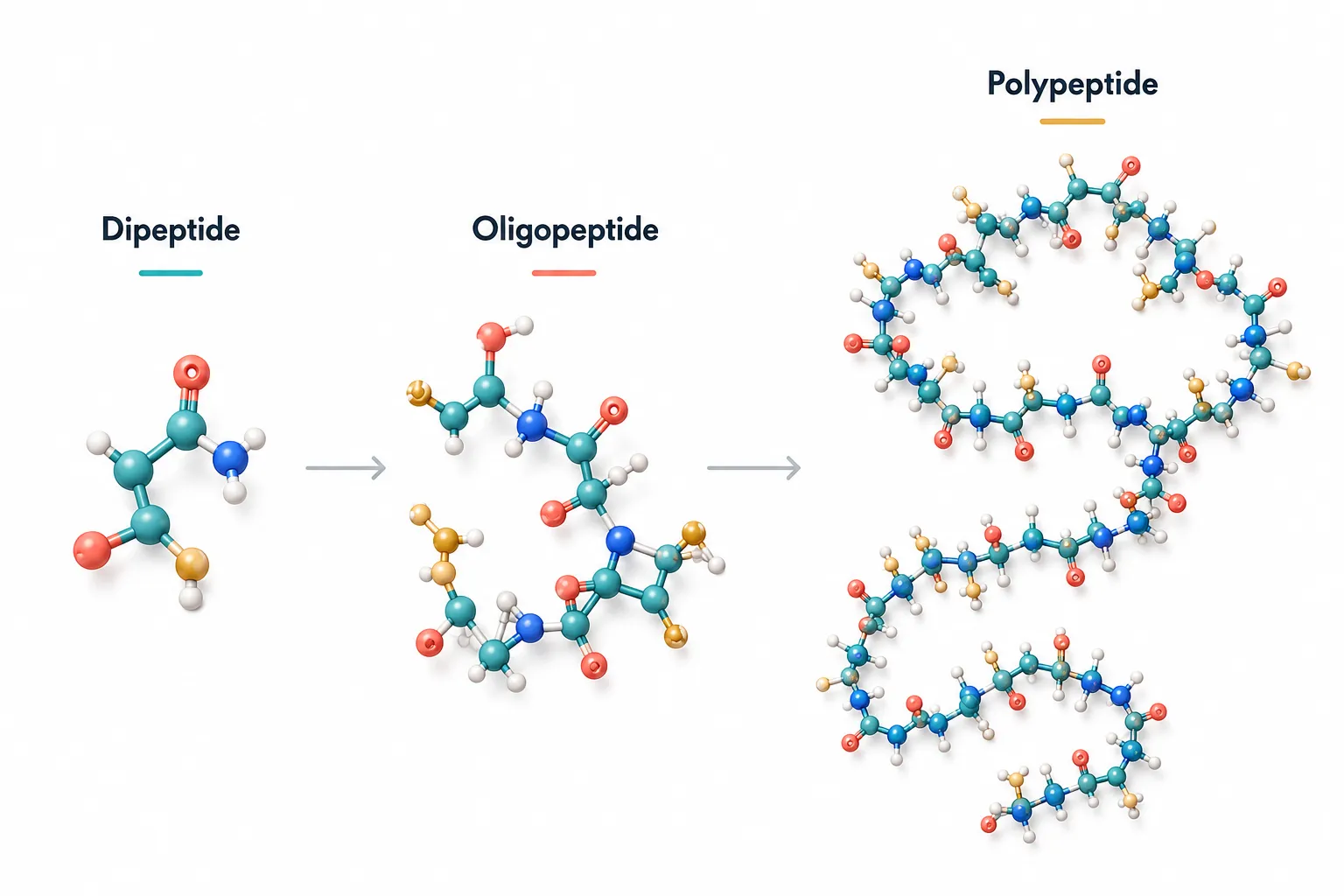
Defining the Size Spectrum: From Dipeptides to Polypeptides
The boundary between a peptide and a polypeptide is a matter of chain length and, by extension, structural complexity.
| Category | Residue Range | Approximate MW | Example |
|---|---|---|---|
| Dipeptide | 2 | < 300 Da | Carnosine |
| Oligopeptide | 3-10 | 300-1,000 Da | GHK-Cu (tripeptide) |
| Peptide | 10-50 | 1,000-5,000 Da | BPC-157 (15 aa) |
| Polypeptide | 50-200+ | 5,000-25,000 Da | GLP-1 precursor fragments |
Peptide hormones sit within the 3-to-200 amino acid window and act as water-soluble signaling molecules that bind cell-surface receptors with high selectivity. Their water solubility is a direct consequence of size: chains short enough to remain in solution without hydrophobic collapse can reach membrane-bound targets efficiently.
Micropeptides, polypeptides with fewer than 100-150 amino acids encoded by short open reading frames, represent a newer research frontier. Unlike peptides produced by post-translational cleavage of larger precursors, micropeptides are primary gene products, which changes how researchers model their synthesis and regulation.
For researchers exploring simple peptides at the shorter end of this spectrum, understanding where a compound sits on the size continuum is the first step in predicting its behavior in a biological system.
How Molecular Size Shapes Research Applications in Endocrine and Metabolic Models
The proglucagon gene is one of the clearest demonstrations of how a single polypeptide precursor can be cleaved into multiple functionally distinct peptides. Glucagon, GLP-1, GLP-2, and oxyntomodulin all derive from the same precursor but differ in length and sequence. Each regulates a distinct axis, glucose homeostasis, appetite, gastrointestinal motility, and lipid metabolism, because each binds a different receptor with a different affinity profile shaped by its specific residue count and tertiary structure.
This is why the study of peptides and polypeptides in human physiology: how molecular size shapes research applications cannot be reduced to "bigger is more potent." A longer chain introduces more folding possibilities, which can increase receptor selectivity but also increase susceptibility to proteolytic degradation.
GLP-1 peptide research exemplifies this tension. Native GLP-1 has a plasma half-life of under two minutes due to rapid cleavage by dipeptidyl peptidase-4 (DPP-4). Analog development has focused on modifying the N-terminal residues, a size and sequence intervention, to resist that cleavage without disrupting receptor binding geometry.
"Molecular size is not just a classification tool, it is the primary engineering variable in peptide drug design."
Similarly, cagrilintide and GLP-1 synergy research explores dual-receptor agonism, where two peptides of different lengths act on complementary metabolic pathways simultaneously.
Mitochondrial and Immune Research: Where Small Chains Carry Large Consequences
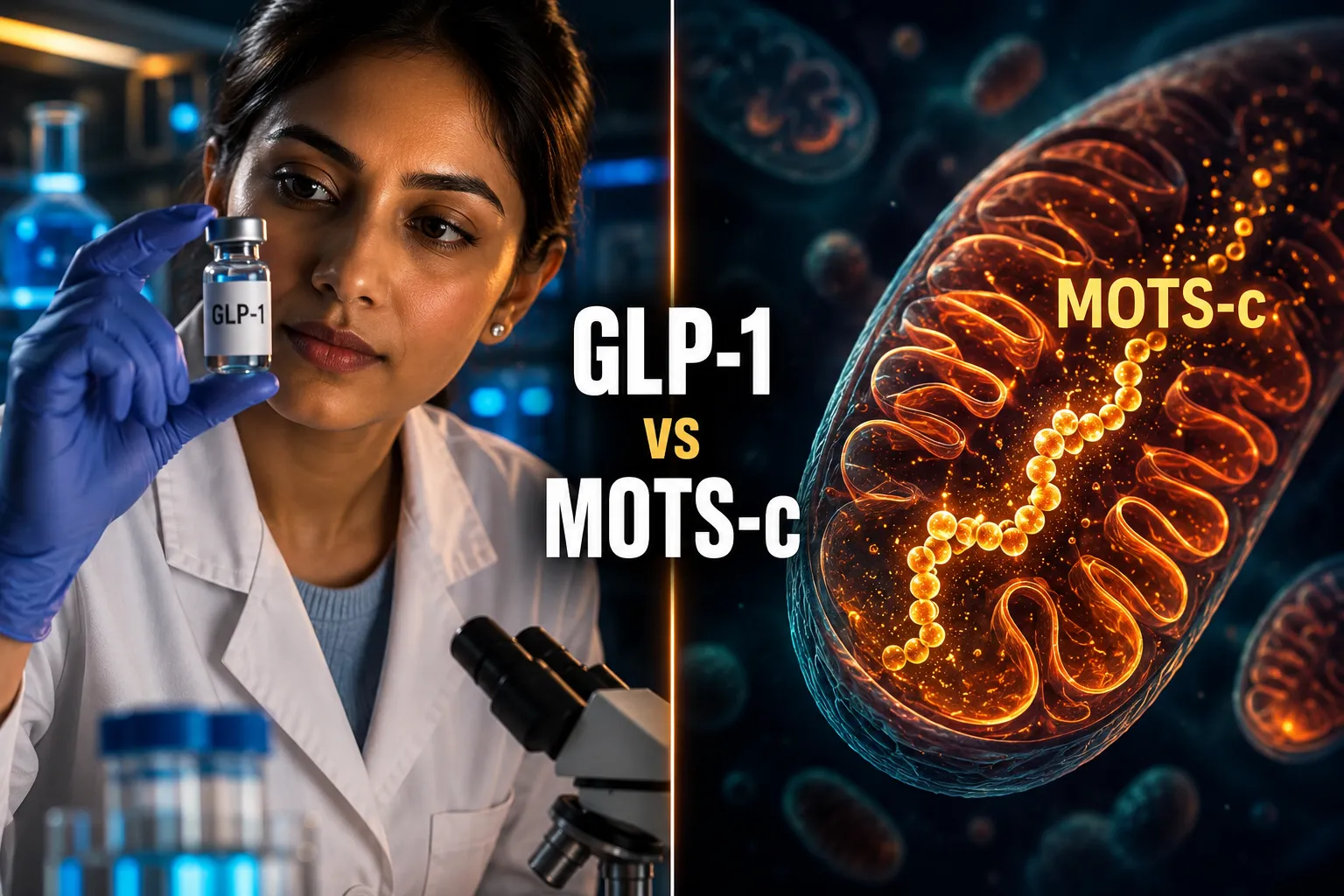
Two research areas illustrate the outsized physiological impact that short peptide chains can have: mitochondrial biology and innate immune modulation.
MOTS-c is a 16-amino acid peptide encoded within mitochondrial DNA, an unusual origin that places it outside the nuclear genome entirely. Research models examining MOTS-c and mitochondrial dynamics have linked this short chain to metabolic flexibility, insulin sensitivity, and stress response regulation. Its small size allows rapid intracellular transit, a pharmacokinetic advantage that larger polypeptides cannot replicate.
SS-31 (elamipretide) is a tetrapeptide, just four amino acids, that targets the inner mitochondrial membrane. Despite its minimal chain length, SS-31 research has examined its role in cardiolipin stabilization and mitochondrial membrane potential. Four residues, precisely arranged, are sufficient to engage a highly specific subcellular target.
On the immune side, BPC-157 at 15 amino acids sits in the mid-peptide range. BPC-157 research themes have investigated tissue repair signaling and mucosal integrity, with its moderate chain length providing a balance between tissue penetration and receptor engagement duration.
Epithalon, a tetrapeptide derived from the thymus, represents another short-chain compound with broad research interest. Epithalon research has explored telomere biology and cellular aging models, a reminder that four residues can carry significant biological information when the sequence is precise.
Pharmacokinetics, Delivery, and the Size-Stability Trade-Off
Peptides face a fundamental pharmacokinetic challenge: the same structural features that make them potent and selective also make them vulnerable. Proteases and peptidases in the gastrointestinal tract and bloodstream degrade most unmodified peptides within minutes. Oral bioavailability is typically low, which is why most research-grade peptides are administered parenterally.
Key size-related pharmacokinetic principles include:
- Shorter chains (< 10 residues) are cleared faster but distribute into tissues more readily.
- Mid-range peptides (10-50 residues) offer a window of improved stability with retained receptor specificity.
- Polypeptides (> 50 residues) may require structural modification (PEGylation, cyclization) to achieve clinically relevant half-lives.
Machine learning models are now being applied to predict which sequence modifications at specific residue positions will improve stability without altering receptor binding. This computational approach treats molecular size as a tunable parameter rather than a fixed property.
For researchers sourcing compounds like tesa, a 44-amino acid GHRH analog, or ipamorelin, a 5-amino acid ghrelin mimetic, understanding the size-stability relationship is essential for designing valid experimental protocols.
Conclusion
The study of peptides and polypeptides in human physiology: how molecular size shapes research applications is ultimately a study in precision. Chain length determines folding behavior, receptor compatibility, metabolic half-life, and delivery feasibility. Researchers who treat molecular size as a primary variable, rather than a background specification, gain a more predictive framework for designing experiments and interpreting results.
Actionable next steps for researchers:
- Map each compound in a study to its residue count and molecular weight before selecting an administration route.
- Cross-reference size data with known protease cleavage sites to anticipate degradation timelines.
- When working with polypeptide-derived fragments (e.g., proglucagon products), account for the parent precursor's folding behavior when modeling fragment activity.
- Explore AI-assisted sequence screening tools to identify size-optimized analogs for target pathways.
- Source compounds from verified suppliers with documented purity data to ensure that molecular weight specifications match actual product composition.
As the field advances in 2026, the intersection of structural biochemistry, computational design, and rigorous sourcing standards will define which peptide research programs yield reproducible, translatable findings.
Leave a Reply
Want to join the discussion?Feel free to contribute!