

Omeprazole and Famotidine in GLP-2-T Studies: Separating Acid Suppression From Intestinal Barrier Effects
Fewer than one pH unit of difference in luminal acidity is enough to alter epithelial permeability, reshape the gut microbiome, and either mask or amplify a peptide's barrier-tightening signal. Yet in many intestinal research protocols, the choice between a proton-pump inhibitor (PPI) and an H2 receptor antagonist (H2RA) is treated as a background detail rather than a true experimental variable. In studies examining GLP-2-T, a modified form of glucagon-like peptide-2 studied for its mucosal repair and barrier-protective properties, this oversight can produce misleading readouts. Understanding how omeprazole and famotidine in GLP-2-T studies: separating acid suppression from intestinal barrier effects demands a precise comparison of two pharmacologically distinct drug classes, their divergent effects on pH, microbiota, and tight-junction biology, and a structured framework for controlling them in intestinal, epithelial, and organoid systems.
Key Takeaways
- Omeprazole (PPI) and famotidine (H2RA) produce fundamentally different pH profiles, microbiome shifts, and off-target mucosal effects that can independently alter intestinal barrier readouts.
- GLP-2 itself inhibits gastric acid secretion, meaning GLP-2-T studies carry an intrinsic acid-modulating signal that must be distinguished from pharmacologic acid suppression.
- Transepithelial electrical resistance (TEER) and FITC-dextran flux, the two most common barrier endpoints, are pH-sensitive and require matched acid-control arms.
- Famotidine is preferred for short-duration experiments where modest, reversible acid blunting is needed; omeprazole suits multi-day models where sustained pH clamping is the deliberate goal.
- Treating the acid suppressor as a named experimental variable, not a background condition, is the single most impactful design change researchers can make in GLP-2-T barrier studies.
Why Acid Suppression Is Not a Neutral Background Condition
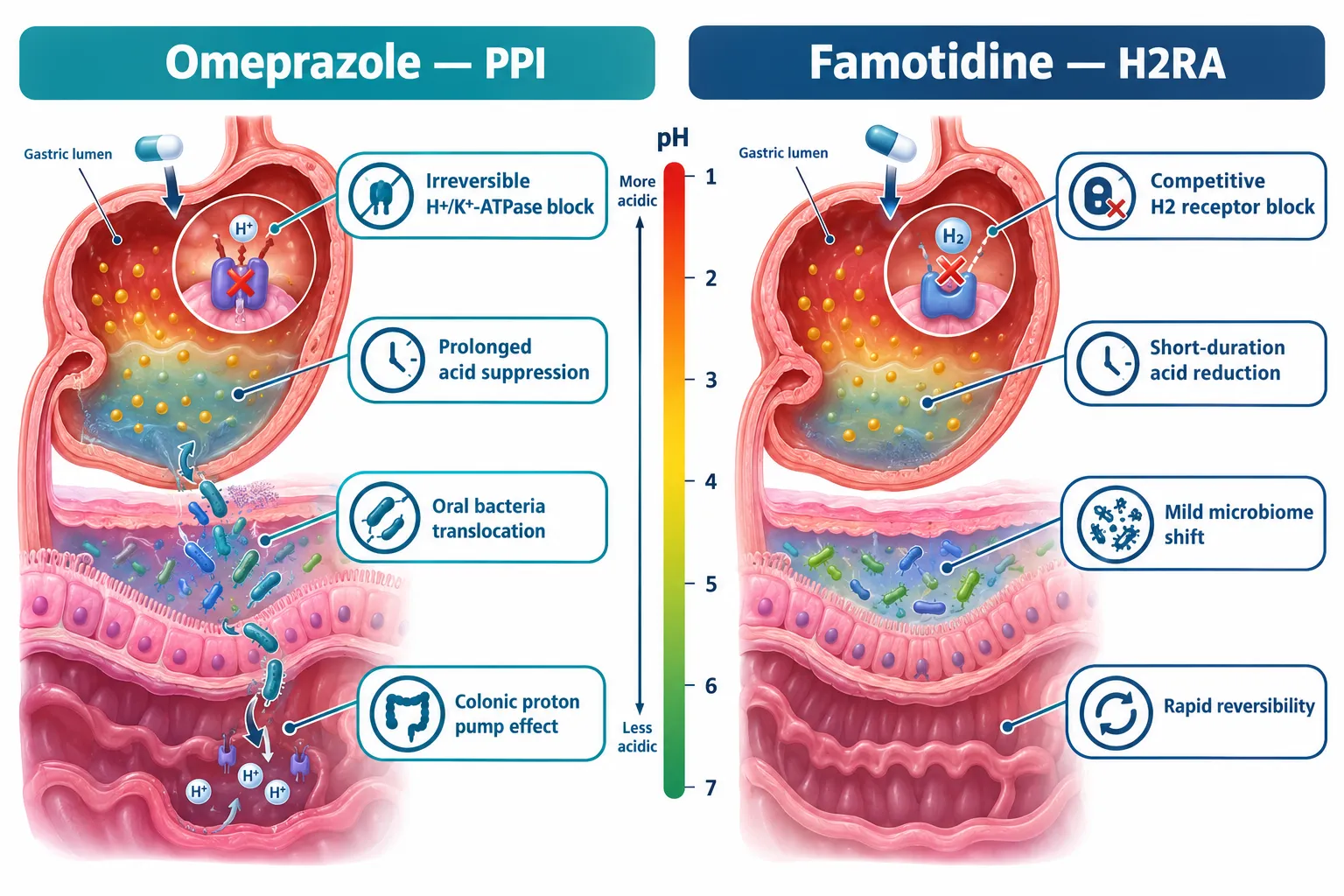
The assumption that acid-suppressive drugs simply "remove acid" and leave everything else unchanged is pharmacologically inaccurate. Omeprazole irreversibly inhibits the gastric H⁺/K⁺-ATPase, producing near-complete acid suppression for many hours even after the drug clears plasma. Famotidine competitively blocks H2 receptors, generating a shorter, milder, and fully reversible reduction in acid output.
These differences extend well beyond the stomach. Omeprazole also acts on colonic proton pumps, altering local electrolyte balance and immune tone. It induces smooth muscle relaxation and inhibits contractile activity, which can destabilize tight-junction regulation through the actin-myosin cytoskeleton, an effect entirely independent of gastric pH. In a longitudinal comparison (omeprazole 20 mg daily vs. famotidine 20 mg daily), the PPI produced significantly greater disruption of the gastric acid barrier and more pronounced translocation of oral bacteria into the lower gut, while famotidine caused milder, more localized changes. These microbiome shifts are not trivial: they alter the luminal environment in which GLP-2-T exerts its barrier effects.
Key pharmacodynamic differences:
| Feature | Omeprazole (PPI) | Famotidine (H2RA) |
|---|---|---|
| Mechanism | Irreversible H⁺/K⁺-ATPase inhibition | Competitive H2 receptor blockade |
| Duration of acid suppression | Prolonged (outlasts plasma half-life) | Shorter, dose-dependent |
| Microbiome impact | Greater oral-bacteria translocation | Milder shifts |
| Off-target mucosal effects | Colonic proton pump, smooth muscle | Minimal beyond acid reduction |
| Preferred use in GLP-2-T models | Multi-day sustained pH clamping | Short experiments under 12 hours |
For researchers sourcing compounds for controlled studies, reviewing GLP-3 RT peptide specifications alongside acid-suppressor selection is a practical starting point for protocol alignment.
GLP-2-T's Own Acid-Modulating Signal Complicates the Picture
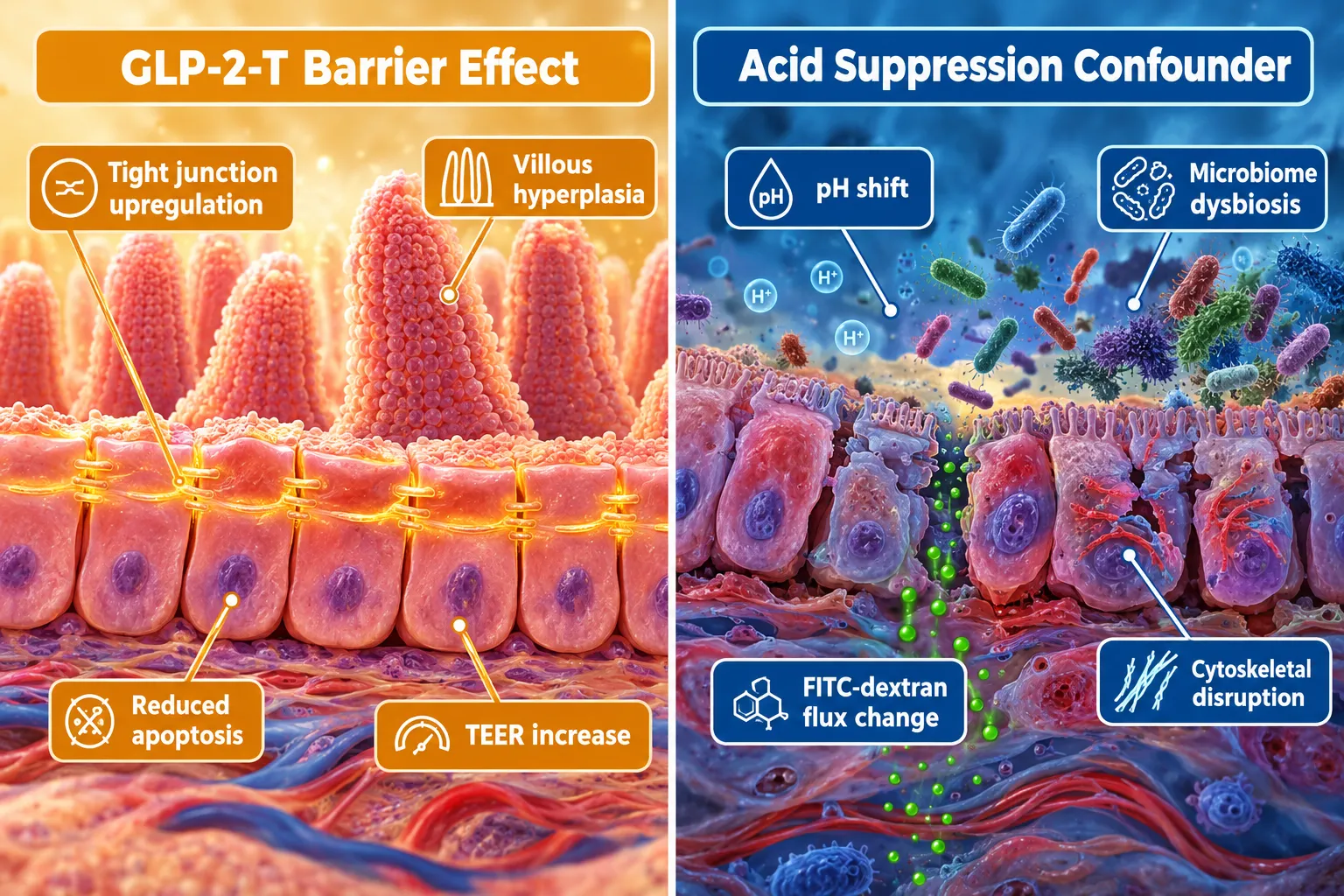
A critical and often overlooked fact is that GLP-2 itself inhibits gastric acid secretion, independent of any co-administered PPI or H2RA. In controlled human infusion studies, native GLP-2 reduced pentagastrin-stimulated gastric acid secretion by roughly 15% and sham-feeding-stimulated secretion by approximately 65%. The dominant mechanism appears to be suppression of parasympathetic pathways rather than direct inhibition of parietal cell function.
This means that in any GLP-2-T experiment, the peptide is already modulating luminal acidity. Layering omeprazole or famotidine on top creates a compound acid-suppression signal whose individual components are difficult to disentangle unless the design explicitly accounts for them. When barrier endpoints such as TEER or FITC-dextran flux improve in a GLP-2-T arm that also received a PPI, the improvement could reflect:
- Direct GLP-2-T effects on tight junctions and crypt cell proliferation
- Reduced luminal acid damaging the epithelium (PPI effect)
- Microbiome changes secondary to acid suppression
- Smooth muscle relaxation altering cytoskeletal tension (omeprazole-specific)
- Any combination of the above
"Treating the acid suppressor as a named experimental variable, not a background condition, is the single most impactful design change researchers can make in GLP-2-T barrier studies."
GLP-2's established biology reinforces this concern. The peptide stimulates crypt cell growth, promotes villous hyperplasia, reduces enterocyte apoptosis, suppresses epithelial permeability, increases intestinal blood flow, and improves nutrient absorption. These are robust, direct barrier-protective actions. But they occur alongside GLP-2-mediated reductions in gastric acid secretion and gastrointestinal motility, meaning the barrier signal is already multi-factorial before any drug is added.
For those exploring the broader landscape of GLP-related peptides, the GLP-3 peptide explained simply resource offers useful context on receptor biology. Researchers interested in sourcing reference compounds can also consult the best place to buy GLP guide for vendor evaluation criteria.
A Practical Framework for Omeprazole and Famotidine in GLP-2-T Studies: Separating Acid Suppression From Intestinal Barrier Effects
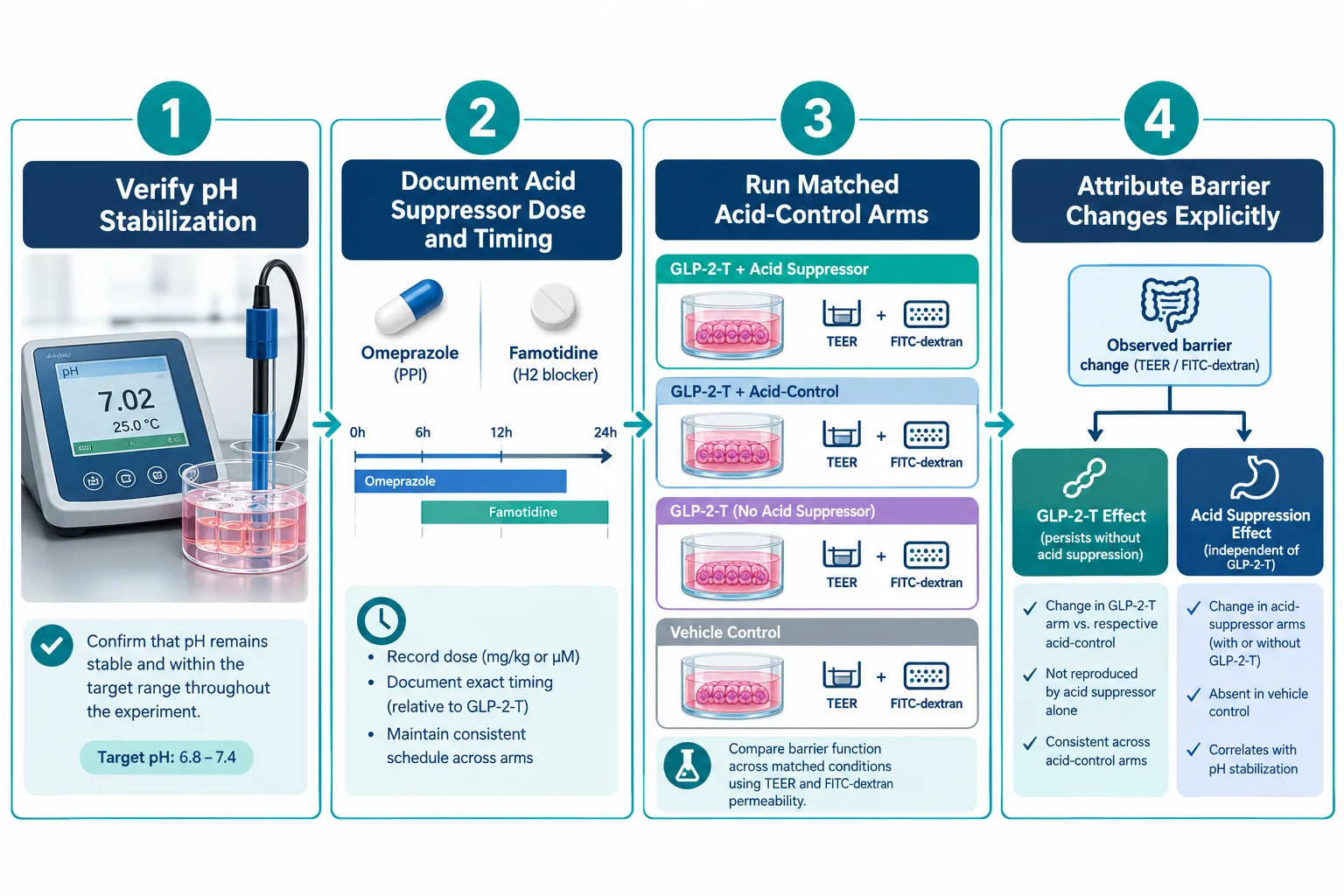
Current guidance on omeprazole and famotidine in GLP-2-T studies: separating acid suppression from intestinal barrier effects converges on four operational rules that apply equally to cell monolayer assays, organoid systems, and in vivo rodent models.
Step 1, Verify pH stabilization before introducing GLP-2-T.
Confirm that the chosen acid suppressor has reached its target pH range and that the system is stable. Introducing the peptide into a still-shifting pH environment conflates temporal acid changes with peptide-driven effects.
Step 2, Document the exact acid suppressor, dose, and time course.
This sounds obvious but is routinely omitted from methods sections. Stating "PPI was administered" without specifying omeprazole versus pantoprazole, dose, and dosing interval makes cross-study comparison impossible.
Step 3, Run matched acid-control arms.
Every GLP-2-T experiment should include:
- A vehicle-only arm (no acid suppressor, no peptide)
- An acid-suppressor-only arm (omeprazole or famotidine without GLP-2-T)
- A GLP-2-T-only arm (no acid suppressor)
- The combined arm (acid suppressor plus GLP-2-T)
This 2×2 factorial design allows direct attribution of TEER and FITC-dextran flux changes to acid suppression, GLP-2-T, or their interaction.
Step 4, Explicitly report the attribution.
Publication-ready methods must state whether observed barrier changes are attributable to acid suppression alone, GLP-2-T alone, or a synergistic interaction. In clinical management of short bowel syndrome, where both GLP-2 analogs and acid suppressors are used concurrently, this distinction is not merely academic; it informs dosing strategy.
Choosing between omeprazole and famotidine:
- Use famotidine when the experiment runs under 12 hours, when rapid and reversible pH elevation is the goal, or when minimizing microbiome disruption is a priority.
- Use omeprazole when the model deliberately incorporates strong, sustained acid suppression as a separate factor, for example, when studying mucosal repair in a high-acid damage model alongside GLP-2-T rescue.
This distinction also matters when comparing results against clinical data. PPIs outperform H2RAs in preventing gastroduodenal mucosal injury in high-risk patients, meaning omeprazole arms will produce an independent mucosal repair signal that must not be misread as GLP-2-T-specific barrier enhancement.
For researchers working with related peptide blends, the GLP-3R 30mg peptide GA9 and GLP3 RETA 20mg GA5 product pages provide formulation details relevant to multi-peptide experimental designs. Those examining visceral and metabolic endpoints alongside barrier function may also find the visceral fat research literature useful for contextualizing systemic readouts.
Conclusion
The core message for any laboratory working with GLP-2-T is straightforward: omeprazole and famotidine are not interchangeable background agents, they are active experimental variables with distinct pH profiles, microbiome consequences, and off-target mucosal effects that directly shape barrier readouts.
Actionable next steps for research teams:
- Audit existing protocols to identify whether the acid suppressor was treated as a variable or a background condition, and flag any published TEER or FITC-dextran data that lacked matched acid-control arms.
- Select the acid suppressor intentionally: famotidine for short, reversible, low-disruption experiments; omeprazole for sustained pH-clamping models where strong acid suppression is itself a study factor.
- Implement the 2×2 factorial design described above as a minimum standard for new GLP-2-T barrier studies.
- Account for GLP-2's intrinsic acid-suppressive effect in statistical models, it is a peptide-driven confounder that operates even in the absence of pharmacologic acid suppression.
- Report acid-suppressor identity, dose, and timing with the same rigor applied to the peptide itself.
Applying these principles will sharpen the signal-to-noise ratio in GLP-2-T research and produce barrier data that is genuinely attributable to the peptide rather than to its pharmacologic environment.