Call or Text 727-513-9780
  • Shopping Cart Shopping Cart
    0Shopping Cart
Pure Tested Peptides | America's most trusted Peptides for sale online
  • Peptides for sale
    • Oral Peptides for sale
      • Peptide Capsules for sale
      • BPC 157 Capsules 1000mcg
      • SLU-PP-332 Capsules | 1000 mcg
      • 5-Amino-1MQ 50mg Capsules
      • Tesofensine 500mcg
    • All Peptides for sale
    • Peptide Sprays
      • BPC 157 Nasal Spray Kit
      • BPC-157 TB500 Nasal Spray Kit
      • Semax Nasal Spray 10mg
      • Selank – Nasal Spray Kit – 10mg
      • Epithalon 50MG Nasal Spray Kit
      • Ipamorelin 10mg Nasal Spray
      • Klow Nasal Spray (BPC-157 + TB-500 + GHK-Cu + KPV) | 80mg
      • Hulk Nasal Spray Tesa / Ipa Blend 6/3 MG
      • Klow Nasal Spray
      • NAD + 500 mg Nasal Spray
      • PT-141 Nasal Spray Kit
    • GHRH Peptides
      • Ipa Peptides
      • CJC-1295 Peptides
        • CJC-1295 with DAC 5 mg
        • CJC-1295 without DAC 5 mg
        • CJC-1295 Ipa 10mg
      • Tesa Peptides
        • Tesa Peptide
        • Tesa 20 mg
    • GHK-Cu Peptides
      • All GHK-Cu Peptides
      • GHK-Cu 100mg
      • KLOW Peptide Blend – Buy KLOW blend online
    • BPC Peptides
      • All BPC Peptides
      • BPC-157
      • BPC-157 TB-500
      • BPC 157 capsules 1000mcg
    • SLU-PP-332 Peptides
      • All SLU-PP-332 Peptides
      • SLU-PP-332 5mg
    • GLP3 Peptides
    • PT-141 Peptides
      • PT-141 Peptides for sale
      • PT-141 10mg
      • PT-141 Nasal Spray
    • CAG Peptides
      • Lipo-C Peptide Blend
      • CAG 5mg
      • CAG 10mg
    • MOTS-C Peptides
      • MOTS-C Peptides for sale
      • MOTS-c peptide
      • MOTS-c 10mg *6 pack*
    • 5 Amino 1MQ Peptides
      • 5 Amino 1MQ Peptides for sale
      • 5-Amino-1MQ 50mg Capsules
      • 5-Amino-1MQ 5mg
    • Epithalon Peptides
      • Epithalon Peptides for sale
      • Epithalon 10mg
      • Epithalon 50mg
  • Shop
    • GLPs
      • 5-Amino-1MQ 50mg Capsules
      • 5-Amino-1MQ 5mg
      • L-Carnitine 500mg/ml
      • Tesofensine 500mcg
      • SLU-PP-332 5mg
      • MOTS-c 10mg *6 pack*
    • Epithalon & BPC Peptides
      • Epithalon 10mg
      • Epithalon 50mg
      • BPC-157
      • BPC 157 capsules 1000mcg
      • BPC-157 TB-500
      • BPC-157 TB500 Nasal Spray Kit
      • BPC 157 Nasal Spray Kit
    • BPC TB-500 & NAD+ Peptides
      • NAD+ 500 mg
      • KLOW Peptide Blend – Buy KLOW blend online
      • GLOW Peptide Blend
      • TB 500 5mg
      • BPC 157 capsules 1000mcg – Supplement
      • BPC 157 Nasal Spray Kit
      • BPC-157
      • BPC-157 TB500 Nasal Spray Kit
      • BPC-157 TB-500
      • BPC 157 capsules 1000mcg
    • LL-37 Peptide
      • LL-37 10 mg
    • MOTS-C & Selank
      • MOTS-c peptide
      • Selank 10mg
    • GHK Peptides
      • GHK-Cu 100mg
      • GLOW Peptide Blend
      • KLOW Peptide Blend – Buy KLOW blend online
  • COAs
  • Wholesale
    • Wholesale Peptides for sale
  • PTP FAQ
  • Affiliates
    • Selank Peptide: Advanced Pharmacological Mechanisms Underlying Its Anxiolytic and Nootropic Effects in Research
      • 5-Amino-1MQ Peptide: Detailed Mechanisms of NNMT Inhibition and Its Impact on Cellular Metabolism Research
        • MOTS-C Peptide: Unraveling Its Role in Mitochondrial Dynamics and Energy Metabolism Research
          • Epithalon Peptide and Telomerase Regulation: Investigating Its Impact on Cellular Senescence and Lifespan Research Models
            • GLP2-T vs GLP2 Tirz Peptide: Understanding the Naming, Mechanistic Nuances, and Research Implications for Gut Health
      • Peptides and Polypeptides in Modern Pharmacology: What Research on Metoprolol, Prednisone, and Amlodipine Reveals
        • Polypeptide Peptides vs NSAIDs: What Naproxen and Diclofenac Teach Tissue-Repair Researchers About BPC‑157 and TB‑500
          • Peptides and Polypeptides in Endocrine Pharmacology: How GLP-1, GLP-2, and GLP-3 Retatrutide Differ From Classic Drugs Like Prednisone and Amlodipine
          • 5‑Amino‑1MQ Peptide and NNMT Inhibition: How It Compares With Statins Like Atorvastatin in Adipose and Lipid Metabolism Research
      • Enclomiphene, Estrogen Receptor Signaling, and Luteinizing Phase Biology: What Hormone Researchers Should Measure
        • Mesenchymal Stem Cells, BPC‑157, and GHK‑Cu: How Tissue Repair Peptides Compare With Classic NSAIDs Like Naproxen in Injury Models
          • Peptide Calculator Use Cases Beyond Growth Hormone: Working Through GLP‑3 Retatrutide, MOTS‑c, and BPC‑157 Research Dosing
        • Polypeptide Peptides in Endocrine and Metabolic Pharmacology: Lessons From Amlodipine, Prednisone, and Metoprolol
        • Peptides Calculator for Advanced Blends: Worked Examples for Tesamorelin, CJC‑1295, and Ipamorelin Stacks
          • Peptides and Polypeptides in Human Physiology: How Molecular Size Shapes Research Applications
            • Selank Peptide: Advanced Pharmacological Mechanisms Underlying Its Anxiolytic and Nootropic Effects in Research
          • 5-Amino-1MQ Peptide: Detailed Mechanisms of NNMT Inhibition and Its Impact on Cellular Metabolism Research
            • MOTS-C Peptide: Unraveling Its Role in Mitochondrial Dynamics and Energy Metabolism Research
              • Epithalon Peptide and Telomerase Regulation: Investigating Its Impact on Cellular Senescence and Lifespan Research Models
                • GLP2-T vs GLP2 Tirz Peptide: Understanding the Naming, Mechanistic Nuances, and Research Implications for Gut Health
                  • Peptides and Polypeptides in Endocrine Pharmacology: How GLP-1, GLP-2, and GLP-3 Retatrutide Differ From Classic Drugs Like Prednisone and Amlodipine
                    • Polypeptide Peptides vs NSAIDs: What Naproxen and Diclofenac Teach Tissue-Repair Researchers About BPC‑157 and TB‑500
                      • Peptides and Polypeptides in Modern Pharmacology: What Research on Metoprolol, Prednisone, and Amlodipine Reveals
                        • 5‑Amino‑1MQ Peptide and NNMT Inhibition: How It Compares With Statins Like Atorvastatin in Adipose and Lipid Metabolism Research
                        • Enclomiphene, Estrogen Receptor Signaling, and Luteinizing Phase Biology: What Hormone Researchers Should Measure
                        • Mesenchymal Stem Cells, BPC‑157, and GHK‑Cu: How Tissue Repair Peptides Compare With Classic NSAIDs Like Naproxen in Injury Models
                        • Peptide Calculator Use Cases Beyond Growth Hormone: Working Through GLP‑3 Retatrutide, MOTS‑c, and BPC‑157 Research Dosing
                        • Polypeptide Peptides in Endocrine and Metabolic Pharmacology: Lessons From Amlodipine, Prednisone, and Metoprolol
                        • Peptides Calculator for Advanced Blends: Worked Examples for Tesamorelin, CJC‑1295, and Ipamorelin Stacks
                        • Peptides and Polypeptides in Human Physiology: How Molecular Size Shapes Research Applications
                        • Selank Peptide: Advanced Pharmacological Mechanisms Underlying Its Anxiolytic and Nootropic Effects in Research
                        • MOTS-C Peptide: Unraveling Its Role in Mitochondrial Dynamics and Energy Metabolism Research
                        • Peptides and Polypeptides in Modern Pharmacology: What Research on Metoprolol, Prednisone, and Amlodipine Reveals
                        • Peptides and Polypeptides in Endocrine Pharmacology: How GLP-1, GLP-2, and GLP-3 Retatrutide Differ From Classic Drugs Like Prednisone and Amlodipine
                        • 5-Amino-1MQ Peptide: Detailed Mechanisms of NNMT Inhibition and Its Impact on Cellular Metabolism Research
                        • Mesenchymal Stem Cells, BPC‑157, and GHK‑Cu: How Tissue Repair Peptides Compare With Classic NSAIDs Like Naproxen in Injury Models
                        • Peptide Calculator Use Cases Beyond Growth Hormone: Working Through GLP‑3 Retatrutide, MOTS‑c, and BPC‑157 Research Dosing
                        • GLP2-T vs GLP2 Tirz Peptide: Understanding the Naming, Mechanistic Nuances, and Research Implications for Gut Health
                        • Polypeptide Peptides in Endocrine and Metabolic Pharmacology: Lessons From Amlodipine, Prednisone, and Metoprolol
                        • Polypeptide Peptides vs NSAIDs: What Naproxen and Diclofenac Teach Tissue-Repair Researchers About BPC‑157 and TB‑500
                        • Peptides and Polypeptides in Human Physiology: How Molecular Size Shapes Research Applications
                        • Peptides Calculator for Advanced Blends: Worked Examples for Tesamorelin, CJC‑1295, and Ipamorelin Stacks
                        • 5‑Amino‑1MQ Peptide and NNMT Inhibition: How It Compares With Statins Like Atorvastatin in Adipose and Lipid Metabolism Research
                        • Enclomiphene, Estrogen Receptor Signaling, and Luteinizing Phase Biology: What Hormone Researchers Should Measure
                        • Epithalon Peptide and Telomerase Regulation: Investigating Its Impact on Cellular Senescence and Lifespan Research Models
                        • Best research protocol Klow blend
                        • best time to take BPC-157
                        • best time to take DSIP (Delta Sleep Inducing Peptide)
                        • best time to take CJC-1295
                        • best time to take AOD-9604
                        • best time to take Follistatin 344
                        • best time to take Ipamorelin
                        • best time to take MK-677 (Ibutamoren)
                        • best time to take Ligandrol (LGD-4033) — research compound
                        • best time to take Ostarine (MK-2866) — research compound
                        • best time to take GHK-CU
                        • best time to take TB-500
                        • best time to take MOTS-c
                        • best time to take Semax
                        • best time to take RAD-140 (Testolone) — research compound
                        • best time to take Thymosin Alpha-1
                        • best time to take PEG-MGF
                        • Biolife Plasma, Octapharma Plasma, and Research Peptides: How Plasma Donation Labs Differ From Peptide Suppliers
                        • best time to take YK-11 — research compound
                        • best time to take PT-141 (Bremelanotide)
                        • Best research protocol Klow blend
                        • 5-Amino-1MQ and MOTS-C Synergy: Metabolic Signaling, Mitochondria, and Research Design
                        • BPC-157 and TB-500: Investigating Their Combined Effects on Angiogenesis and Cellular Migration in Tissue Repair Models
                        • BPC-157 Peptide: Gut Barrier Function, Inflammation, and Tissue-Recovery Research
                        • 5‑Amino‑1MQ and MOTS‑c Synergy in Metabolic Research: Designing NNMT and Mitochondrial Biogenesis Stacks
                        • CJC-1295 with DAC vs. Without DAC: Half-Life, Release Kinetics, and Research Implications
                        • CJC‑1295 with DAC vs. Without DAC: Expanding on Half‑Life Differences Using Tesamorelin and Ipamorelin Blend Case Studies
                        • Collagen Biology and Copper‑Binding Peptides: How GHK‑Cu, Glow Blend, and Klow Blend Interact with Skin and Connective Tissue
                        • Collagen Biology and Regenerative Peptides: How GHK‑Cu, Glow Blend, and Klow Blend Affect Extracellular Matrix Research
                    • DNA, Telomeres, and Longevity Peptides: Positioning Epithalon and MOTS‑c in Genetic Aging Research
                      • Enclomiphene Citrate: serm Mechanism, Testosterone Research, and Stack Compatibility
                        • Enclomiphene vs Enclomiphene Citrate: Formulation, Bioavailability, and Research Distinctions
                        • Epithalon Peptide Research: Telomerase Activation, Aging, and Pineal Gland Function
                        • Estrogen Receptor Signaling and Enclomiphene: How Selective Modulators Compare with Classic Polypeptide Hormones
                        • GHK-Cu Peptide: Advanced Mechanisms in Extracellular Matrix Remodeling and Wound Healing Research
                        • GHK-Cu Peptide: Collagen Synthesis, Wound Repair, and Skin-Barrier Research Models
                        • GLP-1 vs GLP-3 vs GLP-2: Peptide Classification and Research Applications
                        • GLP-2 Peptide Research Guide: Gut Barrier Function, Nutrient Absorption, and Intestinal Recovery Models
                        • GLP-3 Retatrutide vs. GLP-1 Drugs: What Triple-Agonist Biology Changes in Research Models
                        • Ipamorelin and Tesamorelin Combination: Synergistic GH Secretagogue Research and Dosing Protocols
                        • GLP2 Tirz Peptide: What It Is, Why the Name Exists, and How Researchers Should Interpret It
                        • Klow Blend Peptide Nasal Spray: What the Formulation Is Trying to Do in Cognitive Research
                        • Mitochondria, NNMT Inhibition, and Peptide Modulators: Where MOTS‑c and 5‑Amino‑1MQ Fit in Cellular Energy Research
                        • MOTS-c Peptide: Mitochondrial Function, Energy Metabolism, and What Researchers Measure
                        • MOTS-c vs. 5-Amino-1MQ: Which Metabolic Research Questions Each Compound Actually Answers
                        • Nasal Spray Peptides: Bioavailability, Administration, and Semax/Selank Research Applications
                        • PT-141 Peptide Research: Mechanism of Action and Melanocortin Receptor Signaling
                        • Retatrutide for Research: Mechanism, Structure, and GLP-1/GLP-3 Dual Action
                        • Retatrutide for Obesity and Type 2 Diabetes: What the Latest Trial Data Suggest
                        • Tesofensine Peptide Research: Mechanism, Appetite Suppression, and Neuropeptide Y Pathways
  • Contact
    • Contact Customer Service
    • Text Customer Support
  • About US
  • Shop all peptides
  • Affiliate Program
    • Affiliate Signup
  • Login / Register Login / Register Page Link Login / Register Page Link
  • Click to open the search input field Click to open the search input field Search
  • Menu Menu

Tag Archive for: adipose liver co-culture

5-Amino-1MQ and MOTS-c in Adipose, Liver Co-Culture: Separating Lipid Flux From Mitochondrial Stress

5-Amino-1MQ and MOTS-c in Adipose, Liver Co-Culture: Separating Lipid Flux From Mitochondrial Stress

November 4, 2026/0 Comments/in Uncategorized/by

Most metabolic research still treats fat tissue and the liver as separate problems. That is a critical design flaw. When adipocytes flood the portal circulation with free fatty acids, the liver responds within minutes, triggering oxidative stress, altering NAD+ pools, and reshaping mitochondrial dynamics. Studying either organ alone produces an incomplete picture. Research into 5-Amino-1MQ and MOTS-c in adipose, liver co-culture: separating lipid flux from mitochondrial stress directly addresses this gap by forcing both cell types to respond to each other simultaneously.

Key Takeaways

  • 5-Amino-1MQ inhibits NNMT in adipose tissue, raising NAD+ and reducing fat mass in preclinical models
  • MOTS-c is a mitochondria-derived peptide that modulates lipid oxidation and reduces hepatic stress signals
  • Adipose, liver co-culture systems expose cross-tissue crosstalk invisible in single-organ studies
  • Separating lipid flux endpoints from mitochondrial stress markers is essential for clean mechanistic data
  • Neither compound has regulatory approval; all current findings are preclinical or early-stage research

How 5-Amino-1MQ Reshapes Adipose Lipid Flux

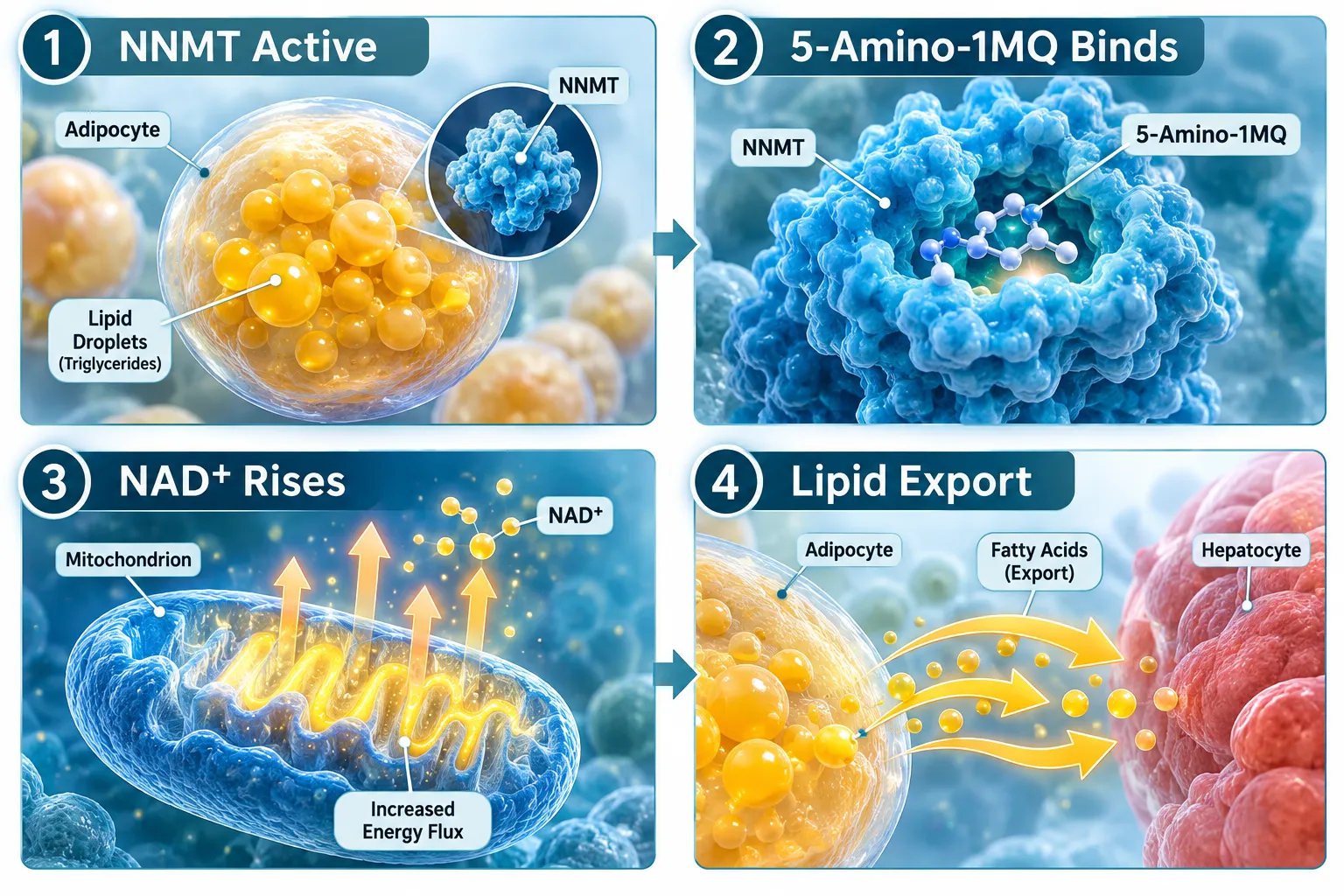
5-Amino-1MQ is a small-molecule inhibitor of nicotinamide N-methyltransferase (NNMT), an enzyme highly expressed in white adipose tissue. NNMT consumes S-adenosyl methionine and deflects nicotinamide away from the NAD+ biosynthesis pathway. By blocking NNMT, 5-Amino-1MQ restores NAD+ availability, shifts adipocytes toward higher energy expenditure, and promotes lipid mobilization.
How 5-Amino-1MQ Reshapes Adipose Lipid Flux

Preclinical mouse studies using high-fat diet models have reported fat mass reductions of roughly 7-9% over several weeks of treatment, without significant changes in lean body mass. Tissue distribution data suggest the compound reaches both adipose depots and hepatic tissue, meaning the liver is not a passive bystander, it receives the downstream lipid load generated when adipocytes begin exporting stored fat more aggressively.

This is precisely why co-culture design matters. When a researcher treats isolated adipocytes with 5-Amino-1MQ and measures only intracellular triglyceride, they miss what happens to the free fatty acids (FFAs) that leave those cells. In a co-culture format, those FFAs travel to co-plated hepatocytes, where they can either fuel beta-oxidation or overwhelm mitochondrial capacity and produce reactive oxygen species (ROS).

Key lipid flux readouts in adipose compartment:

  • Lipolysis rate (glycerol release assay)
  • Free fatty acid secretion into shared media
  • ATGL and HSL enzyme activity
  • Lipid droplet morphology via Oil Red O staining

Connecting these readouts to hepatocyte stress markers in real time is the core proposition of the co-culture model. Researchers interested in visceral fat research will recognize that visceral adipose tissue, in particular, drains directly into the portal vein, making the adipose-to-liver lipid relay clinically relevant.


MOTS-c: Mitochondrial Peptide, Cross-Tissue Signal

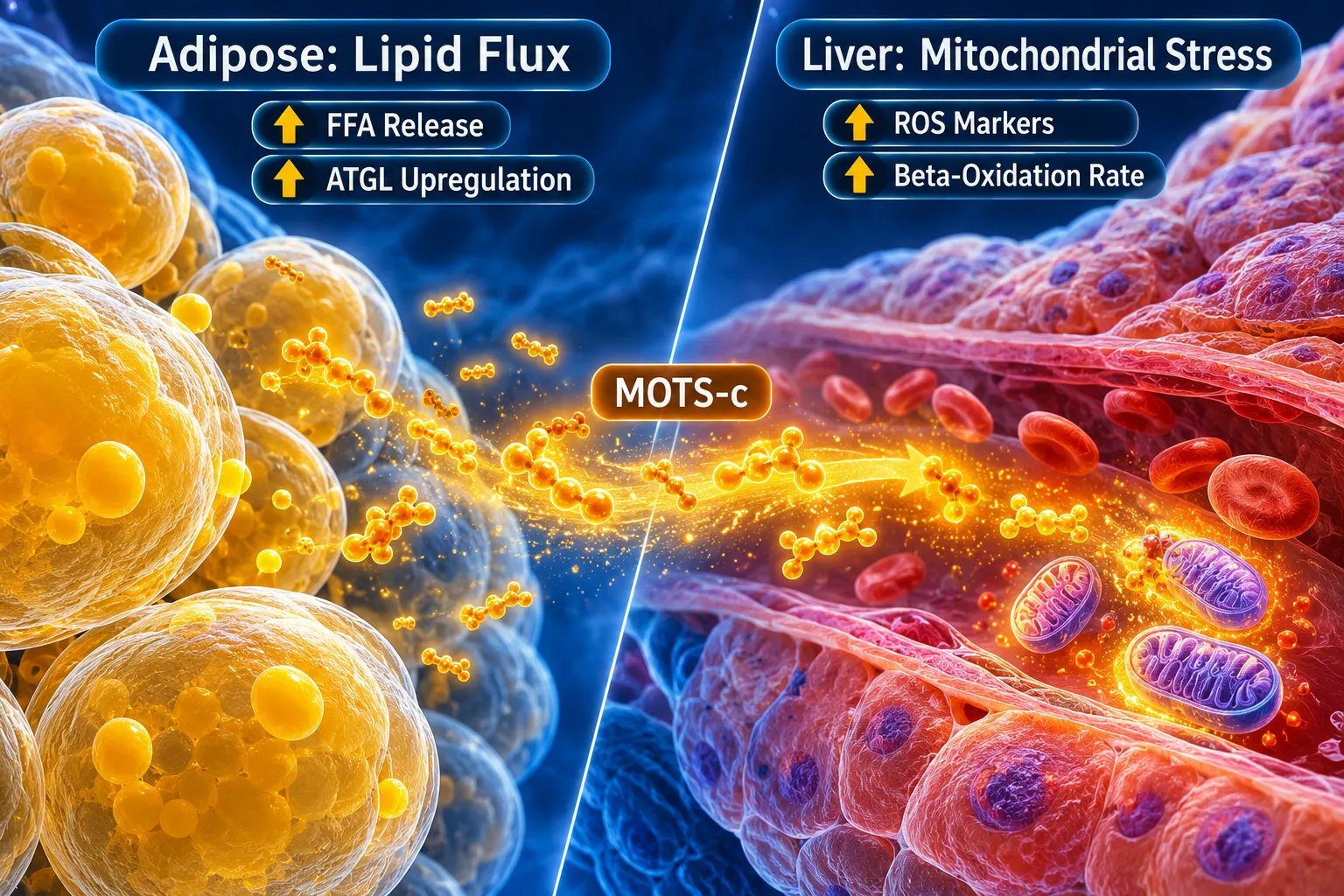
MOTS-c is a 16-amino acid peptide encoded within the 12S rRNA region of mitochondrial DNA. It is released from mitochondria in response to metabolic stress and functions as a retrograde signal that travels between tissues, including from muscle to adipose and from adipose to liver.
MOTS-c: Mitochondrial Peptide, Cross-Tissue Signal

In mouse models, MOTS-c administration has been shown to:

Outcome Adipose Effect Liver Effect
AMPK activation Increased fatty acid oxidation Reduced lipid accumulation
Mitochondrial biogenesis Modest upregulation Protective against steatosis
Inflammatory markers Reduced IL-6, TNF-alpha Lower NF-kB signaling
Insulin sensitivity Improved Improved glucose output

The separation challenge in co-culture is that MOTS-c appears to act on both compartments simultaneously. When both cell types are present, a measured drop in hepatocyte ROS could reflect direct MOTS-c action on liver mitochondria, or it could reflect reduced FFA delivery from MOTS-c-treated adipocytes upstream. Without isolating each signal, the mechanism remains ambiguous.

"The value of co-culture is not simplicity, it is the ability to see the conversation between tissues that single-cell studies never overhear."

This matters enormously for translational work. Research on SS31 mitochondrial dynamics shows how mitochondria-targeted peptides can produce overlapping readouts across tissues, reinforcing the need for careful experimental design. MOTS-c shares some mechanistic territory with NAD peptides in that both influence cellular energy status, though through distinct molecular routes.


Designing the Co-Culture Readout Framework

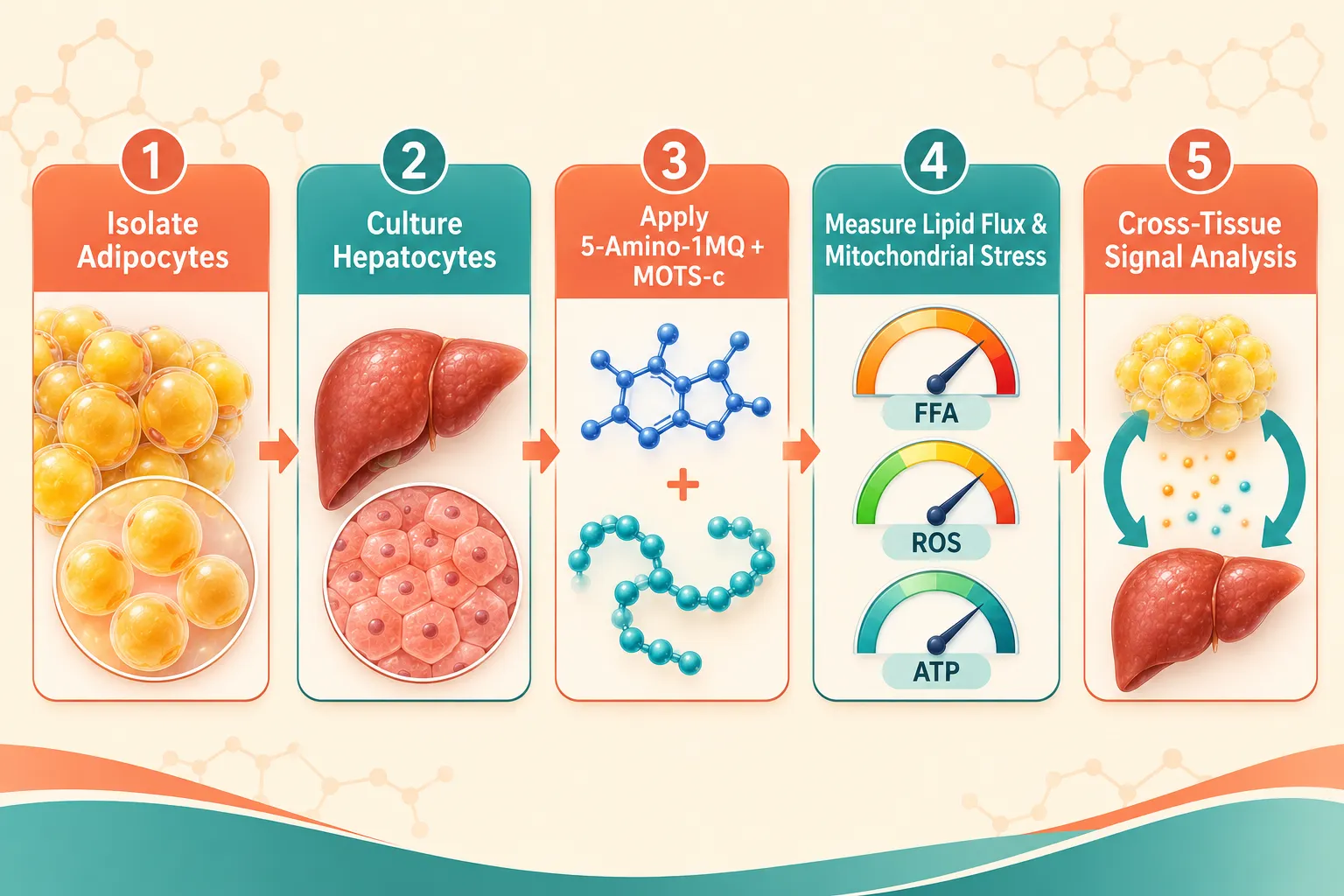
The practical goal of studying 5-Amino-1MQ and MOTS-c in adipose, liver co-culture: separating lipid flux from mitochondrial stress is to assign each measurable outcome to a defined biological process. That requires a layered readout strategy.
Designing the Co-Culture Readout Framework

Recommended co-culture readout tiers:

  1. Lipid flux tier, FFA concentration in conditioned media, hepatocyte lipid droplet area, VLDL secretion rate
  2. Mitochondrial stress tier, Mitochondrial membrane potential (JC-1 assay), ATP/ADP ratio, MitoSOX ROS measurement
  3. Inflammatory tier, IL-6, MCP-1, and TNF-alpha in shared supernatant
  4. Viability tier, LDH release, caspase-3 activity, live/dead cell staining in both compartments

The separation strategy works by applying 5-Amino-1MQ to the adipocyte compartment only, then observing whether hepatocyte mitochondrial stress changes even before MOTS-c is added. If it does, lipid flux from the adipocyte is independently driving hepatic stress. MOTS-c can then be applied to the hepatocyte compartment to quantify direct mitochondrial rescue independent of lipid input.

Combining both agents allows researchers to test a "mitochondrial stack" concept that has gained traction in SS31 peptides research circles, the idea that NAD+-boosting and mitochondria-stabilizing agents work additively rather than redundantly.

For context on how growth hormone-related peptides affect adipose partitioning, work on tesa dosage for fat loss offers a clinically relevant comparison point, since tesa specifically targets visceral depot reduction in a population where liver health is a co-concern.

Confounds to control:

  • Insulin concentration in shared media (affects both lipolysis and hepatic glucose output)
  • Culture duration (acute vs. chronic FFA exposure produces different hepatocyte responses)
  • Cell line vs. primary cell source (3T3-L1 adipocytes differ from primary stromal-vascular fraction)

Conclusion

The combined study of 5-Amino-1MQ and MOTS-c in adipose, liver co-culture: separating lipid flux from mitochondrial stress represents a methodological step forward that single-tissue models cannot replicate. The core insight is straightforward: adipose-driven lipid export and hepatic mitochondrial stress are not parallel processes, they are sequential, with the former often causing the latter.

Actionable next steps for researchers and informed readers:

  • Prioritize co-culture models with physically separated but media-connected compartments to maintain cross-tissue signaling while enabling compartment-specific sampling
  • Use tiered readouts (lipid flux, mitochondrial stress, inflammation, viability) rather than single endpoints
  • Apply 5-Amino-1MQ and MOTS-c sequentially and simultaneously to distinguish additive from synergistic effects
  • Consult preclinical data on related mitochondria-targeted peptides, including SS31 peptide research, to benchmark mitochondrial stress response magnitudes
  • Acknowledge the current regulatory status: both compounds remain research-stage as of 2026, with no clinical approval in any jurisdiction

As co-culture methodology matures and cross-tissue lipid signaling becomes better understood, the mechanistic clarity generated by this model will directly inform how metabolic compounds are developed, dosed, and combined in future therapeutic contexts.

https://www.puretestedpeptides.com/wp-content/uploads/2026/11/5-amino-1mq-and-mots-c-in-adipose-liver-co-culture-separating-lipid-flux-from-mi.webp 1024 1536 https://www.puretestedpeptides.com/wp-content/uploads/2026/01/buy-peptides-online.jpg 2026-11-04 14:05:142026-11-04 14:05:145-Amino-1MQ and MOTS-c in Adipose, Liver Co-Culture: Separating Lipid Flux From Mitochondrial Stress
×

Helpful Links

  • My account
  • Cart
  • Checkout
  • Refund and Returns Policy
  • Privacy Policy
  • SMS Privacy Policy
  • Login
  • My Account
  • Logout

USA Made Lab Tested Peptides

All products are sold for research, laboratory, or analytical purposes only, and are not for human consumption


Pure Tested Peptides is a chemical supplier. Pure Tested Peptides is not a compounding / chemical compounding facility as defined under 503A of the Federal Food, Drug, and Cosmetic act. Pure Tested Peptides is not an outsourcing facility as defined under 503B of the Federal Food, Drug, and Cosmetic act.

The statements made within this website have not been evaluated by the US Food and Drug Administration. The products we offer are not intended to diagnose, treat, cure or prevent any disease.

Human/Animal Consumption Prohibited. Laboratory/In-Vitro Experimental Use Only

Scroll to top Scroll to top Scroll to top