

Retatrutide and Sleep Apnea Research: Separating AHI, Body-Weight, Glycemic, and Respiratory Endpoints
Roughly one billion adults worldwide live with obstructive sleep apnea, yet until 2026 no pharmacologic agent had demonstrated large, sustained reductions in the apnea-hypopnea index (AHI) across a rigorous phase 3 program. The phase 3 TRIUMPH-1-OSA and TRIUMPH-2-OSA trials changed that picture dramatically. For researchers tracking Retatrutide and Sleep Apnea Research: Separating AHI, Body-Weight, Glycemic, and Respiratory Endpoints, the central challenge is not whether the drug works, the trial data make a strong case that it does, but how to determine why it works and which benefits are truly independent of weight loss.
Key Takeaways
- Retatrutide, a triple GIP/GLP-1/glucagon receptor agonist, reduced AHI by up to 34.3 events/hour in participants without diabetes and up to 25.4 events/hour in those with type 2 diabetes versus placebo.
- AHI is the prespecified primary endpoint in the TRIUMPH OSA trials; body-weight and glycemic measures are separate secondary or exploratory endpoints.
- Researchers must model AHI changes after adjusting for concurrent weight loss and glycemic improvements to identify direct respiratory effects.
- Additional respiratory endpoints, hypoxic burden, PROMIS sleep impairment scores, and functional-cure proportions, capture symptom relief independent of scale readouts.
- As of late 2026, retatrutide has no regulatory approval for OSA or obesity; all findings remain investigational.
What Makes Retatrutide Uniquely Relevant to Sleep Apnea
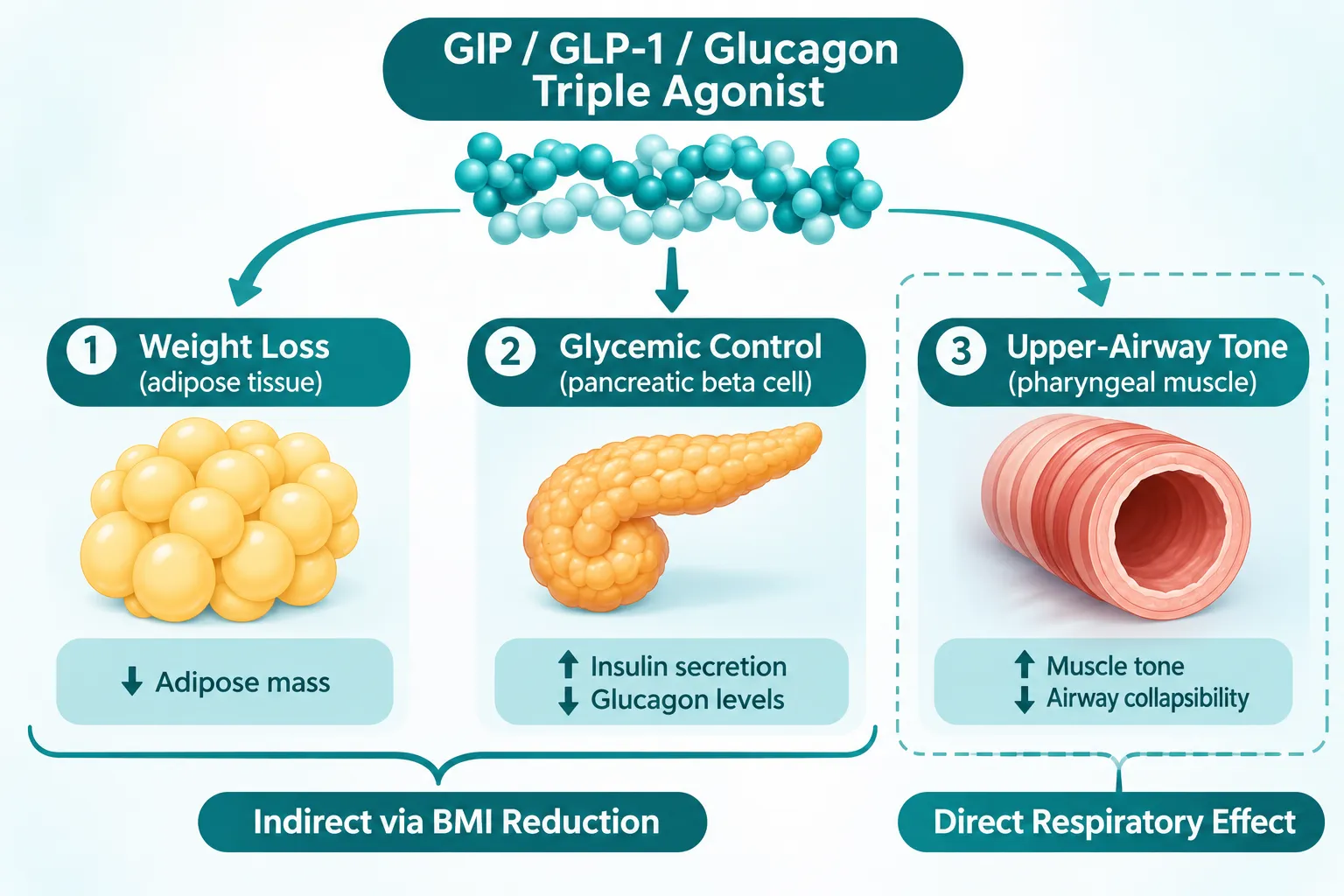
Retatrutide is a once-weekly injectable peptide that activates three receptors simultaneously: glucose-dependent insulinotropic polypeptide (GIP), glucagon-like peptide-1 (GLP-1), and glucagon. This triple mechanism drives potent weight loss, improves insulin sensitivity, and enhances fat oxidation. Phase 2 data showed roughly 24% mean weight loss at 48 weeks with the 12 mg dose, one of the largest reductions ever recorded for a pharmacologic agent.
That weight-loss magnitude matters for sleep apnea because upper-airway collapsibility is closely tied to parapharyngeal fat deposition and body mass. However, the GLP-1 and glucagon arms of the molecule may also affect ventilatory control and airway muscle tone through pathways that do not require weight change. This is the core question driving the endpoint-separation framework in retatrutide OSA research.
For context on how this agent fits within the broader incretin-peptide research landscape, see the overview of GLP-1 peptide generational research concepts and sourcing notes.
The TRIUMPH OSA Endpoint Architecture: AHI, Body-Weight, Glycemic, and Respiratory Outcomes Defined Separately
Understanding the trial design is essential before interpreting any single number.
TRIUMPH-1-OSA enrolled participants with obesity or overweight plus moderate-to-severe OSA but without type 2 diabetes. TRIUMPH-2-OSA enrolled participants with obesity/overweight, OSA, and type 2 diabetes. Both trials ran for 80 weeks with three active doses (4, 9, and 12 mg) plus placebo.
Primary Endpoint: AHI
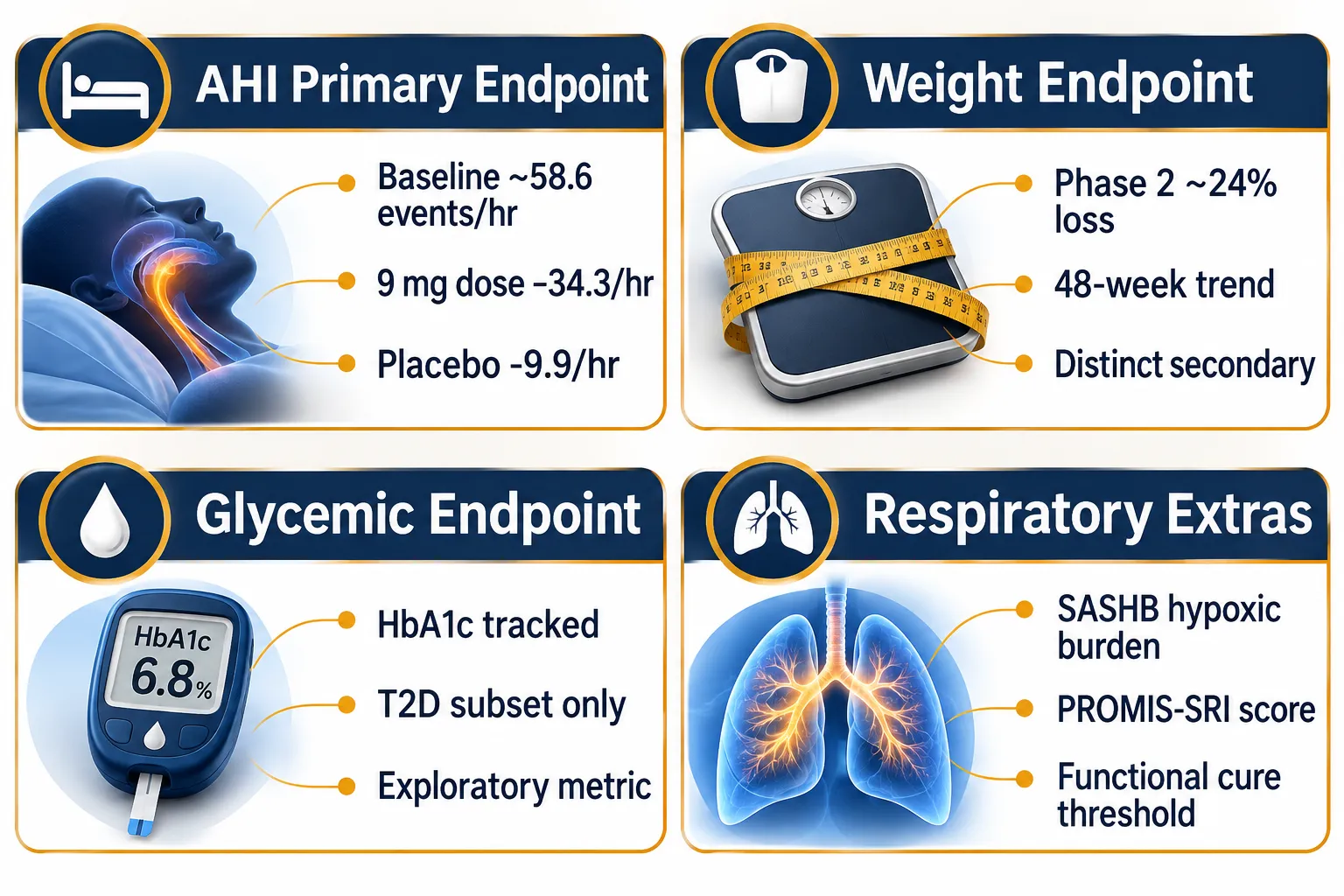
AHI, the number of apnea and hypopnea events per hour of sleep, is the prespecified primary endpoint. Results were striking:
| Trial | Dose | AHI Change (events/hr) | Placebo Change |
|---|---|---|---|
| TRIUMPH-1-OSA | 4 mg | -22.9 | -9.9 |
| TRIUMPH-1-OSA | 9 mg | -34.3 | -9.9 |
| TRIUMPH-1-OSA | 12 mg | -31.7 | -9.9 |
| TRIUMPH-2-OSA | 9 mg | -24.7 | -10.3 |
| TRIUMPH-2-OSA | 12 mg | -25.4 | -10.3 |
In participants with moderate-to-severe OSA at baseline (mean ~58.6 events/hour), retatrutide reduced AHI by up to 36.1 events/hour, a 60.6% reduction from baseline.
Secondary and Exploratory Endpoints
The trial structure deliberately keeps weight and glycemic outcomes analytically distinct from sleep-apnea outcomes:
- Weight endpoints: Percentage body-weight change from baseline, proportion achieving 5%, 10%, and 15% weight loss thresholds.
- Glycemic endpoints (TRIUMPH-2-OSA only): HbA1c change from baseline, fasting glucose.
- Respiratory endpoints beyond AHI: Sleep Apnea-Specific Hypoxic Burden (SASHB), proportion achieving ≥50% AHI reduction, and proportion reaching a "functional cure" (AHI below 5, or AHI 5-14 combined with Epworth Sleepiness Scale score of 10 or lower).
- Patient-reported outcomes: PROMIS Sleep-Related Impairment (PROMIS-SRI) scores.
This separation means a participant who loses 20% of body weight and simultaneously halves their AHI can be analyzed for both outcomes, but neither is used as a covariate to define the other unless a mediation analysis is explicitly run.
Researchers interested in ongoing retatrutide clinical trial updates will find that this endpoint architecture also mirrors the master protocol entries covering knee osteoarthritis subsets, where musculoskeletal and metabolic outcomes are similarly separated.
Separating Direct Respiratory Effects from Weight-Mediated Benefits
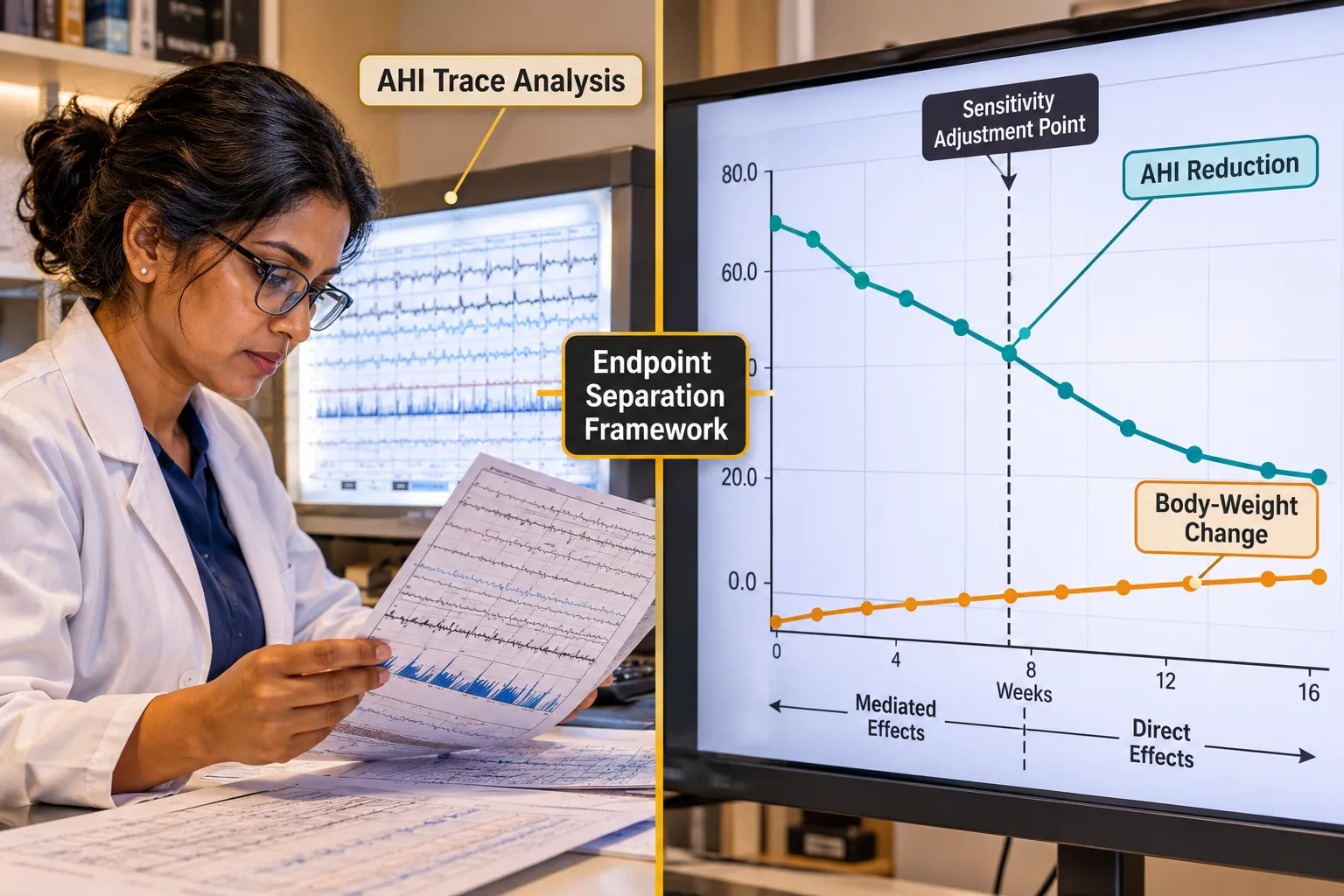
The most scientifically important question in Retatrutide and Sleep Apnea Research: Separating AHI, Body-Weight, Glycemic, and Respiratory Endpoints is whether AHI improvements persist after statistically accounting for weight loss and glycemic change.
Why This Matters
If AHI reduction is entirely explained by weight loss, retatrutide's respiratory profile is essentially identical to any potent anti-obesity agent. If AHI improves beyond what weight loss alone would predict, direct neurochemical or mechanical effects on the upper airway are implicated, a meaningfully different clinical story.
"Modeling AHI changes after adjusting for concurrent weight loss and glycemic improvements is the definitive test of whether retatrutide exerts independent effects on upper-airway collapsibility or ventilatory control."
Tools for Endpoint Separation
Researchers and trial statisticians use several approaches:
- Covariate-adjusted models: Include percentage weight change and HbA1c change as covariates when modeling AHI; residual AHI improvement represents the weight- and glycemia-independent fraction.
- Mediation analysis: Formally partition total AHI effect into a portion mediated by weight loss versus a direct pathway.
- Subgroup analyses by weight-loss tertile: Compare AHI outcomes among participants with minimal, moderate, and large weight loss to visualize dose-response separation.
- Hypoxic burden as a companion metric: SASHB captures oxygen desaturation severity in a way that is less confounded by body habitus than raw AHI, offering an additional independent respiratory signal.
The proportion achieving ≥50% AHI reduction and the functional-cure threshold are also valuable here because they represent all-or-nothing categorical outcomes that can be modeled with logistic regression including weight change as a covariate.
For researchers exploring additional metabolic-protection tools alongside this work, the SS-31 mitochondrial research themes page outlines complementary cellular-energy approaches sometimes studied in parallel with metabolic interventions.
Regulatory and Research Implications for 2026 and Beyond
Eli Lilly's likely regulatory strategy, based on publicly available investor communications and trial registrations, involves seeking multi-indication labeling covering obesity/overweight and OSA, potentially alongside knee osteoarthritis. For an OSA submission, regulators will likely scrutinize:
- Magnitude and durability of AHI reduction over 80 weeks
- Independence of AHI benefit from weight and glycemic changes in prespecified sensitivity analyses
- Hypoxic burden and patient-reported sleep impairment as supporting endpoints capturing meaningful symptom relief
For researchers sourcing the compound for preclinical endpoint-testing work, the Reta 10mg product page and GLP3 RETA CAG 10mg product listing provide formulation details relevant to study design. Those planning longer-term procurement can also review how to buy Reta for sourcing guidance.
As of late 2026, retatrutide has no approved indication for OSA or obesity. All data discussed here are from investigational trials and should not be interpreted as clinical guidance.
Conclusion
Retatrutide and Sleep Apnea Research: Separating AHI, Body-Weight, Glycemic, and Respiratory Endpoints is not merely an academic exercise, it defines how the field will understand, approve, and eventually prescribe this class of agent for sleep-disordered breathing. The TRIUMPH trial architecture is explicitly built for this separation, with AHI as the primary outcome and weight/glycemic metrics tracked in parallel rather than conflated.
Actionable next steps for researchers:
- Design mediation and covariate-adjustment analyses before unblinding to avoid post-hoc inflation.
- Treat SASHB and PROMIS-SRI as primary companion metrics alongside raw AHI, since they capture aspects of respiratory impairment that body-weight change does not explain.
- Monitor Lilly's regulatory submissions closely; the sensitivity analyses submitted to the FDA will be the definitive public record of how much AHI benefit survives weight-loss adjustment.
- Preclinical researchers should align endpoint panels to mirror trial endpoints, AHI analogs, hypoxic-burden surrogates, and metabolic markers, so translational comparisons remain valid.
The convergence of triple-receptor pharmacology, rigorous endpoint separation, and 80-week durability data positions retatrutide as a potential landmark in sleep-apnea pharmacotherapy. Whether that potential translates into regulatory approval depends squarely on how cleanly the respiratory endpoints stand apart from the weight story.