Call or Text 727-513-9780
  • Shopping Cart Shopping Cart
    0Shopping Cart
Pure Tested Peptides | America's most trusted Peptides for sale online
  • Peptides for sale
    • Oral Peptides for sale
      • Peptide Capsules for sale
      • BPC 157 Capsules 1000mcg
      • SLU-PP-332 Capsules | 1000 mcg
      • 5-Amino-1MQ 50mg Capsules
      • Tesofensine 500mcg
    • All Peptides for sale
    • Peptide Sprays
      • BPC 157 Nasal Spray Kit
      • BPC-157 TB500 Nasal Spray Kit
      • Semax Nasal Spray 10mg
      • Selank – Nasal Spray Kit – 10mg
      • Epithalon 50MG Nasal Spray Kit
      • Ipamorelin 10mg Nasal Spray
      • Klow Nasal Spray (BPC-157 + TB-500 + GHK-Cu + KPV) | 80mg
      • Hulk Nasal Spray Tesa / Ipa Blend 6/3 MG
      • Klow Nasal Spray
      • NAD + 500 mg Nasal Spray
      • PT-141 Nasal Spray Kit
    • GHRH Peptides
      • Ipa Peptides
      • CJC-1295 Peptides
        • CJC-1295 with DAC 5 mg
        • CJC-1295 without DAC 5 mg
        • CJC-1295 Ipa 10mg
      • Tesa Peptides
        • Tesa Peptide
        • Tesa 20 mg
    • GHK-Cu Peptides
      • All GHK-Cu Peptides
      • GHK-Cu 100mg
      • KLOW Peptide Blend – Buy KLOW blend online
    • BPC Peptides
      • All BPC Peptides
      • BPC-157
      • BPC-157 TB-500
      • BPC 157 capsules 1000mcg
    • SLU-PP-332 Peptides
      • All SLU-PP-332 Peptides
      • SLU-PP-332 5mg
    • GLP3 Peptides
    • PT-141 Peptides
      • PT-141 Peptides for sale
      • PT-141 10mg
      • PT-141 Nasal Spray
    • CAG Peptides
      • Lipo-C Peptide Blend
      • CAG 5mg
      • CAG 10mg
    • MOTS-C Peptides
      • MOTS-C Peptides for sale
      • MOTS-c peptide
      • MOTS-c 10mg *6 pack*
    • 5 Amino 1MQ Peptides
      • 5 Amino 1MQ Peptides for sale
      • 5-Amino-1MQ 50mg Capsules
      • 5-Amino-1MQ 5mg
    • Epithalon Peptides
      • Epithalon Peptides for sale
      • Epithalon 10mg
      • Epithalon 50mg
  • Shop
    • GLPs
      • 5-Amino-1MQ 50mg Capsules
      • 5-Amino-1MQ 5mg
      • L-Carnitine 500mg/ml
      • Tesofensine 500mcg
      • SLU-PP-332 5mg
      • MOTS-c 10mg *6 pack*
    • Epithalon & BPC Peptides
      • Epithalon 10mg
      • Epithalon 50mg
      • BPC-157
      • BPC 157 capsules 1000mcg
      • BPC-157 TB-500
      • BPC-157 TB500 Nasal Spray Kit
      • BPC 157 Nasal Spray Kit
    • BPC TB-500 & NAD+ Peptides
      • NAD+ 500 mg
      • KLOW Peptide Blend – Buy KLOW blend online
      • GLOW Peptide Blend
      • TB 500 5mg
      • BPC 157 capsules 1000mcg – Supplement
      • BPC 157 Nasal Spray Kit
      • BPC-157
      • BPC-157 TB500 Nasal Spray Kit
      • BPC-157 TB-500
      • BPC 157 capsules 1000mcg
    • LL-37 Peptide
      • LL-37 10 mg
    • MOTS-C & Selank
      • MOTS-c peptide
      • Selank 10mg
    • GHK Peptides
      • GHK-Cu 100mg
      • GLOW Peptide Blend
      • KLOW Peptide Blend – Buy KLOW blend online
  • COAs
  • Wholesale
    • Wholesale Peptides for sale
  • PTP FAQ
  • Affiliates
    • Selank Peptide: Advanced Pharmacological Mechanisms Underlying Its Anxiolytic and Nootropic Effects in Research
      • 5-Amino-1MQ Peptide: Detailed Mechanisms of NNMT Inhibition and Its Impact on Cellular Metabolism Research
        • MOTS-C Peptide: Unraveling Its Role in Mitochondrial Dynamics and Energy Metabolism Research
          • Epithalon Peptide and Telomerase Regulation: Investigating Its Impact on Cellular Senescence and Lifespan Research Models
            • GLP2-T vs GLP2 Tirz Peptide: Understanding the Naming, Mechanistic Nuances, and Research Implications for Gut Health
      • Peptides and Polypeptides in Modern Pharmacology: What Research on Metoprolol, Prednisone, and Amlodipine Reveals
        • Polypeptide Peptides vs NSAIDs: What Naproxen and Diclofenac Teach Tissue-Repair Researchers About BPC‑157 and TB‑500
          • Peptides and Polypeptides in Endocrine Pharmacology: How GLP-1, GLP-2, and GLP-3 Retatrutide Differ From Classic Drugs Like Prednisone and Amlodipine
          • 5‑Amino‑1MQ Peptide and NNMT Inhibition: How It Compares With Statins Like Atorvastatin in Adipose and Lipid Metabolism Research
      • Enclomiphene, Estrogen Receptor Signaling, and Luteinizing Phase Biology: What Hormone Researchers Should Measure
        • Mesenchymal Stem Cells, BPC‑157, and GHK‑Cu: How Tissue Repair Peptides Compare With Classic NSAIDs Like Naproxen in Injury Models
          • Peptide Calculator Use Cases Beyond Growth Hormone: Working Through GLP‑3 Retatrutide, MOTS‑c, and BPC‑157 Research Dosing
        • Polypeptide Peptides in Endocrine and Metabolic Pharmacology: Lessons From Amlodipine, Prednisone, and Metoprolol
        • Peptides Calculator for Advanced Blends: Worked Examples for Tesamorelin, CJC‑1295, and Ipamorelin Stacks
          • Peptides and Polypeptides in Human Physiology: How Molecular Size Shapes Research Applications
            • Selank Peptide: Advanced Pharmacological Mechanisms Underlying Its Anxiolytic and Nootropic Effects in Research
          • 5-Amino-1MQ Peptide: Detailed Mechanisms of NNMT Inhibition and Its Impact on Cellular Metabolism Research
            • MOTS-C Peptide: Unraveling Its Role in Mitochondrial Dynamics and Energy Metabolism Research
              • Epithalon Peptide and Telomerase Regulation: Investigating Its Impact on Cellular Senescence and Lifespan Research Models
                • GLP2-T vs GLP2 Tirz Peptide: Understanding the Naming, Mechanistic Nuances, and Research Implications for Gut Health
                  • Peptides and Polypeptides in Endocrine Pharmacology: How GLP-1, GLP-2, and GLP-3 Retatrutide Differ From Classic Drugs Like Prednisone and Amlodipine
                    • Polypeptide Peptides vs NSAIDs: What Naproxen and Diclofenac Teach Tissue-Repair Researchers About BPC‑157 and TB‑500
                      • Peptides and Polypeptides in Modern Pharmacology: What Research on Metoprolol, Prednisone, and Amlodipine Reveals
                        • 5‑Amino‑1MQ Peptide and NNMT Inhibition: How It Compares With Statins Like Atorvastatin in Adipose and Lipid Metabolism Research
                        • Enclomiphene, Estrogen Receptor Signaling, and Luteinizing Phase Biology: What Hormone Researchers Should Measure
                        • Mesenchymal Stem Cells, BPC‑157, and GHK‑Cu: How Tissue Repair Peptides Compare With Classic NSAIDs Like Naproxen in Injury Models
                        • Peptide Calculator Use Cases Beyond Growth Hormone: Working Through GLP‑3 Retatrutide, MOTS‑c, and BPC‑157 Research Dosing
                        • Polypeptide Peptides in Endocrine and Metabolic Pharmacology: Lessons From Amlodipine, Prednisone, and Metoprolol
                        • Peptides Calculator for Advanced Blends: Worked Examples for Tesamorelin, CJC‑1295, and Ipamorelin Stacks
                        • Peptides and Polypeptides in Human Physiology: How Molecular Size Shapes Research Applications
                        • Selank Peptide: Advanced Pharmacological Mechanisms Underlying Its Anxiolytic and Nootropic Effects in Research
                        • MOTS-C Peptide: Unraveling Its Role in Mitochondrial Dynamics and Energy Metabolism Research
                        • Peptides and Polypeptides in Modern Pharmacology: What Research on Metoprolol, Prednisone, and Amlodipine Reveals
                        • Peptides and Polypeptides in Endocrine Pharmacology: How GLP-1, GLP-2, and GLP-3 Retatrutide Differ From Classic Drugs Like Prednisone and Amlodipine
                        • 5-Amino-1MQ Peptide: Detailed Mechanisms of NNMT Inhibition and Its Impact on Cellular Metabolism Research
                        • Mesenchymal Stem Cells, BPC‑157, and GHK‑Cu: How Tissue Repair Peptides Compare With Classic NSAIDs Like Naproxen in Injury Models
                        • Peptide Calculator Use Cases Beyond Growth Hormone: Working Through GLP‑3 Retatrutide, MOTS‑c, and BPC‑157 Research Dosing
                        • GLP2-T vs GLP2 Tirz Peptide: Understanding the Naming, Mechanistic Nuances, and Research Implications for Gut Health
                        • Polypeptide Peptides in Endocrine and Metabolic Pharmacology: Lessons From Amlodipine, Prednisone, and Metoprolol
                        • Polypeptide Peptides vs NSAIDs: What Naproxen and Diclofenac Teach Tissue-Repair Researchers About BPC‑157 and TB‑500
                        • Peptides and Polypeptides in Human Physiology: How Molecular Size Shapes Research Applications
                        • Peptides Calculator for Advanced Blends: Worked Examples for Tesamorelin, CJC‑1295, and Ipamorelin Stacks
                        • 5‑Amino‑1MQ Peptide and NNMT Inhibition: How It Compares With Statins Like Atorvastatin in Adipose and Lipid Metabolism Research
                        • Enclomiphene, Estrogen Receptor Signaling, and Luteinizing Phase Biology: What Hormone Researchers Should Measure
                        • Epithalon Peptide and Telomerase Regulation: Investigating Its Impact on Cellular Senescence and Lifespan Research Models
                        • Best research protocol Klow blend
                        • best time to take BPC-157
                        • best time to take DSIP (Delta Sleep Inducing Peptide)
                        • best time to take CJC-1295
                        • best time to take AOD-9604
                        • best time to take Follistatin 344
                        • best time to take Ipamorelin
                        • best time to take MK-677 (Ibutamoren)
                        • best time to take Ligandrol (LGD-4033) — research compound
                        • best time to take Ostarine (MK-2866) — research compound
                        • best time to take GHK-CU
                        • best time to take TB-500
                        • best time to take MOTS-c
                        • best time to take Semax
                        • best time to take RAD-140 (Testolone) — research compound
                        • best time to take Thymosin Alpha-1
                        • best time to take PEG-MGF
                        • Biolife Plasma, Octapharma Plasma, and Research Peptides: How Plasma Donation Labs Differ From Peptide Suppliers
                        • best time to take YK-11 — research compound
                        • best time to take PT-141 (Bremelanotide)
                        • Best research protocol Klow blend
                        • 5-Amino-1MQ and MOTS-C Synergy: Metabolic Signaling, Mitochondria, and Research Design
                        • BPC-157 and TB-500: Investigating Their Combined Effects on Angiogenesis and Cellular Migration in Tissue Repair Models
                        • BPC-157 Peptide: Gut Barrier Function, Inflammation, and Tissue-Recovery Research
                        • 5‑Amino‑1MQ and MOTS‑c Synergy in Metabolic Research: Designing NNMT and Mitochondrial Biogenesis Stacks
                        • CJC-1295 with DAC vs. Without DAC: Half-Life, Release Kinetics, and Research Implications
                        • CJC‑1295 with DAC vs. Without DAC: Expanding on Half‑Life Differences Using Tesamorelin and Ipamorelin Blend Case Studies
                        • Collagen Biology and Copper‑Binding Peptides: How GHK‑Cu, Glow Blend, and Klow Blend Interact with Skin and Connective Tissue
                        • Collagen Biology and Regenerative Peptides: How GHK‑Cu, Glow Blend, and Klow Blend Affect Extracellular Matrix Research
                    • DNA, Telomeres, and Longevity Peptides: Positioning Epithalon and MOTS‑c in Genetic Aging Research
                      • Enclomiphene Citrate: serm Mechanism, Testosterone Research, and Stack Compatibility
                        • Enclomiphene vs Enclomiphene Citrate: Formulation, Bioavailability, and Research Distinctions
                        • Epithalon Peptide Research: Telomerase Activation, Aging, and Pineal Gland Function
                        • Estrogen Receptor Signaling and Enclomiphene: How Selective Modulators Compare with Classic Polypeptide Hormones
                        • GHK-Cu Peptide: Advanced Mechanisms in Extracellular Matrix Remodeling and Wound Healing Research
                        • GHK-Cu Peptide: Collagen Synthesis, Wound Repair, and Skin-Barrier Research Models
                        • GLP-1 vs GLP-3 vs GLP-2: Peptide Classification and Research Applications
                        • GLP-2 Peptide Research Guide: Gut Barrier Function, Nutrient Absorption, and Intestinal Recovery Models
                        • GLP-3 Retatrutide vs. GLP-1 Drugs: What Triple-Agonist Biology Changes in Research Models
                        • Ipamorelin and Tesamorelin Combination: Synergistic GH Secretagogue Research and Dosing Protocols
                        • GLP2 Tirz Peptide: What It Is, Why the Name Exists, and How Researchers Should Interpret It
                        • Klow Blend Peptide Nasal Spray: What the Formulation Is Trying to Do in Cognitive Research
                        • Mitochondria, NNMT Inhibition, and Peptide Modulators: Where MOTS‑c and 5‑Amino‑1MQ Fit in Cellular Energy Research
                        • MOTS-c Peptide: Mitochondrial Function, Energy Metabolism, and What Researchers Measure
                        • MOTS-c vs. 5-Amino-1MQ: Which Metabolic Research Questions Each Compound Actually Answers
                        • Nasal Spray Peptides: Bioavailability, Administration, and Semax/Selank Research Applications
                        • PT-141 Peptide Research: Mechanism of Action and Melanocortin Receptor Signaling
                        • Retatrutide for Research: Mechanism, Structure, and GLP-1/GLP-3 Dual Action
                        • Retatrutide for Obesity and Type 2 Diabetes: What the Latest Trial Data Suggest
                        • Tesofensine Peptide Research: Mechanism, Appetite Suppression, and Neuropeptide Y Pathways
  • Contact
    • Contact Customer Service
    • Text Customer Support
  • About US
  • Shop all peptides
  • Affiliate Program
    • Affiliate Signup
  • Login / Register Login / Register Page Link Login / Register Page Link
  • Click to open the search input field Click to open the search input field Search
  • Menu Menu

Tag Archive for: apnea-hypopnea index

Retatrutide Phase 3 Results for Sleep Apnea and Osteoarthritis: How Researchers Should Select Disease-Specific Endpoints

Retatrutide Phase 3 Results for Sleep Apnea and Osteoarthritis: How Researchers Should Select Disease-Specific Endpoints

October 21, 2026/0 Comments/in Uncategorized/by

A drug that cuts dangerous breathing pauses by more than 60 percent and slashes knee pain scores by nearly three-quarters, those are not typical weight-loss numbers. They are disease-specific signals, and they only appear when researchers choose the right endpoint from the start. The retatrutide Phase 3 results for sleep apnea and osteoarthritis: how researchers should select disease-specific endpoints is exactly the question that the TRIUMPH program answers in 2026, offering a practical blueprint for endpoint strategy across multi-system obesity-related conditions.

Key Takeaways

  • Retatrutide's TRIUMPH Phase 3 program met primary endpoints across obesity, obstructive sleep apnea (OSA), and knee osteoarthritis (OA) at approximately 80 weeks.
  • The Apnea-Hypopnea Index (AHI) and the WOMAC pain subscale were chosen as disease-specific primary endpoints for OSA and knee OA, respectively, capturing benefits that go beyond weight loss alone.
  • In knee OA, retatrutide reduced WOMAC pain scores by 73.1%; in OSA, AHI fell by 60.6%, roughly 36 fewer breathing pauses per hour.
  • Co-primary endpoint designs (pairing a disease-specific measure with percent body weight change) are now a model strategy for obesity-linked comorbidities.
  • Full peer-reviewed publications are still pending; most detailed data currently come from company releases and congress presentations.

Why Endpoint Choice Defines What a Trial Can Prove

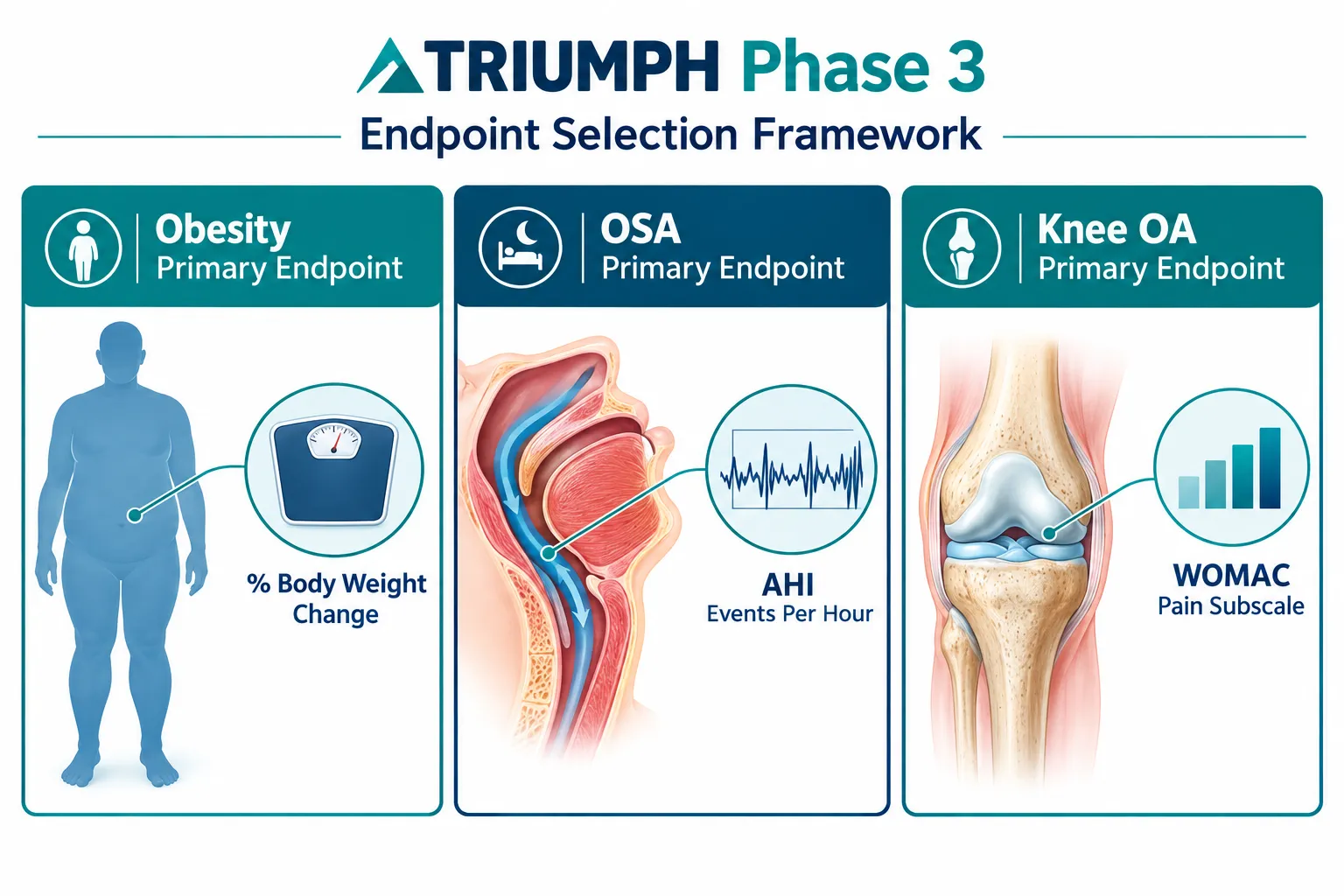
Clinical trials answer only the questions their endpoints ask. In obesity research, percent change in body weight is a well-validated primary measure, but it cannot tell a regulator whether a patient's knee hurts less or whether their airway stays open at night. That gap is exactly why the retatrutide Phase 3 results for sleep apnea and osteoarthritis demand a closer look at endpoint selection methodology.

The TRIUMPH program enrolled 2,339 adults in its flagship obesity trial (TRIUMPH-1), with predefined subsets for knee OA and OSA. Mean weight loss reached 25.9% at the 9 mg dose and 28.3% at 12 mg over 80 weeks. Those figures are powerful, but they served as the platform from which disease-specific endpoints could be evaluated, not as a substitute for them.
Why Endpoint Choice Defines What a Trial Can Prove

Researchers working with GLP-3 Reta peptide materials in preclinical settings face a comparable decision: a biomarker of metabolic activity alone will not capture tissue-level or airway-level outcomes without a purpose-built measurement tool.


Retatrutide Phase 3 Results for Sleep Apnea: The AHI as a Precision Tool

The AHI counts how many times per hour breathing stops or becomes dangerously shallow during sleep. It is the gold-standard disease-specific endpoint for OSA trials because it directly quantifies the pathology, not just a correlate of it.

In participants with moderate-to-severe OSA and obesity, retatrutide reduced AHI by approximately 36.1 events per hour, a 60.6% drop from a baseline of 58.6 events per hour. Clinical commentary from 2026 notes that this reduction appears larger than what weight loss alone would predict, suggesting the AHI was sensitive enough to detect both respiratory and weight-mediated mechanisms simultaneously.

Why AHI worked here:

  • It is continuous, allowing detection of graded improvement.
  • It has established regulatory precedent as a primary endpoint in sleep apnea device and drug trials.
  • It separates responders from non-responders in a way that subjective sleepiness scores cannot.

Secondary measures that strengthen AHI data:

Endpoint Category Example Measure What It Adds
Subjective sleep quality Epworth Sleepiness Scale Patient-reported burden
Cardiometabolic safety Blood pressure, HbA1c Systemic risk context
Body composition Percent fat mass Weight-mediated pathway
Daytime function Patient global impression Functional relevance

Retatrutide Phase 3 Results for Sleep Apnea: The AHI as a Precision Tool

Researchers evaluating retatrutide through the GLP1-Reta research overview will recognize that the triple agonist mechanism, targeting GIP, GLP-1, and glucagon receptors, creates multiple physiological pathways, each of which may need its own measurement instrument.


Retatrutide Phase 3 Results for Osteoarthritis: Applying the WOMAC Subscale Correctly

Knee osteoarthritis endpoints present a different challenge: pain is subjective, functional limitation varies by patient, and structural changes on imaging may not correlate with symptoms in the short term. The TRIUMPH-4 trial addressed this by selecting the WOMAC pain subscale as one co-primary endpoint alongside percent body weight change.

Results showed a mean reduction of 4.3 points (73.1%) from a baseline WOMAC pain score of 6.0. That magnitude is clinically meaningful by any established threshold for minimal clinically important difference (MCID) in knee OA research.

What makes the WOMAC pain subscale the right choice:

  • Disease specificity: It targets pain in the knee joint, not global pain or mood.
  • Regulatory familiarity: Accepted by the FDA and EMA in prior OA drug approvals.
  • Sensitivity to change: Its five-item format detects graded improvement across activities.
  • Patient relevance: Items map directly to daily-life tasks like stair climbing and walking.

The co-primary design, requiring both the WOMAC pain subscale and percent body weight change to meet significance, is particularly important. It forces the trial to demonstrate that symptom relief is not simply a product of patients moving more because they weigh less. It separates the mechanical unloading benefit from any direct anti-inflammatory or analgesic effect.

Researchers interested in complementary tissue-level mechanisms can review related work on SS-31 mitochondrial research themes and SS-31 10mg research peptide considerations as examples of how endpoint granularity differs across biological pathways.


Building a Dual-Endpoint Strategy: A Practical Framework for Researchers

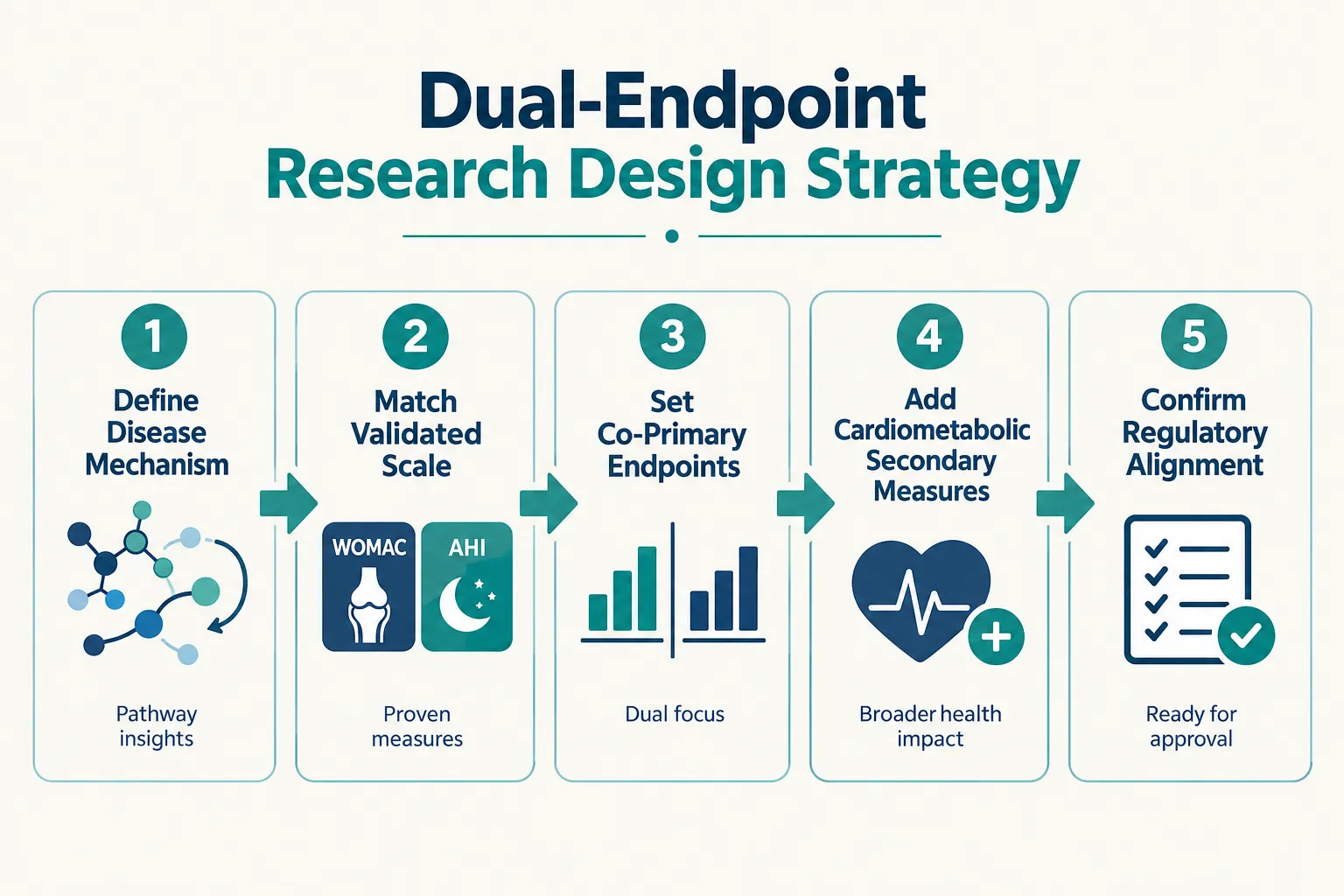
The TRIUMPH program's most transferable contribution may be its endpoint architecture. Across all four trials, Lilly paired a disease-specific primary measure with percent body weight change, then added cardiometabolic and functional secondary endpoints.
Building a Dual-Endpoint Strategy: A Practical Framework for Researchers

Researchers designing their own studies can apply this logic in five steps:

  1. Identify the dominant disease mechanism, airway collapse, joint degradation, glycemic dysregulation, or another target.
  2. Select a validated, regulatory-precedented instrument, AHI for OSA, WOMAC for OA, HbA1c for diabetes.
  3. Pair it with a weight-change measure when obesity is a contributing factor, creating a co-primary structure.
  4. Add functional and patient-reported secondary outcomes to capture daily-life impact.
  5. Include cardiometabolic safety endpoints to satisfy regulatory risk-benefit expectations.

This framework is relevant not only for large Phase 3 programs but for any investigator planning endpoint-driven preclinical or early-phase research. Resources on how to buy Reta and where to buy Reta for research-grade supply are available for investigators setting up controlled studies.

A key principle drawn from the TRIUMPH data: if the chosen endpoint is not sensitive enough to detect the full mechanism of action, a genuinely effective intervention can appear weaker than it is. The 60.6% AHI reduction likely would have been invisible if the trial had used body weight alone as its primary measure.


Conclusion

The retatrutide Phase 3 results for sleep apnea and osteoarthritis: how researchers should select disease-specific endpoints is not an abstract methodological question, it has direct consequences for what regulators see, what clinicians can act on, and what patients ultimately receive. The TRIUMPH program demonstrates that a triple agonist targeting metabolic pathways can produce profound, measurable improvements in OSA and knee OA, but only because the trials were designed to look for those improvements with the right tools.

Actionable next steps for researchers:

  • Use AHI as the primary endpoint for any OSA-adjacent intervention study; pair it with at least one cardiometabolic secondary measure.
  • Apply the WOMAC pain subscale as a co-primary alongside body weight change when studying obesity-related joint disease.
  • Review the TRIUMPH co-primary design structure before finalizing any protocol that addresses an obesity comorbidity.
  • Monitor peer-reviewed publications from the TRIUMPH program as they become available, since full datasets will refine secondary endpoint interpretations.
  • Consult the Reta 30mg research tag and GLP-3 Reta 20mg product page for research-grade material specifications relevant to dose-ranging studies.

Disease-specific endpoints do not just measure outcomes, they define what a drug is allowed to become.

https://www.puretestedpeptides.com/wp-content/uploads/2026/10/retatrutide-phase-3-results-for-sleep-apnea-and-osteoarthritis-how-researchers-s.webp 1024 1536 https://www.puretestedpeptides.com/wp-content/uploads/2026/01/buy-peptides-online.jpg 2026-10-21 13:05:412026-10-21 13:05:41Retatrutide Phase 3 Results for Sleep Apnea and Osteoarthritis: How Researchers Should Select Disease-Specific Endpoints
×

Helpful Links

  • My account
  • Cart
  • Checkout
  • Refund and Returns Policy
  • Privacy Policy
  • SMS Privacy Policy
  • Login
  • My Account
  • Logout

USA Made Lab Tested Peptides

All products are sold for research, laboratory, or analytical purposes only, and are not for human consumption


Pure Tested Peptides is a chemical supplier. Pure Tested Peptides is not a compounding / chemical compounding facility as defined under 503A of the Federal Food, Drug, and Cosmetic act. Pure Tested Peptides is not an outsourcing facility as defined under 503B of the Federal Food, Drug, and Cosmetic act.

The statements made within this website have not been evaluated by the US Food and Drug Administration. The products we offer are not intended to diagnose, treat, cure or prevent any disease.

Human/Animal Consumption Prohibited. Laboratory/In-Vitro Experimental Use Only

Scroll to top Scroll to top Scroll to top