Call or Text 727-513-9780
  • Shopping Cart Shopping Cart
    0Shopping Cart
Pure Tested Peptides | America's most trusted Peptides for sale online
  • Peptides for sale
    • Oral Peptides for sale
      • Peptide Capsules for sale
      • BPC 157 Capsules 1000mcg
      • SLU-PP-332 Capsules | 1000 mcg
      • 5-Amino-1MQ 50mg Capsules
      • Tesofensine 500mcg
    • All Peptides for sale
    • Peptide Sprays
      • BPC 157 Nasal Spray Kit
      • BPC-157 TB500 Nasal Spray Kit
      • Semax Nasal Spray 10mg
      • Selank – Nasal Spray Kit – 10mg
      • Epithalon 50MG Nasal Spray Kit
      • Ipamorelin 10mg Nasal Spray
      • Klow Nasal Spray (BPC-157 + TB-500 + GHK-Cu + KPV) | 80mg
      • Hulk Nasal Spray Tesa / Ipa Blend 6/3 MG
      • Klow Nasal Spray
      • NAD + 500 mg Nasal Spray
      • PT-141 Nasal Spray Kit
    • GHRH Peptides
      • Ipa Peptides
      • CJC-1295 Peptides
        • CJC-1295 with DAC 5 mg
        • CJC-1295 without DAC 5 mg
        • CJC-1295 Ipa 10mg
      • Tesa Peptides
        • Tesa Peptide
        • Tesa 20 mg
    • GHK-Cu Peptides
      • All GHK-Cu Peptides
      • GHK-Cu 100mg
      • KLOW Peptide Blend – Buy KLOW blend online
    • BPC Peptides
      • All BPC Peptides
      • BPC-157
      • BPC-157 TB-500
      • BPC 157 capsules 1000mcg
    • SLU-PP-332 Peptides
      • All SLU-PP-332 Peptides
      • SLU-PP-332 5mg
    • GLP3 Peptides
    • PT-141 Peptides
      • PT-141 Peptides for sale
      • PT-141 10mg
      • PT-141 Nasal Spray
    • CAG Peptides
      • Lipo-C Peptide Blend
      • CAG 5mg
      • CAG 10mg
    • MOTS-C Peptides
      • MOTS-C Peptides for sale
      • MOTS-c peptide
      • MOTS-c 10mg *6 pack*
    • 5 Amino 1MQ Peptides
      • 5 Amino 1MQ Peptides for sale
      • 5-Amino-1MQ 50mg Capsules
      • 5-Amino-1MQ 5mg
    • Epithalon Peptides
      • Epithalon Peptides for sale
      • Epithalon 10mg
      • Epithalon 50mg
  • Shop
    • GLPs
      • 5-Amino-1MQ 50mg Capsules
      • 5-Amino-1MQ 5mg
      • L-Carnitine 500mg/ml
      • Tesofensine 500mcg
      • SLU-PP-332 5mg
      • MOTS-c 10mg *6 pack*
    • Epithalon & BPC Peptides
      • Epithalon 10mg
      • Epithalon 50mg
      • BPC-157
      • BPC 157 capsules 1000mcg
      • BPC-157 TB-500
      • BPC-157 TB500 Nasal Spray Kit
      • BPC 157 Nasal Spray Kit
    • BPC TB-500 & NAD+ Peptides
      • NAD+ 500 mg
      • KLOW Peptide Blend – Buy KLOW blend online
      • GLOW Peptide Blend
      • TB 500 5mg
      • BPC 157 capsules 1000mcg – Supplement
      • BPC 157 Nasal Spray Kit
      • BPC-157
      • BPC-157 TB500 Nasal Spray Kit
      • BPC-157 TB-500
      • BPC 157 capsules 1000mcg
    • LL-37 Peptide
      • LL-37 10 mg
    • MOTS-C & Selank
      • MOTS-c peptide
      • Selank 10mg
    • GHK Peptides
      • GHK-Cu 100mg
      • GLOW Peptide Blend
      • KLOW Peptide Blend – Buy KLOW blend online
  • COAs
  • Wholesale
    • Wholesale Peptides for sale
  • PTP FAQ
  • Affiliates
    • Selank Peptide: Advanced Pharmacological Mechanisms Underlying Its Anxiolytic and Nootropic Effects in Research
      • 5-Amino-1MQ Peptide: Detailed Mechanisms of NNMT Inhibition and Its Impact on Cellular Metabolism Research
        • MOTS-C Peptide: Unraveling Its Role in Mitochondrial Dynamics and Energy Metabolism Research
          • Epithalon Peptide and Telomerase Regulation: Investigating Its Impact on Cellular Senescence and Lifespan Research Models
            • GLP2-T vs GLP2 Tirz Peptide: Understanding the Naming, Mechanistic Nuances, and Research Implications for Gut Health
      • Peptides and Polypeptides in Modern Pharmacology: What Research on Metoprolol, Prednisone, and Amlodipine Reveals
        • Polypeptide Peptides vs NSAIDs: What Naproxen and Diclofenac Teach Tissue-Repair Researchers About BPC‑157 and TB‑500
          • Peptides and Polypeptides in Endocrine Pharmacology: How GLP-1, GLP-2, and GLP-3 Retatrutide Differ From Classic Drugs Like Prednisone and Amlodipine
          • 5‑Amino‑1MQ Peptide and NNMT Inhibition: How It Compares With Statins Like Atorvastatin in Adipose and Lipid Metabolism Research
      • Enclomiphene, Estrogen Receptor Signaling, and Luteinizing Phase Biology: What Hormone Researchers Should Measure
        • Mesenchymal Stem Cells, BPC‑157, and GHK‑Cu: How Tissue Repair Peptides Compare With Classic NSAIDs Like Naproxen in Injury Models
          • Peptide Calculator Use Cases Beyond Growth Hormone: Working Through GLP‑3 Retatrutide, MOTS‑c, and BPC‑157 Research Dosing
        • Polypeptide Peptides in Endocrine and Metabolic Pharmacology: Lessons From Amlodipine, Prednisone, and Metoprolol
        • Peptides Calculator for Advanced Blends: Worked Examples for Tesamorelin, CJC‑1295, and Ipamorelin Stacks
          • Peptides and Polypeptides in Human Physiology: How Molecular Size Shapes Research Applications
            • Selank Peptide: Advanced Pharmacological Mechanisms Underlying Its Anxiolytic and Nootropic Effects in Research
          • 5-Amino-1MQ Peptide: Detailed Mechanisms of NNMT Inhibition and Its Impact on Cellular Metabolism Research
            • MOTS-C Peptide: Unraveling Its Role in Mitochondrial Dynamics and Energy Metabolism Research
              • Epithalon Peptide and Telomerase Regulation: Investigating Its Impact on Cellular Senescence and Lifespan Research Models
                • GLP2-T vs GLP2 Tirz Peptide: Understanding the Naming, Mechanistic Nuances, and Research Implications for Gut Health
                  • Peptides and Polypeptides in Endocrine Pharmacology: How GLP-1, GLP-2, and GLP-3 Retatrutide Differ From Classic Drugs Like Prednisone and Amlodipine
                    • Polypeptide Peptides vs NSAIDs: What Naproxen and Diclofenac Teach Tissue-Repair Researchers About BPC‑157 and TB‑500
                      • Peptides and Polypeptides in Modern Pharmacology: What Research on Metoprolol, Prednisone, and Amlodipine Reveals
                        • 5‑Amino‑1MQ Peptide and NNMT Inhibition: How It Compares With Statins Like Atorvastatin in Adipose and Lipid Metabolism Research
                        • Enclomiphene, Estrogen Receptor Signaling, and Luteinizing Phase Biology: What Hormone Researchers Should Measure
                        • Mesenchymal Stem Cells, BPC‑157, and GHK‑Cu: How Tissue Repair Peptides Compare With Classic NSAIDs Like Naproxen in Injury Models
                        • Peptide Calculator Use Cases Beyond Growth Hormone: Working Through GLP‑3 Retatrutide, MOTS‑c, and BPC‑157 Research Dosing
                        • Polypeptide Peptides in Endocrine and Metabolic Pharmacology: Lessons From Amlodipine, Prednisone, and Metoprolol
                        • Peptides Calculator for Advanced Blends: Worked Examples for Tesamorelin, CJC‑1295, and Ipamorelin Stacks
                        • Peptides and Polypeptides in Human Physiology: How Molecular Size Shapes Research Applications
                        • Selank Peptide: Advanced Pharmacological Mechanisms Underlying Its Anxiolytic and Nootropic Effects in Research
                        • MOTS-C Peptide: Unraveling Its Role in Mitochondrial Dynamics and Energy Metabolism Research
                        • Peptides and Polypeptides in Modern Pharmacology: What Research on Metoprolol, Prednisone, and Amlodipine Reveals
                        • Peptides and Polypeptides in Endocrine Pharmacology: How GLP-1, GLP-2, and GLP-3 Retatrutide Differ From Classic Drugs Like Prednisone and Amlodipine
                        • 5-Amino-1MQ Peptide: Detailed Mechanisms of NNMT Inhibition and Its Impact on Cellular Metabolism Research
                        • Mesenchymal Stem Cells, BPC‑157, and GHK‑Cu: How Tissue Repair Peptides Compare With Classic NSAIDs Like Naproxen in Injury Models
                        • Peptide Calculator Use Cases Beyond Growth Hormone: Working Through GLP‑3 Retatrutide, MOTS‑c, and BPC‑157 Research Dosing
                        • GLP2-T vs GLP2 Tirz Peptide: Understanding the Naming, Mechanistic Nuances, and Research Implications for Gut Health
                        • Polypeptide Peptides in Endocrine and Metabolic Pharmacology: Lessons From Amlodipine, Prednisone, and Metoprolol
                        • Polypeptide Peptides vs NSAIDs: What Naproxen and Diclofenac Teach Tissue-Repair Researchers About BPC‑157 and TB‑500
                        • Peptides and Polypeptides in Human Physiology: How Molecular Size Shapes Research Applications
                        • Peptides Calculator for Advanced Blends: Worked Examples for Tesamorelin, CJC‑1295, and Ipamorelin Stacks
                        • 5‑Amino‑1MQ Peptide and NNMT Inhibition: How It Compares With Statins Like Atorvastatin in Adipose and Lipid Metabolism Research
                        • Enclomiphene, Estrogen Receptor Signaling, and Luteinizing Phase Biology: What Hormone Researchers Should Measure
                        • Epithalon Peptide and Telomerase Regulation: Investigating Its Impact on Cellular Senescence and Lifespan Research Models
                        • Best research protocol Klow blend
                        • best time to take BPC-157
                        • best time to take DSIP (Delta Sleep Inducing Peptide)
                        • best time to take CJC-1295
                        • best time to take AOD-9604
                        • best time to take Follistatin 344
                        • best time to take Ipamorelin
                        • best time to take MK-677 (Ibutamoren)
                        • best time to take Ligandrol (LGD-4033) — research compound
                        • best time to take Ostarine (MK-2866) — research compound
                        • best time to take GHK-CU
                        • best time to take TB-500
                        • best time to take MOTS-c
                        • best time to take Semax
                        • best time to take RAD-140 (Testolone) — research compound
                        • best time to take Thymosin Alpha-1
                        • best time to take PEG-MGF
                        • Biolife Plasma, Octapharma Plasma, and Research Peptides: How Plasma Donation Labs Differ From Peptide Suppliers
                        • best time to take YK-11 — research compound
                        • best time to take PT-141 (Bremelanotide)
                        • Best research protocol Klow blend
                        • 5-Amino-1MQ and MOTS-C Synergy: Metabolic Signaling, Mitochondria, and Research Design
                        • BPC-157 and TB-500: Investigating Their Combined Effects on Angiogenesis and Cellular Migration in Tissue Repair Models
                        • BPC-157 Peptide: Gut Barrier Function, Inflammation, and Tissue-Recovery Research
                        • 5‑Amino‑1MQ and MOTS‑c Synergy in Metabolic Research: Designing NNMT and Mitochondrial Biogenesis Stacks
                        • CJC-1295 with DAC vs. Without DAC: Half-Life, Release Kinetics, and Research Implications
                        • CJC‑1295 with DAC vs. Without DAC: Expanding on Half‑Life Differences Using Tesamorelin and Ipamorelin Blend Case Studies
                        • Collagen Biology and Copper‑Binding Peptides: How GHK‑Cu, Glow Blend, and Klow Blend Interact with Skin and Connective Tissue
                        • Collagen Biology and Regenerative Peptides: How GHK‑Cu, Glow Blend, and Klow Blend Affect Extracellular Matrix Research
                    • DNA, Telomeres, and Longevity Peptides: Positioning Epithalon and MOTS‑c in Genetic Aging Research
                      • Enclomiphene Citrate: serm Mechanism, Testosterone Research, and Stack Compatibility
                        • Enclomiphene vs Enclomiphene Citrate: Formulation, Bioavailability, and Research Distinctions
                        • Epithalon Peptide Research: Telomerase Activation, Aging, and Pineal Gland Function
                        • Estrogen Receptor Signaling and Enclomiphene: How Selective Modulators Compare with Classic Polypeptide Hormones
                        • GHK-Cu Peptide: Advanced Mechanisms in Extracellular Matrix Remodeling and Wound Healing Research
                        • GHK-Cu Peptide: Collagen Synthesis, Wound Repair, and Skin-Barrier Research Models
                        • GLP-1 vs GLP-3 vs GLP-2: Peptide Classification and Research Applications
                        • GLP-2 Peptide Research Guide: Gut Barrier Function, Nutrient Absorption, and Intestinal Recovery Models
                        • GLP-3 Retatrutide vs. GLP-1 Drugs: What Triple-Agonist Biology Changes in Research Models
                        • Ipamorelin and Tesamorelin Combination: Synergistic GH Secretagogue Research and Dosing Protocols
                        • GLP2 Tirz Peptide: What It Is, Why the Name Exists, and How Researchers Should Interpret It
                        • Klow Blend Peptide Nasal Spray: What the Formulation Is Trying to Do in Cognitive Research
                        • Mitochondria, NNMT Inhibition, and Peptide Modulators: Where MOTS‑c and 5‑Amino‑1MQ Fit in Cellular Energy Research
                        • MOTS-c Peptide: Mitochondrial Function, Energy Metabolism, and What Researchers Measure
                        • MOTS-c vs. 5-Amino-1MQ: Which Metabolic Research Questions Each Compound Actually Answers
                        • Nasal Spray Peptides: Bioavailability, Administration, and Semax/Selank Research Applications
                        • PT-141 Peptide Research: Mechanism of Action and Melanocortin Receptor Signaling
                        • Retatrutide for Research: Mechanism, Structure, and GLP-1/GLP-3 Dual Action
                        • Retatrutide for Obesity and Type 2 Diabetes: What the Latest Trial Data Suggest
                        • Tesofensine Peptide Research: Mechanism, Appetite Suppression, and Neuropeptide Y Pathways
  • Contact
    • Contact Customer Service
    • Text Customer Support
  • About US
  • Shop all peptides
  • Affiliate Program
    • Affiliate Signup
  • Login / Register Login / Register Page Link Login / Register Page Link
  • Click to open the search input field Click to open the search input field Search
  • Menu Menu

Tag Archive for: barrier repair peptides

BPC-157 Peptide Research: Separating Angiogenesis, Barrier Repair, and Inflammatory Signaling

BPC-157 Peptide Research: Separating Angiogenesis, Barrier Repair, and Inflammatory Signaling

October 10, 2026/0 Comments/in Uncategorized/by

Fewer than 15 amino acids long, BPC-157 generates more mechanistic debate per residue than almost any other peptide in preclinical science. As 2026 research programs expand across vascular, epithelial, and immune models, the central challenge in BPC-157 peptide research: separating angiogenesis, barrier repair, and inflammatory signaling is no longer whether effects exist, it is how to measure each pathway cleanly without confounding the others.

Key Takeaways

  • BPC-157 activates at least three distinct biological readouts: vascular remodeling, epithelial barrier restoration, and cytokine-level immune modulation.
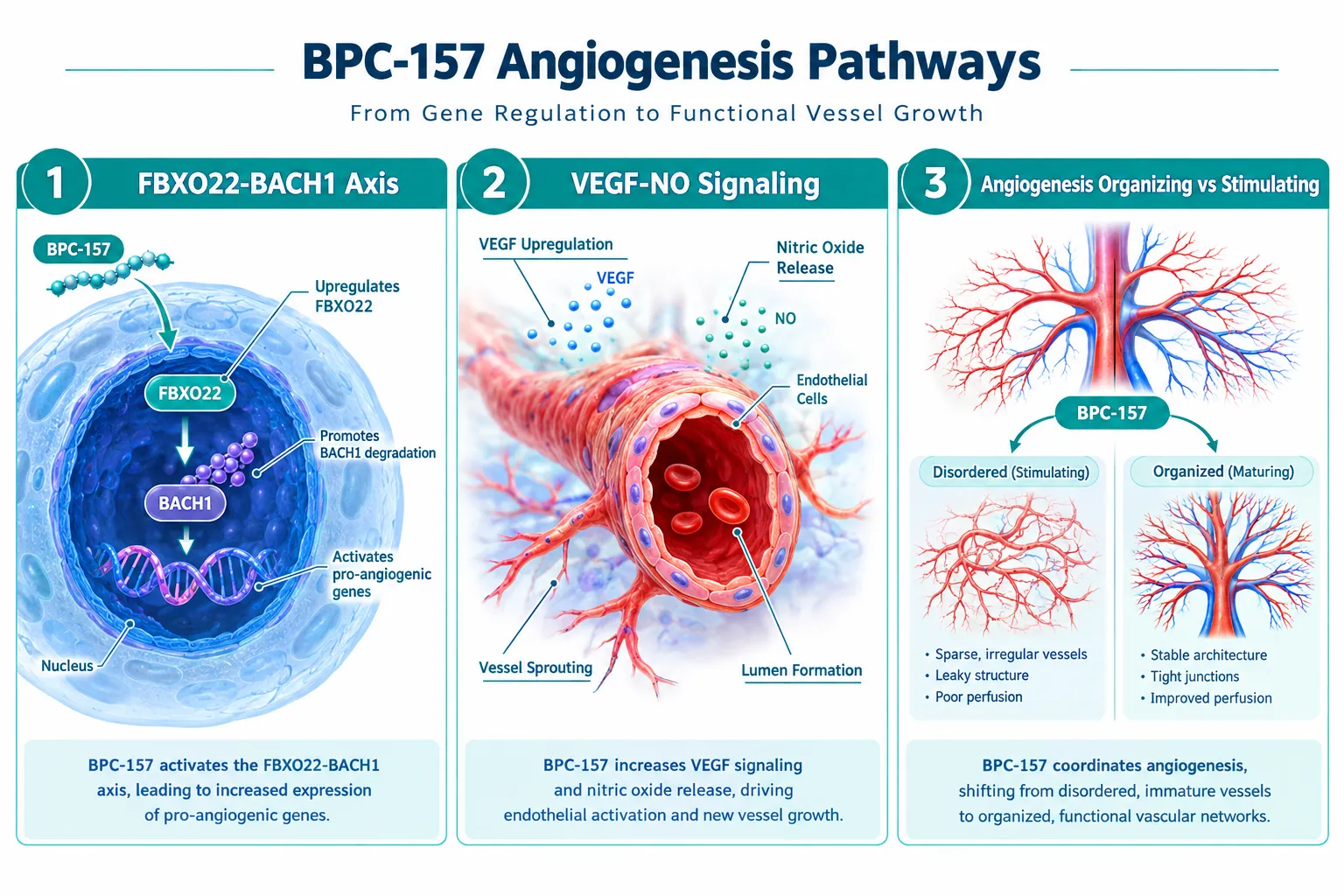
  • New 2026 mechanistic work links the FBXO22-BACH1 axis to BPC-157-driven angiogenesis, shifting the debate from "stimulating" to "organizing" blood vessel growth.
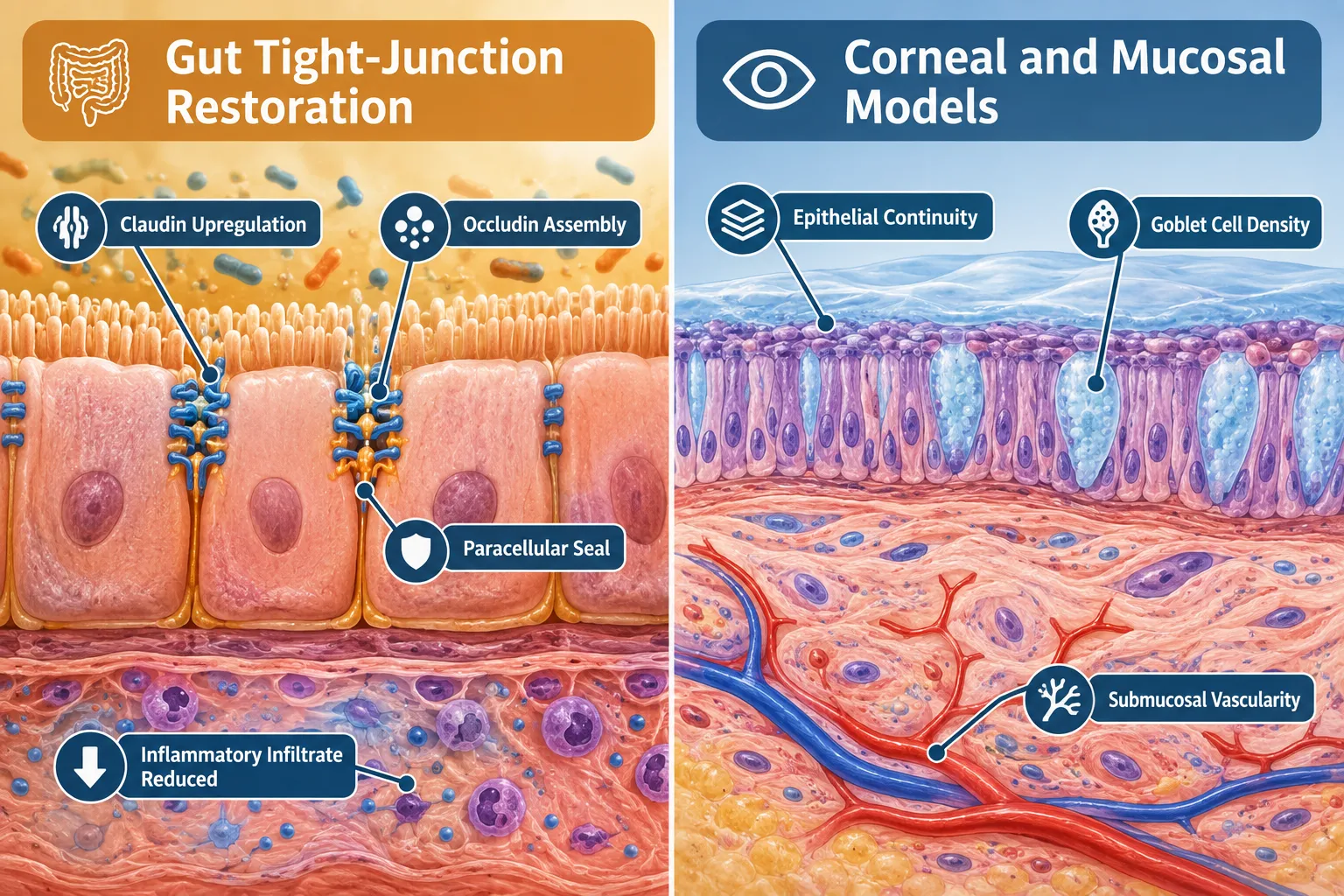
  • Intestinal tight-junction repair is the most replicated barrier-repair finding, but corneal and mucosal models are extending the picture.
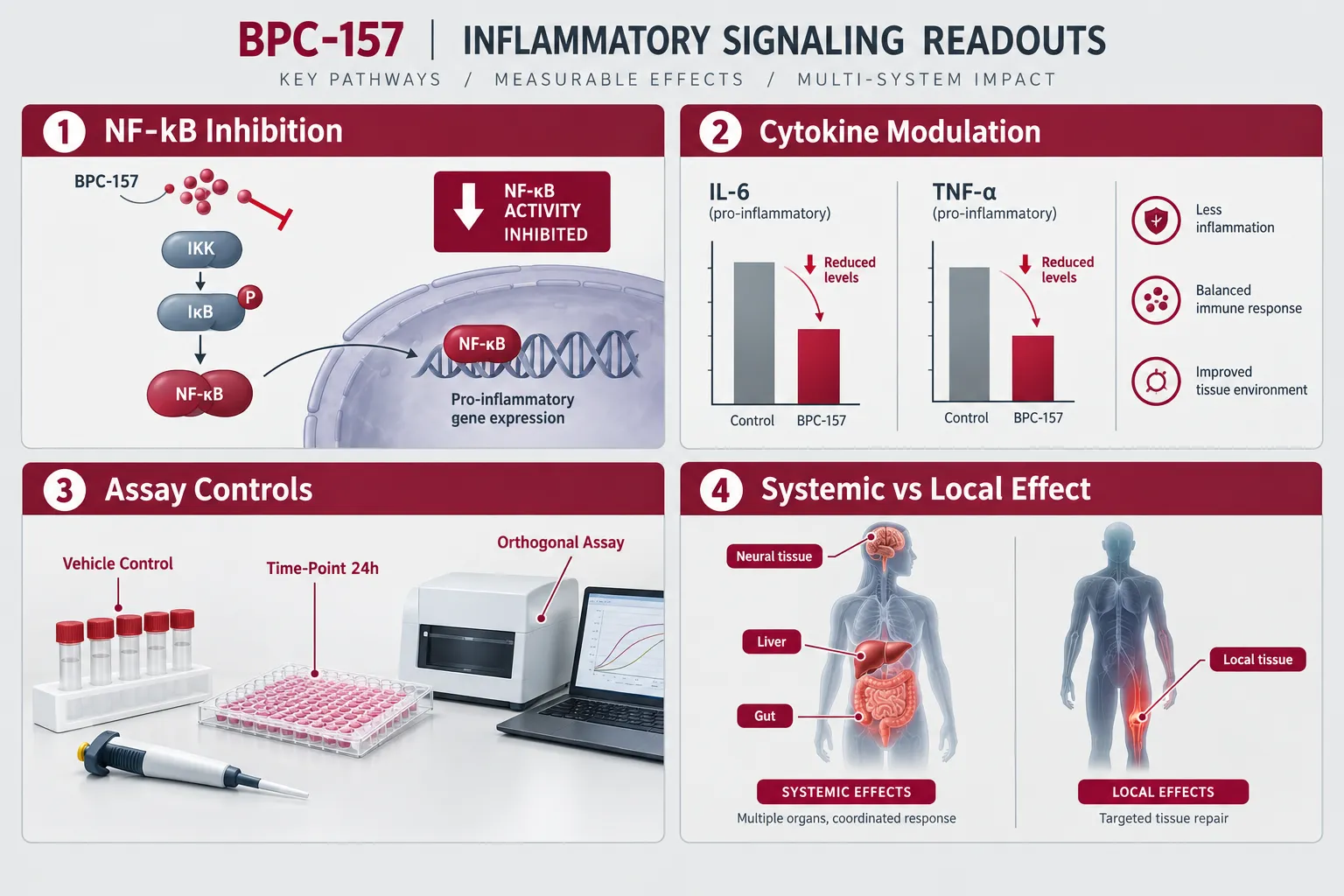
  • NF-kB suppression and downstream cytokine reduction represent the clearest inflammatory signaling readout, though pathway cross-talk complicates interpretation.
  • Rigorous experimental design, orthogonal assays, appropriate controls, and staged time points, is essential for drawing pathway-specific conclusions.

The Angiogenesis Question: Stimulating or Organizing?
The Angiogenesis Question: Stimulating or Organizing?

The oldest debate in BPC-157 peptide research centers on what the compound actually does to blood vessels. Early models consistently showed accelerated capillary formation in wound beds, which led to the label "pro-angiogenic." More precise 2026 mechanistic work complicates that framing significantly.

The FBXO22-BACH1 signaling axis has emerged as a key upstream node. FBXO22, an E3 ubiquitin ligase, targets BACH1 for proteasomal degradation. BACH1 normally represses a suite of pro-vascular genes. When BPC-157 appears to facilitate FBXO22 activity, BACH1 levels drop, and genes governing vessel sprouting and stabilization become more accessible. Critically, this is a regulatory event, not a raw amplification of VEGF output.

The VEGF-nitric oxide (NO) axis remains central to the vascular story. BPC-157 consistently upregulates endothelial nitric oxide synthase (eNOS) in preclinical models, driving local NO production that relaxes vessel walls and supports lumen formation. However, the effect appears dose-sensitive and context-dependent, disordered vasculature in ischemic tissue tends to become more organized, not simply more abundant.

Key distinction: "Angiogenesis-organizing" describes a process that improves vessel architecture and perfusion efficiency. "Angiogenesis-stimulating" implies net new vessel mass regardless of context. The evidence in 2026 leans toward the former.

Recommended assay approach for vascular readouts:

Readout Preferred Assay Critical Control
Capillary density CD31 immunostaining Vehicle-matched sham
Vessel maturation Alpha-SMA co-staining Time-matched baseline
NO production DAF-FM diacetate fluorescence eNOS inhibitor (L-NAME)
BACH1 degradation Western blot / co-IP FBXO22 knockdown line

Researchers exploring related vascular peptide mechanisms may find useful context in IPA Sermorelin Stack Research, which addresses growth-factor-driven vascular signaling in adjacent model systems.


Barrier Repair: Gut, Cornea, and Mucosal Models
Barrier Repair: Gut, Cornea, and Mucosal Models

Intestinal barrier restoration is the most replicated finding in BPC-157 peptide research: separating angiogenesis, barrier repair, and inflammatory signaling requires treating this pathway as mechanistically independent from the vascular work, even though both involve tissue remodeling.

In gut models, BPC-157 consistently accelerates tight-junction reassembly following chemically induced permeability damage. The proteins most clearly affected are claudin family members and occludin, which form the paracellular seal between enterocytes. Upregulation of these proteins reduces translocation of luminal antigens into submucosal tissue, which in turn lowers the inflammatory stimulus that would otherwise perpetuate barrier disruption.

This creates an important experimental pitfall: if a study measures inflammation reduction after BPC-157 administration in a leaky-gut model, the result may reflect barrier repair rather than direct immune modulation. Separating these effects requires:

  1. Measuring tight-junction protein expression at early time points (6-12 hours) before cytokine changes peak
  2. Using a barrier-intact inflammatory model as a parallel arm
  3. Confirming permeability with FITC-dextran flux assays independent of histology

Beyond the gut, barrier-repair activity has been demonstrated in corneal epithelial models and oral mucosal tissue. In corneal studies, BPC-157 accelerates re-epithelialization after abrasion, with effects on goblet cell density and submucosal vascularity that parallel gut findings. This cross-tissue consistency suggests a conserved epithelial repair mechanism rather than organ-specific pharmacology.

For researchers sourcing peptides with documented purity for barrier-model work, the discussion at Where to Buy Research-Grade Glow Blend Peptide covers purity standards and skin-model compatibility considerations relevant to epithelial assay design.

Thymosin Alpha 4 Peptide research offers a useful comparative framework, as thymosin beta-4 also promotes actin cytoskeleton remodeling in epithelial repair, providing an orthogonal positive control for barrier-reassembly studies.


Inflammatory Signaling: NF-kB, Cytokines, and Pathway Cross-Talk
Inflammatory Signaling: NF-kB, Cytokines, and Pathway Cross-Talk

The inflammatory signaling arm of BPC-157 peptide research: separating angiogenesis, barrier repair, and inflammatory signaling demands the most careful experimental architecture, because NF-kB sits at the intersection of all three pathways.

BPC-157 consistently suppresses NF-kB nuclear translocation in preclinical inflammatory models. Downstream, this reduces transcription of TNF-alpha, IL-6, and IL-1-beta, the primary cytokines driving both acute tissue damage and chronic low-grade inflammation. In orthopedic and sports-medicine models, this anti-inflammatory profile has generated significant interest for tendon and ligament repair applications, though clinical data in humans remains minimal as of 2026.

The cross-talk problem is real. Consider this cascade:

  • BPC-157 repairs the gut barrier
  • Reduced antigen translocation lowers systemic LPS burden
  • Lower LPS burden reduces TLR4-NF-kB activation
  • Measured cytokine reduction appears to be a direct anti-inflammatory effect

Without a barrier-intact arm in the study design, the cytokine reduction is easily misattributed. Orthogonal assay strategies that isolate each pathway are not optional, they are methodologically required for publishable mechanistic claims.

Recommended time-point staging for inflammatory readouts:

  • 0-6 hours: Measure NF-kB translocation and immediate cytokine mRNA
  • 12-24 hours: Assess protein-level cytokine secretion (ELISA)
  • 48-72 hours: Evaluate tissue histology and immune cell infiltration
  • Day 7+: Confirm resolution versus suppression using resolution-phase markers (e.g., lipoxin A4)

Cross-system applications, including neurodegeneration models where NF-kB-driven neuroinflammation is a primary target, and liver fibrosis models where stellate cell activation is NF-kB-dependent, are expanding the research footprint. SS-31 Mitochondrial Research Themes provides relevant context for researchers examining mitochondrial-inflammatory crosstalk in these overlapping disease models.

Safety and regulatory framing remains an open issue. BPC-157 is not approved for human use in any jurisdiction as of 2026, and regulatory agencies have flagged uncertainty around systemic vascular effects at higher doses. The "regeneration vs. risk" framing that dominates industry discussion should not substitute for controlled dose-response data in validated models.


Conclusion

Advancing BPC-157 peptide research means resisting the temptation to report a single unified "healing effect." The vascular, epithelial, and immune readouts are real, but they are distinct, they interact, and they require purpose-built experimental designs to separate cleanly.

Actionable next steps for research teams in 2026:

  • Design studies with three parallel arms: vascular-only, barrier-intact inflammatory, and full-model, to isolate pathway contributions
  • Use FBXO22-BACH1 Western blots and eNOS fluorescence assays as orthogonal vascular controls alongside CD31 staining
  • Stage time points explicitly: tight-junction protein expression before cytokine peaks, and resolution markers after the acute phase
  • Include barrier-flux assays (FITC-dextran) in any gut-inflammation model to prevent misattribution of cytokine changes
  • Cross-reference findings against structurally related repair peptides, including Thymosin Alpha 4 Peptide, to build mechanistic confidence through orthogonal validation

The peptide's small size belies its signaling complexity. Rigorous pathway separation is not a methodological luxury, it is the foundation on which any translational claim must eventually stand.

https://www.puretestedpeptides.com/wp-content/uploads/2026/10/bpc-157-peptide-research-separating-angiogenesis-barrier-repair-and-inflammatory.webp 1024 1536 https://www.puretestedpeptides.com/wp-content/uploads/2026/01/buy-peptides-online.jpg 2026-10-10 13:04:492026-10-10 13:04:49BPC-157 Peptide Research: Separating Angiogenesis, Barrier Repair, and Inflammatory Signaling
×

Helpful Links

  • My account
  • Cart
  • Checkout
  • Refund and Returns Policy
  • Privacy Policy
  • SMS Privacy Policy
  • Login
  • My Account
  • Logout

USA Made Lab Tested Peptides

All products are sold for research, laboratory, or analytical purposes only, and are not for human consumption


Pure Tested Peptides is a chemical supplier. Pure Tested Peptides is not a compounding / chemical compounding facility as defined under 503A of the Federal Food, Drug, and Cosmetic act. Pure Tested Peptides is not an outsourcing facility as defined under 503B of the Federal Food, Drug, and Cosmetic act.

The statements made within this website have not been evaluated by the US Food and Drug Administration. The products we offer are not intended to diagnose, treat, cure or prevent any disease.

Human/Animal Consumption Prohibited. Laboratory/In-Vitro Experimental Use Only

Scroll to top Scroll to top Scroll to top