

Semax Peptide Nasal Spray: Administration, Dosing Concepts, and Research Applications
Roughly 90% of peptide compounds degrade significantly before reaching systemic circulation when taken orally, a pharmacokinetic reality that makes the nasal route far more than a convenience. For Semax, a synthetic heptapeptide derived from the ACTH(4-7) fragment, intranasal delivery is not simply one option among many. It is the defining feature of how this compound has been studied, formulated, and applied in both clinical and research contexts. Understanding Semax Peptide Nasal Spray: Administration, Dosing Concepts, and Research Applications means understanding why the nose-to-brain pathway changes everything about how this peptide behaves.
Key Takeaways
- Semax is a synthetic neuropeptide with an established intranasal formulation approved in Russia for cerebrovascular and cognitive conditions.
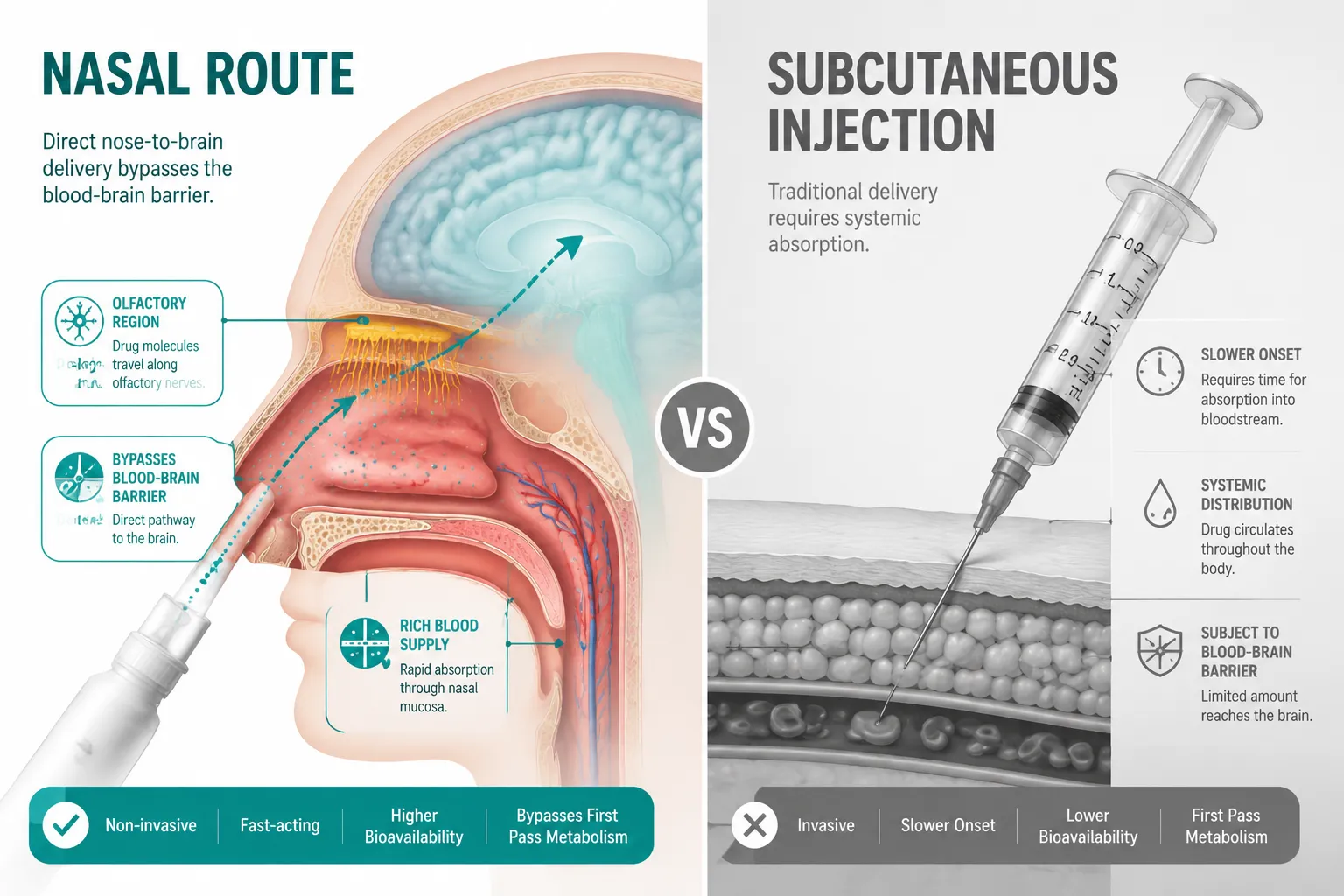
- Nasal delivery bypasses first-pass metabolism and allows direct access to the central nervous system via the olfactory pathway.
- Research dosing concepts differ meaningfully from clinical labeled doses; context and purpose drive the numbers.
- Semax is often studied alongside related neuropeptides such as Selank, sharing overlapping mechanisms and delivery methods.
- Purity and formulation quality are critical variables when sourcing Semax for research purposes.
Why Nasal Delivery Defines Semax Research
The nasal mucosa offers a direct anatomical bridge to the central nervous system. The olfactory epithelium sits at the roof of the nasal cavity, separated from the olfactory bulb by only a thin cribriform plate. Peptides deposited in this region can travel along olfactory nerve axons and enter the brain without crossing the blood-brain barrier in the conventional sense.
For Semax, this matters enormously. The peptide's short amino acid chain, Met-Glu-His-Phe-Pro-Gly-Pro, is susceptible to enzymatic cleavage in the gastrointestinal tract. Oral administration is therefore largely ineffective. Subcutaneous injection is technically viable but introduces variables that make intranasal spray the preferred format in both approved clinical products and research protocols.
Key advantages of intranasal Semax administration:
- Bypasses hepatic first-pass metabolism
- Enables rapid CNS uptake via olfactory and trigeminal pathways
- Non-invasive and repeatable without injection site concerns
- Consistent delivery volume per actuation when using calibrated spray devices
Russia's regulatory body approved intranasal Semax formulations decades ago, primarily for ischemic stroke recovery and cognitive impairment associated with cerebrovascular disease. The approved concentration in those formulations is typically 0.1% (1 mg/mL), with higher-concentration versions at 1% (10 mg/mL) used in more acute clinical settings. This regulatory history gives Semax an unusually robust documentation trail compared to many research peptides.
Researchers exploring related nasal peptide formats may also find value in reviewing the Klow Nasal Spray formulation for comparative delivery context.

Dosing Concepts for Semax Peptide Nasal Spray: Administration, Dosing Concepts, and Research Applications
Dosing in research contexts is not equivalent to clinical prescribing, and that distinction matters. The following concepts reflect patterns observed in preclinical and early human research as of 2026, not medical recommendations.
Standard Concentration Ranges
| Formulation Type | Concentration | Typical Use Context |
|---|---|---|
| Low-dose clinical | 0.1% (1 mg/mL) | Chronic cerebrovascular support |
| High-dose clinical | 1% (10 mg/mL) | Acute stroke protocols |
| Research preparations | 0.5-1% | Cognitive and neuroprotective studies |
Actuation Volume and Dose Calculation
Most calibrated nasal spray devices deliver between 0.1 mL and 0.15 mL per actuation. At a 0.1% concentration, one actuation delivers approximately 100-150 mcg of Semax. At 1%, that same actuation delivers 1-1.5 mg. Researchers must verify the spray device's actuation volume before calculating delivered dose.
"The difference between a 0.1% and a 1% Semax formulation is a tenfold shift in dose per spray, a variable that fundamentally changes the research parameter being tested."
Frequency and Cycle Patterns
In Russian-approved clinical protocols, Semax is administered one to two times daily, typically in cycles of 10 to 14 days. Research guides in 2026 reflect similar cycling logic, often pairing Semax with washout periods to assess sustained versus acute effects. Continuous long-term administration without cycling is less common in documented research.
Researchers studying Semax alongside structurally related peptides should review the Selank and Semax comparison, as both share intranasal delivery methods and overlapping research applications in anxiety and cognition.
Research Applications and Mechanistic Context
Semax's primary mechanism involves upregulation of brain-derived neurotrophic factor (BDNF) and modulation of the serotonergic and dopaminergic systems. These actions underpin its investigation across several research domains.
Active research areas as of 2026:
- Neuroprotection following ischemic events
- Attention and working memory enhancement in cognitive models
- Anxiety modulation and stress response regulation
- Optic nerve damage recovery in animal models
- Potential adjunct role in neurodegenerative disease research
The Selank Peptide Benefits page provides useful parallel context, as Selank shares the anxiolytic research pathway with Semax and is also administered intranasally.
Researchers interested in broader neuropeptide comparisons may also find the Epithalon Peptide profile relevant, given overlapping interest in longevity and neurological resilience.
Regulatory and Sourcing Considerations
Semax holds no FDA or EMA approval as of 2026. In the United States and European Union, it exists exclusively as a research compound. Researchers must source from suppliers that provide third-party purity verification. Consulting Peptide Stores resources can help identify vendors with documented testing standards. Purity certificates and mass spectrometry verification are minimum benchmarks for any research-grade Semax preparation.
For researchers exploring mitochondrial peptides alongside neuroprotective compounds, the SS-31 10mg Research Peptide Considerations article offers useful sourcing and quality guidance applicable across peptide categories.

Conclusion
Semax Peptide Nasal Spray: Administration, Dosing Concepts, and Research Applications converge around one central insight: the intranasal route is not incidental to Semax research, it is foundational to it. The nose-to-brain pathway enables CNS delivery that oral or even some injectable routes cannot replicate with the same efficiency for this peptide class.
Actionable next steps for researchers:
- Verify spray device actuation volume before calculating delivered dose at any concentration.
- Use concentration-specific formulations matched to the research question, 0.1% for lower-dose chronic protocols, 1% for acute or higher-dose investigations.
- Apply cycling protocols consistent with documented clinical use (10-14 day cycles with washout periods).
- Source only from suppliers providing third-party mass spectrometry and purity documentation.
- Review related neuropeptide profiles, including Selank, to contextualize Semax findings within the broader intranasal peptide research landscape.
Rigorous attention to formulation, delivery mechanics, and sourcing quality separates meaningful Semax research from inconclusive results.